


 Скачать презентацию The Ugansky Nature Reserve General Information The
The Ugansky Nature Reserve.pptx
- Количество слайдов: 30
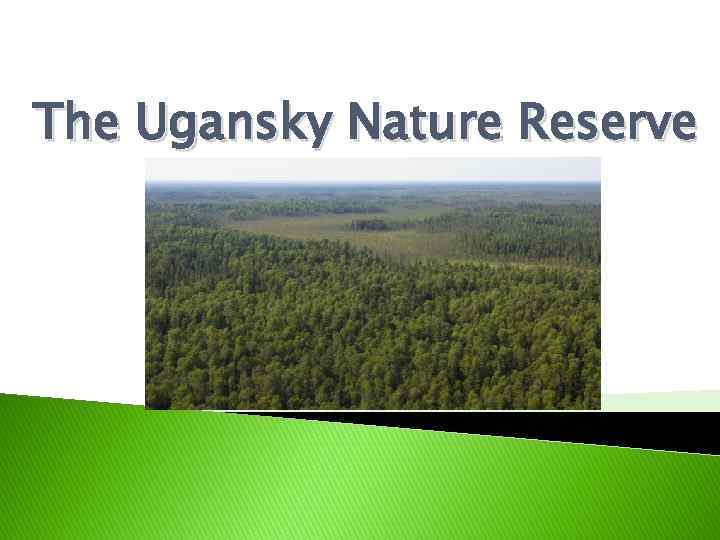 The Ugansky Nature Reserve
 General Information The idea to make a large natural reserve of West Siberian Plain came into view a long time ago. In 1982, May 31 the Council of Ministers passed a resolution to make a Nature Reserve on the area of 648, 6 hectares. The area is surrounded by a protection zone 2 km wide. Nature Reserve- an area of land that is protected in order to keep safe the animals and plants that live there, often because they are rare Resolution- an official decision that is made after a group or organization has voted
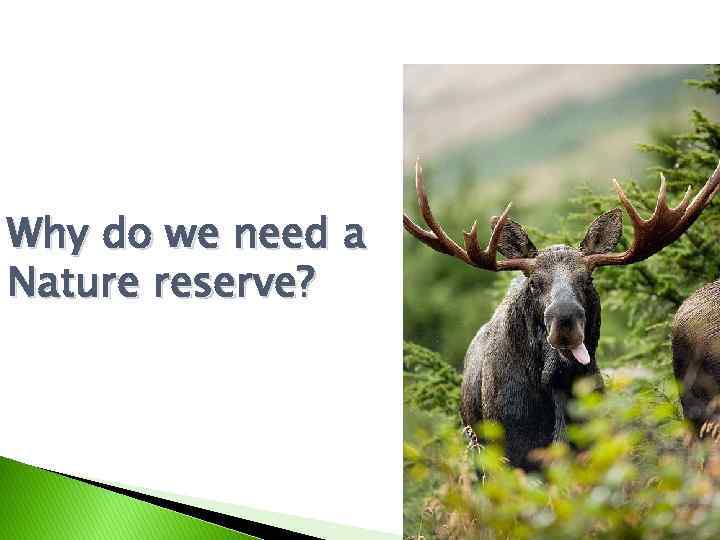 Why do we need a Nature reserve?
 1) To save the biological diversity and keep environmental objects under natural conditions 2) ecological monitoring by keeping the Chronicle of Nature 3) Scientific research
 The regulations of the reserve do not permit: Mining of minerals Disruption of the soil cover Deforestation Collecting medicinal herbs, nuts, mushrooms, berries. Commercial, sporting and pleasure hunt Renting land, water and other natural resources Flights of airplanes and helicopters at the altitude less than 2000 m Permit- means to allow
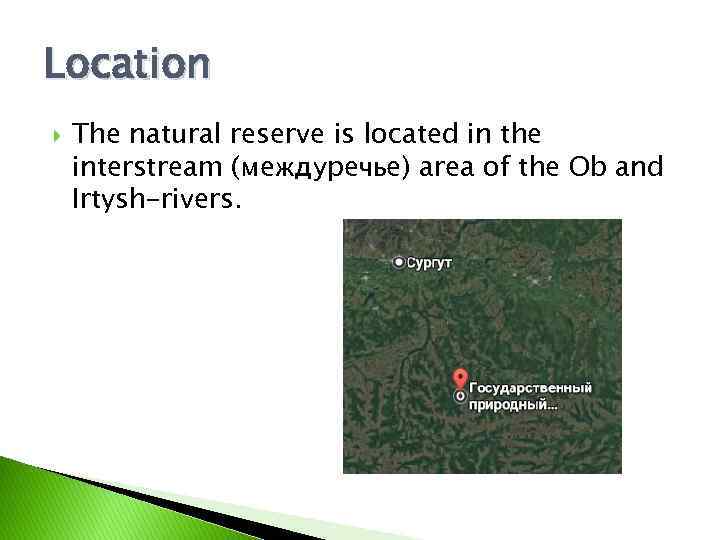 Location The natural reserve is located in the interstream (междуречье) area of the Ob and Irtysh-rivers.
 Climate There are many lakes in the nature reserve. Most of them are shallow and swamp-like. Therefore, the climate of the area is humid. The average temperature of January is -19 The average temperature of July is +16 The blanket of snow reaches 30 -70 cm of height on woodland up to 120 cm on the swamp. Swamp-болото Shallow- мелководье Humid- влажно
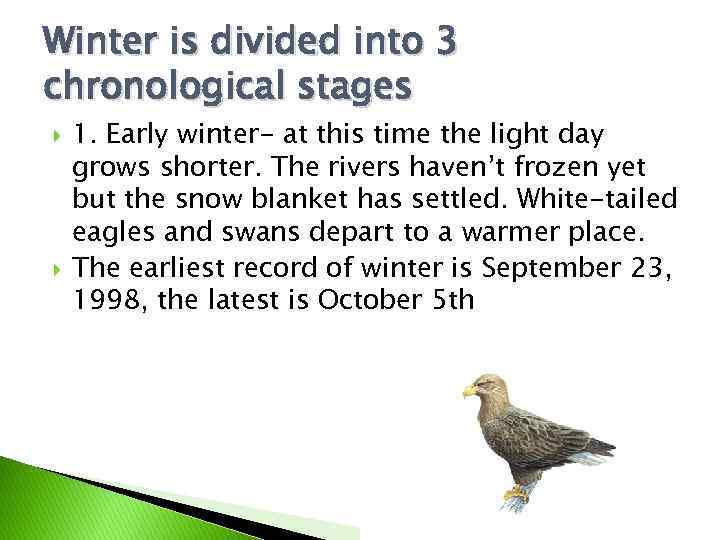 Winter is divided into 3 chronological stages 1. Early winter- at this time the light day grows shorter. The rivers haven’t frozen yet but the snow blanket has settled. White-tailed eagles and swans depart to a warmer place. The earliest record of winter is September 23, 1998, the latest is October 5 th
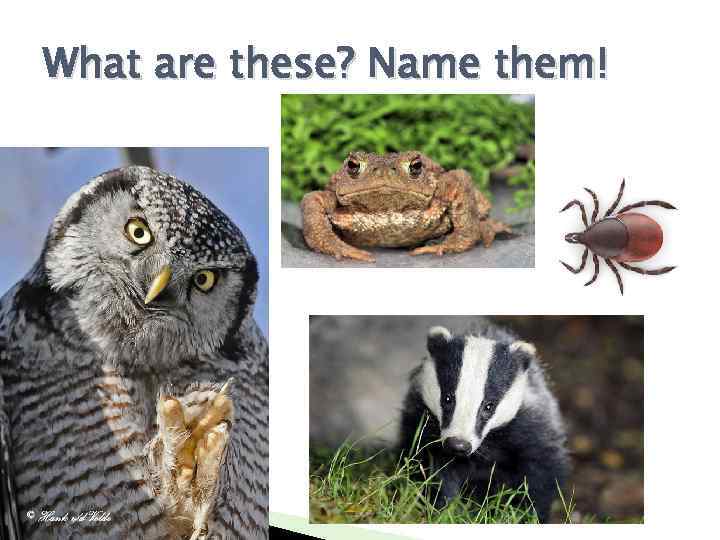
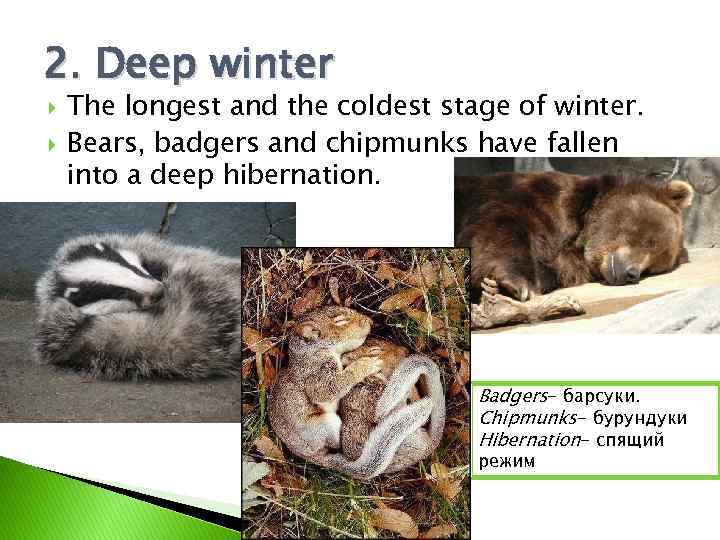 2. Deep winter The longest and the coldest stage of winter. Bears, badgers and chipmunks have fallen into a deep hibernation. Badgers- барсуки. Chipmunks- бурундуки Hibernation- спящий режим
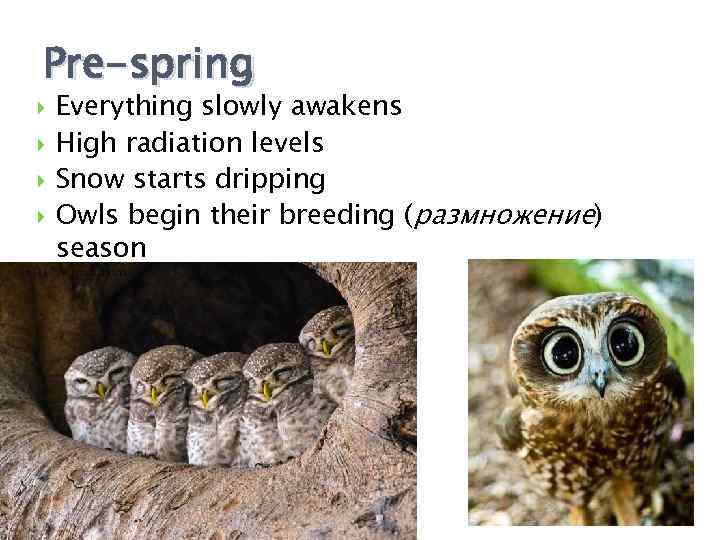 Pre-spring Everything slowly awakens High radiation levels Snow starts dripping Owls begin their breeding (размножение) season
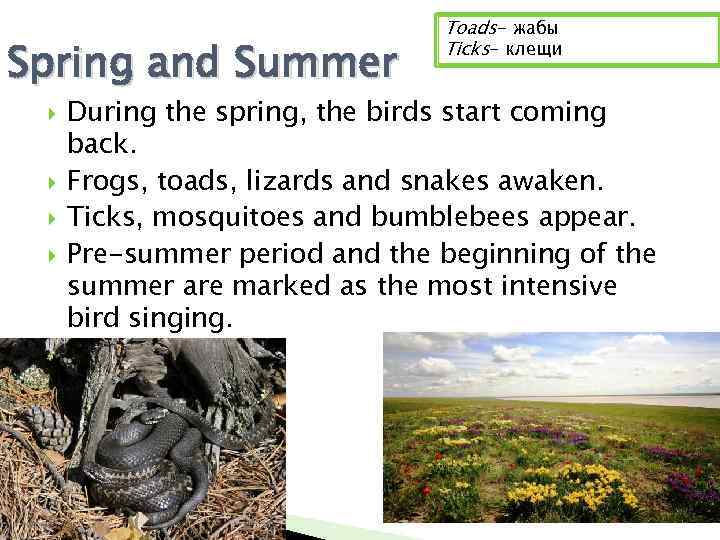 Spring and Summer Toads- жабы Ticks- клещи During the spring, the birds start coming back. Frogs, toads, lizards and snakes awaken. Ticks, mosquitoes and bumblebees appear. Pre-summer period and the beginning of the summer are marked as the most intensive bird singing.
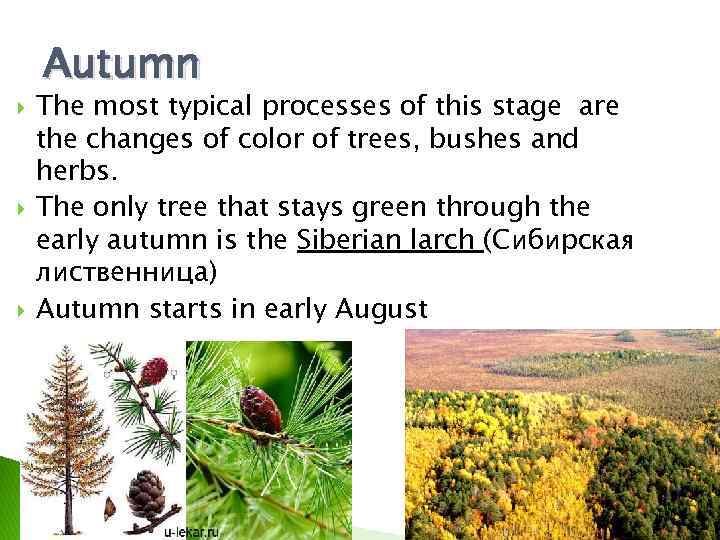 Autumn The most typical processes of this stage are the changes of color of trees, bushes and herbs. The only tree that stays green through the early autumn is the Siberian larch (Сибирская лиственница) Autumn starts in early August
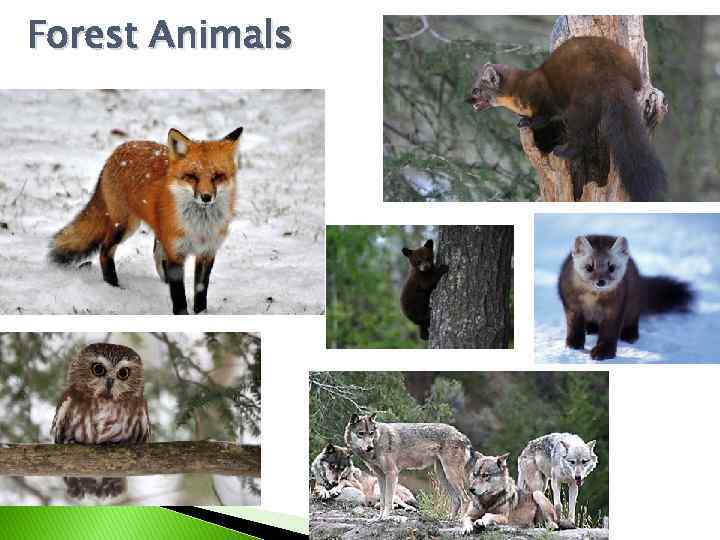 Forest Animals
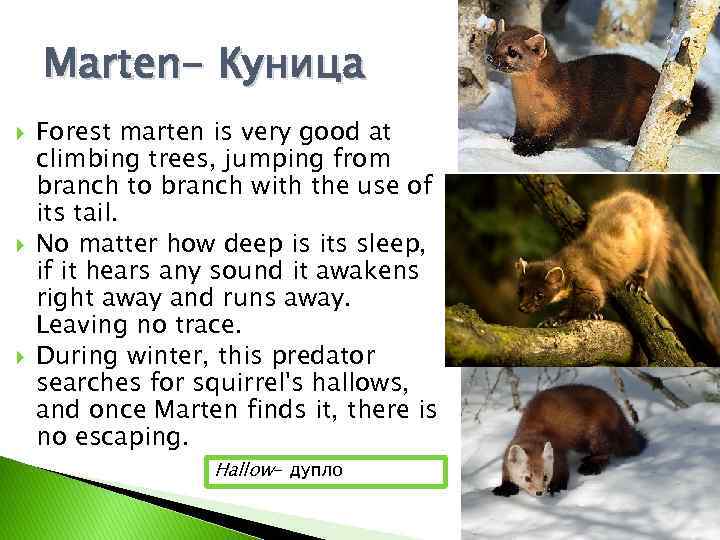 Marten- Куница Forest marten is very good at climbing trees, jumping from branch to branch with the use of its tail. No matter how deep is its sleep, if it hears any sound it awakens right away and runs away. Leaving no trace. During winter, this predator searches for squirrel's hallows, and once Marten finds it, there is no escaping. Hallow- дупло
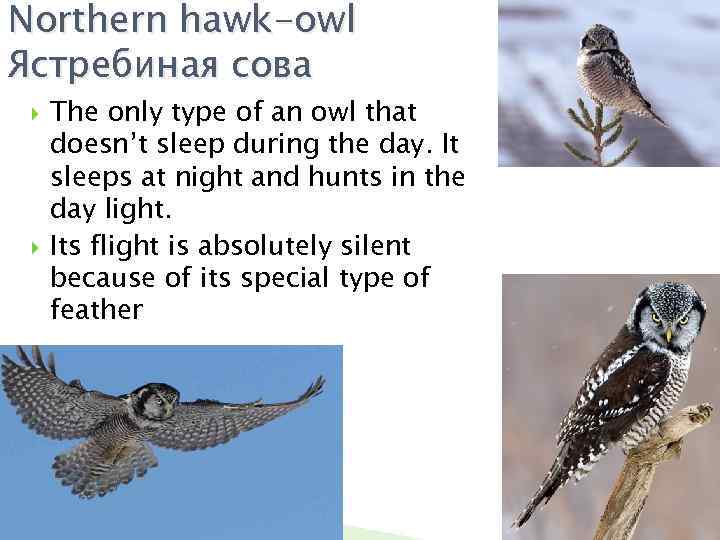 Northern hawk-owl Ястребиная сова The only type of an owl that doesn’t sleep during the day. It sleeps at night and hunts in the day light. Its flight is absolutely silent because of its special type of feather
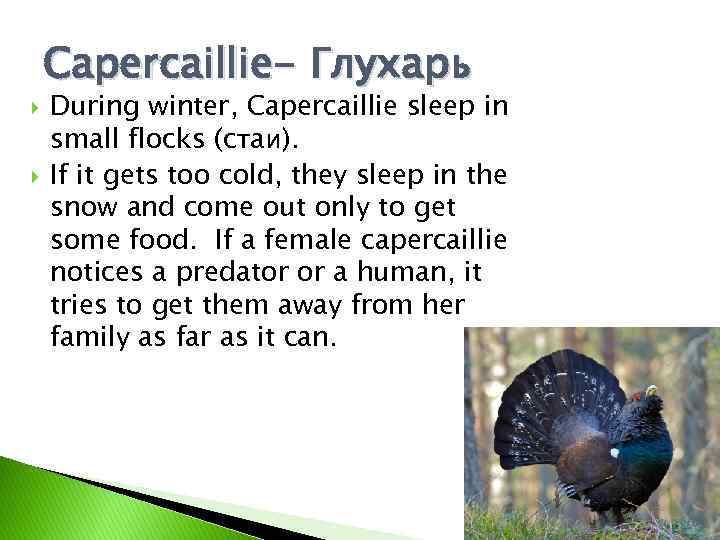 Capercaillie- Глухарь During winter, Capercaillie sleep in small flocks (стаи). If it gets too cold, they sleep in the snow and come out only to get some food. If a female capercaillie notices a predator or a human, it tries to get them away from her family as far as it can.
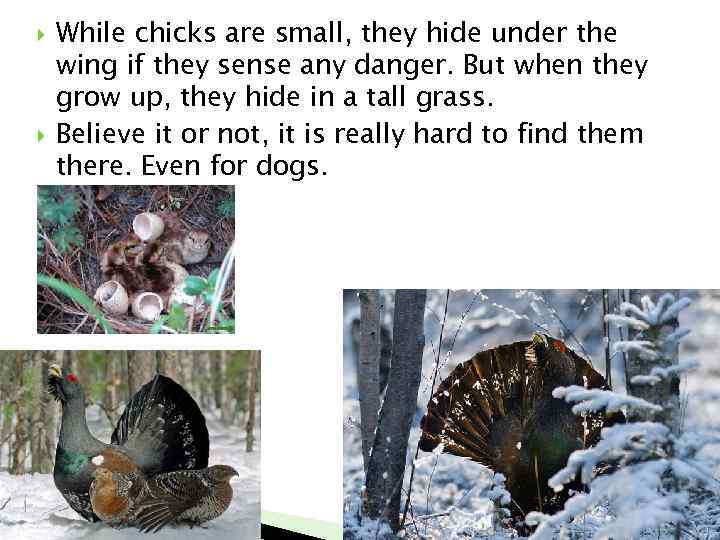 While chicks are small, they hide under the wing if they sense any danger. But when they grow up, they hide in a tall grass. Believe it or not, it is really hard to find them there. Even for dogs.
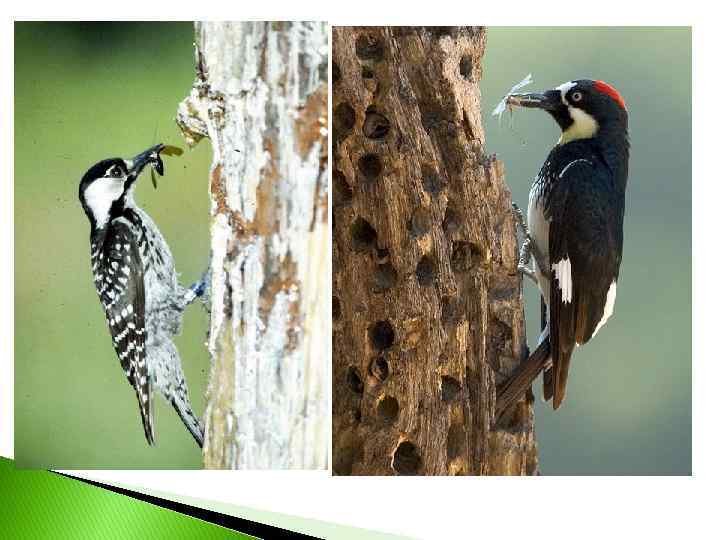
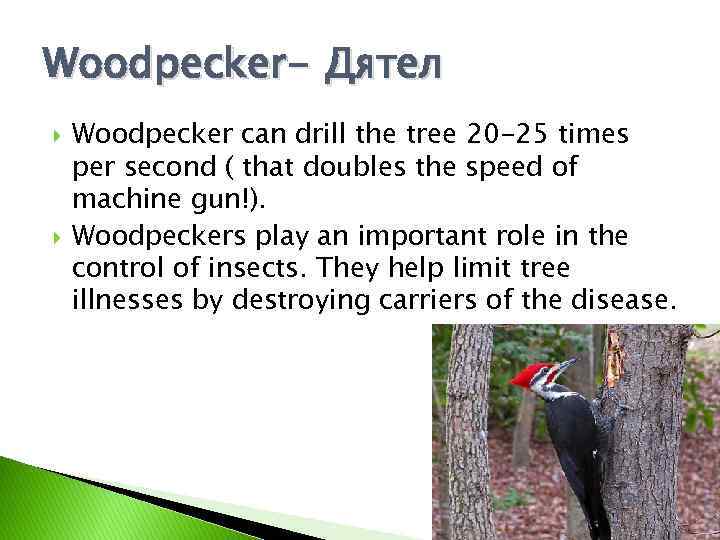 Woodpecker- Дятел Woodpecker can drill the tree 20 -25 times per second ( that doubles the speed of machine gun!). Woodpeckers play an important role in the control of insects. They help limit tree illnesses by destroying carriers of the disease.
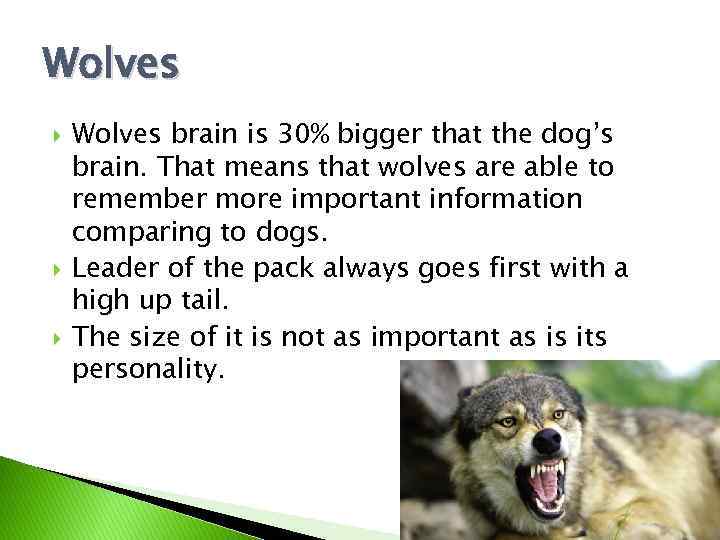 Wolves Wolves brain is 30% bigger that the dog’s brain. That means that wolves are able to remember more important information comparing to dogs. Leader of the pack always goes first with a high up tail. The size of it is not as important as is its personality.
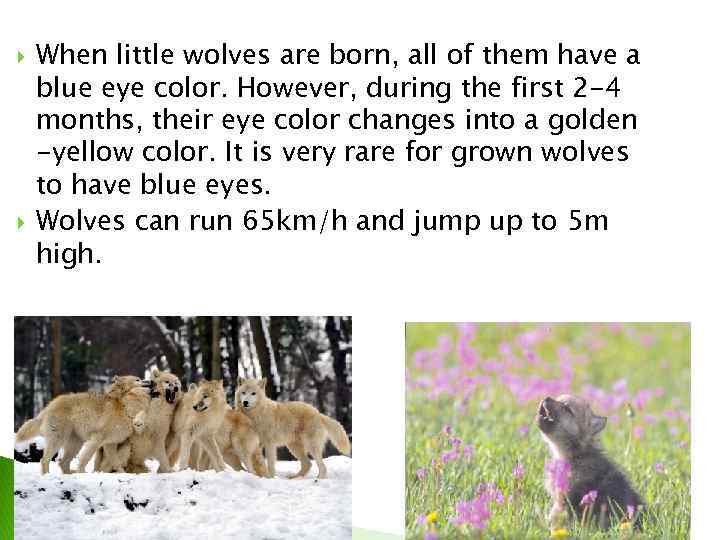 When little wolves are born, all of them have a blue eye color. However, during the first 2 -4 months, their eye color changes into a golden -yellow color. It is very rare for grown wolves to have blue eyes. Wolves can run 65 km/h and jump up to 5 m high.
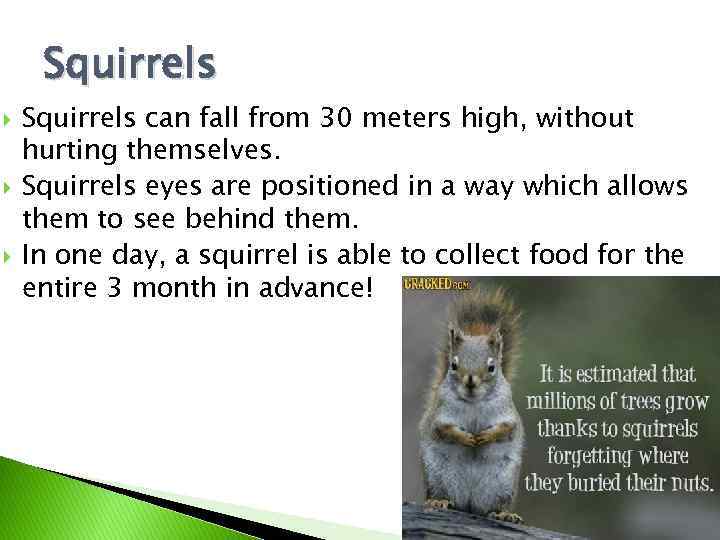 Squirrels can fall from 30 meters high, without hurting themselves. Squirrels eyes are positioned in a way which allows them to see behind them. In one day, a squirrel is able to collect food for the entire 3 month in advance!
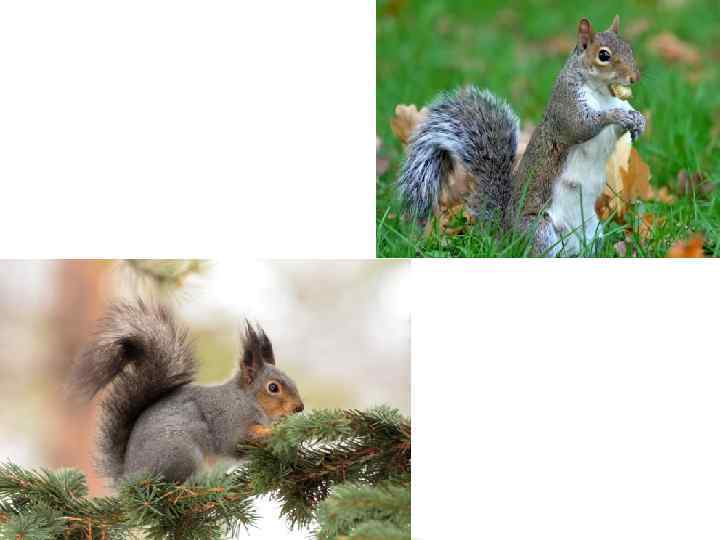
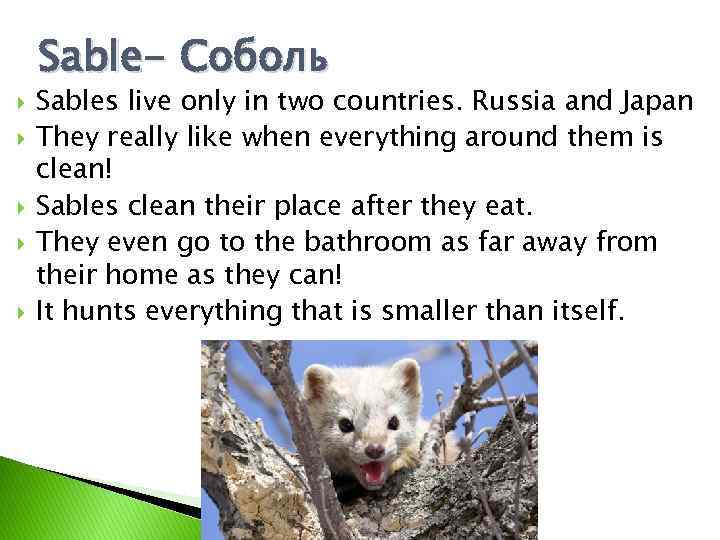 Sable- Соболь Sables live only in two countries. Russia and Japan They really like when everything around them is clean! Sables clean their place after they eat. They even go to the bathroom as far away from their home as they can! It hunts everything that is smaller than itself.
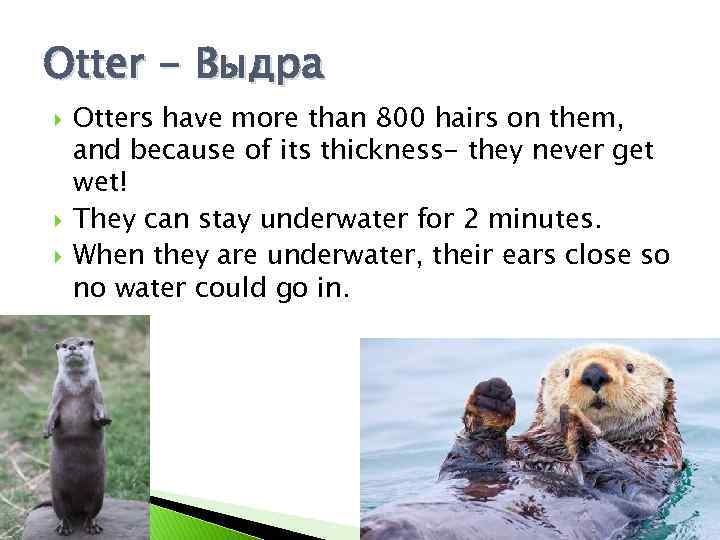 Otter - Выдра Otters have more than 800 hairs on them, and because of its thickness- they never get wet! They can stay underwater for 2 minutes. When they are underwater, their ears close so no water could go in.
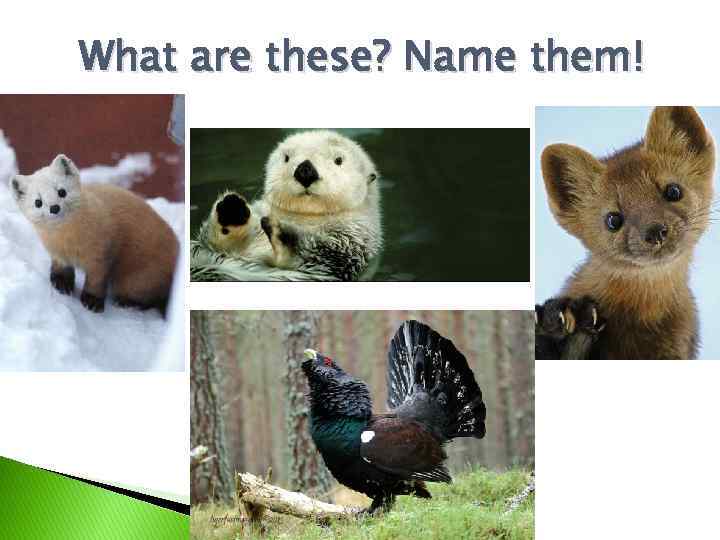 What are these? Name them!
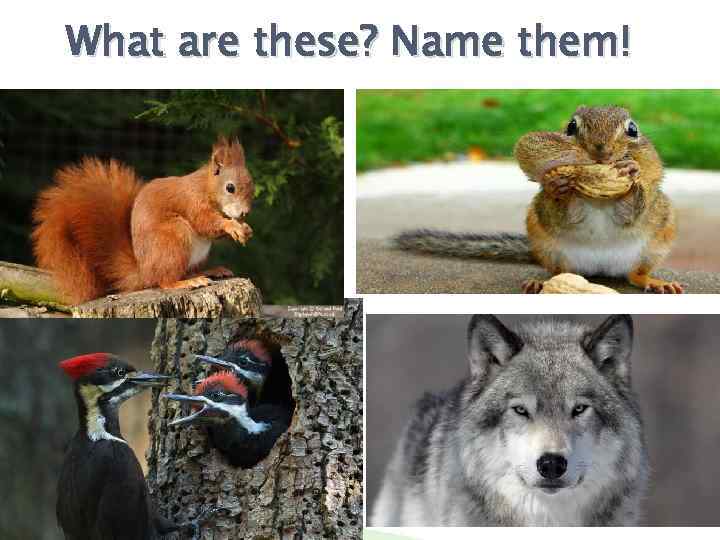 What are these? Name them!
 What are these? Name them!
 Answer the following questions: 1) Who passed the resolution to make a nature reserve in May 31, 1982? 2) Why do we need a Nature reserve? 3) What is NOT permitted on the Ugansky Nature Reserve? 4) What climate does the reserve have? 5) Who falls asleep during “deep winter” ? 6) Tell me about any 3 animals that you’ve learnt about today.