


 Скачать презентацию THE UAR 1958 -61 THREE AND A HALF
b8a88e123558d338ad36d6213c95cc8a.ppt
- Количество слайдов: 16
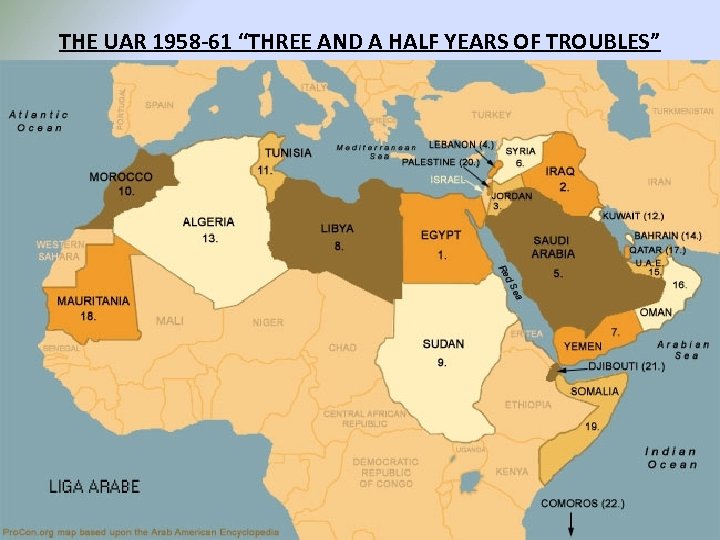 THE UAR 1958 -61 “THREE AND A HALF YEARS OF TROUBLES”
 - After the signing of a union treaty on February 1 st 1958, Syria and Egypt became united under the UNITED ARAB REPUBLIC (UAR). - The union lasted for three years, when a military coup in Damascus precipitated Syria’s withdrawal. - The similarities between the FOM and the Ba’athist Party, made possible for the Syrian Party to ask for help to prevent increasing influence of the Syria’s Communist Party. - A group of Syrian officers asked Nasser if he would agree to a union between the two countries. Nasser embraced his dream of a Pan-Arab state as well as he sought markets for Egyptian goods and jobs for Egyptian workers.
 - The UAR was approved by a plebiscite. - A British cartoon (page 235) suggested that Nasser was annexing Syria due to the appointing of his commander-in-chief Abdel Hakim Amer as Governor-General of Syria. - Nasser was gratified that Iraq broke away from the Baghdad Pact and allied with Syria and Egypt. According to Nasser 1958 was a year of victory for Arab nationalism, but differences among the Arab states were an obstacle to unity. - In 1959, suspecting that communism would infiltrate the Middle East through Syria and Iraq, Nasser carried out a purge of suspected communists in Syria and Egypt. - 280 leaders were arrested, many were sent to concentration camps and military prisons where several were reported to have died as a result of torture.
 - While imprisoning communists, Nasser maintained a close relationship with the USSR and continued receiving financial support for the building of the Aswan Dam. - Nasser blamed the collapse of the UAR on the Egyptian business community. They felt the union might open access to trade with France, once they realized the UAR meant further socialization of both economies, they worked to undermine it. - In 1961, the property of reactionary capitalist was confiscated, more than 80 banks and corporations were put under emergency administration. Nasser was determined to show the implementation of socialism. - The old bourgeois and the industrial bloc opposed by advising foreign investors to stay away. - The National Charter, introduced in 1962, is considered the key document in understanding Nasser’s political ideology.
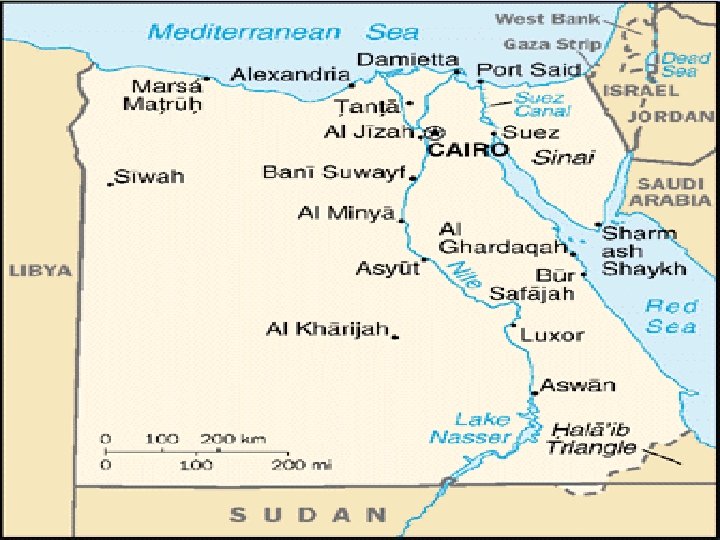
 THE ASWAN DAM - In 1964, the first stage of the dam was completed and Nikita Khrushchev attended the opening ceremony. - The USSR granted more than £ 600 million for the construction of the dam and for the industrialization program of the Second Five Year Plan. - Nasser was awarded the “Order of Lenin” and the “Hero of the Soviet Union”, the relations were amicable, even more when communists prisoners were given parole.
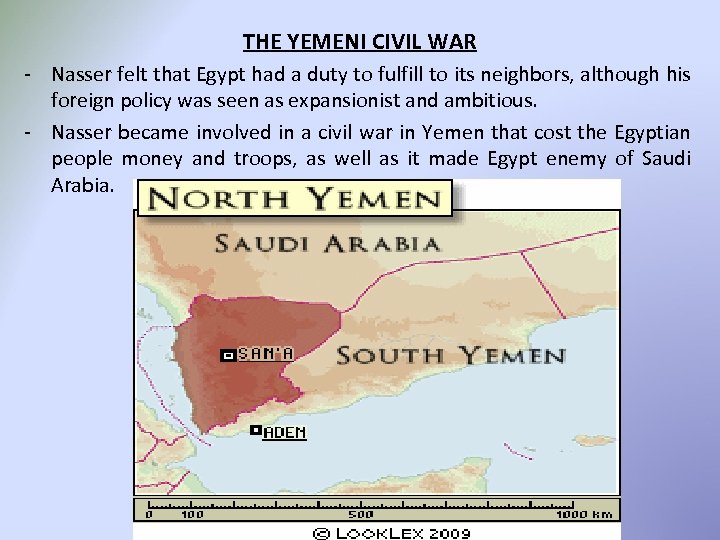 THE YEMENI CIVIL WAR - Nasser felt that Egypt had a duty to fulfill to its neighbors, although his foreign policy was seen as expansionist and ambitious. - Nasser became involved in a civil war in Yemen that cost the Egyptian people money and troops, as well as it made Egypt enemy of Saudi Arabia.
 - In 1918, the Ottoman Empire retreated and northern Yemen gained full independence. - Between 1918 and 1962, Yemen was ruled by the Hamidaddin family. Imam Yahya led a conservative rule which was accepted by the Zaidis but less popular with the Sunni tribes of the southern highland the Tihama. - He was assassinated during the revolution of 1947– 48. However, his son beat off the opponents of feudal rule and succeeded his father. - Arab nationalism made an impact in some circles who opposed the lack of modernization efforts. - In 1962, army officers attempted to seize power, sparking the North Yemen Civil War.
 - The Hamidaddin royalists were supported by Saudi Arabia, Britain, and Jordan, while the republicans were backed by Egypt. - Gamal Abdel Nasser, supported the republicans with as many as 70, 000 Egyptian troops and chemical weapons. - Despite several military moves and peace conferences, the war sank into a stalemate. Egypt's commitment to the war is considered to have been detrimental to its performance in the Six-Day War of June 1967, after which Nasser found it increasingly difficult to maintain his army's involvement and began to pull his forces out of Yemen. - Egyptian military historians refer to the war in Yemen as their Vietnam.
 THE SIX-DAY WAR
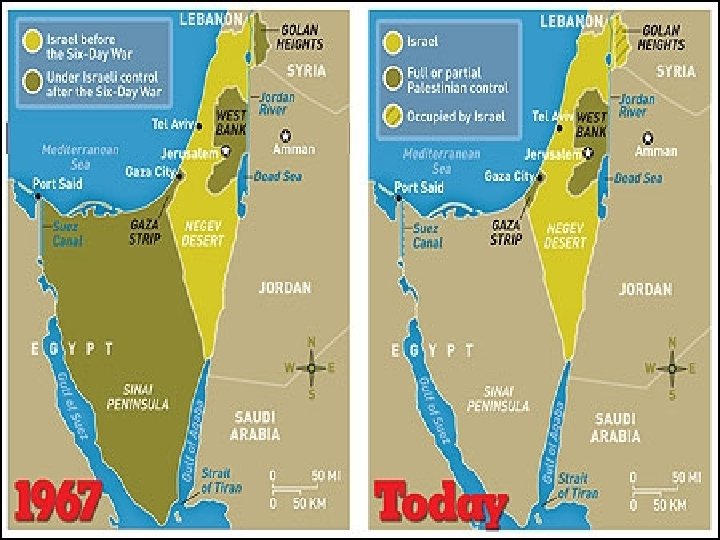
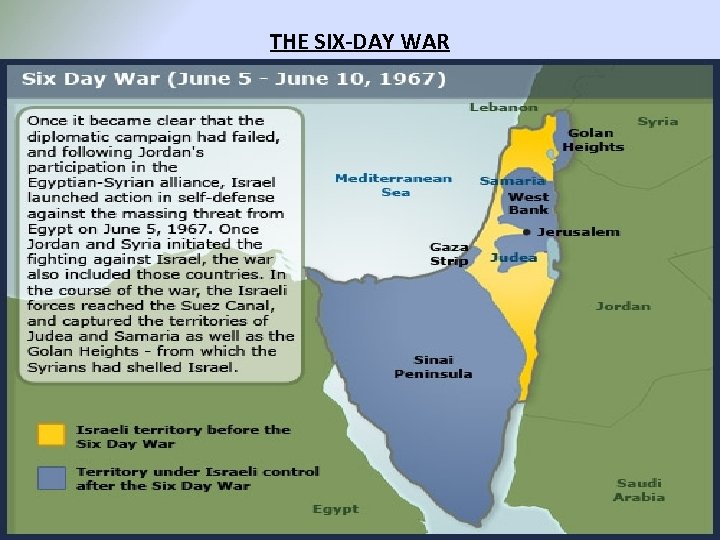
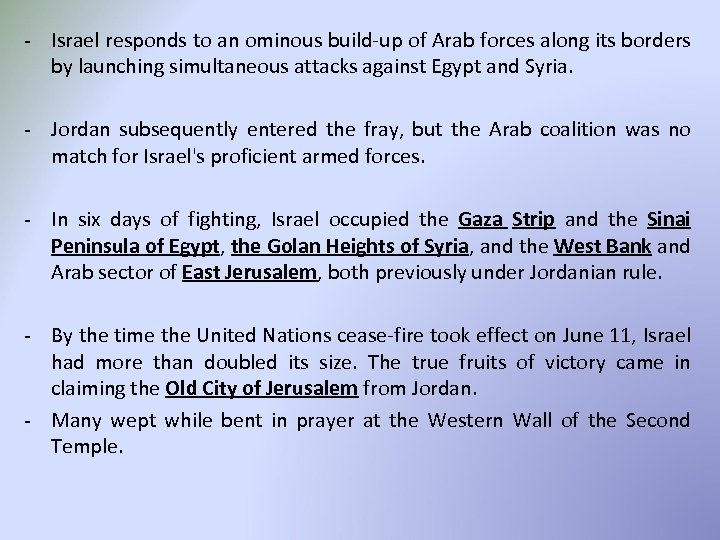 - Israel responds to an ominous build-up of Arab forces along its borders by launching simultaneous attacks against Egypt and Syria. - Jordan subsequently entered the fray, but the Arab coalition was no match for Israel's proficient armed forces. - In six days of fighting, Israel occupied the Gaza Strip and the Sinai Peninsula of Egypt, the Golan Heights of Syria, and the West Bank and Arab sector of East Jerusalem, both previously under Jordanian rule. - By the time the United Nations cease-fire took effect on June 11, Israel had more than doubled its size. The true fruits of victory came in claiming the Old City of Jerusalem from Jordan. - Many wept while bent in prayer at the Western Wall of the Second Temple.
 - The U. N. Security Council called for a withdrawal from all the occupied regions, but Israel declined, permanently annexing East Jerusalem and setting up military administrations in the occupied territories. - Israel let it be known that Gaza, the West Bank, the Golan Heights, and the Sinai would be returned in exchange for Arab recognition of the right of Israel to exist and guarantees against future attack. - Arab leaders, stinging from their defeat, met in August to discuss the future of the Middle East. They decided upon a policy of no peace, no negotiations, and no recognition of Israel, and made plans to defend the rights of Palestinian Arabs in the occupied territories.
 - After the humiliating defeat Nasser offer his resignation on June 9 th, but his supporters took the streets shouting “No leader but Gamal!” - Egypt, however, would eventually negotiate and make peace with Israel, and in 1982 the Sinai Peninsula was returned to Egypt in exchange for full diplomatic recognition of Israel. - Egypt and Jordan later gave up their respective claims to the Gaza Strip and the West Bank to the Palestinians, who opened "land for peace" talks with Israel beginning in the 1990 s. - A permanent Israeli-Palestinian peace agreement remains elusive, as does an agreement with Syria to return the Golan Heights.
 POLITICAL AND ECONOMIC IMPACT OF THE WAR - The Egyptian economy was not so badly affected, despite the loss of the Sinai oilfields and the closure of the Suez Canal. - By 1969, the discovery of new fields increased the oil production to 14 million metric tons. - The world price of cotton increased and the price of wheat decreased that balanced the imports and exports, there was a surplus of £ 43 million. - The USSR continued providing arms and financial support for the completion of the Aswan Dam. - Nasser tried to keep inflation under control with “austerity measures”, but with limited success.
 - Nasser tried to keep inflation under control with “austerity measures”, but with limited success. - There was inflation, shortages of basic essential commodities, debt, an inflated public-sector payroll, urban overcrowding.