


 Скачать презентацию The U S -Taiwan Partnership Expanding Growth Discovering
f96d6ee277ac61b1125f1725527d10c2.ppt
- Количество слайдов: 17
 The U. S. -Taiwan Partnership: Expanding Growth, Discovering Opportunity John Chen-Chung Deng Minister Ministry of Economic Affairs February 10, 2015
 Outlines A. Introduction B. Taiwan’s Economic Prospect C. Taiwan’s Challenges D. Taiwan’s Opportunities E. Conclusions 2
 Introduction Ministry of Economic Affairs (MOEA) • International Trade: trade negotiations, trade promotion, and enhancing trade relations with trading partners • Industrial Development: assisting businesses in R&D, developing and maintaining industrial zones, and developing programs to connect between schools and businesses. • Investment Promotion: attracting foreign investment, and assisting Taiwanese companies to invest abroad. • Small and Medium Enterprises: assisting SMEs in improving their managerial skills, production capabilities & marketing. • Energy Policy Formulation, and • Power, Water and Gasoline supply 3
 Taiwan’s Economic Prospect Expected 3. 22%~ 3. 8% growth (2015) Thanks to US recovery and easing monetary policies in major economies The Purchasing Managers' Indices(PMI) 8. 7% growth so far in 2015 also shows mild recovery. Expected Export growth 3. 56% (2015) Boost by smart devices, 4 G related products Special attentions should be paid to a. oil prices b. softened PRC growth. 4
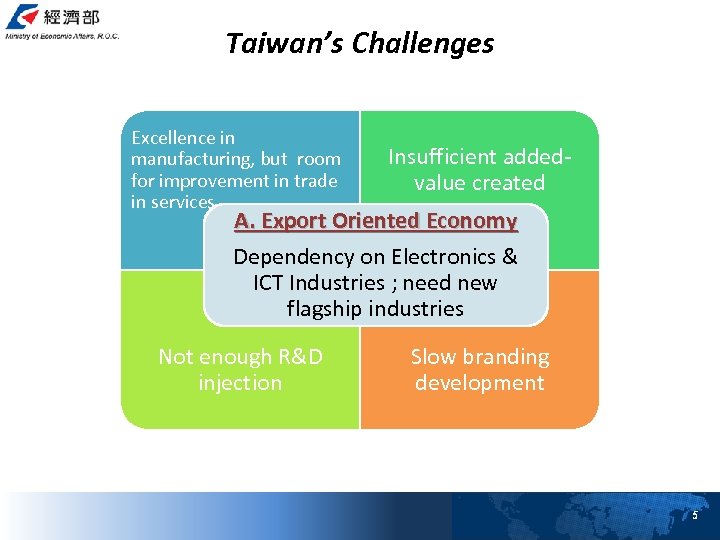 Taiwan’s Challenges Excellence in manufacturing, but room for improvement in trade in services. Insufficient addedvalue created United States A. Export Oriented Economy US $62. 3 Billion Dependency on Electronics & Japan US $61. 6 Billion ICT Industries ; need new Korea flagship. Hong Kong industries Singapore US $27. 5 Billion US $28. 9 Billion Not enough R&D injection US $44. 2 Billion Slow branding development 5
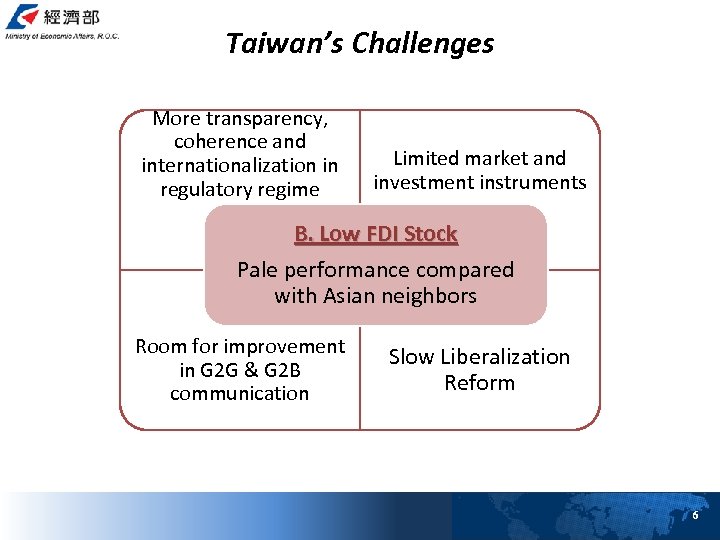 Taiwan’s Challenges More transparency, coherence and internationalization in regulatory regime Limited market and investment instruments United States US $62. 3 Billion B. Low FDI Stock Japan Pale performance US $61. 6 Billion compared with Asian neighbors Korea US $27. 5 Billion Singapore US $28. 9 Billion Room for improvement in G 2 G & G 2 B communication Hong Kong US $44. 2 Billion Slow Liberalization Reform 6
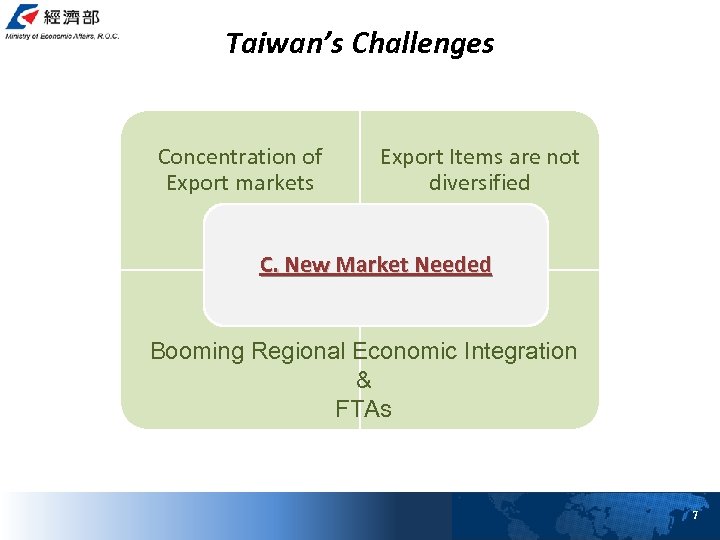 Taiwan’s Challenges Concentration of Export markets Export Items are not diversified United States US $62. 3 Billion Japan C. New Market Needed US $61. 6 Billion Korea US $27. 5 Billion Singapore US $28. 9 Billion Hong Kong US $44. 2 Billion Booming Regional Economic Integration & FTAs 7
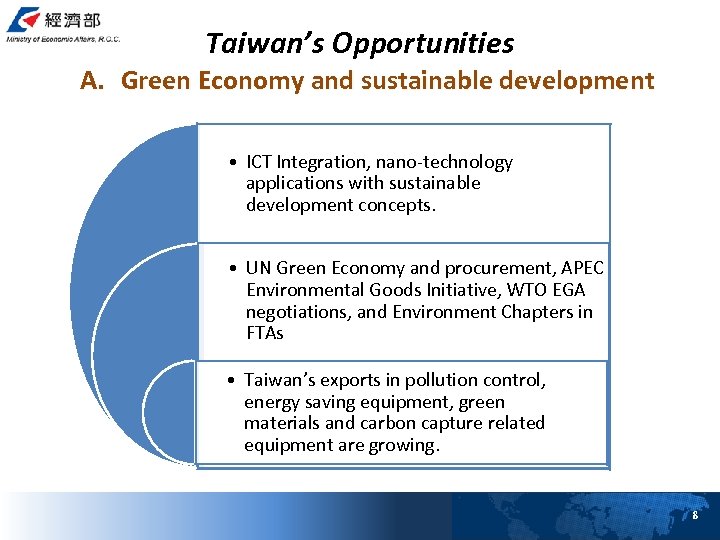 Taiwan’s Opportunities A. Green Economy and sustainable development • ICT Integration, nano-technology applications with sustainable development concepts. • UN Green Economy and Japan procurement, APEC US $61. 6 Billion Environmental Goods Initiative, WTO EGA Korea Hong Environment Chapters in negotiations, and. Kong Singapore US $27. 5 US $44. 2 Billion US $28. 9 FTAs. Billion • Taiwan’s exports in pollution control, energy saving equipment, green materials and carbon capture related equipment are growing. 8
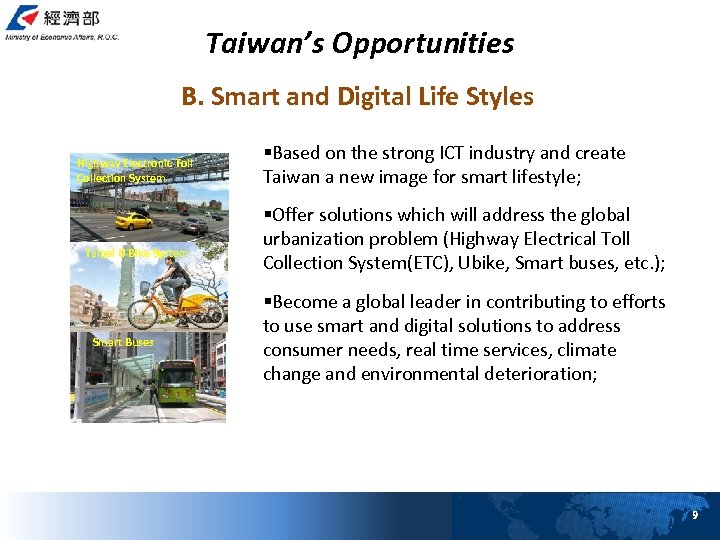 Taiwan’s Opportunities B. Smart and Digital Life Styles Highway Electronic Toll Collection System Taipei U Bike System Smart Buses §Based on the strong ICT industry and create Taiwan a new image for smart lifestyle; §Offer solutions which will address the global urbanization problem (Highway Electrical Toll Collection System(ETC), Ubike, Smart buses, etc. ); §Become a global leader in contributing to efforts to use smart and digital solutions to address consumer needs, real time services, climate change and environmental deterioration; 9
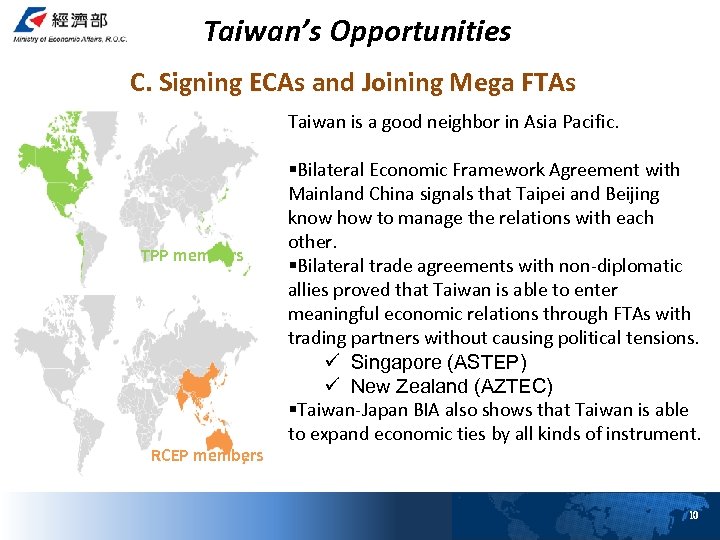 Taiwan’s Opportunities C. Signing ECAs and Joining Mega FTAs Taiwan is a good neighbor in Asia Pacific. TPP members RCEP members §Bilateral Economic Framework Agreement with Mainland China signals that Taipei and Beijing know how to manage the relations with each other. §Bilateral trade agreements with non-diplomatic allies proved that Taiwan is able to enter meaningful economic relations through FTAs with trading partners without causing political tensions. ü Singapore (ASTEP) ü New Zealand (AZTEC) §Taiwan-Japan BIA also shows that Taiwan is able to expand economic ties by all kinds of instrument. 10
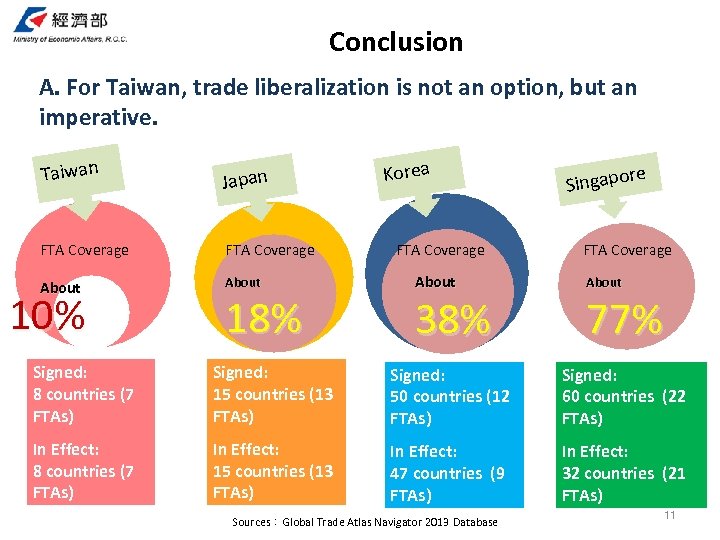 Conclusion A. For Taiwan, trade liberalization is not an option, but an imperative. Taiwan Japan FTA Coverage About 10% 18% Korea FTA Coverage About re Singapo FTA Coverage About 38% 77% Signed: 8 countries (7 FTAs) Signed: 15 countries (13 FTAs) Signed: 50 countries (12 FTAs) Signed: 60 countries (22 FTAs) In Effect: 8 countries (7 FTAs) In Effect: 15 countries (13 FTAs) In Effect: 47 countries (9 FTAs) In Effect: 32 countries (21 FTAs) Sources:Global Trade Atlas Navigator 2013 Database 11
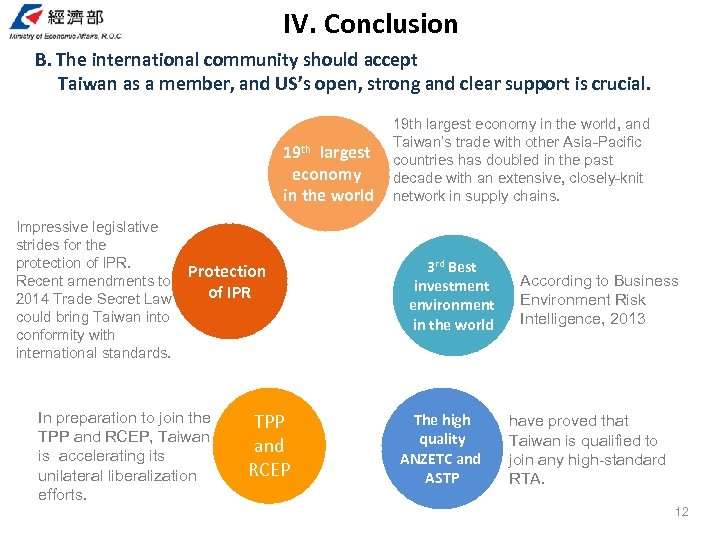 IV. Conclusion B. The international community should accept Taiwan as a member, and US’s open, strong and clear support is crucial. 19 th largest economy in the world Impressive legislative strides for the protection of IPR. Recent amendments to 2014 Trade Secret Law could bring Taiwan into conformity with international standards. Protection of IPR In preparation to join the TPP and RCEP, Taiwan is accelerating its unilateral liberalization efforts. TPP and RCEP 19 th largest economy in the world, and Taiwan’s trade with other Asia-Pacific countries has doubled in the past decade with an extensive, closely-knit network in supply chains. 3 rd Best investment environment in the world The high quality ANZETC and ASTP According to Business Environment Risk Intelligence, 2013 have proved that Taiwan is qualified to join any high-standard RTA. 12
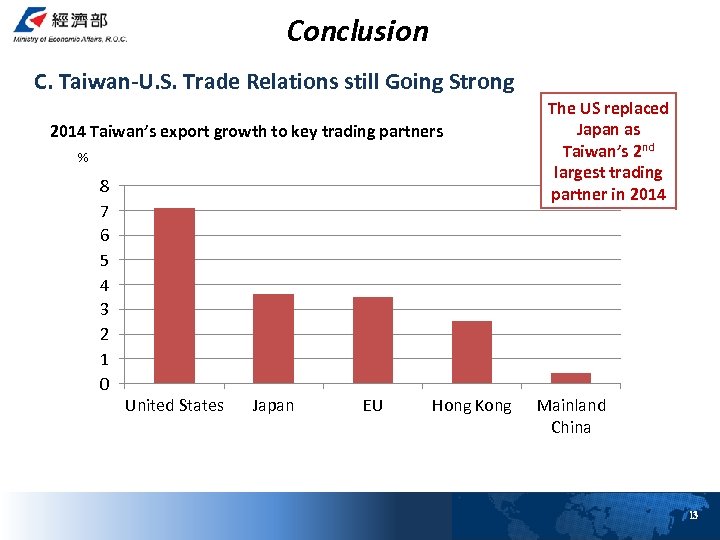 Conclusion C. Taiwan-U. S. Trade Relations still Going Strong 2014 Taiwan’s export growth to key trading partners % 8 7 6 5 4 3 2 1 0 United States Japan EU Hong Kong The US replaced Japan as Taiwan’s 2 nd largest trading partner in 2014 Mainland China 13
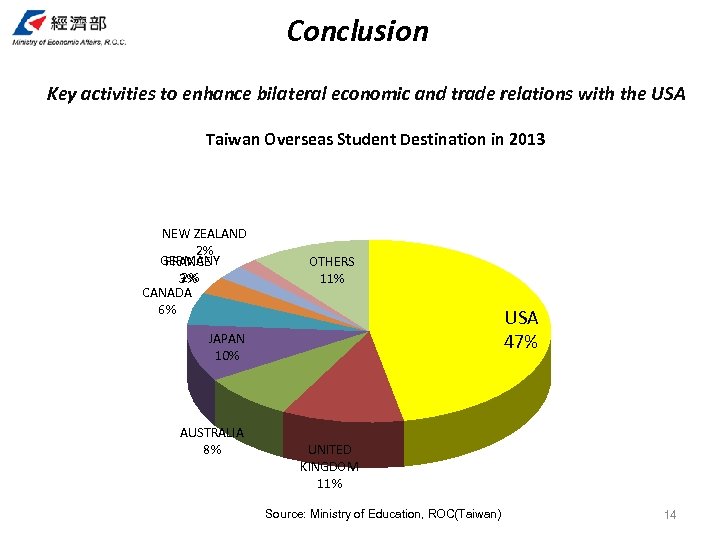 Conclusion Key activities to enhance bilateral economic and trade relations with the USA Taiwan Overseas Student Destination in 2013 NEW ZEALAND 2% GERMANY FRANCE 2% 3% CANADA 6% OTHERS 11% USA 47% JAPAN 10% AUSTRALIA 8% UNITED KINGDOM 11% Source: Ministry of Education, ROC(Taiwan) 14
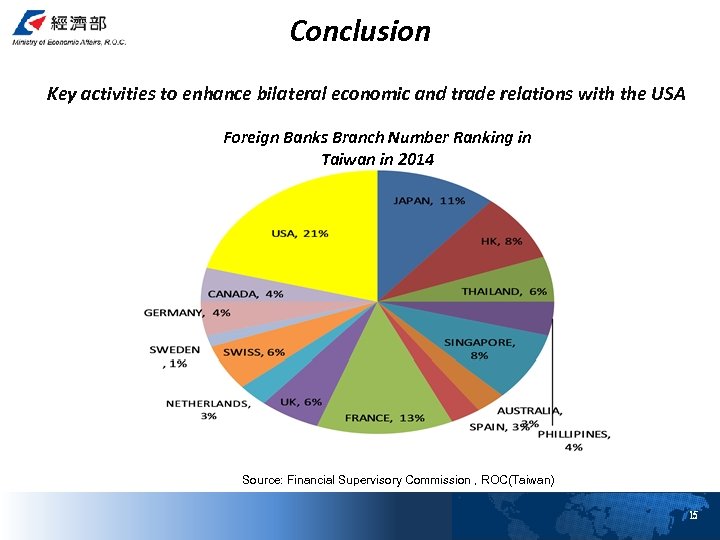 Conclusion Key activities to enhance bilateral economic and trade relations with the USA Foreign Banks Branch Number Ranking in Taiwan in 2014 Source: Financial Supervisory Commission , ROC(Taiwan) 15
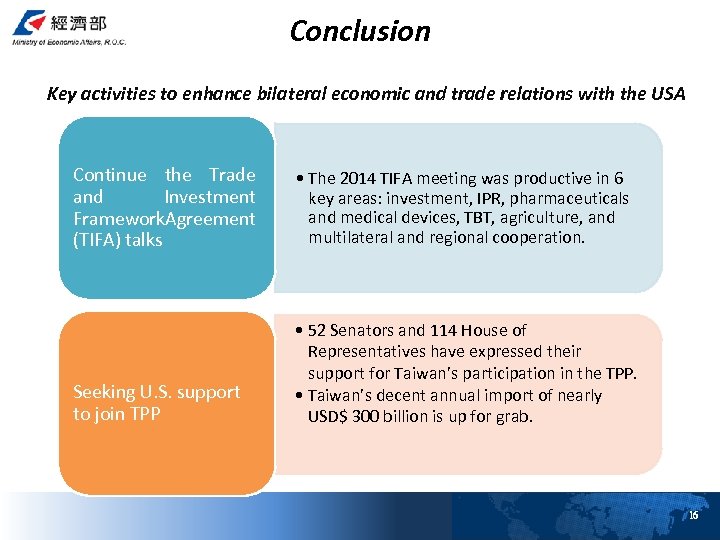 Conclusion Key activities to enhance bilateral economic and trade relations with the USA Continue the Trade and Investment Framework. Agreement (TIFA) talks • The 2014 TIFA meeting was productive in 6 key areas: investment, IPR, pharmaceuticals and medical devices, TBT, agriculture, and multilateral and regional cooperation. Seeking U. S. support to join TPP • 52 Senators and 114 House of Representatives have expressed their support for Taiwan’s participation in the TPP. • Taiwan’s decent annual import of nearly USD$ 300 billion is up for grab. 16
 Thank you