 Скачать презентацию The U S Integrated Ocean Observing System Worth
24677fea7eef5cd508f7454438004356.ppt
- Количество слайдов: 33



The U. S. Integrated Ocean Observing System Worth D. Nowlin, Jr. Texas A&M University NOAA Coastal Services Center NOAA National Data Buoy Center GCOOS Education and Outreach Council: formation meeting November 29, 2004
Outline • What is the Global Ocean Observing System? • What is the Ocean. US Enterprise? • What is the U. S. Integrated Ocean Observing System (IOOS)? • What is the status of the IOOS?
The Global Ocean Observing System
Global Ocean Observing System (GOOS) • GOOS is an end-to-end system of observations, data management, and production and delivery of products/services. • GOOS is being coordinated by U. N. agencies with the participation of some 100 ocean nations. • Together with the World Weather Watch, Global Atmospheric Watch, Global Climate Observing System and Global Terrestrial Observing System, GOOS is a an element of the Global Earth Observing System of Systems

The GOOS Modules The Global Ocean Observing System (GOOS) has been designed and is being implemented in two modules: • A global module designed to monitor, predict, and understand marine surface conditions and climate variability; and • A coastal module designed to sustain healthy marine ecosystems, ensure human health, promote safe and efficient marine transportation, enhance national security, and predict and mitigate against coastal hazards.
The Ocean. US Enterprise
The U. S. Commission on Ocean Policy Report recommends • Implement an Integrated Ocean Observing System • Implement ecosystem–based management • Strengthen regional approach
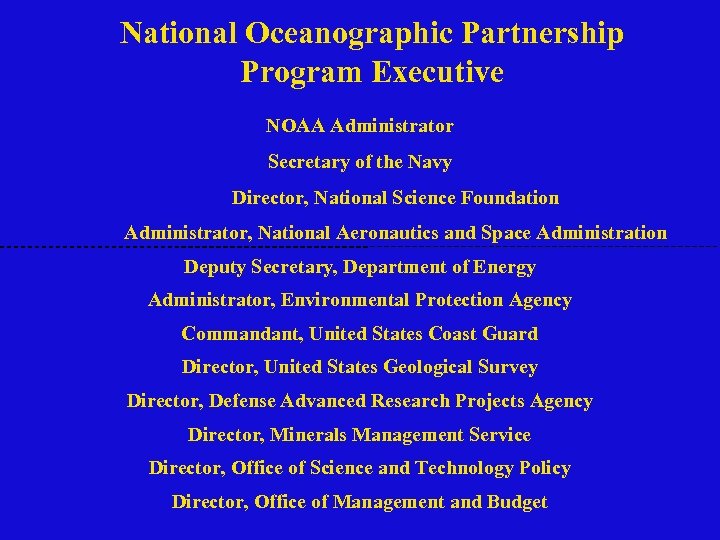
National Oceanographic Partnership Program Executive NOAA Administrator Secretary of the Navy Director, National Science Foundation Administrator, National Aeronautics and Space Administration Deputy Secretary, Department of Energy Administrator, Environmental Protection Agency Commandant, United States Coast Guard Director, United States Geological Survey Director, Defense Advanced Research Projects Agency Director, Minerals Management Service Director, Office of Science and Technology Policy Director, Office of Management and Budget
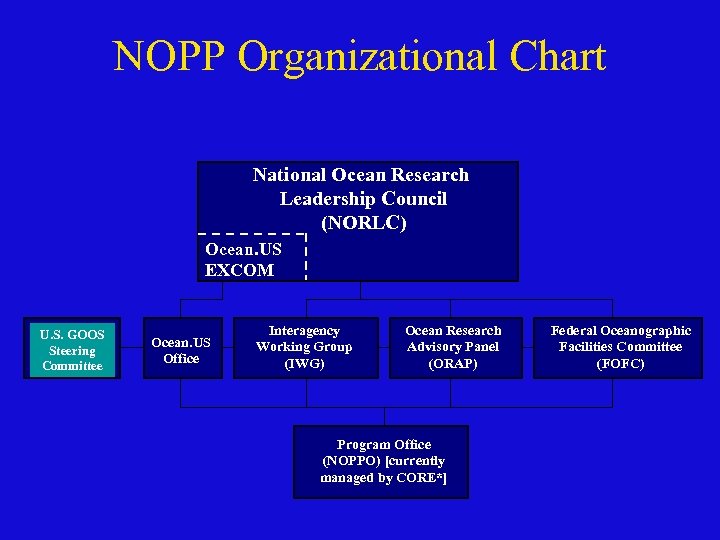
NOPP Organizational Chart National Ocean Research Leadership Council (NORLC) Ocean. US EXCOM U. S. GOOS Steering Committee Ocean. US Office Interagency Working Group (IWG) Ocean Research Advisory Panel (ORAP) Program Office (NOPPO) [currently managed by CORE*] Federal Oceanographic Facilities Committee (FOFC)
Ten–Year Strategic Plan for the NOPP • Achieve & sustain an Integrated Ocean Observing System (IOOS) • Promote lifelong ocean education • Modernize ocean infrastructure & enhance technology development • Foster interagency partnerships to increase & apply scientific knowledge
At the request of the U. S. Congress, the federal agencies of the NOPP are planning and developing a U. S. Integrated Ocean Observing System focused on: • Detecting and Forecasting Oceanic Components of Climate Variability • Facilitating Safe and Efficient Marine Operations • Ensuring National Security • Managing Marine Resources • Preserving and Restoring Healthy Marine Ecosystems • Mitigating Natural Hazards • Ensuring Public Health
The National Office for Integrated and Sustained Ocean Observing and Prediction htttp: //www. ocean. us Dr. Jack Kaye Chair, Executive Committee Thomas Malone Director, Ocean. US Office
Functions of Ocean. US Plan & Coordinate Ø Develop & maintain strategic plan Ø Ensure incorporation of elements into an integrated system Ø Recommend enhancements Ø Recommend R&D priorities Ø Promote collaboration among participating NOPP Agencies & Regional Associations Ø Report regularly to the EXCOM which • Provides policy guidance, ensures sustained agency support, & approves implementing documents
The U. S. Integrated Ocean Observing System
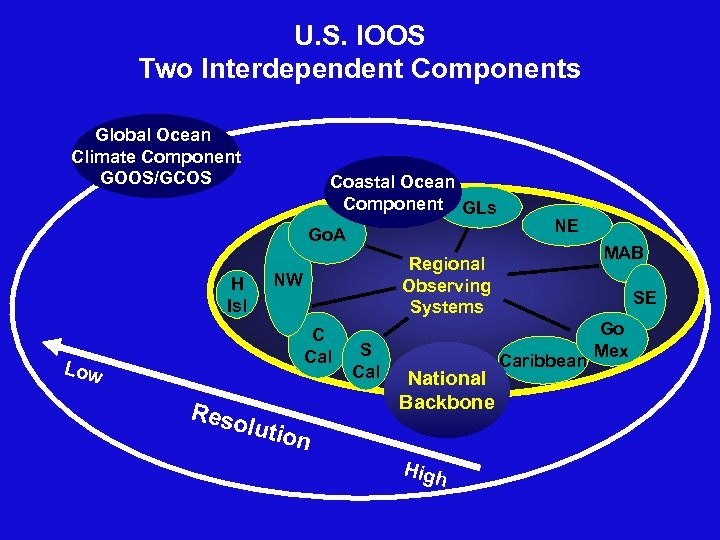
U. S. IOOS Two Interdependent Components Global Ocean Climate Component GOOS/GCOS Coastal Ocean Component GLs Go. A H Isl C Cal Reso lutio MAB Regional Observing Systems NW Low NE S Cal National Backbone n High SE Caribbean Go Mex
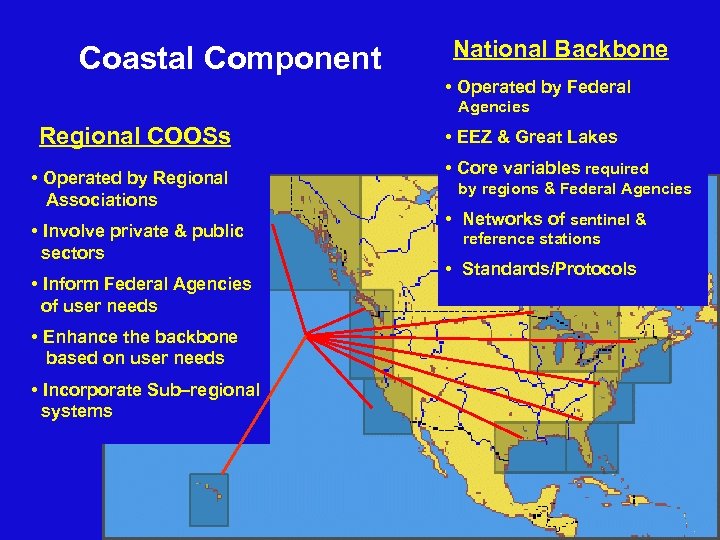
Coastal Component National Backbone • Operated by Federal Agencies Regional COOSs • Operated by Regional Associations • Involve private & public sectors • Inform Federal Agencies of user needs • Enhance the backbone based on user needs • Incorporate Sub–regional systems • EEZ & Great Lakes • Core variables required by regions & Federal Agencies • Networks of sentinel & reference stations • Standards/Protocols
Status of the IOOS: the Development Plan
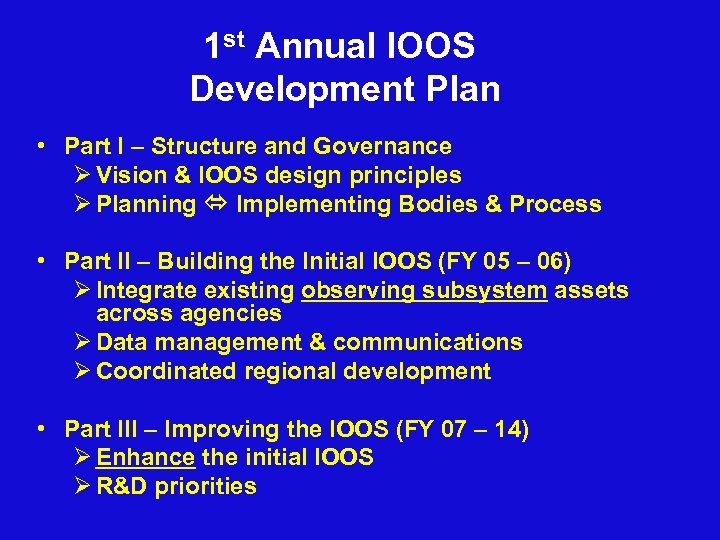
1 st Annual IOOS Development Plan • Part I – Structure and Governance Ø Vision & IOOS design principles Ø Planning Implementing Bodies & Process • Part II – Building the Initial IOOS (FY 05 – 06) Ø Integrate existing observing subsystem assets across agencies Ø Data management & communications Ø Coordinated regional development • Part III – Improving the IOOS (FY 07 – 14) Ø Enhance the initial IOOS Ø R&D priorities
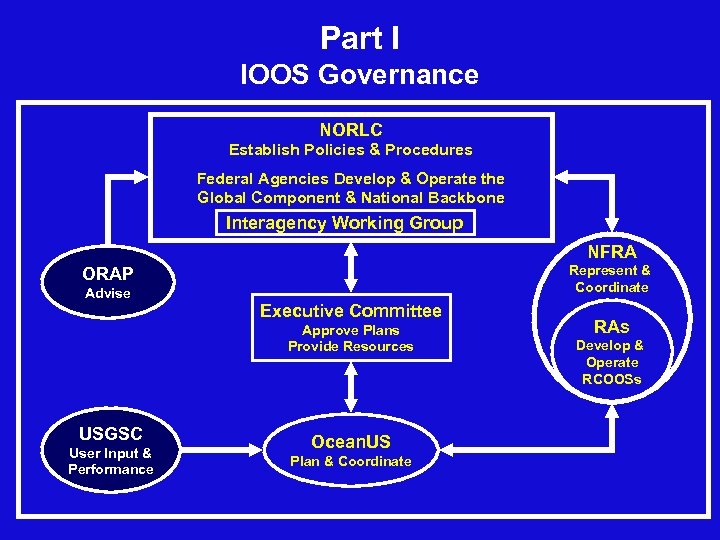
Part I IOOS Governance NORLC Establish Policies & Procedures Federal Agencies Develop & Operate the Global Component & National Backbone Interagency Working Group NFRA Represent & Coordinate ORAP Advise Executive Committee Approve Plans Provide Resources USGSC User Input & Performance Ocean. US Plan & Coordinate RAs Develop & Operate RCOOSs
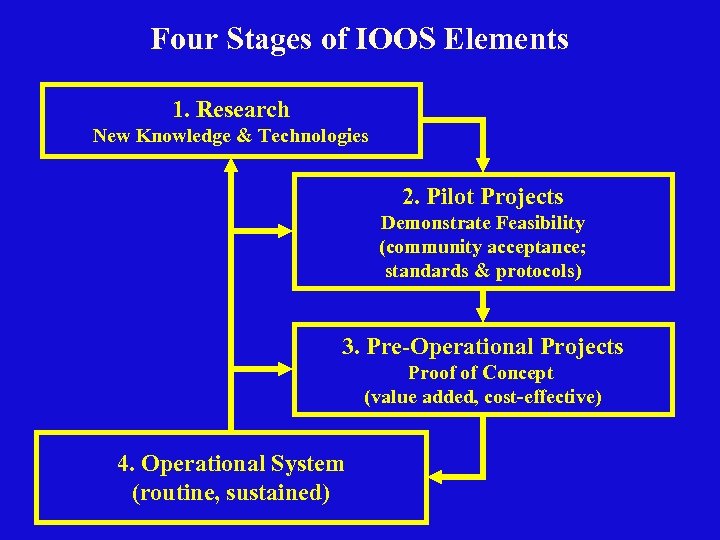
Four Stages of IOOS Elements 1. Research New Knowledge & Technologies 2. Pilot Projects Demonstrate Feasibility (community acceptance; standards & protocols) 3. Pre-Operational Projects Proof of Concept (value added, cost-effective) 4. Operational System (routine, sustained)
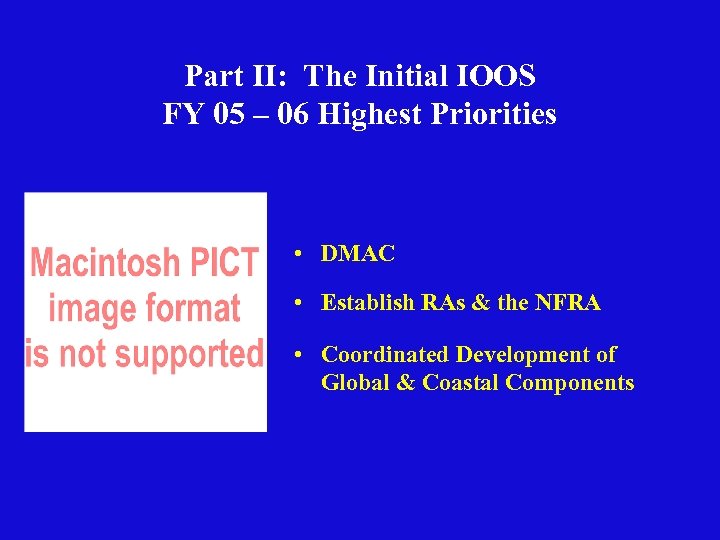
Part II: The Initial IOOS FY 05 – 06 Highest Priorities • DMAC • Establish RAs & the NFRA • Coordinated Development of Global & Coastal Components
Part III – Enhancement Categories • Global Ocean – Climate Component • DMAC • Regional Coastal Ocean Observing Systems • National Backbone Operational Observing Subsystem – Increase density of measurements – Incorporate additional sensors • Education
Part III – Enhancement Categories Research & Pilot Projects • Product–Driven (end–to–end systems) Ø Surface current maps Ø Near shore bathy-topography maps • Target Specific Elements of the IOOS Ø Modeling – Close gap between operational models for • marine meteorology & physical oceanography & • those that require biological & chemical data Ø Ø Benthic habitat mapping In situ sensors for biological & chemical variables Glider technologies Improve spectral, spatial & temporal resolution of space–based remote sensing of coastal systems
The IOOS Global Component • Part of an intergovernmental, cooperative system • Designed to observe and predict global, oceaninfluenced phenomena (such as El Niños, extreme weather, or global warming) • Nearing operational, sustained status.
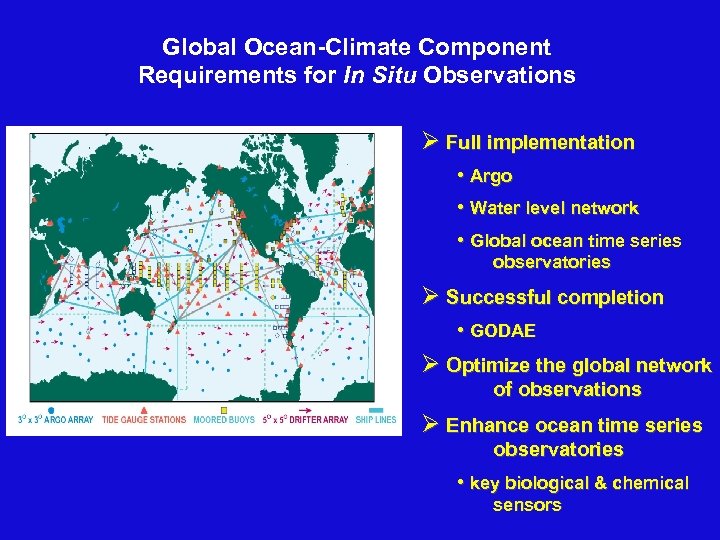
Global Ocean-Climate Component Requirements for In Situ Observations Ø Full implementation • Argo • Water level network • Global ocean time series observatories Ø Successful completion • GODAE Ø Optimize the global network of observations Ø Enhance ocean time series observatories • key biological & chemical sensors
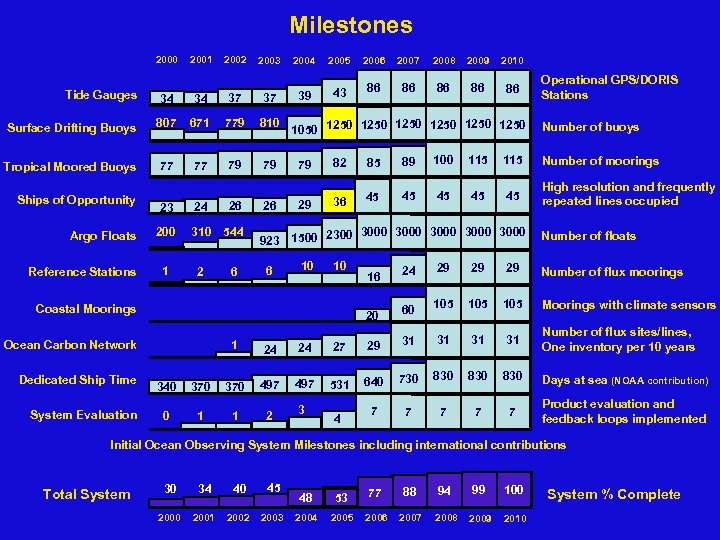
Milestones 2000 2001 2002 2003 2004 2005 2006 2007 2008 2009 2010 39 43 86 86 86 Tide Gauges 34 34 37 37 Surface Drifting Buoys 807 671 779 810 Tropical Moored Buoys 77 77 79 79 Ships of Opportunity Argo Floats Reference Stations 23 24 26 200 310 544 1 2 6 26 1050 1250 1250 79 29 85 89 100 115 Number of moorings 36 45 45 45 High resolution and frequently repeated lines occupied 10 Ocean Carbon Network System Evaluation Number of floats 1 24 24 27 531 340 370 497 0 1 1 2 3 4 16 24 29 29 29 Number of flux moorings 20 6 Coastal Moorings Dedicated Ship Time Number of buoys 82 2300 3000 3000 923 1500 10 Operational GPS/DORIS Stations 60 105 105 Moorings with climate sensors 29 31 31 Number of flux sites/lines, One inventory per 10 years 640 730 830 830 Days at sea (NOAA contribution) 7 7 7 Product evaluation and feedback loops implemented Initial Ocean Observing System Milestones including international contributions Total System 30 34 40 45 2000 2001 2002 2003 48 53 2004 2005 77 88 94 99 100 2006 2007 2008 2009 2010 System % Complete
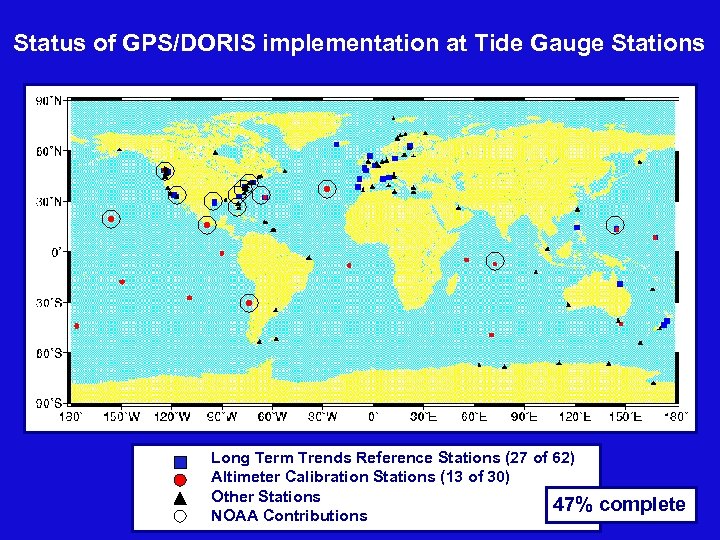
Status of GPS/DORIS implementation at Tide Gauge Stations Long Term Trends Reference Stations (27 of 62) Altimeter Calibration Stations (13 of 30) Other Stations 47% NOAA Contributions complete
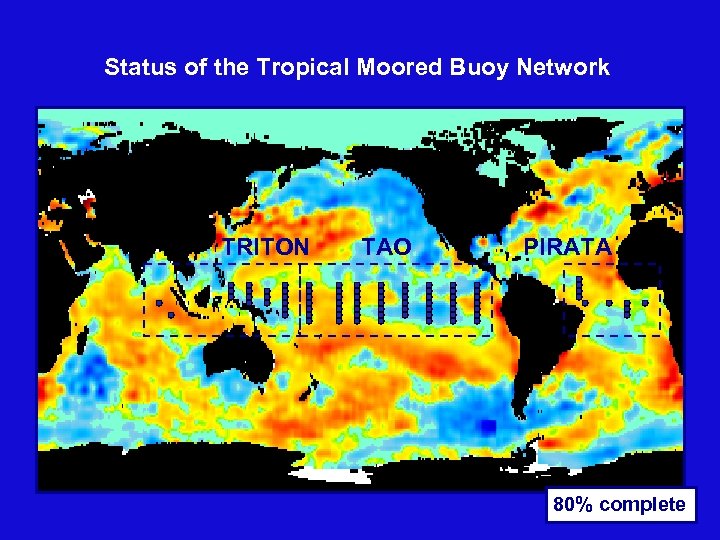
Status of the Tropical Moored Buoy Network TRITON TAO PIRATA 80% complete
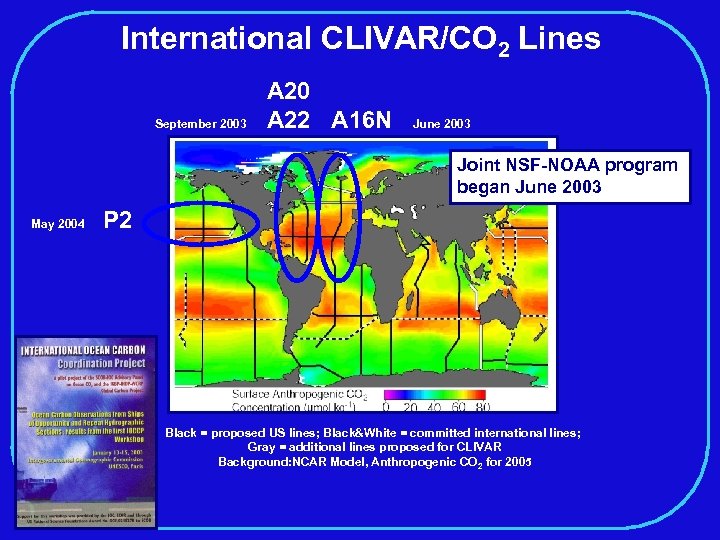
International CLIVAR/CO 2 Lines September 2003 A 20 A 22 A 16 N June 2003 Joint NSF-NOAA program began June 2003 May 2004 P 2 Black = proposed US lines; Black&White = committed international lines; Gray = additional lines proposed for CLIVAR Background: NCAR Model, Anthropogenic CO 2 for 2005
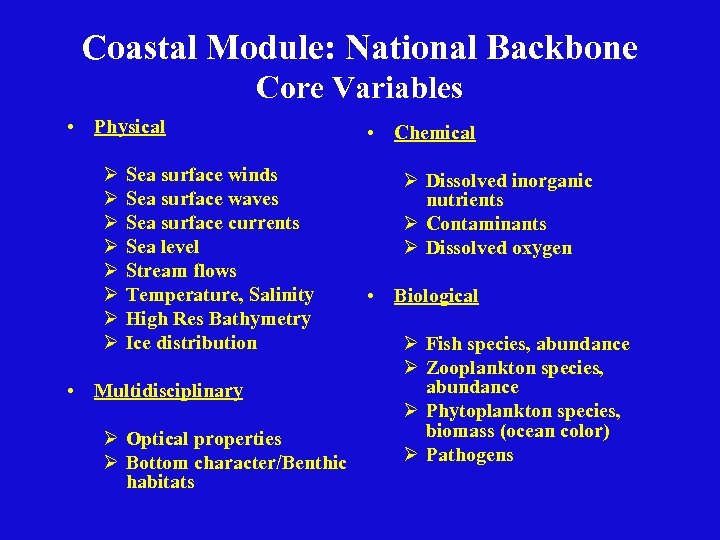
Coastal Module: National Backbone Core Variables • Physical Ø Ø Ø Ø Sea surface winds Sea surface waves Sea surface currents Sea level Stream flows Temperature, Salinity High Res Bathymetry Ice distribution • Multidisciplinary Ø Optical properties Ø Bottom character/Benthic habitats • Chemical Ø Dissolved inorganic nutrients Ø Contaminants Ø Dissolved oxygen • Biological Ø Fish species, abundance Ø Zooplankton species, abundance Ø Phytoplankton species, biomass (ocean color) Ø Pathogens
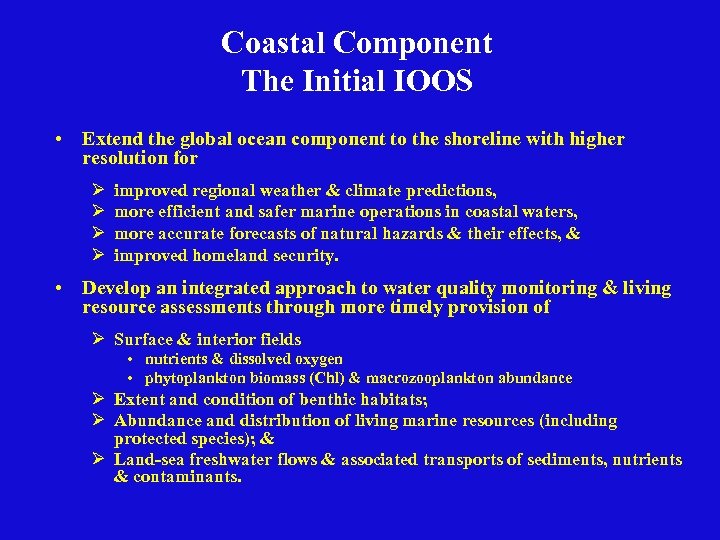
Coastal Component The Initial IOOS • Extend the global ocean component to the shoreline with higher resolution for Ø Ø improved regional weather & climate predictions, more efficient and safer marine operations in coastal waters, more accurate forecasts of natural hazards & their effects, & improved homeland security. • Develop an integrated approach to water quality monitoring & living resource assessments through more timely provision of Ø Surface & interior fields • nutrients & dissolved oxygen • phytoplankton biomass (Chl) & macrozooplankton abundance Ø Extent and condition of benthic habitats; Ø Abundance and distribution of living marine resources (including protected species); & Ø Land-sea freshwater flows & associated transports of sediments, nutrients & contaminants.
Coastal Component The Initial IOOS • Extend the global ocean component to the shoreline with higher resolution for Ø Ø improved regional weather & climate predictions, more efficient and safer marine operations in coastal waters, more accurate forecasts of natural hazards & their effects, & improved homeland security. • Develop an integrated approach to water quality monitoring & living resource assessments through more timely provision of Ø Surface & interior fields • nutrients & dissolved oxygen • phytoplankton biomass (Chl) & macrozooplankton abundance Ø Extent and condition of benthic habitats; Ø Abundance and distribution of living marine resources (including protected species); & Ø Land-sea freshwater flows & associated transports of sediments, nutrients & contaminants.
Thank you http: //www. ocean. us http: //ocean. tamu. edu/GOOS/goos. html
Скачать презентацию The U S Integrated Ocean Observing System Worth
24677fea7eef5cd508f7454438004356.ppt