


 Скачать презентацию The U S Constitution AP Government Politics
83ac2b49dd29c420dbf0e20756402ef7.ppt
- Количество слайдов: 94
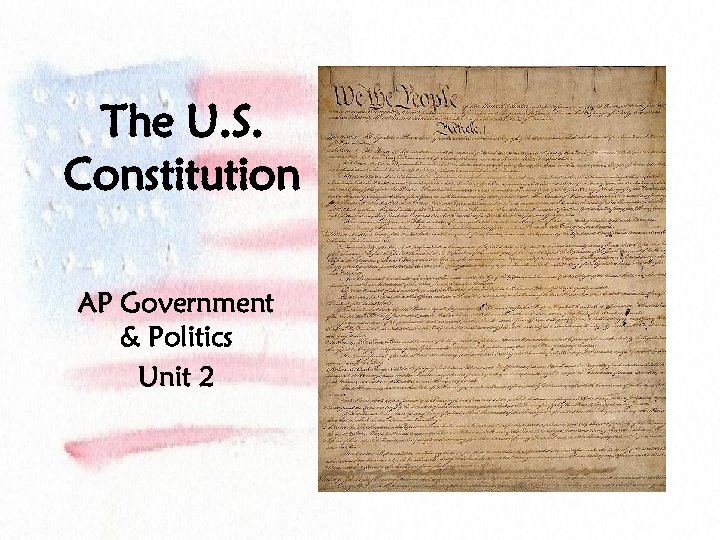 The U. S. Constitution AP Government & Politics Unit 2
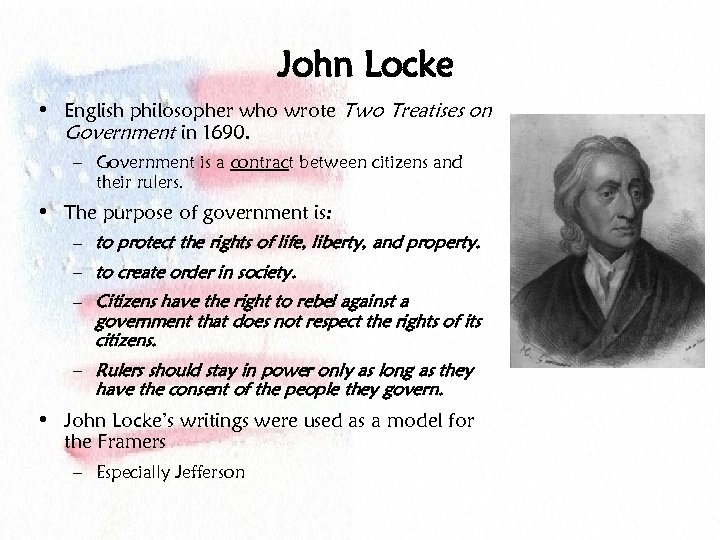 John Locke • English philosopher who wrote Two Treatises on Government in 1690. – Government is a contract between citizens and their rulers. • The purpose of government is: – to protect the rights of life, liberty, and property. – to create order in society. – Citizens have the right to rebel against a government that does not respect the rights of its citizens. – Rulers should stay in power only as long as they have the consent of the people they govern. • John Locke’s writings were used as a model for the Framers – Especially Jefferson
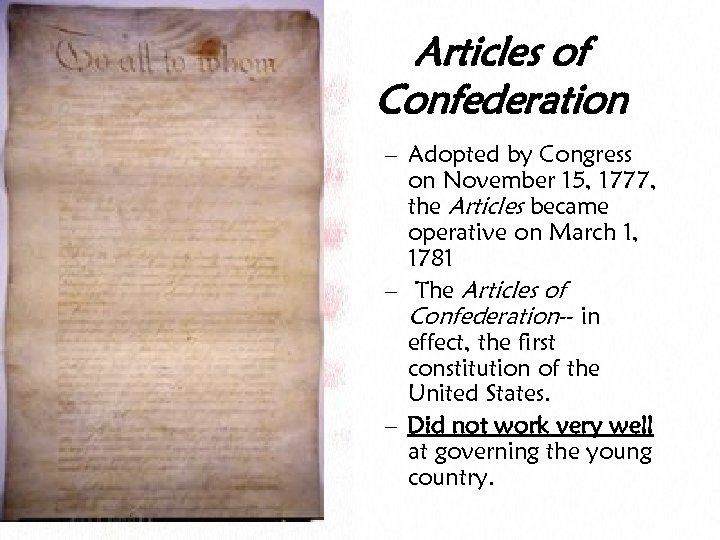 Articles of Confederation – Adopted by Congress on November 15, 1777, the Articles became operative on March 1, 1781 – The Articles of Confederation-- in effect, the first constitution of the United States. – Did not work very well at governing the young country.
 The Weaknesses of the Articles • • Could not tax Could not raise a national army National currency was ineffective No Regulation of trade between states • • • No Executive Branch No Judicial Branch A unicameral (one-house) Congress –States charged each other tariffs – 9 of 13 votes to pass a law – 13 out of 13 states needed to amend. Representatives were frequently absent!
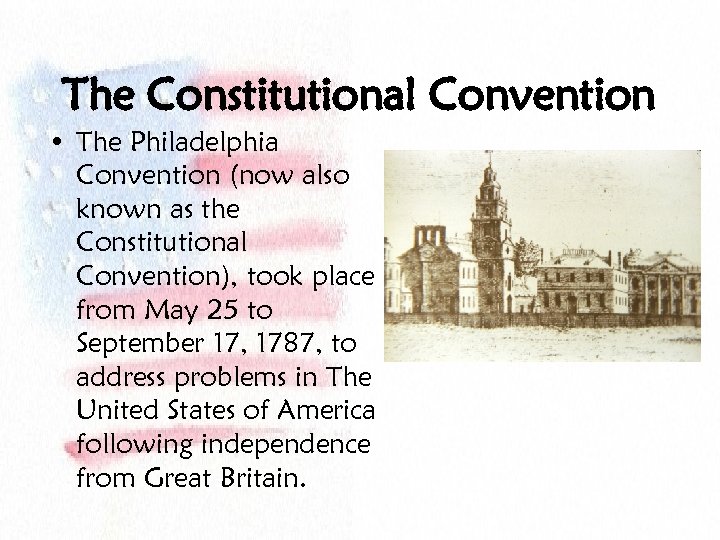 The Constitutional Convention • The Philadelphia Convention (now also known as the Constitutional Convention), took place from May 25 to September 17, 1787, to address problems in The United States of America following independence from Great Britain.
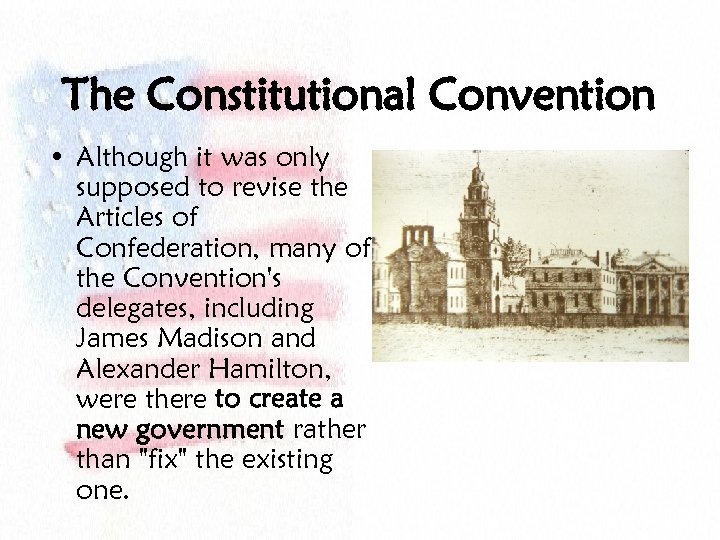 The Constitutional Convention • Although it was only supposed to revise the Articles of Confederation, many of the Convention's delegates, including James Madison and Alexander Hamilton, were there to create a new government rather than "fix" the existing one.
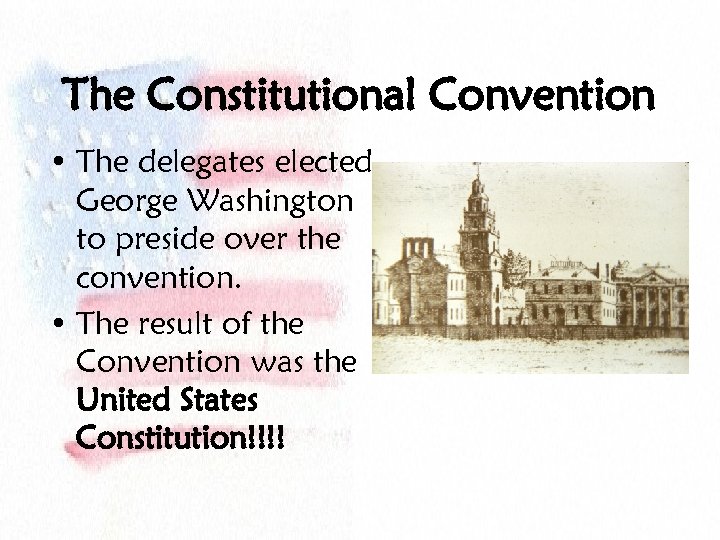 The Constitutional Convention • The delegates elected George Washington to preside over the convention. • The result of the Convention was the United States Constitution!!!!
 Virginia Plan • On May 29, 1787, Virginia proposed what became known as "The Virginia Plan. ”. • The legislature was to be set up with 2 houses: one with members elected by the people for 3 -year terms and the other composed of older leaders elected by the state legislatures for 7 -year terms. • Both would use population as a basis for dividing seats among the states.
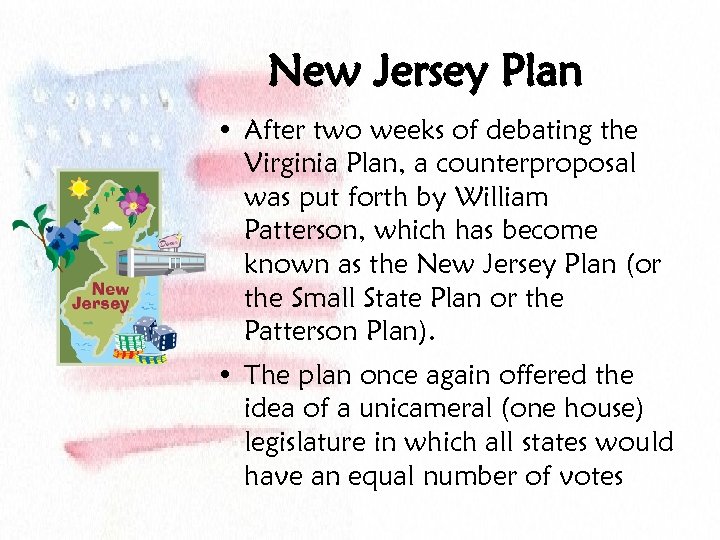 New Jersey Plan • After two weeks of debating the Virginia Plan, a counterproposal was put forth by William Patterson, which has become known as the New Jersey Plan (or the Small State Plan or the Patterson Plan). • The plan once again offered the idea of a unicameral (one house) legislature in which all states would have an equal number of votes
 The Great Compromise (AKA Connecticut Compromise) • To solve the differences regarding representation the Framers appointed a committee which recommended a compromise, known as the Connecticut Compromise or the Great Compromise. • The solution contained three important parts: Congress would be a legislature, with a Senate and a House of Representatives. • The small states received the equal representation they desired in the Senate. The large states won control of the House which was given important powers related to taxing and spending.
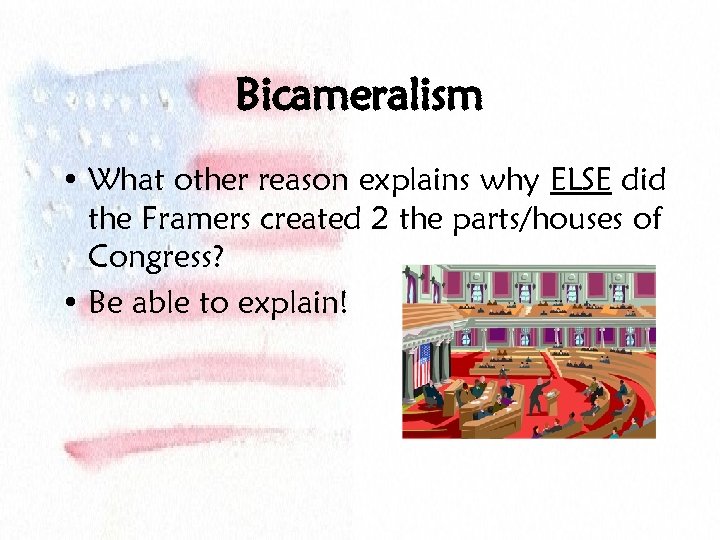 Bicameralism • What other reason explains why ELSE did the Framers created 2 the parts/houses of Congress? • Be able to explain!
 US Constitution • The Constitution of the United States comprises the primary law of the U. S. Federal Government and the landmark legal document of the United States. • The Constitution of the United States is the oldest Federal constitution in existence and was framed by a convention of delegates from twelve of the thirteen original states in Philadelphia in May 1787. • It also describes the three chief branches of the Federal Government and their jurisdictions. In addition, it lays out the basic rights of citizens of the United States.
 The Organization of the US Constitution • There are seven Articles in the Constitution • The Articles are divided into Sections • Sections are divided into Clauses Example: I. Article 1. Section 1. Clause
 For the Quiz: Know the Seven Articles! • Article I – The Legislative Branch • Article II – The Executive Branch • Article III – The Judicial Branch • Article IV – Relationships among the States • Article V – Amending the Constitution • Article VI – Supreme Law of the Land – Debts, Supremacy, Oaths of Office • Article VII – The Ratification Process
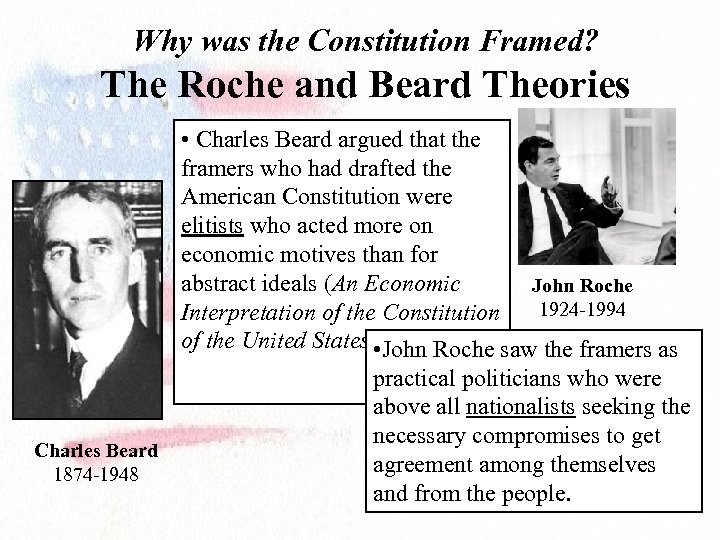 Why was the Constitution Framed? The Roche and Beard Theories • Charles Beard argued that the framers who had drafted the American Constitution were elitists who acted more on economic motives than for abstract ideals (An Economic John Roche 1924 -1994 Interpretation of the Constitution of the United States- • John Roche saw the framers as 1913) Charles Beard 1874 -1948 practical politicians who were above all nationalists seeking the necessary compromises to get agreement among themselves and from the people.
 Who Said It? ? ? “The Constitution was…a vivid demonstration of effective democratic political action, and of the forging of a nation…. which literally persuaded its countrymen to hoist themselves by their own boot straps. ”
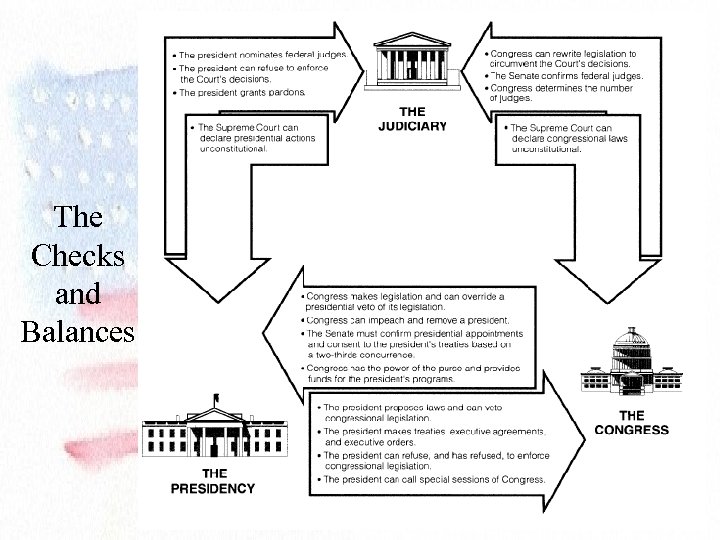 The Checks and Balances
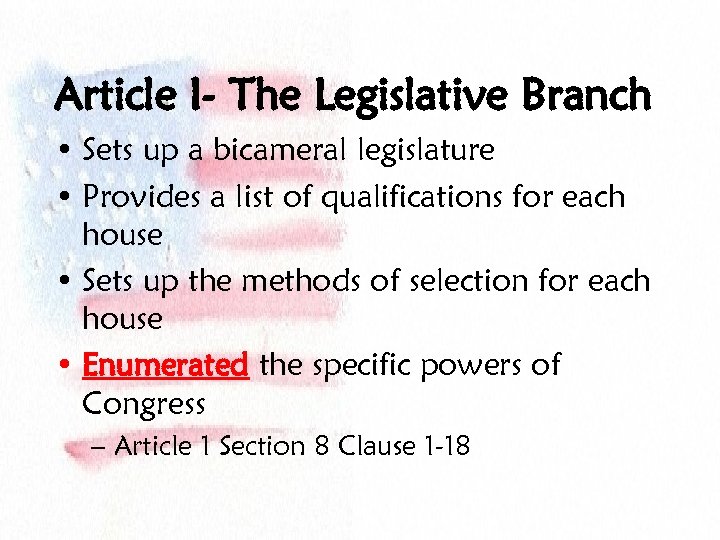 Article I- The Legislative Branch • Sets up a bicameral legislature • Provides a list of qualifications for each house • Sets up the methods of selection for each house • Enumerated the specific powers of Congress – Article 1 Section 8 Clause 1 -18
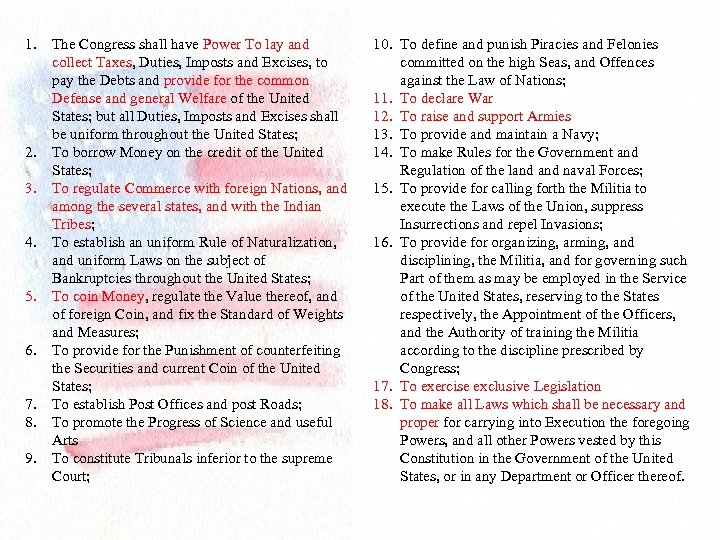 1. The Congress shall have Power To lay and collect Taxes, Duties, Imposts and Excises, to pay the Debts and provide for the common Defense and general Welfare of the United States; but all Duties, Imposts and Excises shall be uniform throughout the United States; 2. To borrow Money on the credit of the United States; 3. To regulate Commerce with foreign Nations, and among the several states, and with the Indian Tribes; 4. To establish an uniform Rule of Naturalization, and uniform Laws on the subject of Bankruptcies throughout the United States; 5. To coin Money, regulate the Value thereof, and of foreign Coin, and fix the Standard of Weights and Measures; 6. To provide for the Punishment of counterfeiting the Securities and current Coin of the United States; 7. To establish Post Offices and post Roads; 8. To promote the Progress of Science and useful Arts 9. To constitute Tribunals inferior to the supreme Court; 10. To define and punish Piracies and Felonies committed on the high Seas, and Offences against the Law of Nations; 11. To declare War 12. To raise and support Armies 13. To provide and maintain a Navy; 14. To make Rules for the Government and Regulation of the land naval Forces; 15. To provide for calling forth the Militia to execute the Laws of the Union, suppress Insurrections and repel Invasions; 16. To provide for organizing, arming, and disciplining, the Militia, and for governing such Part of them as may be employed in the Service of the United States, reserving to the States respectively, the Appointment of the Officers, and the Authority of training the Militia according to the discipline prescribed by Congress; 17. To exercise exclusive Legislation 18. To make all Laws which shall be necessary and proper for carrying into Execution the foregoing Powers, and all other Powers vested by this Constitution in the Government of the United States, or in any Department or Officer thereof.
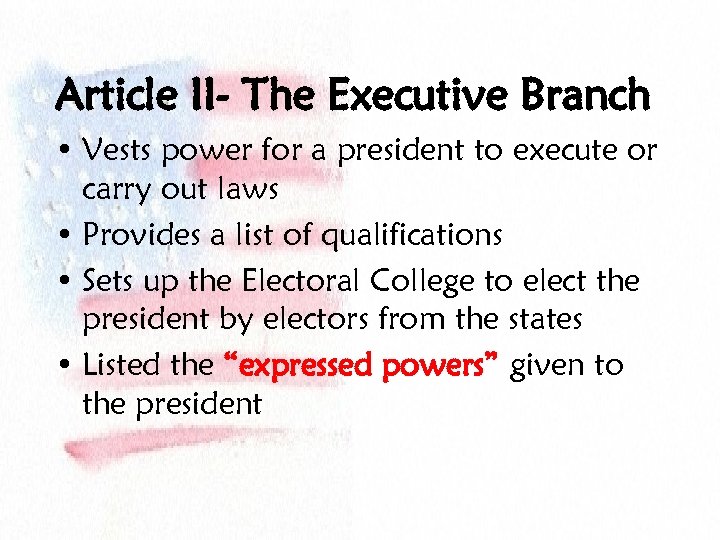 Article II- The Executive Branch • Vests power for a president to execute or carry out laws • Provides a list of qualifications • Sets up the Electoral College to elect the president by electors from the states • Listed the “expressed powers” given to the president
 1. Act as the Commander in Chief of the Army, Navy and National Guard (when called into service) 2. Grant "Reprieves and Pardons" except in the case of impeachment 3. Make treaties with other nations with the "Advice and Consent" of two thirds of the Senate 4. Appoint Ambassadors, Supreme Court Justices and all other "Officers of the United States" (including cabinet members) with the support of a majority in the Senate
 Article III- The Judicial Branch • Establishes a Supreme Court • Justices and other federal judges serve lifetime terms set loosely as “good behavior” • The power grants the Supreme Court jurisdiction over "all Cases, in Law and Equity, arising under this Constitution, the Laws of the United States, and Treaties made, or which shall be made, under their Authority. "
 Article IV- The Relationships Among the States • Mandated that the states honor and respect each other’s laws and judicial procedures • Set up the rules for new states to be admitted
 Article V- Amendments • Created a pathway for new amendments to be added to the new Constitution • The first Ten Amendments are known as The Bill of Rights
 Article VI and VII • Article VI – Establishes the Supremacy of the national government and limited the use of religious tests • Article VII – Set up procedures for ratifying the Constitution – 9/13 states
 Important Constitutional Powers to Know • Enumerated Powers • Concurrent Powers • Reserved Powers • Implied Powers • Denied Powers
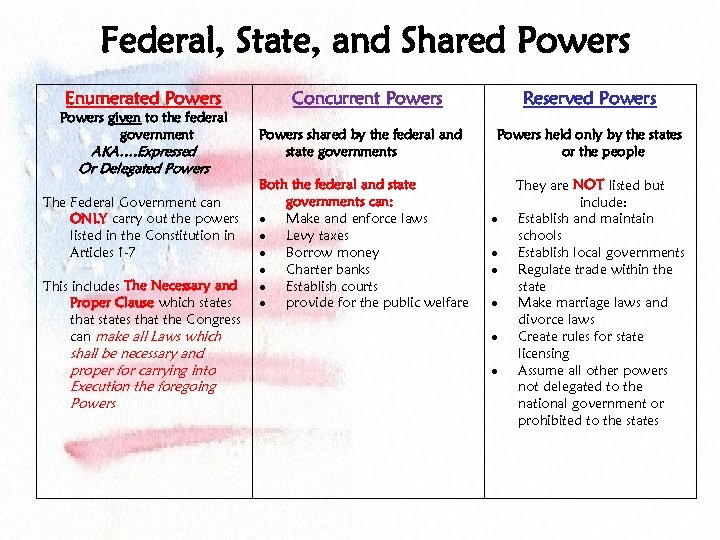 Federal, State, and Shared Powers Enumerated Powers given to the federal government AKA…. Expressed Or Delegated Powers The Federal Government can ONLY carry out the powers listed in the Constitution in Articles 1 -7 This includes The Necessary and Proper Clause which states that the Congress can make all Laws which shall be necessary and proper for carrying into Execution the foregoing Powers Concurrent Powers shared by the federal and state governments Both the federal and state governments can: Make and enforce laws Levy taxes Borrow money Charter banks Establish courts provide for the public welfare Reserved Powers held only by the states or the people They are NOT listed but include: Establish and maintain schools Establish local governments Regulate trade within the state Make marriage laws and divorce laws Create rules for state licensing Assume all other powers not delegated to the national government or prohibited to the states
 Enumerated Powers (or delegated or expressed) • Enumerated Powers are powers given to the federal government by the terms of the U. S. Constitution. – Congressional powers are found in Article I Section 8 of the United States Constitution • They enumerate the authority granted to the United States Congress. • Congress may exercise only those powers that are stated in the Constitution, and are limited by the Bill of Rights and the other protections found in the Constitution.
 Reserved Powers • Reserved powers are those that have been reserved specifically for the states or are of a traditionally state scope. • These consist mostly of police powers, such as providing fire and police protection, establishment of health regulations, licensing, and education(? ).
 Concurrent Powers • Concurrent powers are those held to some extent by both the federal and state governments. • Both, for example, have taxation power, the ability to construct and maintain roads, and other spending for the general welfare.
 Implied Powers • Implied Powers give the branches of government flexibility when it comes to carrying out their express powers. – The Legislative Branch’s implied powers flow from the Necessary and Proper Clause. – The Executive Branch’s implied powers flow from the powers of Commander-in-Chief, and the Executive's emergency powers. – The Judicial Branch has assumed the implied power of judicial review, as shown in Marbury v. Madison.
 Denied Powers • Many things are denied of both or either levels of government. – States, for example, have no authority to coin money or wage war. – Neither may pass a bill of attainder or any ex post facto law. • The Bill of Rights applies restrictions to the federal government, but Bill of Rights originally had no effect of restriction on the states. • However, interpretation of the 14 th Amendment's due process clause has incorporated much of the upholding of civil rights to the states. all of the Bill of Rights applies restrictions to the federal government.
 Methods of Formally Amending the Constitution Part 1. Proposing an Amendment • There are essentially two ways spelled out in the Constitution for how to propose an amendment. 1. By way of the Congress 2. By way of the states • The second way has never been used.
 Methods of Formally Amending the Constitution Proposal by Congress Method • The first method is for a bill proposing to pass both houses of the legislature, by a two-thirds majority in each. • This is the route taken by all current amendments. – Because of some long outstanding amendments, such as the 27 th, Congress will normally put a time limit (typically seven years) for the bill to be approved as an amendment (for example, see the 21 st and 22 nd).
 Methods of Amending the Constitution Proposal by the States Method • The second method prescribed is for a Constitutional Convention to be called by twothirds of the legislatures of the States • This route has never been taken, and there is discussion in political science circles about just how such a convention would be convened, and what kind of changes it would bring about. – Either way, (Congress OR State method) the amendments must be then sent to the states to be approved by three-fourths of the legislatures or conventions.
 Part 2 Approval/Ratification by the States • Regardless of which of the two proposal routes is taken, the amendment must be ratified, or approved, by three-fourths of states. • Once the amendment has passed both houses, it goes on to the states where ¾ of states must ratify it
 Part 2 Approval/Ratification by the States • There are two ways to do this, too. 1. Through the state legislatures 2. Or by a state convention. • Amendments are sent to the legislatures of the states by default. • Only one amendment, the 21 st, specified a convention. • In any case, passage by the legislature or convention is by simple majority.
 To Summarize…. The Constitution, then, spells out four paths for an amendment: 1. Proposal by convention of states, ratification by state conventions (never used) 2. Proposal by convention of states, ratification by state legislatures (never used) 3. Proposal by Congress, ratification by state conventions (used once- 21 st) 4. Proposal by Congress, ratification by state legislatures (used all other times)
 Methods of Informally “Amending” the Constitution There are essentially three ways that change can occur: 1. Through the courts and judicial review • Established in Marbury v Madison 2. Through Congress and the elastic clause • When federal powers are stretched in new directions that were not enumerated 3. Through social and cultural change • Laws, regulations, referendums passed concerning equality for all; modern ideas…
 Important Clauses of the Constitution to Know • Supremacy Clause • Necessary and Proper Clause • Commerce Clause • Contract Clause • Full Faith and Credit Clause • Republican Form of Government Clause • The Suspension Clause
 Supremacy Clause • Article VI- "This Constitution, and the Laws of the United States which shall be made in Pursuance thereof; and all Treaties made, or which shall be made, under the Authority of the United States, shall be the supreme Law of the Land; and the Judges in every State shall be bound thereby, any Thing in the Constitution or Laws of any State to the contrary notwithstanding…. ” • Under the Supremacy Clause, everyone must follow federal law in the face of conflicting state law.
 Necessary and Proper Clause • Article I- Section 8 – “To make all Laws which shall be necessary and proper for carrying into Execution the foregoing Powers and all other Powers vested by this Constitution in the Government of the United States, or in any Department or Officer thereof” • Also known as the elastic clause because it can be used to stretch the powers of the federal government • This clause grants to Congress the power to enact laws to carry out the “enumerated powers” which are specifically assigned to the federal government.
 (Interstate) Commerce Clause • Article I, Section 8, Clause 3 – "To regulate Commerce with foreign Nations, and among the several States, and with the Indian Tribes. " • The direct source of one the most important powers of the federal government • Strengthens federal power while setting limitations on state power
 Contract Clause • Article I, Section 10, Clause 1 – No State shall enter into any Treaty, Alliance, or Confederation; grant Letters of Marque and Reprisal; coin Money; emit Bills of Credit; make any Thing but gold and silver Coin a Tender in Payment of Debts; pass any Bill of Attainder, ex post facto Law, or Law impairing the Obligation of Contracts, or grant any Title of Nobility. • The Contract Clause applies to contracts between private individuals or contracts made by a state government. – However, if a contract endangers the health, safety, or welfare of the public, the state may regulate or void it.
 Full Faith and Credit Clause • Article IV, Section 1. – “Full faith and credit shall be given in each state to the public acts, records, and judicial proceedings of every other state. . . – Section 2. The citizens of each state shall be entitled to all privileges and immunities of citizens in the several states. • The Full Faith and Credit Clause requires each state to recognize a judgment entered in another state
 Republican Form of Government Clause • Article IV, Section 4 – The United States shall guarantee to every state in this union a republican form of government, and shall protect each of them against invasion; and on application of the legislature, or of the executive (when the legislature cannot be convened) against domestic violence • This insures that the citizens of each state that their state governments elect their officials and that republican standards are followed
 The Suspension Clause • Habeas Corpus means “You have the Body” and refers to our legal rights to see the proof when arrested. • The U. S. Constitution refers to habeas rights in Article I, Section 9 – The Suspension Clause – The privilege of the Writ of Habeas Corpus shall not be suspended, unless when in Cases of Rebellion or Invasion the public Safety may require it. • A writ of habeas corpus is a judicial mandate to a prison official ordering that an inmate be brought to the court so it can be determined whether or not that person is imprisoned lawfully and whether or not he should be released from custody. • Prisoners often seek release by filing a petition for a writ of habeas corpus.
 The Federalist Papers • Essays written in 1787 and 1788 by James Madison, John Jay, and Alexander Hamilton under the penname of Publius • Designed to advocate the ratification of the new constitution by the states – “An authoritative but unofficial explanation of American government by those who created it. ”
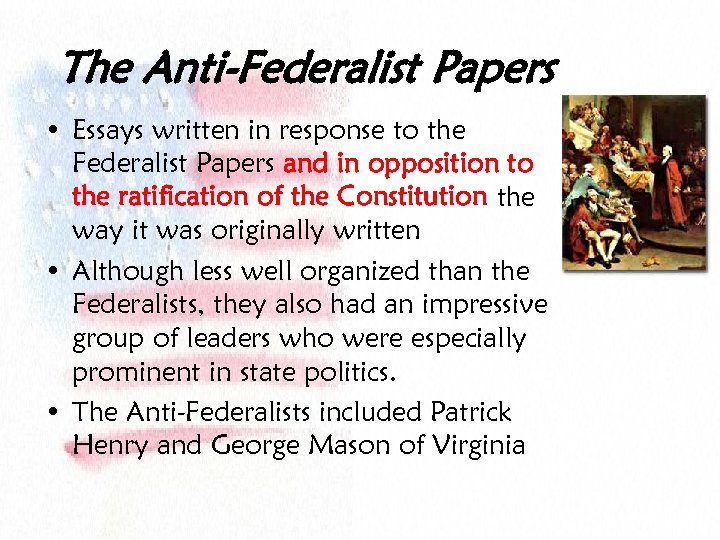 The Anti-Federalist Papers • Essays written in response to the Federalist Papers and in opposition to the ratification of the Constitution the way it was originally written • Although less well organized than the Federalists, they also had an impressive group of leaders who were especially prominent in state politics. • The Anti-Federalists included Patrick Henry and George Mason of Virginia
 Compare the Two Groups The Federalists • Property owners, landed rich, merchants of the Northeast and Middle Atlantic states • Elitists • Saw themselves and those of their class the most fit to govern • Wanted a strong central government with a bicameral legislature including a non-elected upper house (Senate) The Anti-Federalists • Small farmers, shopkeeper, laborers • Believed in “the common man” and participatory democracy • Viewed elites as corrupt • Sought greater protection for individual rights • Wanted stronger state governments with a large unicameral legislature to provide greater representation
 The Road to Ratification • The ratification process started when the Congress turned the Constitution over to the state legislatures for consideration through specially elected state conventions of the people. • These states were the first five to ratify: 1. Delaware 2. New Jersey 3. Georgia, 4. Pennsylvania 5. Connecticut.
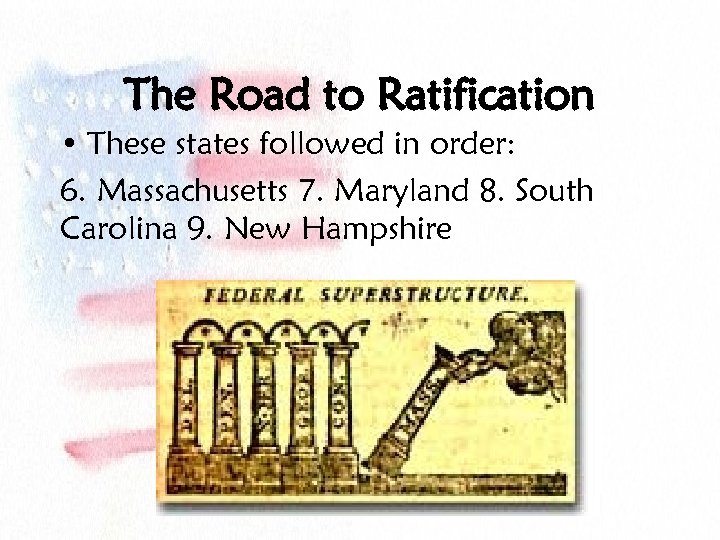 The Road to Ratification • These states followed in order: 6. Massachusetts 7. Maryland 8. South Carolina 9. New Hampshire
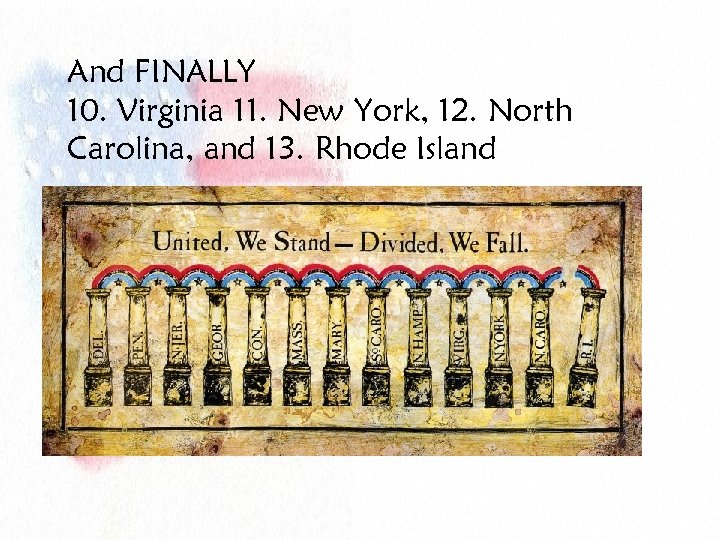 And FINALLY 10. Virginia 11. New York, 12. North Carolina, and 13. Rhode Island
 The Legacy of the Anti-Federalists • The BILL OF RIGHTS is a legacy of the “victory-in-defeat” of Antifederalists. – Eventually even James Madison was swayed to support its creation and eventual addition to the Constitution • Their continued participation in the political process even when they seemed to have lost on the more general issue had immense importance.
 The Bill of Rights • A number of prominent Americans were alarmed at the omission of individual liberties in the proposed constitution. • The Bill of Rights satisfied these critics and in 1791 became the first ten amendments to the Constitution. . . known collectively as The Bill of Rights.
 • Amendment I – Congress shall make no law respecting an establishment of religion, or prohibiting the free exercise thereof; or abridging the freedom of speech, or of the press; or the right of the people peaceably to assemble, and to petition the government for a redress of grievances. • Amendment II – A well regulated militia, being necessary to the security of a free state, the right of the people to keep and bear arms, shall not be infringed. • Amendment III – No soldier shall, in time of peace be quartered in any house, without the consent of the owner, nor in time of war, but in a manner to be prescribed by law.
 • Amendment IV – The right of the people to be secure in their persons, houses, papers, and effects, against unreasonable searches and seizures, shall not be violated, and no warrants shall issue, but upon probable cause, supported by oath or affirmation, and particularly describing the place to be searched, and the persons or things to be seized. • Amendment V – No person shall be held to answer for a capital, or otherwise infamous crime, unless on a presentment or indictment of a grand jury, except in cases arising in the land or naval forces, or in the militia, when in actual service in time of war or public danger; nor shall any person be subject for the same offense to be twice put in jeopardy of life or limb; nor shall be compelled in any criminal case to be a witness against himself, nor be deprived of life, liberty, or property, without due process of law; nor shall private property be taken for public use, without just compensation.
 • Amendment VI – In all criminal prosecutions, the accused shall enjoy the right to a speedy and public trial, by an impartial jury of the state and district wherein the crime shall have been committed, which district shall have been previously ascertained by law, and to be informed of the nature and cause of the accusation; to be confronted with the witnesses against him; to have compulsory process for obtaining witnesses in his favor, and to have the assistance of counsel for his defense. • Amendment VII – In suits at common law, where the value in controversy shall exceed twenty dollars, the right of trial by jury shall be preserved, and no fact tried by a jury, shall be otherwise reexamined in any court of the United States, than according to the rules of the common law.
 • Amendment VIII – Excessive bail shall not be required, nor excessive fines imposed, nor cruel and unusual punishments inflicted. • Amendment IX – The enumeration in the Constitution, of certain rights, shall not be construed to deny or disparage others retained by the people. • Amendment X – The powers not delegated to the United States by the Constitution, nor prohibited by it to the states, are reserved to the states respectively, or to the people.
 Amendment XI The Judicial power of the United States shall not be construed to extend to any suit in law or equity, commenced or prosecuted against one of the United States by Citizens of another State, or by Citizens or Subjects of any Foreign State. Amendment XII The Electors shall meet in their respective states, and vote by ballot for President and Vice-President, one of whom, at least, shall not be an inhabitant of the same state with themselves; they shall name in their ballots the person voted for as President, and in distinct ballots the person voted for as Vice-President, and they shall make distinct lists of all persons voted for as President, and of all persons voted for as Vice-President…directed to the President of the Senate
 • Amendment XIII Neither slavery nor involuntary servitude, except as a punishment for crime whereof the party shall have been duly convicted, shall exist within the United States, or any place subject to their jurisdiction. • Amendment XIV All persons born or naturalized in the United States, and subject to the jurisdiction thereof, are citizens of the United States and of the State wherein they reside. No State shall make or enforce any law which shall abridge the privileges or immunities of citizens of the United States; nor shall any State deprive any person of life, liberty, or property, without due process of law; nor deny to any person within its jurisdiction the equal protection of the laws.
 • Amendment XV The right of citizens of the United States to vote shall not be denied or abridged by the United States or by any State on account of race, color, or previous condition of servitude. • Amendment XVI The Congress shall have power to lay and collect taxes on incomes, from whatever source derived, without apportionment among the several States, and without regard to any census or enumeration
 • Amendment XVII The Senate of the United States shall be composed of two Senators from each State, elected by the people thereof, for six years; and each Senator shall have one vote. The electors in each State shall have the qualifications requisite for electors of the most numerous branch of the State legislatures • Amendment XVIII After one year from the ratification of this article the manufacture, sale, or transportation of intoxicating liquors within, the importation thereof into, or the exportation thereof from the United States and all territory subject to the jurisdiction thereof for beverage purposes is hereby prohibited. Amendment XIX The right of citizens of the United States to vote shall not be denied or abridged by the United States or by any State on account of sex.
 Amendment XX The terms of the President and Vice President shall end at noon on the 20 th day of January, and the terms of Senators and Representatives at noon on the 3 d day of January, of the years in which such terms would have ended if this article had not been ratified; and the terms of their successors shall then begin. , at the time fixed for the beginning of the term of the President, the President elect shall have died, the Vice President elect shall become President. If a President shall not have been chosen before the time fixed for the beginning of his term, or if the President elect shall have failed to qualify, then the Vice President elect shall act as President until a President shall have qualified; and the Congress may by law provide for the case wherein neither a President elect nor a Vice President elect shall have qualified, declaring who shall then act as President, or the manner in which one who is to act shall be selected, and such person shall act accordingly until a President or Vice President shall have qualified.
 Amendment XXI The eighteenth article of amendment to the Constitution of the United States is hereby repealed Amendment XXII No person shall be elected to the office of the President more than twice, and no person who has held the office of President, or acted as President, for more than two years of a term to which some other person was elected President shall be elected to the office of the President more than once.
 Amendment XXIII The District (of Columbia) constituting the seat of government of the United States shall appoint in such manner as the Congress may direct a number of electors of President and Vice President equal to the whole number of Senators and Representatives in Congress to which the District would be entitled if it were a state… they shall be in addition to those appointed by the states, but they shall be considered, for the purposes of the election of President and Vice President… Amendment XXIV The right of citizens of the United States to vote in any primary or other election for President or Vice President, for electors for President or Vice President, or for Senator or Representative in Congress, shall not be denied or abridged by the United States or any state by reason of failure to pay any poll tax or other tax.
 Amendment XXV In case of the removal of the President from office or of his death or resignation, the Vice President shall become President. Whenever there is a vacancy in the office of the Vice President, the President shall nominate a Vice President who shall take office upon confirmation by a majority vote of both Houses of Congress. Whenever the President transmits to the President pro tempore of the Senate and the Speaker of the House of Representatives his written declaration that he is unable to discharge the powers and duties of his office, and until he transmits to them a written declaration to the contrary, such powers and duties shall be discharged by the Vice President as Acting President. Whenever the Vice President and a majority of either the principal officers of the executive departments or of such other body as Congress may by law provide, transmit to the President pro tempore of the Senate and the Speaker of the House of Representatives their written declaration that the President is unable to discharge the powers and duties of his office, the Vice President shall immediately assume the powers and duties of the office as Acting President.
 Amendment XXVI The right of citizens of the United States, who are 18 years of age or older, to vote, shall not be denied or abridged by the United States or any state on account of age. Amendment XXVII No law varying the compensation for the services of the Senators and Representatives shall take effect until an election of Representatives shall have intervened.
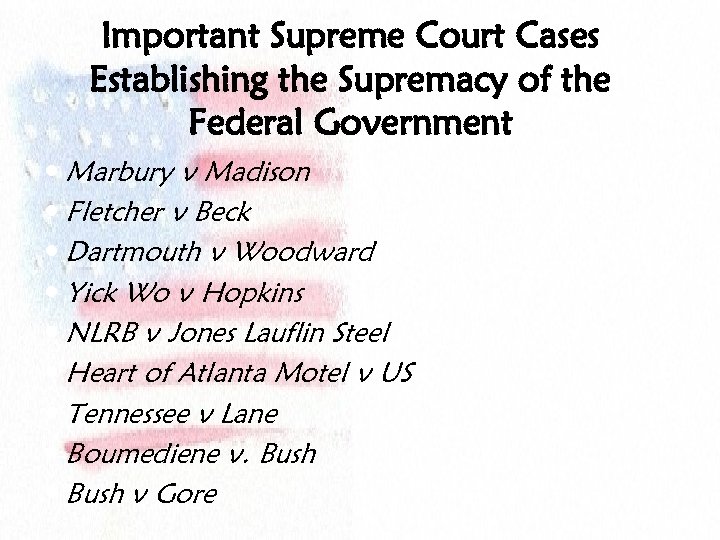 Important Supreme Court Cases Establishing the Supremacy of the Federal Government Marbury v Madison Fletcher v Beck Dartmouth v Woodward Yick Wo v Hopkins NLRB v Jones Lauflin Steel Heart of Atlanta Motel v US Tennessee v Lane Boumediene v. Bush v Gore
 AP Government Case File • Name of case- Date of Decision • Facts of Case– What happened, who won • Importance of Case – How did the Supreme Court decision impact the law, how we live, work… • Unit 2 Case File – Cases that show the growing power of the federal government • Case files will be checked periodically– No Procrastination!!
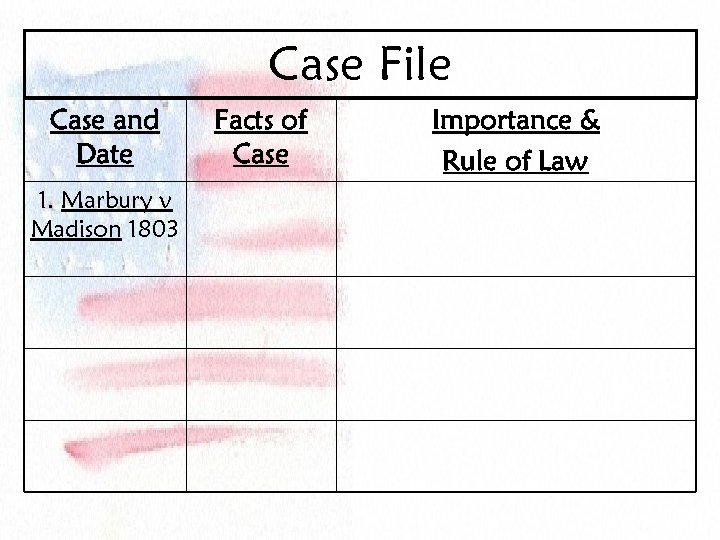 Case File Case and Date 1. Marbury v Madison 1803 Facts of Case Importance & Rule of Law
 Marbury v. Madison (1803) • The Judiciary Act of 1801 gave the president the right to appoint members of the judicial branch. • William Marbury had been commissioned justice of the peace in the District of Columbia by President John Adams in the “midnight appointments” at the very end of his administration. • When the new administration did not deliver the commission, Marbury sued James Madison, Jefferson’s Secretary of State.
 Importance of Case • The Court and Chief Justice John Marshall ruled that a part of the Judiciary Act of 1789 was unconstitutional, thus the appointment was voided. (The BIG winner was the Court and Marshall) • The Court’s decision in Marbury v Madison (1803)established “judicial review”. • Thus the Court could declare acts of Congress, and acts of the president unconstitutional if they exceeded the powers granted by the Constitution.
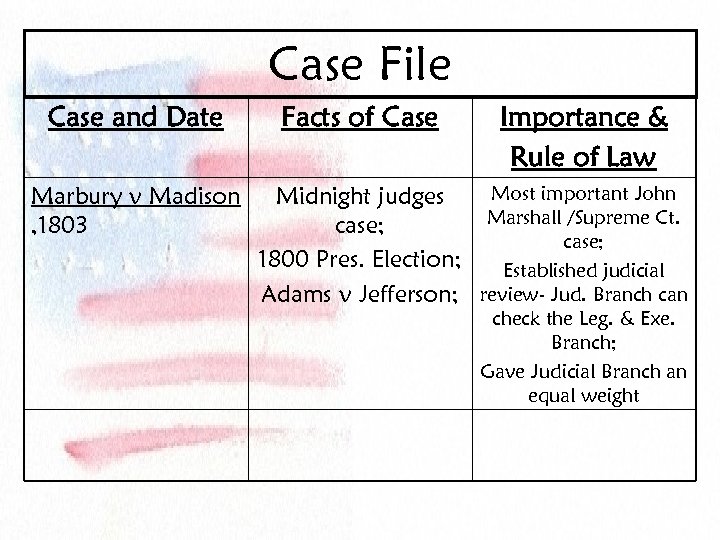 Case File Case and Date Marbury v Madison , 1803 Facts of Case Importance & Rule of Law Most important John Midnight judges Marshall /Supreme Ct. case; 1800 Pres. Election; Established judicial Adams v Jefferson; review- Jud. Branch can check the Leg. & Exe. Branch; Gave Judicial Branch an equal weight
 Fletcher v. Peck (1810) • John Peck purchased land in Georgia that had previously been sold under the 1795 Land Act. • A new GA administration passed a law voiding the land grants made by the previous administration (The Yazoo Land Fraud) • Peck sold this land to Robert Fletcher and in 1803 Fletcher brought suit against Peck, claiming that he did not have clear title to the land when he sold it. • Did Fletcher have a case and the right to the land he bought from Peck?
 Decision and Importance • The Court said YES! • Marshall ruled that the contract had to stand so, Peck’s original contract was held as valid interpreting Article I, Sect 10 of the Constitution to forbid states to declare contracts void. • Importance: Created contract law and invalidated illegal state laws.
 Dartmouth v. Woodward (1815) • Dartmouth College’s charter was granted by King George III in 1769. • In 1815, the legislature of New Hampshire attempted to invalidate Dartmouth's charter in order to convert the school from a private to a public institution. • The trustees of the College objected, and thus sought to have the act of the legislature declared unconstitutional. • Who won? ? ?
 Decision and Importance • Dartmouth won! • The decision was in favor of the college, and invalidated the act of the New Hampshire legislature and allowed Dartmouth to remain a private institution. • Importance: Strengthened the Commerce and Contract clause and limiting the power of the States to interfere with private institutions' charters; protected contracts against specifically state encroachments. – More recently it has had the effect of safeguarding business enterprises from state governments’ dominion.
 Yick Wo v Hopkins-1880 • Facts of the Case • An 1880 ordinance of the city of San Francisco required all laundries in wooden buildings to hold a permit. Although workers of Chinese descent operated 89% of the city's laundry businesses, not a single Chinese owner was granted a permit. • Yick Wo operated a laundry businesses without a permit and, after refusing to pay a $10 fine, was imprisoned by the city.
 Yick Wo v Hopkins • Question • Did the unequal enforcement of the city ordinance violate Yick Wo’s rights under the Equal Protection Clause of the Fourteenth Amendment? What do you think? ? • …or shall any State deprive any person of life, liberty, or property…nor deny to any person within its jurisdiction the equal protection of the laws.
 Importance • In a unanimous opinion the Court concluded that, despite the impartial wording of the law, its biased enforcement violated the Equal Protection Clause of the 14 th Amendment. • According to the Court, even if the law is impartial on its face, "if it is applied and administered by public authority with an evil eye and an unequal hand, so as practically to make unjust and illegal discriminations between persons in similar circumstances, material to their rights, the denial of equal justice is still within the prohibition of the Constitution. "
 NLRB vs. Jones Laulfin Steel (1937) • Jones operated a national-level iron and steel plant. He was accused of discriminatory discharges of its employees for their involvement in union activities. • He was sued by the National Labor Relations Board for unlawfully firing his employees. • Does Congress have the power to enforce the NLRB regulations at Jones’ business?
 Decision and Importance of Case • The Court said, “Yes!” – Congress had the power because of the Commerce Clause. • …“(the employees’ firings) could have “immediate and catastrophic effects on interstate commerce”. • Set precedence for other businesses dealing with labor unions who had to follow federal guidelines.
 Heart of Atlanta Motel vs. United States (1964) • The Heart of Atlanta motel was a large, 216 room motel in Atlanta, GA. which refused to rent rooms to black patrons. • The owner of the motel filed suit in federal court, arguing that the requirements of the Civil Rights Act exceeded the authority granted to Congress over interstate commerce.
 Decision and Importance of Case • The Court said, “NO!” • Why important? -Interstate commerce and public accommodations can not be discriminated – Used often in Civil Rights cases
 Bush v. Gore (2000) Facts of the Case: Following the closely contested 2000 presidential election, the Florida Supreme Court ordered 9000 contested ballots from Miami-Dade County had to be recounted by hand. It also ordered that every county in Florida must immediately begin manually recounting all "undervotes" which did not clearly indicate a vote for president because there were enough contested ballots to place the outcome of the election in doubt. Governor George Bush filed a request for review in the U. S. Supreme Court and sought an emergency petition to reverse the Florida Supreme Court's decision.
 Bush v. Gore (2000) • Questions of Law: 1. Did the decision by the Florida Supreme Court violate Article II Section 1 Clause 2 of the U. S. Constitution by making new election law? 2. Did the “standardless” manual recount of votes violate the Equal Protection and Due Process Clauses of the Constitution?
 Importance In a hotly contested, 5 -4 decision the Supreme Court ruled for presidential candidate George W. Bush 1. Yes , the Florida Supreme Ct. acted incorrectly Noting that the Equal Protection clause guarantees individuals that their ballots cannot be devalued by "later arbitrary and disparate treatment, " the opinion held 7 -2 that the Florida Supreme Court's scheme for recounting ballots was unconstitutional. 2. Yes, the manual recounts were unconstitutional Even if the recount was fair in theory, it was unfair in practice. The record suggested that different standards were applied from ballot to ballot, precinct to precinct, and county to county.
 Tennessee v Lane (2003) • Facts of the Case • George Lane was disabled and could not access upper floors in Tennessee state courthouses. Lane sued Tennessee in federal district court, alleging that by denying him public services based on his disabilities, Tennessee was in violation of Title II of the Americans with Disabilities Act (1990). • According to Title II, no person may be denied access to "services, programs, or activities" on the basis of his disability. The act allows alleged victims of discrimination to sue states for damages.
 Importance • In a 5 -to-4 opinion the Court held that Congress had sufficiently demonstrated the problems faced by disabled persons were protected by the Due Process clause of the 14 th Amendment (such as access to a court). • The Court also emphasized that the remedy required from the states were not unreasonable they just had to make reasonable accommodations to allow disabled persons to exercise their fundamental rights. • Thus, Congress did have the authority under the 14 th Amendment to regulate the actions of the states in this case.
 Boumediene v. Bush (2008): • Facts of the Case: • In 2002 Lakhdar Boumediene and five other Algerian natives were seized by Bosnian police when U. S. intelligence officers suspected their involvement in a plot to attack the U. S. embassy there. The U. S. government classified the men as enemy combatants in the war on terror and detained them at the Guantanamo Bay Naval Base (GITMO), which is located on land that the U. S. leases from Cuba. – They were not given habeas rights or due process rights.
 Boumediene v. Bush (2008): • Questions of Law Are the detainees at Guantanamo Bay entitled to the protection of the Fifth Amendment due process rights and habeas rights ? If so has the U. S. violated the Suspension Clause of the Constitution?
 Importance • Yes to the questions (5 -4 split decision) – The Court ruled in favor of the detainees in each question. – The procedures laid out in the Detainee Treatment Act were not adequate substitutes for the habeas writ. – The detainees were not barred from seeking habeas or invoking the Suspension Clause merely because they had been designated as enemy combatants or held at Guantanamo Bay.
 The Legacy of the U. S. Constitution • The Constitution was created out of a tough-minded political process that demanded hard work, disagreement, compromise, and conflict. • Out of that struggle the modern American nation took shape and would continue to be modified.