


 Скачать презентацию The Two-Teacher Model Teaching Corporate Planning How Did
b0e7108c06c4919135ce3239b3912f6d.ppt
- Количество слайдов: 16
 The Two-Teacher Model: Teaching Corporate Planning How Did We Implement Our CLIL project ? Lic Sc(Econ), Ms (Eng) Lotta Saarikoski , Principal Lecturer in Industrial Economics Dr Eeva Rauto, Senior Lecturer in English VAMK, University of Applied Sciences FL-Medium Studies in Tertiary Education 11. 9. 2007
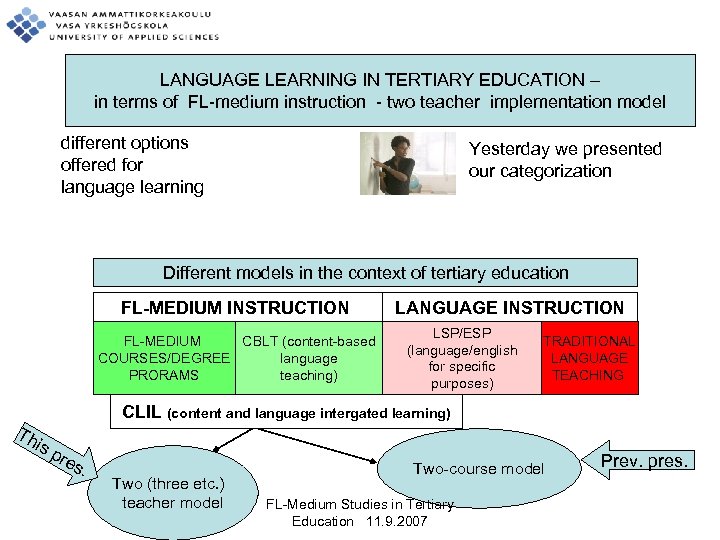 LANGUAGE LEARNING IN TERTIARY EDUCATION – in terms of FL-medium instruction - two teacher implementation model different options offered for language learning Yesterday we presented our categorization Different models in the context of tertiary education FL-MEDIUM INSTRUCTION FL-MEDIUM CBLT (content-based COURSES/DEGREE language PRORAMS teaching) Th LANGUAGE INSTRUCTION LSP/ESP (language/english for specific purposes) TRADITIONAL LANGUAGE TEACHING CLIL (content and language intergated learning) is pre s. Two (three etc. ) teacher model Two-course model FL-Medium Studies in Tertiary Education 11. 9. 2007 Prev. pres.
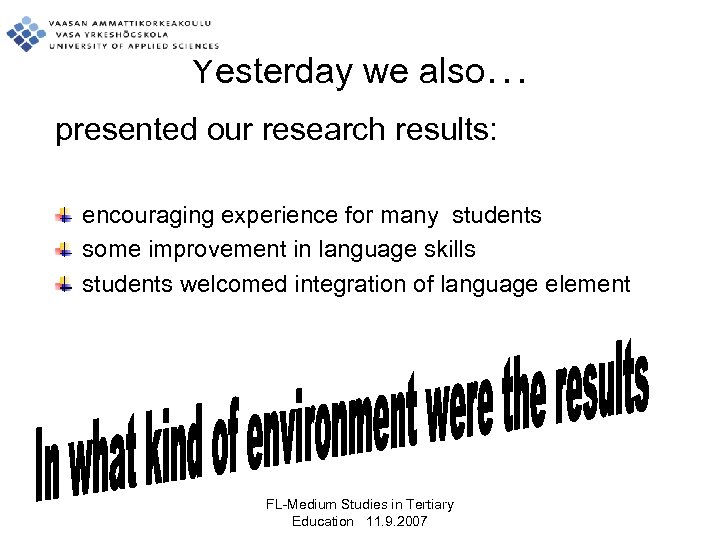 Yesterday we also… presented our research results: encouraging experience for many students some improvement in language skills students welcomed integration of language element FL-Medium Studies in Tertiary Education 11. 9. 2007
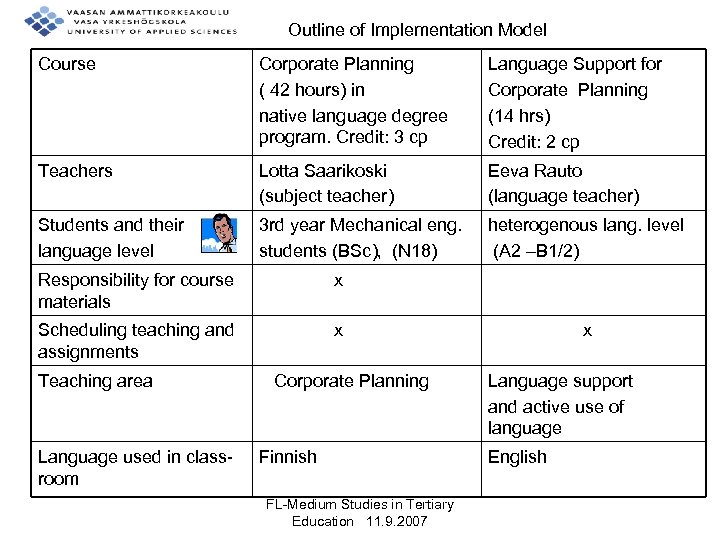 Outline of Implementation Model Course Corporate Planning ( 42 hours) in native language degree program. Credit: 3 cp Language Support for Corporate Planning (14 hrs) Credit: 2 cp Teachers Lotta Saarikoski (subject teacher) Eeva Rauto (language teacher) Students and their language level 3 rd year Mechanical eng. students (BSc), (N 18) heterogenous lang. level (A 2 –B 1/2) Responsibility for course materials x Scheduling teaching and assignments x Teaching area Language used in classroom Corporate Planning Finnish FL-Medium Studies in Tertiary Education 11. 9. 2007 x Language support and active use of language English
 Co-operation between subject teacher (teacher 1) and language teacher (teacher 2) Pre- and post tests for follow-up on language development were planned together. Also surveys were planned together. The text in the course package was divided into suitable sections( 6 sections 6 Language Support sessions). Teacher 1 picked the central texts to be covered by teacher 2 in the Language Support sessions Schedule for Language Support was made. Assignments suitable for each topic to be covered were planned together and inserted in the schedule. The schedule was given to the students in the beginning of the course. (cf. transparency) FL-Medium Studies in Tertiary Education 11. 9. 2007
 Co-operation between subject teacher (teacher 1) and language teacher (teacher 2), cont. Regular follow-up meetings were held every three weeks Students’ opinions were asked and suggestions made by them taken into account The results of the surveys (cf. yesterday’s presentation) were analyzed together and conclusions were made FL-Medium Studies in Tertiary Education 11. 9. 2007
 Course materials: a sample text to show the level of the language Example on transparency Challenge for B 1 European Level (Reading) (cf. the Incomprehensible Input Hypothesis (Braidi 1993) and I+1 Hypothesis (Krashen 1983) FL-Medium Studies in Tertiary Education 11. 9. 2007
 Course materials: a sample text to show the level of the language • Within industry there are certain variables– key success factors…Key success factors are those variables that can affect significantly the overall competitive positions of all companies They are usually determined by the economic and technological characteristics of the indstry and by the competitive weapons on which the firms in the industry have built they strategies. …(Using Key Success Factors to Create an Industry Matrix) • The continued popularity of the functional and process approaches to describe what managers do is a tribute to their clarity and simplisticity. …The emphasis that managers give to the various roles (related to management) seems to change with their organizational level. (Introduction to Management) FL-Medium Studies in Tertiary Education 11. 9. 2007
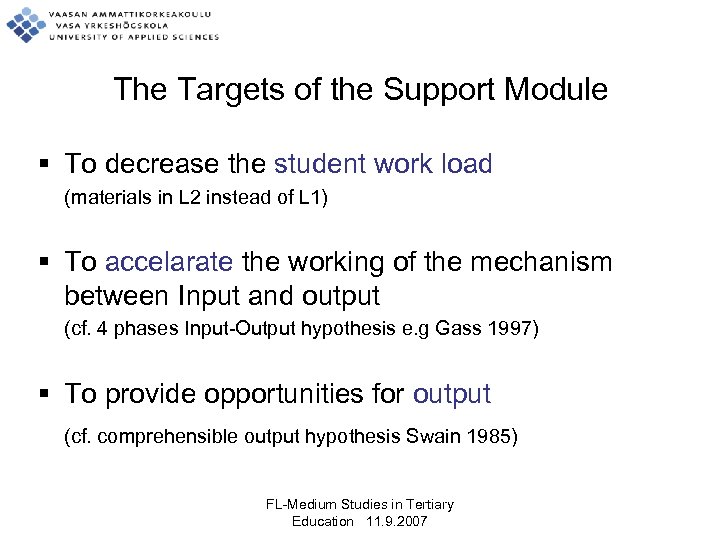 The Targets of the Support Module § To decrease the student work load (materials in L 2 instead of L 1) § To accelarate the working of the mechanism between Input and output (cf. 4 phases Input-Output hypothesis e. g Gass 1997) § To provide opportunities for output (cf. comprehensible output hypothesis Swain 1985) FL-Medium Studies in Tertiary Education 11. 9. 2007
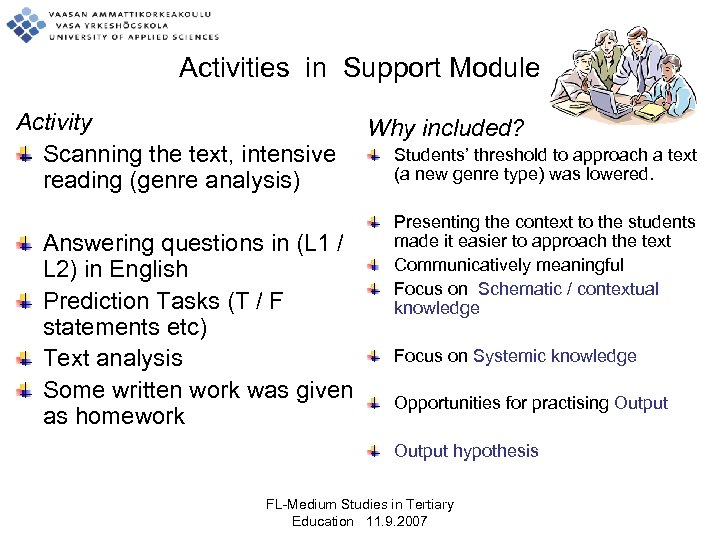 Activities in Support Module Activity Scanning the text, intensive reading (genre analysis) Answering questions in (L 1 / L 2) in English Prediction Tasks (T / F statements etc) Text analysis Some written work was given as homework Why included? Students’ threshold to approach a text (a new genre type) was lowered. Presenting the context to the students made it easier to approach the text Communicatively meaningful Focus on Schematic / contextual knowledge Focus on Systemic knowledge Opportunities for practising Output hypothesis FL-Medium Studies in Tertiary Education 11. 9. 2007
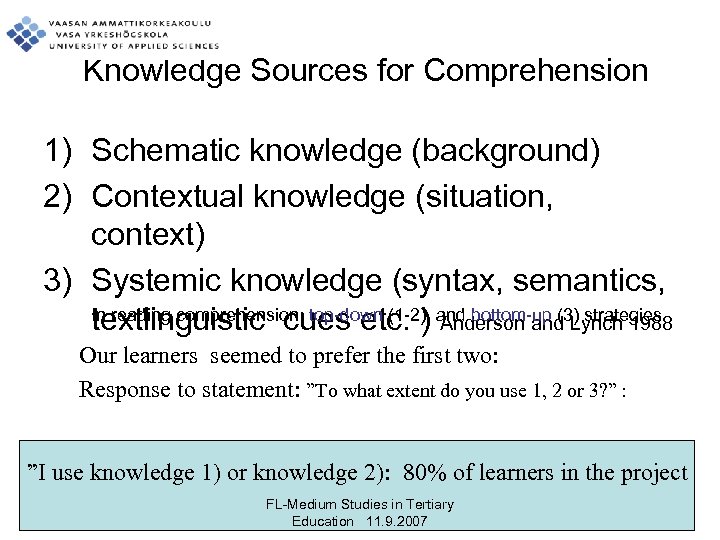 Knowledge Sources for Comprehension 1) Schematic knowledge (background) 2) Contextual knowledge (situation, context) 3) Systemic knowledge (syntax, semantics, In reading comprehension: top-down (1 -2) and bottom-up (3) strategies textlinguistic cues etc. ) Anderson and Lynch 1988 Our learners seemed to prefer the first two: Response to statement: ”To what extent do you use 1, 2 or 3? ” : ”I use knowledge 1) or knowledge 2): 80% of learners in the project FL-Medium Studies in Tertiary Education 11. 9. 2007
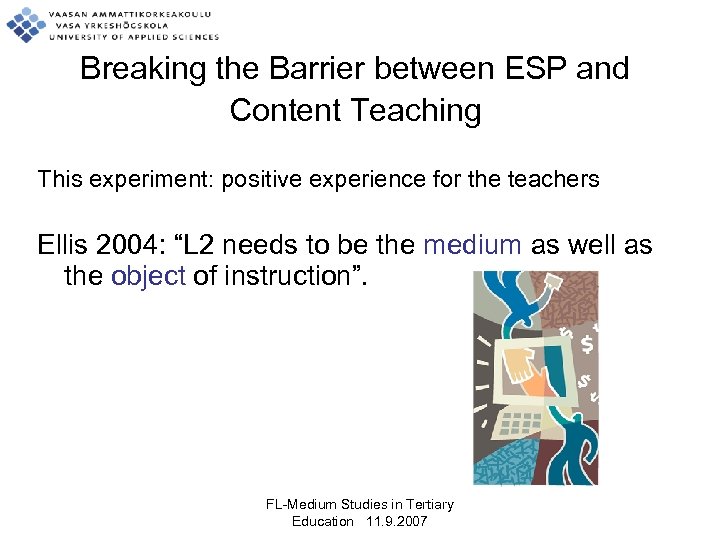 Breaking the Barrier between ESP and Content Teaching This experiment: positive experience for the teachers Ellis 2004: “L 2 needs to be the medium as well as the object of instruction”. FL-Medium Studies in Tertiary Education 11. 9. 2007
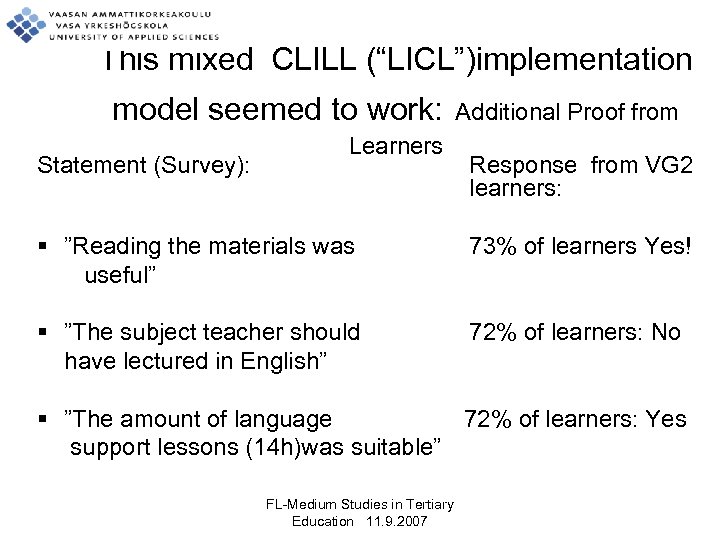 This mixed CLILL (“LICL”)implementation model seemed to work: Statement (Survey): Learners Additional Proof from Response from VG 2 learners: § ”Reading the materials was useful” 73% of learners Yes! § ”The subject teacher should have lectured in English” 72% of learners: No § ”The amount of language 72% of learners: Yes support lessons (14 h)was suitable” FL-Medium Studies in Tertiary Education 11. 9. 2007
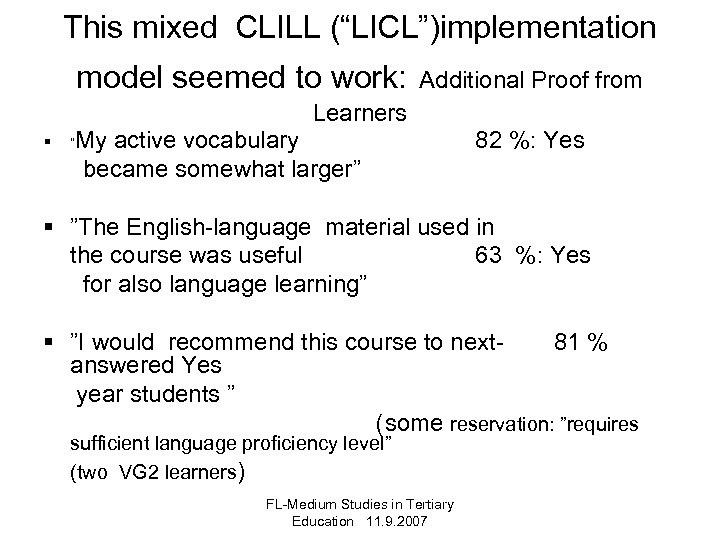 This mixed CLILL (“LICL”)implementation model seemed to work: Additional Proof from Learners § ” My active vocabulary became somewhat larger” 82 %: Yes § ”The English-language material used in the course was useful 63 %: Yes for also language learning” § ”I would recommend this course to next 81 % answered Yes year students ” (some reservation: ”requires sufficient language proficiency level” (two VG 2 learners) FL-Medium Studies in Tertiary Education 11. 9. 2007
 FL-Medium Studies in Tertiary Education 11. 9. 2007
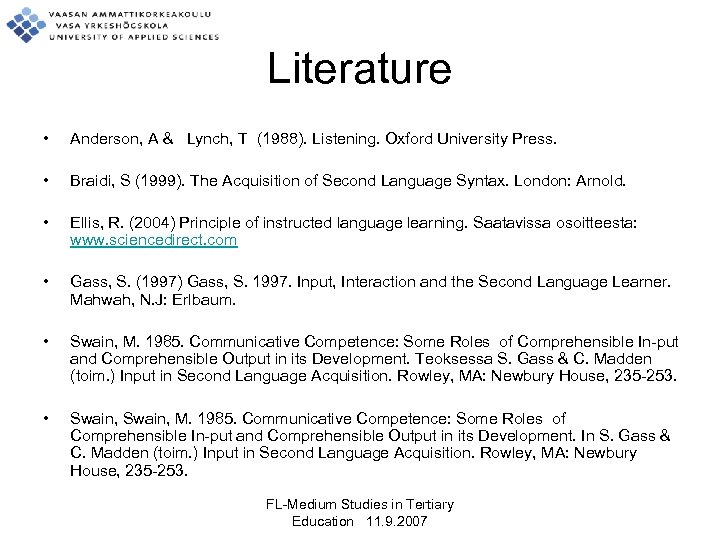 Literature • Anderson, A & Lynch, T (1988). Listening. Oxford University Press. • Braidi, S (1999). The Acquisition of Second Language Syntax. London: Arnold. • Ellis, R. (2004) Principle of instructed language learning. Saatavissa osoitteesta: www. sciencedirect. com • Gass, S. (1997) Gass, S. 1997. Input, Interaction and the Second Language Learner. Mahwah, N. J: Erlbaum. • Swain, M. 1985. Communicative Competence: Some Roles of Comprehensible In put and Comprehensible Output in its Development. Teoksessa S. Gass & C. Madden (toim. ) Input in Second Language Acquisition. Rowley, MA: Newbury House, 235 -253. • Swain, M. 1985. Communicative Competence: Some Roles of Comprehensible In put and Comprehensible Output in its Development. In S. Gass & C. Madden (toim. ) Input in Second Language Acquisition. Rowley, MA: Newbury House, 235 -253. FL-Medium Studies in Tertiary Education 11. 9. 2007