


 Скачать презентацию The Transition to Digital Television Jérôme Adda University
741bfe31c3ee4108a11429f9aa0f82a6.ppt
- Количество слайдов: 39
 The Transition to Digital Television Jérôme Adda University College London Marco Ottaviani London Business School
 Talk Plan 1. 2. 3. 4. 5. Digital television Business and public policy problem Model Data and results Effects of policies on viewers’ incentives
 From Analogue to Digital TV TV platforms: terrestrial, cable, satellite, broadband TV Benefits: digital compression technology allows more efficient use of bandwidth, by a factor of 6 Costs: investment in transmission equipment by broadcasters and in reception equipment by viewers Benefits and costs • are unevenly distributed among players • vary across platforms
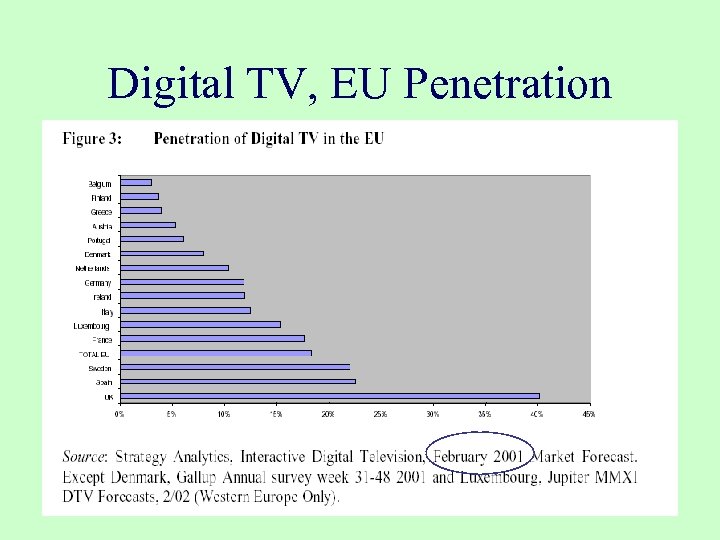 Digital TV, EU Penetration
 Coordination Problem • Viewers’ incentives to migrate from analogue depend on: (i) benefits from additional digital channels (ii) cost of digital reception equipment (‘set top box’ = STB or integrated television sets & aerial upgrade) • Broadcasters make channels available on digital platform if there are many digital viewers • Manufacturers and retailers offer cheap digital equipment if many viewers demand it
 Public Good Problem Broadcasting transmission is a ‘public good’: if one viewer is reached, all viewers are also reached at no additional cost [‘non rivalry’] So, bandwidth (satellite transponder space, terrestrial spectrum) can be freed up only if all analogue viewers have migrated to digital
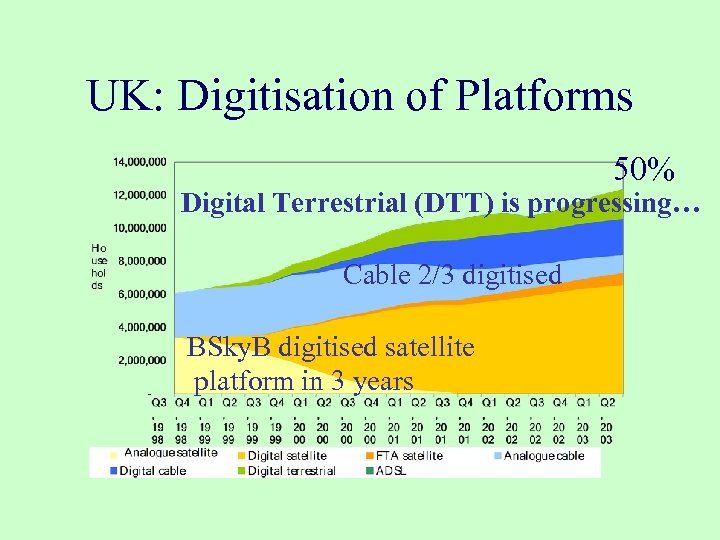 UK: Digitisation of Platforms 50% Digital Terrestrial (DTT) is progressing… Cable 2/3 digitised BSky. B digitised satellite platform in 3 years
 Business Policy In the UK: • Satellite (pay TV) network run by BSky. B – – • Analogue only network up to 1998 Digital & analogue ‘simulcasting’, 1998 -2001 Installed digital STB to all subscribers (free of charge) Analogue signal switched off in 2001 Digital terrestrial – – Pay operator (ITV Digital) subsidised digiboxes 19982002, bankrupt 2002 Now platform run by Freeview, subscription free
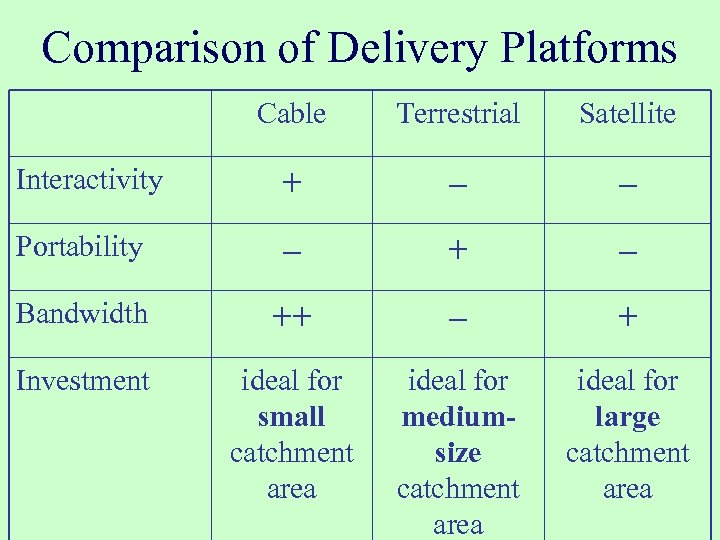 Comparison of Delivery Platforms Cable Terrestrial Satellite Interactivity + – – Portability – + – Bandwidth ++ – + Investment ideal for small catchment area ideal for mediumsize catchment area ideal for large catchment area
 Talk Plan 1. 2. 3. 4. 5. Digital television Business and public policy problem Model Data and results Effects of policies on viewers’ incentives
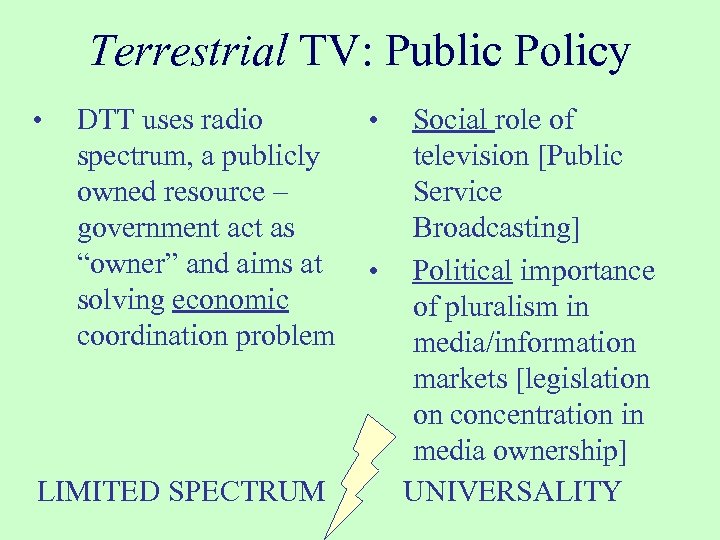 Terrestrial TV: Public Policy • DTT uses radio spectrum, a publicly owned resource – government act as “owner” and aims at solving economic coordination problem LIMITED SPECTRUM • Social role of television [Public Service Broadcasting] • Political importance of pluralism in media/information markets [legislation on concentration in media ownership] UNIVERSALITY
![Terrestrial Spectrum Constraint Limited amount of spectrum [e. g. , 368 MHz in UK]](https://present5.com/presentation/741bfe31c3ee4108a11429f9aa0f82a6/image-12.jpg "Terrestrial Spectrum Constraint Limited amount of spectrum [e. g. , 368 MHz in UK]") Terrestrial Spectrum Constraint Limited amount of spectrum [e. g. , 368 MHz in UK] that can be used for analogue & digital TV • Population coverage of DTT [to 2/3] is limited until analogue switched off • Power of DTT is limited until switch off, requiring often additional investment on antenna Ø Trade off between number of analogue and digital channels and population coverage
Terrestrial Spectrum Constraint Limited amount of spectrum [e. g. , 368 MHz in UK] that can be used for analogue & digital TV • Population coverage of DTT [to 2/3] is limited until analogue switched off • Power of DTT is limited until switch off, requiring often additional investment on antenna Ø Trade off between number of analogue and digital channels and population coverage
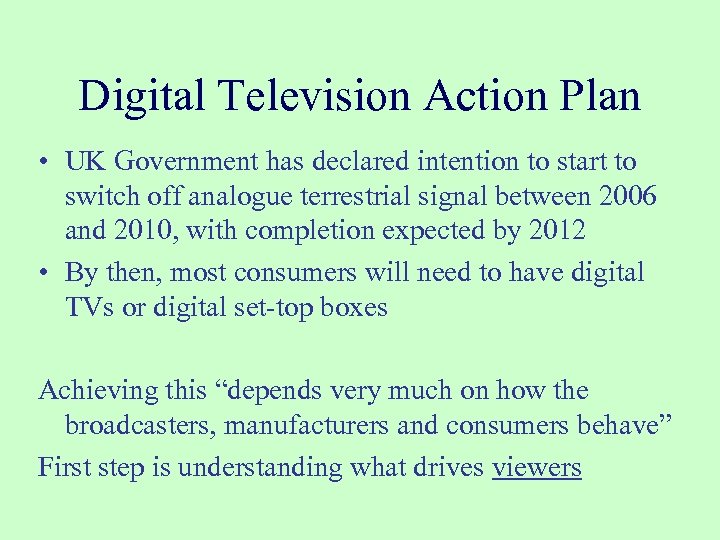 Digital Television Action Plan • UK Government has declared intention to start to switch off analogue terrestrial signal between 2006 and 2010, with completion expected by 2012 • By then, most consumers will need to have digital TVs or digital set-top boxes Achieving this “depends very much on how the broadcasters, manufacturers and consumers behave” First step is understanding what drives viewers
 Talk Plan 1. 2. 3. 4. 5. Digital television Business and public policy problem Model Data and results Effects of policies on viewers’ incentives
 Purpose of Model • built to predict numbers of viewers who adopt different TV platforms • over time • depending on exogenous market and policy parameters Framework for considering policy effects
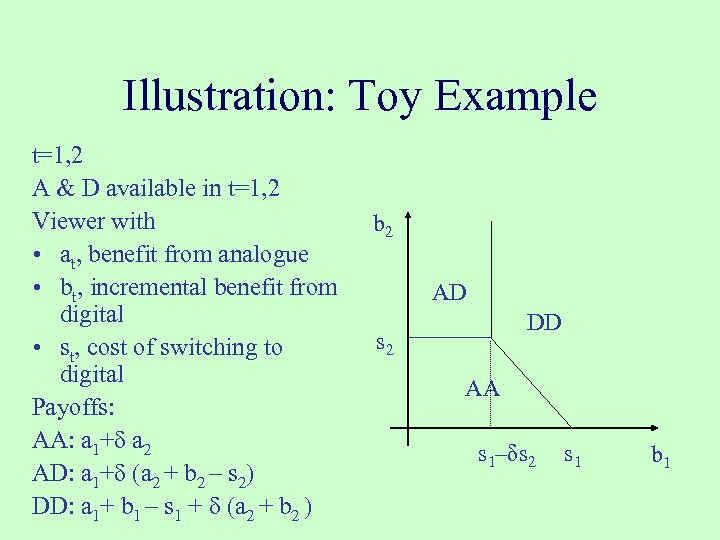 Illustration: Toy Example t=1, 2 A & D available in t=1, 2 Viewer with • at, benefit from analogue • bt, incremental benefit from digital • st, cost of switching to digital Payoffs: AA: a 1+δ a 2 AD: a 1+δ (a 2 + b 2 – s 2) DD: a 1+ b 1 – s 1 + δ (a 2 + b 2 ) b 2 AD DD s 2 AA s 1–δs 2 s 1 b 1
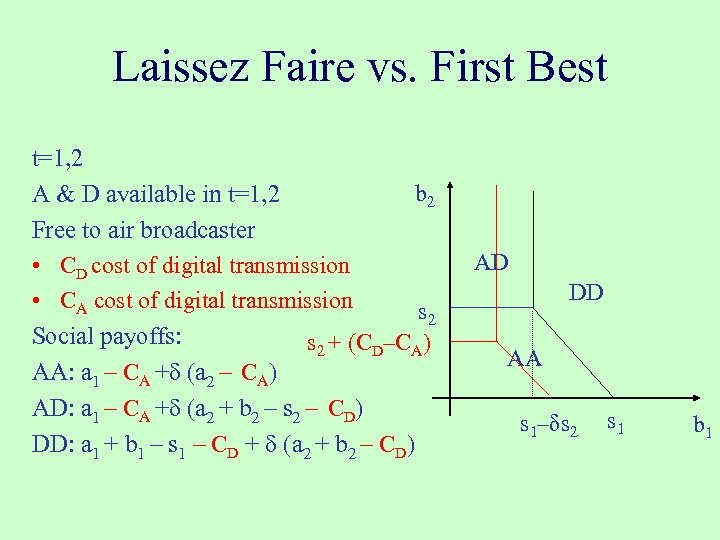 Laissez Faire vs. First Best t=1, 2 b 2 A & D available in t=1, 2 Free to air broadcaster • CD cost of digital transmission • CA cost of digital transmission s 2 Social payoffs: s 2 + (CD–CA) AA: a 1 – CA +δ (a 2 – CA) AD: a 1 – CA +δ (a 2 + b 2 – s 2 – CD) DD: a 1 + b 1 – s 1 – CD + δ (a 2 + b 2 – CD) AD DD AA s 1–δs 2 s 1 b 1
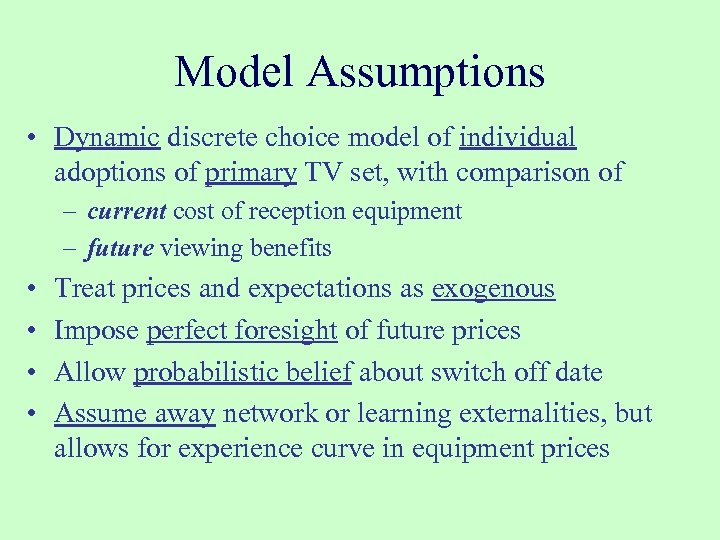 Model Assumptions • Dynamic discrete choice model of individual adoptions of primary TV set, with comparison of – current cost of reception equipment – future viewing benefits • • Treat prices and expectations as exogenous Impose perfect foresight of future prices Allow probabilistic belief about switch off date Assume away network or learning externalities, but allows for experience curve in equipment prices
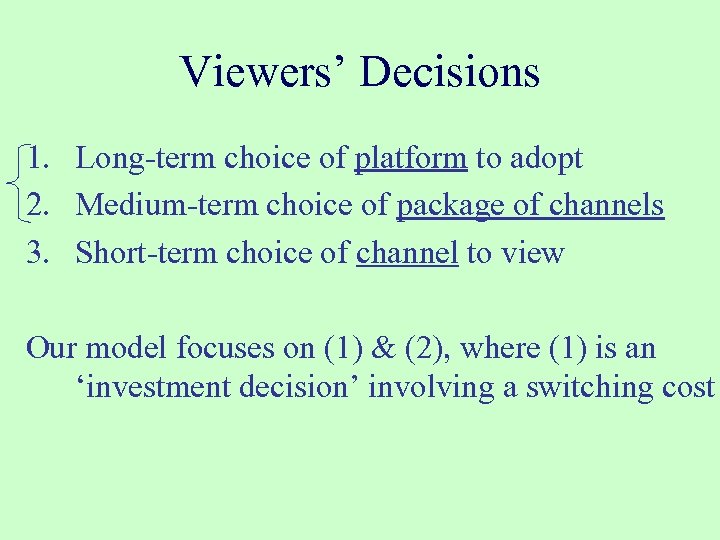 Viewers’ Decisions 1. Long-term choice of platform to adopt 2. Medium-term choice of package of channels 3. Short-term choice of channel to view Our model focuses on (1) & (2), where (1) is an ‘investment decision’ involving a switching cost
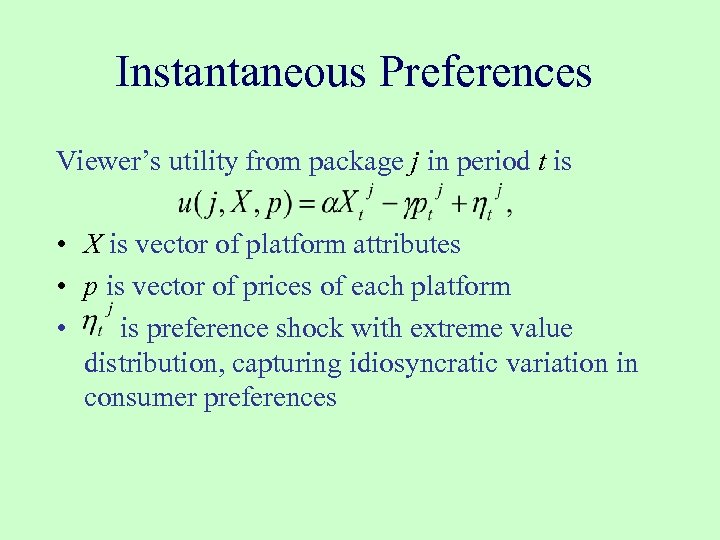 Instantaneous Preferences Viewer’s utility from package j in period t is • X is vector of platform attributes • p is vector of prices of each platform • is preference shock with extreme value distribution, capturing idiosyncratic variation in consumer preferences
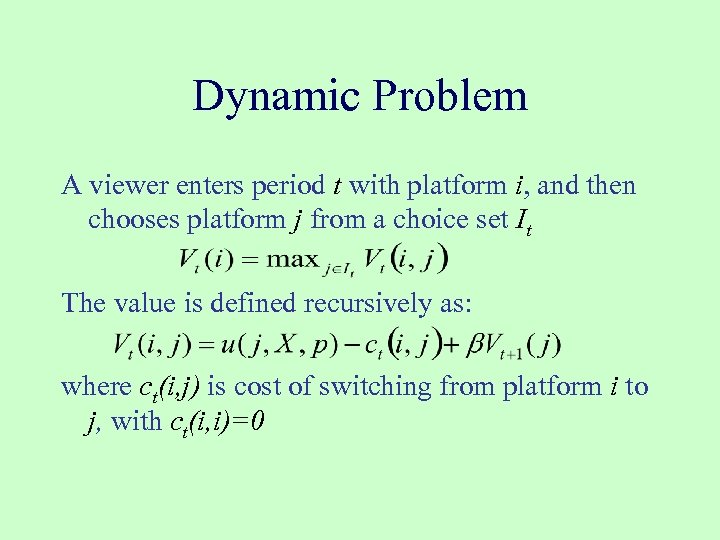 Dynamic Problem A viewer enters period t with platform i, and then chooses platform j from a choice set It The value is defined recursively as: where ct(i, j) is cost of switching from platform i to j, with ct(i, i)=0
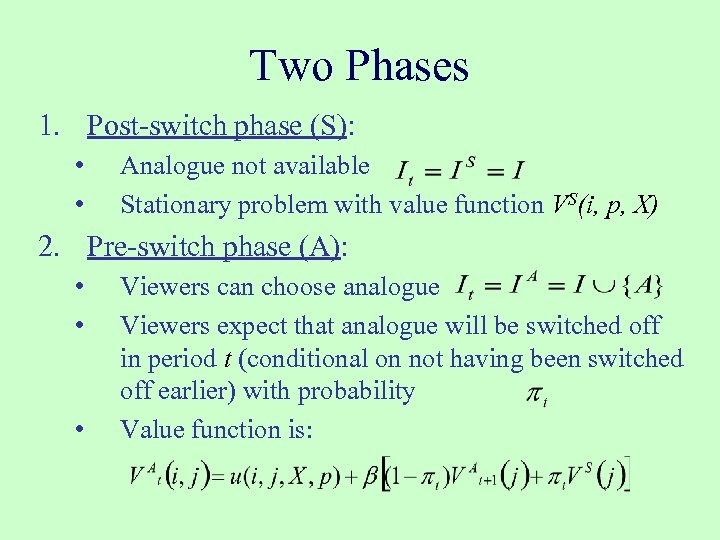 Two Phases 1. Post-switch phase (S): • • Analogue not available Stationary problem with value function VS(i, p, X) 2. Pre-switch phase (A): • • • Viewers can choose analogue Viewers expect that analogue will be switched off in period t (conditional on not having been switched off earlier) with probability Value function is:
 Talk Plan 1. 2. 3. 4. 5. What is digital television? Why should we economists care? Purpose of our model Data and results Effects of policies on viewers’ incentives
 Data • Survey data with stated preferences for television by UK consumers • 434 individuals’ choices in up to 40 different scenarios • In total 16, 010 observation
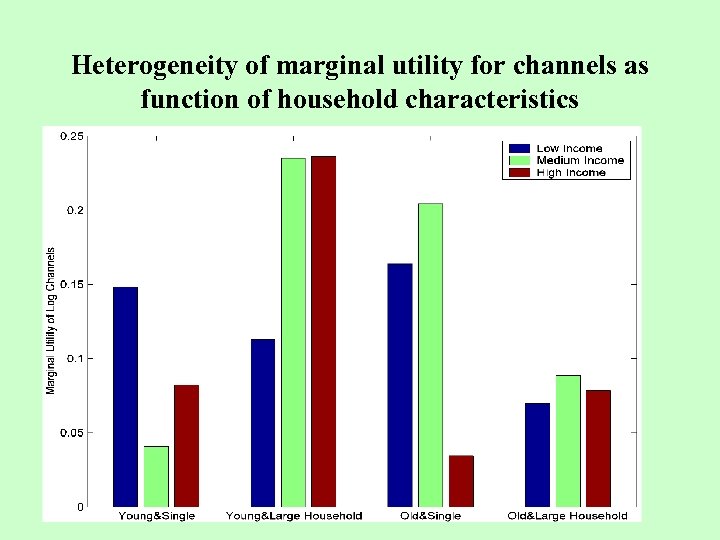 Heterogeneity of marginal utility for channels as function of household characteristics
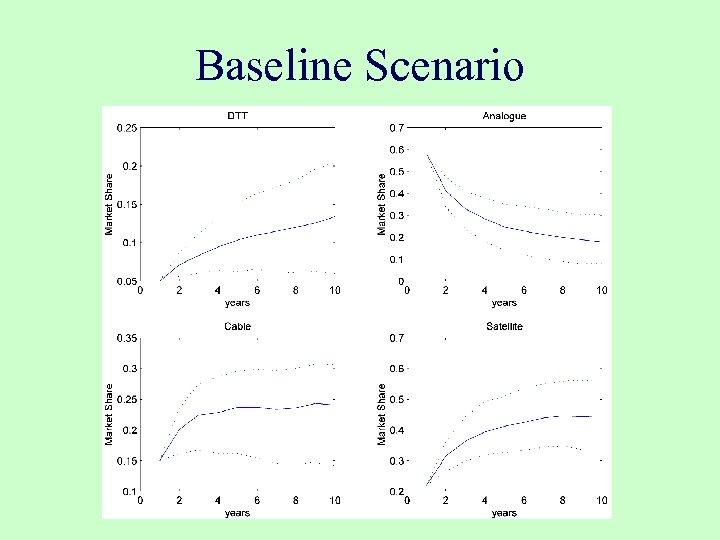 Baseline Scenario
 Talk Plan 1. 2. 3. 4. 5. What is digital television? Why should we economists care? Model Data and results Effects of policies on viewers’ incentives
 Policy Alternatives • A firm switch off date has been adopted in Berlin • The UK has increased the number of channels available on the DTT platform as well as its coverage • Subsidies to low-income have been given to low income households in Berlin • Pay-television content might be made available on the French DTT platform • Subsidies have been introduced in Italy • Digital equipment has been mandated in the US
 UK: September 1999 Announcement The Government is committed to ensuring that terrestrial analogue broadcasting signals are maintained until: • Everyone who can currently get the main public service broadcasting channels in analogue form (BBC 1 and 2, ITV, Channel 4/S 4 C and Channel 5) can receive them on digital systems; • Switching to digital is an affordable option for the vast majority of people; • As a target indicator of affordability, 95% of consumers have access to digital equipment.
 Timing Issue “The switch over process could start to happen as early as 2006 and be completed by 2010, depending on the progress made by broadcasters and manufactures, and the interests of consumers being served. ” Question: What is the effect of credible announcement of switch off in 2010?
 Firm Commitment to Switch off Simulations show that: • Almost all viewers (more than 95%) will adopt digital TV before switch off, if they perceive switch off to be inevitable in 2010 Reason: • Preference for television is very strong, so very few viewers will opt out of television to save the cost of set top box… Firm commitment to switch off date should work
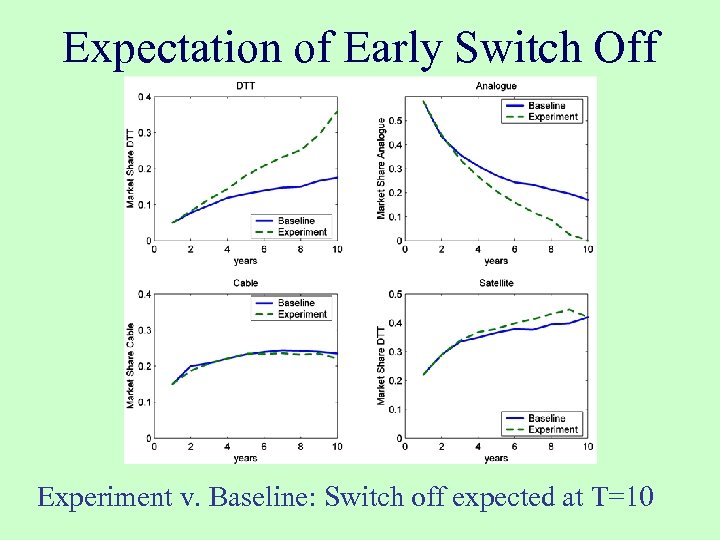 Expectation of Early Switch Off Experiment v. Baseline: Switch off expected at T=10
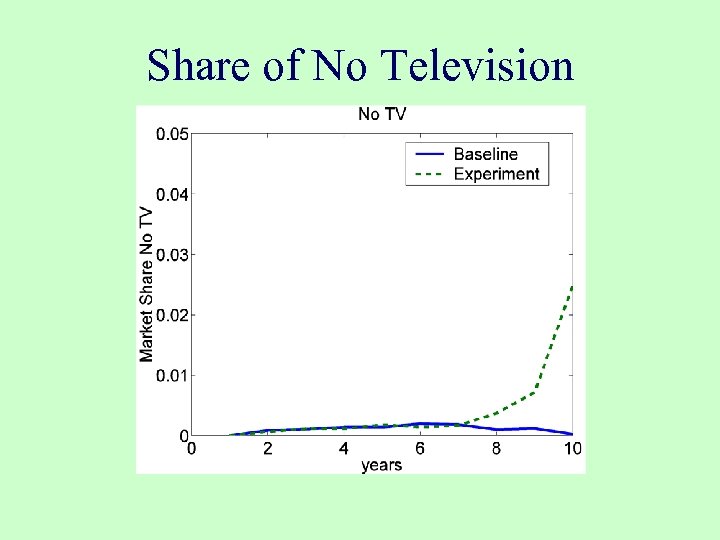 Share of No Television
 Conditional Switch off Policy With switch off conditional on meeting 95% criterion, multiple equilibria result. In one equilibrium, switch off takes place at T=10. In another equilibrium, there is no switch off at T=10. 1. The “switch off at T=10” equilibrium survives. 2. There is also a “no switch off at T=10” equilibrium in which consumers expect no switch off: – Given that consumers expect that analogue will not be switched off, (at least 5% of) consumers will not buy set top boxes – 95% criterion will not be met at time of switch off – So, there will be no switch off
 Other Policies If firm commitment to switch off is not politically feasible, other policies to speed up adoption: • Increase quality of digital channels • Give subsidies to STB • Give coupons/rebates on TV licences to lowincome families or old viewers
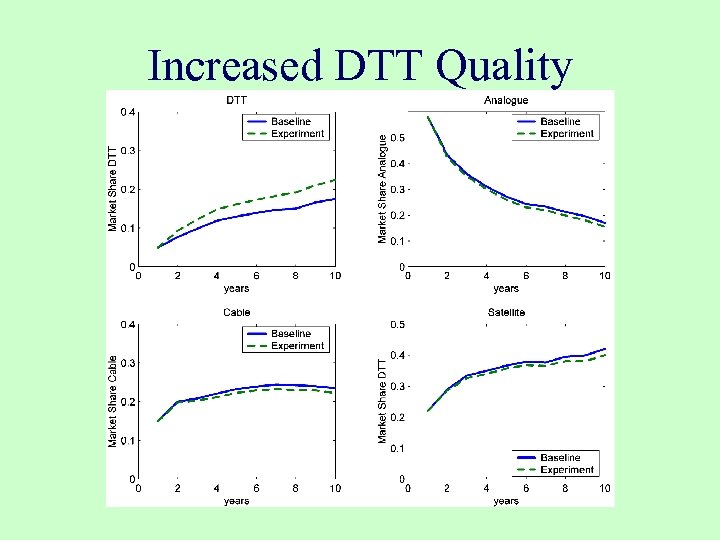 Increased DTT Quality
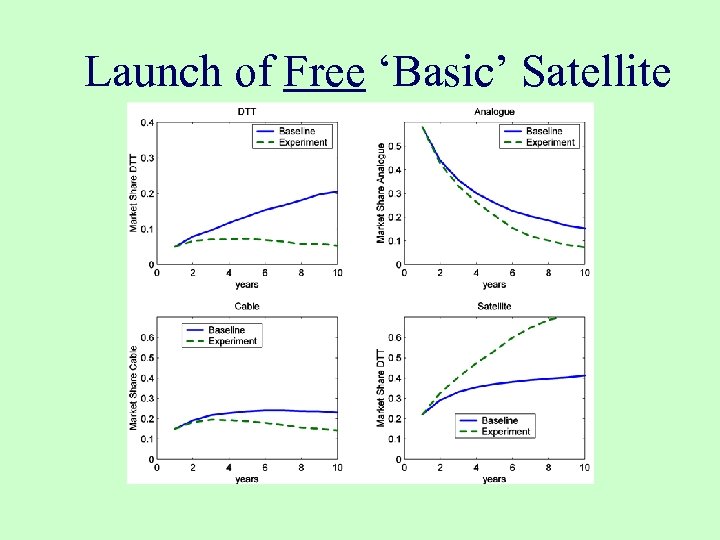 Launch of Free ‘Basic’ Satellite
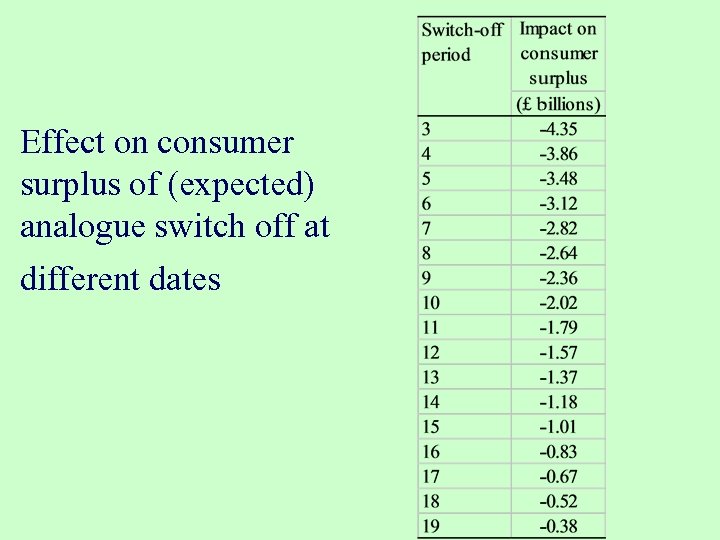 Effect on consumer surplus of (expected) analogue switch off at different dates
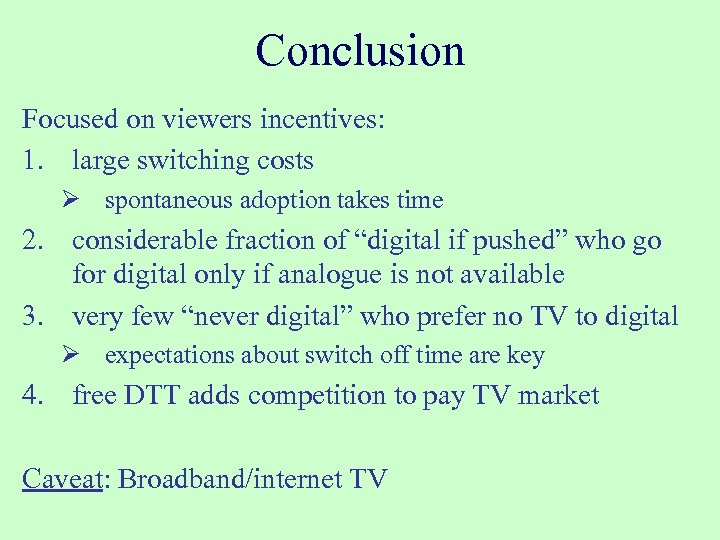 Conclusion Focused on viewers incentives: 1. large switching costs Ø spontaneous adoption takes time 2. considerable fraction of “digital if pushed” who go for digital only if analogue is not available 3. very few “never digital” who prefer no TV to digital Ø expectations about switch off time are key 4. free DTT adds competition to pay TV market Caveat: Broadband/internet TV