 Скачать презентацию The Top IS Job Chapter 2 Information Systems
317c480c2fea3a62bc15b5ad4191af1b.ppt
- Количество слайдов: 54



The Top IS Job Chapter 2 Information Systems Management in Practice 8 th Edition © 2009 Pearson Education, Inc. Publishing as Prentice Hall 2 -1
Today’s Lecture l l Introduction Where is the IS organization headed? l l The escalating benefits of information technology Traditional functions are being “nibbled away” New roles are emerging Toward “IS Lite” © 2009 Pearson Education, Inc. Publishing as Prentice Hall 2 -2
Today’s Lecture cont’d l The CIO’s responsibilities l CIO’s roles in 3 eras l Leading § l Governing § l Establishing an IS Governance Structure Investing § l Creating a vision by understanding the business Shaping the IT portfolio Managing § Establishing credibility and fostering change © 2009 Pearson Education, Inc. Publishing as Prentice Hall 2 -3
Today’s Lecture cont’d l l l The Office of the CIO Whither CIOs Conclusion Questions and Exercises References © 2009 Pearson Education, Inc. Publishing as Prentice Hall 2 -4
Introduction l l Growing demand for IT managers in the U. S. and worldwide. Management of IT in past 50 years has drastically changed. l l Basic functioning cost reduction decision support inter-organizational supply-chain and “business eco-system” Onus on top executives to provide IT vision and leadership. © 2009 Pearson Education, Inc. Publishing as Prentice Hall 2 -5
Where is the IS organization headed? © 2009 Pearson Education, Inc. Publishing as Prentice Hall 2 -6
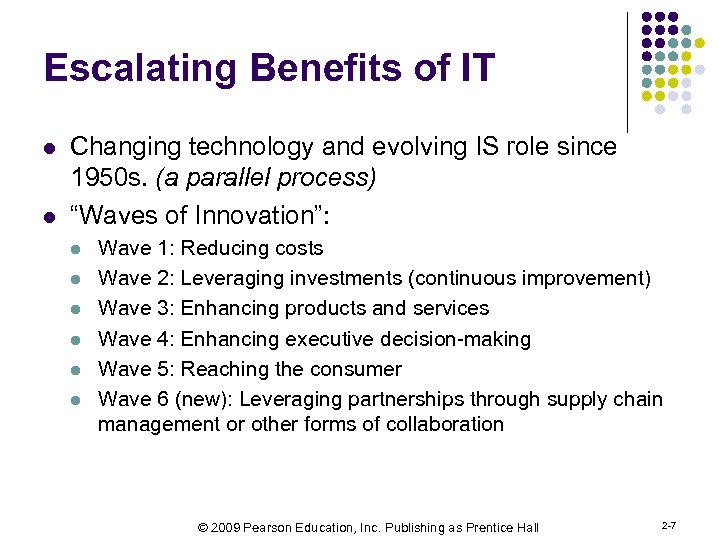
Escalating Benefits of IT l l Changing technology and evolving IS role since 1950 s. (a parallel process) “Waves of Innovation”: l l l Wave 1: Reducing costs Wave 2: Leveraging investments (continuous improvement) Wave 3: Enhancing products and services Wave 4: Enhancing executive decision-making Wave 5: Reaching the consumer Wave 6 (new): Leveraging partnerships through supply chain management or other forms of collaboration © 2009 Pearson Education, Inc. Publishing as Prentice Hall 2 -7
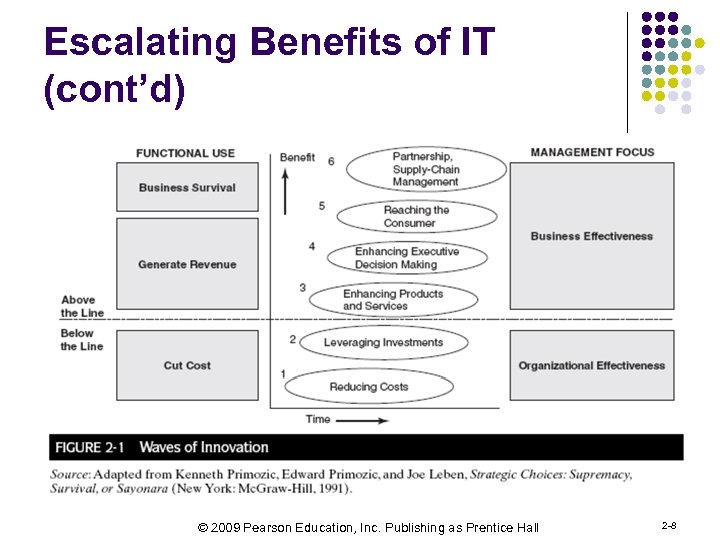
Escalating Benefits of IT (cont’d) © 2009 Pearson Education, Inc. Publishing as Prentice Hall 2 -8
The SABRE System (American Airlines) l Case example of “Waves of Innovation” l l Evolution: Handwritten reservation system (1950 s) to Web-based system (2000 s). Waves 1 and 2 (1960 s) l l l SABRE (CRS) built to reduce costs of making airline seat reservations. ROI on staff expenditure. Wave 3 (1970 s) l System enhanced to span organizational boundary for travel agents (provide direct access to CRS) © 2009 Pearson Education, Inc. Publishing as Prentice Hall 2 -9
The SABRE System (American Airlines) cont’d l Wave 4 (late 1980 s) l l Wave 5 (1990 s) l l Revenue Management System (provide decision support to managers) under SABRE Airline Solutions (new division). System extended to provide direct Web access to customers (CRS, flight information, movie etc. ) Wave 6 (2000 s) l Sabre (small letters) spun off from AMR in 2000, leveraged partnerships and technology. © 2009 Pearson Education, Inc. Publishing as Prentice Hall 2 -10
The SABRE System (American Airlines) cont’d l Throughout waves of innovation, strong IS involvement was crucial. l Evolving with changes in technology l l From money-making to extending organizational boundaries to spinning off. So what is the function of the IS organization? © 2009 Pearson Education, Inc. Publishing as Prentice Hall 2 -11
Traditional Functions are Being Nibbled Away l Traditional set of responsibilities for IS l l l Managing operations of data centers, local and remote systems and networks Managing corporate data and legacy systems Performing system analysis and design and constructing new systems Planning and integration of systems Identifying opportunities for new systems © 2009 Pearson Education, Inc. Publishing as Prentice Hall 2 -12
Traditional Functions are Being Nibbled Away cont’d l Trends that are moving traditional roles out of IS: l Distributed Systems l l l Ever more knowledgable users Better application packages l l Migration of software applications to user areas Systems development to integration Outsourcing l Based on fiscal and managerial considerations © 2009 Pearson Education, Inc. Publishing as Prentice Hall 2 -13
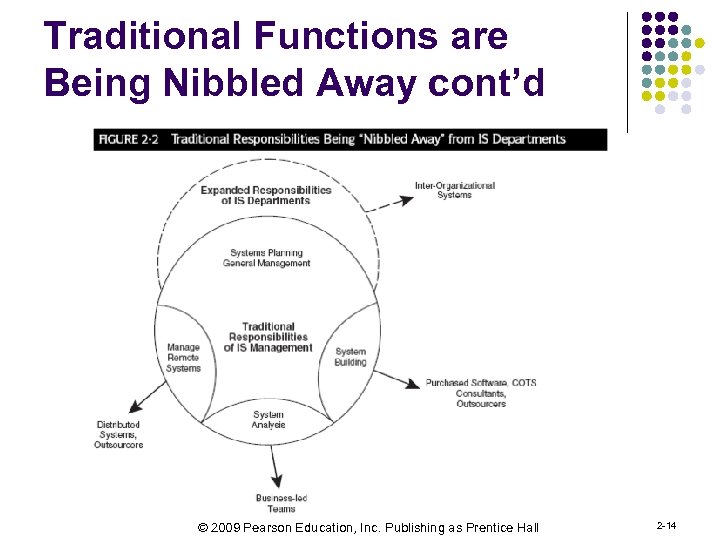
Traditional Functions are Being Nibbled Away cont’d © 2009 Pearson Education, Inc. Publishing as Prentice Hall 2 -14
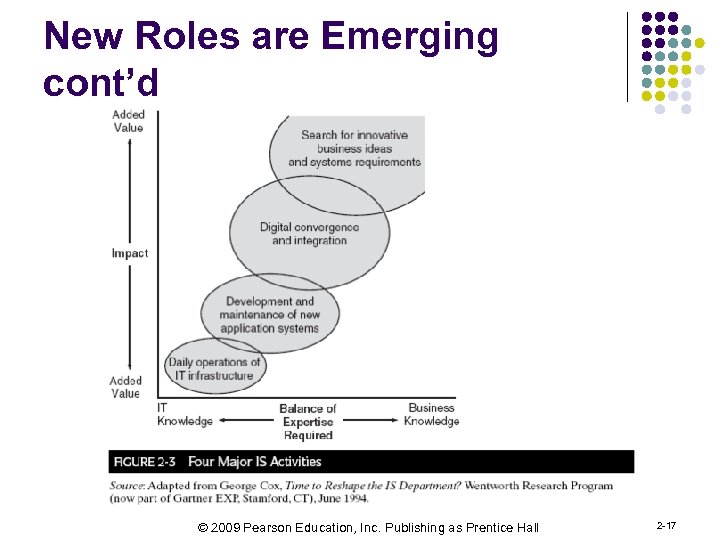
New Roles are Emerging l IS involves a cluster of functions: l l l Run operations Develop systems Develop architecture Identify business requirements Create IT-enabled innovations © 2009 Pearson Education, Inc. Publishing as Prentice Hall 2 -15
New Roles are Emerging cont’d l Different set of skills and management strategy needed for each function: l l Maximize efficiencies of IT operations Better allocation of IT personnel time Prioritize resources to demonstrate usefulness of new software projects IT-enabled business innovations © 2009 Pearson Education, Inc. Publishing as Prentice Hall 2 -16
New Roles are Emerging cont’d © 2009 Pearson Education, Inc. Publishing as Prentice Hall 2 -17
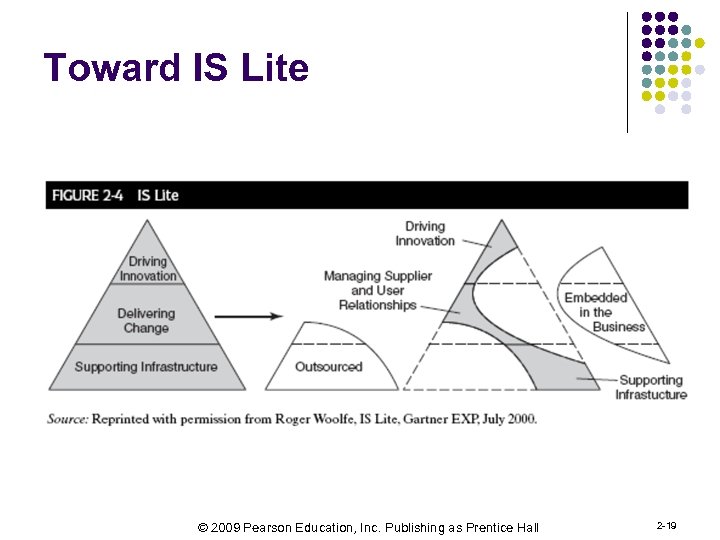
Toward IS Lite l IS started “centralized” and then evolved into “federal” model. l l Some things (e. g standards, operations) centralized Others (e. g. applications development) dispersed to best meet local needs. Solution: shift attention from roles to processes IS Lite: managing three overall processes l l l Driving innovation (dispersed) Managing change (dispersed) Supporting infrastructure (centralized) © 2009 Pearson Education, Inc. Publishing as Prentice Hall 2 -18
Toward IS Lite © 2009 Pearson Education, Inc. Publishing as Prentice Hall 2 -19
Life. Scan l Case example: The “Federal” Model l Johnson and Johnson subsidiary New CIO with business-IS alignment agenda 3 -stage framework that is focused on execution and performance measurement (value, on time, budget) © 2009 Pearson Education, Inc. Publishing as Prentice Hall 2 -20
Life. Scan cont’d l Strong project management, not allowing scope creep (business value, on time, within budget) l l l Emphasis on staff with leadership and brokering skills Outsourcing (Tata, J&J outsourcing agreements) Adopt J&J quality-driven culture into IS processes and working closely with business units for alignment every step of the way. Centralization of policies, procedures etc. All IS projects business led and locally owned by business units. © 2009 Pearson Education, Inc. Publishing as Prentice Hall 2 -21
The CIO’s Responsibilities l Evolution of CIO’s job emphasis over last 20 years l Almost like a “bell curve” l l 80 s: Chief architect (strategic use of IT) 90 s: addressing business issues (more than technology manager) Late 90 s to early 2000 s (forefront role) Mid 2000 s onwards: slide back toward back seat-more responsibilities, lots of justification and less $ © 2009 Pearson Education, Inc. Publishing as Prentice Hall 2 -22
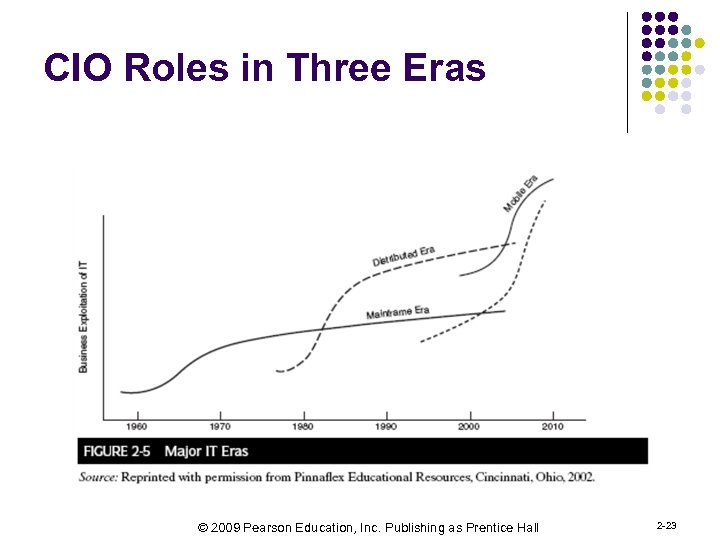
CIO Roles in Three Eras © 2009 Pearson Education, Inc. Publishing as Prentice Hall 2 -23
CIO Roles in Three Eras l The Mainframe Era l l l Predominated 1960 s – early ’ 80 s Role of DP / IS manager = operational manager of a specialist function Distributed Era l l l In the ’ 80 s as PCs become commonplace LANs and WANs linking computers Took on 4 more roles: l Organizational designer l Technology advisor l Technology architect l Informed buyer © 2009 Pearson Education, Inc. Publishing as Prentice Hall 2 -24
CIO Roles in Three Eras l The Web Era l l Started in the mid-1990 s for some Arose from the emergence of the Internet (especially WWW) as a business tool Era is still in “infancy” but add to the CIOs job, the role of business visionary Relationship between CEO and CIO vary along a wide spectrum. © 2009 Pearson Education, Inc. Publishing as Prentice Hall 2 -25
CIO Roles Today l Leading l l Governing l l Establishing an IS governance structure Investing l l Creating vision by understanding the business Shaping the IT portfolio Managing l Establishing credibility, managing IT functions, and fostering change © 2009 Pearson Education, Inc. Publishing as Prentice Hall 2 -26
Leading: Creating vision by understanding the business l Understanding the business l l l l Encourage project teams to study the marketplace Concentrate on lines of business Sponsor weekly briefings Attend industry meetings with line executives Read industry publications Hold informal listening sessions Partner with a line executive © 2009 Pearson Education, Inc. Publishing as Prentice Hall 2 -27
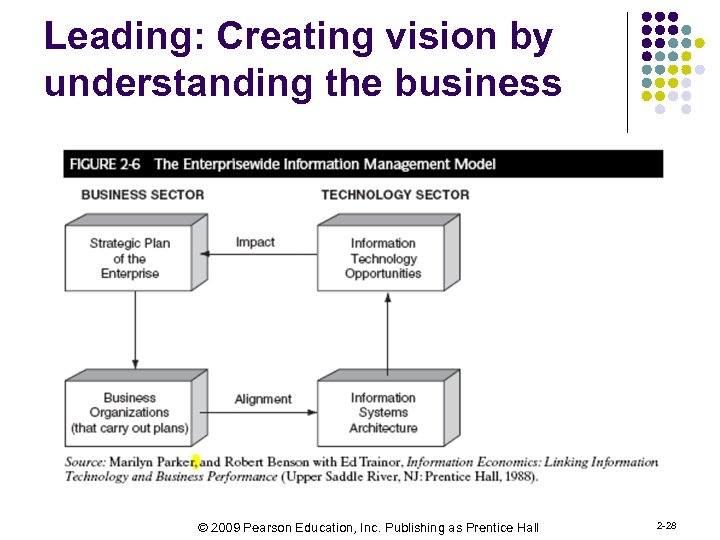
Leading: Creating vision by understanding the business © 2009 Pearson Education, Inc. Publishing as Prentice Hall 2 -28
Leading: Creating vision by understanding the business l Creating a vision of the future and selling it l CIO must be proactive and not simply reactive l l What is a vision? l l Statement of perceived future Why develop a vision? l l A leader not a follower A vision of a desirable future can provide stability when it sets a direction for an organization Selling the vision © 2009 Pearson Education, Inc. Publishing as Prentice Hall 2 -29
British Petroleum (BP) l Case example of creating a vision of the future and selling it l 150 business units in 100 countries l l Each with own balance sheet and performance criteria Need to reconcile business unit independence with overarching HQ strategy (“speed matters”) l l Strong core values and operational excellence How can IT be a value-add? © 2009 Pearson Education, Inc. Publishing as Prentice Hall 2 -30
British Petroleum (BP) l John Leggate’s “Digital Business” vision. l l l Technology provider to strategy-creation role Strategy, architecture, differentiated services based on business streams (processes) Living on the Web Socializing technical directions (adoption) Going forward: Foster learning and focus on explanation (assimilation) © 2009 Pearson Education, Inc. Publishing as Prentice Hall 2 -31
Leading: Creating vision by understanding the business l Creating a vision of the future and selling it (cont’d) l Encouraging champions of IT projects l l l “Boundary-spanner-in-practice” Typically someone with authority Need information Need resources Need support © 2009 Pearson Education, Inc. Publishing as Prentice Hall 2 -32
Aetna Life and Casualty l Case example of creating a vision of the future and selling it l l l Vision: “breakthrough technologies” Sought out business champions Pilot studies l l l Feedback for new technologies experimentation Steering Committees Challenges l l Adoption (attention and use) Value (beyond piecemeal payoffs) © 2009 Pearson Education, Inc. Publishing as Prentice Hall 2 -33
Governing: Establishing an IS governance structure l Definition: IS Governance l l “The assignment of decision rights and the accountability framework to encourage behavior in the use of IT. ” (Weill & Woodham, 2002) Governance versus management l l Governance is about deciding who makes decisions. Management is about making decisions once decision rights have been assigned. © 2009 Pearson Education, Inc. Publishing as Prentice Hall 2 -34
Governing: Establishing an IS governance structure l Importance of corporate IT governance l l Large and diverse IT assets Striking a balance between global and local needs IT portfolio (in sync with business needs) Assigning decision rights l Governance style l l Definition: who has a decision right and input right. Six governance styles © 2009 Pearson Education, Inc. Publishing as Prentice Hall 2 -35
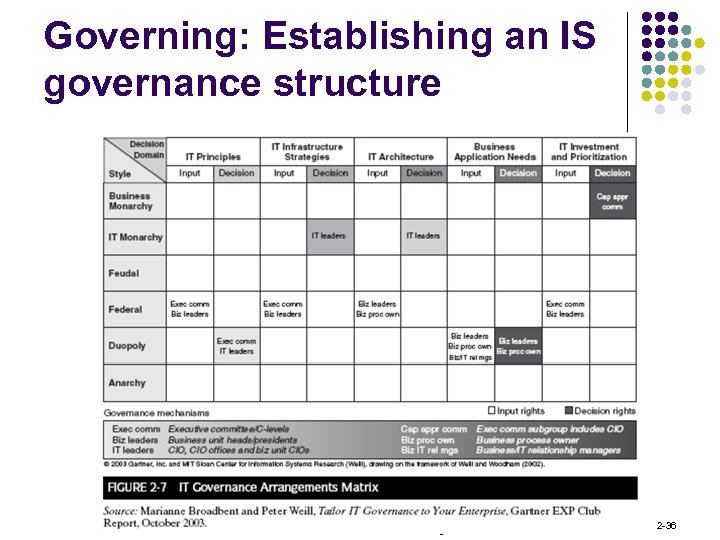
Governing: Establishing an IS governance structure © 2009 Pearson Education, Inc. Publishing as Prentice Hall 2 -36
Duke Energy International l Case example of IS governance l l Diverse portfolio of natural gas and electric supply, delivery and trading businesses. CIO: “When am I free to decide on my own versus when should I involve others? ” l l l I involve others if the consequences of my actions will come to bear on those others. I do not involve others if the consequences of my actions will come to bear just on me. I inform others when the consequences of my actions will be of benefit to others. © 2009 Pearson Education, Inc. Publishing as Prentice Hall 2 -37
Investing: Shaping the IT Portfolio l l Diminishing marginal increase today but still preposterous amount of IT investments. Two perspectives in IT investment: l Strategic view l l What to invest in? Tactical view l How to make investment decisions? © 2009 Pearson Education, Inc. Publishing as Prentice Hall 2 -38
Investing: Shaping the IT Portfolio l A Strategic view of making IT investments l Mc. Kinsey Global Institute study of “new economy” l l Targeting IT investments l l IT, competition, innovation and productivity in virtuous circle Prioritizing on “levers that matter” = greatest productivity Timing of IT investments l Based on company needs and goals © 2009 Pearson Education, Inc. Publishing as Prentice Hall 2 -39
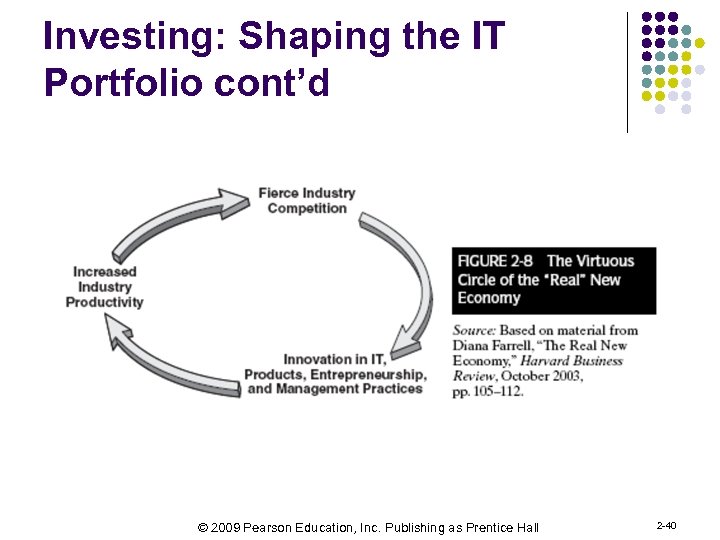
Investing: Shaping the IT Portfolio cont’d © 2009 Pearson Education, Inc. Publishing as Prentice Hall 2 -40
Investing: Shaping the IT Portfolio l Sequencing of IT investments l l Wal-mart versus Kmart case example Complementing IT investments l l “The whole is not the sum of its parts” (synergy) Complementarities between management practices, business processes and technology © 2009 Pearson Education, Inc. Publishing as Prentice Hall 2 -41
Wal-mart versus Kmart l Case example: Sequencing and timing IT investments l Wal-mart l l Step 1: installed systems to automate the flow of products in its internal supply chain Step 2: turned outward to suppliers, coordinating its own operations with theirs Step 3: turned to customers to better plan its merchandising mix and replenishment Step 4: data warehouse © 2009 Pearson Education, Inc. Publishing as Prentice Hall 2 -42
Wal-mart versus Kmart l l l Mistake: used IT to target its marketing promotions versus investing in supply chain Result: increase in demand from successful promotions could not be met due to problems getting the products into stores in a timely fashion. Result: lost sales and revenues © 2009 Pearson Education, Inc. Publishing as Prentice Hall 2 -43
Investing: Shaping the IT Porfolio cont’d l A tactical view of making IT investments l l Portfolio (holistic) approach to deciding on how to make IT investment decisions. Numerous approaches to prioritizing l l Business Scorecards 80 -20 Principle Cost-Benefit analysis (CBA) Net Present Value (NPV) © 2009 Pearson Education, Inc. Publishing as Prentice Hall 2 -44
AXA Financial l Case example of tactical view of making IT investments l l French global financial services organization with 140, 000 employees and managing $795 billion in assets. New governance methodology (beyond IT) l l l Economics-informed investments (precludes emotional attachment or other non-financial factors) Modeled after fund management Governance committee involve all C-level executives © 2009 Pearson Education, Inc. Publishing as Prentice Hall 2 -45
Investing: Shaping the IT Portfolio cont’d l l l Benefits from Discussions Categorizing projects for comparisons Address project risks Prioritize quarterly and apportion your budget accordingly Consistency (team decision-making) © 2009 Pearson Education, Inc. Publishing as Prentice Hall 2 -46
Managing: Establishing Credibility and Fostering Change l l CIOs must first establish credibility in IS before change can come about. Establishing Credibility l l l Focus first and foremost on the “today” even before talking about the “tomorrow” Deliver value-added, quality services First impression matters © 2009 Pearson Education, Inc. Publishing as Prentice Hall 2 -47
Managing: Establishing Credibility and Fostering Change l l Technical aspects only half the battle Emphasis on change management l l Changing the way people work, bringing it to the next level Disruptive to current work practices § l Leads to resistance Methodologies to implement IT-enabled change © 2009 Pearson Education, Inc. Publishing as Prentice Hall 2 -48
Managing: Establishing Credibility and Fostering Change l Working across organizational lines l CIOs now find that systems they implement affect people outside their firm boundaries l l Arms-length to more cordial relationship with partners (suppliers and customers) Change need buy-in from these external stakeholders © 2009 Pearson Education, Inc. Publishing as Prentice Hall 2 -49
REXAM l Case example of working across organizational lines l l One of the world’s top 5 consumer packaging companies and the world’s top drink can maker Rethinking interactions with customers (B 2 B) l l l Leverage Internet to deliver “exceptional service” “Knock their socks off” Result: cash flow improvements, barriers to switching, profit increase © 2009 Pearson Education, Inc. Publishing as Prentice Hall 2 -50
REXAM cont’d l CIO’s role l External and business-oriented § l Steering Committee’s role l l Convincing existing customers and business development Firm-wide commitment from C-level executives for expanded e-business initiatives envisioned by CIO. Online catalogue © 2009 Pearson Education, Inc. Publishing as Prentice Hall 2 -51
The Office of the CIO l Chief Information Officer (CIO) l l Chief Technology Officer (CTO) l l IT planning, architecture, new technologies Chief Operations Officer (COO) l l Top management, customers, suppliers Daily IS operations Chief Project Officer (CPO) l Projects management © 2009 Pearson Education, Inc. Publishing as Prentice Hall 2 -52
Conclusion: Recap l Why does the IS organization exist? l l What is the role of the IS organization? l l l Constant factor in parallel process of technological changes and IS evolution Changing across the timeline toward IS Lite CIO’s job How does the IS organization perform its job l Strategies © 2009 Pearson Education, Inc. Publishing as Prentice Hall 2 -53
All rights reserved. No part of this publication may be reproduced, stored in a retrieval system, or transmitted, in any form or by any means, electronic, mechanical, photocopying, recording, or otherwise, without the prior written permission of the publisher. Printed in the United States of America. Copyright © 2009 Pearson Education, Inc. Publishing as Prentice Hall © 2009 Pearson Education, Inc. Publishing as Prentice Hall 2 -54
Скачать презентацию The Top IS Job Chapter 2 Information Systems
317c480c2fea3a62bc15b5ad4191af1b.ppt