


 Скачать презентацию The Time Value of Money n n n
9a645b0d35b189a211b5cb914a9d6dd7.ppt
- Количество слайдов: 28
 The Time Value of Money n n n Time Value of Money Concept Future and Present Values of single payments Future and Present values of periodic payments (Annuities) Present value of perpetuity Future and Present values of annuity due Annual Percentage Yield (APY) 1
 The Time Value of Money Concept n n We know that receiving $1 today is worth more than $1 in the future. This is due to opportunity costs The opportunity cost of receiving $1 in the future is the interest we could have earned if we had received the $1 sooner 2
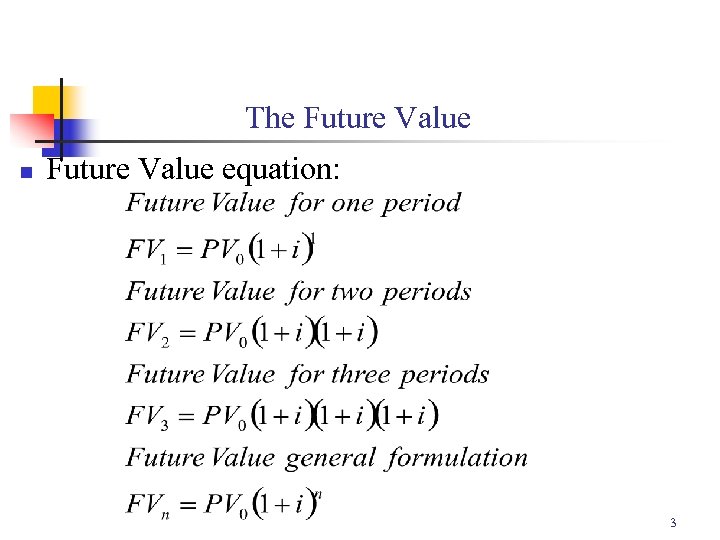 The Future Value n Future Value equation: 3
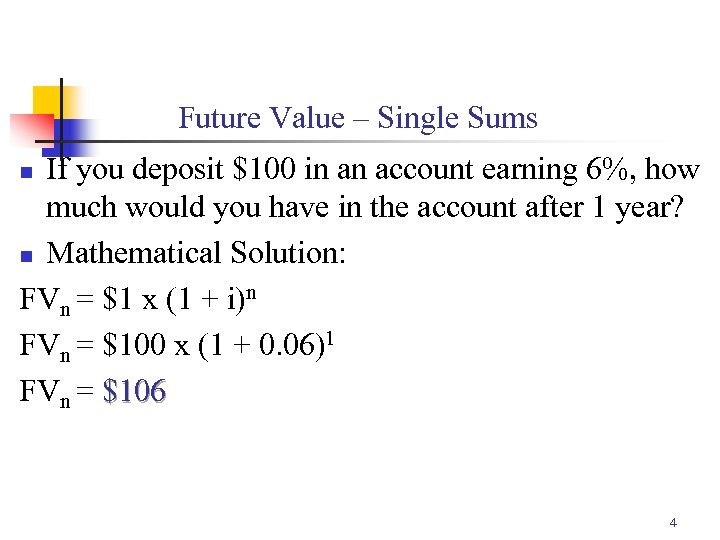 Future Value – Single Sums If you deposit $100 in an account earning 6%, how much would you have in the account after 1 year? n Mathematical Solution: FVn = $1 x (1 + i)n FVn = $100 x (1 + 0. 06)1 FVn = $106 n 4
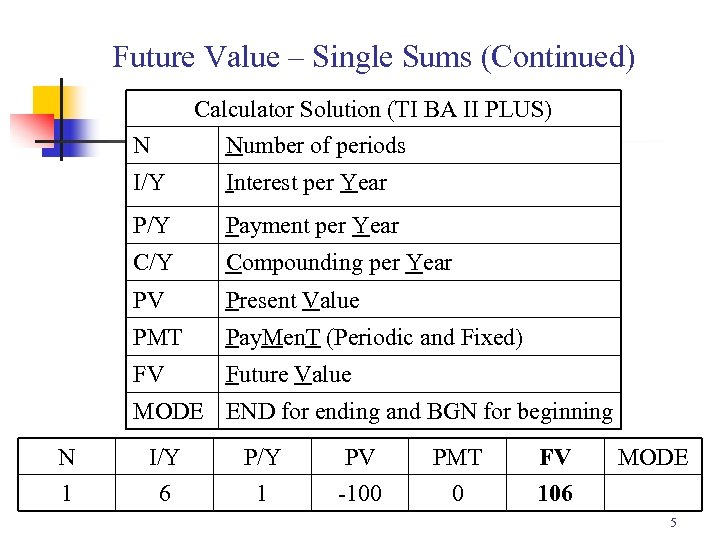 Future Value – Single Sums (Continued) N Calculator Solution (TI BA II PLUS) Number of periods I/Y Interest per Year P/Y Payment per Year C/Y Compounding per Year PV Present Value PMT Pay. Men. T (Periodic and Fixed) FV Future Value MODE END for ending and BGN for beginning N 1 I/Y 6 P/Y 1 PV -100 PMT 0 FV 106 MODE 5
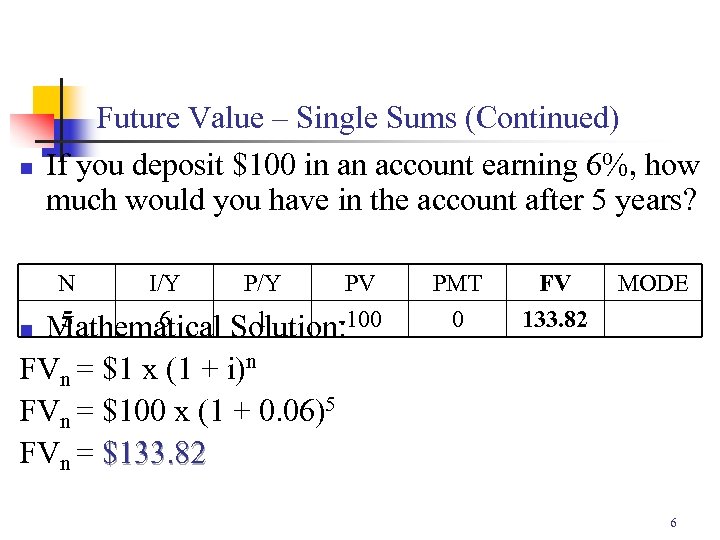 n Future Value – Single Sums (Continued) If you deposit $100 in an account earning 6%, how much would you have in the account after 5 years? N I/Y PV 5 6 1 -100 n Mathematical Solution: PMT 0 FV 133. 82 MODE FVn = $1 x (1 + i)n FVn = $100 x (1 + 0. 06)5 FVn = $133. 82 6
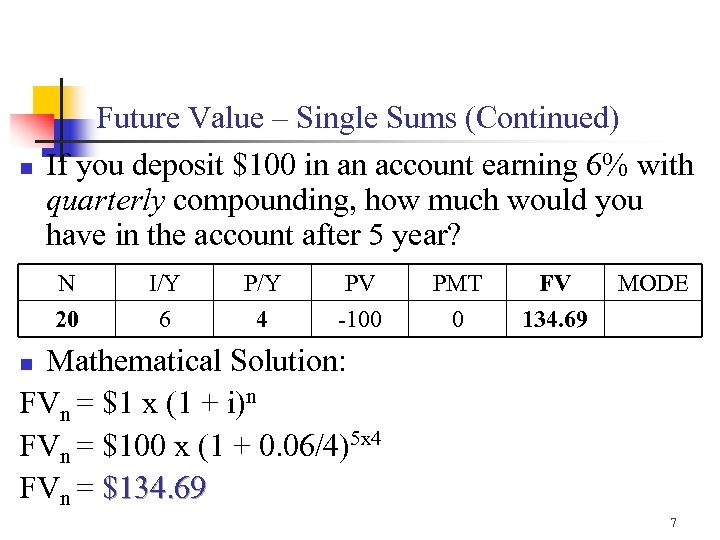 n Future Value – Single Sums (Continued) If you deposit $100 in an account earning 6% with quarterly compounding, how much would you have in the account after 5 year? N 20 I/Y 6 P/Y 4 PV -100 PMT 0 FV 134. 69 MODE Mathematical Solution: FVn = $1 x (1 + i)n FVn = $100 x (1 + 0. 06/4)5 x 4 FVn = $134. 69 n 7
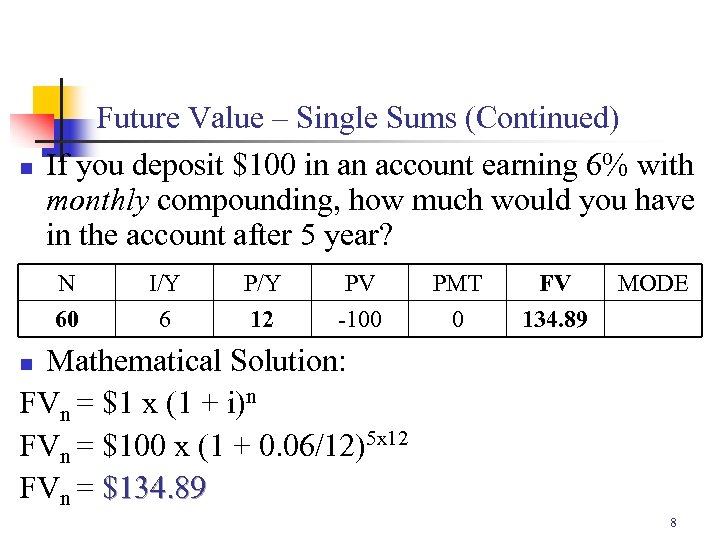 n Future Value – Single Sums (Continued) If you deposit $100 in an account earning 6% with monthly compounding, how much would you have in the account after 5 year? N 60 I/Y 6 P/Y 12 PV -100 PMT 0 FV 134. 89 MODE Mathematical Solution: FVn = $1 x (1 + i)n FVn = $100 x (1 + 0. 06/12)5 x 12 FVn = $134. 89 n 8
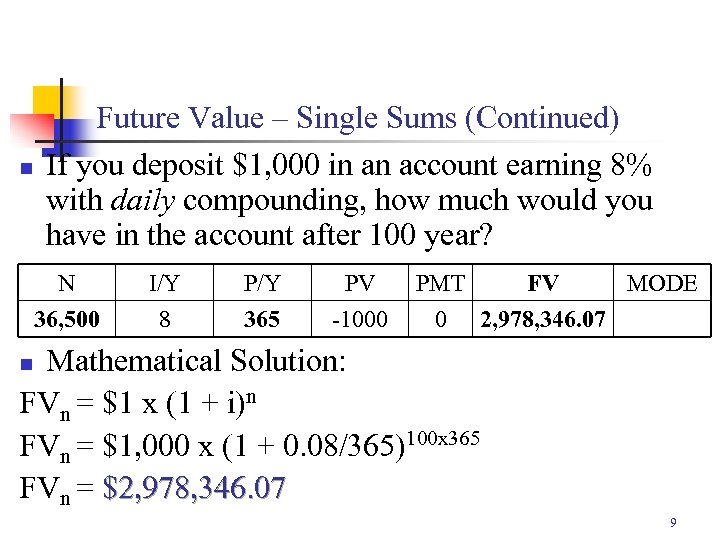 n Future Value – Single Sums (Continued) If you deposit $1, 000 in an account earning 8% with daily compounding, how much would you have in the account after 100 year? N 36, 500 I/Y 8 P/Y 365 PV -1000 PMT FV MODE 0 2, 978, 346. 07 Mathematical Solution: FVn = $1 x (1 + i)n FVn = $1, 000 x (1 + 0. 08/365)100 x 365 FVn = $2, 978, 346. 07 n 9
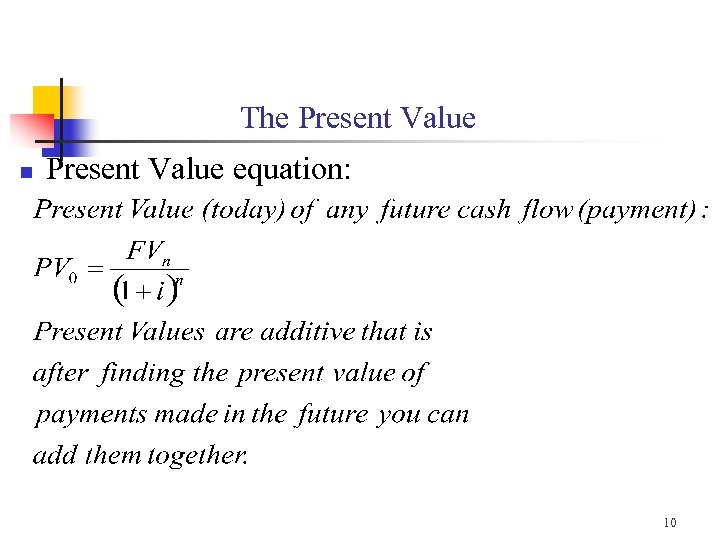 The Present Value n Present Value equation: 10
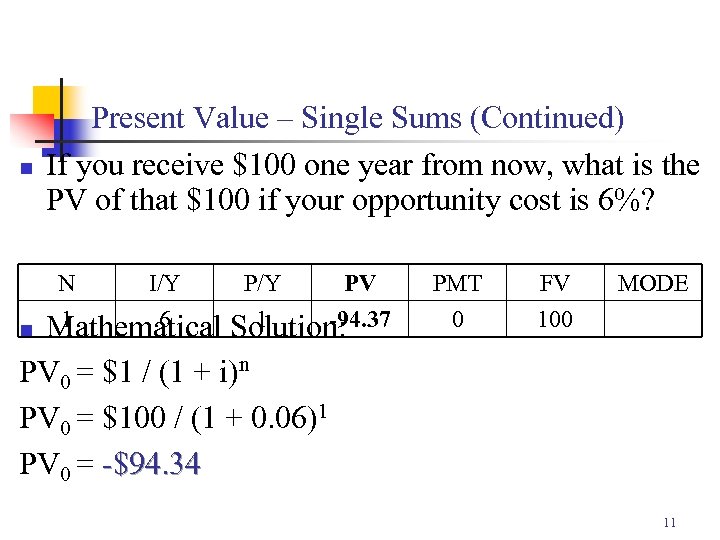 n Present Value – Single Sums (Continued) If you receive $100 one year from now, what is the PV of that $100 if your opportunity cost is 6%? N I/Y PV 1 6 1 -94. 37 n Mathematical Solution: PMT 0 FV 100 MODE PV 0 = $1 / (1 + i)n PV 0 = $100 / (1 + 0. 06)1 PV 0 = -$94. 34 11
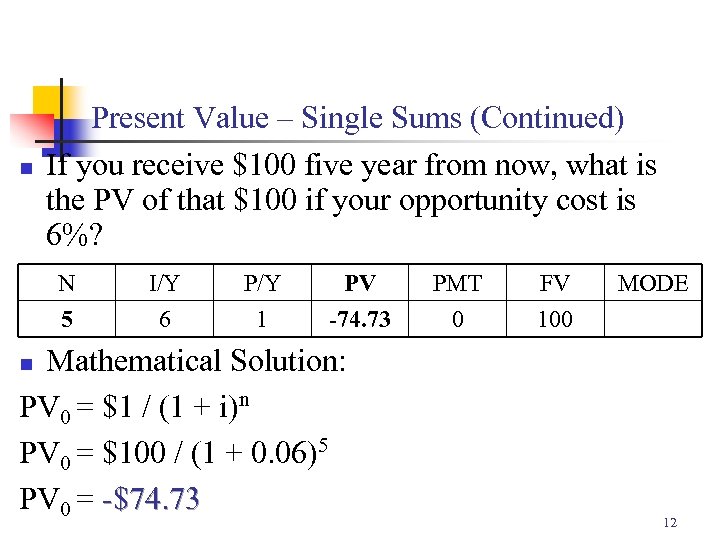 n Present Value – Single Sums (Continued) If you receive $100 five year from now, what is the PV of that $100 if your opportunity cost is 6%? N 5 I/Y 6 P/Y 1 PV -74. 73 Mathematical Solution: PV 0 = $1 / (1 + i)n PV 0 = $100 / (1 + 0. 06)5 PV 0 = -$74. 73 PMT 0 FV 100 MODE n 12
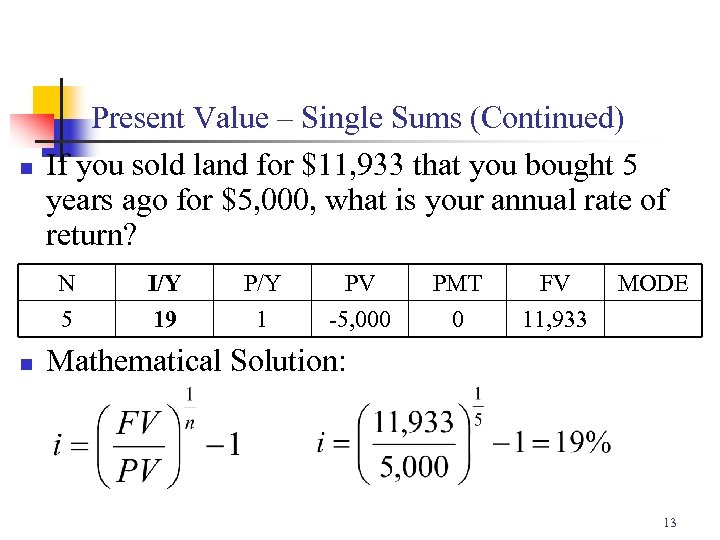 n Present Value – Single Sums (Continued) If you sold land for $11, 933 that you bought 5 years ago for $5, 000, what is your annual rate of return? N 5 n I/Y 19 P/Y 1 PV -5, 000 PMT 0 FV 11, 933 MODE Mathematical Solution: 13
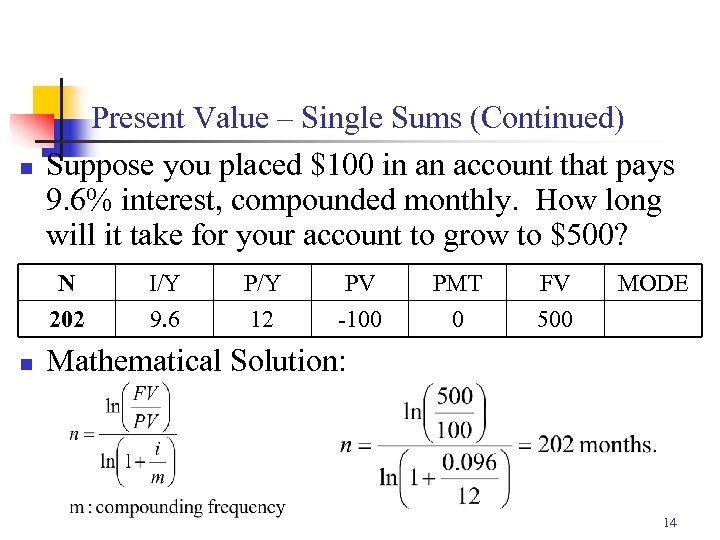 n Present Value – Single Sums (Continued) Suppose you placed $100 in an account that pays 9. 6% interest, compounded monthly. How long will it take for your account to grow to $500? N 202 n I/Y 9. 6 P/Y 12 PV -100 PMT 0 FV 500 MODE Mathematical Solution: 14
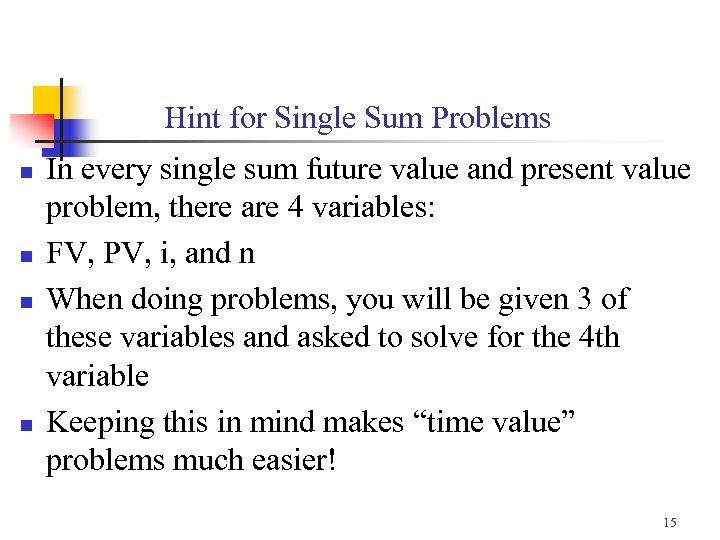 Hint for Single Sum Problems n n In every single sum future value and present value problem, there are 4 variables: FV, PV, i, and n When doing problems, you will be given 3 of these variables and asked to solve for the 4 th variable Keeping this in mind makes “time value” problems much easier! 15
 Compounding and Discounting Cash Flow Streams n n n Annuity: a sequence of equal cash flows, occurring at the end of each period If you buy a bond, you will receive equal semiannual coupon interest payments over the life of the bond If you borrow money to buy a house or a car, you will pay a stream of equal payments 16
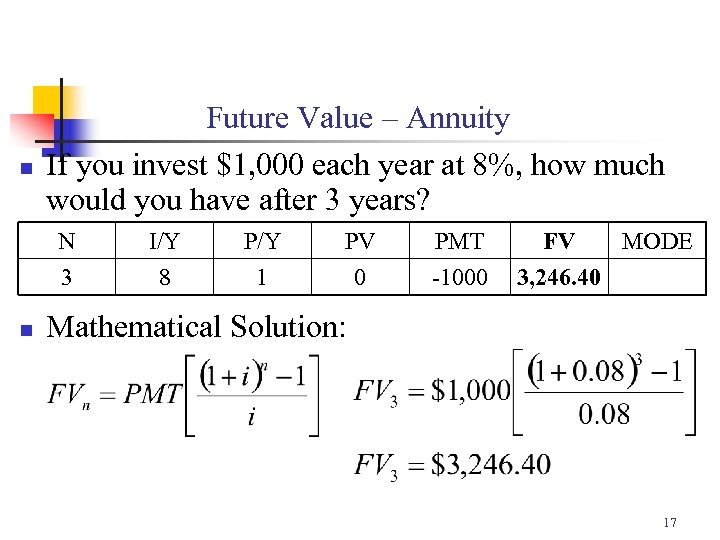 n Future Value – Annuity If you invest $1, 000 each year at 8%, how much would you have after 3 years? N 3 n I/Y 8 P/Y 1 PV 0 PMT -1000 FV MODE 3, 246. 40 Mathematical Solution: 17
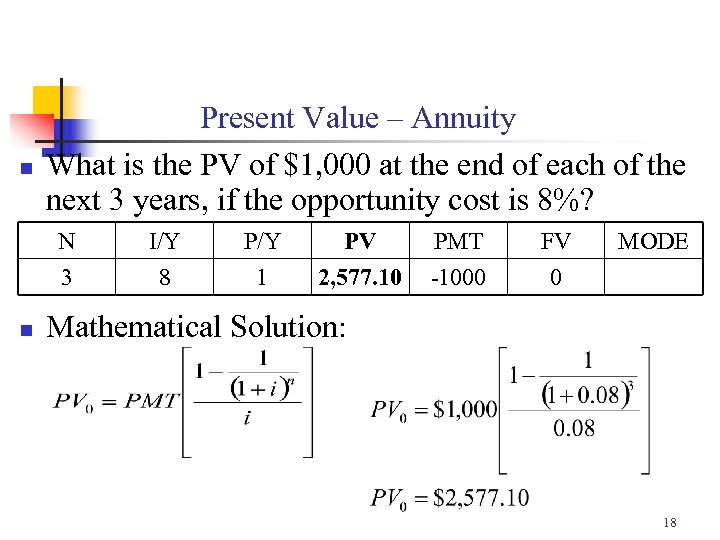 n Present Value – Annuity What is the PV of $1, 000 at the end of each of the next 3 years, if the opportunity cost is 8%? N 3 n I/Y 8 P/Y 1 PV 2, 577. 10 PMT -1000 FV 0 MODE Mathematical Solution: 18
 Perpetuities n n Suppose you will receive a fixed payment every period (month, year, etc. ) forever. This is an example of a perpetuity You can think of a perpetuity as an annuity that goes on 19
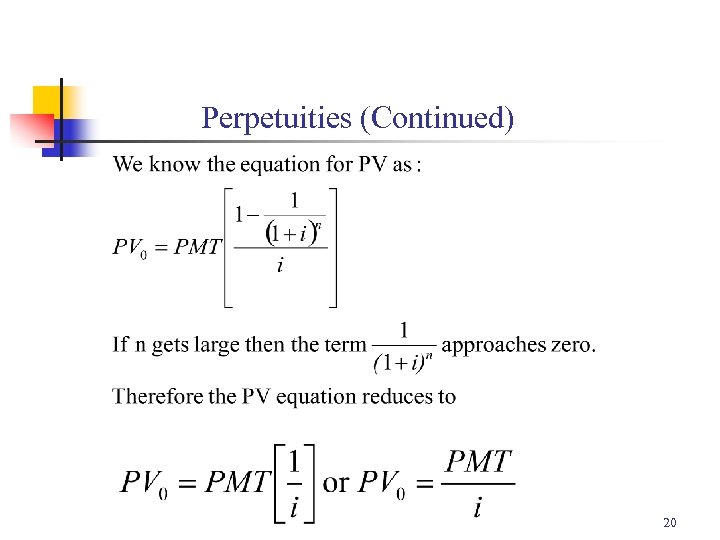 Perpetuities (Continued) 20
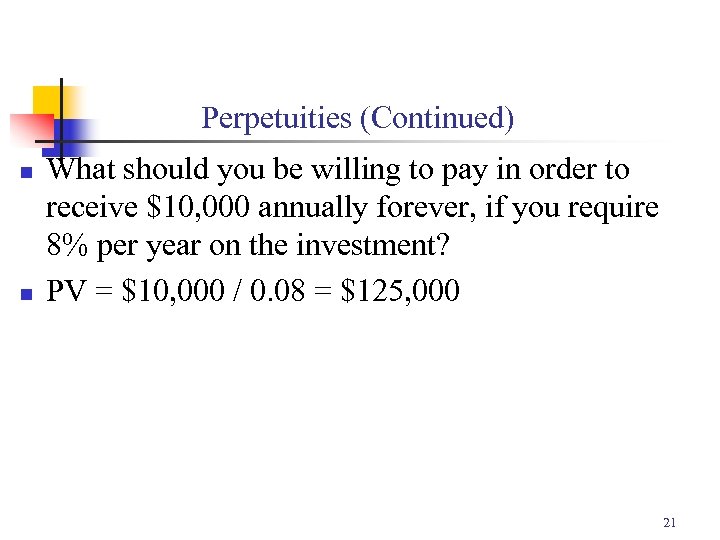 Perpetuities (Continued) n n What should you be willing to pay in order to receive $10, 000 annually forever, if you require 8% per year on the investment? PV = $10, 000 / 0. 08 = $125, 000 21
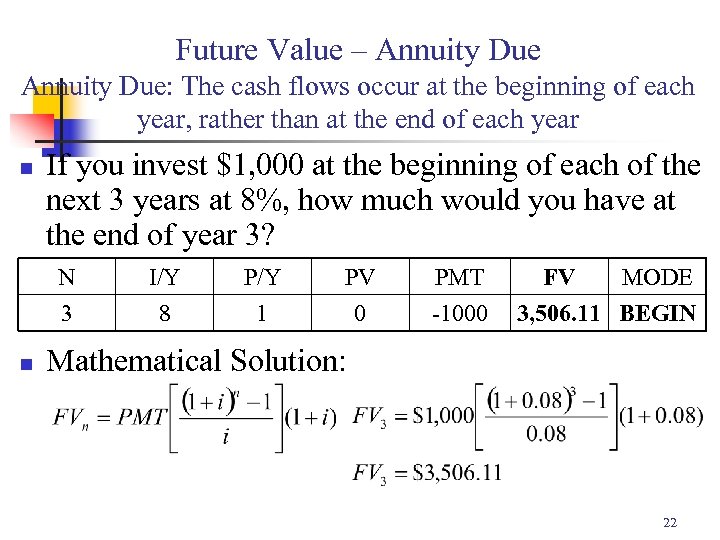 Future Value – Annuity Due: The cash flows occur at the beginning of each year, rather than at the end of each year n If you invest $1, 000 at the beginning of each of the next 3 years at 8%, how much would you have at the end of year 3? N 3 n I/Y 8 P/Y 1 PV 0 PMT -1000 FV MODE 3, 506. 11 BEGIN Mathematical Solution: 22
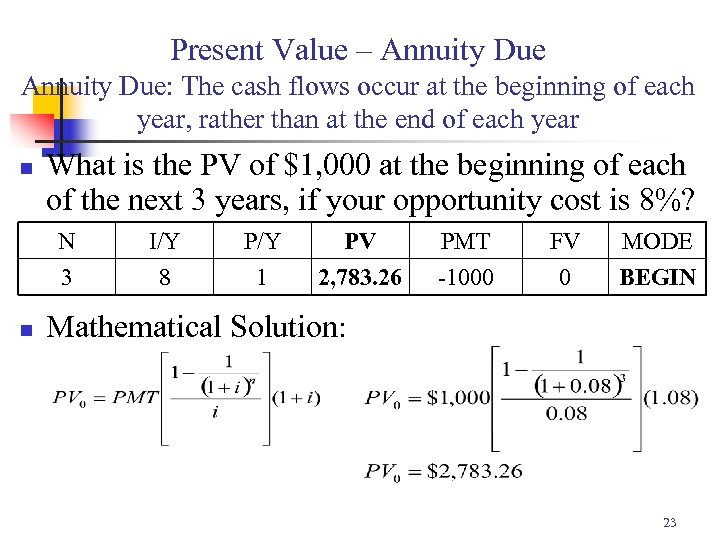 Present Value – Annuity Due: The cash flows occur at the beginning of each year, rather than at the end of each year n What is the PV of $1, 000 at the beginning of each of the next 3 years, if your opportunity cost is 8%? N 3 n I/Y 8 P/Y 1 PV 2, 783. 26 PMT -1000 FV 0 MODE BEGIN Mathematical Solution: 23
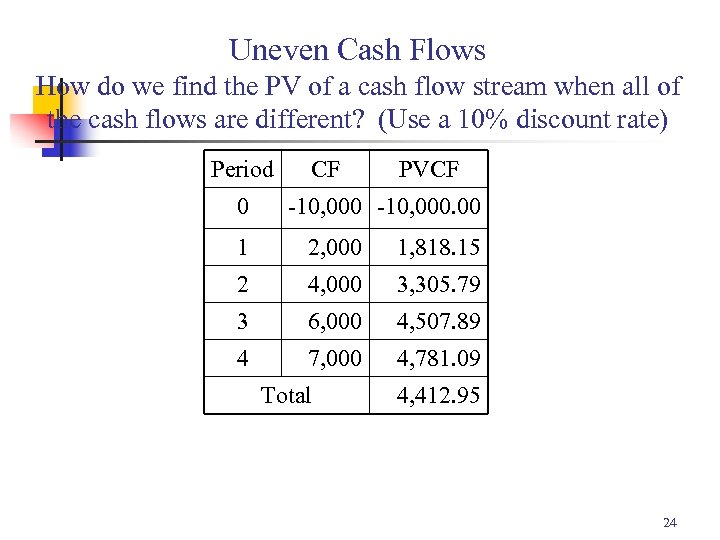 Uneven Cash Flows How do we find the PV of a cash flow stream when all of the cash flows are different? (Use a 10% discount rate) Period 0 CF PVCF -10, 000. 00 1 2, 000 1, 818. 15 2 4, 000 3, 305. 79 3 6, 000 4, 507. 89 4 7, 000 4, 781. 09 Total 4, 412. 95 24
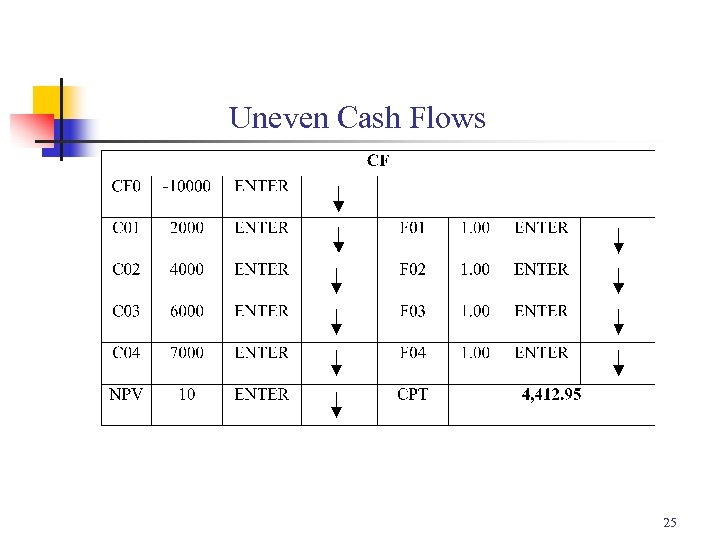 Uneven Cash Flows 25
 Annual Percentage Yield (APY) or Effective Annual Rate (EAR) n Which is the better loan: n n 8. 00% compounded annually, or 7. 85% compounded quarterly? We can’t compare these nominal (quoted) interest rates, because they don’t include the same number of compounding periods per year! We need to calculate the APY 26
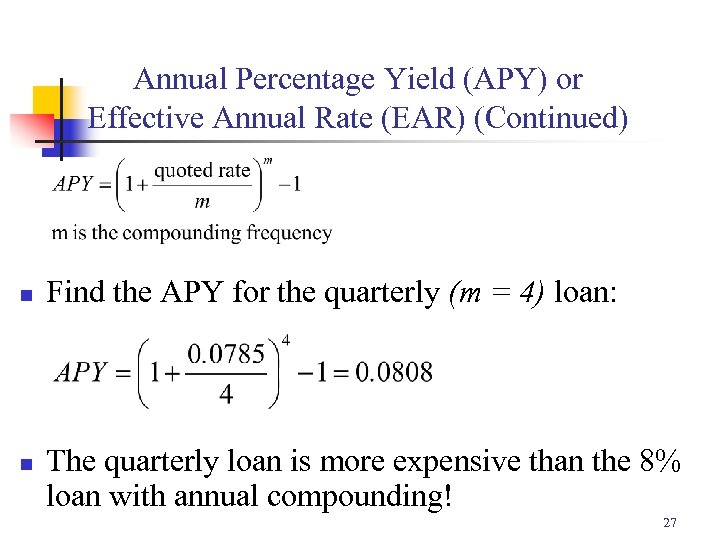 Annual Percentage Yield (APY) or Effective Annual Rate (EAR) (Continued) n n Find the APY for the quarterly (m = 4) loan: The quarterly loan is more expensive than the 8% loan with annual compounding! 27
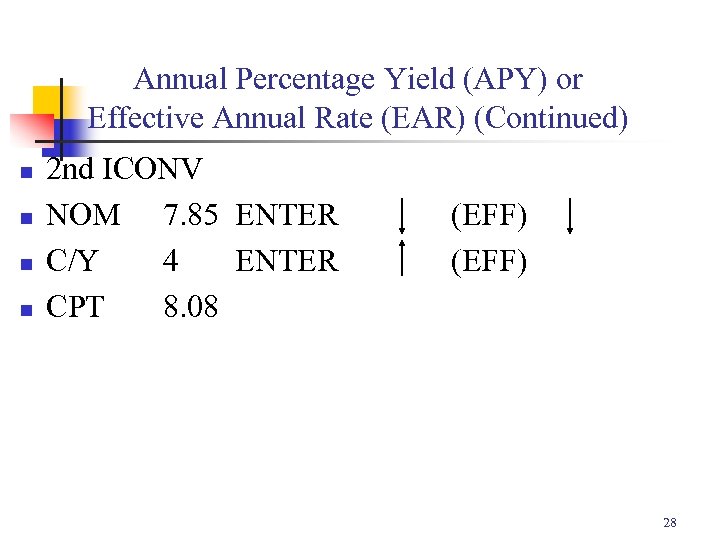 Annual Percentage Yield (APY) or Effective Annual Rate (EAR) (Continued) n n 2 nd ICONV NOM 7. 85 ENTER C/Y 4 ENTER CPT 8. 08 (EFF) 28