


 Скачать презентацию The Time Value of Money Compounding and Discounting
9e117e510f09b4052af45701a41a1fc3.ppt
- Количество слайдов: 93
 The Time Value of Money Compounding and Discounting Single Sums
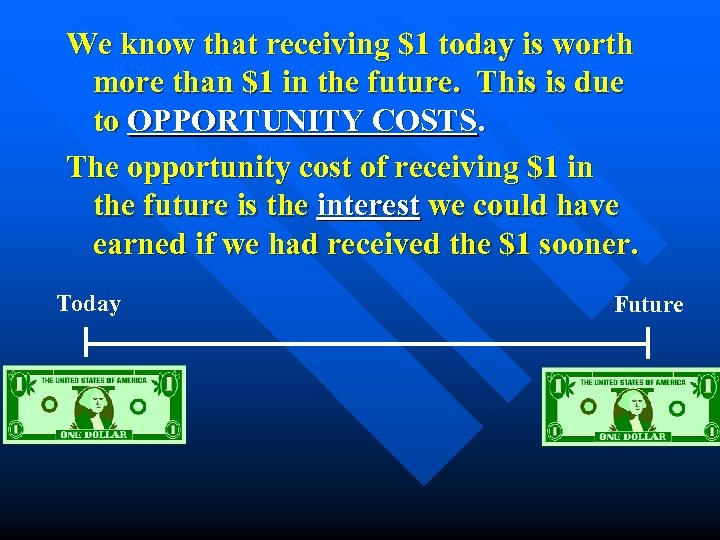 We know that receiving $1 today is worth more than $1 in the future. This is due to OPPORTUNITY COSTS. The opportunity cost of receiving $1 in the future is the interest we could have earned if we had received the $1 sooner. Today Future
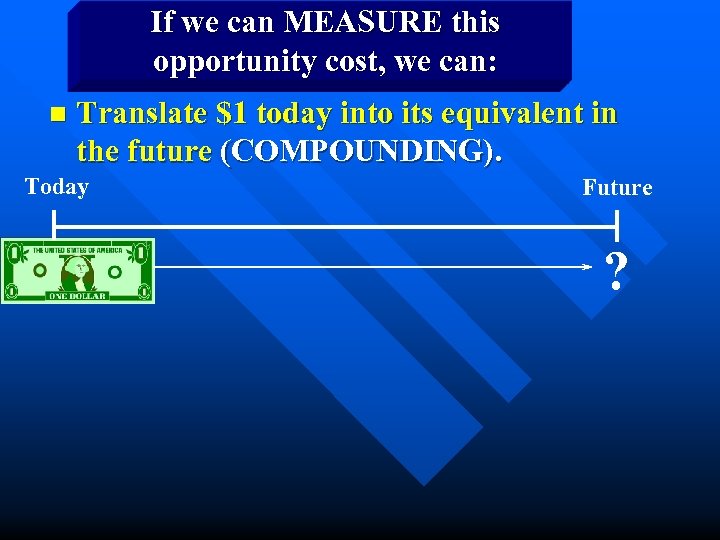 If we can MEASURE this opportunity cost, we can: n Translate $1 today into its equivalent in the future (COMPOUNDING). Today Future ?
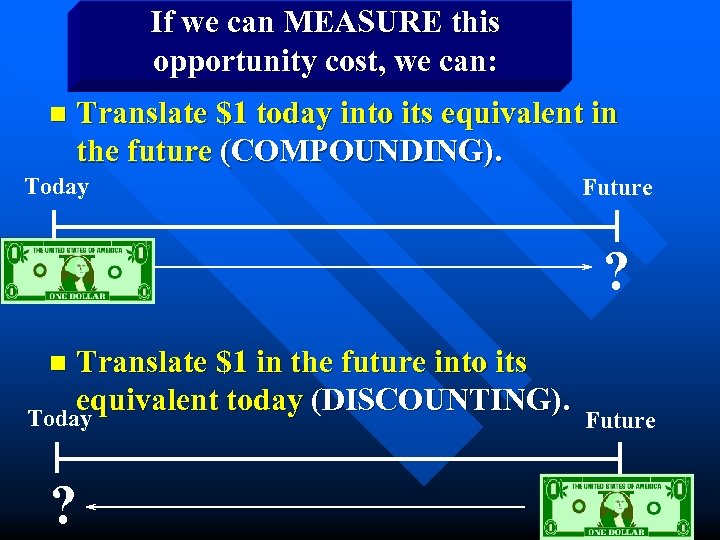 If we can MEASURE this opportunity cost, we can: n Translate $1 today into its equivalent in the future (COMPOUNDING). Today Future ? Translate $1 in the future into its equivalent today (DISCOUNTING). Today n ? Future
 Future Value
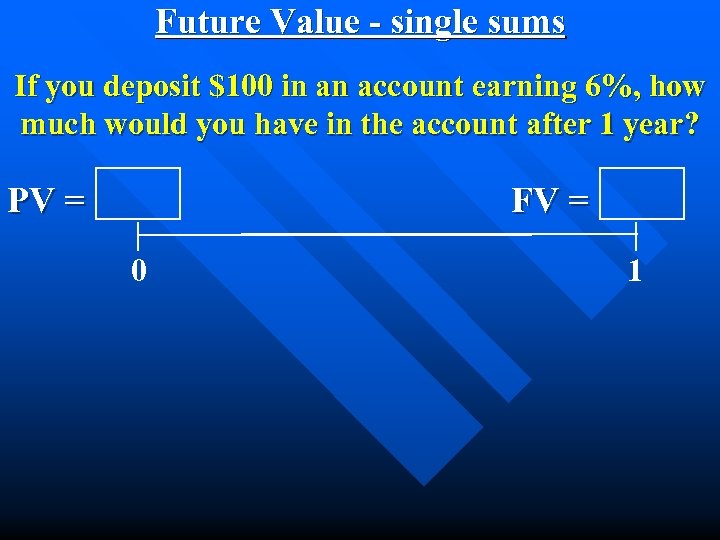 Future Value - single sums If you deposit $100 in an account earning 6%, how much would you have in the account after 1 year? PV = FV = 0 1
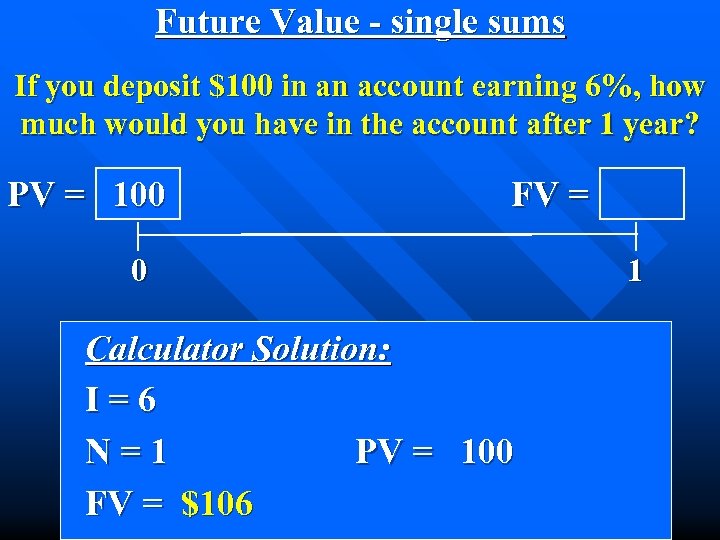 Future Value - single sums If you deposit $100 in an account earning 6%, how much would you have in the account after 1 year? PV = 100 FV = 0 Calculator Solution: I=6 N=1 PV = 100 FV = $106 1
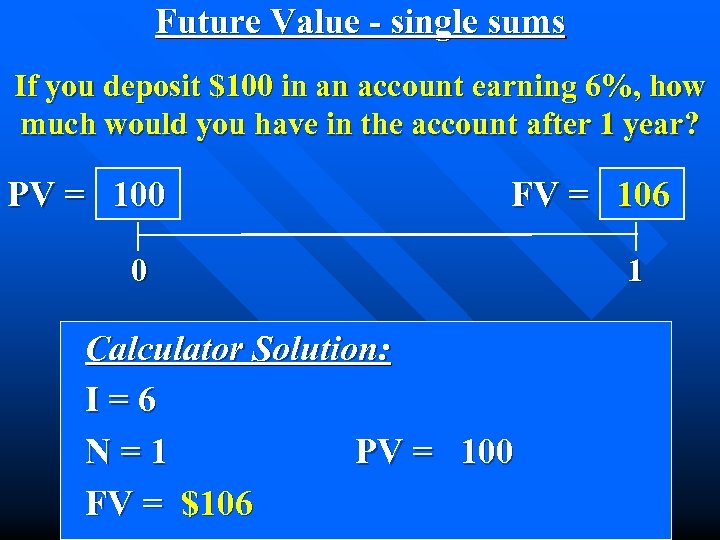 Future Value - single sums If you deposit $100 in an account earning 6%, how much would you have in the account after 1 year? PV = 100 FV = 106 0 Calculator Solution: I=6 N=1 PV = 100 FV = $106 1
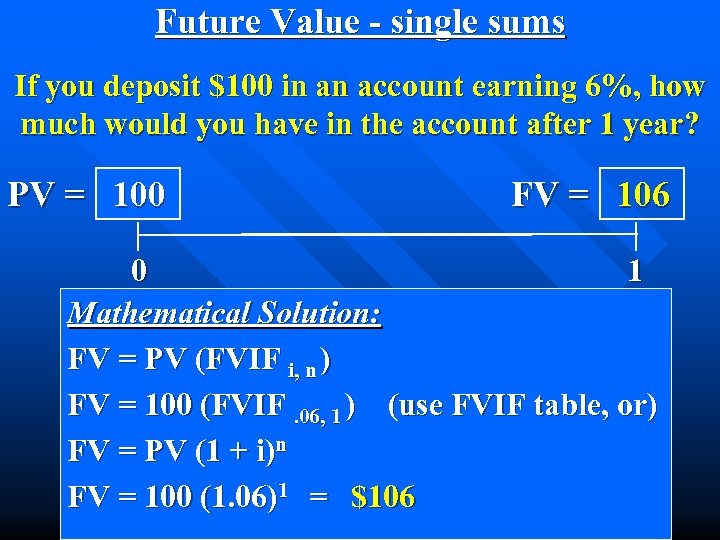 Future Value - single sums If you deposit $100 in an account earning 6%, how much would you have in the account after 1 year? PV = 100 FV = 106 0 1 Mathematical Solution: FV = PV (FVIF i, n ) FV = 100 (FVIF. 06, 1 ) (use FVIF table, or) FV = PV (1 + i)n FV = 100 (1. 06)1 = $106
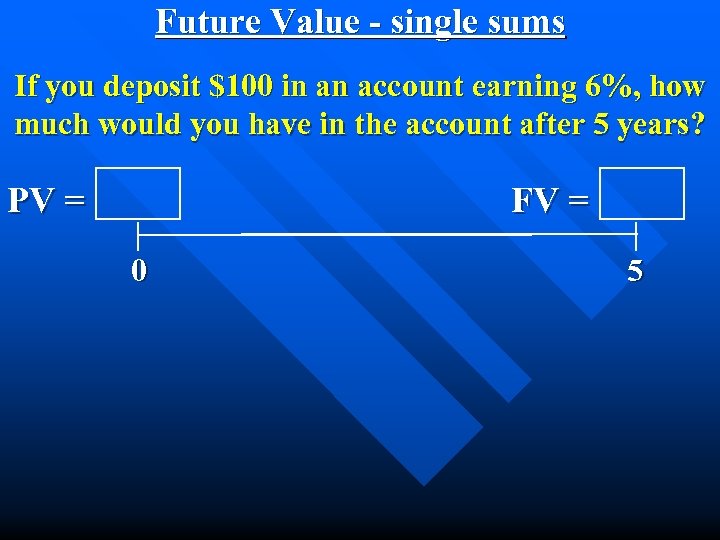 Future Value - single sums If you deposit $100 in an account earning 6%, how much would you have in the account after 5 years? PV = FV = 0 5
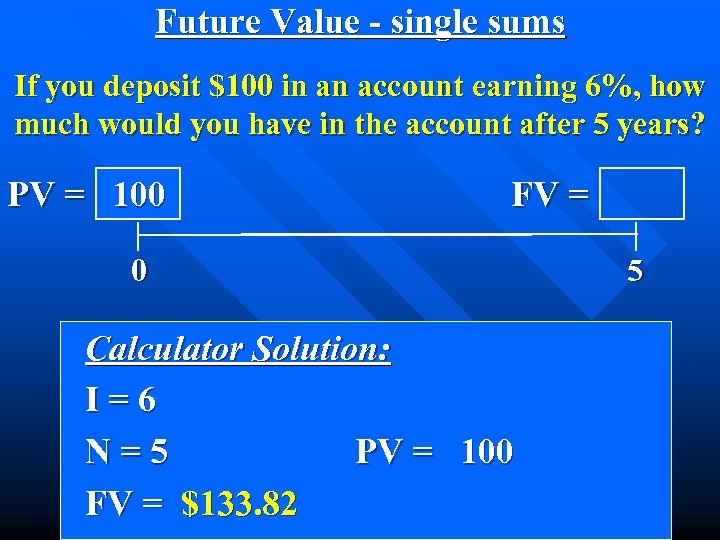 Future Value - single sums If you deposit $100 in an account earning 6%, how much would you have in the account after 5 years? PV = 100 FV = 0 Calculator Solution: I=6 N=5 PV = 100 FV = $133. 82 5
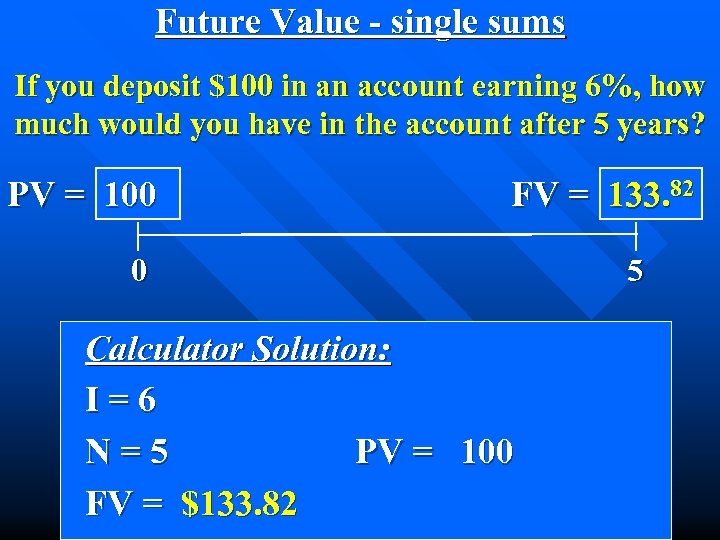 Future Value - single sums If you deposit $100 in an account earning 6%, how much would you have in the account after 5 years? PV = 100 FV = 133. 82 0 Calculator Solution: I=6 N=5 PV = 100 FV = $133. 82 5
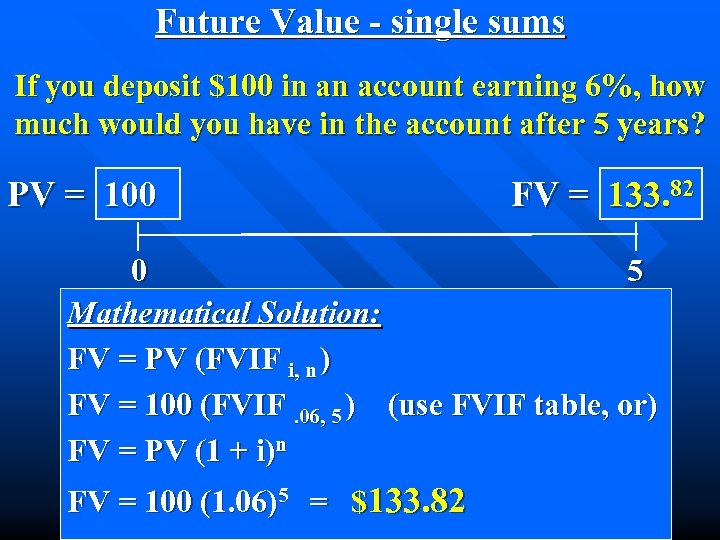 Future Value - single sums If you deposit $100 in an account earning 6%, how much would you have in the account after 5 years? PV = 100 FV = 133. 82 0 5 Mathematical Solution: FV = PV (FVIF i, n ) FV = 100 (FVIF. 06, 5 ) (use FVIF table, or) FV = PV (1 + i)n FV = 100 (1. 06)5 = $133. 82
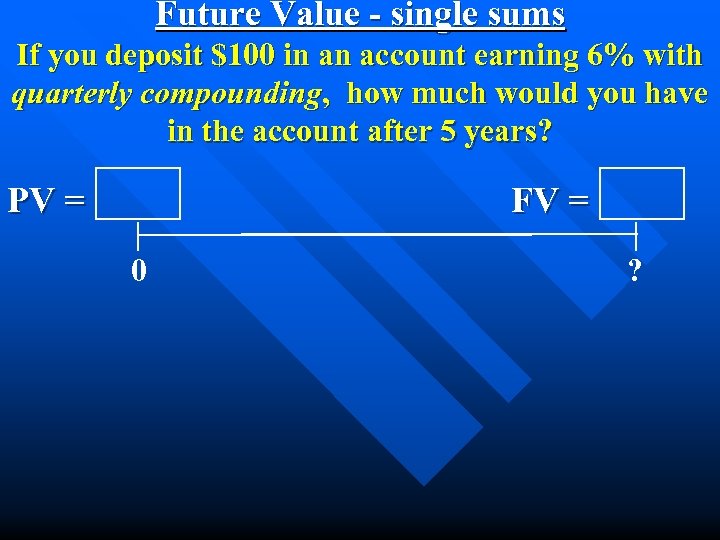 Future Value - single sums If you deposit $100 in an account earning 6% with quarterly compounding, how much would you have in the account after 5 years? PV = FV = 0 ?
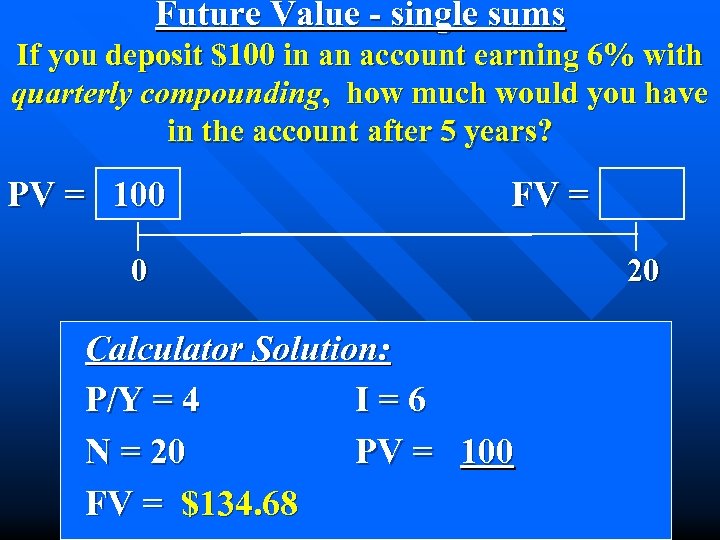 Future Value - single sums If you deposit $100 in an account earning 6% with quarterly compounding, how much would you have in the account after 5 years? PV = 100 FV = 0 Calculator Solution: P/Y = 4 I=6 N = 20 PV = 100 FV = $134. 68 20
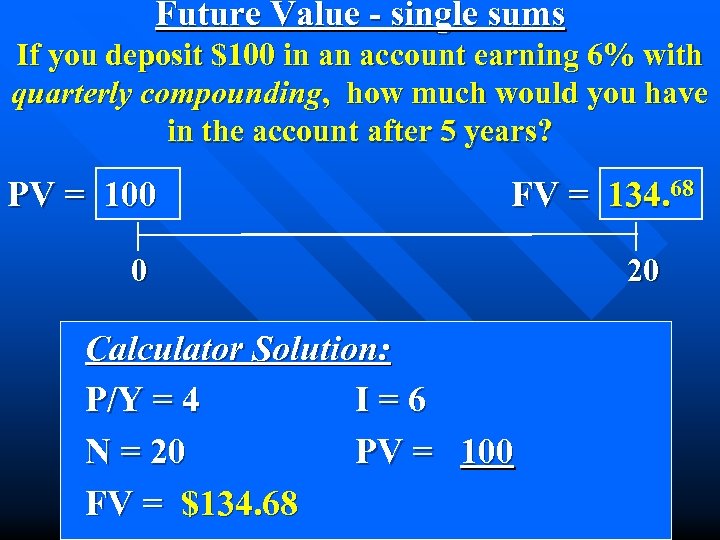 Future Value - single sums If you deposit $100 in an account earning 6% with quarterly compounding, how much would you have in the account after 5 years? PV = 100 FV = 134. 68 0 Calculator Solution: P/Y = 4 I=6 N = 20 PV = 100 FV = $134. 68 20
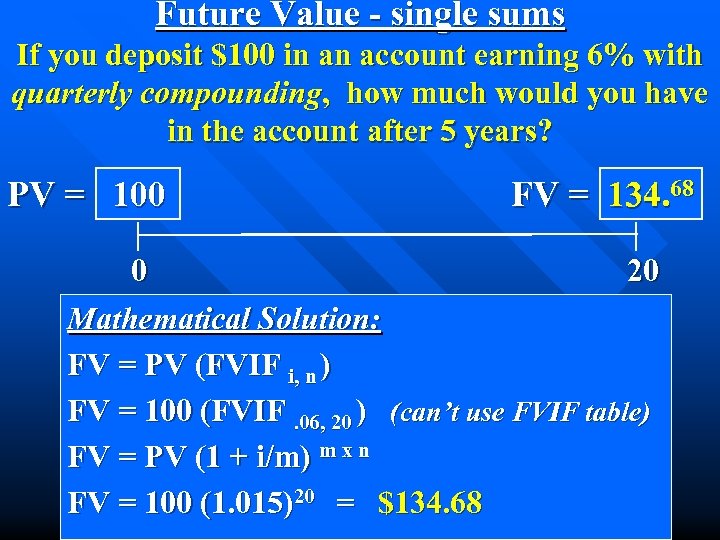 Future Value - single sums If you deposit $100 in an account earning 6% with quarterly compounding, how much would you have in the account after 5 years? PV = 100 FV = 134. 68 0 20 Mathematical Solution: FV = PV (FVIF i, n ) FV = 100 (FVIF. 06, 20 ) (can’t use FVIF table) FV = PV (1 + i/m) m x n FV = 100 (1. 015)20 = $134. 68
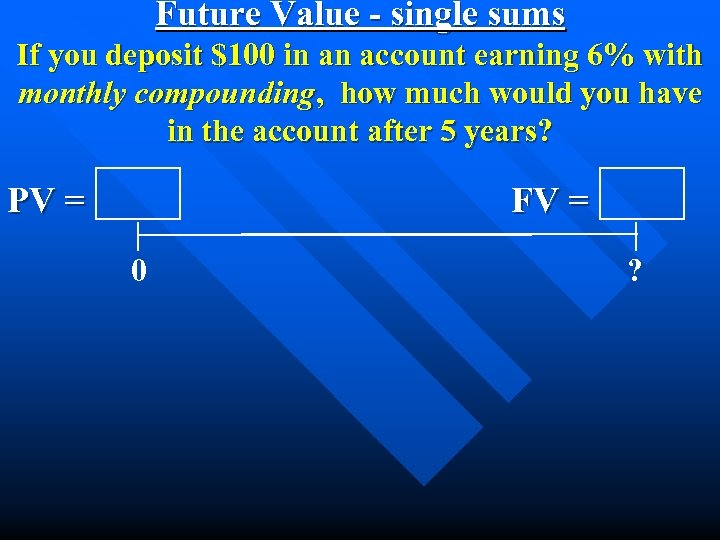 Future Value - single sums If you deposit $100 in an account earning 6% with monthly compounding, how much would you have in the account after 5 years? PV = FV = 0 ?
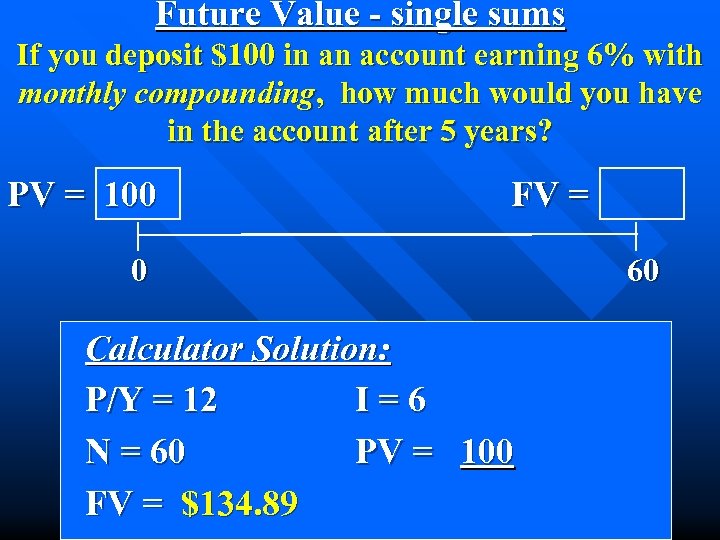 Future Value - single sums If you deposit $100 in an account earning 6% with monthly compounding, how much would you have in the account after 5 years? PV = 100 FV = 0 Calculator Solution: P/Y = 12 I=6 N = 60 PV = 100 FV = $134. 89 60
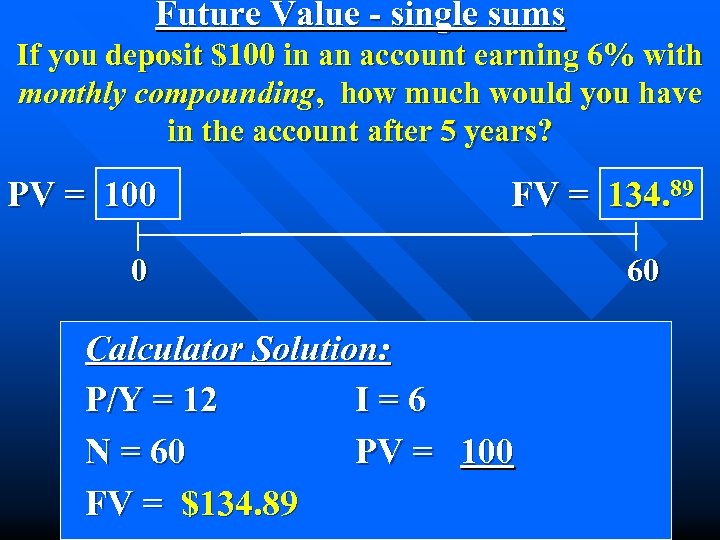 Future Value - single sums If you deposit $100 in an account earning 6% with monthly compounding, how much would you have in the account after 5 years? PV = 100 FV = 134. 89 0 Calculator Solution: P/Y = 12 I=6 N = 60 PV = 100 FV = $134. 89 60
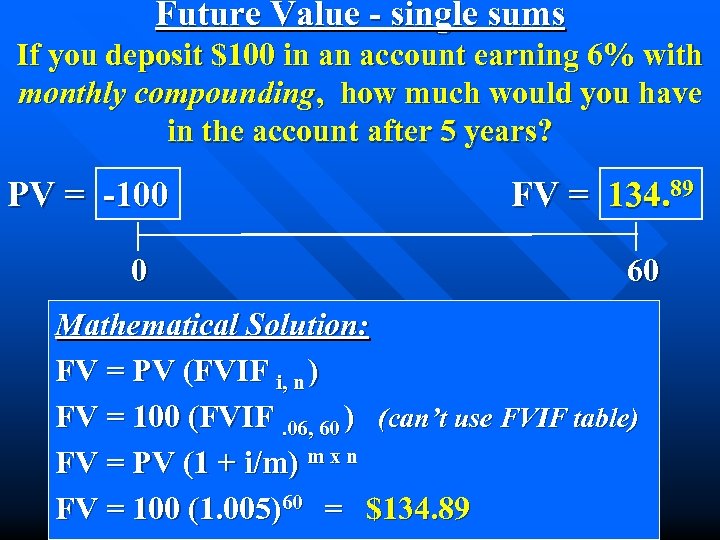 Future Value - single sums If you deposit $100 in an account earning 6% with monthly compounding, how much would you have in the account after 5 years? PV = -100 0 FV = 134. 89 60 Mathematical Solution: FV = PV (FVIF i, n ) FV = 100 (FVIF. 06, 60 ) (can’t use FVIF table) FV = PV (1 + i/m) m x n FV = 100 (1. 005)60 = $134. 89
 Present Value
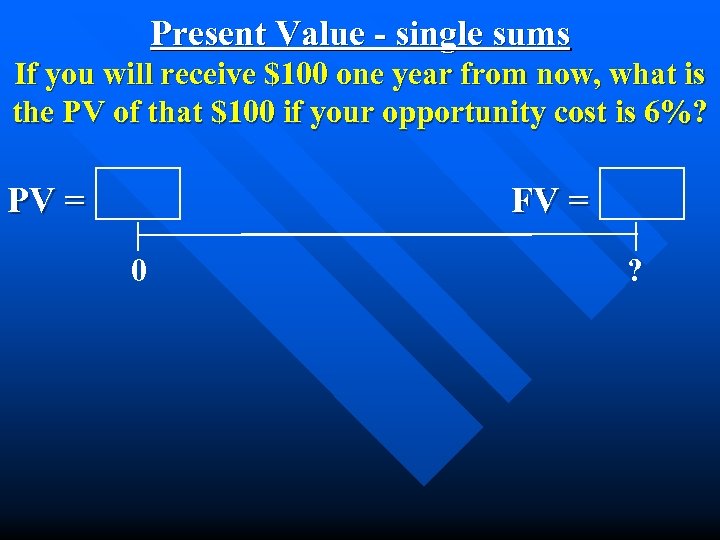 Present Value - single sums If you will receive $100 one year from now, what is the PV of that $100 if your opportunity cost is 6%? PV = FV = 0 ?
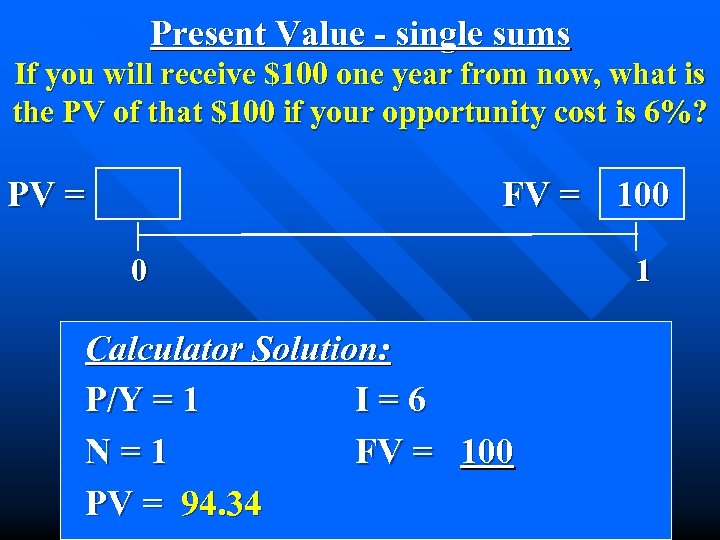 Present Value - single sums If you will receive $100 one year from now, what is the PV of that $100 if your opportunity cost is 6%? PV = FV = 100 0 Calculator Solution: P/Y = 1 I=6 N=1 FV = 100 PV = 94. 34 1
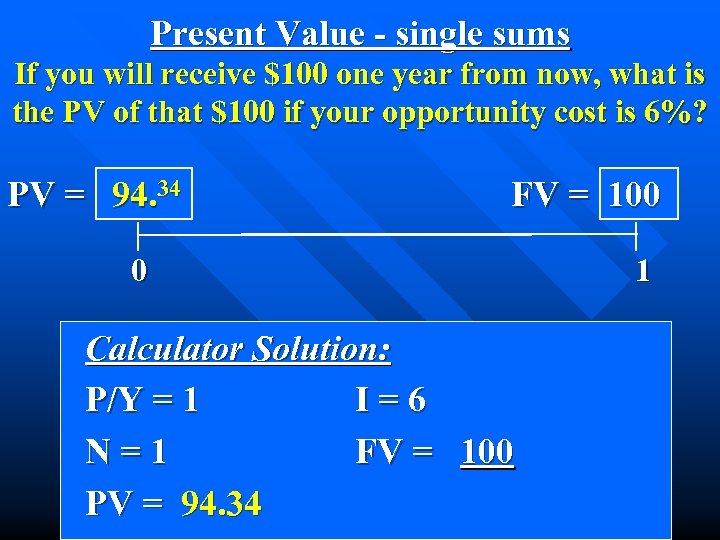 Present Value - single sums If you will receive $100 one year from now, what is the PV of that $100 if your opportunity cost is 6%? PV = 94. 34 FV = 100 0 Calculator Solution: P/Y = 1 I=6 N=1 FV = 100 PV = 94. 34 1
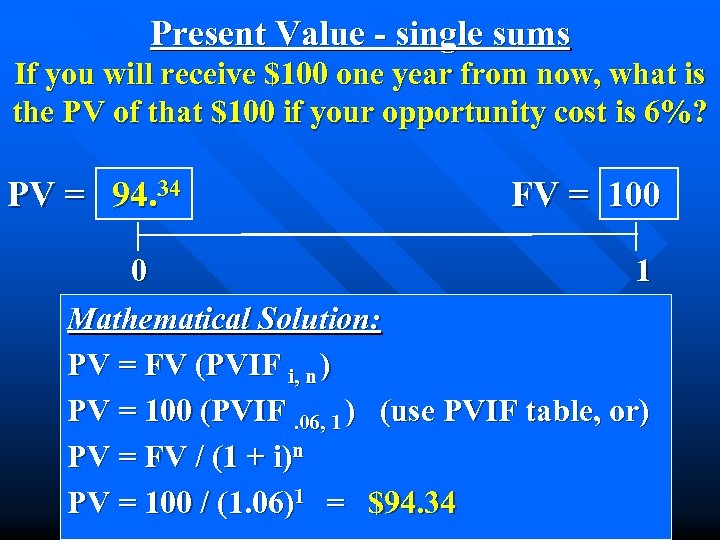 Present Value - single sums If you will receive $100 one year from now, what is the PV of that $100 if your opportunity cost is 6%? PV = 94. 34 FV = 100 0 1 Mathematical Solution: PV = FV (PVIF i, n ) PV = 100 (PVIF. 06, 1 ) (use PVIF table, or) PV = FV / (1 + i)n PV = 100 / (1. 06)1 = $94. 34
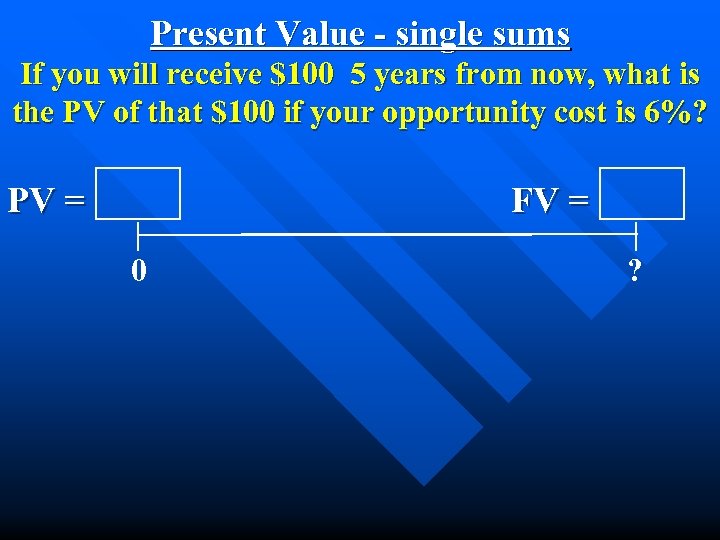 Present Value - single sums If you will receive $100 5 years from now, what is the PV of that $100 if your opportunity cost is 6%? PV = FV = 0 ?
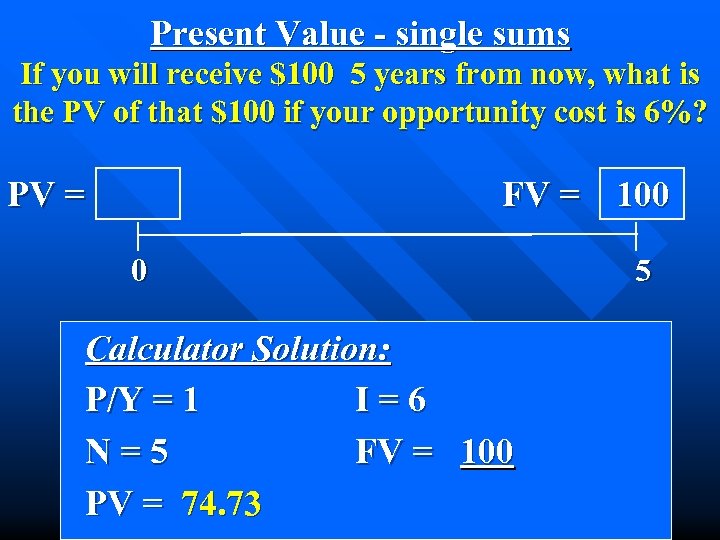 Present Value - single sums If you will receive $100 5 years from now, what is the PV of that $100 if your opportunity cost is 6%? PV = FV = 100 0 Calculator Solution: P/Y = 1 I=6 N=5 FV = 100 PV = 74. 73 5
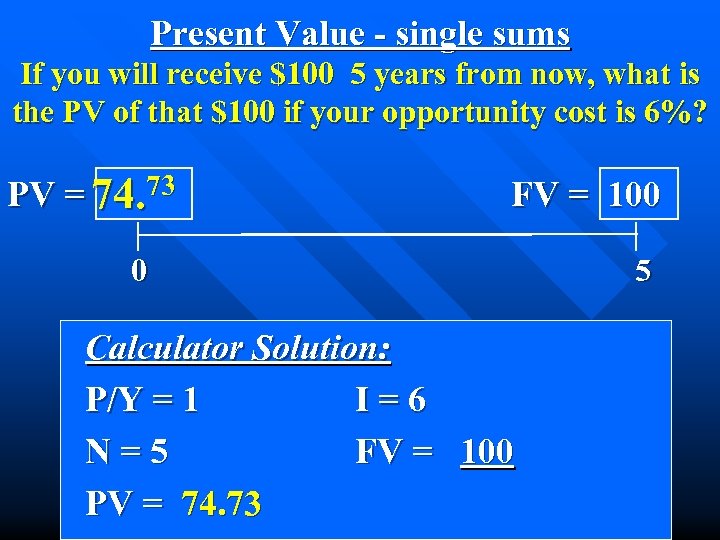 Present Value - single sums If you will receive $100 5 years from now, what is the PV of that $100 if your opportunity cost is 6%? PV = 74. 73 FV = 100 0 Calculator Solution: P/Y = 1 I=6 N=5 FV = 100 PV = 74. 73 5
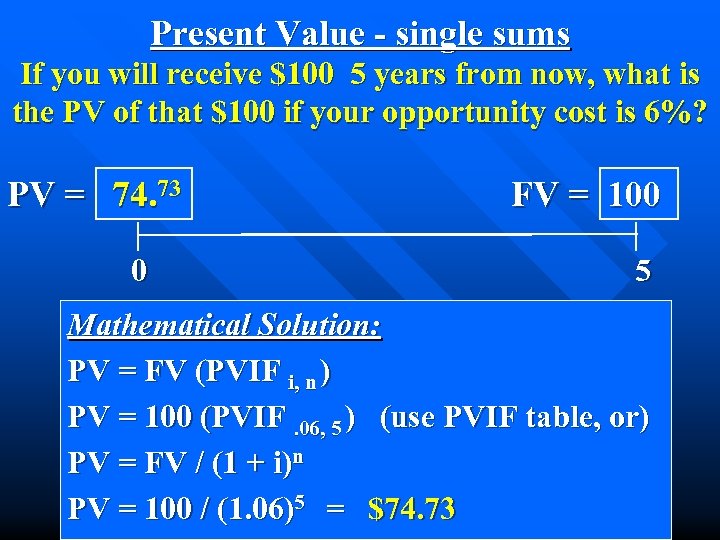 Present Value - single sums If you will receive $100 5 years from now, what is the PV of that $100 if your opportunity cost is 6%? PV = 74. 73 0 FV = 100 5 Mathematical Solution: PV = FV (PVIF i, n ) PV = 100 (PVIF. 06, 5 ) (use PVIF table, or) PV = FV / (1 + i)n PV = 100 / (1. 06)5 = $74. 73
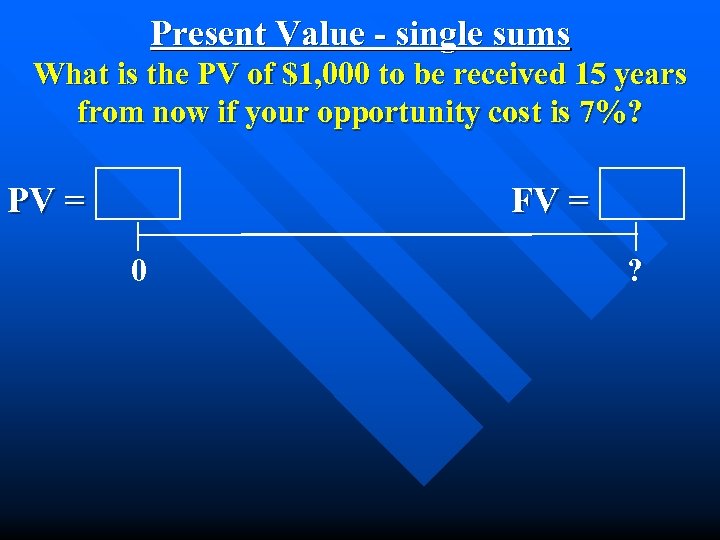 Present Value - single sums What is the PV of $1, 000 to be received 15 years from now if your opportunity cost is 7%? PV = FV = 0 ?
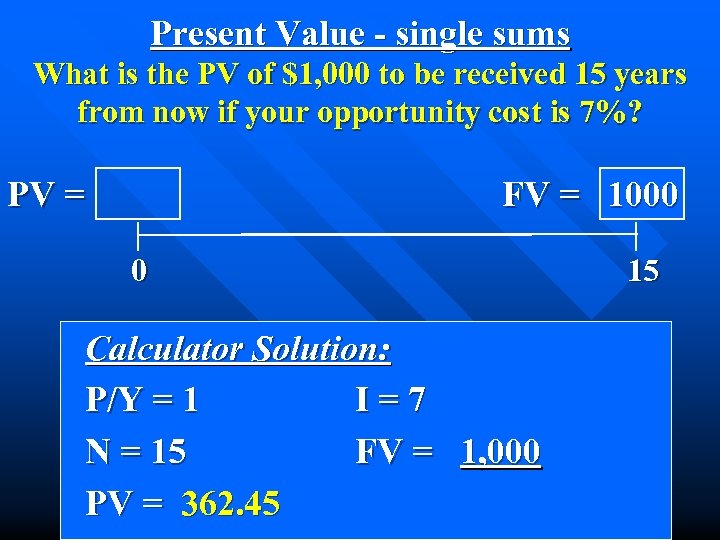 Present Value - single sums What is the PV of $1, 000 to be received 15 years from now if your opportunity cost is 7%? PV = FV = 1000 0 Calculator Solution: P/Y = 1 I=7 N = 15 FV = 1, 000 PV = 362. 45 15
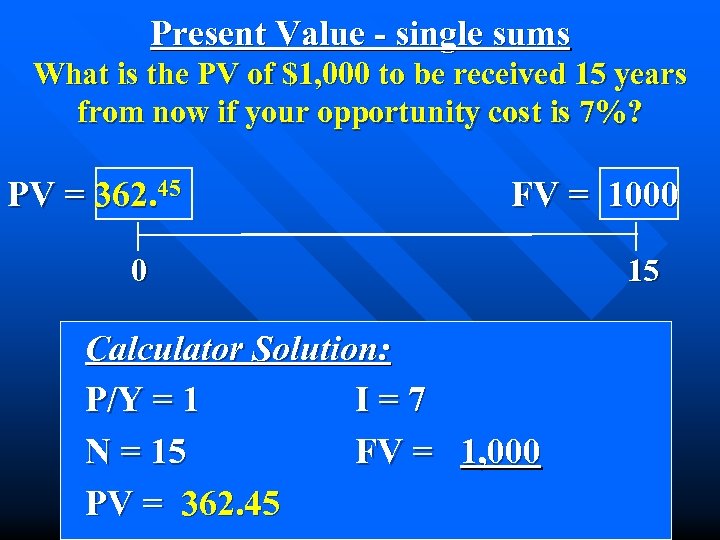 Present Value - single sums What is the PV of $1, 000 to be received 15 years from now if your opportunity cost is 7%? PV = 362. 45 FV = 1000 0 Calculator Solution: P/Y = 1 I=7 N = 15 FV = 1, 000 PV = 362. 45 15
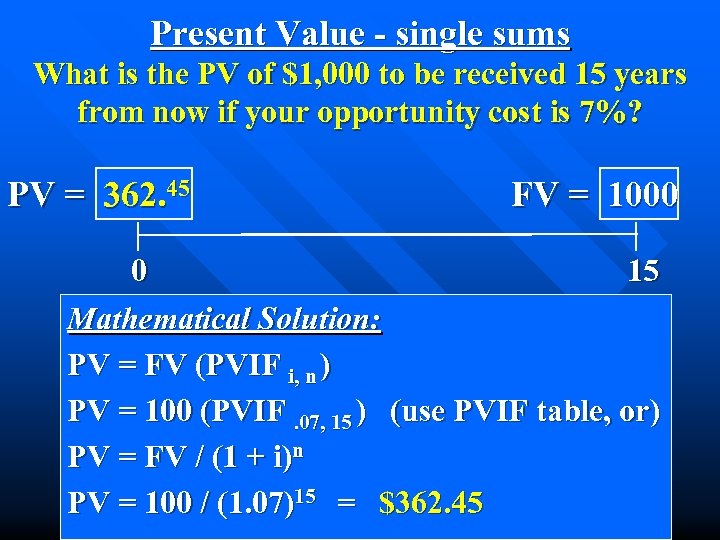 Present Value - single sums What is the PV of $1, 000 to be received 15 years from now if your opportunity cost is 7%? PV = 362. 45 FV = 1000 0 15 Mathematical Solution: PV = FV (PVIF i, n ) PV = 100 (PVIF. 07, 15 ) (use PVIF table, or) PV = FV / (1 + i)n PV = 100 / (1. 07)15 = $362. 45
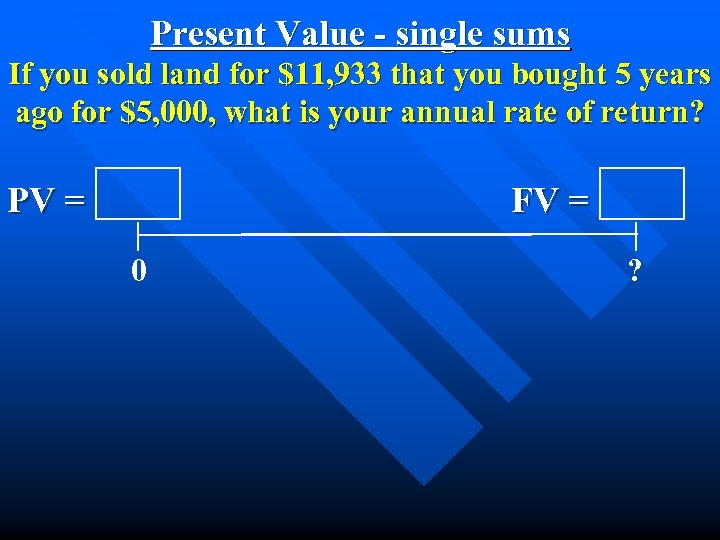 Present Value - single sums If you sold land for $11, 933 that you bought 5 years ago for $5, 000, what is your annual rate of return? PV = FV = 0 ?
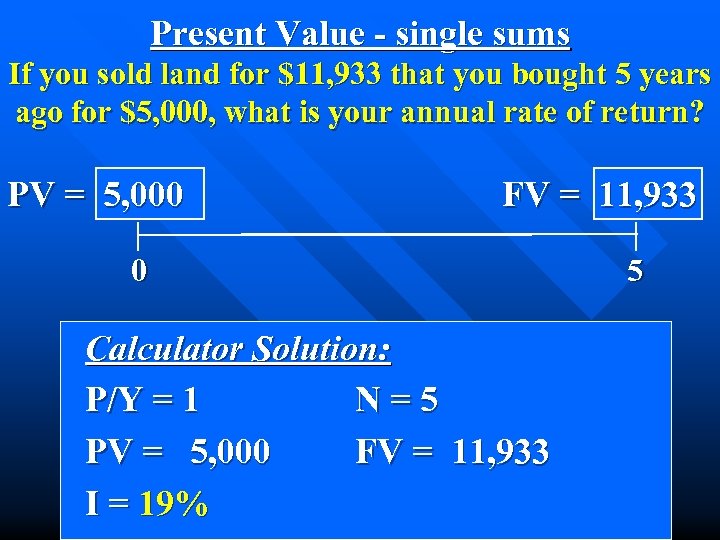 Present Value - single sums If you sold land for $11, 933 that you bought 5 years ago for $5, 000, what is your annual rate of return? PV = 5, 000 FV = 11, 933 0 Calculator Solution: P/Y = 1 N=5 PV = 5, 000 FV = 11, 933 I = 19% 5
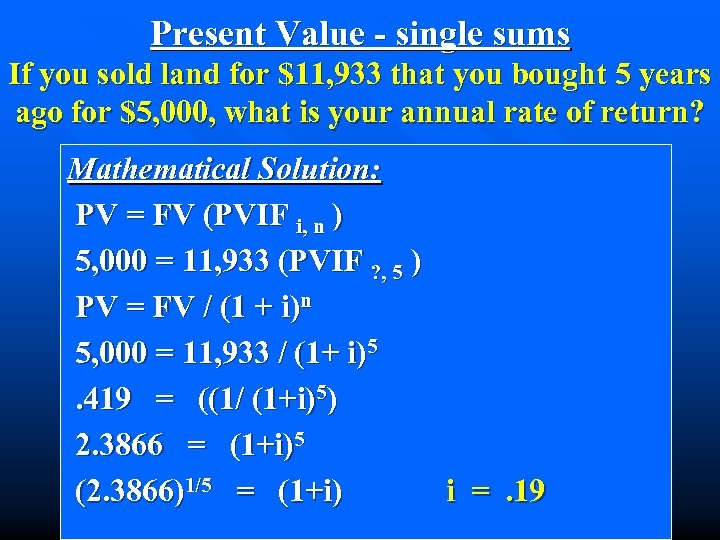 Present Value - single sums If you sold land for $11, 933 that you bought 5 years ago for $5, 000, what is your annual rate of return? Mathematical Solution: PV = FV (PVIF i, n ) 5, 000 = 11, 933 (PVIF ? , 5 ) PV = FV / (1 + i)n 5, 000 = 11, 933 / (1+ i)5. 419 = ((1/ (1+i)5) 2. 3866 = (1+i)5 (2. 3866)1/5 = (1+i) i =. 19
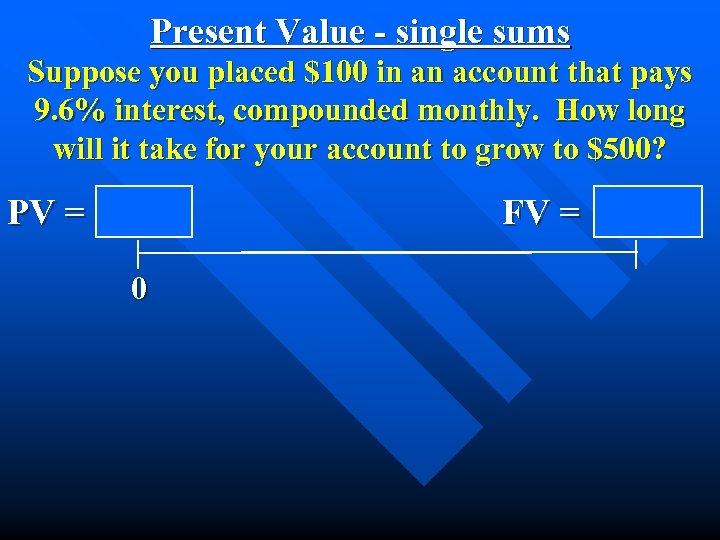 Present Value - single sums Suppose you placed $100 in an account that pays 9. 6% interest, compounded monthly. How long will it take for your account to grow to $500? PV = FV = 0
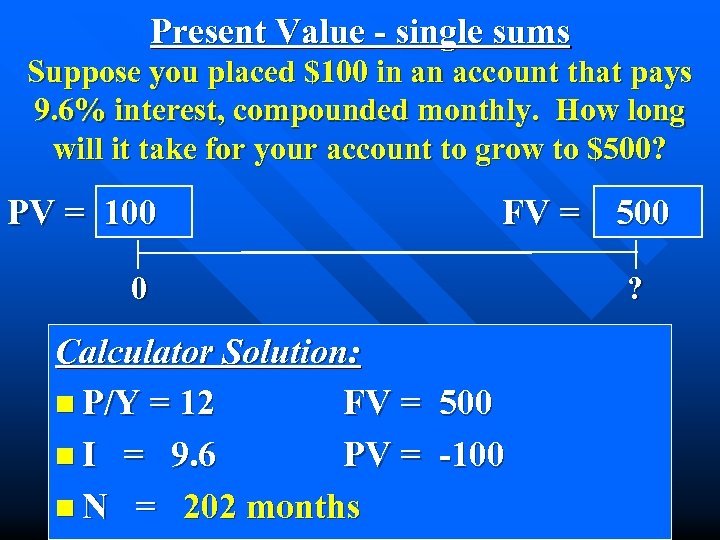 Present Value - single sums Suppose you placed $100 in an account that pays 9. 6% interest, compounded monthly. How long will it take for your account to grow to $500? PV = 100 FV = 500 0 Calculator Solution: n P/Y = 12 FV = 500 n I = 9. 6 PV = -100 n N = 202 months ?
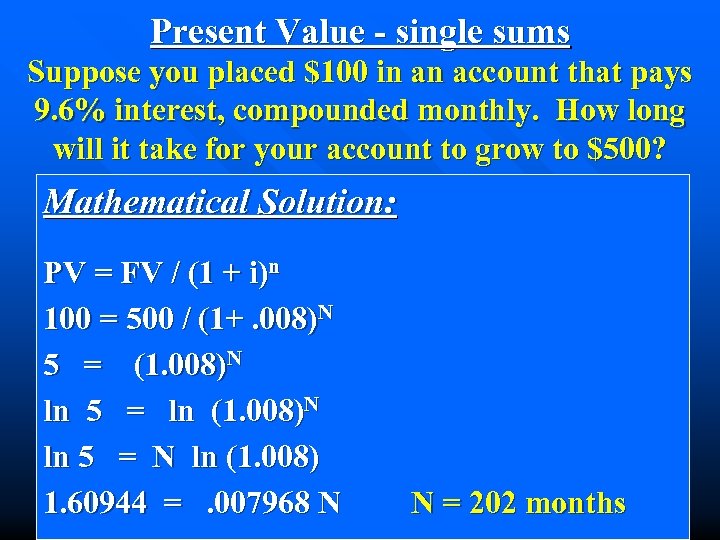 Present Value - single sums Suppose you placed $100 in an account that pays 9. 6% interest, compounded monthly. How long will it take for your account to grow to $500? Mathematical Solution: PV = FV / (1 + i)n 100 = 500 / (1+. 008)N 5 = (1. 008)N ln 5 = ln (1. 008)N ln 5 = N ln (1. 008) 1. 60944 =. 007968 N N = 202 months
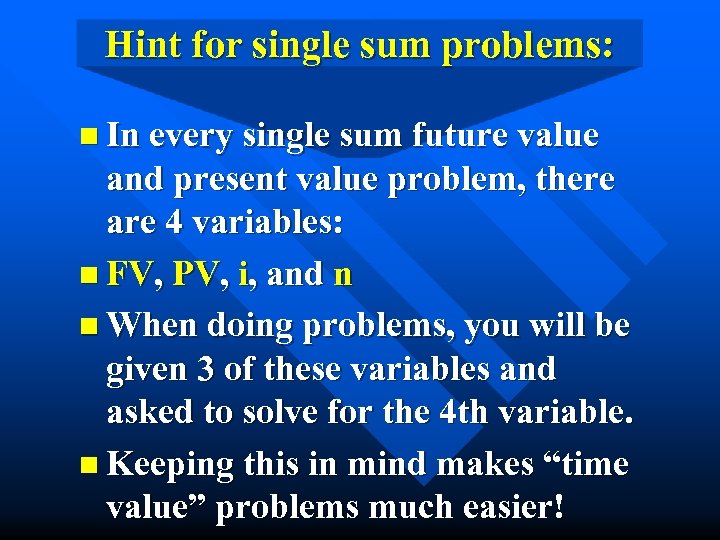 Hint for single sum problems: n In every single sum future value and present value problem, there are 4 variables: n FV, PV, i, and n n When doing problems, you will be given 3 of these variables and asked to solve for the 4 th variable. n Keeping this in mind makes “time value” problems much easier!
 The Time Value of Money Compounding and Discounting Cash Flow Streams 0 1 2 3 4
 Annuities n Annuity: a sequence of equal cash flows, occurring at the end of each period.
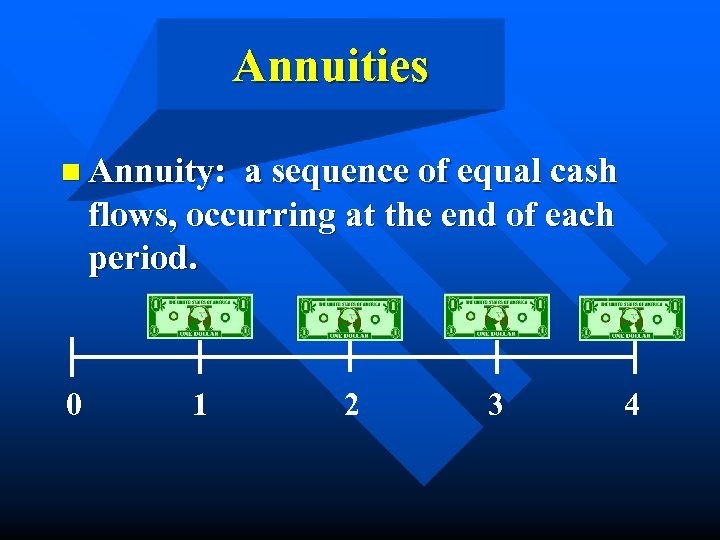 Annuities n Annuity: a sequence of equal cash flows, occurring at the end of each period. 0 1 2 3 4
 Examples of Annuities: n If you buy a bond, you will receive equal coupon interest payments over the life of the bond. n If you borrow money to buy a house or a car, you will pay a stream of equal payments.
 Examples of Annuities: n If you buy a bond, you will receive equal coupon interest payments over the life of the bond. n If you borrow money to buy a house or a car, you will pay a stream of equal payments.
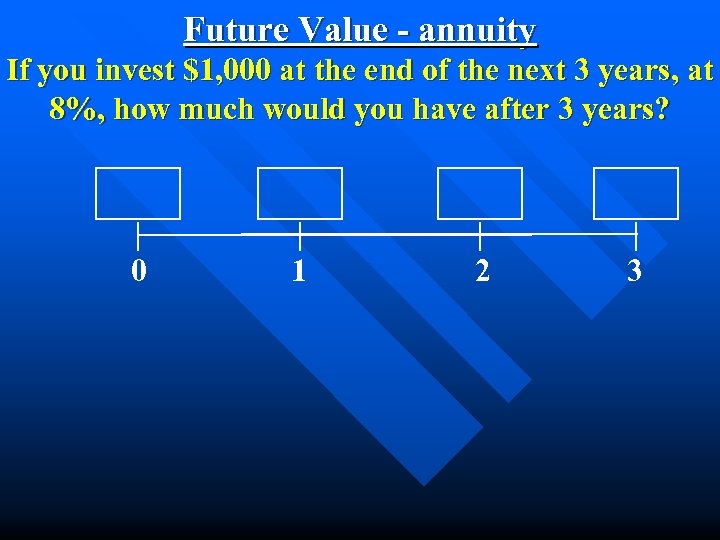 Future Value - annuity If you invest $1, 000 at the end of the next 3 years, at 8%, how much would you have after 3 years? 0 1 2 3
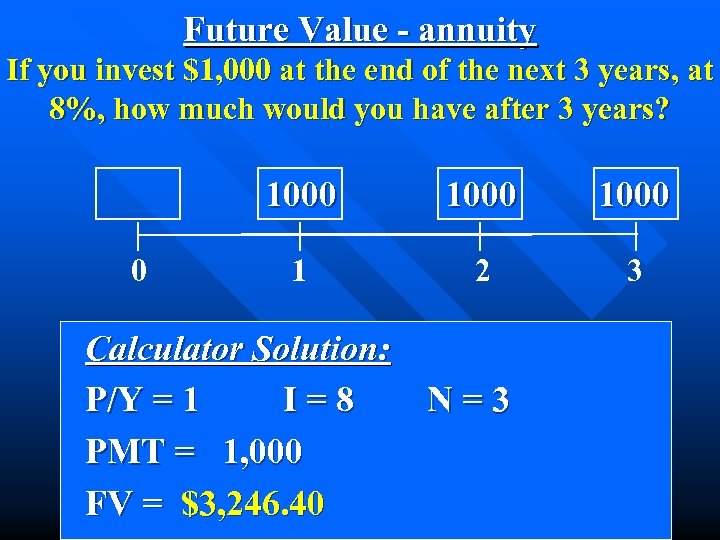 Future Value - annuity If you invest $1, 000 at the end of the next 3 years, at 8%, how much would you have after 3 years? 1000 0 1000 1 2 3 Calculator Solution: P/Y = 1 I=8 N=3 PMT = 1, 000 FV = $3, 246. 40
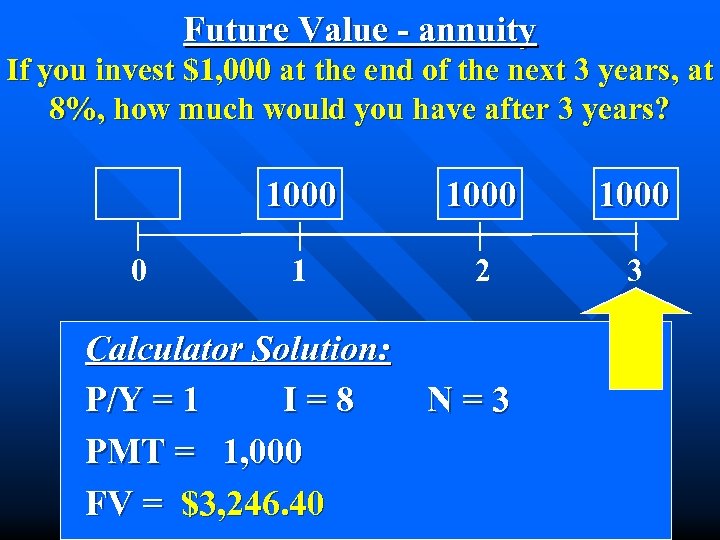 Future Value - annuity If you invest $1, 000 at the end of the next 3 years, at 8%, how much would you have after 3 years? 1000 0 1000 1 2 3 Calculator Solution: P/Y = 1 I=8 N=3 PMT = 1, 000 FV = $3, 246. 40
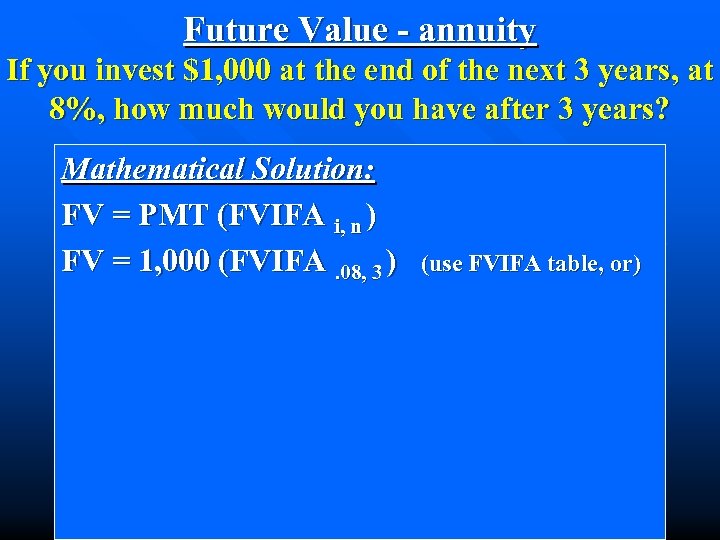 Future Value - annuity If you invest $1, 000 at the end of the next 3 years, at 8%, how much would you have after 3 years? Mathematical Solution: FV = PMT (FVIFA i, n ) FV = 1, 000 (FVIFA. 08, 3 ) (use FVIFA table, or)
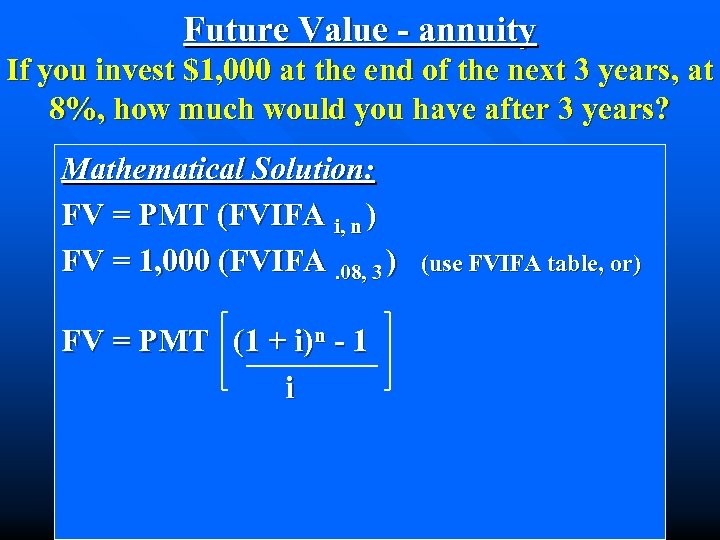 Future Value - annuity If you invest $1, 000 at the end of the next 3 years, at 8%, how much would you have after 3 years? Mathematical Solution: FV = PMT (FVIFA i, n ) FV = 1, 000 (FVIFA. 08, 3 ) FV = PMT (1 + i)n - 1 i (use FVIFA table, or)
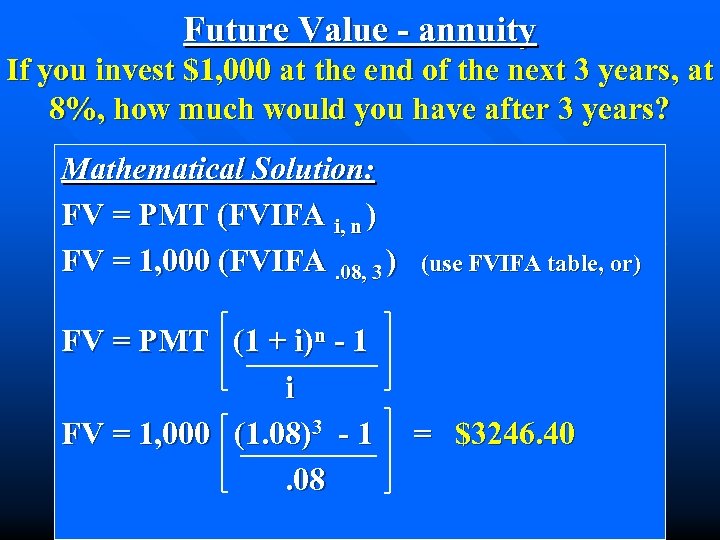 Future Value - annuity If you invest $1, 000 at the end of the next 3 years, at 8%, how much would you have after 3 years? Mathematical Solution: FV = PMT (FVIFA i, n ) FV = 1, 000 (FVIFA. 08, 3 ) FV = PMT (1 + i)n - 1 i FV = 1, 000 (1. 08)3 - 1. 08 (use FVIFA table, or) = $3246. 40
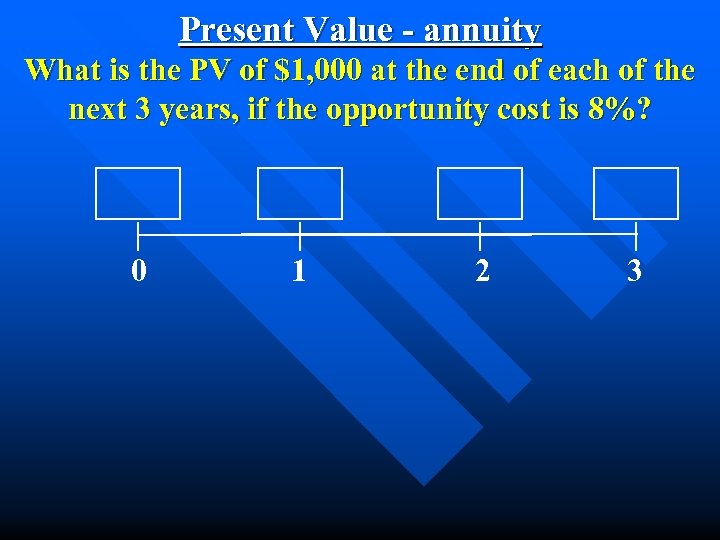 Present Value - annuity What is the PV of $1, 000 at the end of each of the next 3 years, if the opportunity cost is 8%? 0 1 2 3
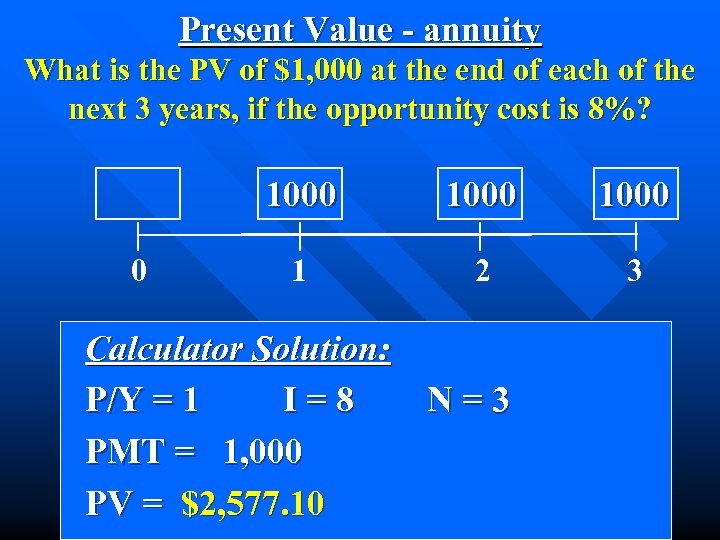 Present Value - annuity What is the PV of $1, 000 at the end of each of the next 3 years, if the opportunity cost is 8%? 1000 0 1000 1 2 3 Calculator Solution: P/Y = 1 I=8 N=3 PMT = 1, 000 PV = $2, 577. 10
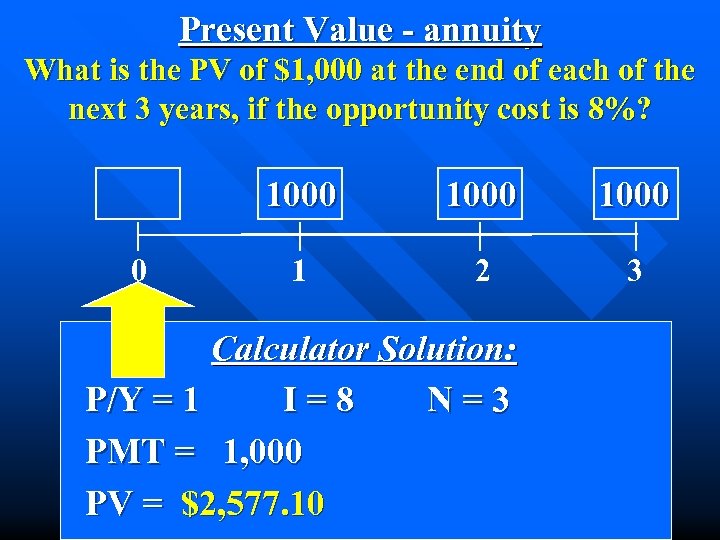 Present Value - annuity What is the PV of $1, 000 at the end of each of the next 3 years, if the opportunity cost is 8%? 1000 0 1000 1 2 3 Calculator Solution: P/Y = 1 I=8 N=3 PMT = 1, 000 PV = $2, 577. 10
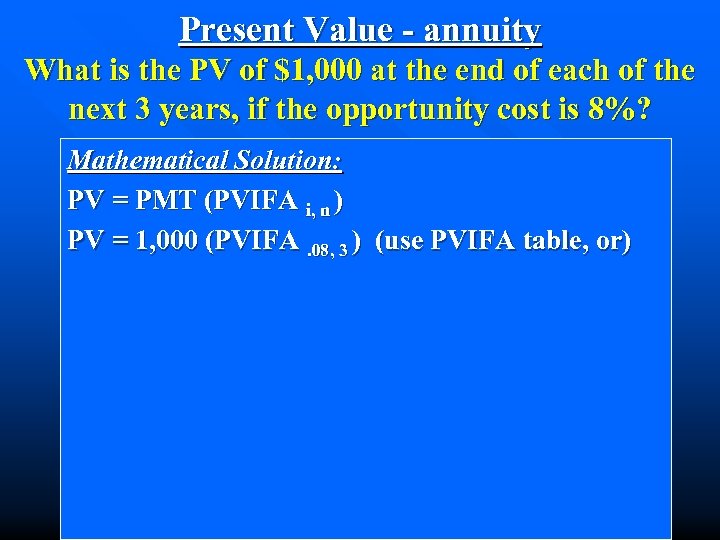 Present Value - annuity What is the PV of $1, 000 at the end of each of the next 3 years, if the opportunity cost is 8%? Mathematical Solution: PV = PMT (PVIFA i, n ) PV = 1, 000 (PVIFA. 08, 3 ) (use PVIFA table, or)
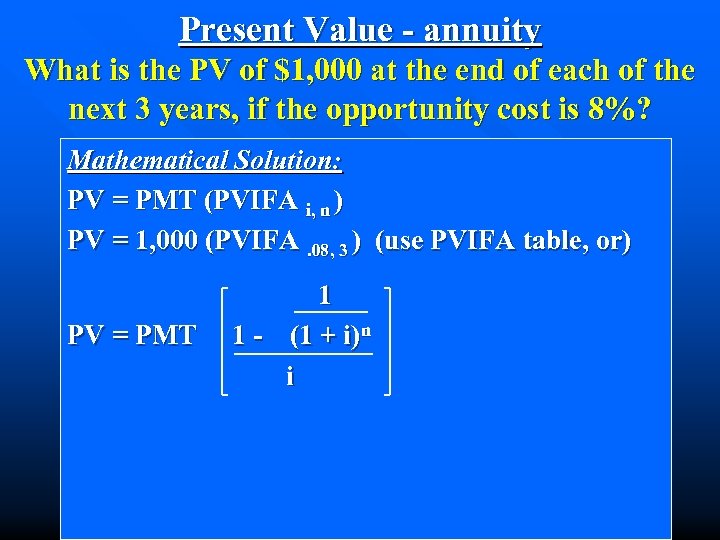 Present Value - annuity What is the PV of $1, 000 at the end of each of the next 3 years, if the opportunity cost is 8%? Mathematical Solution: PV = PMT (PVIFA i, n ) PV = 1, 000 (PVIFA. 08, 3 ) (use PVIFA table, or) PV = PMT 1 1 - (1 + i)n i
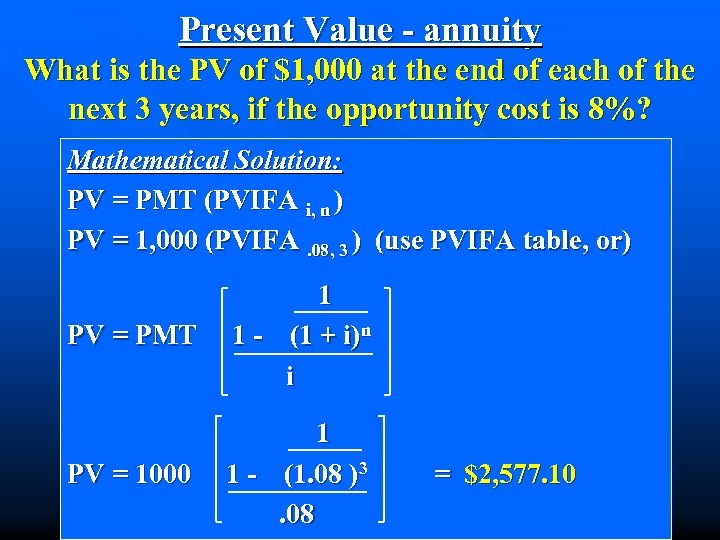 Present Value - annuity What is the PV of $1, 000 at the end of each of the next 3 years, if the opportunity cost is 8%? Mathematical Solution: PV = PMT (PVIFA i, n ) PV = 1, 000 (PVIFA. 08, 3 ) (use PVIFA table, or) PV = PMT 1 1 - (1 + i)n i PV = 1000 1 1 - (1. 08 )3. 08 = $2, 577. 10
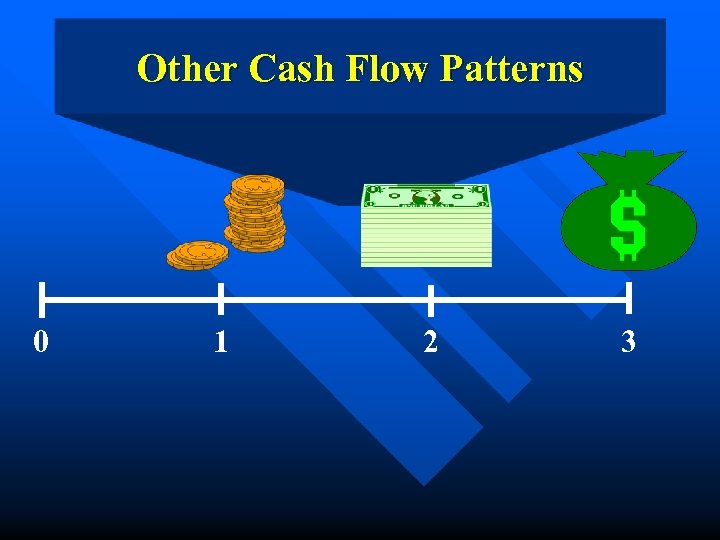 Other Cash Flow Patterns 0 1 2 3
 Perpetuities n Suppose you will receive a fixed payment every period (month, year, etc. ) forever. This is an example of a perpetuity. n You can think of a perpetuity as an annuity that goes on forever.
 Present Value of a Perpetuity n When we find the PV of an annuity, we think of the following relationship:
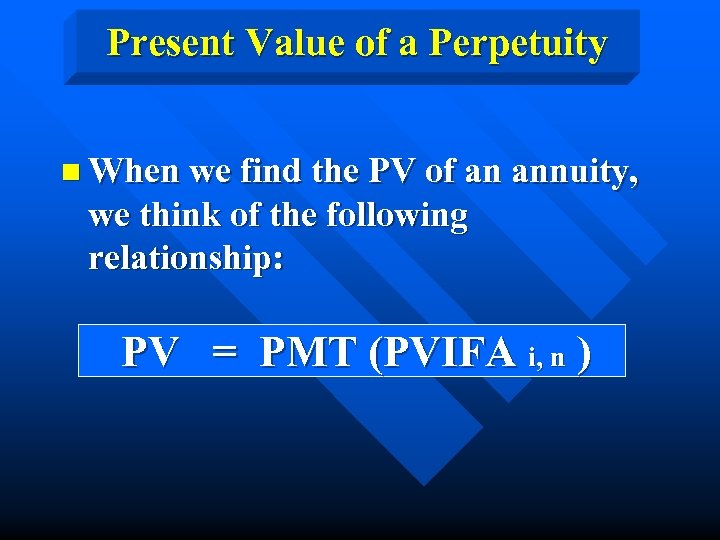 Present Value of a Perpetuity n When we find the PV of an annuity, we think of the following relationship: PV = PMT (PVIFA i, n )
 Mathematically, (PVIFA i, n ) =
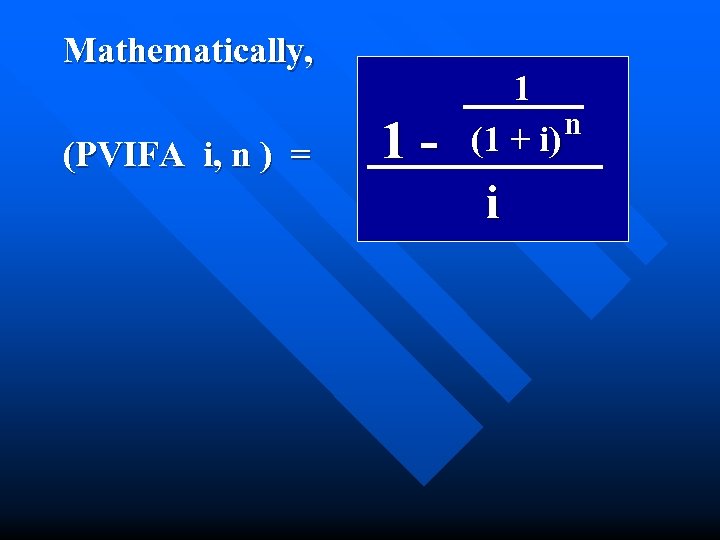 Mathematically, (PVIFA i, n ) = 1 - 1 n (1 + i) i
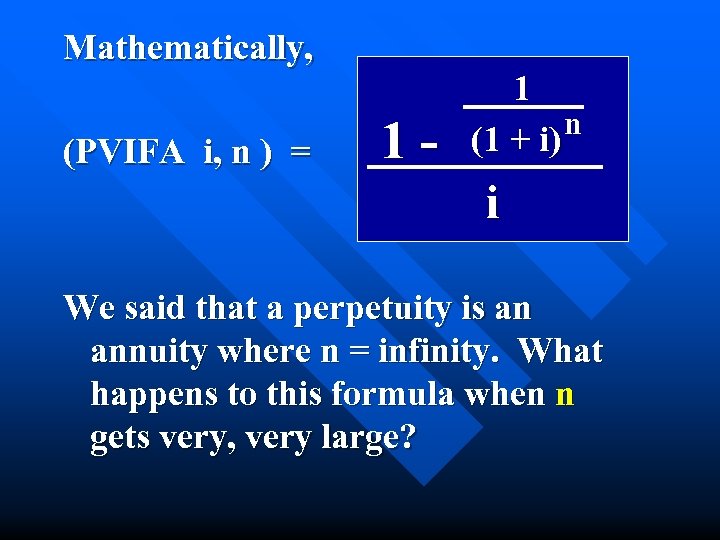 Mathematically, (PVIFA i, n ) = 1 - 1 n (1 + i) i We said that a perpetuity is an annuity where n = infinity. What happens to this formula when n gets very, very large?
 When n gets very large,
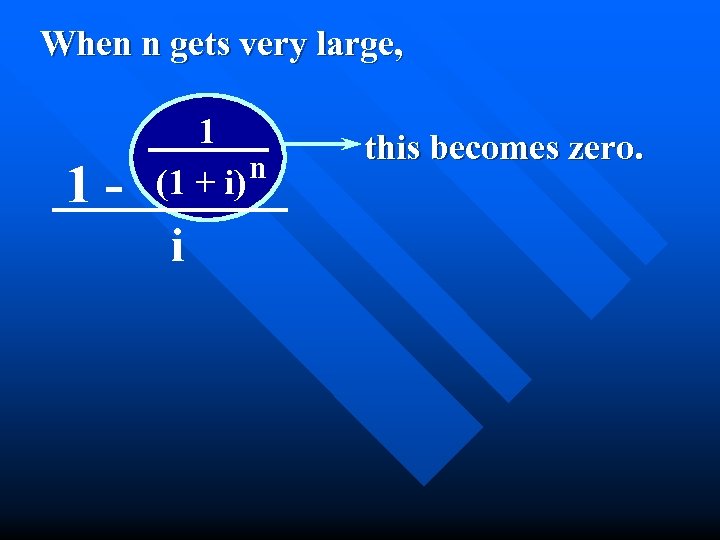 When n gets very large, 1 - 1 n (1 + i) i this becomes zero.
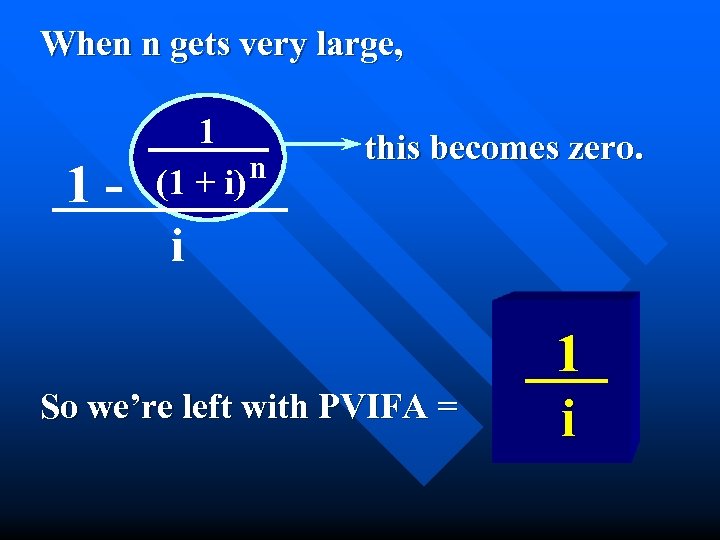 When n gets very large, 1 - 1 n (1 + i) this becomes zero. i So we’re left with PVIFA = 1 i
 Present Value of a Perpetuity n So, the PV of a perpetuity is very simple to find:
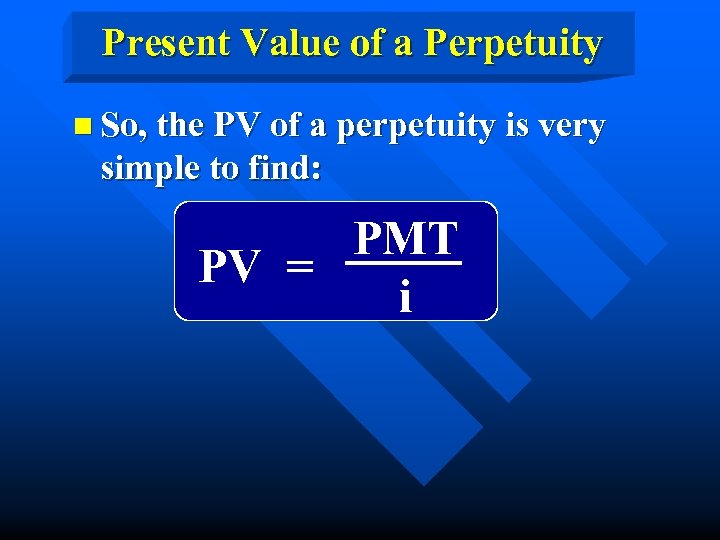 Present Value of a Perpetuity n So, the PV of a perpetuity is very simple to find: PMT PV = i
 What should you be willing to pay in order to receive $10, 000 annually forever, if you require 8% per year on the investment?
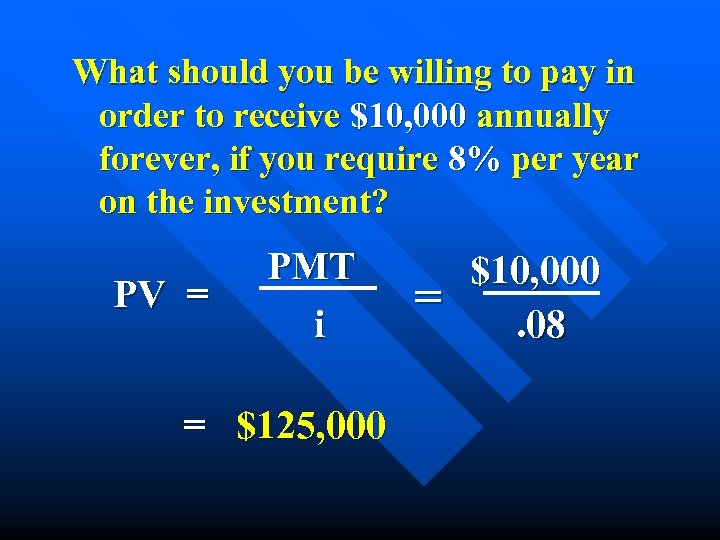 What should you be willing to pay in order to receive $10, 000 annually forever, if you require 8% per year on the investment? PV = PMT i = $125, 000 = $10, 000. 08
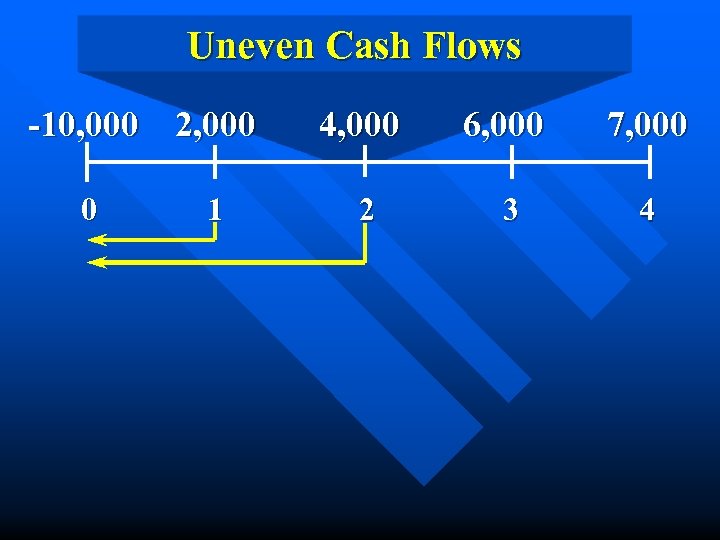
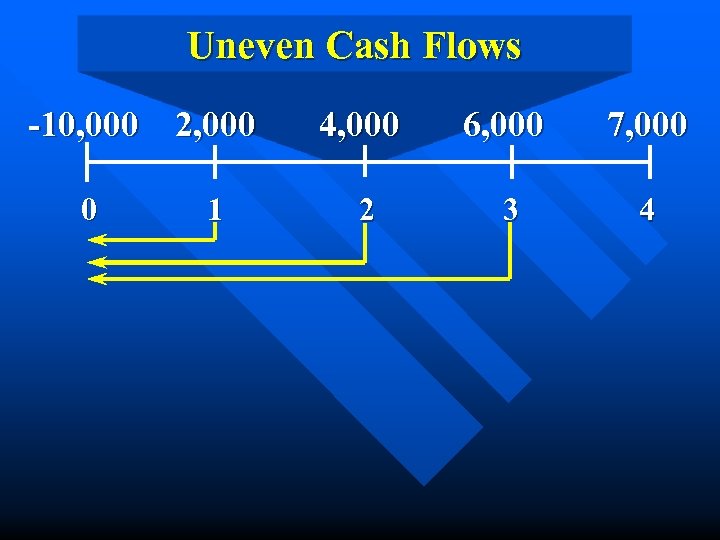
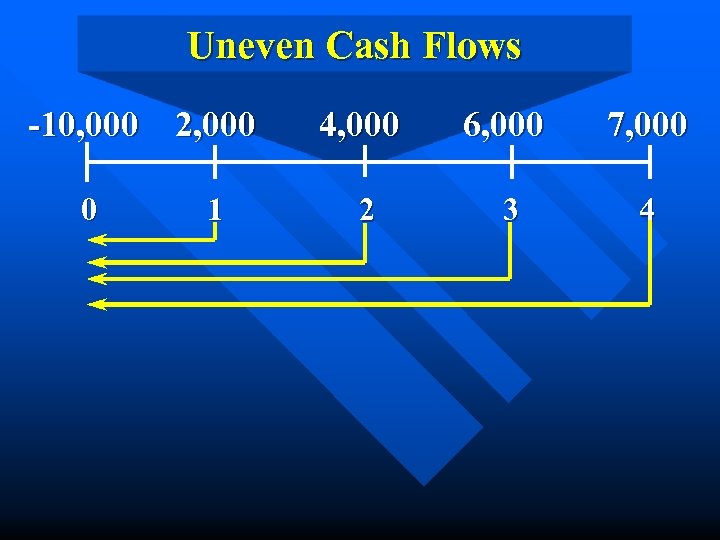
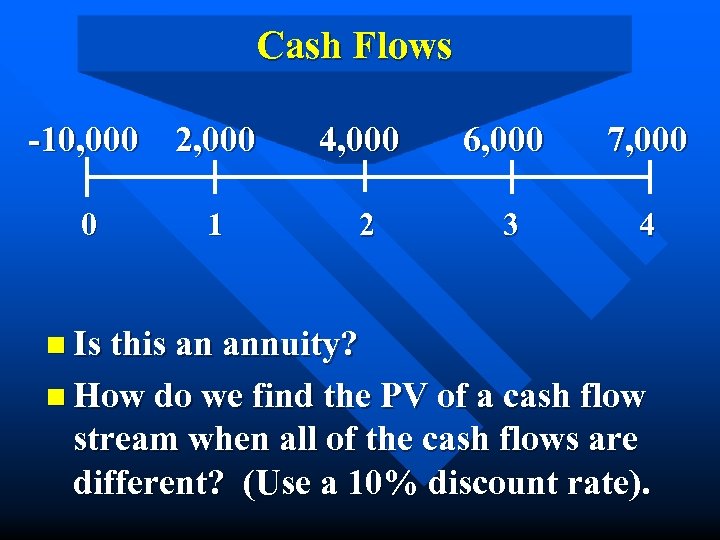 Cash Flows -10, 000 2, 000 0 1 4, 000 6, 000 7, 000 2 3 4 n Is this an annuity? n How do we find the PV of a cash flow stream when all of the cash flows are different? (Use a 10% discount rate).
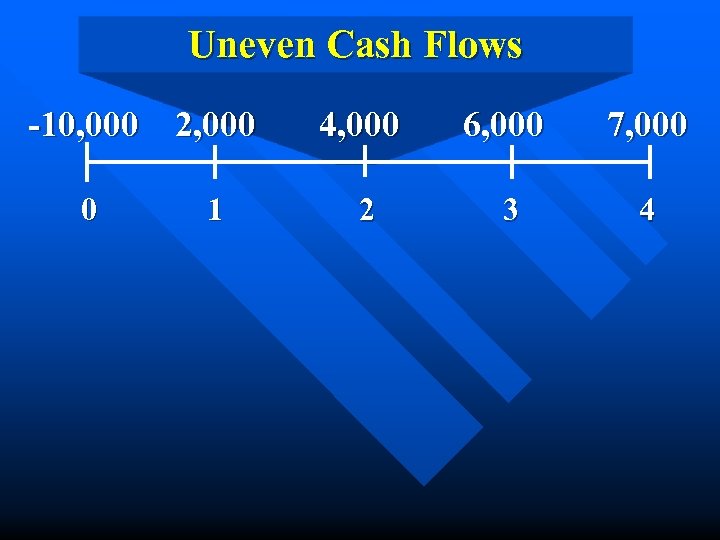 Uneven Cash Flows -10, 000 2, 000 0 1 4, 000 6, 000 7, 000 2 3 4
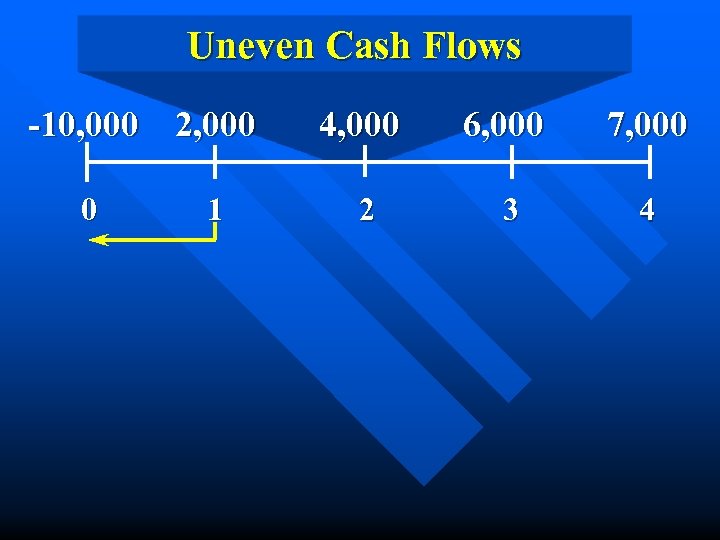 Uneven Cash Flows -10, 000 2, 000 0 1 4, 000 6, 000 7, 000 2 3 4
 Uneven Cash Flows -10, 000 2, 000 0 1 4, 000 6, 000 7, 000 2 3 4
 Uneven Cash Flows -10, 000 2, 000 0 1 4, 000 6, 000 7, 000 2 3 4
 Uneven Cash Flows -10, 000 2, 000 0 1 4, 000 6, 000 7, 000 2 3 4
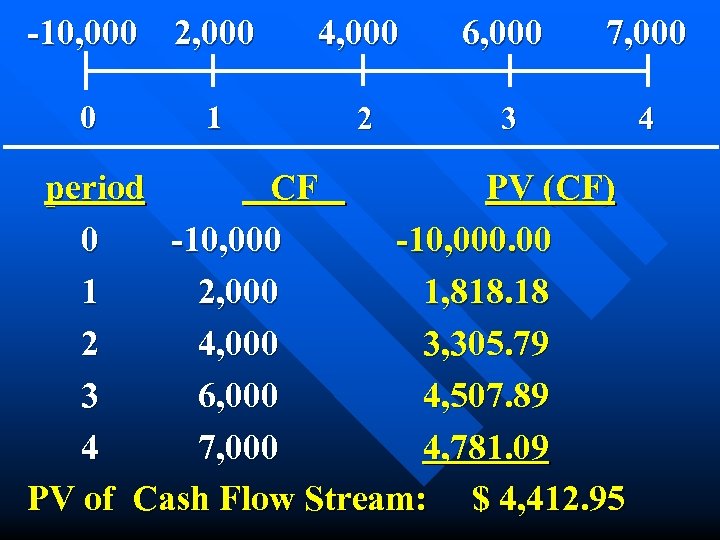 -10, 000 2, 000 0 1 4, 000 6, 000 7, 000 2 3 4 period CF PV (CF) 0 -10, 000. 00 1 2, 000 1, 818. 18 2 4, 000 3, 305. 79 3 6, 000 4, 507. 89 4 7, 000 4, 781. 09 PV of Cash Flow Stream: $ 4, 412. 95
 Example n After graduation, you plan to invest $400 per month in the stock market. If you earn 12% per year on your stocks, how much will you have accumulated when you retire in 30 years?
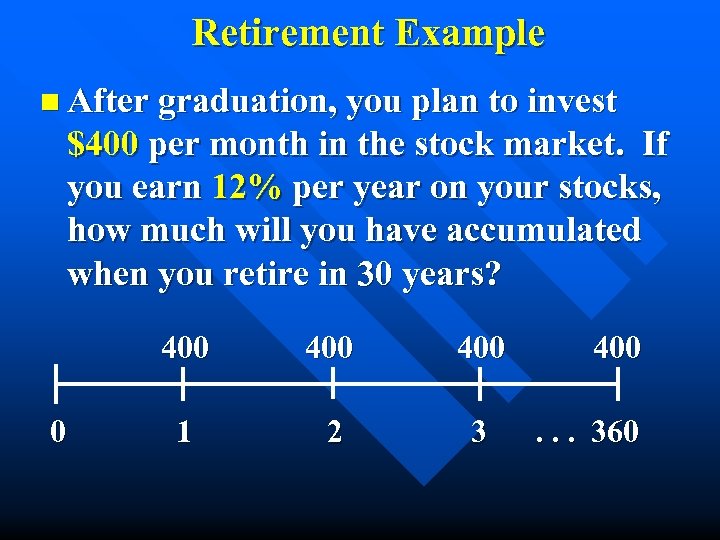 Retirement Example n After graduation, you plan to invest $400 per month in the stock market. If you earn 12% per year on your stocks, how much will you have accumulated when you retire in 30 years? 400 0 400 1 2 3 400. . . 360
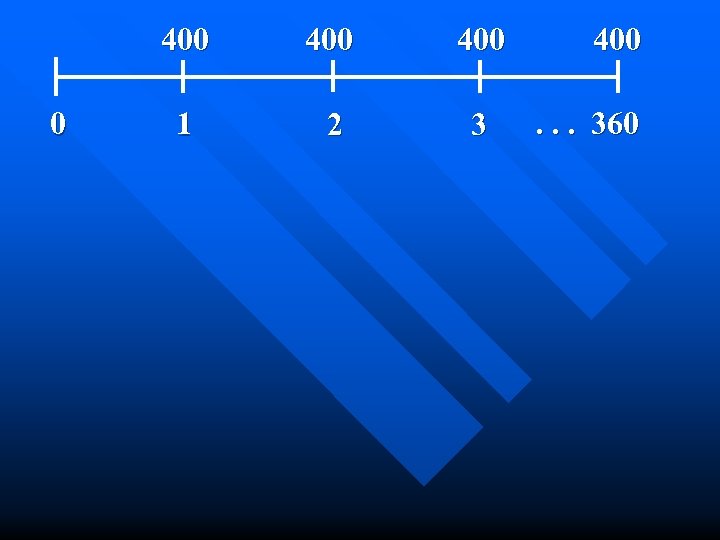 400 0 400 1 2 3 400. . . 360
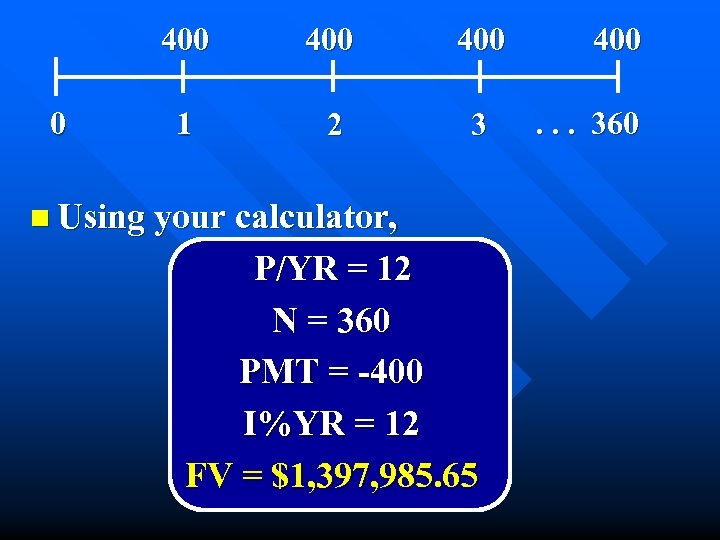 400 0 400 1 2 3 n Using your calculator, P/YR = 12 N = 360 PMT = -400 I%YR = 12 FV = $1, 397, 985. 65 400. . . 360
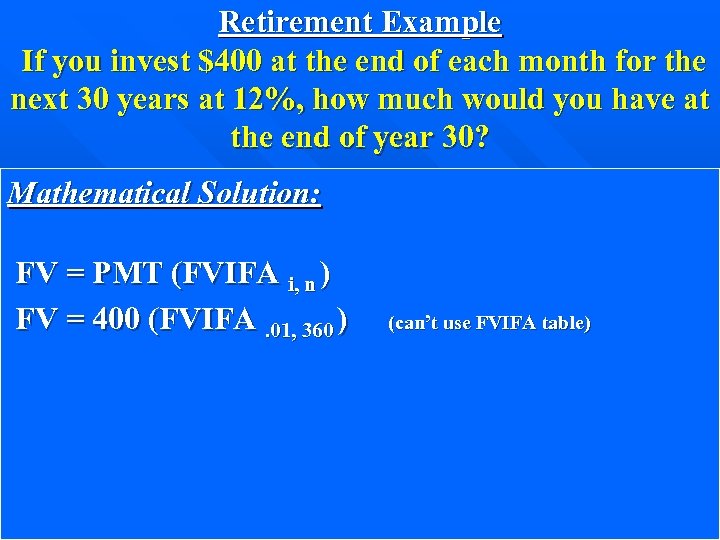 Retirement Example If you invest $400 at the end of each month for the next 30 years at 12%, how much would you have at the end of year 30? Mathematical Solution: FV = PMT (FVIFA i, n ) FV = 400 (FVIFA. 01, 360 ) (can’t use FVIFA table)
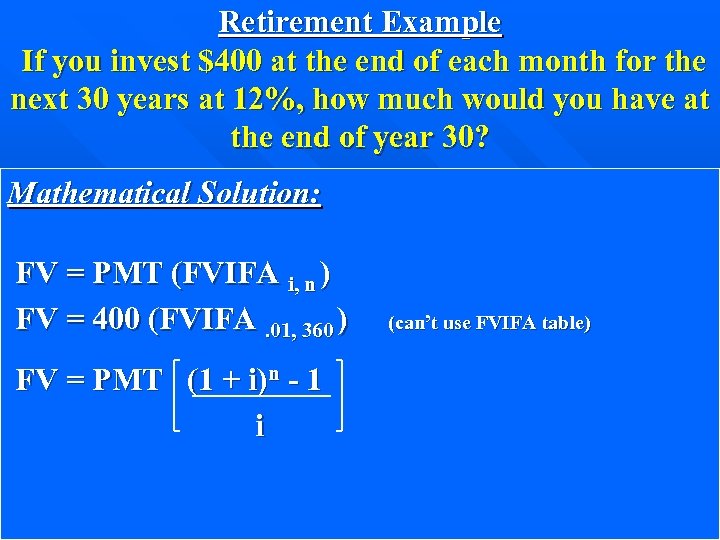 Retirement Example If you invest $400 at the end of each month for the next 30 years at 12%, how much would you have at the end of year 30? Mathematical Solution: FV = PMT (FVIFA i, n ) FV = 400 (FVIFA. 01, 360 ) FV = PMT (1 + i)n - 1 i (can’t use FVIFA table)
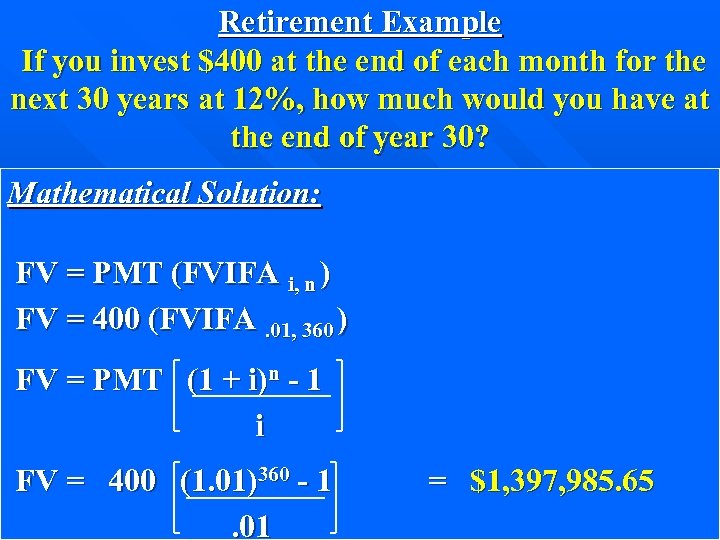 Retirement Example If you invest $400 at the end of each month for the next 30 years at 12%, how much would you have at the end of year 30? Mathematical Solution: FV = PMT (FVIFA i, n ) FV = 400 (FVIFA. 01, 360 ) FV = PMT (1 + i)n - 1 i FV = 400 (1. 01)360 - 1. 01 = $1, 397, 985. 65
 House Payment Example If you borrow $100, 000 at 7% fixed interest for 30 years in order to buy a house, what will be your monthly house payment?
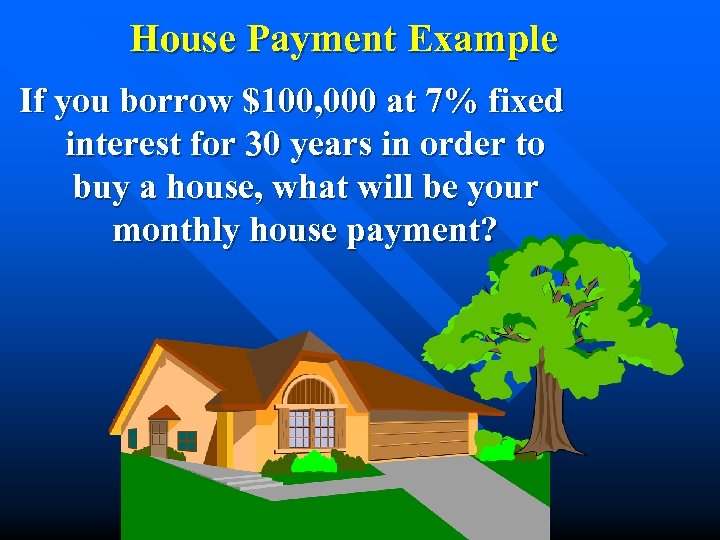 House Payment Example If you borrow $100, 000 at 7% fixed interest for 30 years in order to buy a house, what will be your monthly house payment?
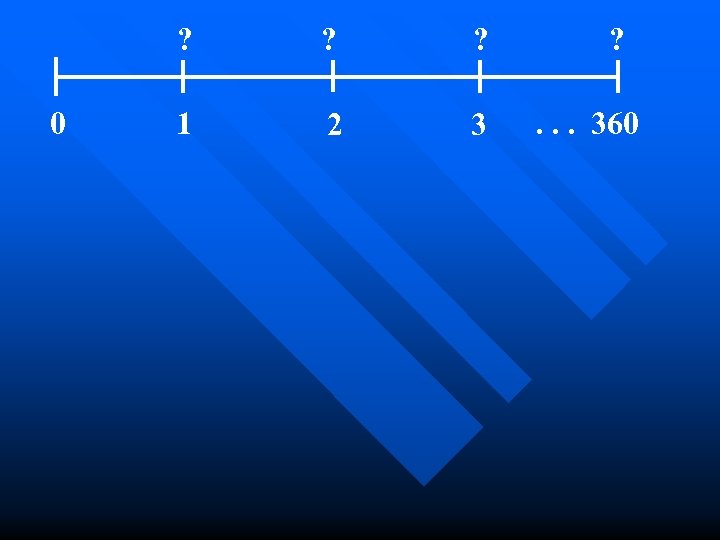 ? 0 ? ? 1 2 3 ? . . . 360
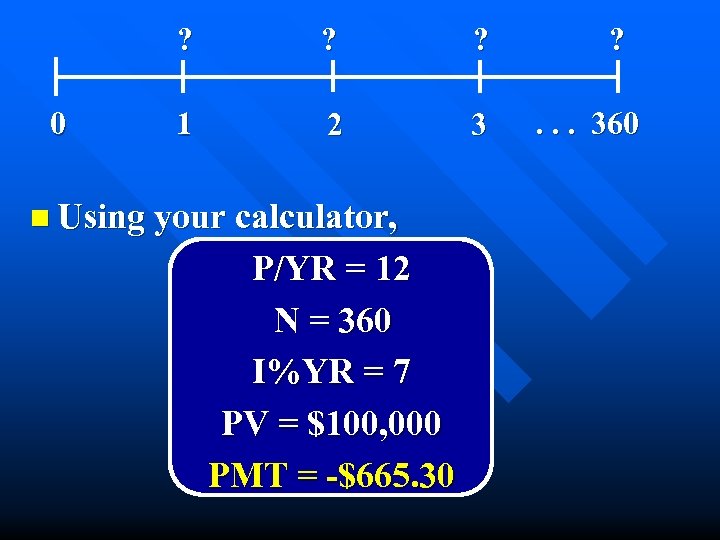 ? 0 ? ? 1 2 3 n Using your calculator, P/YR = 12 N = 360 I%YR = 7 PV = $100, 000 PMT = -$665. 30 ? . . . 360
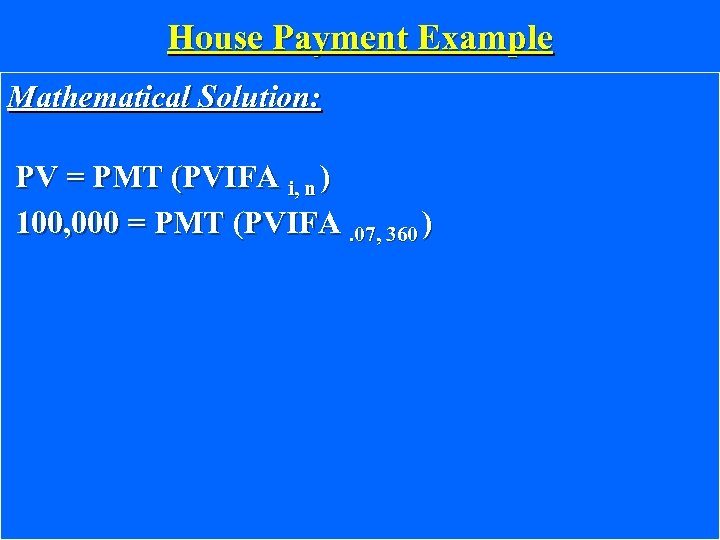 House Payment Example Mathematical Solution: PV = PMT (PVIFA i, n ) 100, 000 = PMT (PVIFA. 07, 360 )
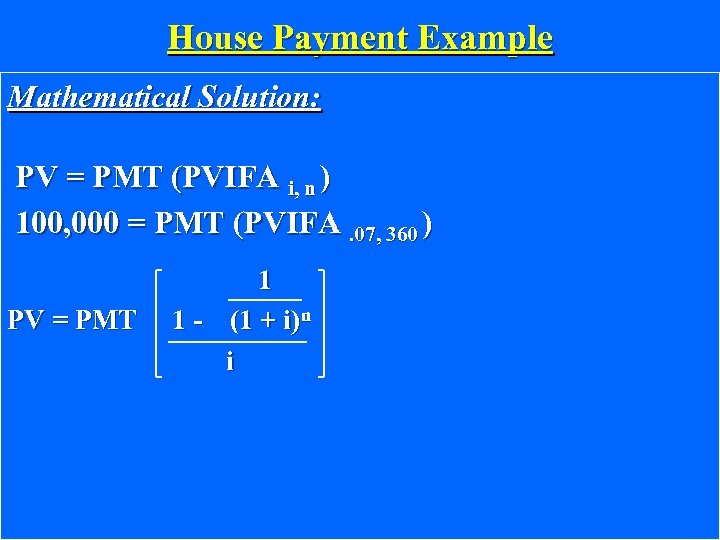 House Payment Example Mathematical Solution: PV = PMT (PVIFA i, n ) 100, 000 = PMT (PVIFA. 07, 360 ) PV = PMT 1 1 - (1 + i)n i
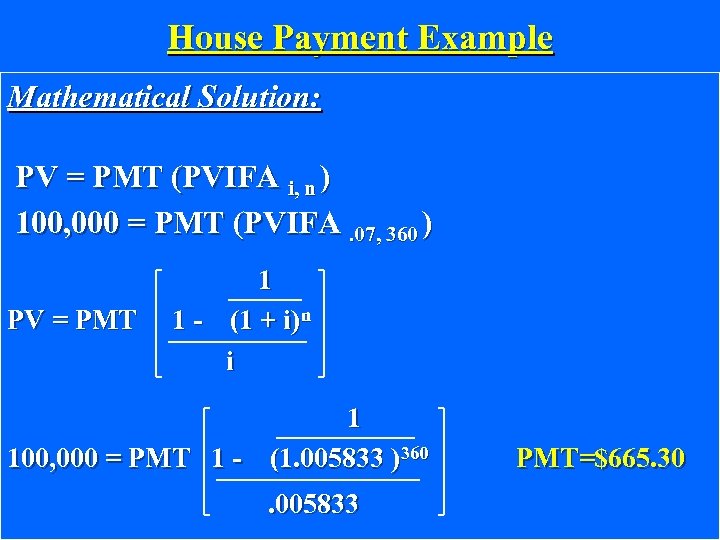 House Payment Example Mathematical Solution: PV = PMT (PVIFA i, n ) 100, 000 = PMT (PVIFA. 07, 360 ) PV = PMT 1 1 - (1 + i)n i 1 100, 000 = PMT 1 - (1. 005833 )360. 005833 PMT=$665. 30