

The Theory of Consumer Choice Chapter 21 Copyright


 Скачать презентацию The Theory of Consumer Choice Chapter 21 Copyright
38738-chap_21.ppt
- Количество слайдов: 95
The Theory of Consumer Choice Chapter 21 Copyright © 2001 by Harcourt, Inc. All rights reserved. Requests for permission to make copies of any part of the work should be mailed to: Permissions Department, Harcourt College Publishers, 6277 Sea Harbor Drive, Orlando, Florida 32887-6777.
The theory of consumer choice addresses the following questions: Do all demand curves slope downward? How do wages affect labor supply? How do interest rates affect household saving? Do the poor prefer to receive cash or in-kind transfers?
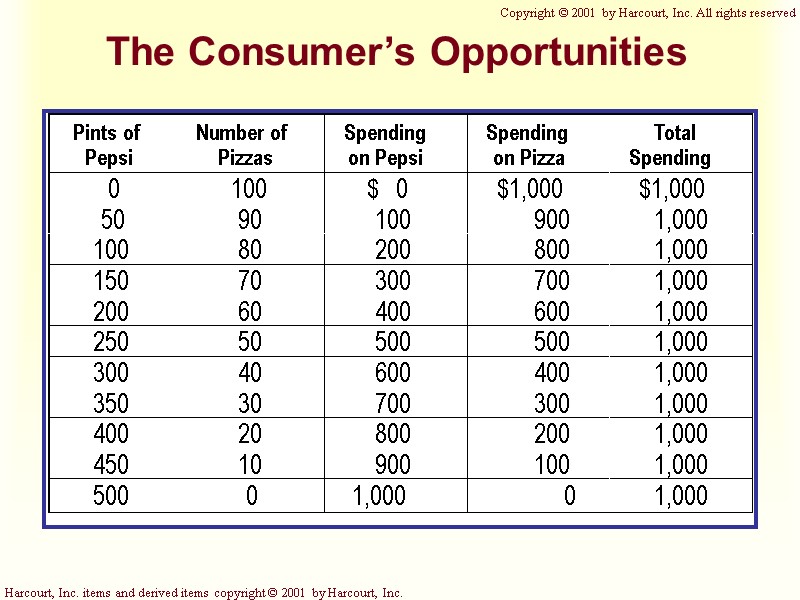
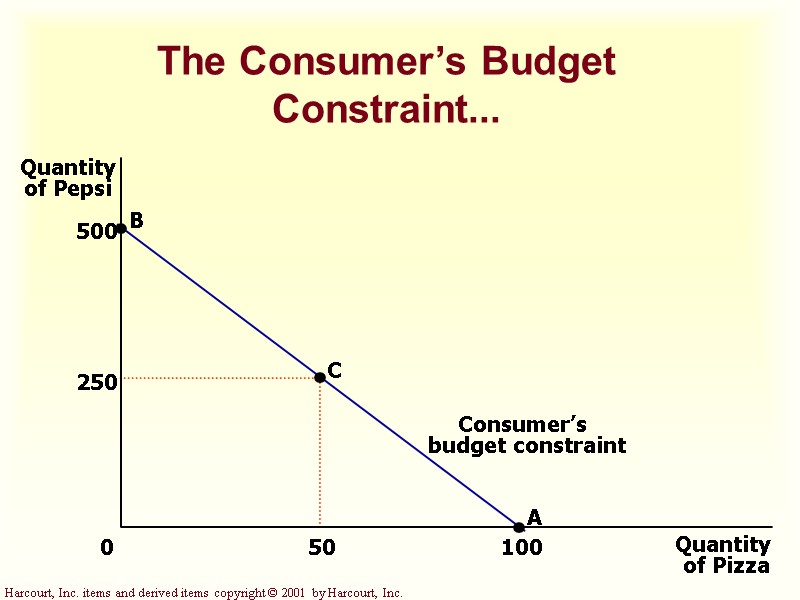
The Budget Constraint The budget constraint depicts the consumption “bundles” that a consumer can afford. People consume less than they desire because their spending is constrained, or limited, by their income.
The Budget Constraint It shows the various combinations of goods the consumer can afford given his or her income and the prices of the two goods.
The Consumer’s Opportunities Copyright © 2001 by Harcourt, Inc. All rights reserved
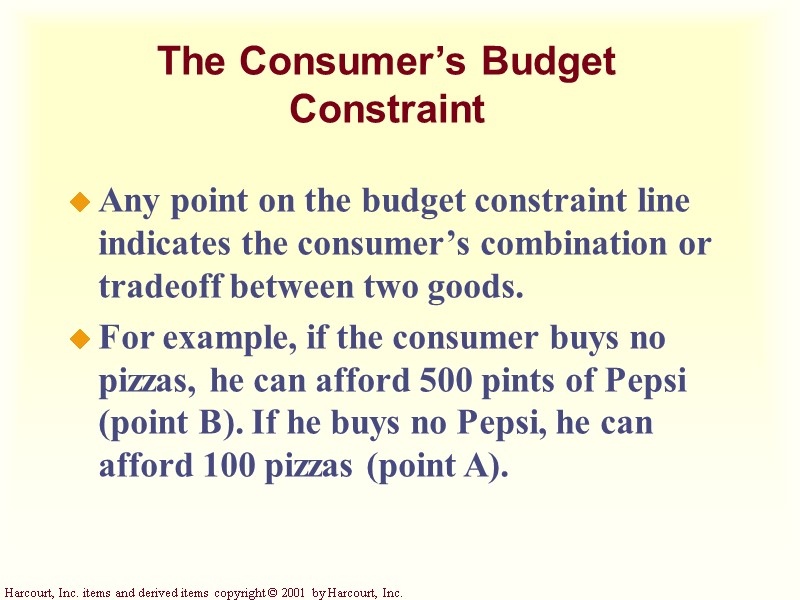
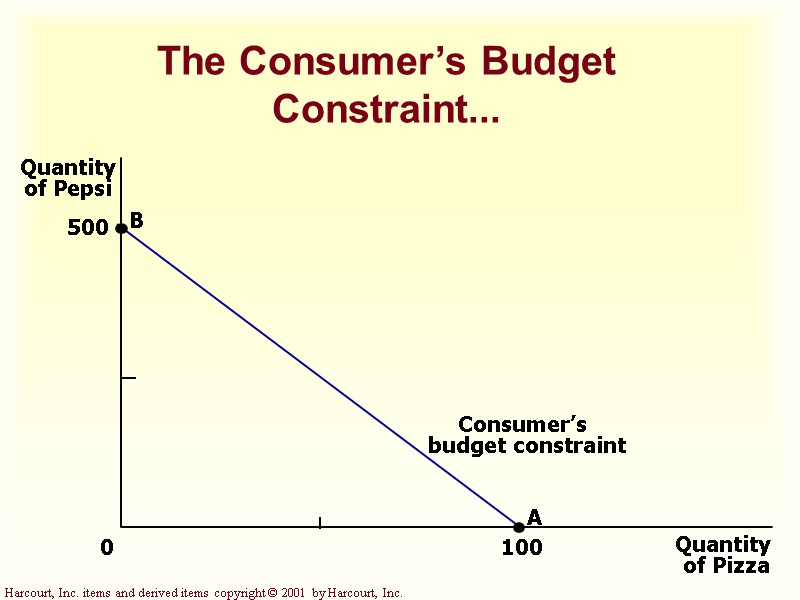
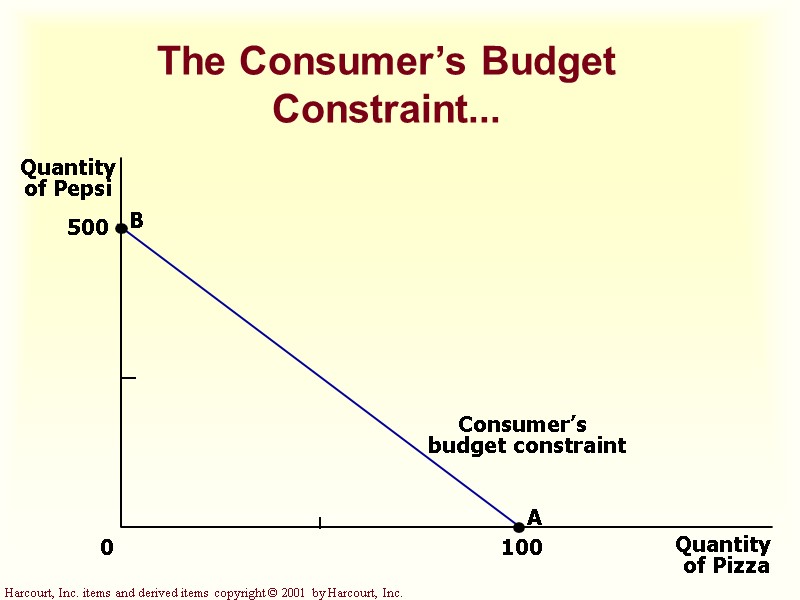
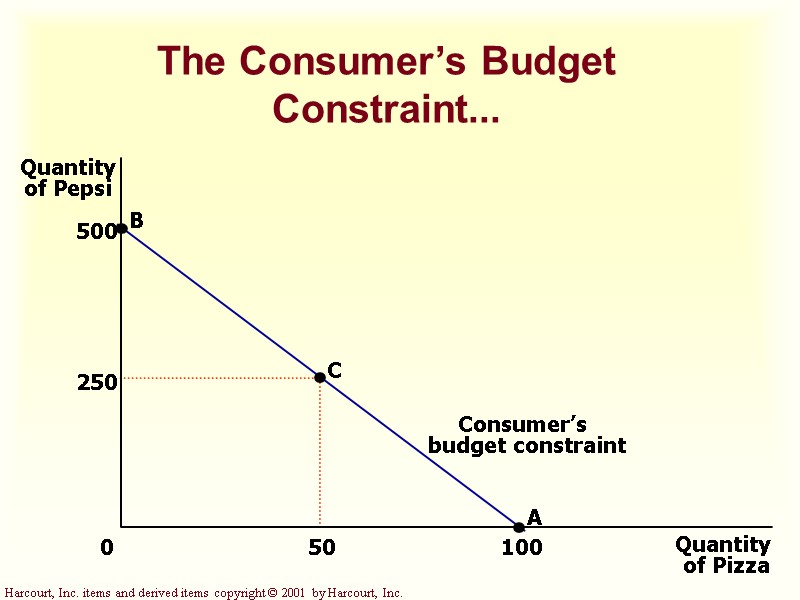
The Consumer’s Budget Constraint Any point on the budget constraint line indicates the consumer’s combination or tradeoff between two goods. For example, if the consumer buys no pizzas, he can afford 500 pints of Pepsi (point B). If he buys no Pepsi, he can afford 100 pizzas (point A).
The Consumer’s Budget Constraint... 0
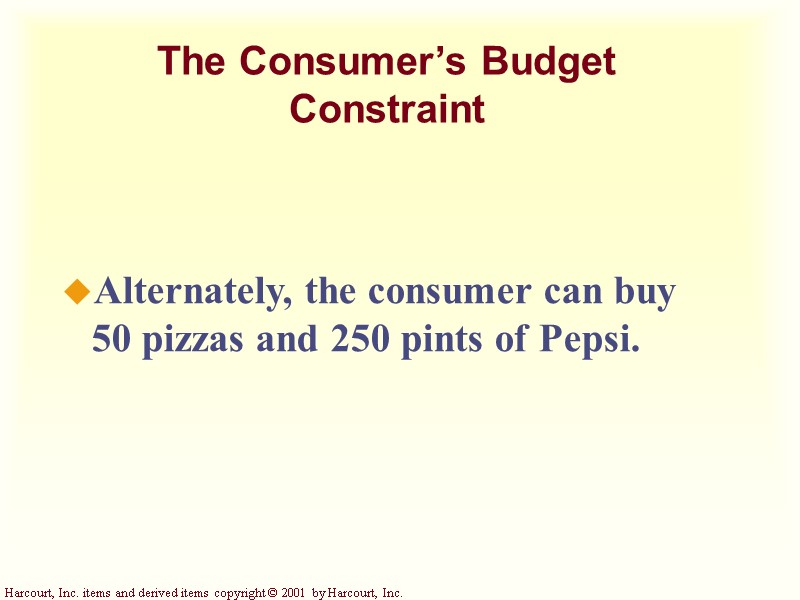
The Consumer’s Budget Constraint Alternately, the consumer can buy 50 pizzas and 250 pints of Pepsi.
The Consumer’s Budget Constraint... 0 100 500 B A
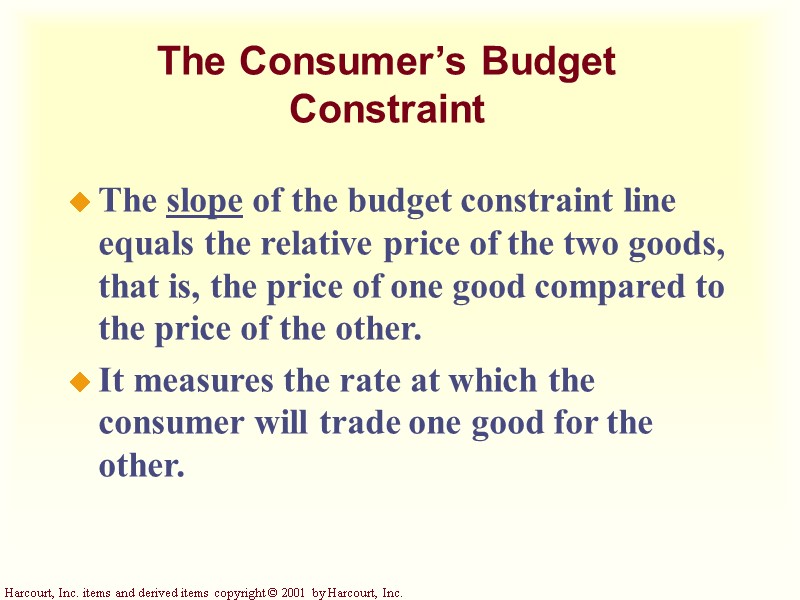
The Consumer’s Budget Constraint The slope of the budget constraint line equals the relative price of the two goods, that is, the price of one good compared to the price of the other. It measures the rate at which the consumer will trade one good for the other.
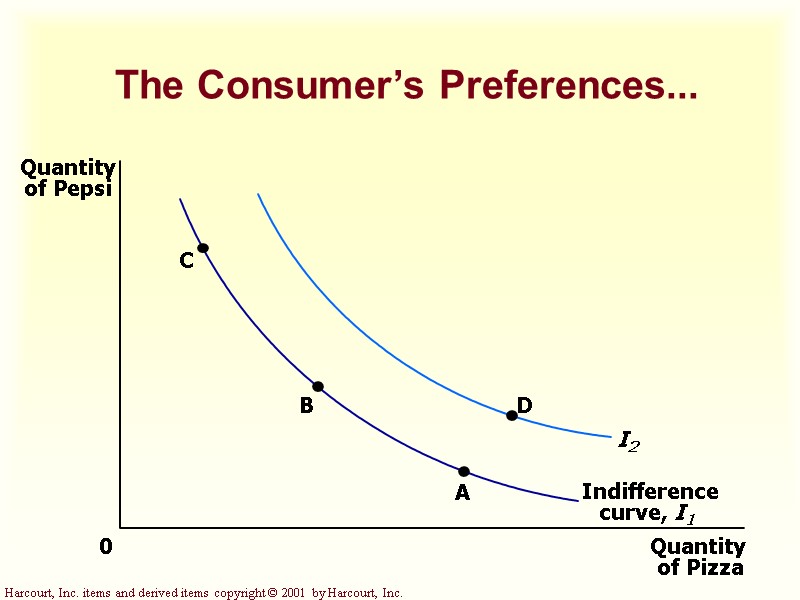
Preferences: What the Consumer Wants A consumer’s preference among consumption bundles may be illustrated with indifference curves.
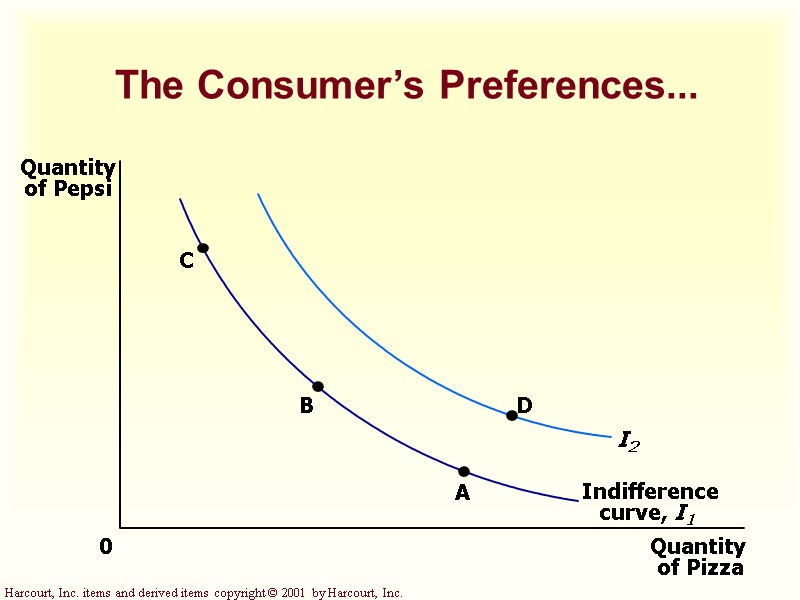
Representing Preferences with Indifference Curves An indifference curve shows bundles of goods that make the consumer equally happy.
The Consumer’s Preferences... 0
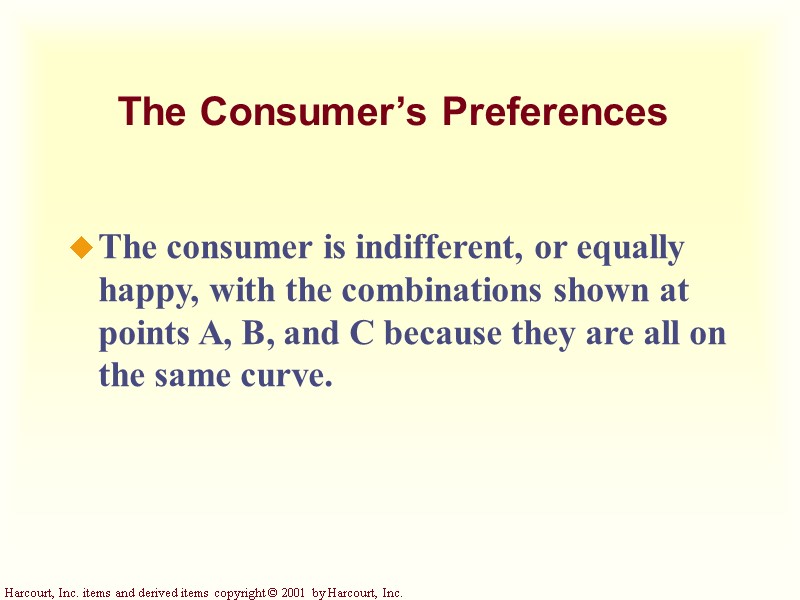
The consumer is indifferent, or equally happy, with the combinations shown at points A, B, and C because they are all on the same curve. The Consumer’s Preferences
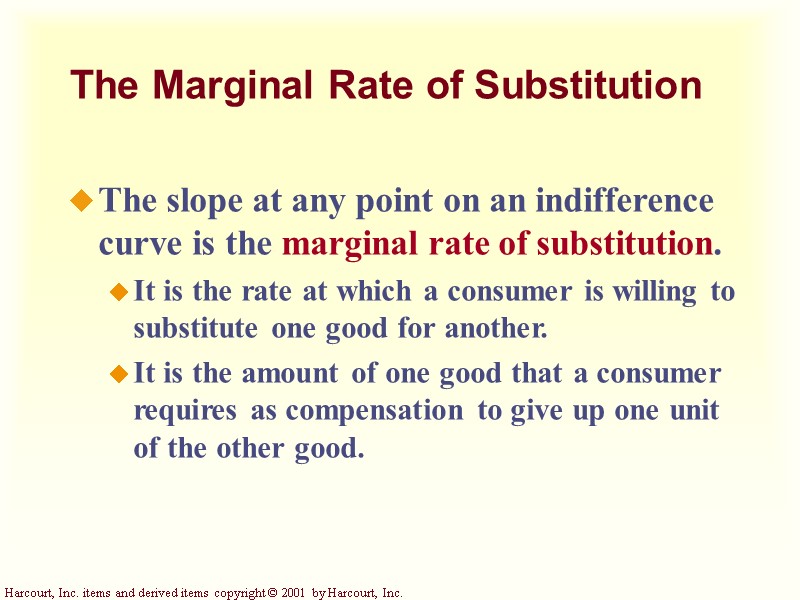
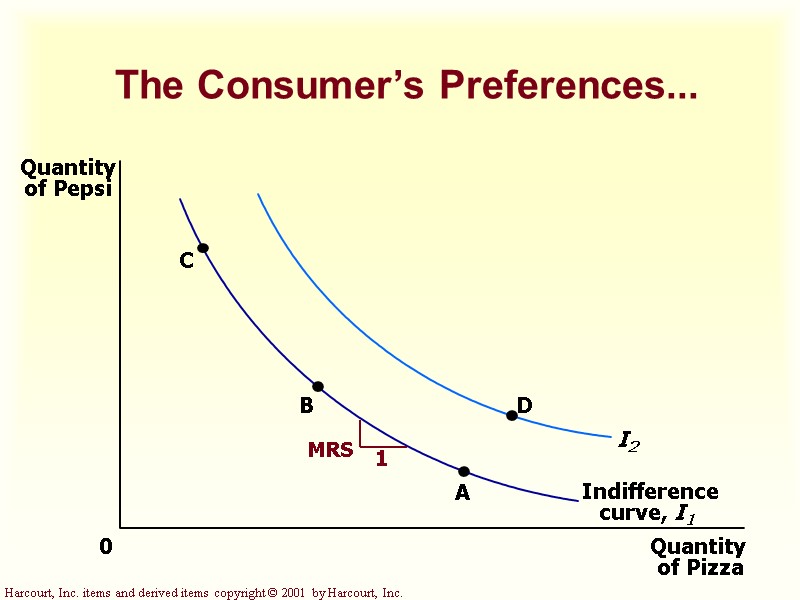
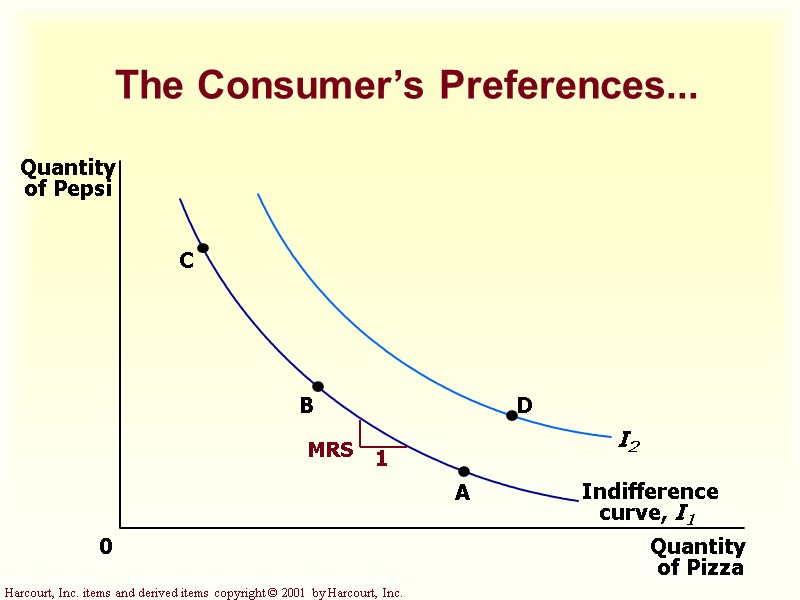
The Marginal Rate of Substitution The slope at any point on an indifference curve is the marginal rate of substitution. It is the rate at which a consumer is willing to substitute one good for another. It is the amount of one good that a consumer requires as compensation to give up one unit of the other good.
The Consumer’s Preferences... 0 C B A D I2
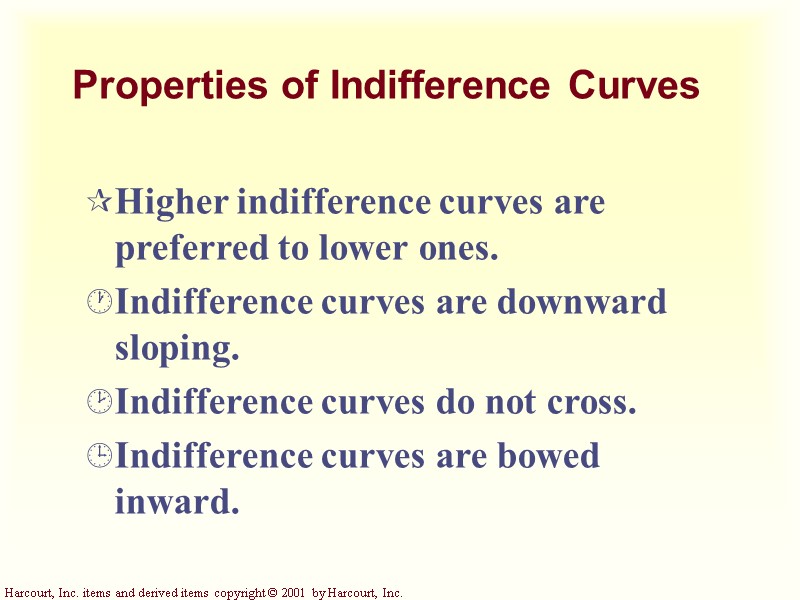
Properties of Indifference Curves Higher indifference curves are preferred to lower ones. Indifference curves are downward sloping. Indifference curves do not cross. Indifference curves are bowed inward.
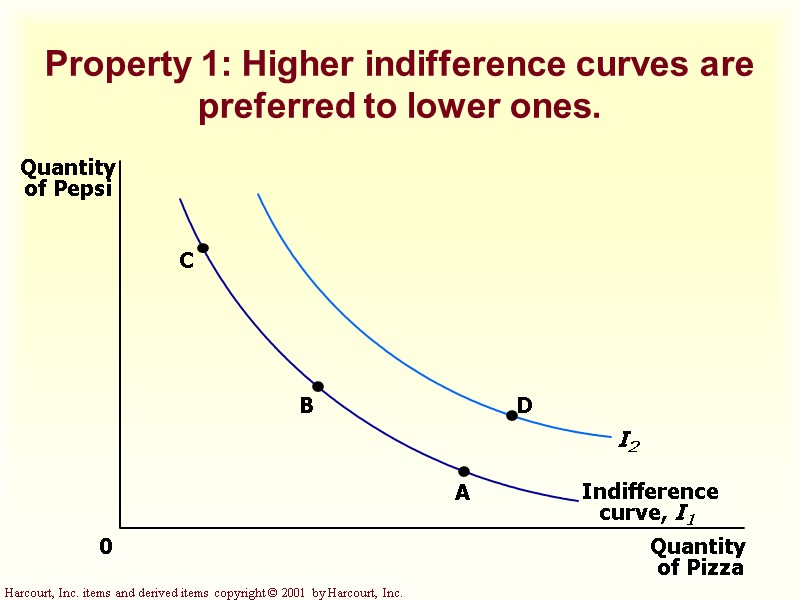
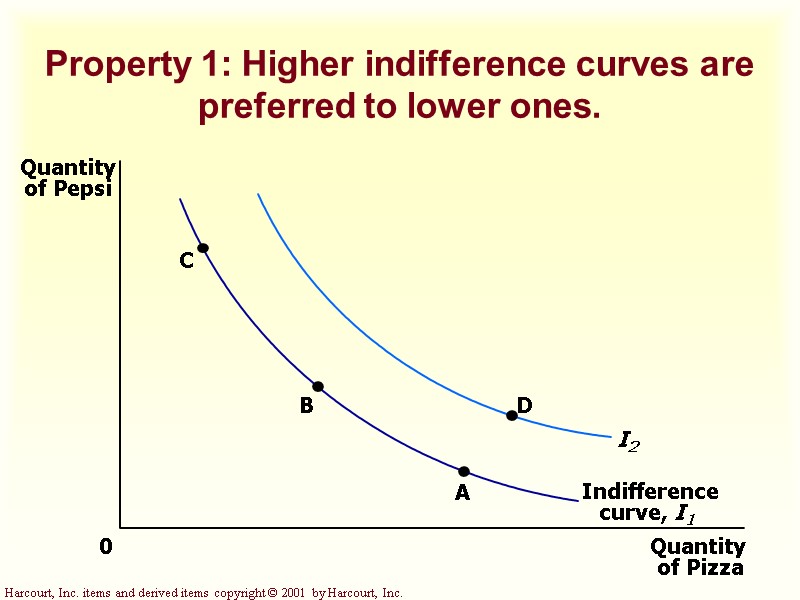
Property 1: Higher indifference curves are preferred to lower ones. Consumers usually prefer more of something to less of it. Higher indifference curves represent larger quantities of goods than do lower indifference curves.
Property 1: Higher indifference curves are preferred to lower ones. 0 C B A D I2
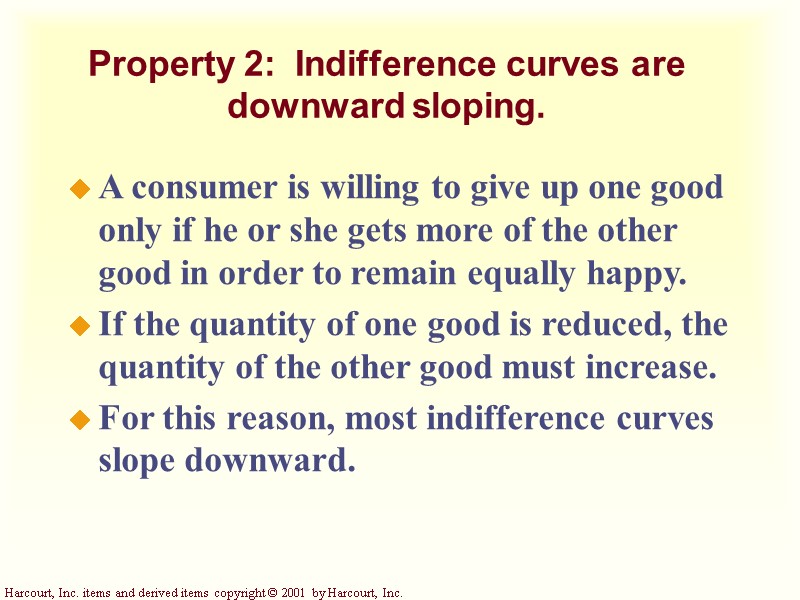
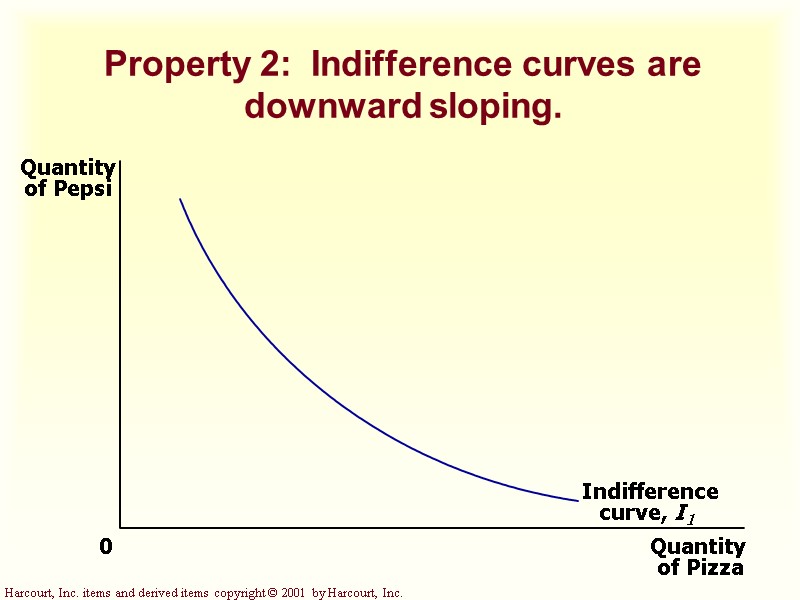
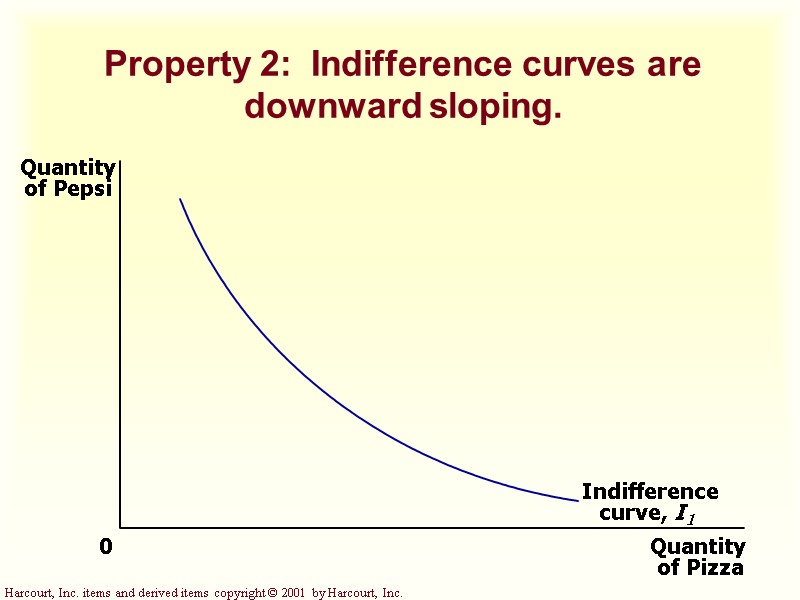
Property 2: Indifference curves are downward sloping. A consumer is willing to give up one good only if he or she gets more of the other good in order to remain equally happy. If the quantity of one good is reduced, the quantity of the other good must increase. For this reason, most indifference curves slope downward.
Property 2: Indifference curves are downward sloping. 0
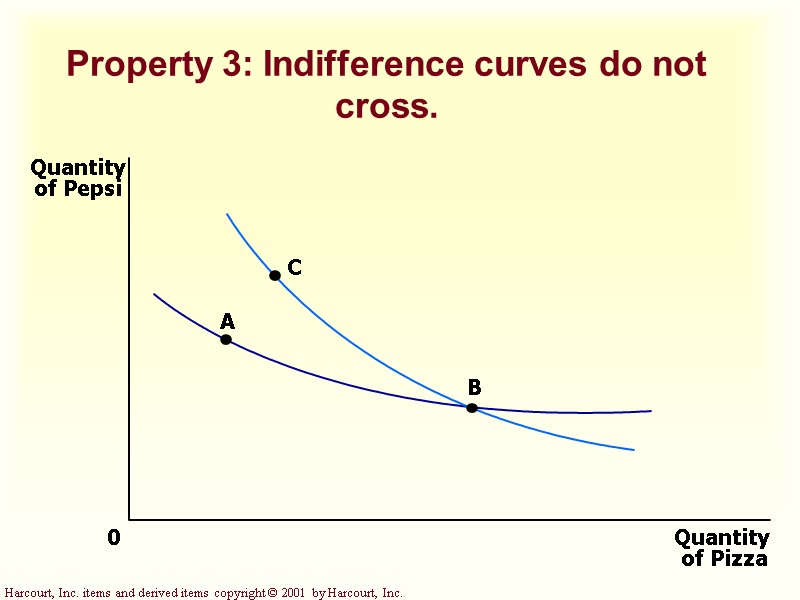
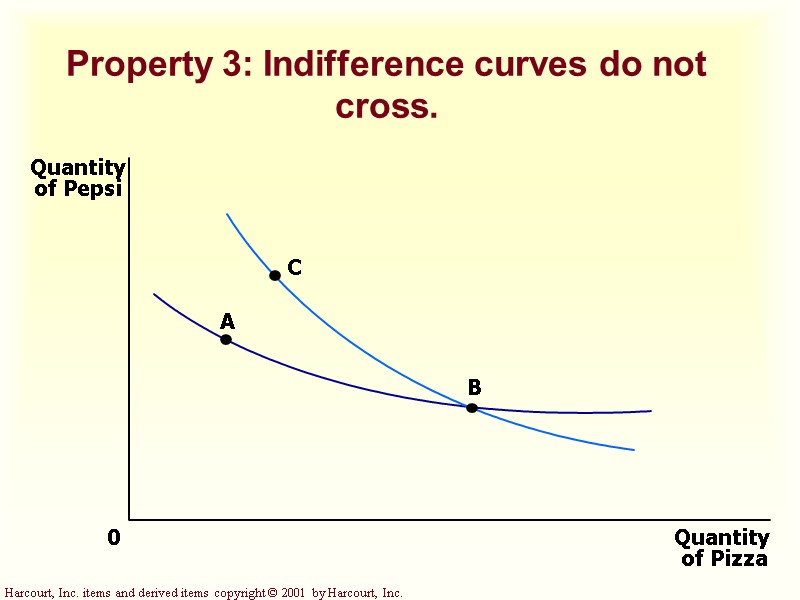
Property 3: Indifference curves do not cross. Points A and B should make the consumer equally happy. Points B and C should make the consumer equally happy. This implies that A and C would make the consumer equally happy. But C has more of both goods compared to A.
Property 3: Indifference curves do not cross. 0 C A B
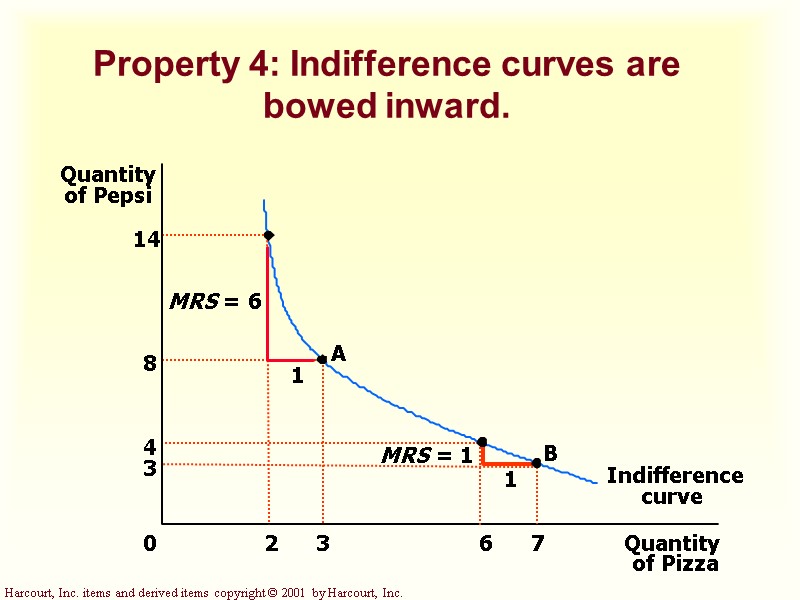
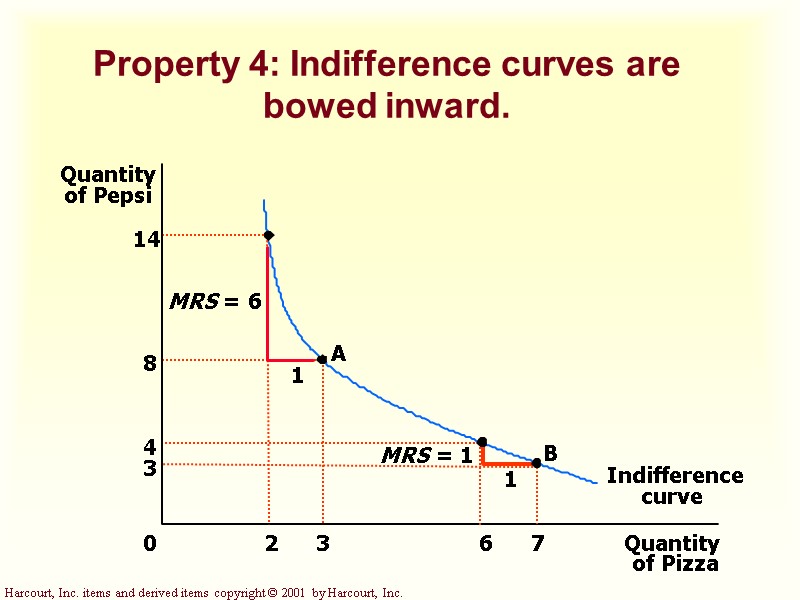
Property 4: Indifference curves are bowed inward. People are more willing to trade away goods that they have in abundance and less willing to trade away goods of which they have little. These differences in a consumer’s marginal substitution rates cause his or her indifference curve to bow inward.
Property 4: Indifference curves are bowed inward. 0
Two Extreme Examples of Indifference Curves Perfect substitutes Perfect complements
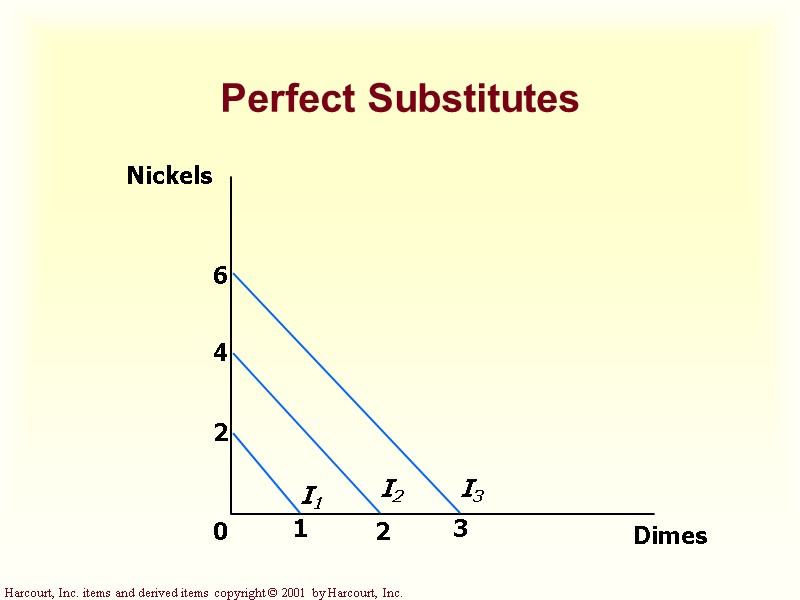
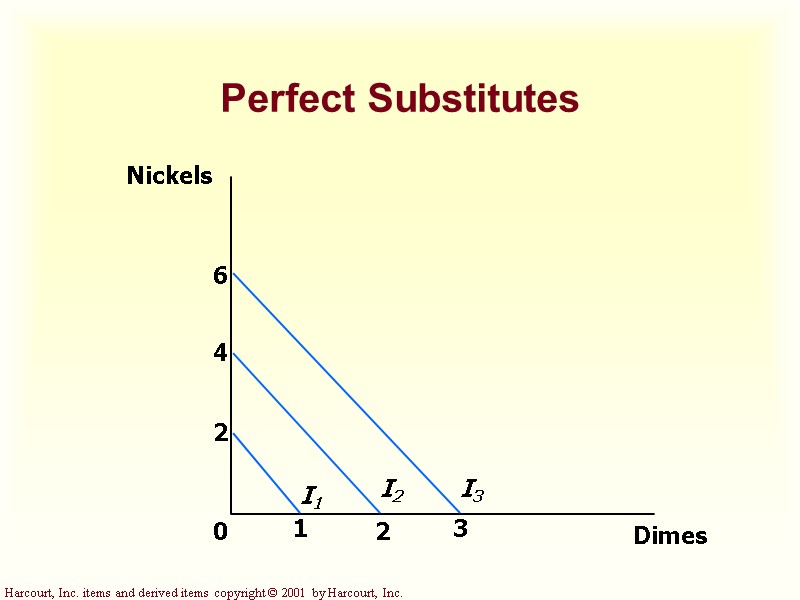
Perfect Substitutes Two goods with straight-line indifference curves are perfect substitutes. The marginal rate of substitution is a fixed number.
Perfect Substitutes Dimes 0
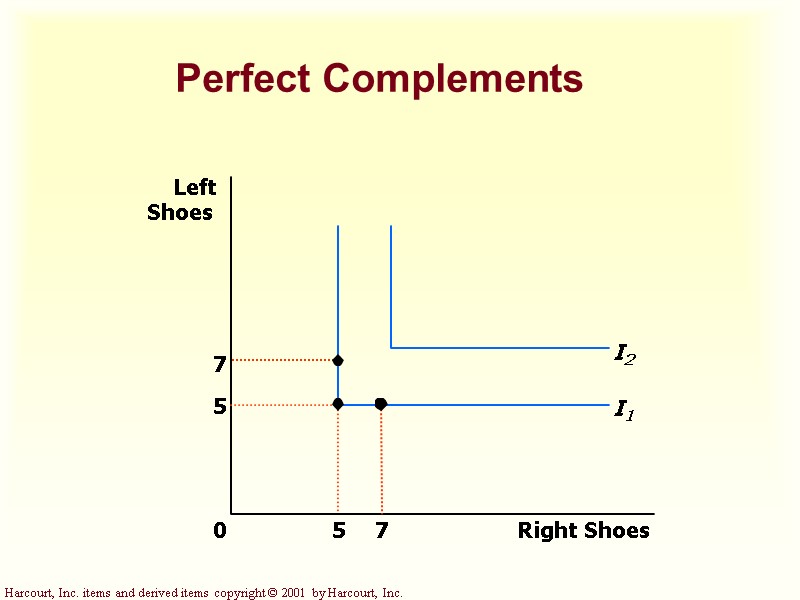
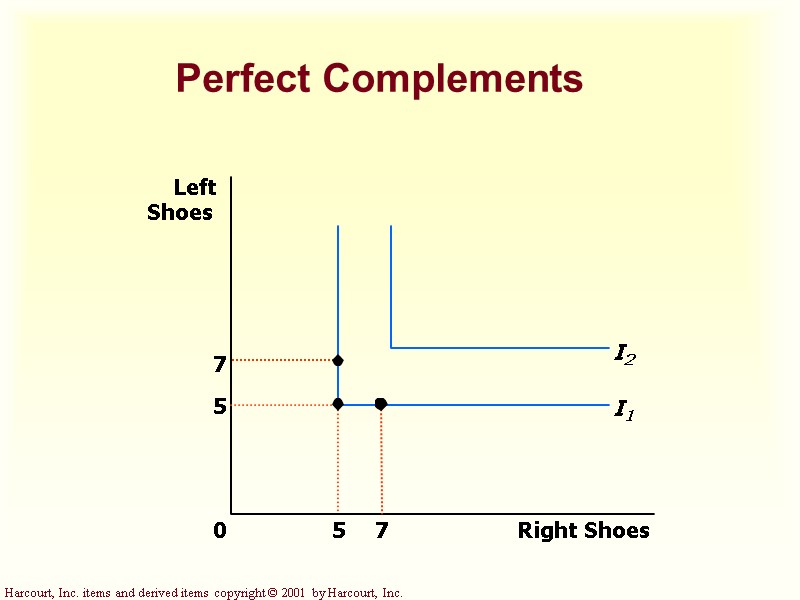
Perfect Complements Two goods with right-angle indifference curves are perfect complements.
Perfect Complements Right Shoes 0
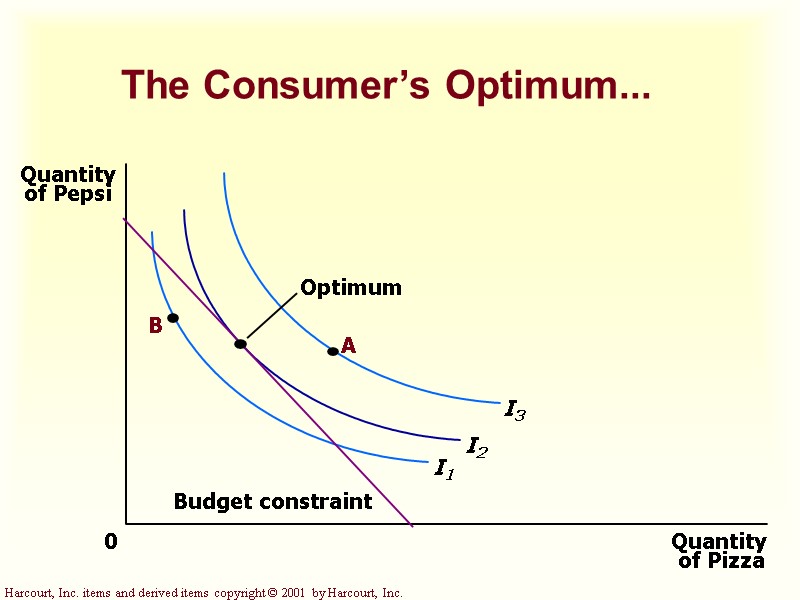
Optimization: What the Consumer Chooses Consumers want to get the combination of goods on the highest possible indifference curve. However, the consumer must also end up on or below his budget constraint.
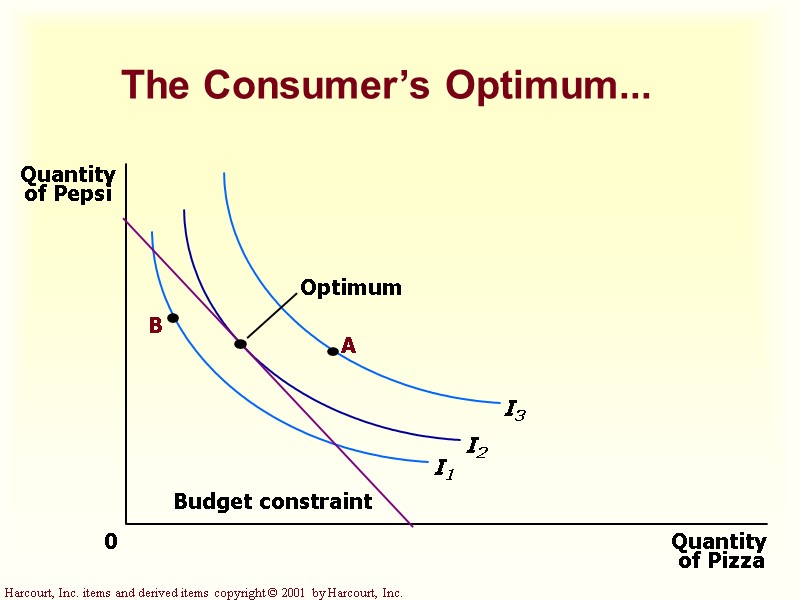
Optimization: What the Consumer Chooses Combining the indifference curve and the budget constraint determines the consumer’s optimal choice. Consumer optimum occurs at the point where the highest indifference curve and the budget constraint are tangent.
The Consumer’s Optimal Choice The consumer chooses consumption of the two goods so that the marginal rate of substitution equals the relative price.
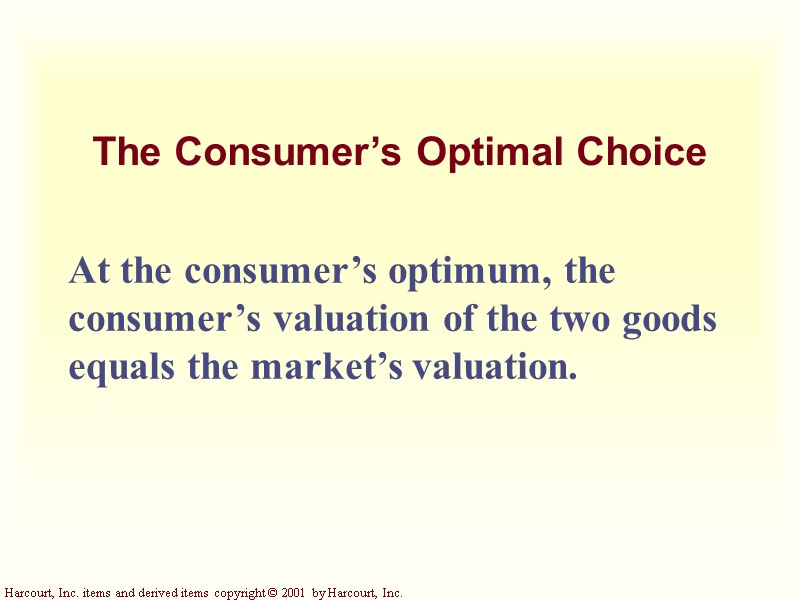
The Consumer’s Optimal Choice At the consumer’s optimum, the consumer’s valuation of the two goods equals the market’s valuation.
The Consumer’s Optimum... 0
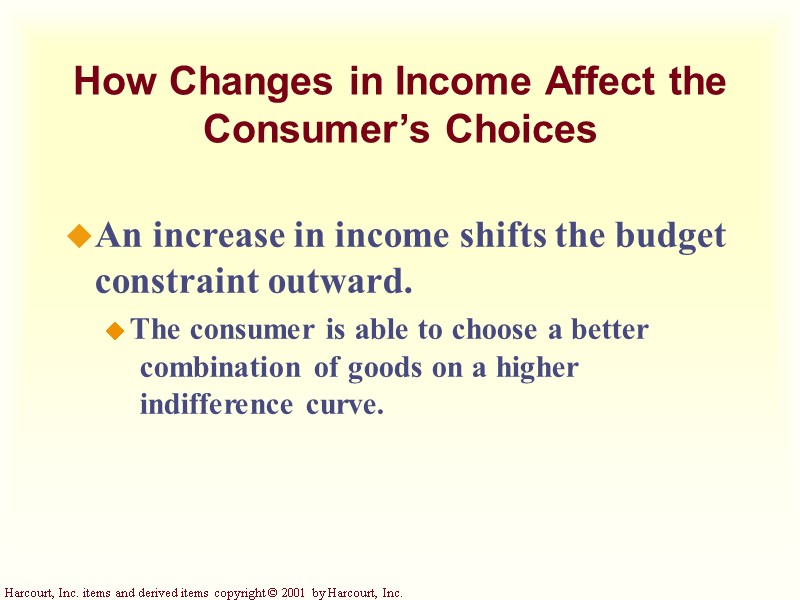
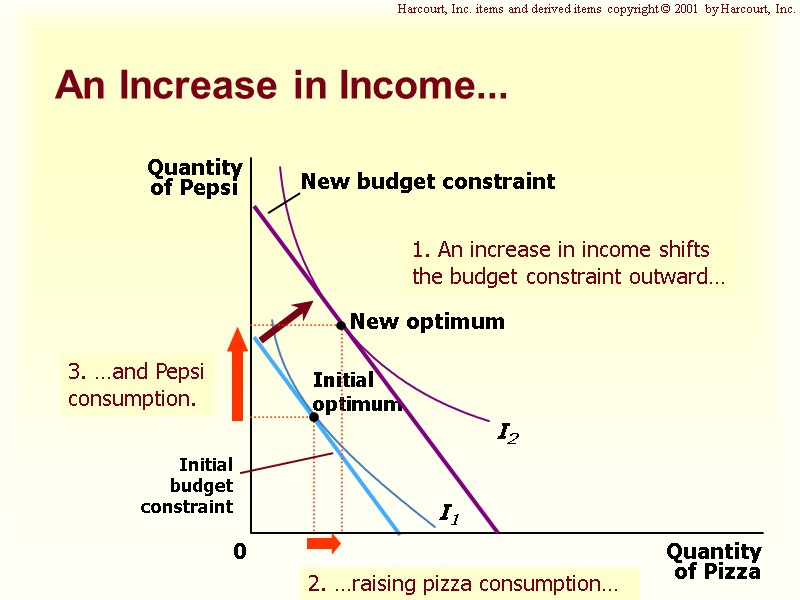
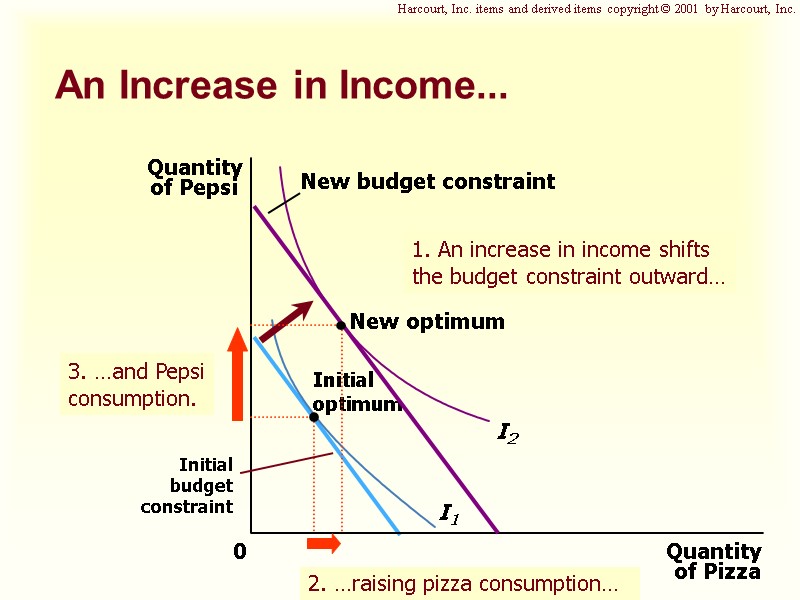
How Changes in Income Affect the Consumer’s Choices An increase in income shifts the budget constraint outward. The consumer is able to choose a better combination of goods on a higher indifference curve.
An Increase in Income... 0 I1 Initial optimum Initial budget constraint Harcourt, Inc. items and derived items copyright © 2001 by Harcourt, Inc.
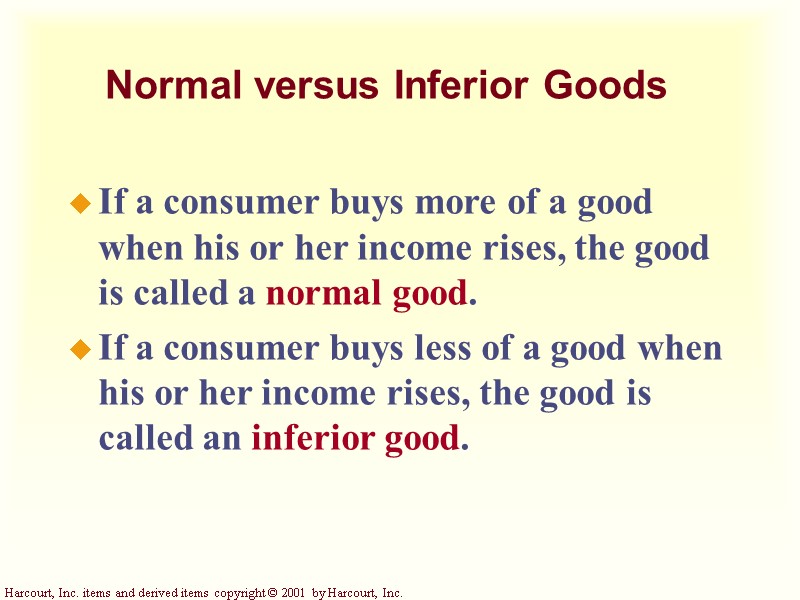
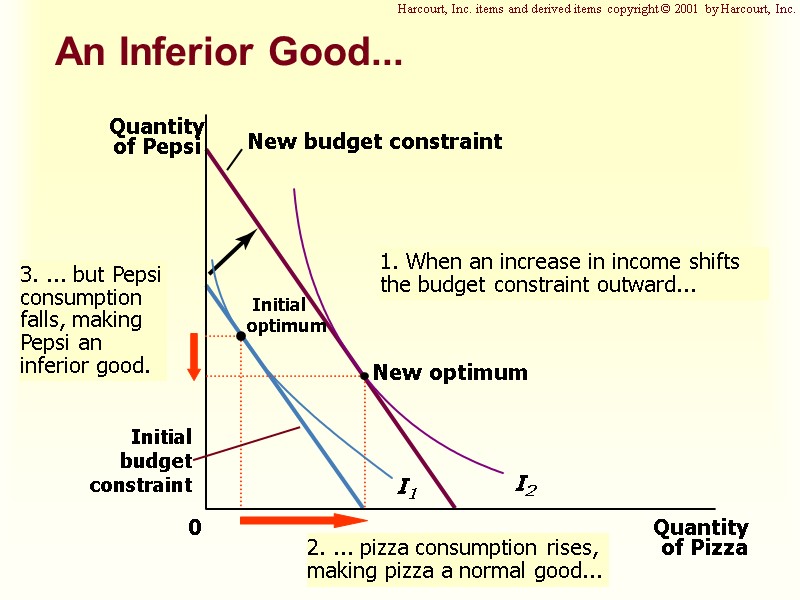
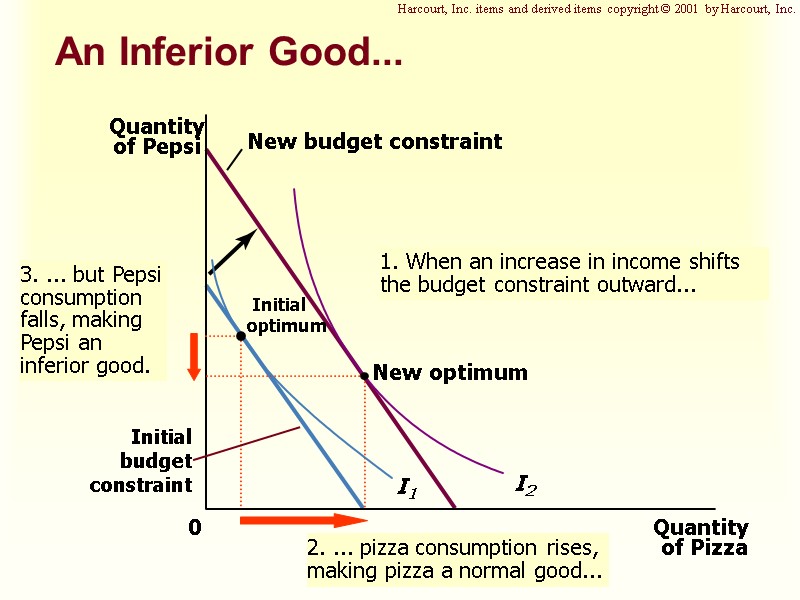
Normal versus Inferior Goods If a consumer buys more of a good when his or her income rises, the good is called a normal good. If a consumer buys less of a good when his or her income rises, the good is called an inferior good.
An Inferior Good... Quantity of Pizza Quantity of Pepsi 0 Initial optimum I1 Initial budget constraint Harcourt, Inc. items and derived items copyright © 2001 by Harcourt, Inc.
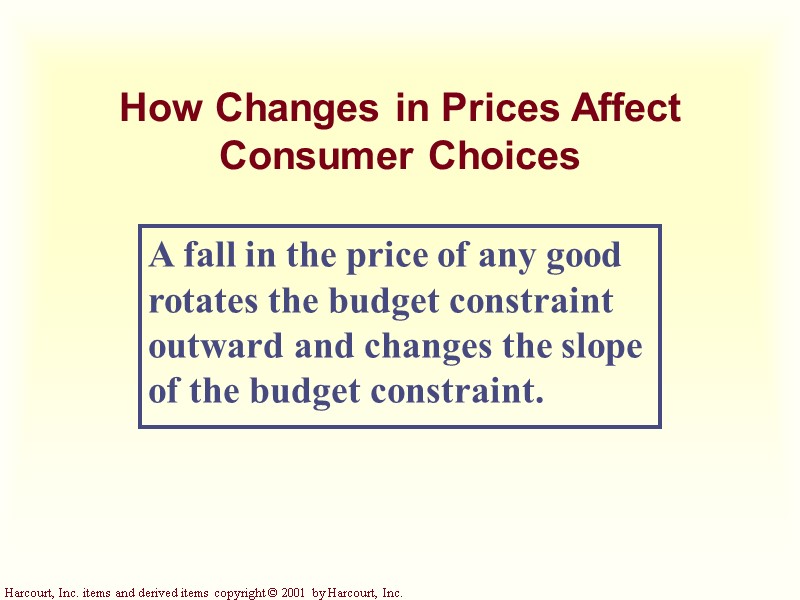
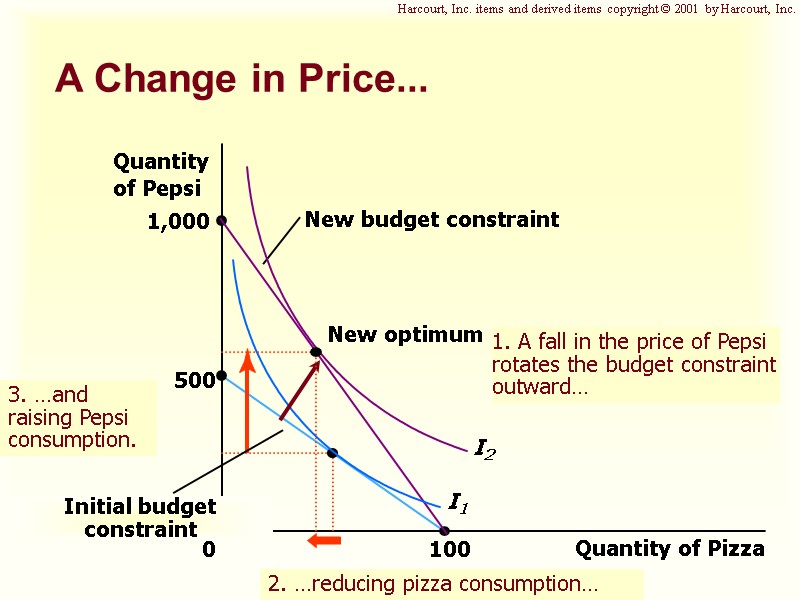
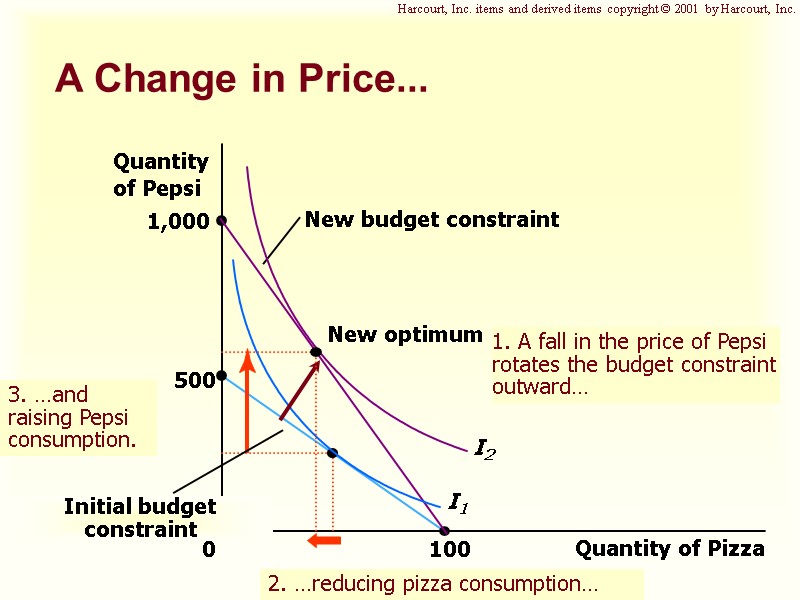
How Changes in Prices Affect Consumer Choices A fall in the price of any good rotates the budget constraint outward and changes the slope of the budget constraint.
A Change in Price... Quantity of Pizza 100 Quantity of Pepsi 1,000 500 0 Initial budget constraint Harcourt, Inc. items and derived items copyright © 2001 by Harcourt, Inc.
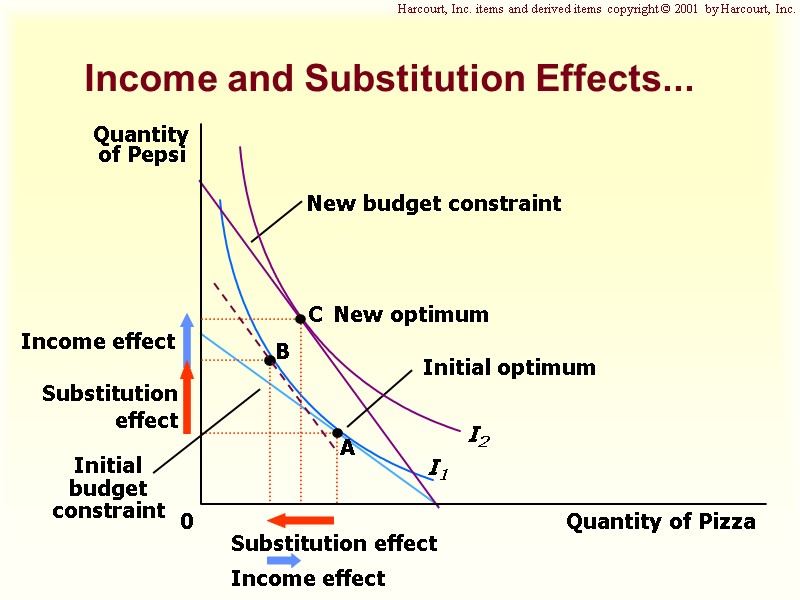
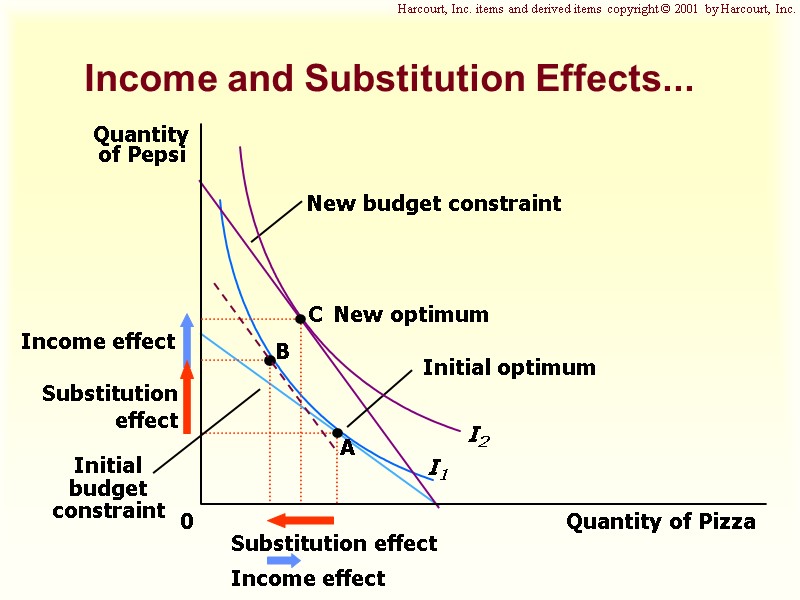
Income and Substitution Effects A price change has two effects on consumption. An income effect A substitution effect
The Income Effect The income effect is the change in consumption that results when a price change moves the consumer to a higher or lower indifference curve.
The Substitution Effect The substitution effect is the change in consumption that results when a price change moves the consumer along an indifference curve to a point with a different marginal rate of substitution.
A Change in Price: Substitution Effect A price change first causes the consumer to move from one point on a indifference curve to another on the same curve. Illustrated by movement from point A to point B.
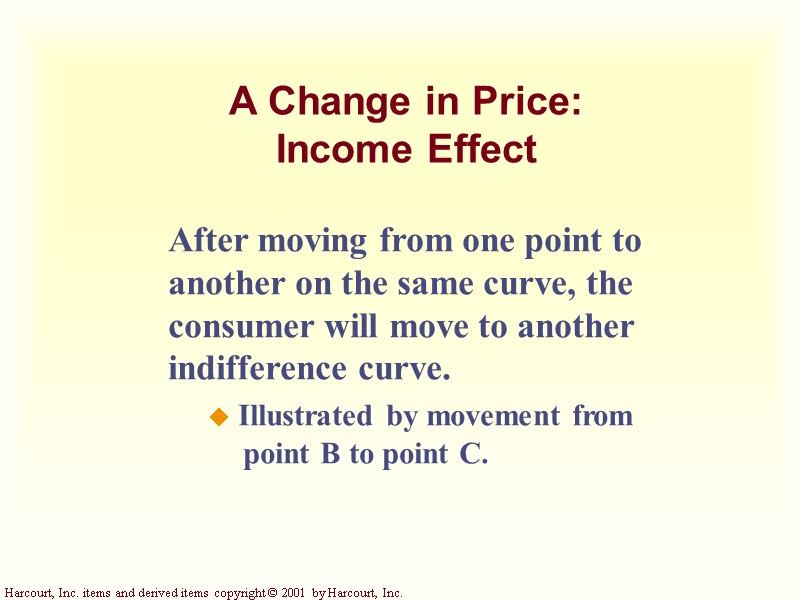
A Change in Price: Income Effect After moving from one point to another on the same curve, the consumer will move to another indifference curve. Illustrated by movement from point B to point C.
Income and Substitution Effects... Quantity of Pizza 0 A Initial optimum I1 Initial budget constraint Harcourt, Inc. items and derived items copyright © 2001 by Harcourt, Inc.
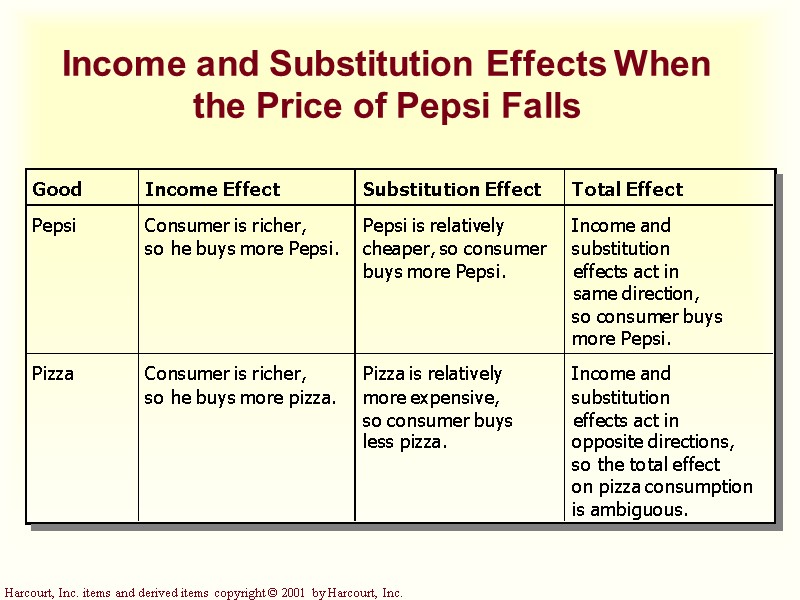
Income and Substitution Effects When the Price of Pepsi Falls
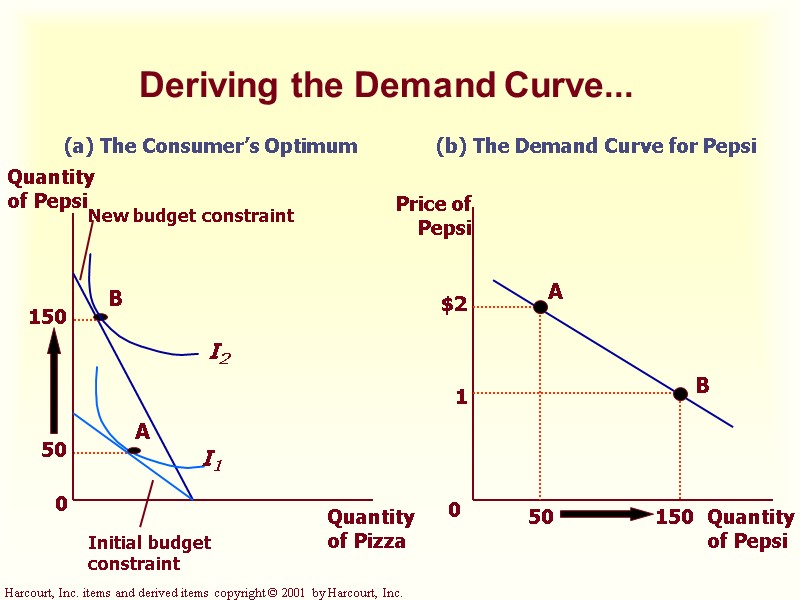
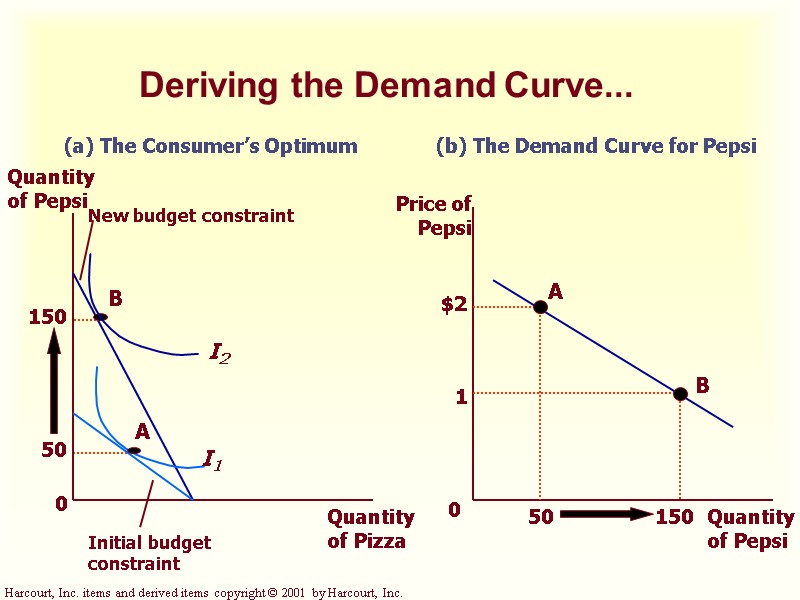
Deriving the Demand Curve A consumer’s demand curve can be viewed as a summary of the optimal decisions that arise from his or her budget constraint and indifference curves.
Deriving the Demand Curve... (a) The Consumer’s Optimum (b) The Demand Curve for Pepsi I1 I2 A B Initial budget constraint New budget constraint 50 150 Quantity of Pizza Quantity of Pepsi 0 0 Quantity of Pepsi 50 150 1 $2 Price of Pepsi A B
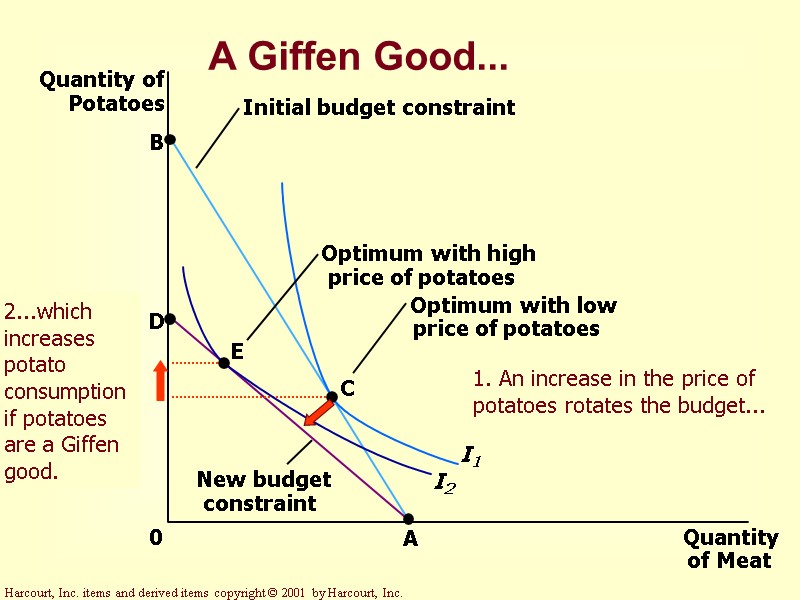
Do all demand curves slope downward? Demand curves can sometimes slope upward. This happens when a consumer buys more of a good when its price rises.
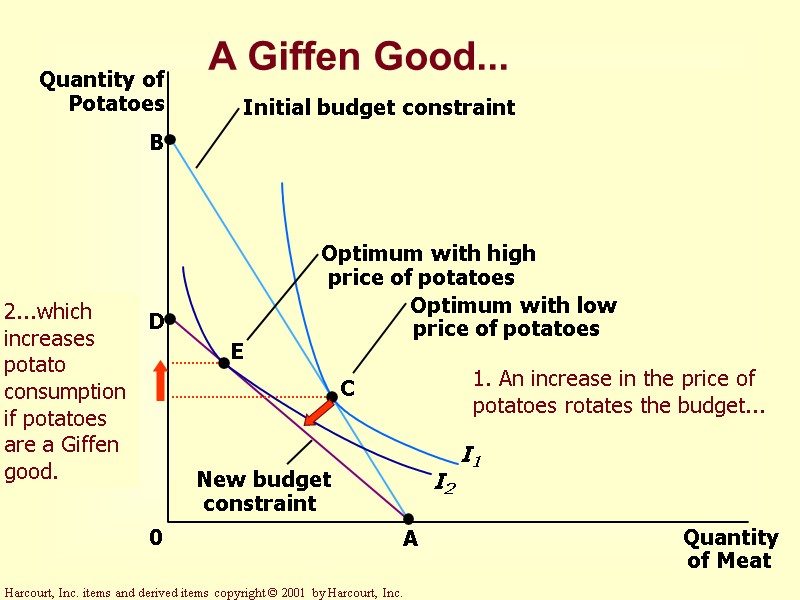
Giffen Goods Economists use the term Giffen good to describe a good that violates the law of demand. Giffen goods are inferior goods for which the income effect dominates the substitution effect. They have demand curves that slope upwards.
Quantity of Meat A Quantity of Potatoes 0 E C I2 I1 Initial budget constraint New budget constraint D B Optimum with low price of potatoes Optimum with high price of potatoes A Giffen Good...
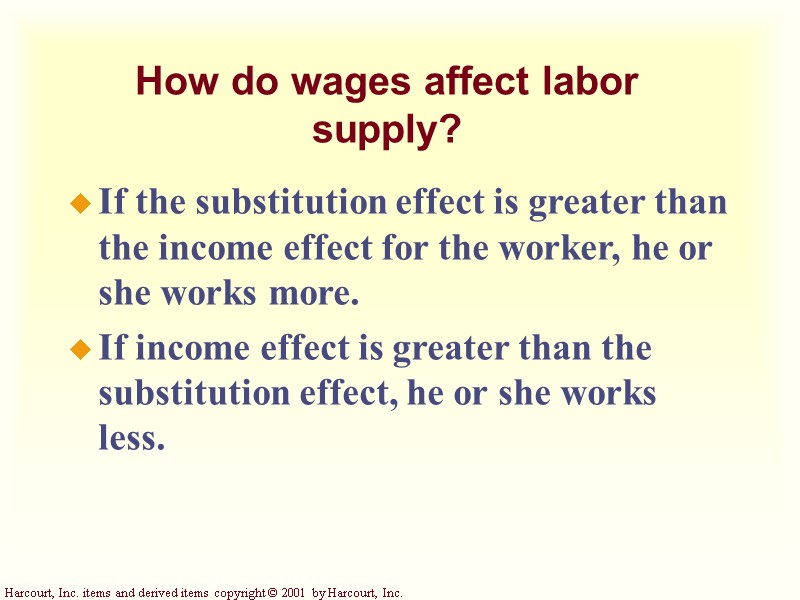
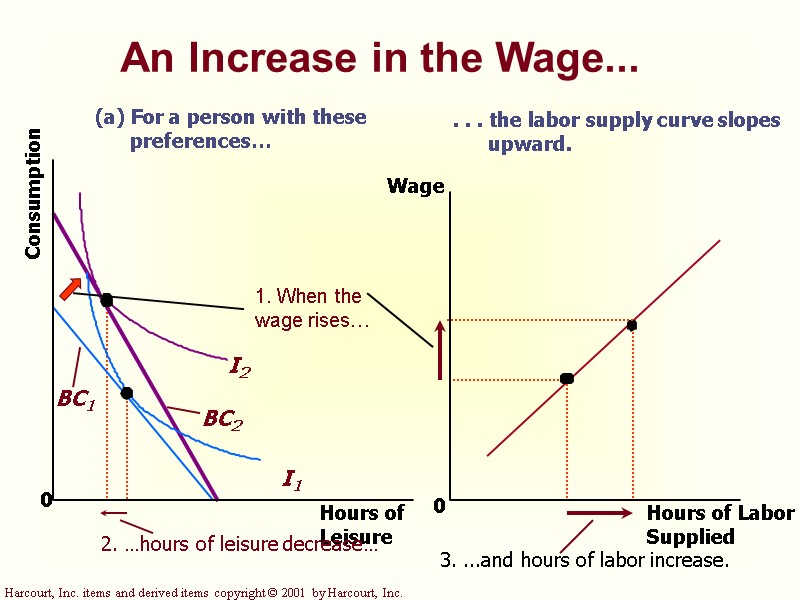
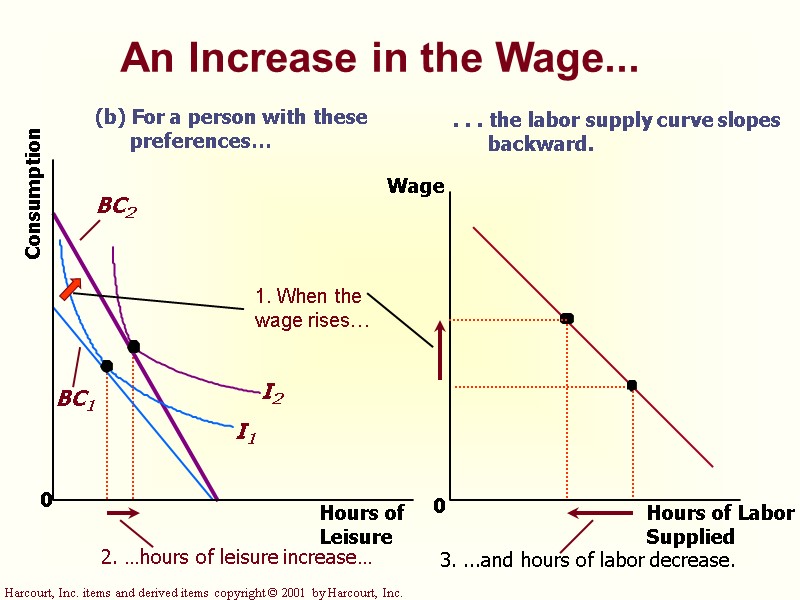
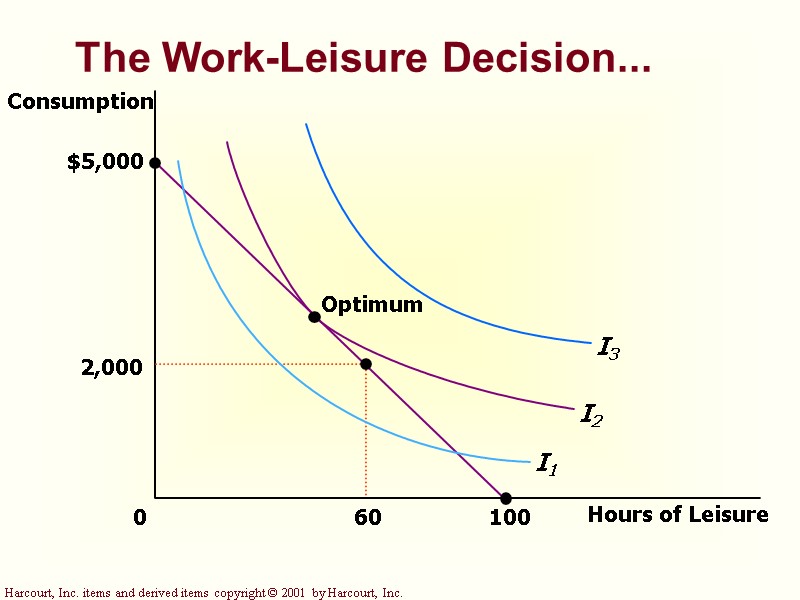
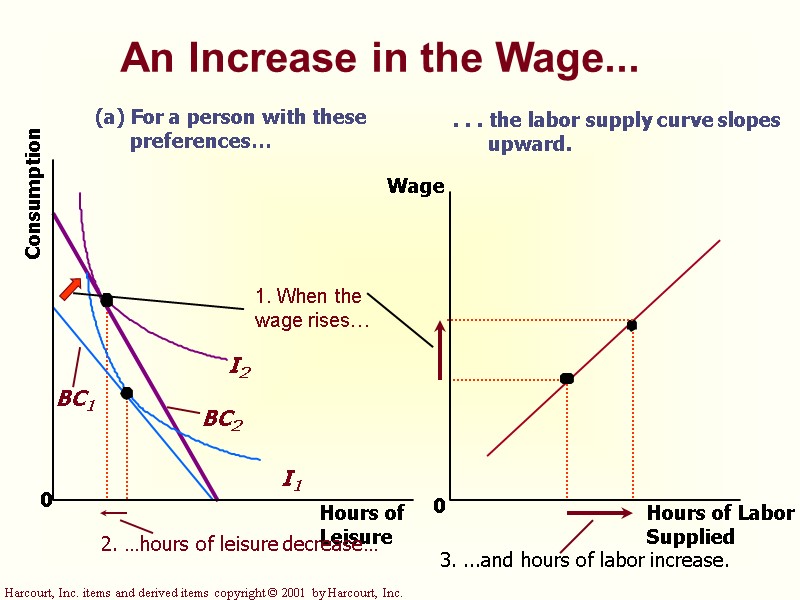
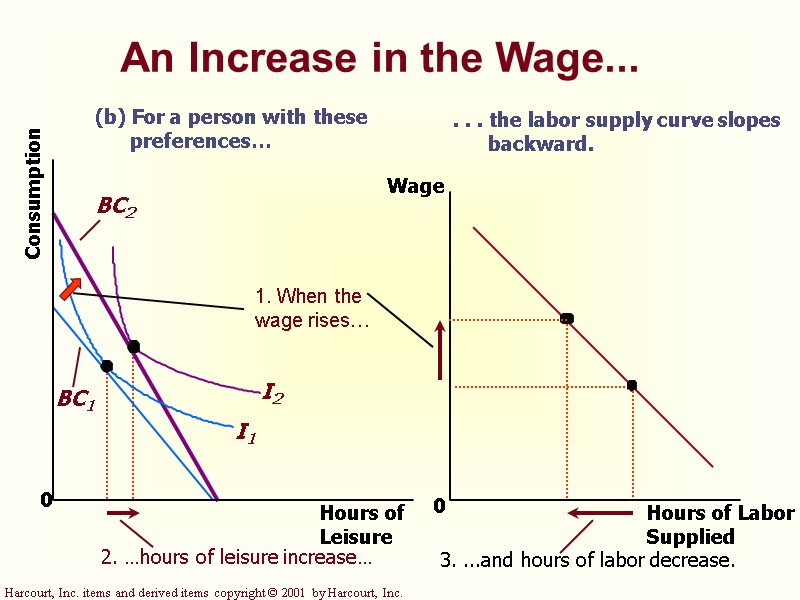
How do wages affect labor supply? If the substitution effect is greater than the income effect for the worker, he or she works more. If income effect is greater than the substitution effect, he or she works less.
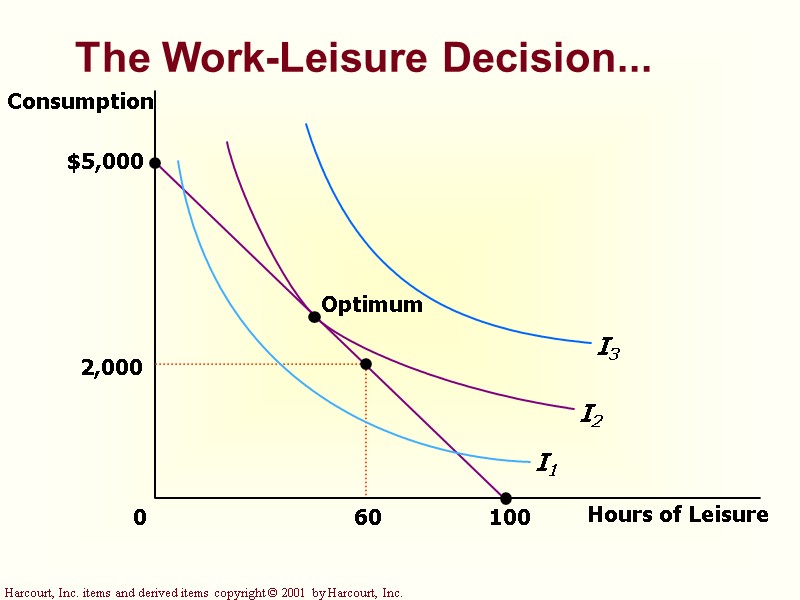
Hours of Leisure 0 2,000 $5,000 60 Consumption 100 Optimum I3 I2 I1 The Work-Leisure Decision...
Hours of Labor Supplied 0 Wage . . . the labor supply curve slopes upward. Hours of Leisure 0 Consumption (a) For a person with these preferences… I2 I1 BC2 BC1 An Increase in the Wage...
Hours of Labor Supplied 0 Wage . . . the labor supply curve slopes backward. Hours of Leisure 0 Consumption (b) For a person with these preferences… I2 I1 BC2 BC1 An Increase in the Wage...
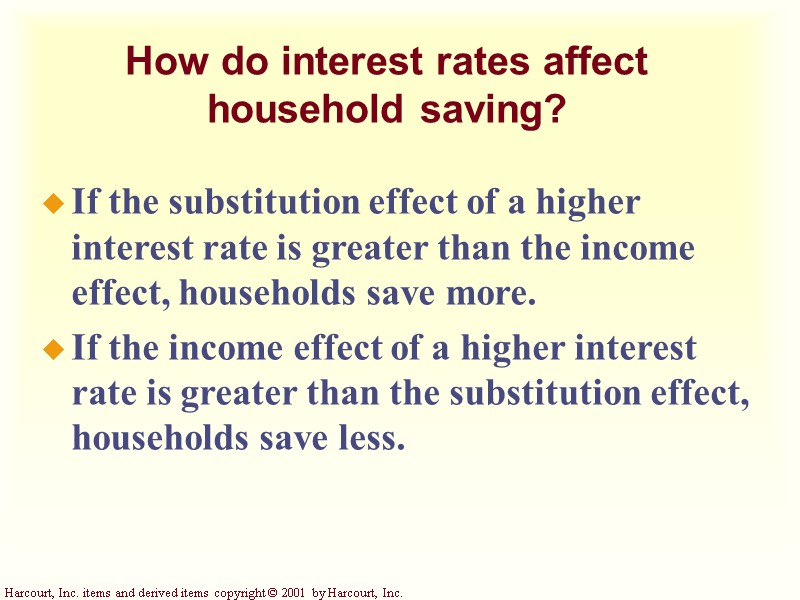
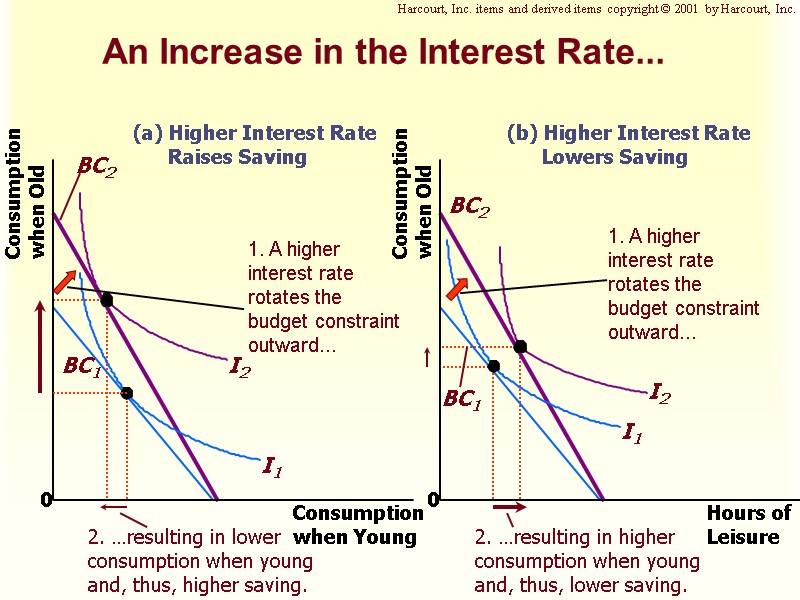
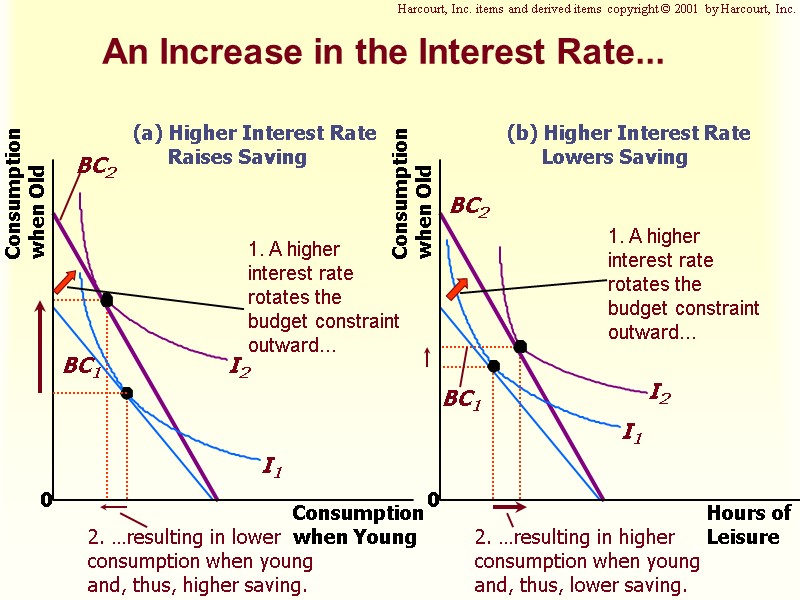
How do interest rates affect household saving? If the substitution effect of a higher interest rate is greater than the income effect, households save more. If the income effect of a higher interest rate is greater than the substitution effect, households save less.
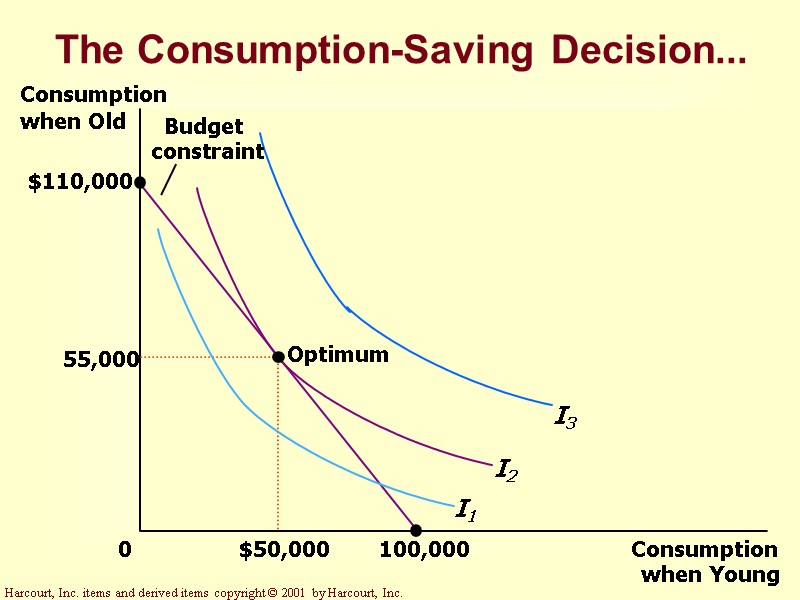
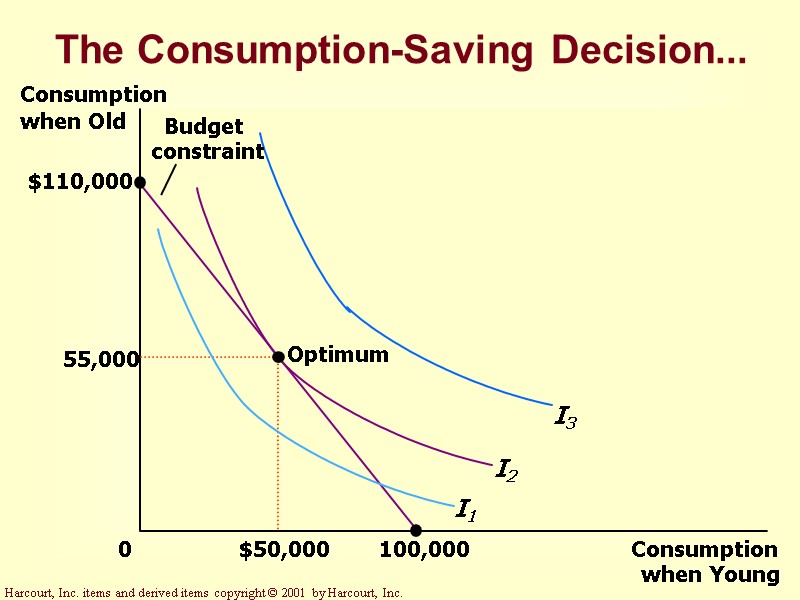
Consumption when Young 0 55,000 $110,000 $50,000 Consumption when Old 100,000 Optimum I3 I2 I1 Budget constraint The Consumption-Saving Decision...
An Increase in the Interest Rate... 0 Consumption when Old I2 I1 BC2 BC1 Consumption when Young Hours of Leisure 0 I2 I1 BC2 BC1 Consumption when Old (a) Higher Interest Rate Raises Saving (b) Higher Interest Rate Lowers Saving Harcourt, Inc. items and derived items copyright © 2001 by Harcourt, Inc.
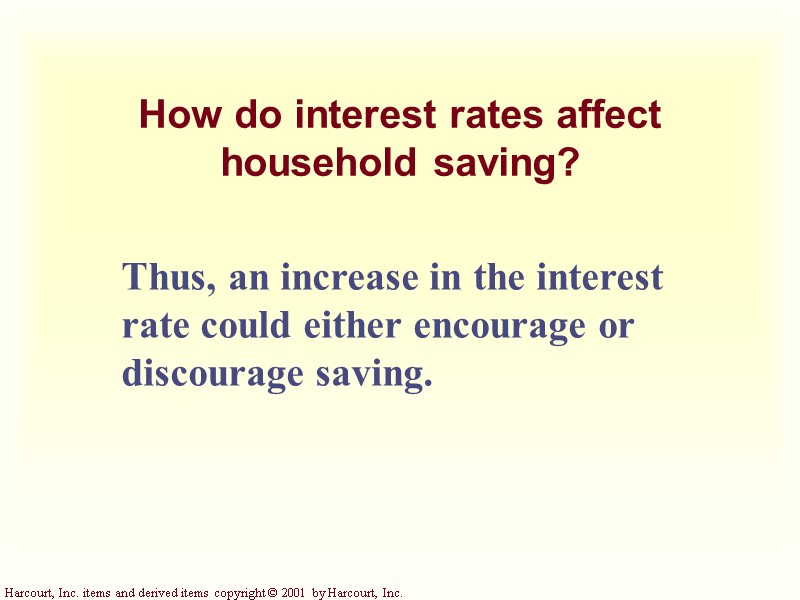
How do interest rates affect household saving? Thus, an increase in the interest rate could either encourage or discourage saving.
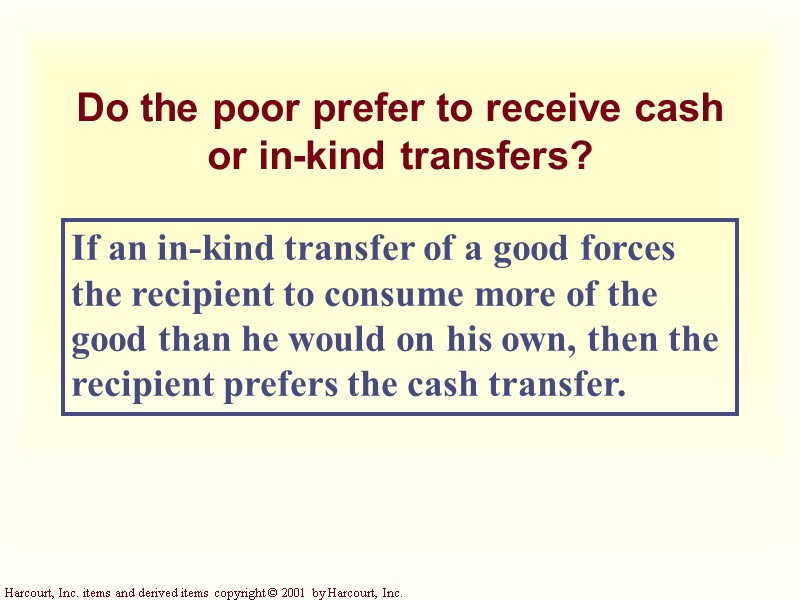
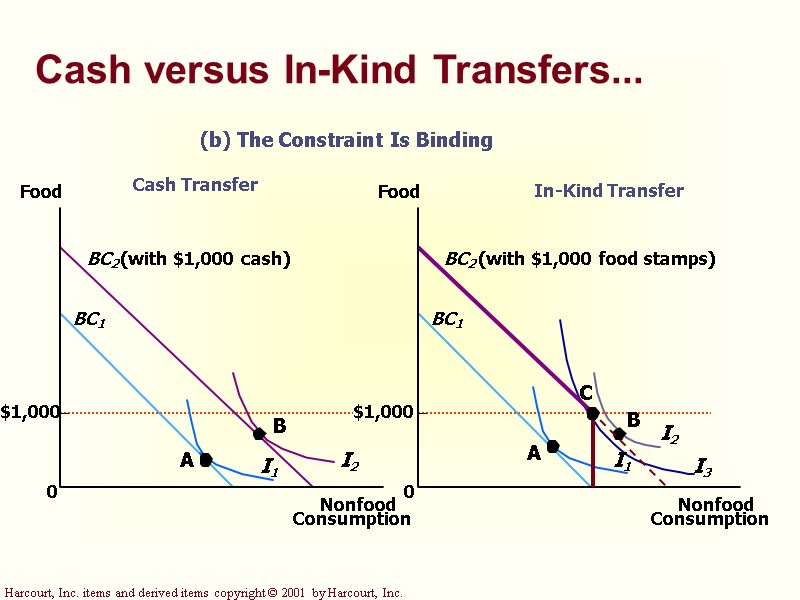
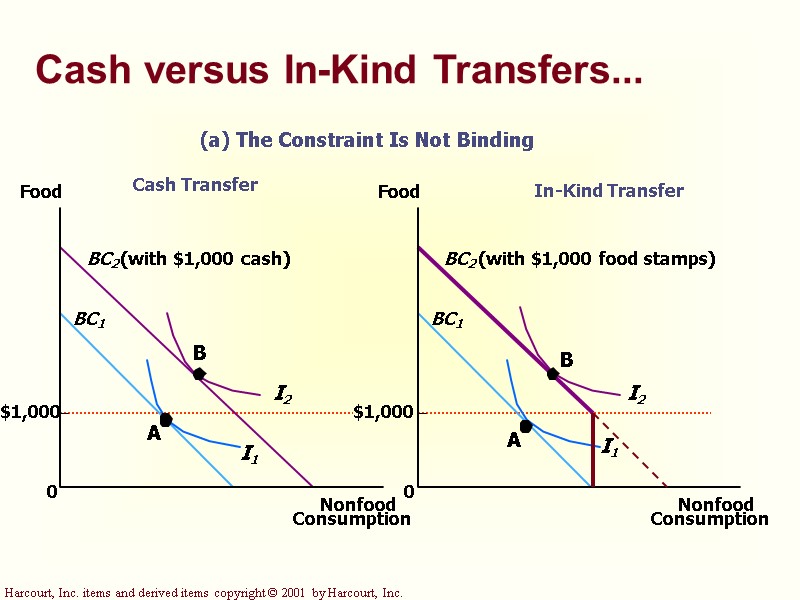
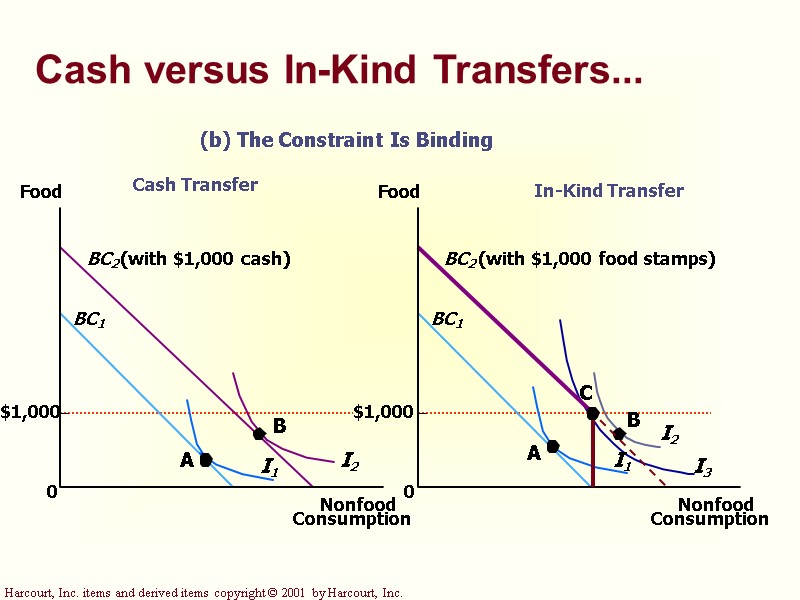
Do the poor prefer to receive cash or in-kind transfers? If an in-kind transfer of a good forces the recipient to consume more of the good than he would on his own, then the recipient prefers the cash transfer.
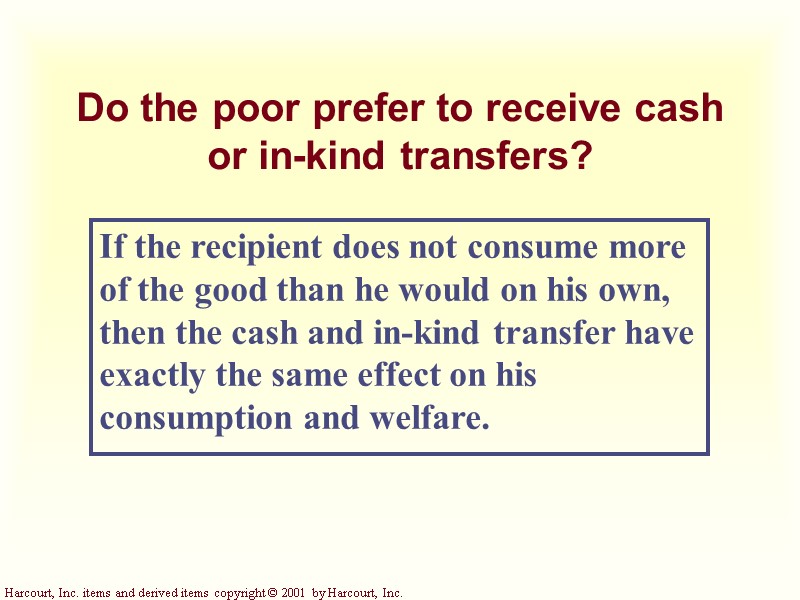
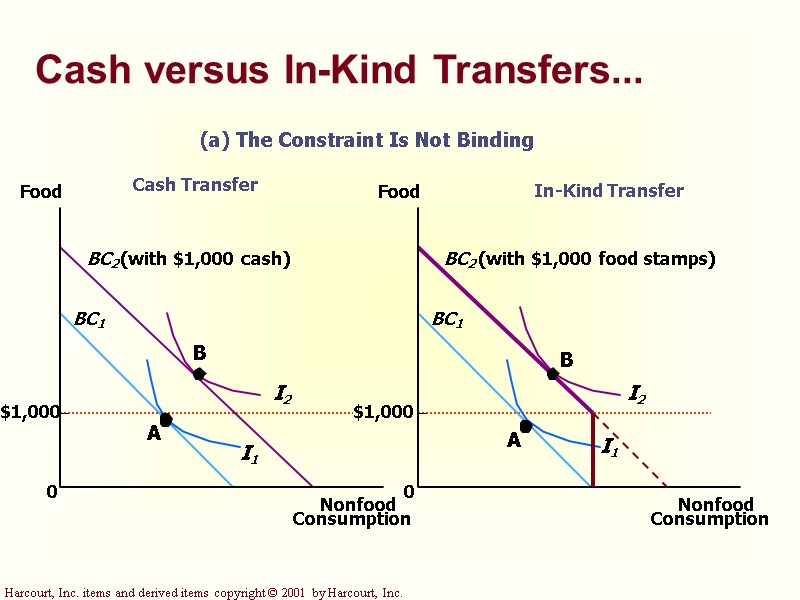
Do the poor prefer to receive cash or in-kind transfers? If the recipient does not consume more of the good than he would on his own, then the cash and in-kind transfer have exactly the same effect on his consumption and welfare.
Cash Transfer In-Kind Transfer (a) The Constraint Is Not Binding Nonfood Consumption 0 $1,000 $1,000 Food A B I2 I1 BC1 BC2 (with $1,000 cash) Nonfood Consumption 0 Food A B I2 I1 BC1 BC2 (with $1,000 food stamps) Cash versus In-Kind Transfers...
Cash Transfer In-Kind Transfer (b) The Constraint Is Binding Nonfood Consumption 0 $1,000 $1,000 Food A B I2 I1 BC1 BC2 (with $1,000 cash) Nonfood Consumption 0 Food A B I2 I1 BC1 BC2 (with $1,000 food stamps) Cash versus In-Kind Transfers... C I3
Summary A consumer’s budget constraint shows the possible combinations of different goods he can buy given his income and the prices of the goods. The slope of the budget constraint equals the relative price of the goods. The consumer’s indifference curves represent his preferences.
Summary Points on higher indifference curves are preferred to points on lower indifference curves. The slope of an indifference curve at any point is the consumer’s marginal rate of substitution. The consumer optimizes by choosing the point on his budget constraint that lies on the highest indifference curve.
Summary When the price of a good falls, the impact on the consumer’s choices can be broken down into an income effect and a substitution effect. The income effect is the change in consumption that arises because a lower price makes the consumer better off. The income effect is reflected by the movement from a lower to a higher indifference curve.
Summary The substitution effect is the change in consumption that arises because a price change encourages greater consumption of the good that has become relatively cheaper. The substitution effect is reflected by a movement along an indifference curve to a point with a different slope.
Summary The theory of consumer choice can explain: Why demand curves can potentially slope upward. How wages affect labor supply. How interest rates affect household saving. Whether the poor prefer to receive cash or in-kind transfers.
The Consumer’s Budget Constraint...
The Consumer’s Budget Constraint...
The Consumer’s Preferences...
The Consumer’s Preferences...
Property 1: Higher indifference curves are preferred to lower ones.
Property 2: Indifference curves are downward sloping.
Property 3: Indifference curves do not cross.
Property 4: Indifference curves are bowed inward.
Perfect Substitutes
Perfect Complements
The Consumer’s Optimum...
An Increase in Income... Harcourt, Inc. items and derived items copyright © 2001 by Harcourt, Inc.
An Inferior Good... Harcourt, Inc. items and derived items copyright © 2001 by Harcourt, Inc.
A Change in Price... Harcourt, Inc. items and derived items copyright © 2001 by Harcourt, Inc.
Income and Substitution Effects... Harcourt, Inc. items and derived items copyright © 2001 by Harcourt, Inc.
Deriving the Demand Curve...
A Giffen Good...
The Work-Leisure Decision...
An Increase in the Wage...
An Increase in the Wage...
The Consumption-Saving Decision...
An Increase in the Interest Rate... Harcourt, Inc. items and derived items copyright © 2001 by Harcourt, Inc.
Cash versus In-Kind Transfers...
Cash versus In-Kind Transfers...