Скачать презентацию The theme of the given course work is
The theme of the given course work.pptx
- Количество слайдов: 14
 The theme of the given course work is COMPLEX TRANSFORMATION
 The aim of this work is to give the main notions of complex transformation and show the using them on the practice The main objectives of our course paper are: q to make theoretical research upon this theme q to reveal the main types of complex transformation q To analyze their influence q to study the problems of translating of complex translation q to make practical research upon this theme q to work with сomplex transformations in the works q to make a conclusion
 Introduction CONTENTS Chapter 1: Complex Transformation in translation 1. 1) Ways of Achieving Equivalence 1. 2) Complex transformations 1. 3) Types of complex transformations Chapter 2: Practical analysis 2. 1 A translation analysis of the work of Arthur Koestler “Burning Abyss’’ Conclusion Bibliography Appendix
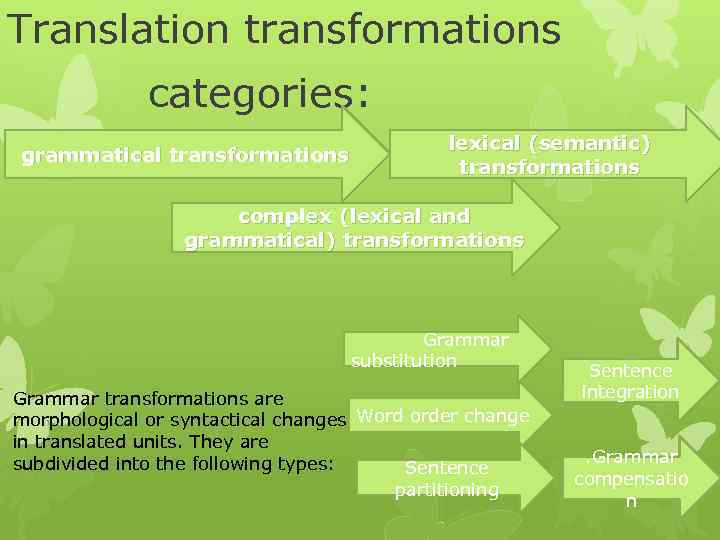 Translation transformations categories: grammatical transformations lexical (semantic) transformations complex (lexical and grammatical) transformations Grammar substitution Grammar transformations are morphological or syntactical changes Word order change in translated units. They are subdivided into the following types: Sentence partitioning Sentence integration. Grammar compensatio n
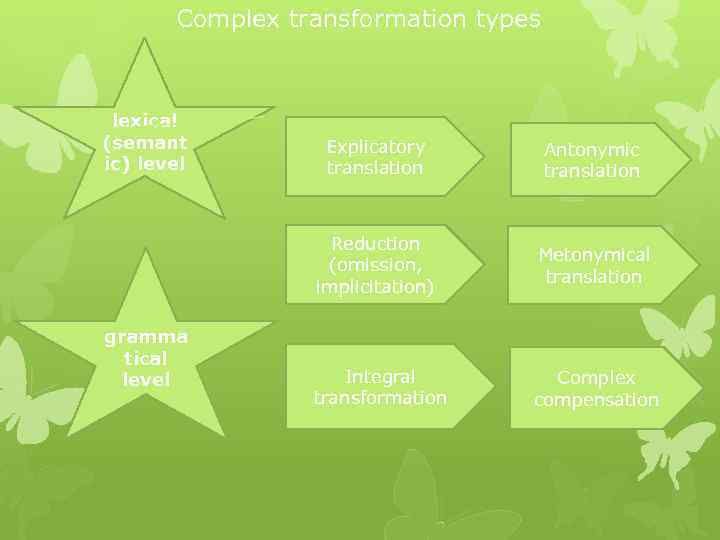 Complex transformation types lexical (semant iс) level Antonymic translation Reduction (omission, implicitation) gramma tical level Explicatory translation Metonymical translation Integral transformation Complex compensation
 According to the methodology realistic approach under significant , requiring conservation in translation , means: I. 1) the characteristics of the era ; II. 2) national and social specificity ; III. 3) creative individuality of the author; IV. 4) a particular genre ; V. 5) the unity of form and content ; VI. 6 ) Compliance with the ratio of parts and the whole.
 We identified six types of translation process, such as Explicatory translation Complex compensation Antonymic translation Integral transformation Reduction (omission, implicitation) Metonymical translation
 In practical part of the course work we analyzed the work of the Arthur Koestler “Burning Abyss” In this paper we presented a Kazakh translation of text and we gave a general characterization. We also conducted an analysis of the difficulties encountered in the translation process and justify the adequacy of the use of certain transformations, depending on the specifics of the source material.
 -The man was a pound of finger pressure from death. -Еркек өлім аузында болды -In this example, we observe the reception of a functional replacement against the background of another technique - the semantic development. In Kazakh it is impossible to use a direct translation of the English expression in this situation, therefore it is rethought: a pound of finger pressure –жақын– қарсаңында-өлім аузында(in this context)
 -Lie down and catch some winks -Жатып мызғып алыңыз. Another example of a functional replacement. In kazakh there is no direct equivalent to the selected combination, but there is an equivalent in stylistic terms equivalent, used in translation. Functionally they are equal, because Mean the same thing «кішкене ұйықтау» and are used in both languages in a conversational style
 …you know how it is when you’re lost – noises are funny. . білесің бе, егер жоғалып қалсаң, сыбыс сенімен әзілдеседі First, there was a substitution of the subordinate sentence of the mode of action (how it is. . . ) for the circumstances of the time (егер…), secondly, the whole transformation was applied on the background of the semantic development: it is impossible to say «қызық сыбыс(немесе күлкілі)» So you have to think about what that means. As a result, it turns out - when a person gets lost, he becomes frightened, and he starts to take different sounds and rustles for wild animals, etc. Therefore, it turns out that «сыбыс ойнайды <адаммен > жаман ойындар» .
 She’s as Baptist as you can get. Ол өзегіне дейін Баптист In this example, we meet a separate method of functional replacement: the English figurative expression is translated by an adequate figurative expression of the Kazakh language.
 Summarizing the results of this section, we can conclude that the analysis of examples taken from the work " Burning Abyss " shows that the most commonly used technique is concretization (14%), functional replacement (17%), semantic development (19%) metonymy translation (1%). Least often used were: translation commentary (2%) and explication (2%).