

The theme : «Characteristics of natural

 Скачать презентацию The theme : «Characteristics of natural
характеристика прир рес земли.ppt
- Количество слайдов: 16
The theme : «Characteristics of natural resources Earth's» Lecturer: associate professor, Candidate of agricultural sciences Koshkarov Nurgali Buteshevich
PLAN n 1. Classification of Natural Resources n 2. The problem of ensuring human society of natural resources n 3. Environmental management n 4. Development of low-waste technologies
Natural resources § Natural resources - these are the livelihoods of people who have not been created by their labor, but are in the nature. These include water, soil, plants, animals, minerals, which are used directly or in processed form. Natural resources give people food, clothing, shelter, fuel, energy, raw materials for industry. § Natural resources are classified according to their use: for production, health, aesthetic, scientific, etc. ; as belonging to the different components of nature: the land, water, forest, mineral, etc. ; by depletion: on exhaustible and inexhaustible. Exhaustible resources are divided into renewable, relatively of renewable and nonrenewable.
§ Non-renewable resources - are the resources that are completely restored or recovered much more slowly than is their human use in the foreseeable future. These include mineral resources, ie minerals. § By regarding renewable resources include soil - loose surface horizon land capable of producing crop plants and forest resources. Soil - one of the most valuable and scarce resources. It is slow, with the participation of climate and living organisms. § Renewable resources - is vegetation, fauna and some mineral resources, such as salt, precipitated in the lakes and sea lagoons. By inexhaustible resources include space, climate and water.
Inexhaustible resources § Space resources - is the solar radiation, the energy of the tides. The amount of solar energy on the earth's surface depends on the state of the atmosphere, its degree of contamination. § Climatic resources include air, wind, precipitation, and rainfall can also be applied to water resources. § Water resources - it's water reserves in the world.
Land resources § The soil - the basis of all wealth, the main wealth, on which depends the existence of man. § It is a natural historical biokosnyh body resulting from exposure to living and dead organisms, the atmosphere and the natural water on the surface of rocks in different conditions of climate and terrain and under the earth's gravity.
Animal world § Earth is home to about 1. 5 million species of living organisms, of which 1 mln. is animals. However, the ratio of biomass of plants and animals converse animal biomass is only about 1% of the total biomass of living organisms in the biosphere
Forest resources § Wood plays a huge role in the preservation of water and land resources, to improve the environment. Forests have important environmental functions - shelterbelts, soil protection, climate-and others. § Total timber reserves in the world is 358 billion m ³, of which the share of the country accounts for 80 billion m ³.
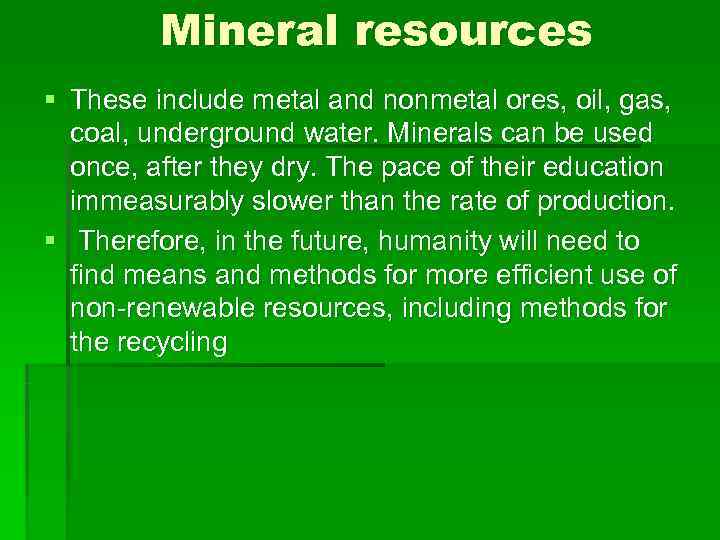
Mineral resources § These include metal and nonmetal ores, oil, gas, coal, underground water. Minerals can be used once, after they dry. The pace of their education immeasurably slower than the rate of production. § Therefore, in the future, humanity will need to find means and methods for more efficient use of non-renewable resources, including methods for the recycling
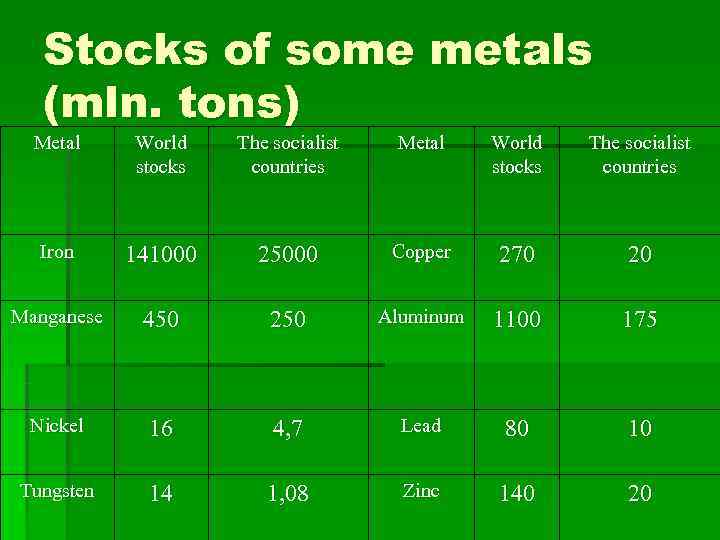
Stocks of some metals (mln. tons) Metal World The socialist stocks countries Iron 141000 25000 Copper 270 20 Manganese 450 250 Aluminum 1100 175 Nickel 16 4, 7 Lead 80 10 Tungsten 14 1, 08 Zinc 140 20
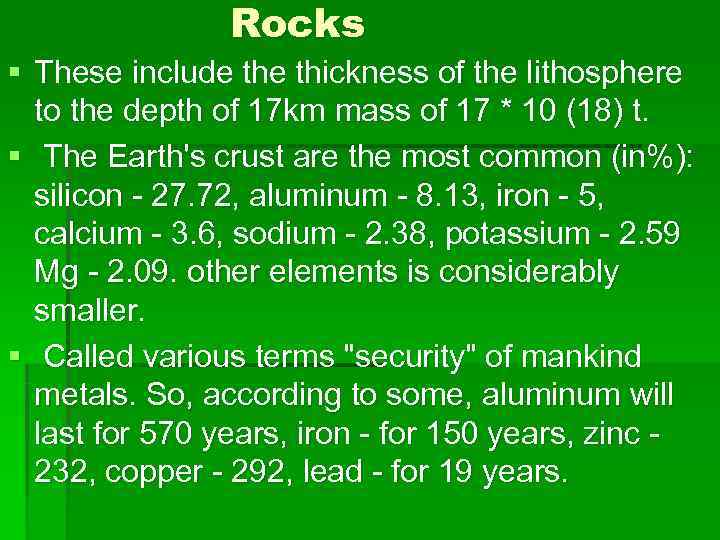
Rocks § These include thickness of the lithosphere to the depth of 17 km mass of 17 * 10 (18) t. § The Earth's crust are the most common (in%): silicon - 27. 72, aluminum - 8. 13, iron - 5, calcium - 3. 6, sodium - 2. 38, potassium - 2. 59 Mg - 2. 09. other elements is considerably smaller. § Called various terms "security" of mankind metals. So, according to some, aluminum will last for 570 years, iron - for 150 years, zinc - 232, copper - 292, lead - for 19 years.
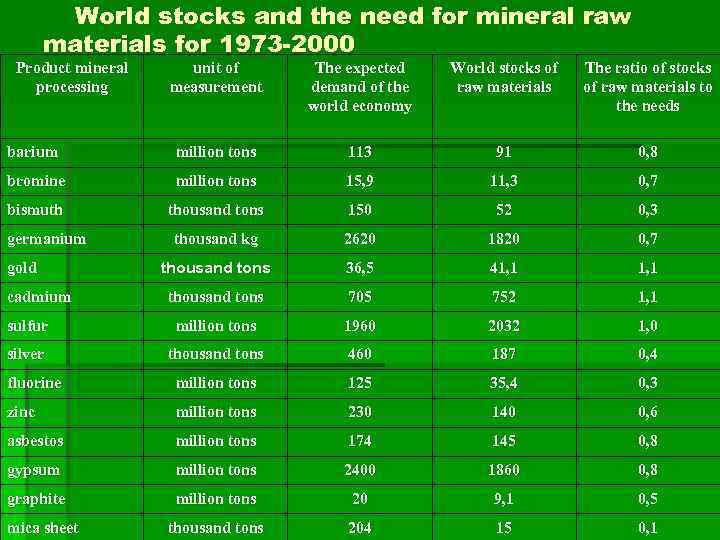
World stocks and the need for mineral raw materials for 1973 -2000 Product mineral unit of The expected World stocks of The ratio of stocks processing measurement demand of the raw materials of raw materials to world economy the needs barium million tons 113 91 0, 8 bromine million tons 15, 9 11, 3 0, 7 bismuth thousand tons 150 52 0, 3 germanium thousand kg 2620 1820 0, 7 gold thousand tons 36, 5 41, 1 1, 1 cadmium thousand tons 705 752 1, 1 sulfur million tons 1960 2032 1, 0 silver thousand tons 460 187 0, 4 fluorine million tons 125 35, 4 0, 3 zinc million tons 230 140 0, 6 asbestos million tons 174 145 0, 8 gypsum million tons 2400 1860 0, 8 graphite million tons 20 9, 1 0, 5 mica sheet thousand tons 204 15 0, 1
Optimization of natureuse § Under this direction should be understood in the most appropriate solutions using those or other resources and natural systems on the basis of national strategic approach and the forecast with regard to the interests of different industries and the economy as the current time, and in view of the near and distant future.
Greening production § It should be understood assimilation of production (technological) processes, ie resource cycles, closed natural cycle of matter in the biosphere. Constitute the basis of ecological development and implementation of low-waste, energy and resource saving technologies. Strictly non-waste technology is impossible in principle by the law of conservation of matter. § In the natural biogeochemical cycles of the matter constantly removed from the circulation, but between these cycles and resource cycles there is a fundamental difference: in the nature coming out of the cycle of the substance does not pollute the environment and do not go to waste, and in stock.
§ Mendeleev belongs to a remarkable statement: there is no waste in chemistry, and there are unused materials. So, this waste can and should be used. This is also a challenge based on the latest achievements of science and technology and allows us to solve two problems: First, cut production and involved in the production of new resources, and secondly with the maximum benefit to prevent environmental pollution.
§ All, without exception, wood forest products, including the bark, roots, twigs, pine needles and leaves, lends itself to a full recovery. § Zero waste wood - a feasible task, and in reducing deforestation through better use of wood at the same time preserves important environmental, space and protective functions of forest plantations.