



 The th 16 of August We are family
 We are family 1. Extended family 2. Great – parents 3. Great – great – parents 4. An only child 5. Cousins 6. Couples 7. Stepmother 8. Half- brother 9. Single – parent families 10. In - laws
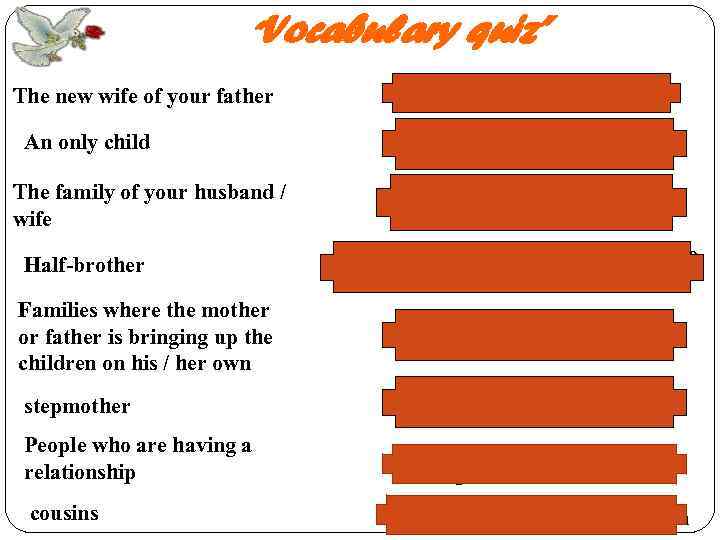 “Vocabulary The new wife of your father An only child The family of your husband / wife Half-brother quiz” stepmother A child who doesn’t have any brothers or sisters In-laws Boys who have (for example) the same father as you but a different mother Families where the mother or father is bringing up the children on his / her own Single-parent families stepmother The new wife of your father People who are having a relationship cousins couples Your uncle’s or aunt’s children
 How words work Each other We use each other when two people do the same thing. It means A does an action to B and B does the same action to A.
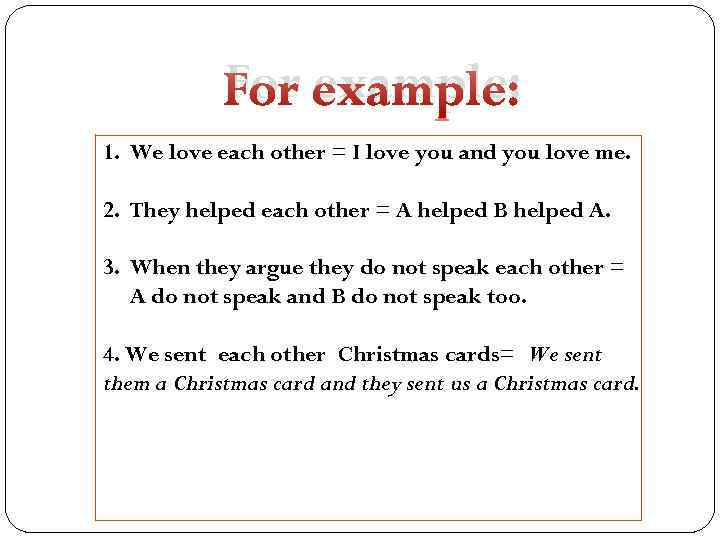 For example: 1. We love each other = I love you and you love me. 2. They helped each other = A helped B helped A. 3. When they argue they do not speak each other = A do not speak and B do not speak too. 4. We sent each other Christmas cards= We sent them a Christmas card and they sent us a Christmas card.
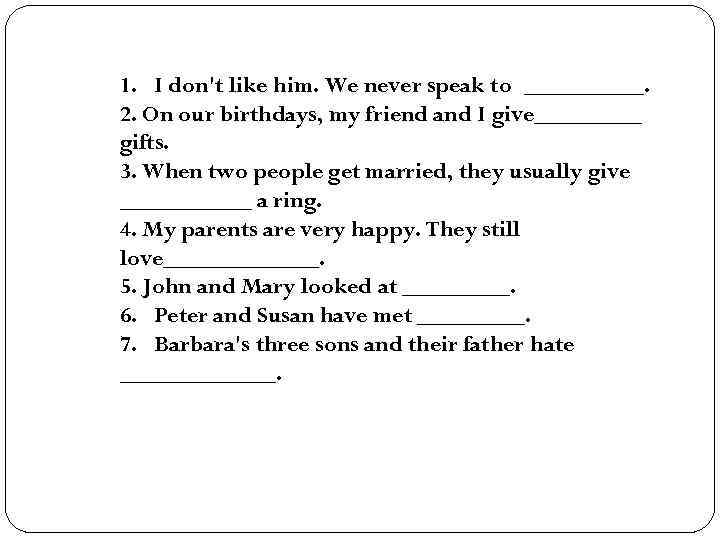 1. I don't like him. We never speak to _____. 2. On our birthdays, my friend and I give_____ gifts. 3. When two people get married, they usually give ______ a ring. 4. My parents are very happy. They still love_______. 5. John and Mary looked at _____. 6. Peter and Susan have met _____. 7. Barbara's three sons and their father hate _______.
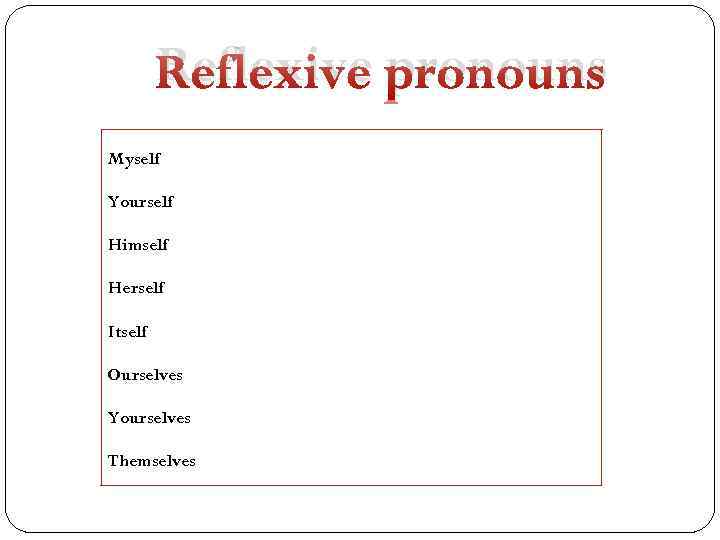 Reflexive pronouns Myself Yourself Himself Herself Itself Ourselves Yourselves Themselves
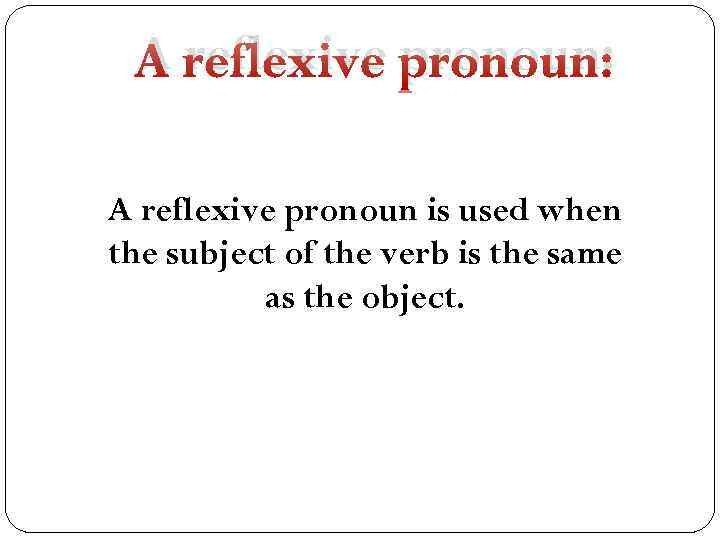 A reflexive pronoun: A reflexive pronoun is used when the subject of the verb is the same as the object.
 1. I cut myself. 2. You have to do it yourself. 3. She looked at herself in the mirror.
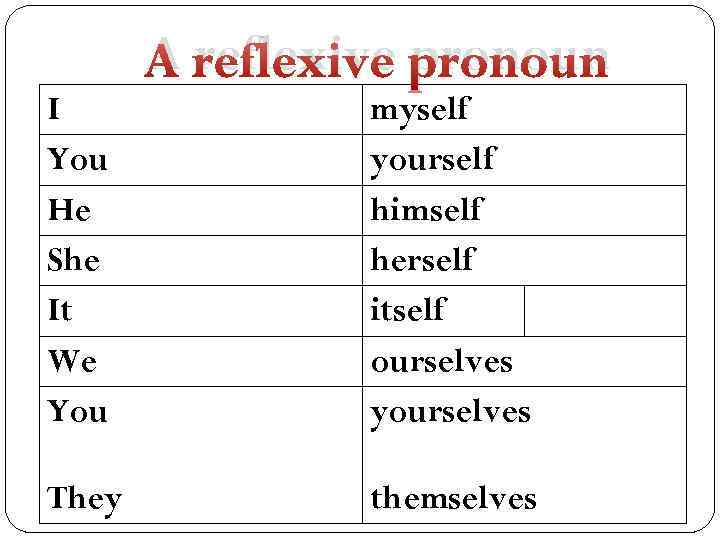 A reflexive pronoun I You He She It We You myself yourself himself herself itself ourselves yourselves They themselves
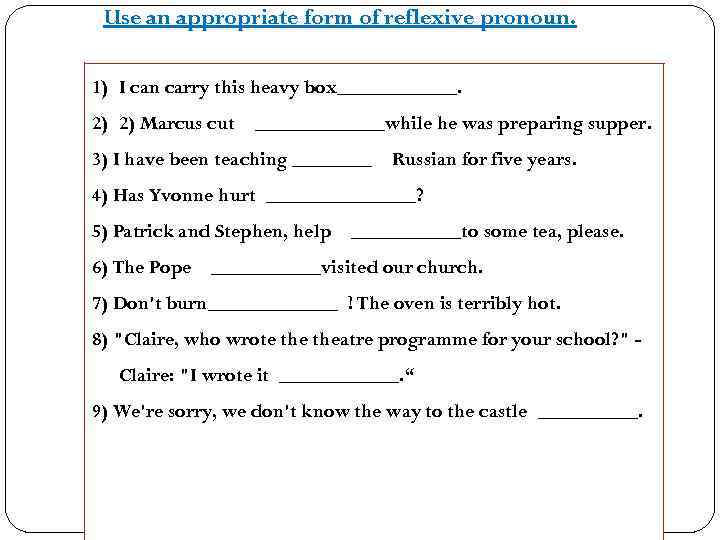 Use an appropriate form of reflexive pronoun. 1) I can carry this heavy box______. 2) 2) Marcus cut _______while he was preparing supper. 3) I have been teaching ____ Russian for five years. 4) Has Yvonne hurt ________? 5) Patrick and Stephen, help ______to some tea, please. 6) The Pope ______visited our church. 7) Don't burn_______ ! The oven is terribly hot. 8) "Claire, who wrote theatre programme for your school? " Claire: "I wrote it ______. “ 9) We're sorry, we don't know the way to the castle _____.
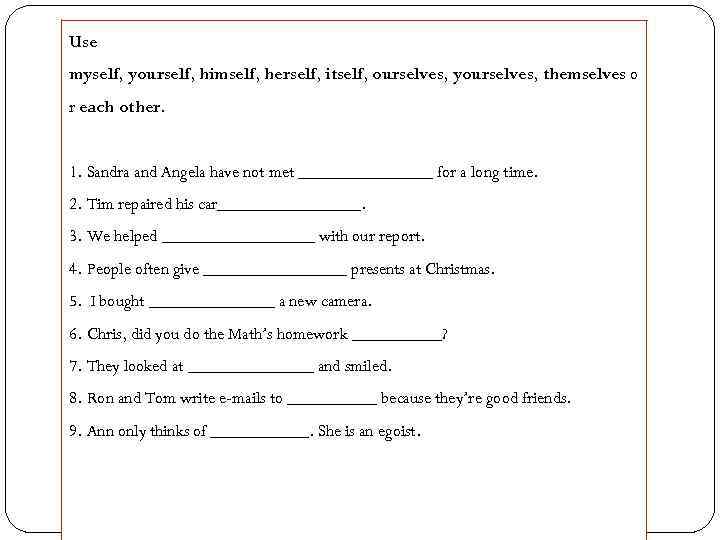 Use myself, yourself, himself, herself, itself, ourselves, yourselves, themselves o r each other. 1. Sandra and Angela have not met ________ for a long time. 2. Tim repaired his car________. 3. We helped _________ with our report. 4. People often give ________ presents at Christmas. 5. I bought _______ a new camera. 6. Chris, did you do the Math’s homework _____? 7. They looked at _______ and smiled. 8. Ron and Tom write e-mails to _____ because they’re good friends. 9. Ann only thinks of ______. She is an egoist.
 Vocabulary Personality
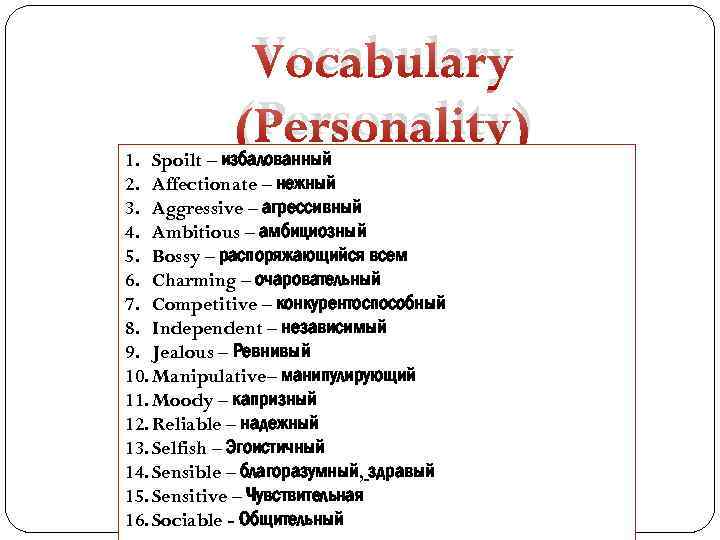 Vocabulary (Personality) 1. Spoilt – избалованный 2. Affectionate – нежный 3. Aggressive – агрессивный 4. Ambitious – амбициозный 5. Bossy – распоряжающийся всем 6. Charming – очаровательный 7. Competitive – конкурентоспособный 8. Independent – независимый 9. Jealous – Ревнивый 10. Manipulative– манипулирующий 11. Moody – капризный 12. Reliable – надежный 13. Selfish – Эгоистичный 14. Sensible – благоразумный, здравый 15. Sensitive – Чувствительная 16. Sociable - Общительный
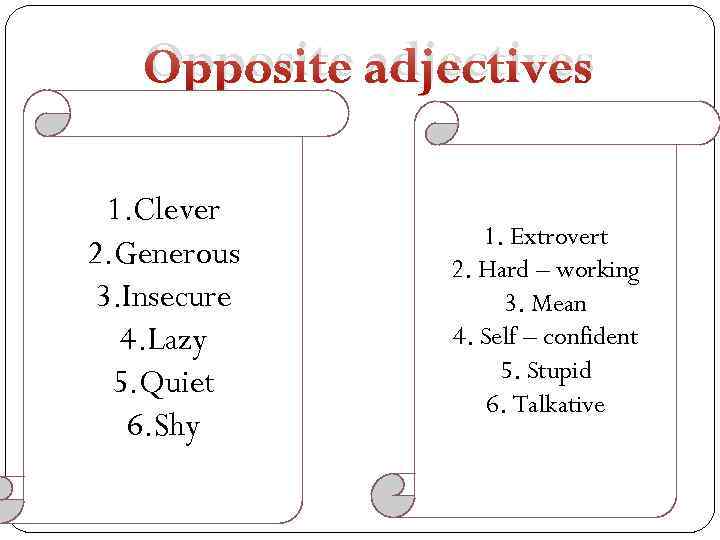 Opposite adjectives 1. Clever 2. Generous 3. Insecure 4. Lazy 5. Quiet 6. Shy 1. Extrovert 2. Hard – working 3. Mean 4. Self – confident 5. Stupid 6. Talkative
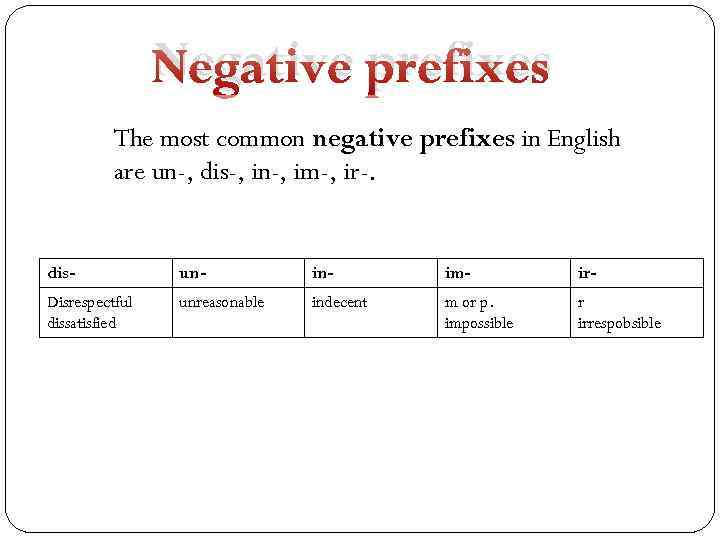 Negative prefixes The most common negative prefixes in English are un-, dis-, in-, im-, ir-. dis- un- im- ir- Disrespectful dissatisfied unreasonable indecent m or p. impossible r irrespobsible
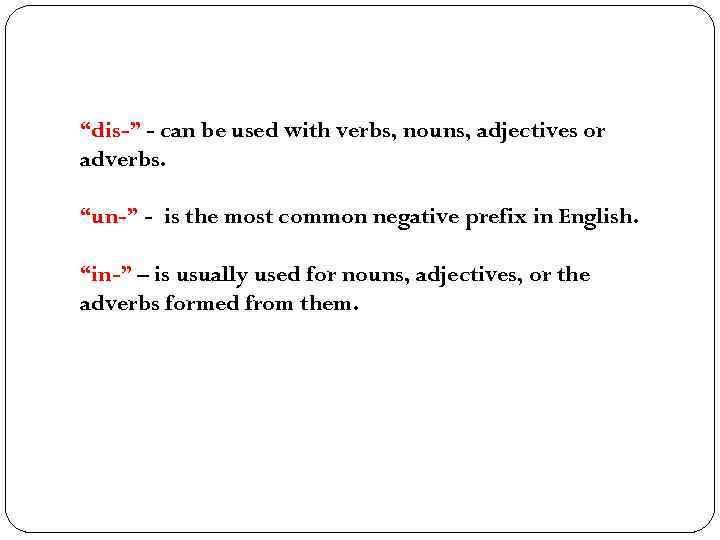 “dis-” - can be used with verbs, nouns, adjectives or adverbs. “un-” - is the most common negative prefix in English. “in-” – is usually used for nouns, adjectives, or the adverbs formed from them.
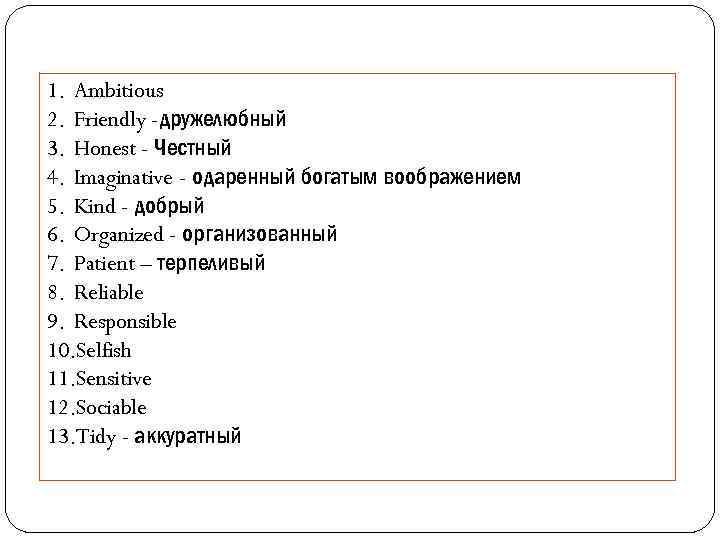 1. Ambitious 2. Friendly -дружелюбный 3. Honest - Честный 4. Imaginative - одаренный богатым воображением 5. Kind - добрый 6. Organized - организованный 7. Patient – терпеливый 8. Reliable 9. Responsible 10. Selfish 11. Sensitive 12. Sociable 13. Tidy - аккуратный
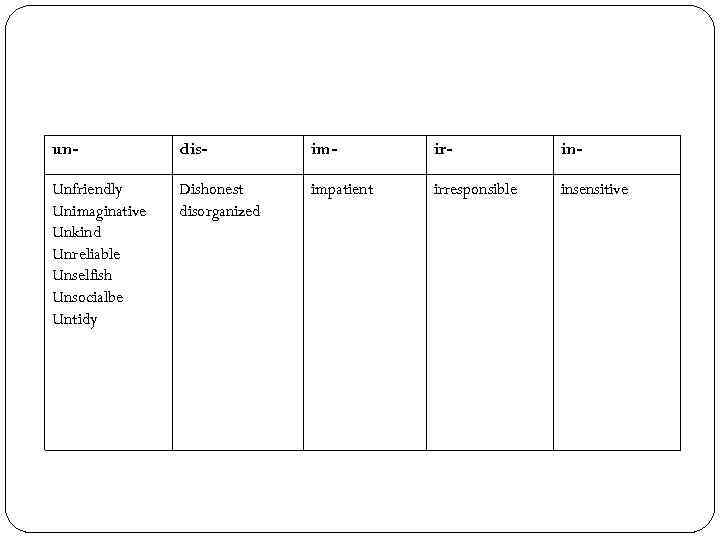 un- dis- im- ir- in- Unfriendly Unimaginative Unkind Unreliable Unselfish Unsocialbe Untidy Dishonest disorganized impatient irresponsible insensitive