


 Скачать презентацию The Texas Advanced Computing Center Developing a Scientific
68dcd74edf590cfceac36a01b01054d8.ppt
- Количество слайдов: 19
 The Texas Advanced Computing Center: Developing a Scientific Computing Curriculum Jay Boisseau, Director Texas Advanced Computing Center The University of Texas at Austin March 4, 2010
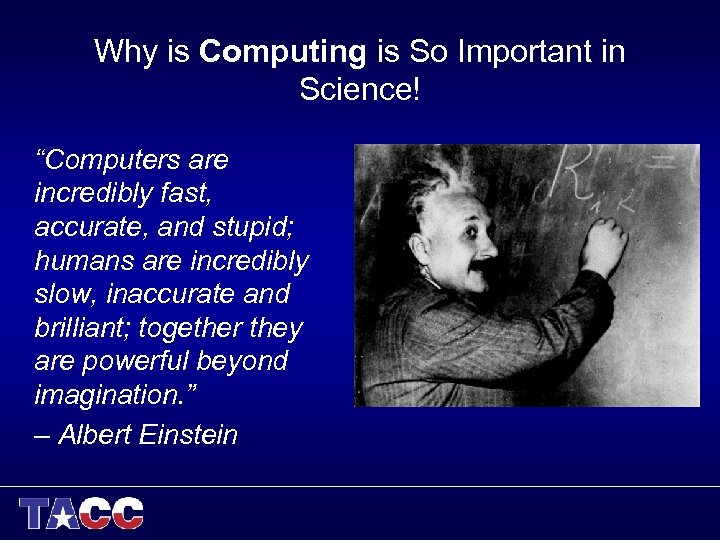 Why is Computing is So Important in Science! “Computers are incredibly fast, accurate, and stupid; humans are incredibly slow, inaccurate and brilliant; together they are powerful beyond imagination. ” – Albert Einstein
 TACC Mission To enable discoveries that advance science and society through the application of advanced computing technologies.
 TACC’s Vision • Provide the most powerful, capable computing technologies and techniques that enable people— researchers, educators, developers, engineers, businessmen, etc. —to advance science and society. • Provide leadership in the advanced computing community in technology R&D, support, education, and expertise to ensure maximum impact of current and future technologies in diverse applications. • Enable transformational science and societal achievements that change, influence, and improve our understanding of the world, and the world itself.
![We Know It’s About the Physics… [Courtesy of San Diego Supercomputer Center]](https://present5.com/presentation/68dcd74edf590cfceac36a01b01054d8/image-5.jpg "We Know It’s About the Physics… [Courtesy of San Diego Supercomputer Center]") We Know It’s About the Physics… [Courtesy of San Diego Supercomputer Center]
We Know It’s About the Physics… [Courtesy of San Diego Supercomputer Center]
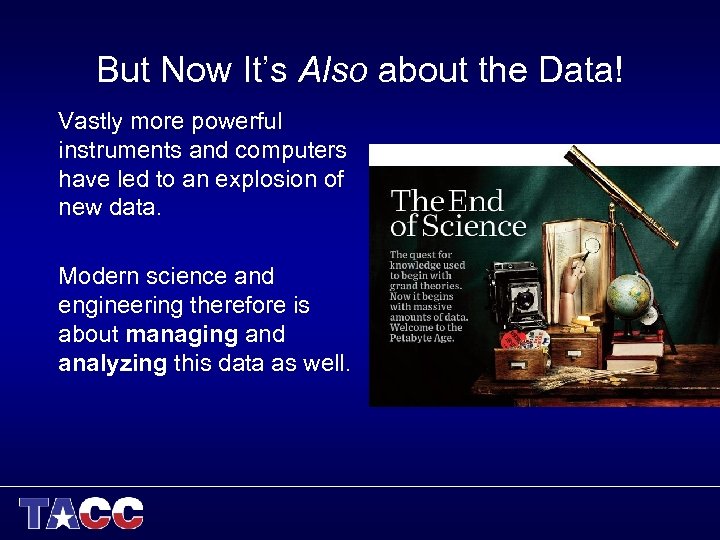 But Now It’s Also about the Data! Vastly more powerful instruments and computers have led to an explosion of new data. Modern science and engineering therefore is about managing and analyzing this data as well.
 Computing & Science Over the past 60+ years, computers have become the most important general-purpose instrument of science. – every field of science is using computational resources and techniques to complement theory and observations – percentage of research using computing continues to climb Many challenging problems require tremendously powerful computers for problem size, solution speed. – simulation-driven science requiring solutions of differential equations in 3 D space for huge numbers of timesteps – data-driven science requiring statistical, search, and other analysis techniques on vast data
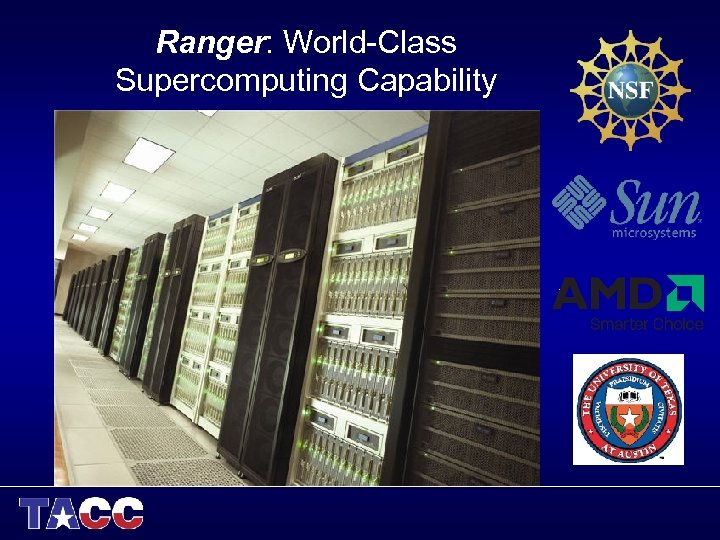 Ranger: World-Class Supercomputing Capability
 Ranger System Summary • Peak Performance – 579. 4 Teraflops – 3, 936 Sun four-socket blades – 15, 744 AMD “Barcelona” processors • Quad-core, four flops/clock cycle • 62, 976 total processor cores • Total Memory - 123 Terabytes – 2 GB/core, 32 GB/node – 123 TB/s aggregate bandwidth • Interconnect – 1 GB/s, 1. 6 -2. 85 sec latency – Sun Data Center Switches (2), Infini. Band, up to 3456 4 x ports each – Full non-blocking 7 -stage fabric – 7. 8 TB/s backplane – Mellanox Connect. X Infini. Band HCAs
 Massive Computing Requires Massive Data Storage: Meet Corral! 1. 2 petabytes of disk storage – Data. Direct disk – 8 Dell 1950 and 8 Dell 2950 servers Multiple ways to access data – – Web Databases File system i. RODS
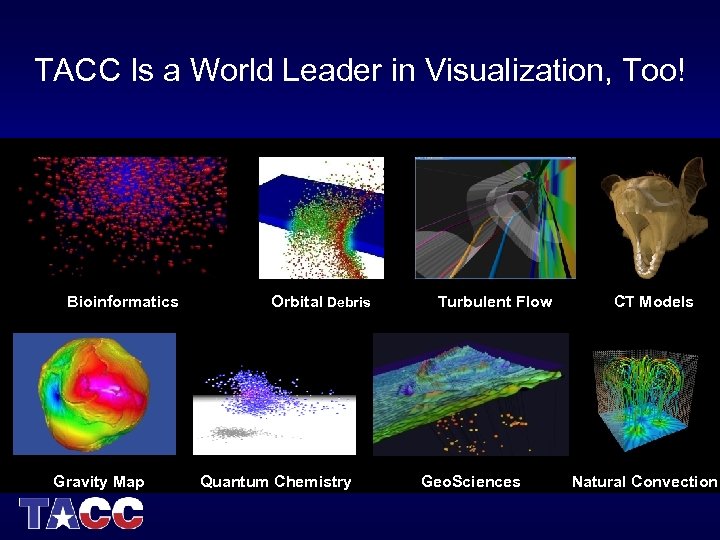 TACC Is a World Leader in Visualization, Too! Bioinformatics Gravity Map Orbital Debris Quantum Chemistry Turbulent Flow Geo. Sciences CT Models Natural Convection
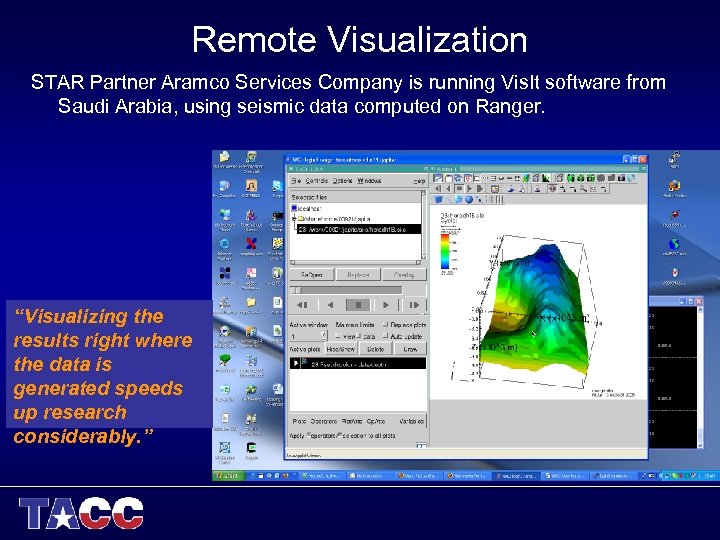 Remote Visualization STAR Partner Aramco Services Company is running Vis. It software from Saudi Arabia, using seismic data computed on Ranger. “Visualizing the results right where the data is generated speeds up research considerably. ”
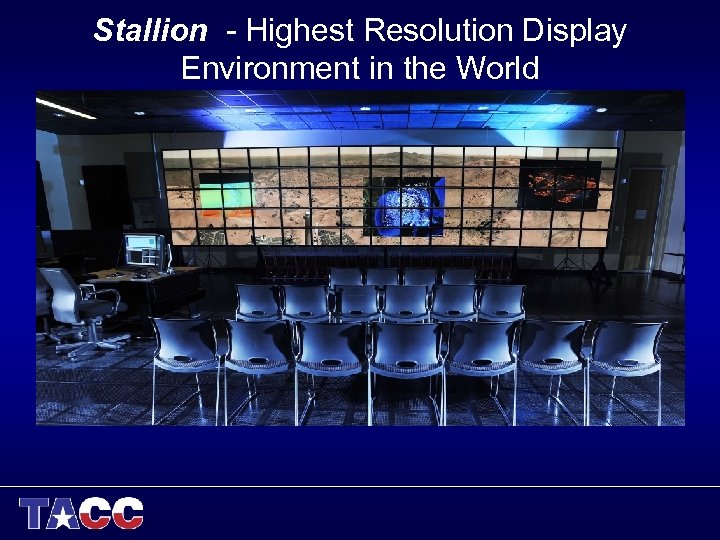 Stallion - Highest Resolution Display Environment in the World
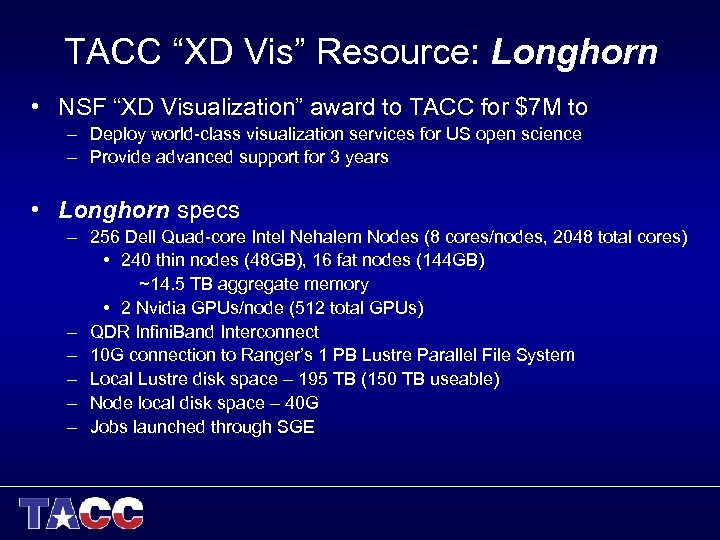 TACC “XD Vis” Resource: Longhorn • NSF “XD Visualization” award to TACC for $7 M to – Deploy world-class visualization services for US open science – Provide advanced support for 3 years • Longhorn specs – 256 Dell Quad-core Intel Nehalem Nodes (8 cores/nodes, 2048 total cores) • 240 thin nodes (48 GB), 16 fat nodes (144 GB) ~14. 5 TB aggregate memory • 2 Nvidia GPUs/node (512 total GPUs) – QDR Infini. Band Interconnect – 10 G connection to Ranger’s 1 PB Lustre Parallel File System – Local Lustre disk space – 195 TB (150 TB useable) – Node local disk space – 40 G – Jobs launched through SGE
 So Why is TACC Teaching Classes? • In the 90 s, CS curricula changed: the tech industry influenced the programming language focus but also in topics focus • But the importance of computing to science and engineering didn’t change—it also grew • We’ve had 10 -20 years of reduced focused in CS curricula on scientific computing, overlapping with the onset of massive parallelism
 TACC’s Comprehensive Classes • • Intro to Scientific Programming Scientific/Technical Computing Parallel Computing for Science & Engineering Visualization & Data Analysis for Science & Engineering • Distributed & Grid Computing for Science & Engineering – Will probably become Distributed, Grid & Cloud Computing
 Challenges Remain • Still don’t have a scientific computing department – But do have a graduate computational science degree plan and an undergrad certificate now • Must still put materials in form to be distributed, and to record and broadcast – Thank you, Chevron! • Must find time for staff to constantly update the materials—currently a volunteer effort!
 Summary ² Advanced computing techniques more important than ever: in science, engineering, and beyond. ² Computing curricula changed in the 90’s due to growth of computing sales to business, consumers. ² TACC has developed a comprehensive scientific computing curriculum to prepare students for both research and industry careers. ² We have a long way to go towards addressing the tremendous need for more technical computing education, but things are changing.
 Please feel free to contact me with any questions or suggestions: boisseau@tacc. utexas. edu