


 Скачать презентацию The term structure of interest rates Definitions and
b47488d3078d990c710ced34ddb26f40.ppt
- Количество слайдов: 27
 The term structure of interest rates Definitions and illustrations
 Objective Understand the relationship between interest rates and expectations of future interest rates
 Outline • Spot vs. forward interest rates • Implications for bond valuations • Term structures of interest rates • Theories on term structures
 Spot vs. forward interest rates Spot rate Simple annual rate of interest, or the YTM on a pure discount bond maturing at time t Forward rate Implied future interest rate, as estimated today Forward rates reveal expectations of future interest rates
 On spot rates Spot rates can be: • quoted (ex: banks on GIC) • calculated from bond data
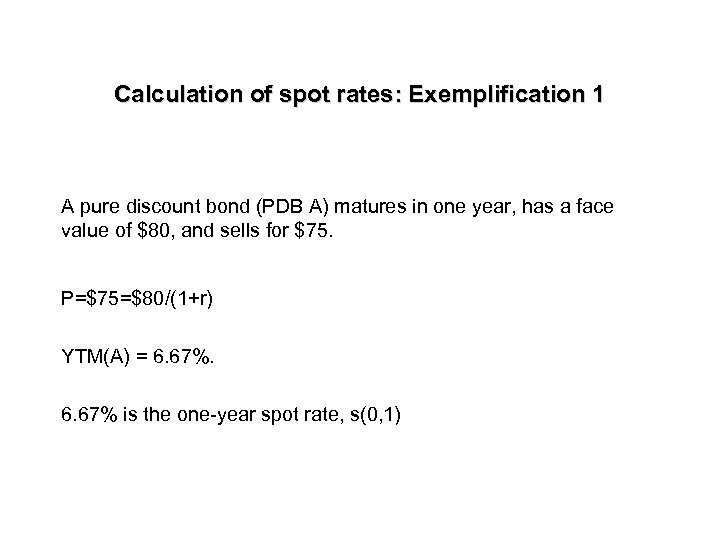 Calculation of spot rates: Exemplification 1 A pure discount bond (PDB A) matures in one year, has a face value of $80, and sells for $75. P=$75=$80/(1+r) YTM(A) = 6. 67% is the one-year spot rate, s(0, 1)
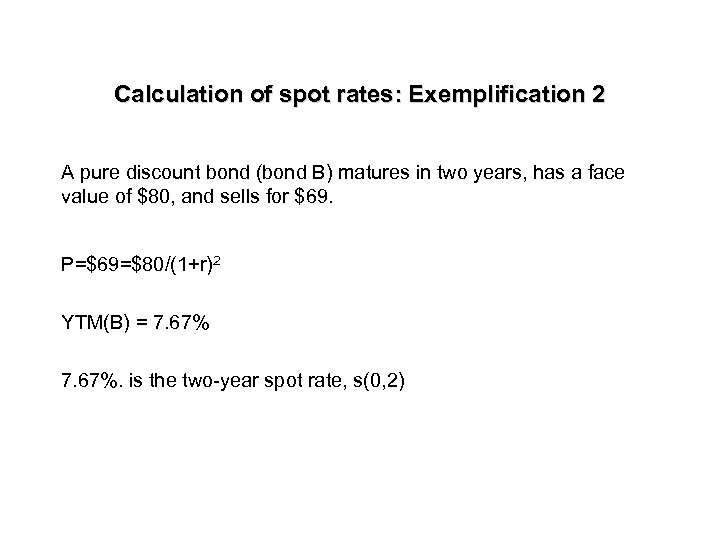 Calculation of spot rates: Exemplification 2 A pure discount bond (bond B) matures in two years, has a face value of $80, and sells for $69. P=$69=$80/(1+r)2 YTM(B) = 7. 67%. is the two-year spot rate, s(0, 2)
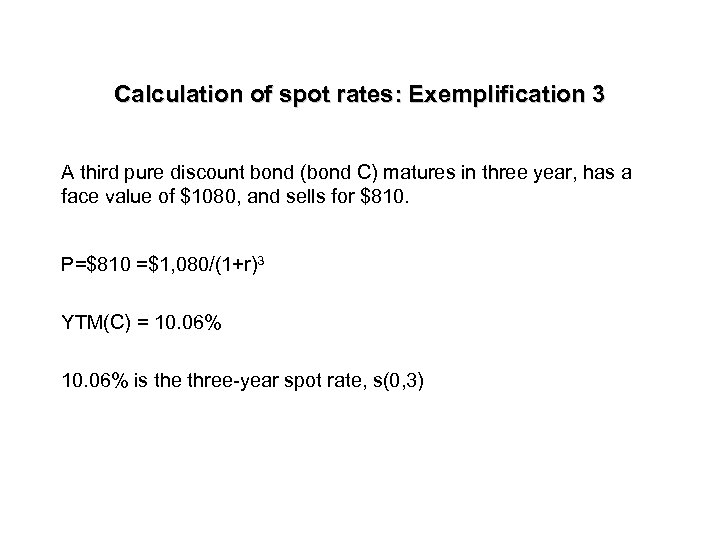 Calculation of spot rates: Exemplification 3 A third pure discount bond (bond C) matures in three year, has a face value of $1080, and sells for $810. P=$810 =$1, 080/(1+r)3 YTM(C) = 10. 06% is the three-year spot rate, s(0, 3)
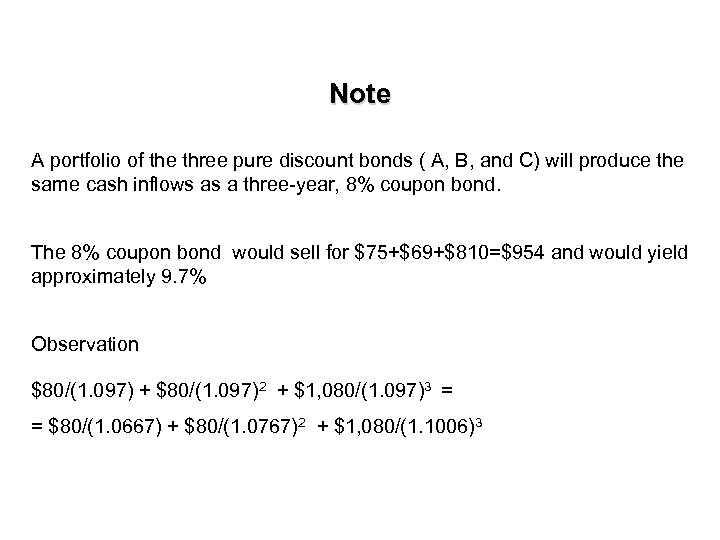 Note A portfolio of the three pure discount bonds ( A, B, and C) will produce the same cash inflows as a three-year, 8% coupon bond. The 8% coupon bond would sell for $75+$69+$810=$954 and would yield approximately 9. 7% Observation $80/(1. 097) + $80/(1. 097)2 + $1, 080/(1. 097)3 = = $80/(1. 0667) + $80/(1. 0767)2 + $1, 080/(1. 1006)3
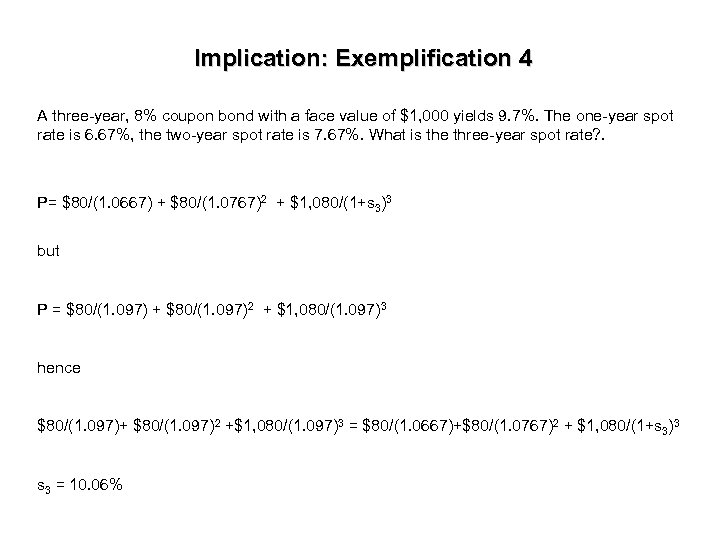 Implication: Exemplification 4 A three-year, 8% coupon bond with a face value of $1, 000 yields 9. 7%. The one-year spot rate is 6. 67%, the two-year spot rate is 7. 67%. What is the three-year spot rate? . P= $80/(1. 0667) + $80/(1. 0767)2 + $1, 080/(1+s 3)3 but P = $80/(1. 097) + $80/(1. 097)2 + $1, 080/(1. 097)3 hence $80/(1. 097)+ $80/(1. 097)2 +$1, 080/(1. 097)3 = $80/(1. 0667)+$80/(1. 0767)2 + $1, 080/(1+s 3)3 s 3 = 10. 06%
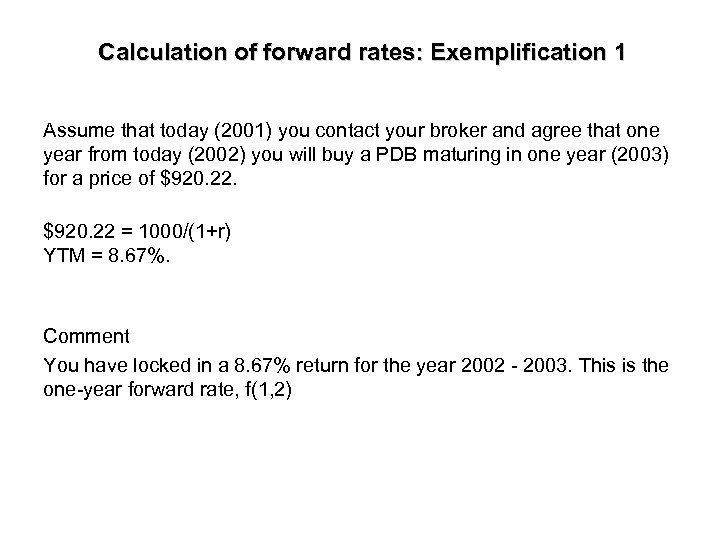 Calculation of forward rates: Exemplification 1 Assume that today (2001) you contact your broker and agree that one year from today (2002) you will buy a PDB maturing in one year (2003) for a price of $920. 22 = 1000/(1+r) YTM = 8. 67%. Comment You have locked in a 8. 67% return for the year 2002 - 2003. This is the one-year forward rate, f(1, 2)
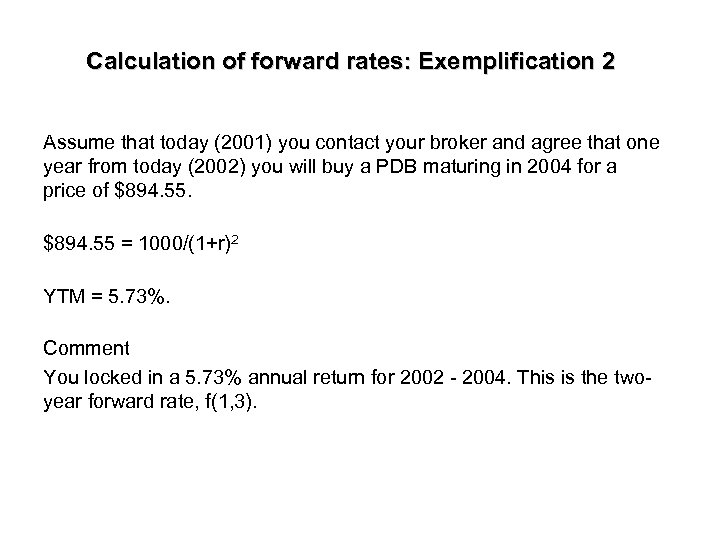 Calculation of forward rates: Exemplification 2 Assume that today (2001) you contact your broker and agree that one year from today (2002) you will buy a PDB maturing in 2004 for a price of $894. 55 = 1000/(1+r)2 YTM = 5. 73%. Comment You locked in a 5. 73% annual return for 2002 - 2004. This is the twoyear forward rate, f(1, 3).
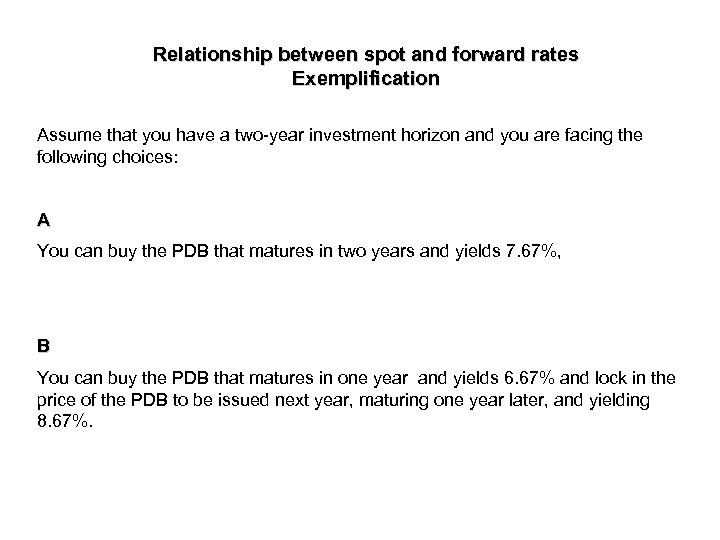 Relationship between spot and forward rates Exemplification Assume that you have a two-year investment horizon and you are facing the following choices: A You can buy the PDB that matures in two years and yields 7. 67%, B You can buy the PDB that matures in one year and yields 6. 67% and lock in the price of the PDB to be issued next year, maturing one year later, and yielding 8. 67%.
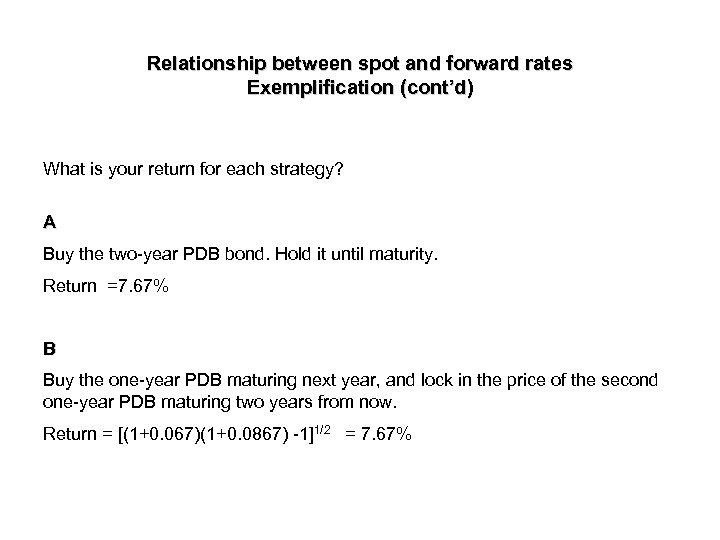 Relationship between spot and forward rates Exemplification (cont’d) What is your return for each strategy? A Buy the two-year PDB bond. Hold it until maturity. Return =7. 67% B Buy the one-year PDB maturing next year, and lock in the price of the second one-year PDB maturing two years from now. Return = [(1+0. 067)(1+0. 0867) -1]1/2 = 7. 67%
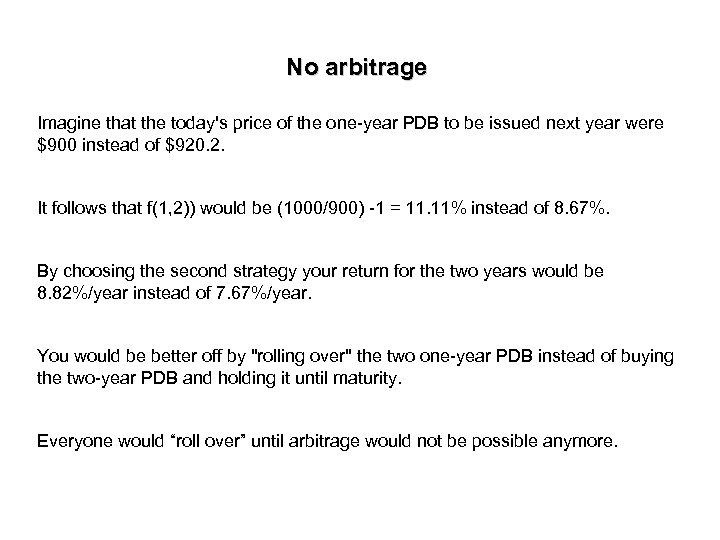 No arbitrage Imagine that the today's price of the one-year PDB to be issued next year were $900 instead of $920. 2. It follows that f(1, 2)) would be (1000/900) -1 = 11. 11% instead of 8. 67%. By choosing the second strategy your return for the two years would be 8. 82%/year instead of 7. 67%/year. You would be better off by "rolling over" the two one-year PDB instead of buying the two-year PDB and holding it until maturity. Everyone would “roll over” until arbitrage would not be possible anymore.
![Relationship between spot and forward rates: Two -year horizon [1+s(0, 2)]2 = [1+s(0, 1)][1+f(1,](https://present5.com/presentation/b47488d3078d990c710ced34ddb26f40/image-16.jpg "Relationship between spot and forward rates: Two -year horizon [1+s(0, 2)]2 = [1+s(0, 1)][1+f(1,") Relationship between spot and forward rates: Two -year horizon [1+s(0, 2)]2 = [1+s(0, 1)][1+f(1, 2)]
Relationship between spot and forward rates: Two -year horizon [1+s(0, 2)]2 = [1+s(0, 1)][1+f(1, 2)]
![Relationship between spot and forward rates: Three -year horizon [1+s(0, 3)]3 = [1+s(0, 1)][1+f(1,](https://present5.com/presentation/b47488d3078d990c710ced34ddb26f40/image-17.jpg "Relationship between spot and forward rates: Three -year horizon [1+s(0, 3)]3 = [1+s(0, 1)][1+f(1,") Relationship between spot and forward rates: Three -year horizon [1+s(0, 3)]3 = [1+s(0, 1)][1+f(1, 2)][1+f(2, 3)] = [1+s(0, 2)]2 [1+f(2, 3)] Note [1+f(1, 2)][1+f(2, 3)] = [1+f(1, 3)]2 hence [1+s(0, 3)]3 = [1+s(0, 1)][1+f(1, 3)]2
Relationship between spot and forward rates: Three -year horizon [1+s(0, 3)]3 = [1+s(0, 1)][1+f(1, 2)][1+f(2, 3)] = [1+s(0, 2)]2 [1+f(2, 3)] Note [1+f(1, 2)][1+f(2, 3)] = [1+f(1, 3)]2 hence [1+s(0, 3)]3 = [1+s(0, 1)][1+f(1, 3)]2
![Generalization [1 + s(0, k)]k [1 + f(k, t)] (t-k) = [1 + s(0,](https://present5.com/presentation/b47488d3078d990c710ced34ddb26f40/image-18.jpg "Generalization [1 + s(0, k)]k [1 + f(k, t)] (t-k) = [1 + s(0,") Generalization [1 + s(0, k)]k [1 + f(k, t)] (t-k) = [1 + s(0, t)]t
Generalization [1 + s(0, k)]k [1 + f(k, t)] (t-k) = [1 + s(0, t)]t
 The term structure of interest rates Relationship between bond yields and various bond maturity dates
 The term structure of interest rates • Upward sloping • Downward sloping • Flat
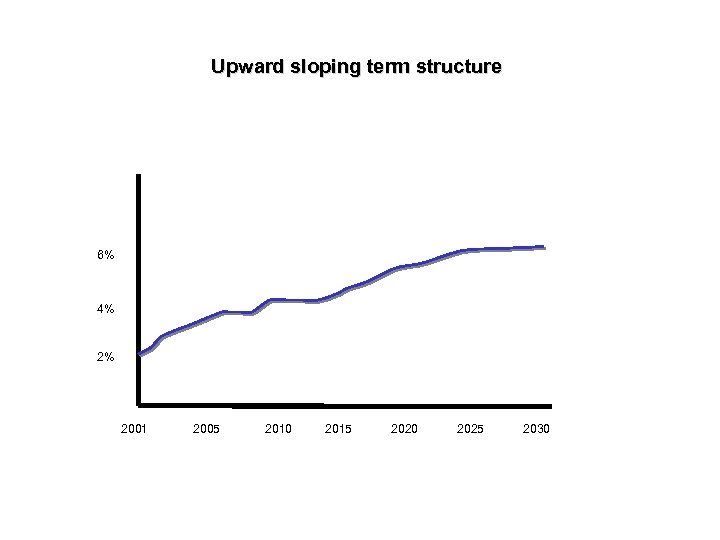 Upward sloping term structure 6% 4% 2% 2001 2005 2010 2015 2020 2025 2030
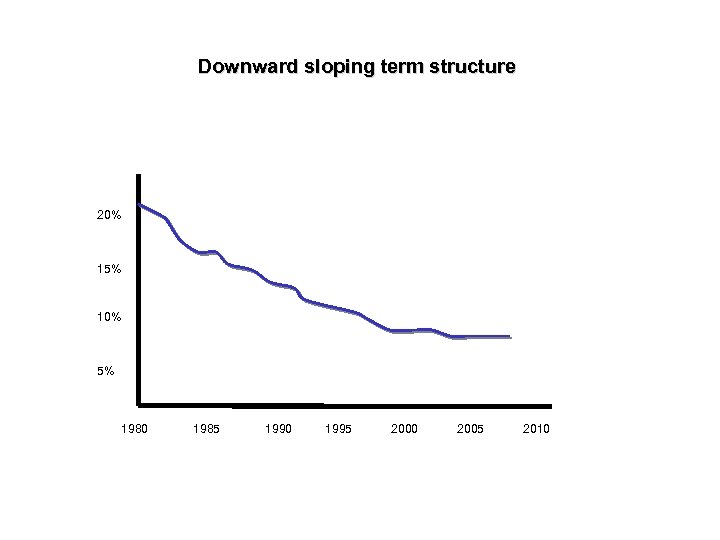 Downward sloping term structure 20% 15% 10% 5% 1980 1985 1990 1995 2000 2005 2010
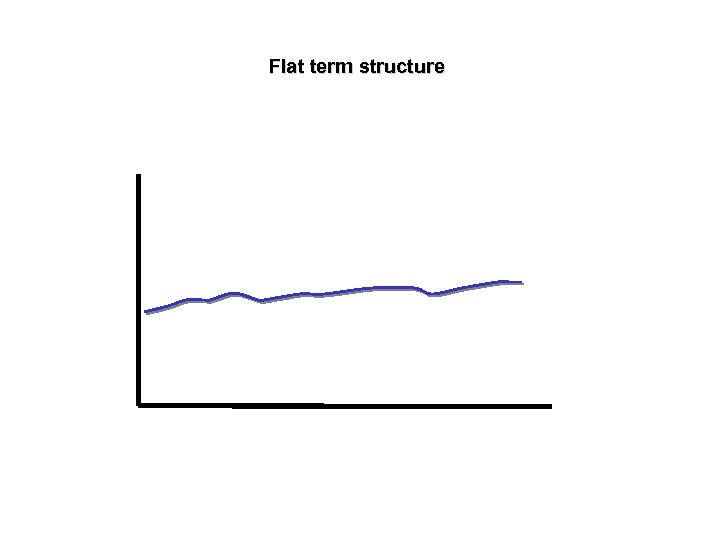 Flat term structure
 Theories on term structures • Unbiased Expectations • Liquidity Preference • Market Segmentation
 Unbiased Expectations Investors believe f = E(s) Does not explain why term structures are mostly upward sloping
 Liquidity Preference Investors believe f = E(s) + liquidity premium
 Market Segmentation There are: • short-term borrowers and short-term lenders • medium-term borrowers and medium-term lenders • long-term borrowers and long-term lenders The term structure depends on the relative demand/supply in each market segment