


 Скачать презентацию The Ten Most Common Online Legal Pitfalls for
d834464bba5361c705cf5b0079bd838b.ppt
- Количество слайдов: 44
 The Ten Most Common Online Legal Pitfalls for Nonprofits. . . and How to Avoid Them November 18, 2008 Lisa M. Hix Jeffrey S. Tenenbaum Venable, LLP Washington, DC Association of Corporate Counsel www. acc. com
 Page 2 Online Trends For organizations with fewer than 250, 000 email addresses on file, the number of unique web visitors over the past year grew 10. 8 percent Traffic soared 34 percent for groups with more than 250, 000 addresses on file Overall, 3 percent of those unique visitors became subscribers, up slightly from 2. 8 percent the year before Across all clients, email files grew 32 percent, a rate that provides nonprofits an opportunity to engage with more of their constituents
 Page 3 Online Trends Revenue from online sources, including e-commerce activities, is up 25 percent The average gift size among nonprofits in the study grew from $56 to $60 Online gifts higher than the average gift from traditional channels
 Page 4 Today’s Focus Building Online Presence Legal Rights to Internet Materials Building Online Communities Listservs, Chat Rooms Outreach E-mail Marketing
 Page 5 Internet Content
 Page 6 What’s Involved All Online Content: Publications Promotional Pieces Photos Graphics Video
 Page 7 Who owns your “intellectual capital? ” Employee Works Site Designers Authors and Speakers Articles Speeches, handouts and Power. Point presentations Volunteers & Committees Position papers Articles
 Page 8 Securing Rights Applies to All Intellectual Property Text, Graphics, Photos, Video Assignment Transfer of all copyright ownership Tax-exempt may use in any form, at any time License Limited by scope, but can be very broad
 Page 9 Securing Rights - License Define Future Uses Particularly important for previously published materials Define Geographic Area Exclusive or non-exclusive Perpetual or limited in duration Define Payment (or Non-Payment) Terms Obtain Licenses from All Authors and Speakers
 Page 10 What If We Don’t Have An Agreement? Implied License Narrowly Construed and Subject to Interpretation If Material Exists Elsewhere, Link to Source
 Page 11 Practical Tips Strategy License, Assignment, or Shared Ownership? Adopt a standard policy and practice for all volunteer and committee work. Volunteers sign from outset of work
 Page 12 Practical Tips All authors sign standard agreements Obtain right to publish AND post online Speakers grant rights to post online Paid Contractors agree to standard assignment
 Page 13 Protecting Your Intellectual Property Allowing others to use articles Clearly define use and duration Ensure you have what you give away Hyperlinks by third parties Monitoring others’ use
 Page 14 Listservs and Chat Rooms
 Page 15 Limiting Liability Assess Your Vulnerabilities Antitrust? Defamation? Contributory Copyright Infringement? Political Activity? Giving “Professional” Advice? Anything Else?
 Page 16 Use Terms Require all participants to follow established rules: Affirmative act, such as “click and accept” to enter Disclaim all warranties, guarantees, liability Prohibit defamatory, infringing, potential antitrust, and political discussions (among others, such as no sales, no negative discussion of specific companies or professsionals, etc. )
 Page 17 Use Terms Monitor postings Act when inappropriate material is posted Monitoring Does Not Create Liability but Be Careful Where Moderator/Editor* See Sec. 230 of the federal Communications Decency Act, although does not antitrust or copyright or trademark infringement liability
 Page 18 Disclaimers
 Page 19 Liability for Models & Advice Model Forms & Policies Disclaimer and exclusion of liability statement Set out in each model document Website Links No product endorsement of 3 rd party No guarantees re: accuracy of 3 rd party content
 Page 20 Internet Tax Exemption Issues
 Page 21 Multiple Tax-Exempt Entities Affiliated Organizations: With multiple sites, consider different entry points “Tab” for 501(c)(3) entity and any PACs Gives an indicia of operational separation Possible to “attribute” activity – important both for political and for non-charitable operations Reasonable Apportionment of Site Costs
 Page 22 IRS Announcement 2000 -84 Several Questions Regarding Online Activity Asked Most Remain Unanswered Focus: Political and Lobbying Activities for 501(c)(3)s Advertising and Business Activities Solicitation of Contributions
 Page 23 Political Activity & Lobbying 501(c)(3) tax-exempts are limited to “insubstantial” activities attempting to influence legislation If making a 501(h) election, subject to certain financial limits With internet communications being so important, 501(h) is more attractive – measures in terms of dollars, not “substantiality, ” which is difficult to measure. If no 501(h) election, ensure that “appearance” of lobbying on site if “insubstantial” in proportion to nonlobbying
 Page 24 Political Activity & Lobbying In all cases, must track lobbying expenses Apportionment of costs particularly important Consider limiting access to members Allows apportionment to “direct lobbying” (for 501(h) electors, spending ceiling is 4 times higher) Carefully monitor content – and links A website that contains a view of legislation, as well as a link to a voting legislator’s e-mail, will be considered a “call to action”
 Page 25 Lobbying and Political Activity Policies Check sites for links added inadvertently or without authorization Freedom Alliance – Lost 501(c)(3) status due to excessive lobbying, including link to partisan site 501(c)(3) Organizations – ABSOLUTELY prohibited from campaign intervention 501(c)(4) Organizations – Primary activity cannot be campaign intervention
 Page 26 Political Action Committees (PACs) Affiliated Organizations Because PACs are often established in tandem with 501(c)(4) organizations, must avoid attribution of PAC site with 501(c)(3) Two-Click Policy: Material separated from 501(c)(3) page must be at least 2 clicks away Assists in correcting perception that PAC message originates with 501(c)(3)
 Page 27 Chat Rooms As yet, no IRS guidance: To be safe, assume that chat room discussions involving lobbying or electioneering could be attributed Prohibit any biased or partisan communications related to candidate elections
 Page 28 Internet Tax Issues
 Page 29 Unrelated Business Income Tax — The Basics Tax-exempts are not exempt from all taxes, only from those taxes that would otherwise apply to income received from activities that are substantially related to their exempt purposes. Income from the sale of advertising is almost always taxable. Income may be offset by directly-connected expenses.
 Page 30 Corporate Presence on Website Banner Advertisements Corporate Sponsorships Links Online Periodicals Merchant Affiliation Online Charity Malls Virtual Storefronts Online Auctions
 Page 31 Qualified Sponsorship Payments “Qualified sponsorship payment” is a payment in exchange for which the corporate sponsor neither gets nor expects any return benefit other than: Goods or services, or other benefits, the total value of which does not exceed two percent of the sponsorship payment; or Recognition, i. e. , use or acknowledgment of the sponsor’s name, logo, or product lines in connection with the nonprofit’s activities
 Page 32 Advertisement Comparative or qualitative language Price, savings or value information Endorsements Inducement to buy
 Page 33 Exclusions to Safe Harbor Internet Periodicals Unavailable for acknowledgments of corporate support appearing in a nonprofit’s “regularly scheduled and printed material, ” such as newsletters and magazines. For these purposes, “printed material” presumably includes materials that are published electronically.
 Page 34 Hyperlinks Can convert acknowledgment to advertising Should go to sponsor’s homepage Cannot lead to a website that features the nonprofit’s endorsement of the sponsor’s products Be certain that when hyperlinks are provided in exchange for payment to have written agreement (for tax and general liability reasons). Exercise oversight over the location of the hyperlink (both on the relevant tax-exempt web page and on the “linked-to” page).
 Page 35 Application Banner Advertisements – monitor both content and links Periodical Advertising – IRS provides a favorable method for allocating expenses against advertising income Online version sufficiently like hard copy periodical? Sufficient segregation of online periodical income and costs?
 Page 36 Application On-line Charity Malls: % of purchase price goes to charity Structure as payment of royalty fees, rather than referral Virtual Storefronts Section 513(c) Fragmentation Rule IRS will review each piece of merchandise On-line Auctions Regularly carried on? Conducted by outside vendor? Must be “continually controlled” by charity
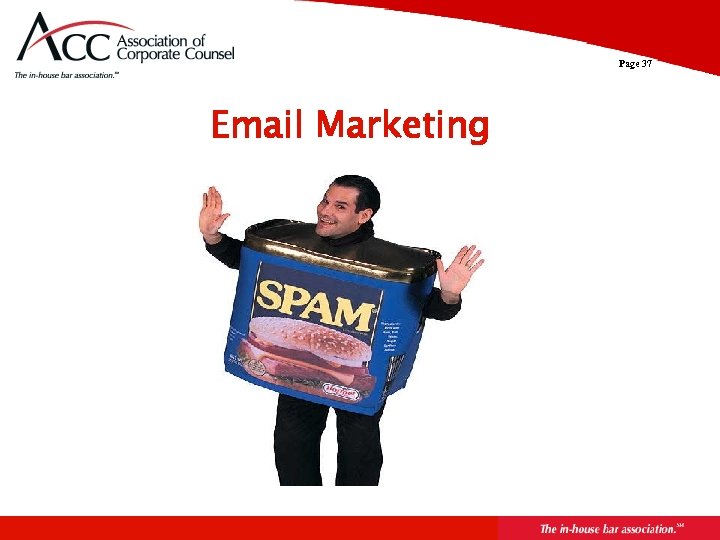 Page 37 Email Marketing
 Page 38 Application Emails that are primarily intended to advertise or promote a commercial product or service, such as membership in the organization or the sale of organization publications Members generally excluded
 Page 39 General Rules Give clear and conspicuous notice of the opportunity to opt-out. The notice must be in every email message containing a commercial offer. No fee or other obligations on the message recipient before processing the recipient's opt-out request Provide a functioning opt-out in every commercial email message. This can be a return email address or other Internet-based mechanism that is capable of receiving opt-out requests for at least 30 days after the transmission of the original message. Further, if the recipient has opted-out, the sender may not rent, exchange or otherwise transfer or release the email address of the recipient.
 Page 40 General Rules Provide a valid physical postal address of the sender. Clear and conspicuous notice that email is an advertisement or solicitation Make sure the "from" line accurately and clearly reflects the sender. Something like "products@nonprofit. org, " "programs@nonprofit. org" or "memberservices@nonprofit. org" could be used to identify your organization Use a valid subject line. There currently are no labeling requirements for the subject line ("ADV" for advertisement, for example).
 Page 41 Privacy & Confidentiality
 Page 42 Fair Information Practices Notify as to information gathered, how used, and what 3 rd parties it will be shared with Provide option for information not to be shared with 3 rd parties Provide information about security safeguarding Provide access for individuals to review and correct information
 Page 43 QUESTIONS?
 Thank you for attending another presentation from ACC’s Desktop Learning Webcasts Please be sure to complete the evaluation form for this program as your comments and ideas are helpful in planning future programs. You may also contact Lillian Moyano Yob at yob@acc. com or Susanna Mc. Donald at Mc. Donald@acc. com This and other ACC webcasts have been recorded and are available, for one year after the presentation date, as archived webcasts at www. webcasts. acc. com. You can also find transcripts of these programs in ACC’s Virtual Library at www. acc. com/vl