


 Скачать презентацию The Synthesis of Modified Organic Dyes for Improved
7abb94812664ae30531e3964c18bdd25.ppt
- Количество слайдов: 12
 The Synthesis of Modified Organic Dyes for Improved Integration with a Hole. Transport Material. 1 OMAR K. ABDI SCIENCE AT THE INTERFACE AUGUST 14 2012 DEPARTMENT OF CHEMISTRY AND BIOLOGY RYERSON UNIVERSITY
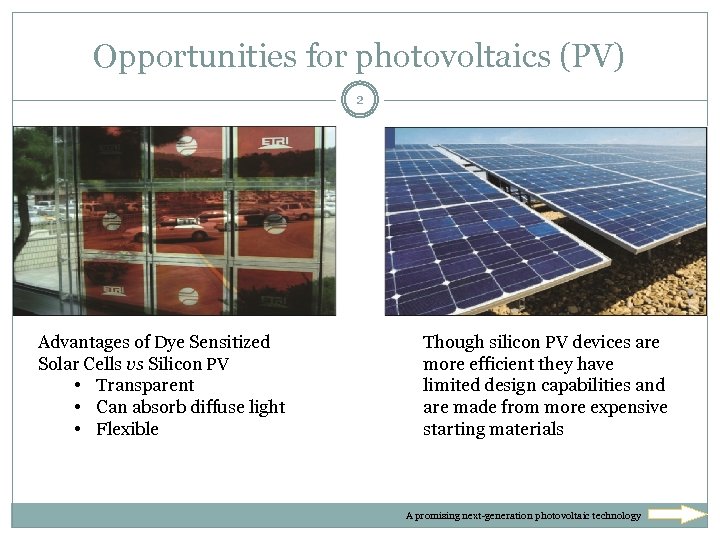 Opportunities for photovoltaics (PV) 2 Advantages of Dye Sensitized Solar Cells vs Silicon PV • Transparent • Can absorb diffuse light • Flexible Though silicon PV devices are more efficient they have limited design capabilities and are made from more expensive starting materials A promising next-generation photovoltaic technology
 Dye-Sensitized Solar Cell (DSSC) 3 The dye is the power-house of the cell Chromophore π-spacer Anchor Hagberg D. P. , et al. , J. Org. Chem. , 2007. 72, 9550 The problems inherent in the I-/I 3 - electrolyte
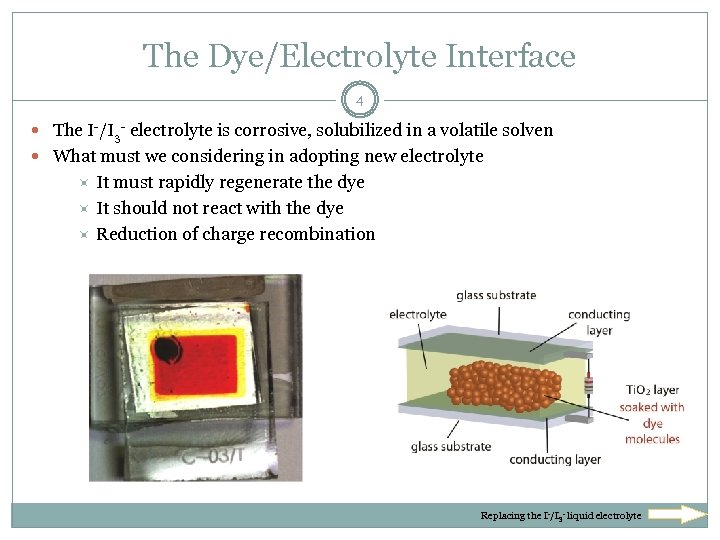 The Dye/Electrolyte Interface 4 The I-/I 3 - electrolyte is corrosive, solubilized in a volatile solven What must we considering in adopting new electrolyte It must rapidly regenerate the dye It should not react with the dye Reduction of charge recombination Replacing the I-/I 3 - liquid electrolyte
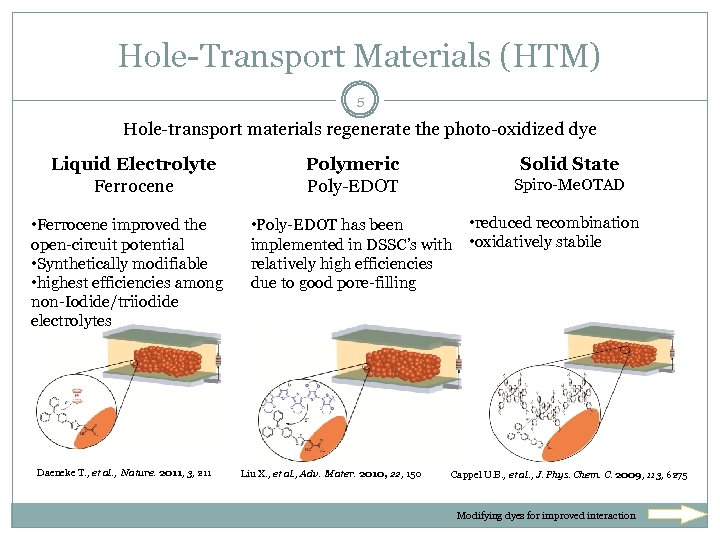 Hole-Transport Materials (HTM) 5 Hole-transport materials regenerate the photo-oxidized dye Liquid Electrolyte Ferrocene • Ferrocene improved the open-circuit potential • Synthetically modifiable • highest efficiencies among non-Iodide/triiodide electrolytes Daeneke T. , et al. , Nature. 2011, 3, 211 Polymeric Poly-EDOT Solid State Spiro-Me. OTAD • Poly-EDOT has been implemented in DSSC’s with relatively high efficiencies due to good pore-filling Liu X. , et al. , Adv. Mater. 2010, 22, 150 • reduced recombination • oxidatively stabile Cappel U. B. , et al. , J. Phys. Chem. C. 2009, 113, 6275 Modifying dyes for improved interaction
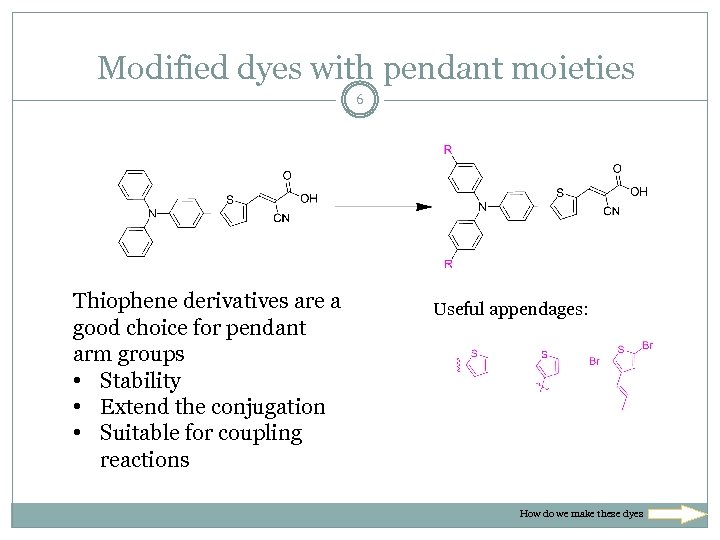 Modified dyes with pendant moieties 6 Thiophene derivatives are a good choice for pendant arm groups • Stability • Extend the conjugation • Suitable for coupling reactions Useful appendages: How do we make these dyes
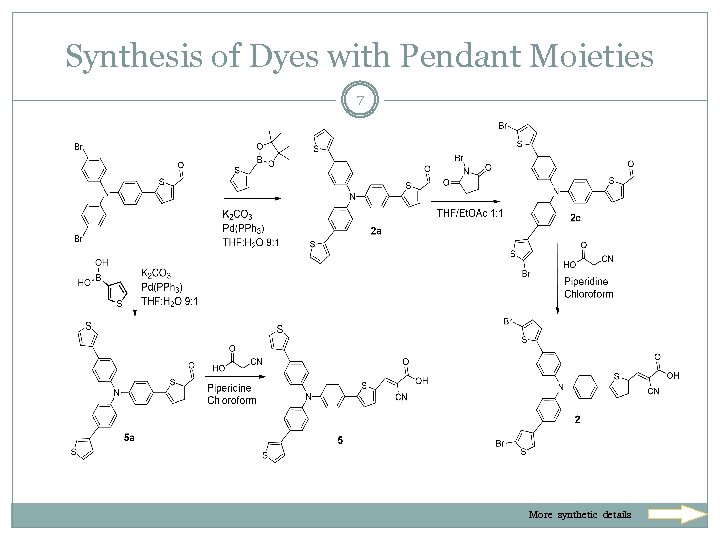 Synthesis of Dyes with Pendant Moieties 7 More synthetic details
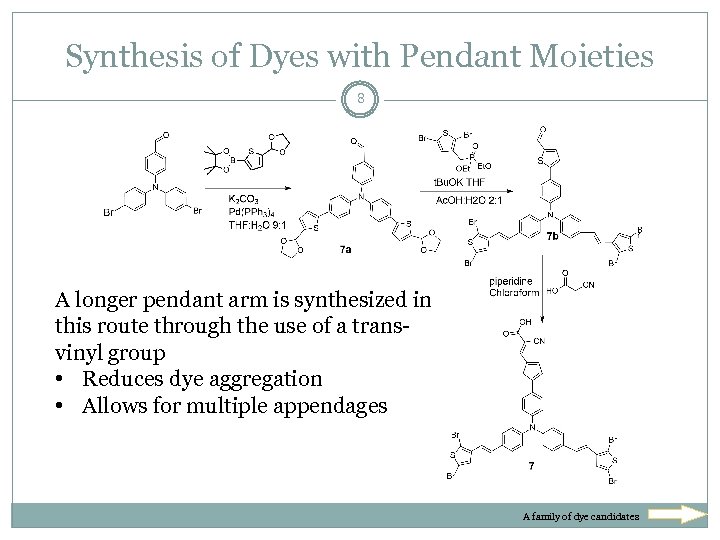 Synthesis of Dyes with Pendant Moieties 8 A longer pendant arm is synthesized in this route through the use of a transvinyl group • Reduces dye aggregation • Allows for multiple appendages A family of dye candidates
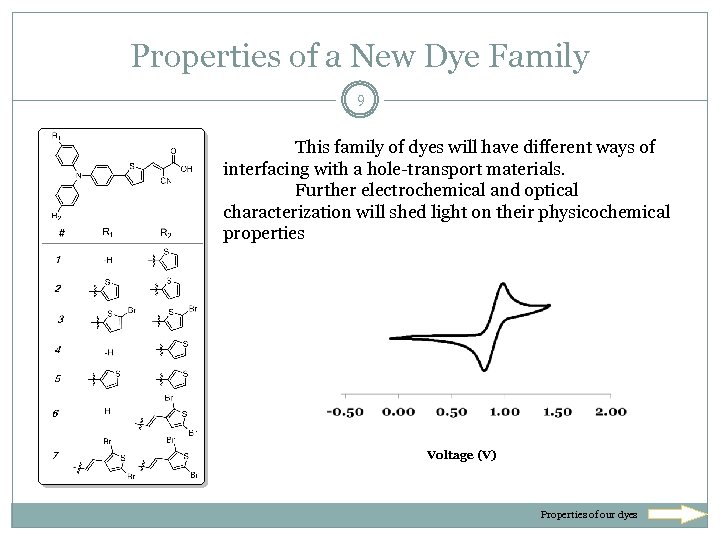 Properties of a New Dye Family 9 This family of dyes will have different ways of interfacing with a hole-transport materials. Further electrochemical and optical characterization will shed light on their physicochemical properties Voltage (V) Properties of our dyes
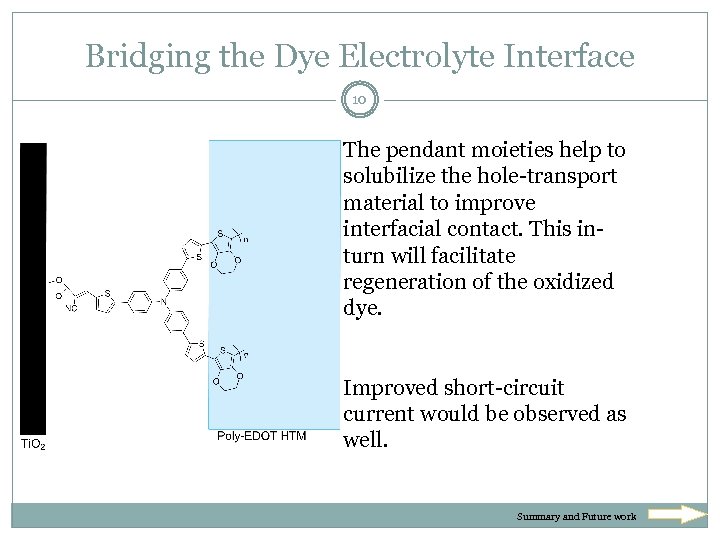 Bridging the Dye Electrolyte Interface 10 The pendant moieties help to solubilize the hole-transport material to improve interfacial contact. This inturn will facilitate regeneration of the oxidized dye. Improved short-circuit current would be observed as well. Summary and Future work
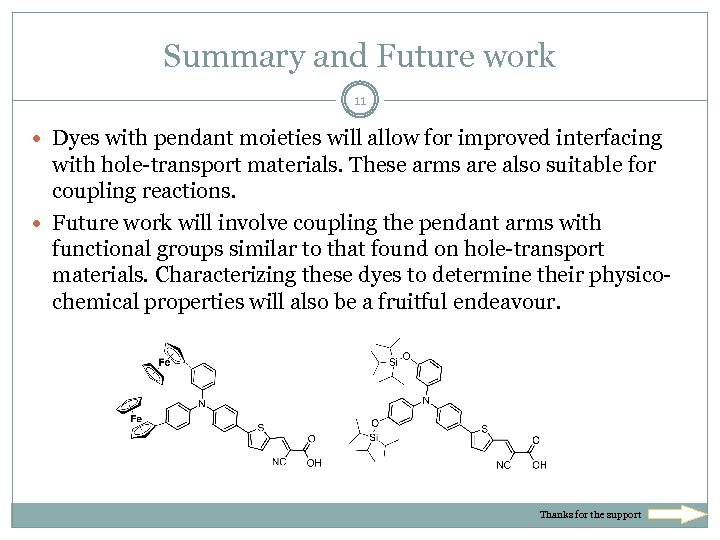 Summary and Future work 11 Dyes with pendant moieties will allow for improved interfacing with hole-transport materials. These arms are also suitable for coupling reactions. Future work will involve coupling the pendant arms with functional groups similar to that found on hole-transport materials. Characterizing these dyes to determine their physicochemical properties will also be a fruitful endeavour. Thanks for the support
 Acknowledgements Current Group 12 Dr. Bryan Koivisto (PI) Dr. Catherine Bonnier (PDF) Devin Machin (BSc) Omar Abdi (BSc) Muhammad Yousaf (MSc)