 Скачать презентацию The Swift GRB Observatory The Mission
8eeef8a9c9ad468b71cf9550d9c5a96c.ppt
- Количество слайдов: 33



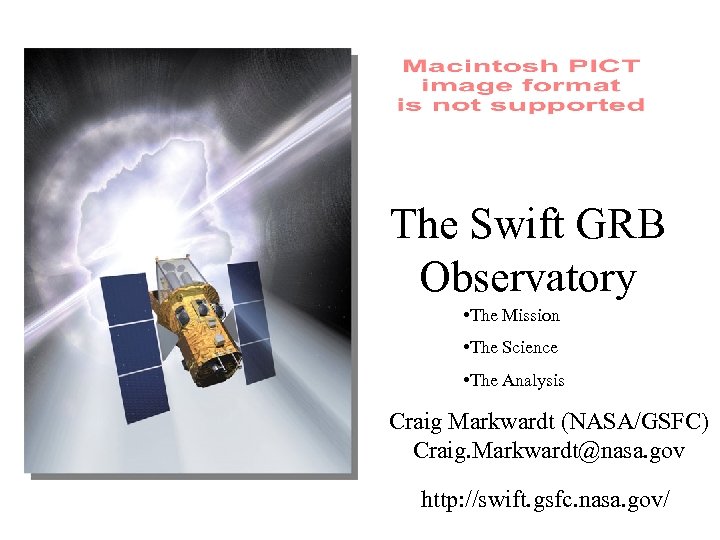
The Swift GRB Observatory • The Mission • The Science • The Analysis Craig Markwardt (NASA/GSFC) Craig. Markwardt@nasa. gov http: //swift. gsfc. nasa. gov/
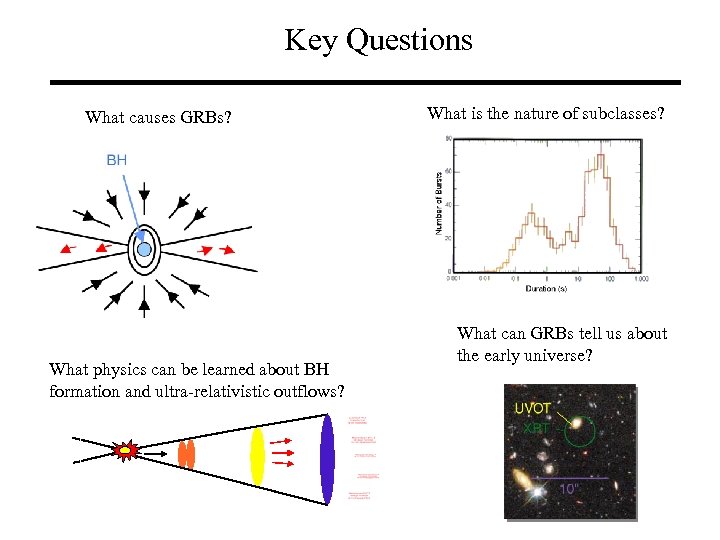
Key Questions What causes GRBs? What physics can be learned about BH formation and ultra-relativistic outflows? What is the nature of subclasses? What can GRBs tell us about the early universe?
Outline GRB Summary - the main science questions How we built Swift and its instruments Some science results What you can do? Some crucial lore to help you along when analyzing Swift data
Summary of Gamma-Ray Bursts Gamma-ray transients lasting 0. 05 - 1000 seconds first detected in the 1960 s Completely unpredictable in time and space Energy release: - ~1051 erg (if beamed) - ~1053 - 1054 erg (if isotropic) - Most luminous explosions in the universe! Distance: cosmological (z 0. 5) Morphology: - Simple “short” bursts - Complex “long” bursts Afterglows - have been detected since 1997 in optical and X-ray
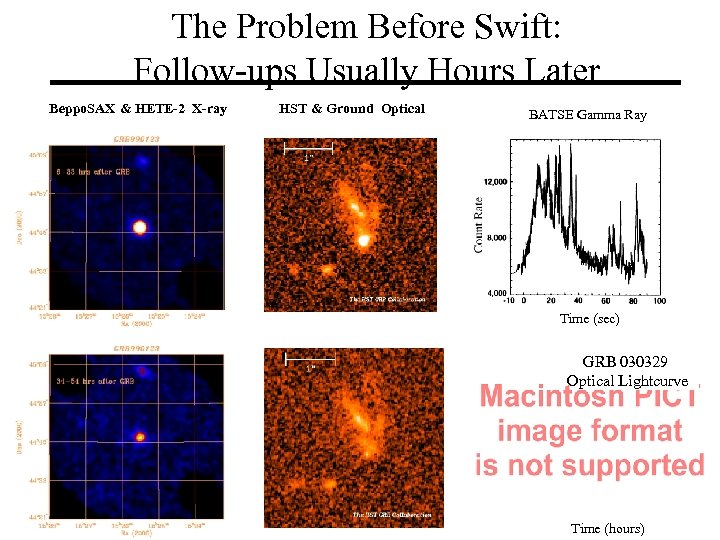
The Problem Before Swift: Follow-ups Usually Hours Later Beppo. SAX & HETE-2 X-ray HST & Ground Optical BATSE Gamma Ray Time (sec) GRB 030329 Optical Lightcurve Time (hours)
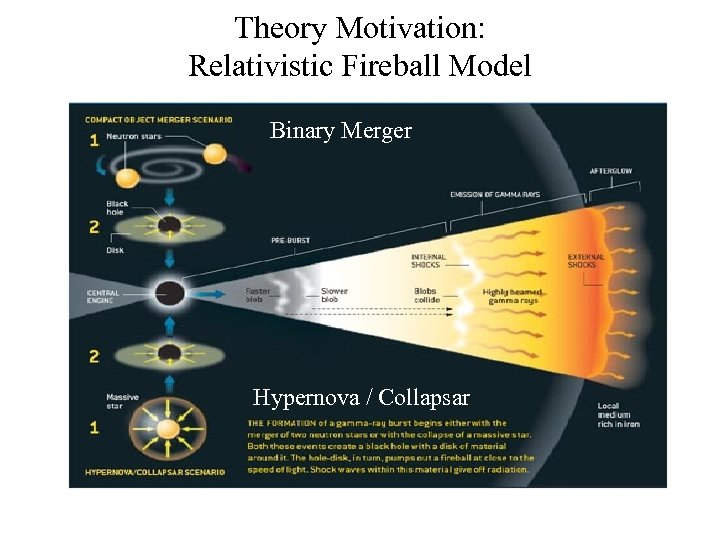
Theory Motivation: Relativistic Fireball Model Binary Merger Hypernova / Collapsar
Swift Mission Concept Wide field gamma-ray imager detects gamma-ray bursts On-board decision making - Spacecraft slews autonomously Rapid slewing capability - Get to gamma-ray burst locations quickly, sometimes while the prompt GRB emission is still occurring Complement of sensitive narrow field X-ray and UVOptical instruments to follow the afterglow Rapid ground notification of GRB Extensive follow-up network on the ground Automated science data processing within 2 hours
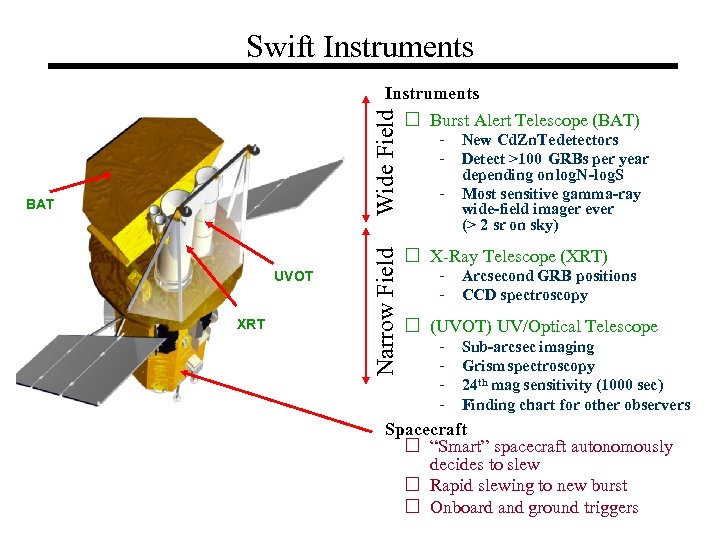
Swift Instruments BAT XRT UVOT XRT Spacecraft Narrow Field UVOT Wide Field Instruments Burst Alert Telescope (BAT) - New Cd. Zn. Te detectors Detect >100 GRBs per year depending on log. N-log. S Most sensitive gamma-ray wide-field imager ever (> 2 sr on sky) X-Ray Telescope (XRT) - Arcsecond GRB positions CCD spectroscopy (UVOT) UV/Optical Telescope - Sub-arcsec imaging Grism spectroscopy 24 th mag sensitivity (1000 sec) Finding chart for other observers Spacecraft “Smart” spacecraft autonomously decides to slew Rapid slewing to new burst Onboard and ground triggers
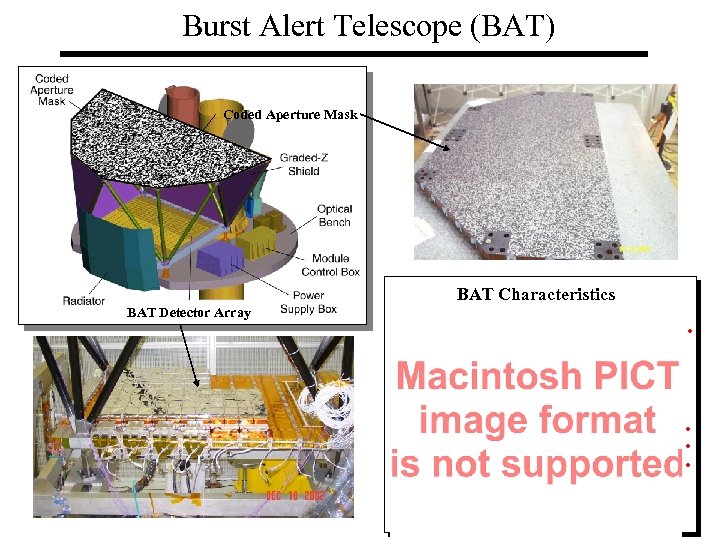
Burst Alert Telescope (BAT) Coded Aperture Mask BAT Characteristics BAT Detector Array • •
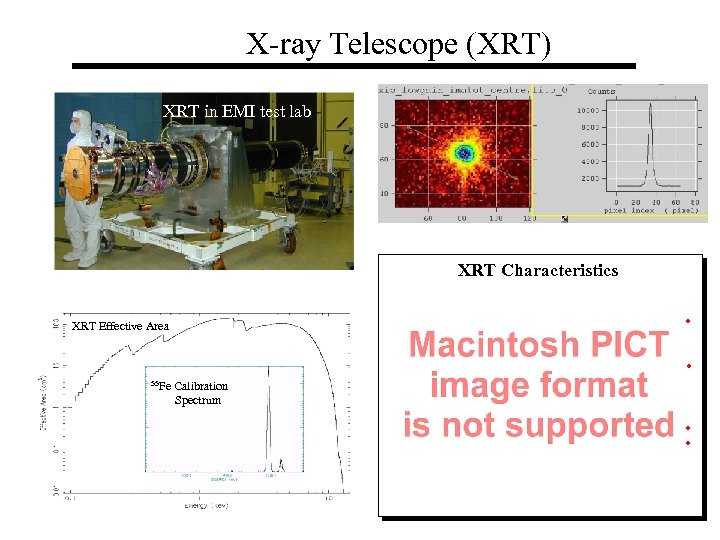
X-ray Telescope (XRT) XRT in EMI test lab XRT Characteristics • XRT Effective Area • 55 Fe Calibration Spectrum • •
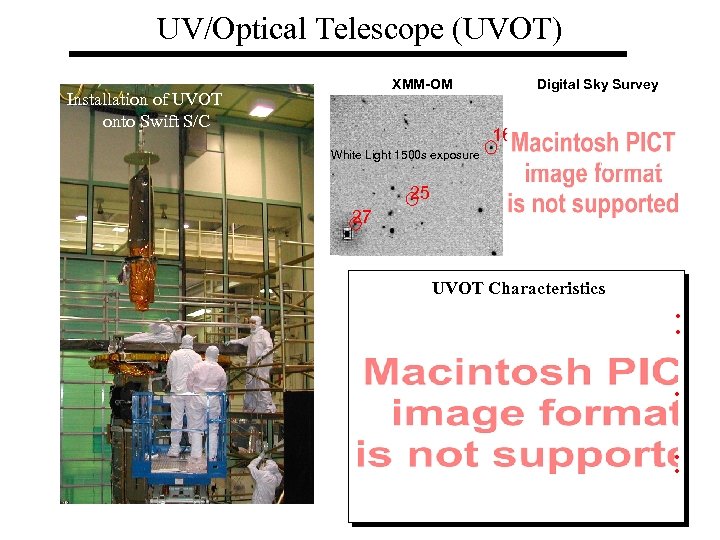
UV/Optical Telescope (UVOT) XMM-OM Installation of UVOT onto Swift S/C Digital Sky Survey 16 White Light 1500 s exposure 5‘ 25 27 UVOT Characteristics • • •
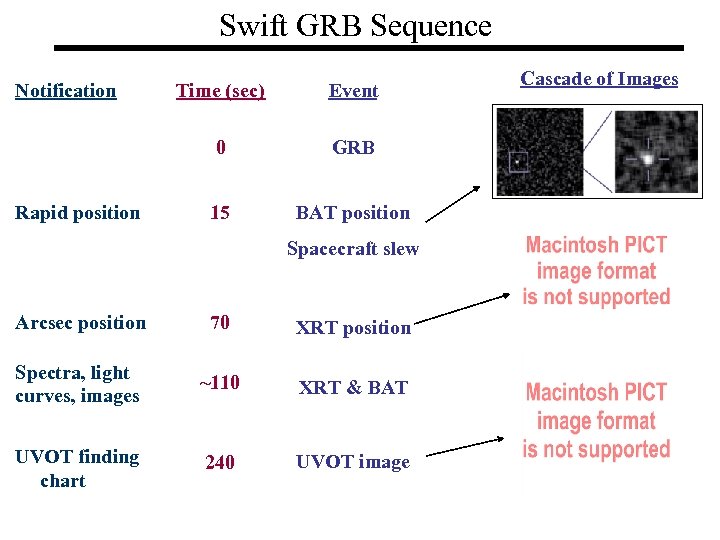
Swift GRB Sequence Notification Event 0 Rapid position Time (sec) GRB 15 BAT position Spacecraft slew Arcsec position 70 XRT position Spectra, light curves, images ~110 XRT & BAT UVOT finding chart 240 UVOT image Cascade of Images
Swift Science Results Example Swift GRB response Long bursts vs. short bursts Using GRB afterglows as a light house to study the early universe
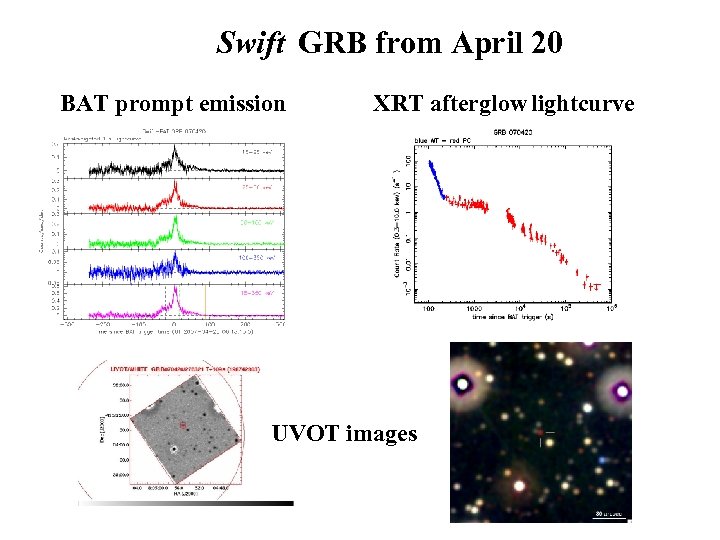
Swift GRB from April 20 BAT prompt emission XRT afterglow lightcurve UVOT images
Revelations of Swift Rapid, precise positions - Allows ground based follow-ups - Identification and redshift of host galaxy Early-time light curves - X-ray “flaring” - Prompt X-ray and optical emission (during the burst) constrains fireball models Excellent g-ray background-subtraction - We now know that GRBs can last much longer!
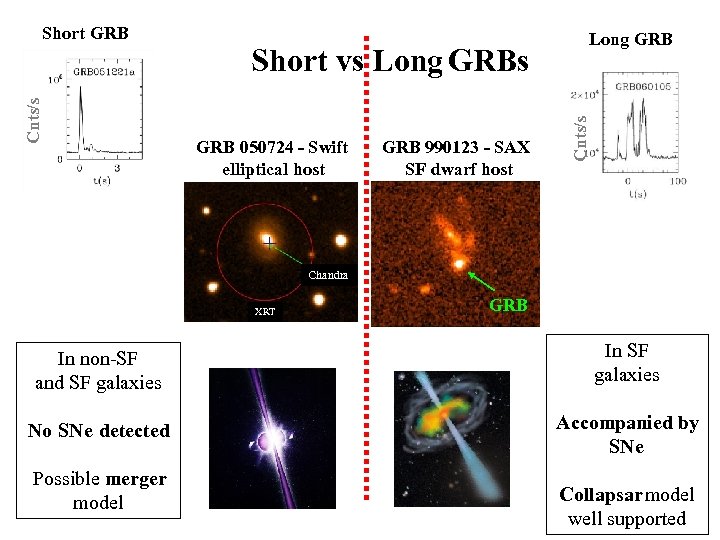
Short vs Long GRBs GRB 050724 - Swift elliptical host GRB 990123 - SAX SF dwarf host Long GRB Cnts/s Short GRB Chandra XRT GRB In non-SF and SF galaxies In SF galaxies No SNe detected Accompanied by SNe Possible merger model Collapsar model well supported
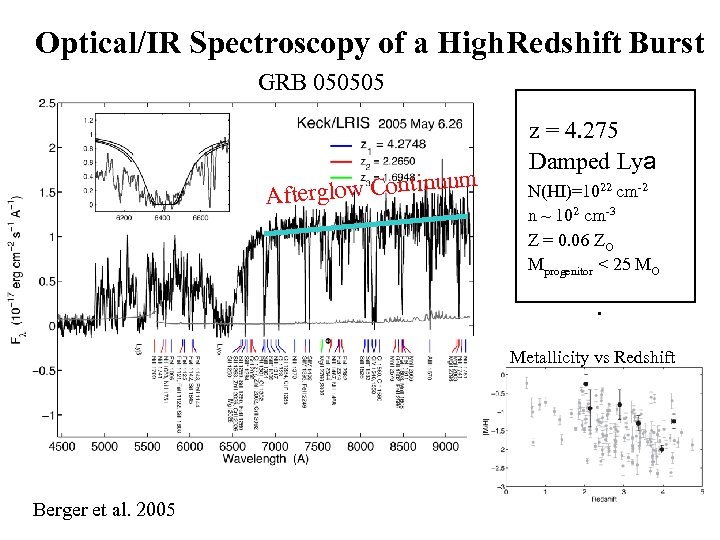
Optical/IR Spectroscopy of a High Redshift Burst GRB 050505 m nuu fterglow Conti A z = 4. 275 Damped Lya N(HI)=1022 cm-2 n ~ 102 cm-3 Z = 0. 06 ZO Mprogenitor < 25 MO . . Metallicity vs Redshift Berger et al. 2005
How Does Swift Work? Observing with Swift Analyzing Swift data - BAT - XRT - UVOT
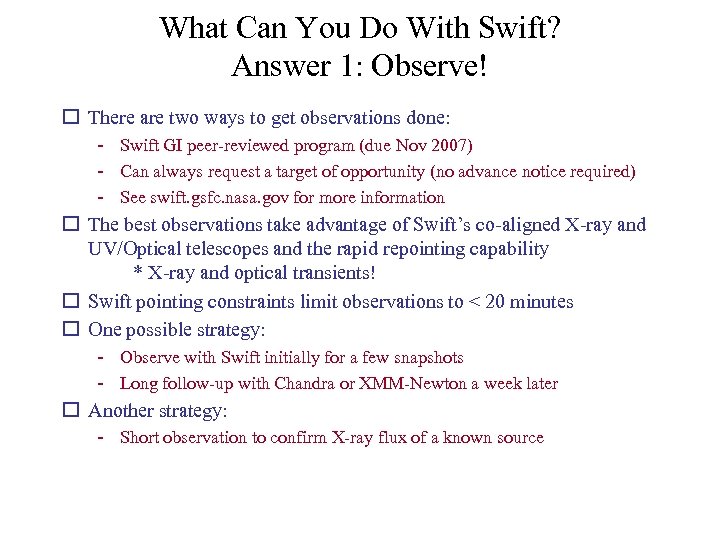
What Can You Do With Swift? Answer 1: Observe! There are two ways to get observations done: - Swift GI peer-reviewed program (due Nov 2007) - Can always request a target of opportunity (no advance notice required) - See swift. gsfc. nasa. gov for more information The best observations take advantage of Swift’s co-aligned X-ray and UV/Optical telescopes and the rapid repointing capability * X-ray and optical transients! Swift pointing constraints limit observations to < 20 minutes One possible strategy: - Observe with Swift initially for a few snapshots - Long follow-up with Chandra or XMM-Newton a week later Another strategy: - Short observation to confirm X-ray flux of a known source
What Can You Do With Swift? Answer 2: Analyze! Swift analysis software is distributed with HEASoft (aka FTOOLS) All of the instruments have canned pipeline scripts which give you a good starting point. All of the instruments also have extensive manuals for recipes and reference material. (swift. gsfc. nasa. gov)
Swift Data Organized by observation number and segment Example: 00241293 000 (use on-line GRB / obs. num. converter) The gamma-ray burst data is always in segment number 000 Data is first available in a “quicklook” area at Goddard, and then migrates to the archives within a week or so.
BAT Analysis Starting point: batgrbproduct script This script will make images, light curves and spectra, and response matrices and is semi-intelligent You should be able to load these into standard tools like DS 9 (images), Xronos (light curves), and XSPEC (spectra) Sometimes the script will fail to find the burst time interval, and you will need to specify it by hand (usually short bursts) It is possible to make spectra while the spacecraft is slewing; BUT, you must make response matrices if the spacecraft moves more than ~15 degrees
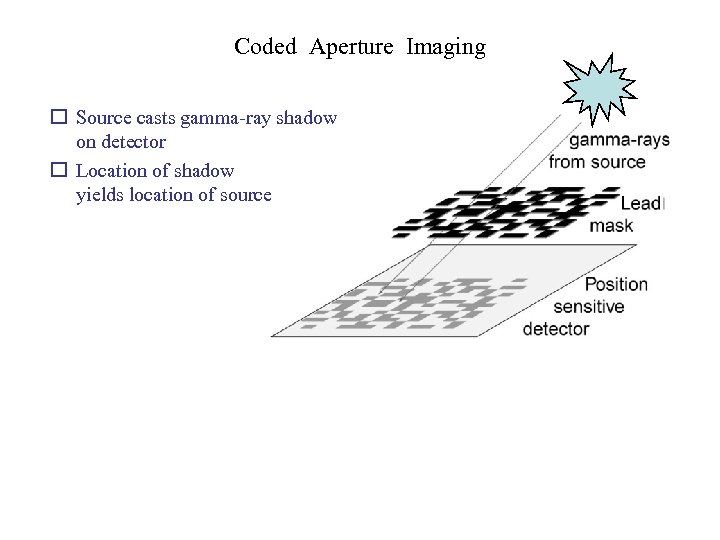
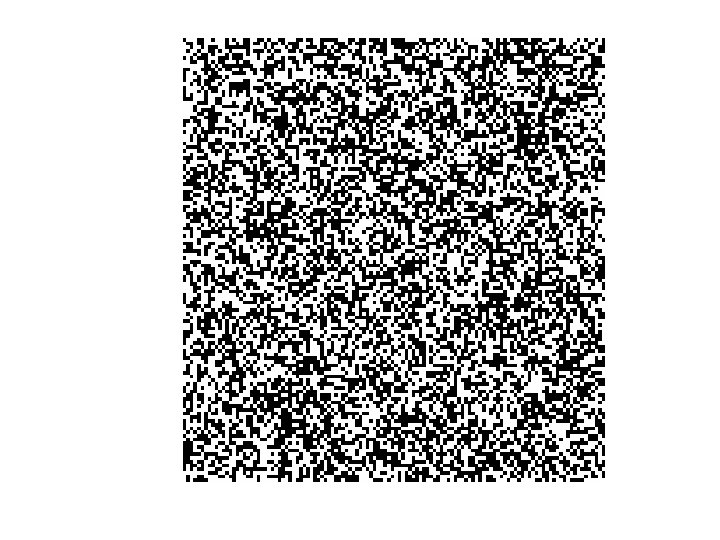
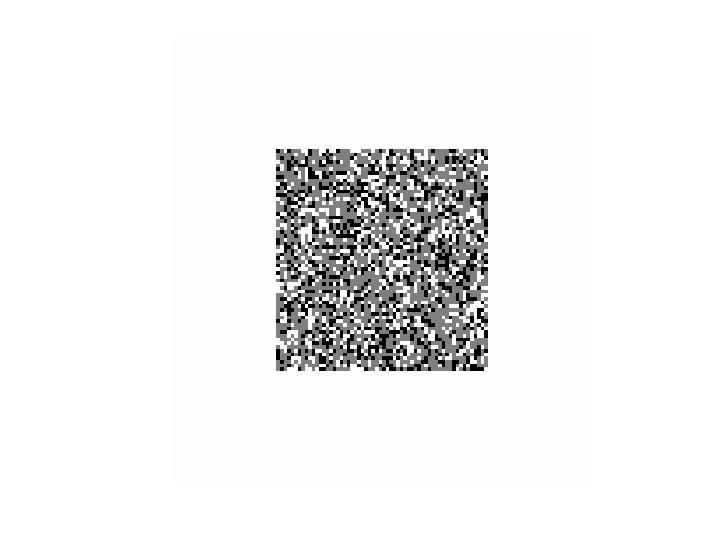
Coded Aperture Imaging Source casts gamma-ray shadow on detector Location of shadow yields location of source
XRT Analysis Starting point: xrtpipeline script Major XRT issues: - Cooler failure; more “hot/noisy” pixels - Micrometeoroid hit May 2005; created “dead/noisy” columns Both of these problems create unusable regions on the CCD, which sometimes overlap with your source Compensate with following crucial xrtpipeline parameters - createmkffile =YES createexpomap =YES useexpomap =YES pcbiascorr =YES (HEASoft 6. 3. 1) Other tips: - Exclude dead columns when creating background region - Windowed Timing mode must be analyzed one orbit at a time
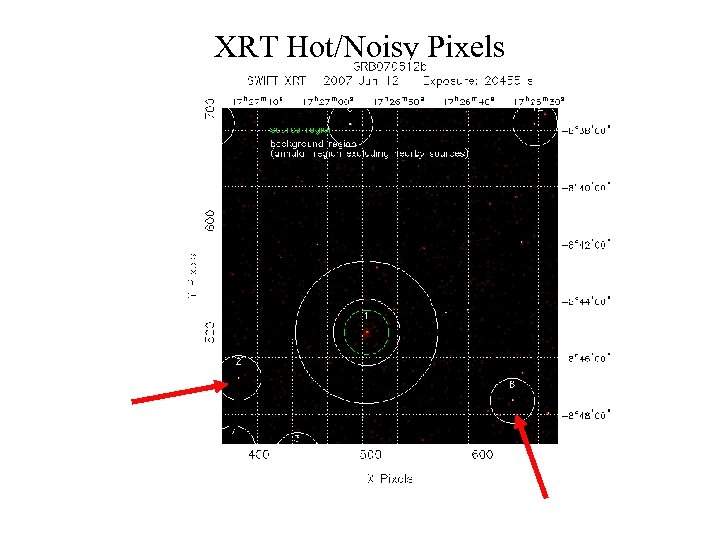
XRT Hot/Noisy Pixels
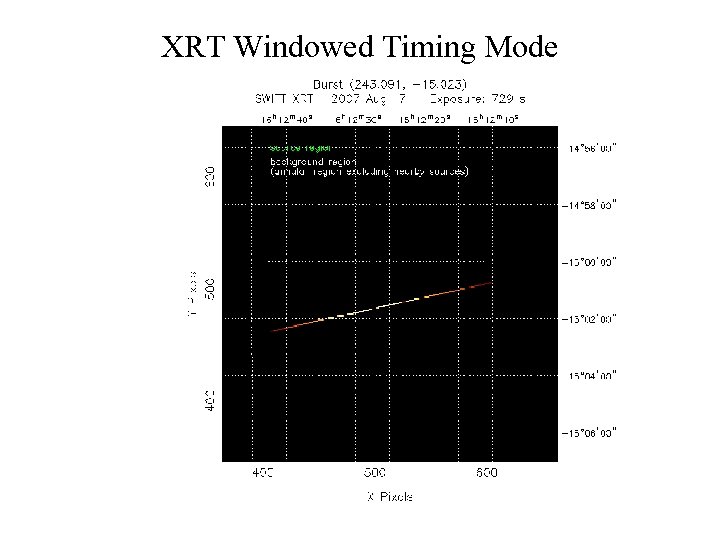
XRT Windowed Timing Mode
UVOT Analysis Two crucial tools uvotsource - computes the magnitude of a known source for one image uvotmaghist - computes a light curve from multiple images Requires recent (>Nov 2006) data to work properly Other important points - UVOT magnitude scale is calibrated for 5” aperture (region) For fainter sources use smaller apertures and uvotapercorr A GRB may not appear in UV/Blue filters if it is at high redshift UVOT generates “image” and “event” data on-board, but it is all convert to images on the ground
Other Kinds of Bursts (Just to keep things confusing) X-ray bursts- thermonuclear burning from the surface of an accreting neutron star Accretion “outburst”- episode of mass transfer lasting days to weeks Soft Gamma Repeater ( GRs) - probably a highly S magnetic neutron star with millisecond bursts Swift detects all of these too!
Possible Projects Mystery: why is BAT trigger 287042 not a gamma-ray burst High redshift burst GRB 050904 - What were the spectrum and duration… …in the rest frame of the burst? Pick a burst - Perform joint BAT and XRT analysis

Backup Slides
 Скачать презентацию The Swift GRB Observatory The Mission
8eeef8a9c9ad468b71cf9550d9c5a96c.ppt