 Скачать презентацию The Sustainable Competitiveness of the Green Energy Industries
bc5cbc8d70a88ca3b537a193508e7e14.ppt
- Количество слайдов: 21



The Sustainable Competitiveness of the Green Energy Industries in Taiwan Daw Ma, Chung-Hua Institution for Economic Research June, 2015 Chung-Hua Institution for Economic Research
Outline • Innovative Taiwan • Overview of the Green Energy Industries • Comparative Advantages of Taiwan’s Green Energy Industries • Sustainable Competitiveness of Taiwan’s Green Energy Industries • Conclusion 2 Chung-Hua Institution for Economic Research
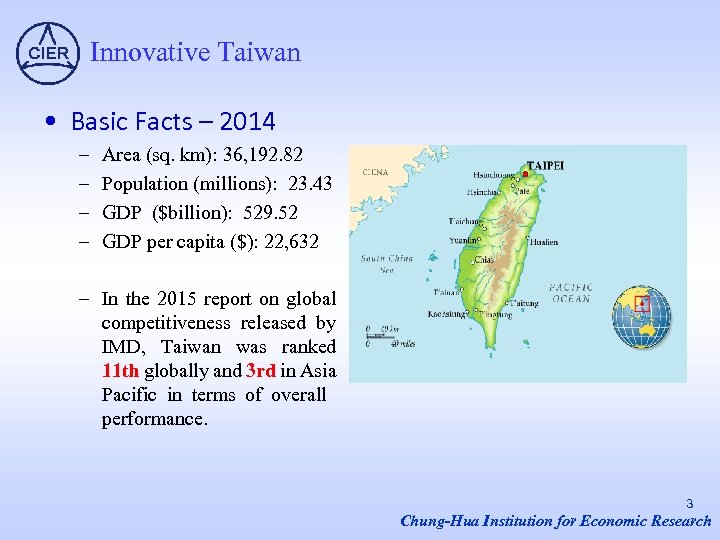
Innovative Taiwan • Basic Facts – 2014 – – Area (sq. km): 36, 192. 82 Population (millions): 23. 43 GDP ($billion): 529. 52 GDP per capita ($): 22, 632 – In the 2015 report on global competitiveness released by IMD, Taiwan was ranked 11 th globally and 3 rd in Asia Pacific in terms of overall performance. 3 Chung-Hua Institution for Economic Research
Innovative Taiwan • Basic Facts – 2014 – According to the “Global Competitiveness Report” of WEF, Taiwan’s performance of Innovation: scored 5. 1 (ranked 10 th) • • • Capacity for Innovation: scored 4. 8 (ranked 23 th) Company spending on R&D: scored 4. 6 (ranked 18 th) Availability on scientists and engineers: scored 5. 0 (ranked 14 th) Quality of scientific research institutions: scored 5. 2 (ranked 22 th) University- Industry collaboration in R&D: scored 5. 1 (ranked 14 th) Gov’t procurement of advanced tech products: scored 4. 1 (ranked 24 th) P. S. : Score 1~7(Best), Ranked among 144 countries 4 Chung-Hua Institution for Economic Research
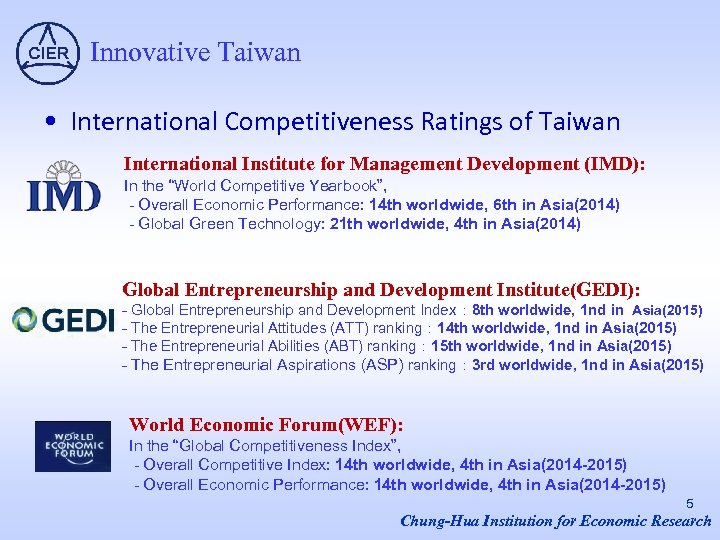
Innovative Taiwan • International Competitiveness Ratings of Taiwan International Institute for Management Development (IMD): In the “World Competitive Yearbook”, - Overall Economic Performance: 14 th worldwide, 6 th in Asia(2014) - Global Green Technology: 21 th worldwide, 4 th in Asia(2014) Global Entrepreneurship and Development Institute(GEDI): - Global Entrepreneurship and Development Index: 8 th worldwide, 1 nd in Asia(2015) - The Entrepreneurial Attitudes (ATT) ranking: 14 th worldwide, 1 nd in Asia(2015) - The Entrepreneurial Abilities (ABT) ranking: 15 th worldwide, 1 nd in Asia(2015) - The Entrepreneurial Aspirations (ASP) ranking: 3 rd worldwide, 1 nd in Asia(2015) World Economic Forum(WEF): In the “Global Competitiveness Index”, - Overall Competitive Index: 14 th worldwide, 4 th in Asia(2014 -2015) - Overall Economic Performance: 14 th worldwide, 4 th in Asia(2014 -2015) 5 Chung-Hua Institution for Economic Research
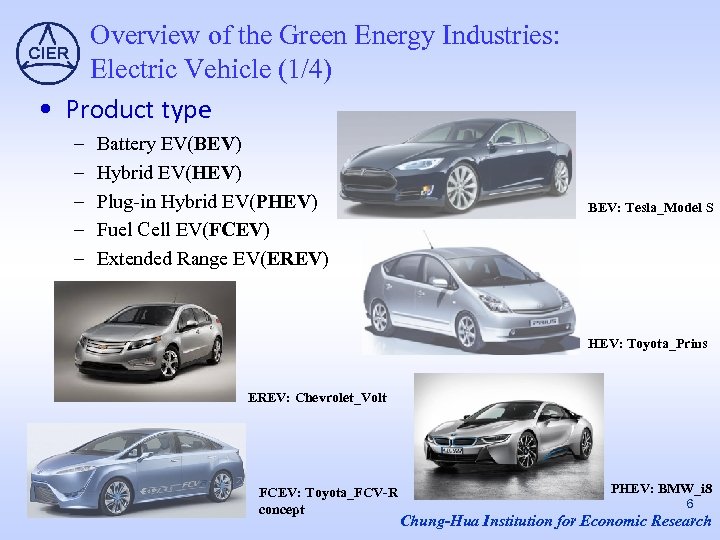
Overview of the Green Energy Industries: Electric Vehicle (1/4) • Product type – – – Battery EV(BEV) Hybrid EV(HEV) Plug-in Hybrid EV(PHEV) Fuel Cell EV(FCEV) Extended Range EV(EREV) BEV: Tesla_Model S HEV: Toyota_Prius EREV: Chevrolet_Volt FCEV: Toyota_FCV-R concept PHEV: BMW_i 8 6 Chung-Hua Institution for Economic Research
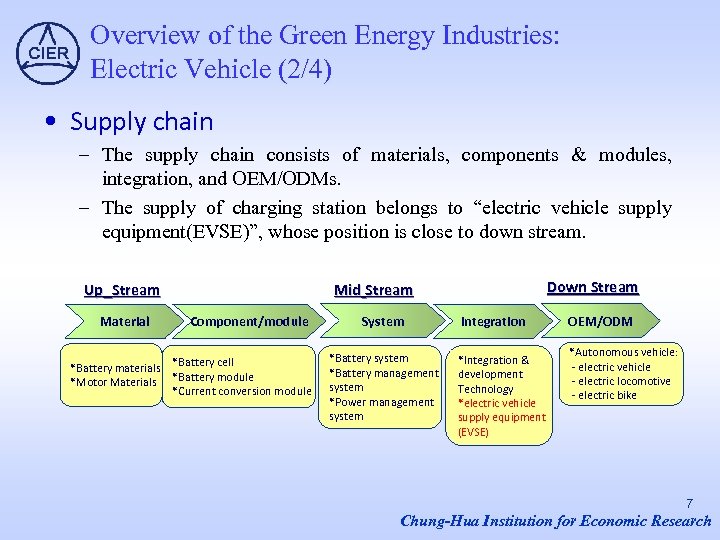
Overview of the Green Energy Industries: Electric Vehicle (2/4) • Supply chain – The supply chain consists of materials, components & modules, integration, and OEM/ODMs. – The supply of charging station belongs to “electric vehicle supply equipment(EVSE)”, whose position is close to down stream. Up Stream Material *Battery materials *Motor Materials Down Stream Mid Stream Component/module *Battery cell *Battery module *Current conversion module System *Battery system *Battery management system *Power management system Integration *Integration & development Technology *electric vehicle supply equipment (EVSE) OEM/ODM *Autonomous vehicle: - electric vehicle - electric locomotive - electric bike 7 Chung-Hua Institution for Economic Research
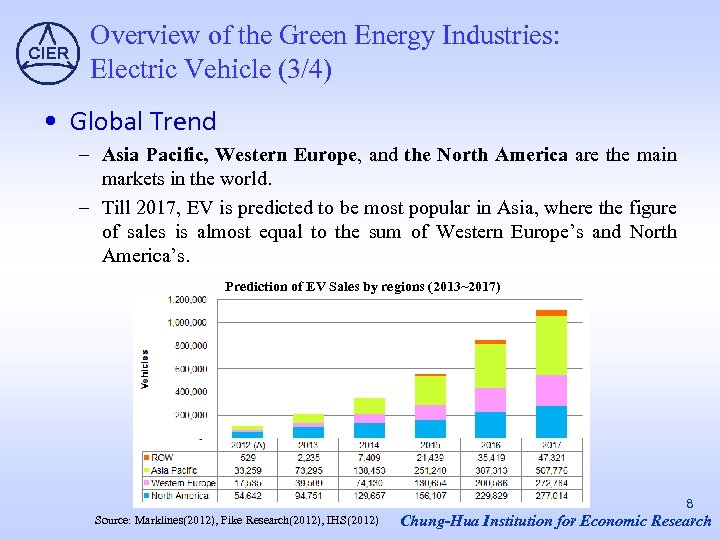
Overview of the Green Energy Industries: Electric Vehicle (3/4) • Global Trend – Asia Pacific, Western Europe, and the North America are the main markets in the world. – Till 2017, EV is predicted to be most popular in Asia, where the figure of sales is almost equal to the sum of Western Europe’s and North America’s. Prediction of EV Sales by regions (2013~2017) 8 Source: Marklines(2012), Pike Research(2012), IHS(2012) Chung-Hua Institution for Economic Research
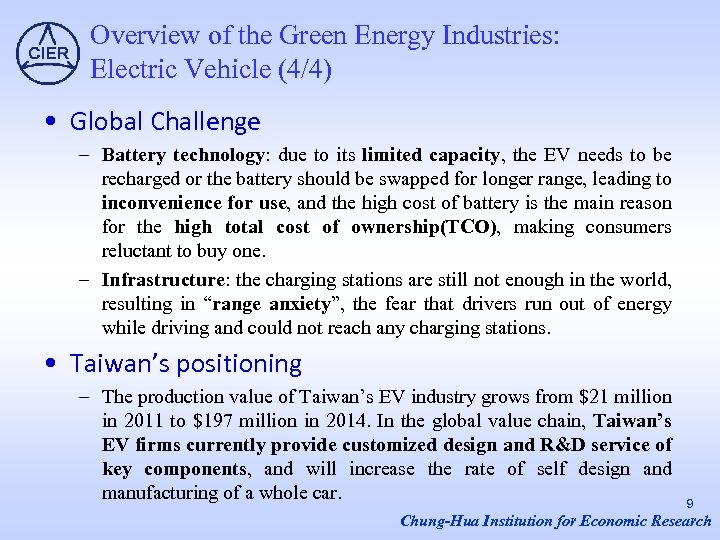
Overview of the Green Energy Industries: Electric Vehicle (4/4) • Global Challenge – Battery technology: due to its limited capacity, the EV needs to be recharged or the battery should be swapped for longer range, leading to inconvenience for use, and the high cost of battery is the main reason for the high total cost of ownership(TCO), making consumers reluctant to buy one. – Infrastructure: the charging stations are still not enough in the world, resulting in “range anxiety”, the fear that drivers run out of energy while driving and could not reach any charging stations. • Taiwan’s positioning – The production value of Taiwan’s EV industry grows from $21 million in 2011 to $197 million in 2014. In the global value chain, Taiwan’s EV firms currently provide customized design and R&D service of key components, and will increase the rate of self design and manufacturing of a whole car. 9 Chung-Hua Institution for Economic Research
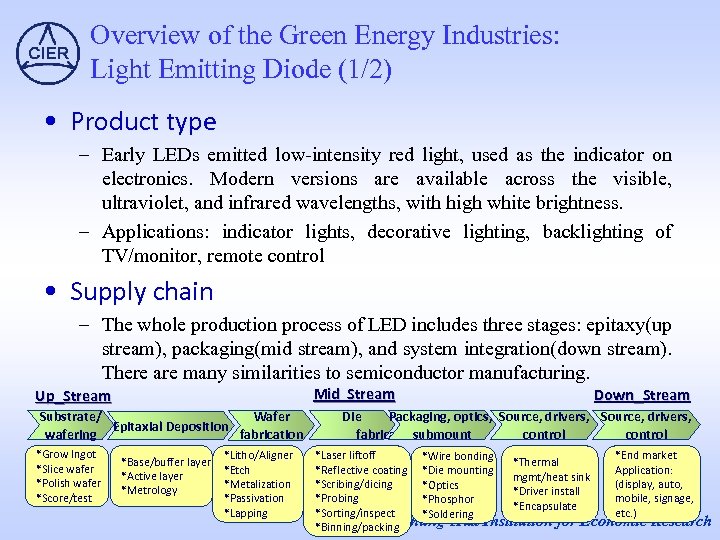
Overview of the Green Energy Industries: Light Emitting Diode (1/2) • Product type – Early LEDs emitted low-intensity red light, used as the indicator on electronics. Modern versions are available across the visible, ultraviolet, and infrared wavelengths, with high white brightness. – Applications: indicator lights, decorative lighting, backlighting of TV/monitor, remote control • Supply chain – The whole production process of LED includes three stages: epitaxy(up stream), packaging(mid stream), and system integration(down stream). There are many similarities to semiconductor manufacturing. Mid Stream Up Stream Substrate/ Wafer Epitaxial Deposition wafering fabrication *Grow Ingot *Slice wafer *Polish wafer *Score/test *Base/buffer layer *Active layer *Metrology *Litho/Aligner *Etch *Metalization *Passivation *Lapping Down Stream Die Packaging, optics, Source, drivers, fabrication submount control *Laser liftoff *End market *Wire bonding *Thermal *Reflective coating *Die mounting Application: mgmt/heat sink *Scribing/dicing (display, auto, *Optics *Driver install *Probing mobile, signage, *Phosphor 10 *Encapsulate *Sorting/inspect etc. ) *Soldering *Binning/packing. Chung-Hua Institution for Economic Research
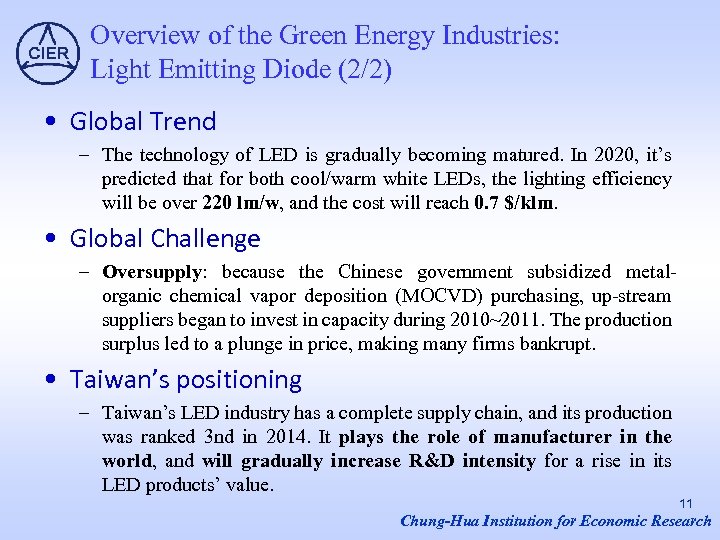
Overview of the Green Energy Industries: Light Emitting Diode (2/2) • Global Trend – The technology of LED is gradually becoming matured. In 2020, it’s predicted that for both cool/warm white LEDs, the lighting efficiency will be over 220 lm/w, and the cost will reach 0. 7 $/klm. • Global Challenge – Oversupply: because the Chinese government subsidized metalorganic chemical vapor deposition (MOCVD) purchasing, up-stream suppliers began to invest in capacity during 2010~2011. The production surplus led to a plunge in price, making many firms bankrupt. • Taiwan’s positioning – Taiwan’s LED industry has a complete supply chain, and its production was ranked 3 nd in 2014. It plays the role of manufacturer in the world, and will gradually increase R&D intensity for a rise in its LED products’ value. 11 Chung-Hua Institution for Economic Research
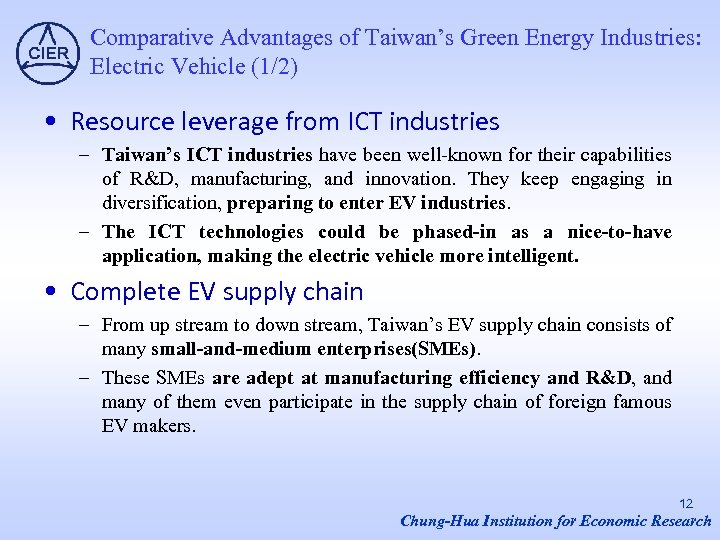
Comparative Advantages of Taiwan’s Green Energy Industries: Electric Vehicle (1/2) • Resource leverage from ICT industries – Taiwan’s ICT industries have been well-known for their capabilities of R&D, manufacturing, and innovation. They keep engaging in diversification, preparing to enter EV industries. – The ICT technologies could be phased-in as a nice-to-have application, making the electric vehicle more intelligent. • Complete EV supply chain – From up stream to down stream, Taiwan’s EV supply chain consists of many small-and-medium enterprises(SMEs). – These SMEs are adept at manufacturing efficiency and R&D, and many of them even participate in the supply chain of foreign famous EV makers. 12 Chung-Hua Institution for Economic Research
Comparative Advantages of Taiwan’s Green Energy Industries: Electric Vehicle (2/2) • Strategic alliance in R&D – Taiwan Automotive Research Consortium (TARC) consists of research institutes/laboratories, universities, and industries, focusing on the R&D of EV technology. TARC initiates five major clusters of motor, energy storage, system integration, auxiliaries, and niche EV. The clustering is aimed to integrate the EV supply chain, and thus enhance the R&D capabilities. • Recognition from abroad – The quality and reliability of Taiwan’s EV firms are recognized globally, and reputation is earned. Many Taiwanese firms win the business contracts from abroad, such as: • • Pihsiang(必翔)’s micro car: sold to EU Luxgen(納智捷)’s electric SUV “EV+”: sold to Russia Delta(台達電)’s electric vehicle supply equipment(EVSE): sold to Norway RAC EV(華德動能)’s all-electric bus: sold to the Philippines 13 Chung-Hua Institution for Economic Research
Comparative Advantages of Taiwan’s Green Energy Industries: Light Emitting Diode • Well-developed R&D resource and know-how – Most of the LED firms have high-quality R&D manpower, and many of them form strategic alliances of R&D. Furthermore, the cumulated know-how in IC industry could be leveraged for the use of LED industry. • Capabilities in technology – The LED industry in Taiwan is R&D-intensive, adept at patent deployment, and has capabilities of high efficient production. • Cross-strait platform for LED industry – The cross-strait cooperation platform on LED industry between Taiwan and mainland China has been established. Under this framework, the two sides could cooperate in the development of technologies, promote demonstrative trials, and set common standards. Thus, this platform could strengthen Taiwan’s influence on the China’s market. 14 Chung-Hua Institution for Economic Research
Sustainable Competitiveness of Taiwan’s Green Energy Industries: EV (1/2) • Continue with R&D on battery technology – The current EV’s battery is expensive, and drivers need to spend lots of time recharging it. The battery is the bottleneck of the adoption of EV. – Taiwan’s upstream firms will continue with the R&D on battery materials and other key components, solving the critical bottleneck and increasing its bargaining power in the EV’s value chain. • Early adoption of EV on micro car & electric bus – The development of EV industry lies in the strategy to induce early adoption, gaining a foothold in Taiwan. – The car’s gas emission and heavy traffic are the worst problems in Taiwan’s metropolitan areas; “micro cars” and “electric bus” could be the solution, and as well are suitable for the strategy of early adoption. 15 Chung-Hua Institution for Economic Research
Sustainable Competitiveness of Taiwan’s Green Energy Industries: EV (2/2) • “ICT + EV” as a strategy – Globally, traditional car makers possess abundant resource (e. g. capital, skills, branding images) and try to establish their dominance in the newly-developed EV industry. – In order to compete with these car makers, Taiwan’s best way is to leverage the advantage of its ICT industries as a differentiation strategy, considering the potential application of ICT technologies on EV design. • Overseas markets expansion – Taiwan’s EV firms should reach out and enlarge their business deployment beyond the narrow domestic market to learn how to fulfill the needs from other markets. – Besides the great Chinese area, Taiwan’s EV firms should pay attention to Europe/North America, and other new markets as well. 16 Chung-Hua Institution for Economic Research
Sustainable Competitiveness of Taiwan’s Green Energy Industries: Light Emitting Diode (1/2) • “Diversification & differentiation” as a strategy – Taiwan’s LED industry used to pursue the goal of manufacturing efficiency for lower cost, better lighting quality, and larger capacity. – As the global LED market evolves, however, the main priority of Taiwan’s LED industry should be “diversification and differentiation” strategy. Taiwan is advised to diversify and differentiate its LED products for higher added value, and develop strategic cooperation for a stronger bargaining position in the global LED value chain. • Develop niche market of special lighting categories – Since the LED market has become matured, Taiwan’s LED firms should enter the categories of special lighting, such as emergency lighting, medical lighting, plant factory, and any potential application on agriculture/forestry/fishery/animal husbandry. 17 Chung-Hua Institution for Economic Research
Sustainable Competitiveness of Taiwan’s Green Energy Industries: Light Emitting Diode (2/2) • Increase influence on consumers – Taiwan’s LED industry used to be good at manufacturing of intermediate goods, which could bring little value-added. As the competition has intensified, Taiwan should establish its own consumer branding, increasing larger influence on consumers and creating higher value. • Discover new synergies – In terms of innovative application, Taiwan should discover stronger connections with the countries possessing advanced technologies for more strategic cooperation, and simultaneously extend to reach overseas new markets for exports. 18 Chung-Hua Institution for Economic Research
Conclusion: The Strategies to Increase Taiwan’s Sustainable Competitiveness (1/2) • Resource Leverage from the green industries – The current semiconductor/ICT industries has made substantial contributions to Taiwan’s economic growth. Since there are many similarities, the resource could be leveraged as a backbone of, and exploited as advantages for, the green energy industries. • Directions for the industrial development – The EV industry is at its initial stage, and requires strategies of mastering key technologies and early adoption to enlarge market penetration. – The LED industry is at growth stage, and faced problems of “low value added” and “over supply”. The best way is to develop multiple application and achieve a breakthrough in technology. 19 Chung-Hua Institution for Economic Research
Conclusion: The Strategies to Increase Taiwan’s Sustainable Competitiveness (2/2) • The main driving forces – Besides government’s industrial policies (policy push), Taiwan’s EV/LED industries need to stimulate more innovation (innovation push), and enlarge their global business deployment (market expansion). – As the global competition soars, these main driving forces will navigate to generate more sustainable competitiveness in the future. 20 Chung-Hua Institution for Economic Research
THANKS FOR YOUR LISTENING Daw Ma Chung-Hua Institution for Economic Research Taipei, Taiwan E-mail: daw_ma@cier. edu. tw 21 Chung-Hua Institution for Economic Research
Скачать презентацию The Sustainable Competitiveness of the Green Energy Industries
bc5cbc8d70a88ca3b537a193508e7e14.ppt