 Скачать презентацию The Sustainability Challenge 追求可持续发展 积极应对挑战 Meeting the Needs
2a177b815a51b999e1a89ff82f2ab22c.ppt
- Количество слайдов: 19



The Sustainability Challenge: 追求可持续发展,积极应对挑战 : Meeting the Needs of the Water-Energy Nexus 聚焦水资源与能源需求的瓶颈问题 Dr. Wang Xiao Lan, Commercial Director for Asia Pacific, Water & Process Solutions, The Dow Chemical Company 王晓兰博士 陶氏化学 水处理及过程解决方案事业部 亚太区总经理
The Sustainability Challenge: Meeting the Needs of the Water-Energy Nexus The World is Quickly Heading Towards “Water Bankruptcy”* 全球正在濒临 “水资源破产 ”* • Global population soaring 全球人口不断迅速增长 • Food, energy and freshwater becoming scarce 食品、能源和淡水日渐短缺 • Water for potable or industrial use is limited 饮用水和 业用水有限 • Some supplies not useable 部分地区的供水无法使用 *2009 Davos World Economics Forum *源自达沃斯世界经济论坛
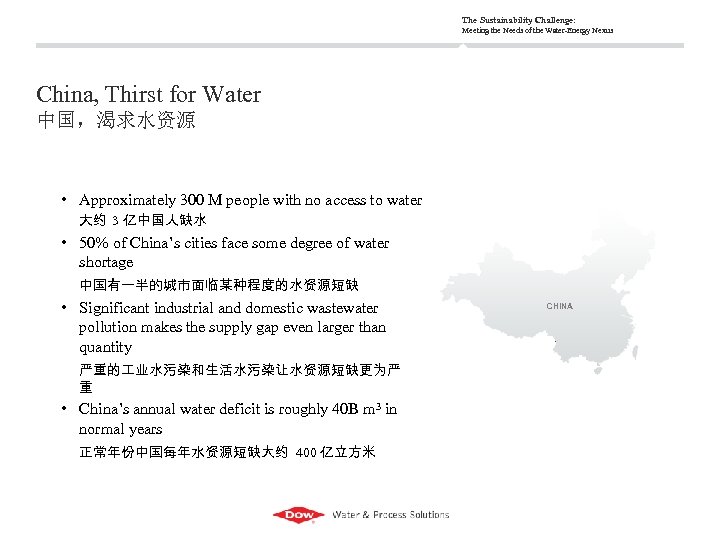
The Sustainability Challenge: Meeting the Needs of the Water-Energy Nexus China, Thirst for Water 中国,渴求水资源 • Approximately 300 M people with no access to water 大约 3 亿中国人缺水 • 50% of China’s cities face some degree of water shortage 中国有一半的城市面临某种程度的水资源短缺 • Significant industrial and domestic wastewater pollution makes the supply gap even larger than quantity 严重的 业水污染和生活水污染让水资源短缺更为严 重 • China’s annual water deficit is roughly 40 B m 3 in normal years 正常年份中国每年水资源短缺大约 400 亿立方米 CHINA
The Sustainability Challenge: Meeting the Needs of the Water-Energy Nexus Energy Challenge 能源挑战 Fresh water and on demand energy are intimately intertwined 淡水资源和能源需求之间密不可分的纽带关系 • When per capita GDP = $3 k energy demands explode • When per capita GDP = $10 k this tapers off 当人均 GDP 达到 3, 000 美元时,能源需求会出现暴涨 当人均 GDP 达到 1 万美元时,能源需求会逐渐减弱 • As of 2009, only 55 out of 191 countries had a per capita GDP ppp above $10 k* 截至 2009 年,在全球191 个国家中只有 55 个国家人均 GDP 超过 1 万美元* • Water availability impacts energy generation; energy is needed to secure water resources 能源生产需要用水;水资源利用也离不开能源 • Lack of technology, poor management or inefficiencies in one area can affect the sustainability of the other • 一个领域技术短缺、管理不当或者效率低下,就会影响另 一个领域的可持续发展 *According to the CIA World Factbook *源自《CIA世界各国概况》
The Sustainability Challenge: Meeting the Needs of the Water-Energy Nexus MINIMIZING FRESH WATER USE IN ENERGY PRODUCTION 在能源生产过程中尽量减少淡水的耗用
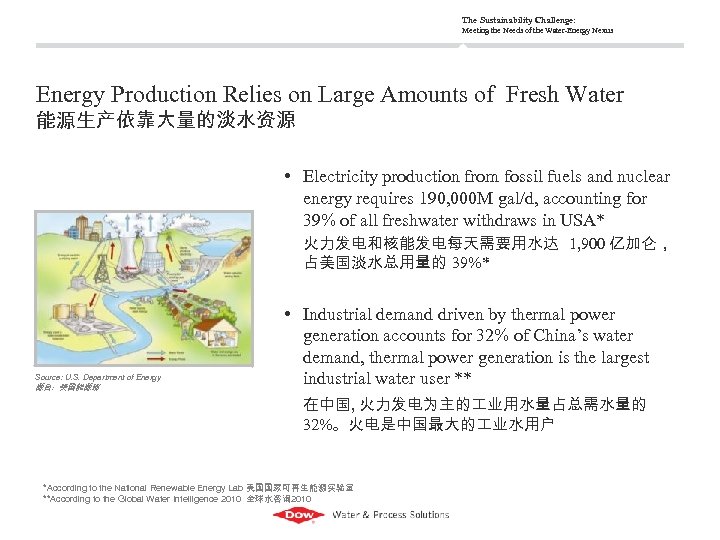
The Sustainability Challenge: Meeting the Needs of the Water-Energy Nexus Energy Production Relies on Large Amounts of Fresh Water 能源生产依靠大量的淡水资源 • Electricity production from fossil fuels and nuclear energy requires 190, 000 M gal/d, accounting for 39% of all freshwater withdraws in USA* 火力发电和核能发电每天需要用水达 1, 900 亿加仑, 占美国淡水总用量的 39%* Source: U. S. Department of Energy 源自:美国能源部 • Industrial demand driven by thermal power generation accounts for 32% of China’s water demand, thermal power generation is the largest industrial water user ** 在中国, 火力发电为主的 业用水量占总需水量的 32%。火电是中国最大的 业水用户 *According to the National Renewable Energy Lab 美国国家可再生能源实验室 **According to the Global Water Intelligence 2010 全球水咨询 2010
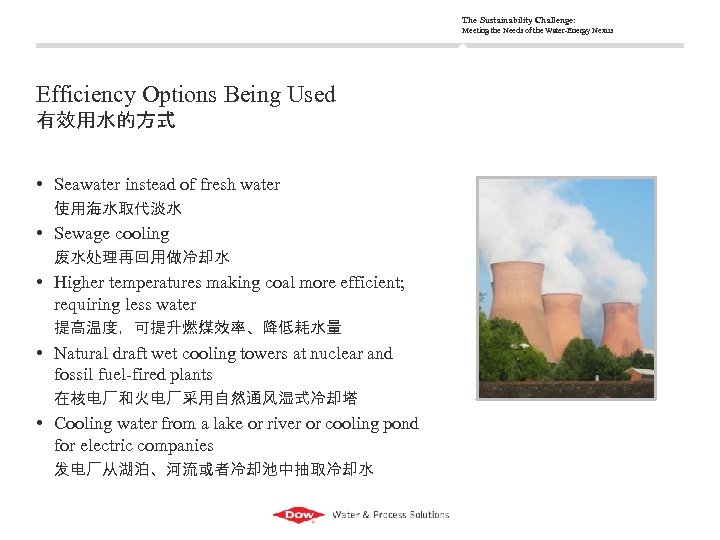
The Sustainability Challenge: Meeting the Needs of the Water-Energy Nexus Efficiency Options Being Used 有效用水的方式 • Seawater instead of fresh water 使用海水取代淡水 • Sewage cooling 废水处理再回用做冷却水 • Higher temperatures making coal more efficient; requiring less water 提高温度,可提升燃煤效率、降低耗水量 • Natural draft wet cooling towers at nuclear and fossil fuel-fired plants 在核电厂和火电厂采用自然通风湿式冷却塔 • Cooling water from a lake or river or cooling pond for electric companies 发电厂从湖泊、河流或者冷却池中抽取冷却水
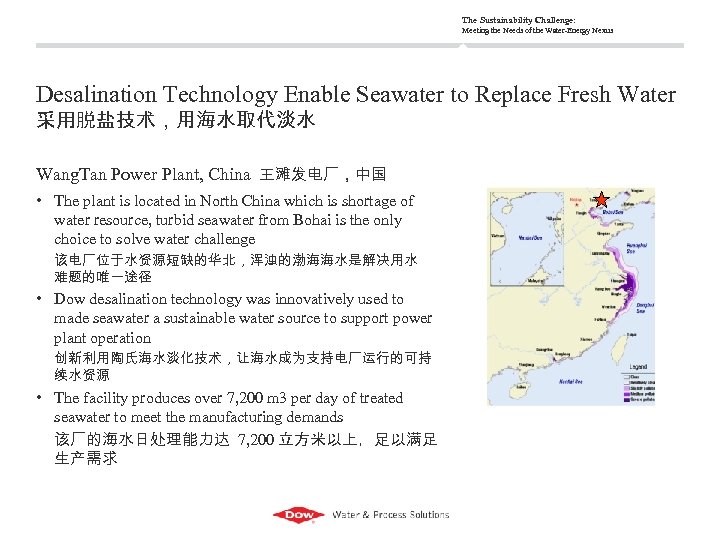
The Sustainability Challenge: Meeting the Needs of the Water-Energy Nexus Desalination Technology Enable Seawater to Replace Fresh Water 采用脱盐技术,用海水取代淡水 Wang. Tan Power Plant, China 王滩发电厂,中国 • The plant is located in North China which is shortage of water resource, turbid seawater from Bohai is the only choice to solve water challenge 该电厂位于水资源短缺的华北,浑浊的渤海海水是解决用水 难题的唯一途径 • Dow desalination technology was innovatively used to made seawater a sustainable water source to support power plant operation 创新利用陶氏海水淡化技术,让海水成为支持电厂运行的可持 续水资源 • The facility produces over 7, 200 m 3 per day of treated seawater to meet the manufacturing demands 该厂的海水日处理能力达 7, 200 立方米以上,足以满足 生产需求
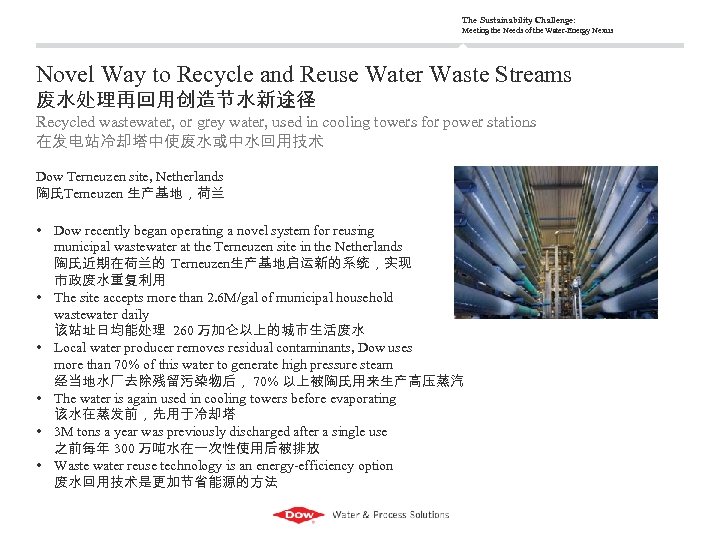
The Sustainability Challenge: Meeting the Needs of the Water-Energy Nexus Novel Way to Recycle and Reuse Water Waste Streams 废水处理再回用创造节水新途径 Recycled wastewater, or grey water, used in cooling towers for power stations 在发电站冷却塔中使废水或中水回用技术 Dow Terneuzen site, Netherlands 陶氏Terneuzen 生产基地,荷兰 • Dow recently began operating a novel system for reusing municipal wastewater at the Terneuzen site in the Netherlands 陶氏近期在荷兰的 Terneuzen生产基地启运新的系统,实现 市政废水重复利用 • The site accepts more than 2. 6 M/gal of municipal household wastewater daily 该站址日均能处理 260 万加仑以上的城市生活废水 • Local water producer removes residual contaminants, Dow uses more than 70% of this water to generate high pressure steam 经当地水厂去除残留污染物后, 70% 以上被陶氏用来生产高压蒸汽 • The water is again used in cooling towers before evaporating 该水在蒸发前,先用于冷却塔 • 3 M tons a year was previously discharged after a single use 之前每年 300 万吨水在一次性使用后被排放 • Waste water reuse technology is an energy-efficiency option 废水回用技术是更加节省能源的方法
The Sustainability Challenge: Meeting the Needs of the Water-Energy Nexus MINIMIZING ENERGY USE IN WATER PRODUCTION 最大程度降低水生产过程中的能耗
The Sustainability Challenge: Meeting the Needs of the Water-Energy Nexus Large Amounts of Energy to Extract, Treat and Deliver Potable Water 收集、处理和提供饮用水需要耗用大量的能源 • In the US, 4% of all power generation is used for water supply and treatment 在美国,有 4% 的电力被用于供水和水处理 • 75% of the cost of the municipal water processing and distribution is electricity 市政水处理和供应成本中,电费占 75% • 2 key areas where advances in chemical engineering can facilitate decreased energy requirements for water processing: 化 程的进步,有效地降低了水处理的能耗 – Water treatment, specifically desalination of salt water 海水淡化 艺的发展 – Treatment of contaminated water and wastewater for re -use 废水处理及回用 艺的发展
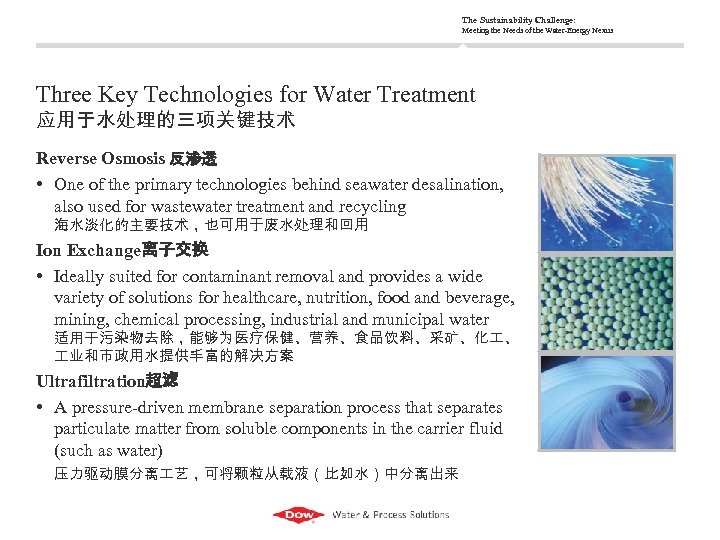
The Sustainability Challenge: Meeting the Needs of the Water-Energy Nexus Three Key Technologies for Water Treatment 应用于水处理的三项关键技术 Reverse Osmosis 反渗透 • One of the primary technologies behind seawater desalination, also used for wastewater treatment and recycling 海水淡化的主要技术,也可用于废水处理和回用 Ion Exchange离子交换 • Ideally suited for contaminant removal and provides a wide variety of solutions for healthcare, nutrition, food and beverage, mining, chemical processing, industrial and municipal water 适用于污染物去除,能够为医疗保健、营养、食品饮料、采矿、化 、 业和市政用水提供丰富的解决方案 Ultrafiltration超滤 • A pressure-driven membrane separation process that separates particulate matter from soluble components in the carrier fluid (such as water) 压力驱动膜分离 艺,可将颗粒从载液(比如水)中分离出来
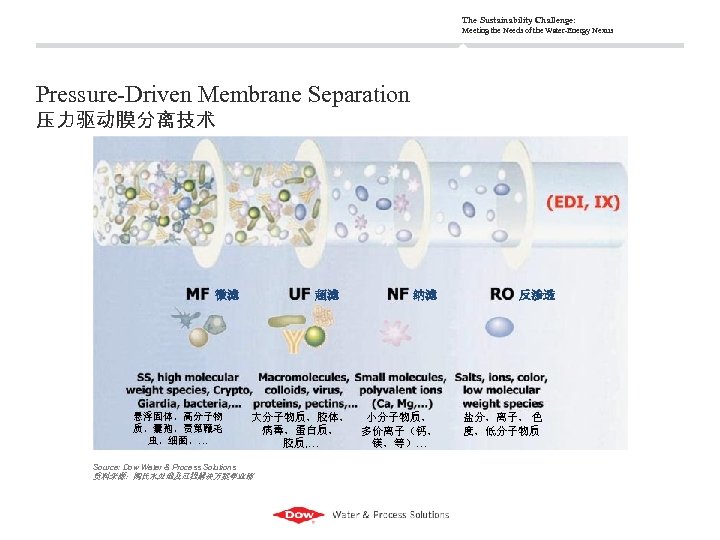
The Sustainability Challenge: Meeting the Needs of the Water-Energy Nexus Pressure-Driven Membrane Separation 压力驱动膜分离技术 微滤 悬浮固体,高分子物 质,囊孢,贾第鞭毛 虫,细菌,… Source: Dow Water & Process Solutions 超滤 纳滤 大分子物质,胶体, 小分子物质, 病毒,蛋白质, 多价离子(钙, 胶质, … 镁,等)… 资料来源:陶氏水处理及过程解决方案事业部 反渗透 盐分,离子, 色 度,低分子物质
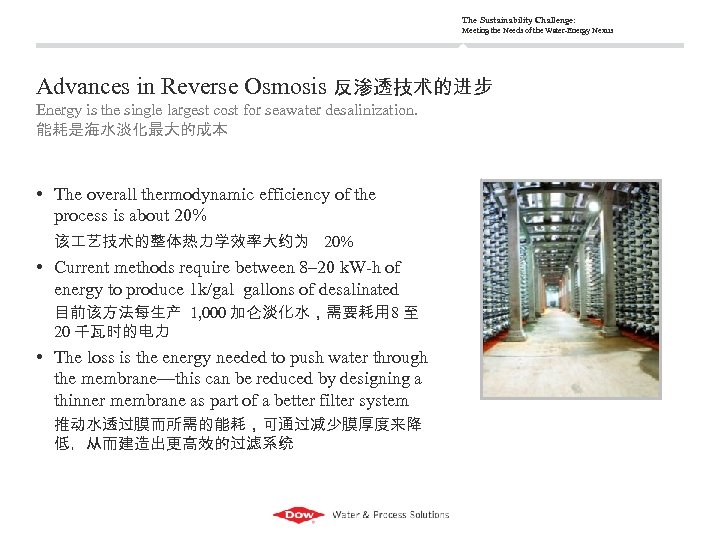
The Sustainability Challenge: Meeting the Needs of the Water-Energy Nexus Advances in Reverse Osmosis 反渗透技术的进步 Energy is the single largest cost for seawater desalinization. 能耗是海水淡化最大的成本 • The overall thermodynamic efficiency of the process is about 20% 该 艺技术的整体热力学效率大约为 20% • Current methods require between 8– 20 k. W-h of energy to produce 1 k/gal gallons of desalinated 目前该方法每生产 1, 000 加仑淡化水,需要耗用 8 至 20 千瓦时的电力 • The loss is the energy needed to push water through the membrane—this can be reduced by designing a thinner membrane as part of a better filter system 推动水透过膜而所需的能耗,可通过减少膜厚度来降 低,从而建造出更高效的过滤系统
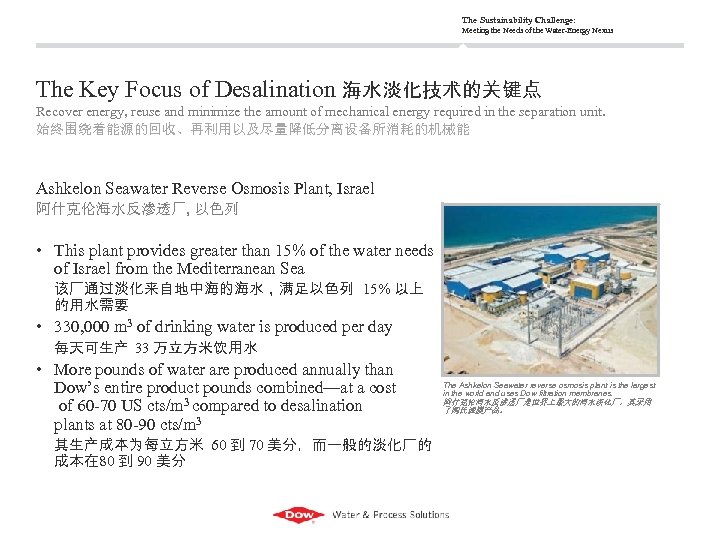
The Sustainability Challenge: Meeting the Needs of the Water-Energy Nexus The Key Focus of Desalination 海水淡化技术的关键点 Recover energy, reuse and minimize the amount of mechanical energy required in the separation unit. 始终围绕着能源的回收、再利用以及尽量降低分离设备所消耗的机械能 Ashkelon Seawater Reverse Osmosis Plant, Israel 阿什克伦海水反渗透厂, 以色列 • This plant provides greater than 15% of the water needs of Israel from the Mediterranean Sea 该厂通过淡化来自地中海的海水,满足以色列 15% 以上 的用水需要 • 330, 000 m 3 of drinking water is produced per day 每天可生产 33 万立方米饮用水 • More pounds of water are produced annually than Dow’s entire product pounds combined—at a cost of 60 -70 US cts/m 3 compared to desalination plants at 80 -90 cts/m 3 其生产成本为每立方米 60 到 70 美分,而一般的淡化厂的 成本在 80 到 90 美分 The Ashkelon Seawater reverse osmosis plant is the largest in the world and uses Dow filtration membranes. 阿什克伦海水反渗透厂是世界上最大的海水淡化厂,其采用 了陶氏滤膜产品。
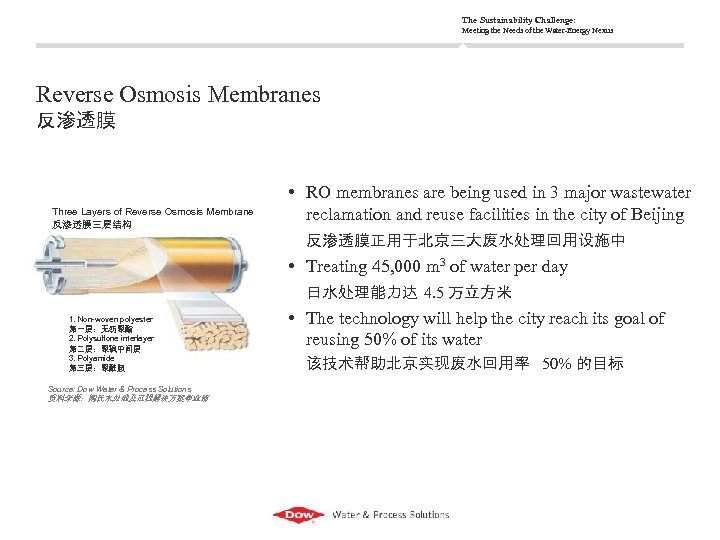
The Sustainability Challenge: Meeting the Needs of the Water-Energy Nexus Reverse Osmosis Membranes 反渗透膜 Three Layers of Reverse Osmosis Membrane 反渗透膜三层结构 • RO membranes are being used in 3 major wastewater reclamation and reuse facilities in the city of Beijing 反渗透膜正用于北京三大废水处理回用设施中 • Treating 45, 000 m 3 of water per day 日水处理能力达 4. 5 万立方米 1. Non-woven polyester 第一层:无纺聚酯 2. Polysulfone interlayer 第二层:聚砜中间层 3. Polyamide 第三层:聚酰胺 Source: Dow Water & Process Solutions 资料来源:陶氏水处理及过程解决方案事业部 • The technology will help the city reach its goal of reusing 50% of its water 该技术帮助北京实现废水回用率 50% 的目标
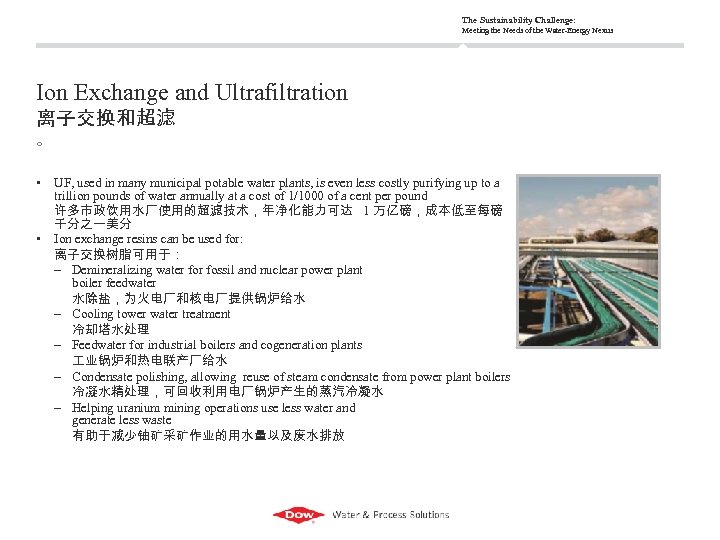
The Sustainability Challenge: Meeting the Needs of the Water-Energy Nexus Ion Exchange and Ultrafiltration 离子交换和超滤 。 • • UF, used in many municipal potable water plants, is even less costly purifying up to a trillion pounds of water annually at a cost of 1/1000 of a cent per pound 许多市政饮用水厂使用的超滤技术,年净化能力可达 1 万亿磅,成本低至每磅 千分之一美分 Ion exchange resins can be used for: 离子交换树脂可用于: – Demineralizing water fossil and nuclear power plant boiler feedwater 水除盐,为火电厂和核电厂提供锅炉给水 – Cooling tower water treatment 冷却塔水处理 – Feedwater for industrial boilers and cogeneration plants 业锅炉和热电联产厂给水 – Condensate polishing, allowing reuse of steam condensate from power plant boilers 冷凝水精处理,可回收利用电厂锅炉产生的蒸汽冷凝水 – Helping uranium mining operations use less water and generate less waste 有助于减少铀矿采矿作业的用水量以及废水排放
The Sustainability Challenge: Meeting the Needs of the Water-Energy Nexus How Can Technology Create Sustainability? 技术如何实现可持续发展? • Modern water treatment technology and distribution infrastructure allows us to conquer disease, to build advanced industrial economies and to increase standards of living 现代水处理技术和给排水基础设施可帮助我们预防 疾病,发展先进的 业经济,提高人类的生活水平 • The latest technologies allow us to minimize the water needed for electricity generation while continuing to provide energy to a burgeoning population 最新的技术让我们在最大程度地减少发电用水的同时 继续为不断快速增长的人口有效地提供能源 • Novel technology can convert impossible source into sustainable fresh water to meet industrial and residential demands 创新的技术将不可能变为可能,将过去无法利用的水 源,如海水、市政 业废水转换成为可持续利用的水 资源
The Sustainability Challenge: 追求可持续发展,积极应对挑战 : Meeting the Needs of the Water-Energy Nexus 聚焦水资源减少与能源需求剧增的瓶颈问题 Dr. Wang Xiao Lan, Commercial Director for Asia Pacific, Dow Water & Process Solutions 王晓兰博士 陶氏水处理及过程解决方案事业部 亚太区总经理 Learn more at dowwaterandprocess. com ®™ Trademark of The Dow Chemical Company (“Dow”) or an affiliated company of Dow
Скачать презентацию The Sustainability Challenge 追求可持续发展 积极应对挑战 Meeting the Needs
2a177b815a51b999e1a89ff82f2ab22c.ppt