


 Скачать презентацию The Sun the Ionosphere and HF Propagation Carl
5dfcd3eace0b53311ac2223276c28648.ppt
- Количество слайдов: 30
 The Sun, the Ionosphere and HF Propagation Carl Luetzelschwab K 9 LA k 9 la@arrl. net http: //k 9 la. us Kamloops ARC Nov 2015 K 9 LA
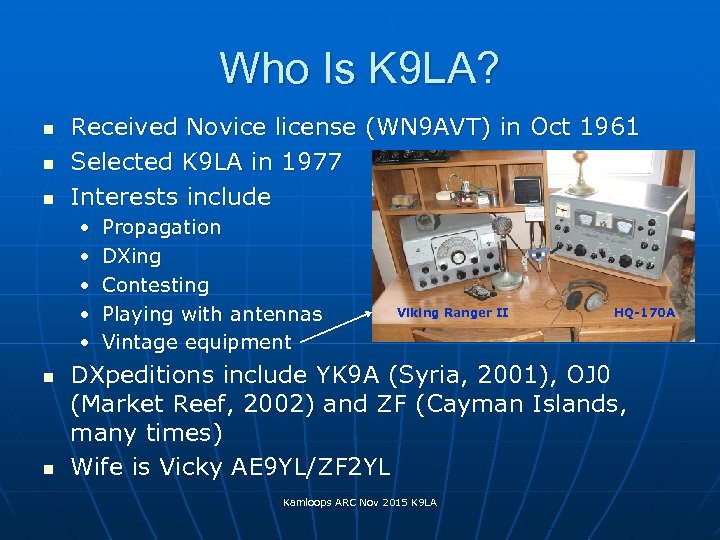 Who Is K 9 LA? n n n Received Novice license (WN 9 AVT) in Oct 1961 Selected K 9 LA in 1977 Interests include • • • n n Propagation DXing Contesting Playing with antennas Vintage equipment Viking Ranger II HQ-170 A DXpeditions include YK 9 A (Syria, 2001), OJ 0 (Market Reef, 2002) and ZF (Cayman Islands, many times) Wife is Vicky AE 9 YL/ZF 2 YL Kamloops ARC Nov 2015 K 9 LA
 Some of My Favorite Movie Stars Kamloops ARC Nov 2015 K 9 LA
 But This Is My Favorite Star Kamloops ARC Nov 2015 K 9 LA
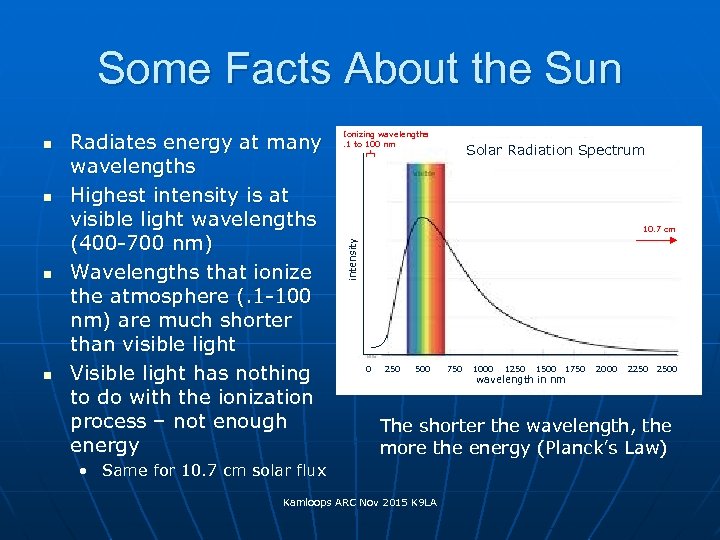 Some Facts About the Sun n Radiates energy at many wavelengths Highest intensity is at visible light wavelengths (400 -700 nm) Wavelengths that ionize the atmosphere (. 1 -100 nm) are much shorter than visible light Visible light has nothing to do with the ionization process – not enough energy Ionizing wavelengths. 1 to 100 nm Solar Radiation Spectrum 10. 7 cm intensity n 0 250 500 750 1000 1250 1500 1750 wavelength in nm 2000 2250 2500 The shorter the wavelength, the more the energy (Planck’s Law) • Same for 10. 7 cm solar flux Kamloops ARC Nov 2015 K 9 LA
 Early Ionospheric Studies n n n n 1901 – Marconi hears Poldhu 1902 – Kennelly (US) & Heaviside (UK) independently suggest that the Earth’s upper atmosphere consists of an electrically conducting region (the Kennelly-Heaviside layer) 1925 – Appleton finds conclusive evidence of a conducting region by measuring arrival angles of nearby transmitter 1925 – Breit and Tuve confirm existence of reflecting region with the first ionosonde (swept-frequency upward-looking radar) 1926 - Watson-Watt coins the term “ionosphere” 1927 – Sharp decrease in critical frequency (measured by an ionosonde) seen during solar eclipse – deduce that solar radiation forms the ionosphere 1928 – Pettit ties sunspots to solar radiation – the more sunspots, the more radiation Kamloops ARC Nov 2015 K 9 LA
 Sunspots n n n Sunspots are the result of magnetic fields in the Sun that erupt through the surface, forming a huge magnetic loop The solar surface in this area cools significantly, causing this area to be darker The area around the sunspot emits radiation at wavelengths that ionize the atmosphere • Sunspots (and 10. 7 cm solar flux) are a proxy for the true ionizing radiation Kamloops ARC Nov 2015 K 9 LA
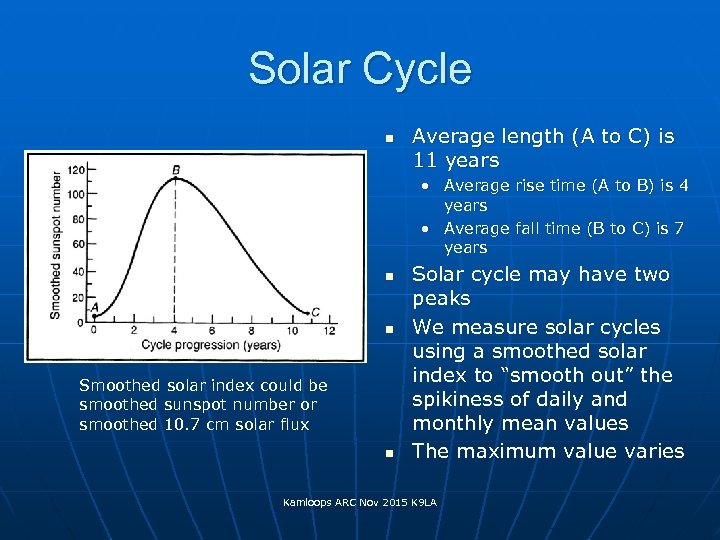 Solar Cycle n Average length (A to C) is 11 years • Average rise time (A to B) is 4 years • Average fall time (B to C) is 7 years n n Smoothed solar index could be smoothed sunspot number or smoothed 10. 7 cm solar flux n Solar cycle may have two peaks We measure solar cycles using a smoothed solar index to “smooth out” the spikiness of daily and monthly mean values The maximum value varies Kamloops ARC Nov 2015 K 9 LA
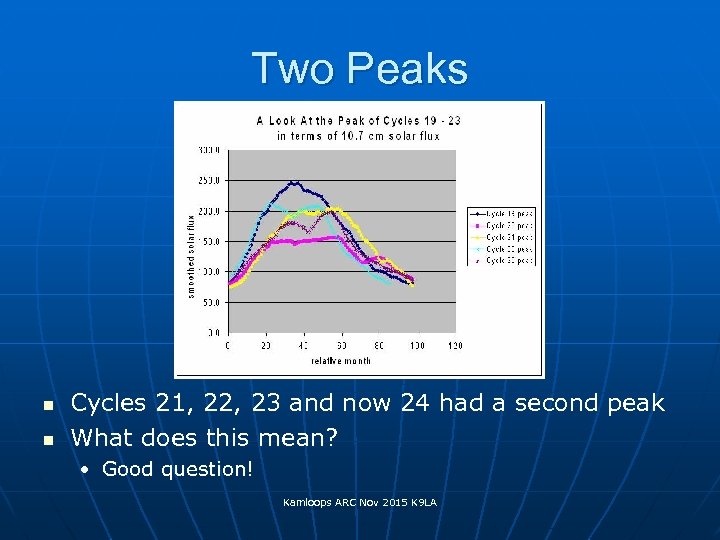 Two Peaks n n Cycles 21, 22, 23 and now 24 had a second peak What does this mean? • Good question! Kamloops ARC Nov 2015 K 9 LA
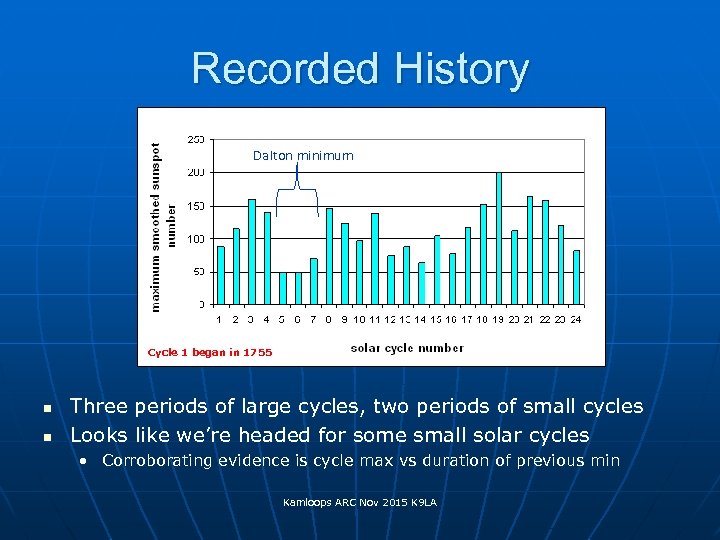 Recorded History Dalton minimum Cycle 1 began in 1755 n n Three periods of large cycles, two periods of small cycles Looks like we’re headed for some small solar cycles • Corroborating evidence is cycle max vs duration of previous min Kamloops ARC Nov 2015 K 9 LA
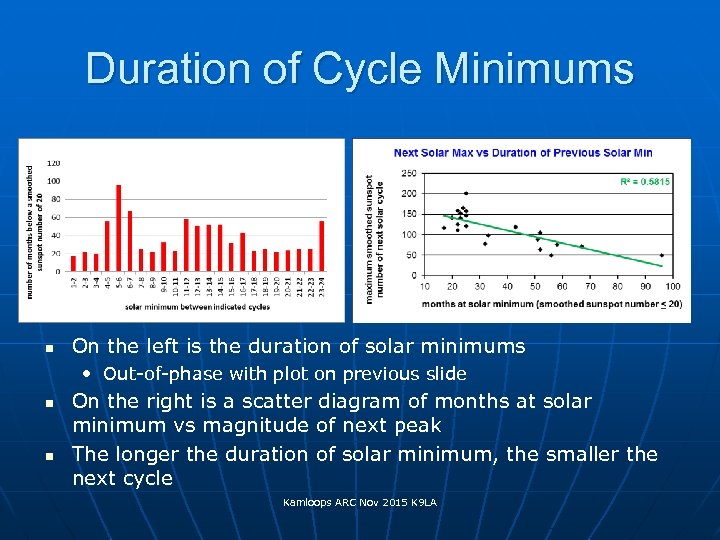 Duration of Cycle Minimums n On the left is the duration of solar minimums • Out-of-phase with plot on previous slide n n On the right is a scatter diagram of months at solar minimum vs magnitude of next peak The longer the duration of solar minimum, the smaller the next cycle Kamloops ARC Nov 2015 K 9 LA
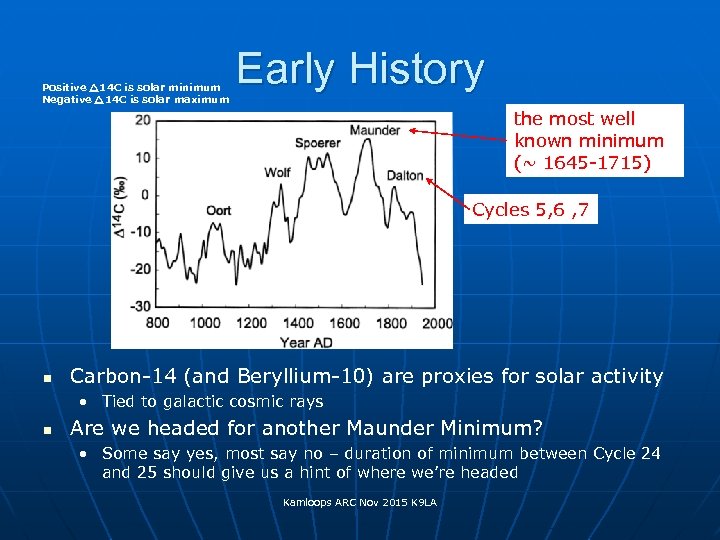 Positive 14 C is solar minimum Negative 14 C is solar maximum Early History the most well known minimum (~ 1645 -1715) Cycles 5, 6 , 7 n Carbon-14 (and Beryllium-10) are proxies for solar activity • Tied to galactic cosmic rays n Are we headed for another Maunder Minimum? • Some say yes, most say no – duration of minimum between Cycle 24 and 25 should give us a hint of where we’re headed Kamloops ARC Nov 2015 K 9 LA
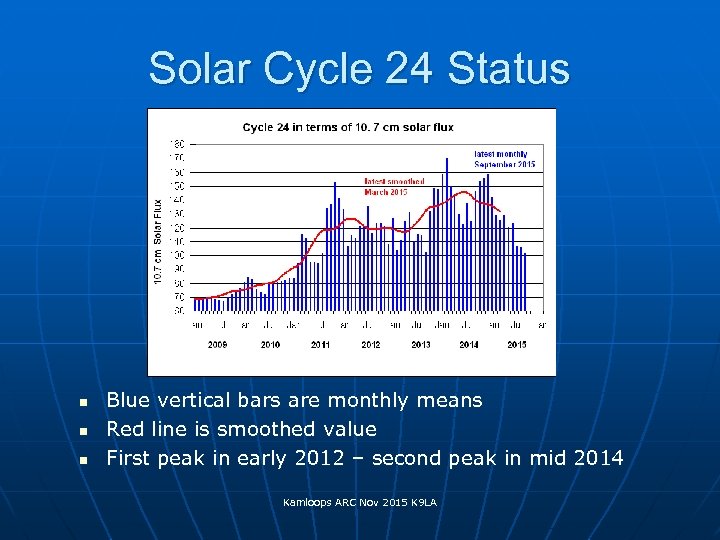 Solar Cycle 24 Status n n n Blue vertical bars are monthly means Red line is smoothed value First peak in early 2012 – second peak in mid 2014 Kamloops ARC Nov 2015 K 9 LA
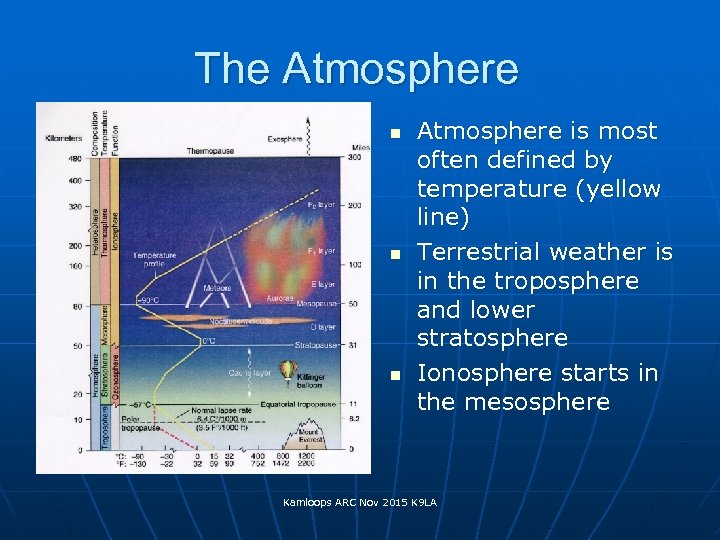 The Atmosphere n n n Atmosphere is most often defined by temperature (yellow line) Terrestrial weather is in the troposphere and lower stratosphere Ionosphere starts in the mesosphere Kamloops ARC Nov 2015 K 9 LA
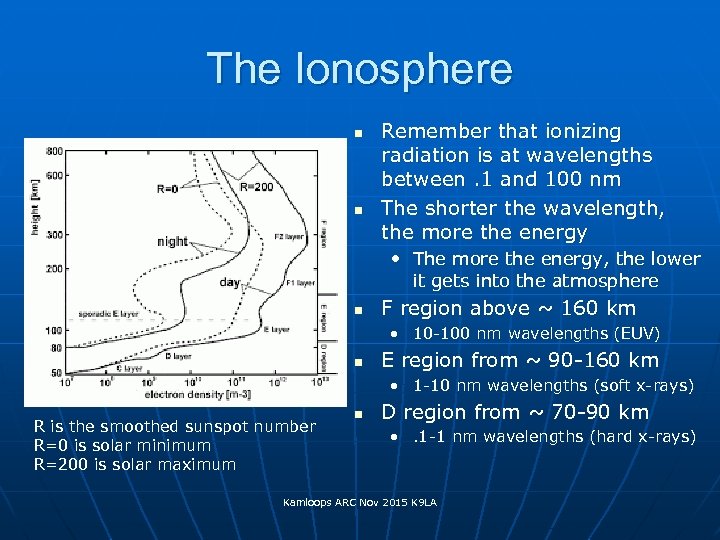 The Ionosphere n n Remember that ionizing radiation is at wavelengths between. 1 and 100 nm The shorter the wavelength, the more the energy • The more the energy, the lower it gets into the atmosphere n F region above ~ 160 km • 10 -100 nm wavelengths (EUV) n E region from ~ 90 -160 km • 1 -10 nm wavelengths (soft x-rays) R is the smoothed sunspot number R=0 is solar minimum R=200 is solar maximum n D region from ~ 70 -90 km • . 1 -1 nm wavelengths (hard x-rays) Kamloops ARC Nov 2015 K 9 LA
 Critical Frequency and MUF n Ionosondes measure the critical frequencies of the ionosphere • Critical frequency of a region is the frequency at which the RF pulse does not return to Earth (it goes through the region) • Ionosondes report critical frequencies for the E, F 1 and F 2 regions (and sporadic E when present) n Using spherical geometry, we can estimate the maximum frequency that will propagate over a given path at a given time Kamloops ARC Nov 2015 K 9 LA
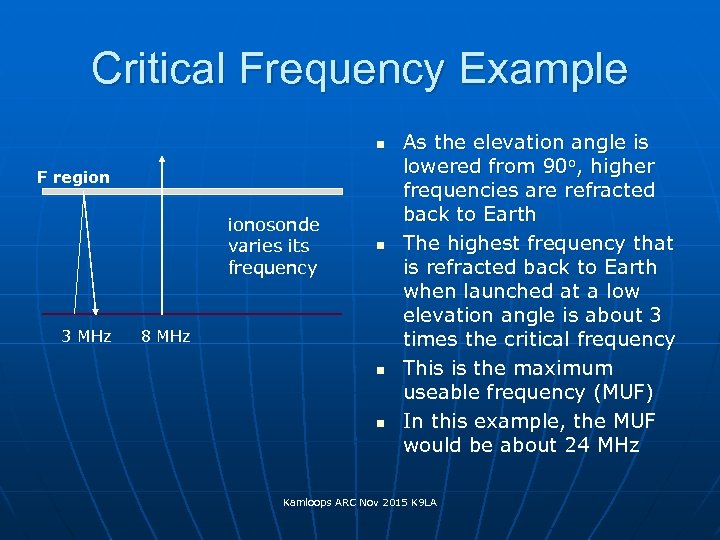 Critical Frequency Example n F region ionosonde varies its frequency 3 MHz n 8 MHz n n As the elevation angle is lowered from 90 o, higher frequencies are refracted back to Earth The highest frequency that is refracted back to Earth when launched at a low elevation angle is about 3 times the critical frequency This is the maximum useable frequency (MUF) In this example, the MUF would be about 24 MHz Kamloops ARC Nov 2015 K 9 LA
 Variability of the Ionosphere n The ionosphere varies significantly • • • n n Over a solar cycle - most ionization at solar maximum Monthly – Fall months best in northern hemisphere Throughout the day – max around noon, min before dawn The ionosphere is affected by disturbances to propagation Our understanding of the ionosphere is statistical in nature over a month’s time frame • Thus our propagation predictions are statistical in nature over a month’s time frame • We do not have a daily model of the ionosphere Kamloops ARC Nov 2015 K 9 LA
 The Bands n Our bands fall into three categories • 160 m, 80 m, 40 m: these bands are very dependent on ionospheric absorption n Best during the night and best at solar minimum • 15 m, 12 m, 10 m: these bands are very dependent on the MUF n Best during the day and best at solar maximum • 30 m, 20 m, 17 m: these are transition bands n n n Not entirely dependent on absorption Not entirely dependent on MUF Hold up well throughout a solar cycle Kamloops ARC Nov 2015 K 9 LA
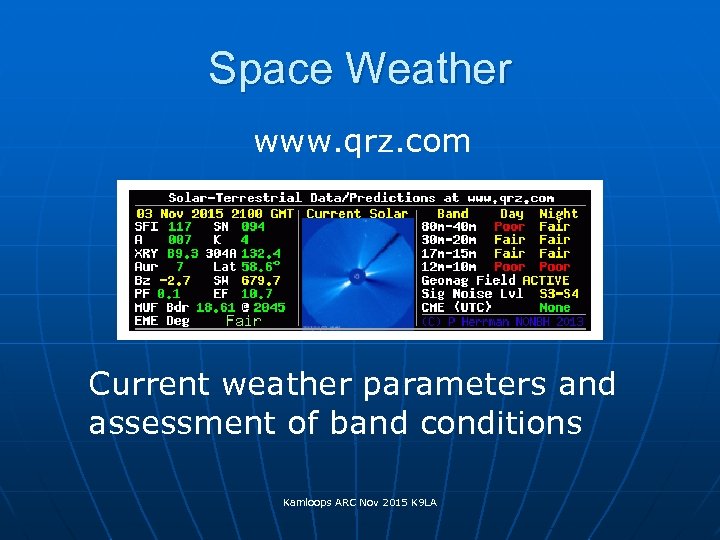 Space Weather www. qrz. com Current weather parameters and assessment of band conditions Kamloops ARC Nov 2015 K 9 LA
 What We Desire n Solar activity • In general we desire a high sunspot number (0 -200) and a high 10. 7 cm solar flux (65 -300) • Openings vs 10. 7 cm solar flux n n 10 m: 12 m: 15 m: long-term solar flux > > > 100 75 50 Geomagnetic field activity • In general we desire A < 7 and K < 2 n n A and K are measures of the deviation of the Earth’s magnetic field from quiet conditions A is a daily index, K is a 3 -hour index Kamloops ARC Nov 2015 K 9 LA
 What Bands Are Open? n n Since we don’t have a daily model of the ionosphere, knowing the 10. 7 cm solar flux does not pin down the MUF for a given path at a given time We can use propagation predictions to give a statistical view of what the best band would be for the desired path • W 6 ELProp is a user-friendly propagation prediction program that is a free download • Visit the Tutorials link at http: //k 9 la. us for info about W 6 ELProp (how to download it, set it up and interpret the results) Kamloops ARC Nov 2015 K 9 LA
 Listen Real-Time! n n n The IARU/NCDXF beacon project has a beacon on 20 m, 17 m, 15 m, 12 m and 10 m in 18 countries worldwide Each beacon transmits for 10 seconds – so in 3 minutes you can assess worldwide openings on a band http: //www. ncdxf. org/pages/beacons. html for details Kamloops ARC Nov 2015 K 9 LA
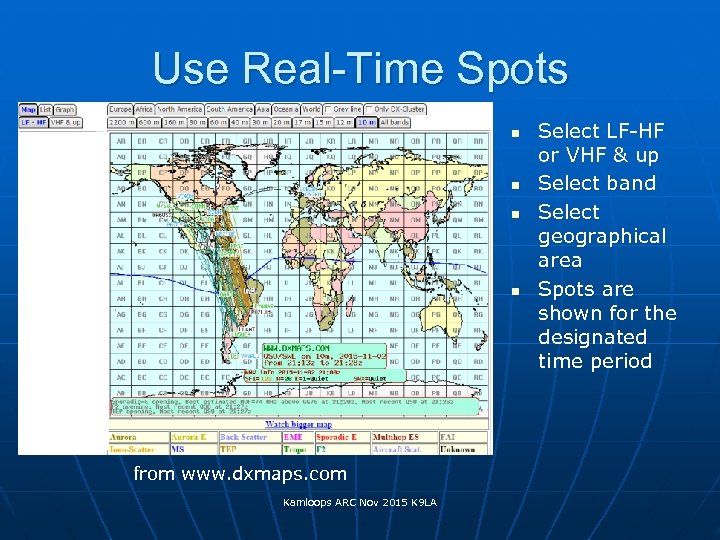 Use Real-Time Spots n n from www. dxmaps. com Kamloops ARC Nov 2015 K 9 LA Select LF-HF or VHF & up Select band Select geographical area Spots are shown for the designated time period
 Modes of Propagation n n Most of our HF QSOs are made via the true great circle short path Other HF propagation modes exist • • • n Long path Skewed path Scatter path (implies loss = weak signal) Path could be via F region, Es region, auroral ionization, equatorial ionization (TEP), etc Kamloops ARC Nov 2015 K 9 LA
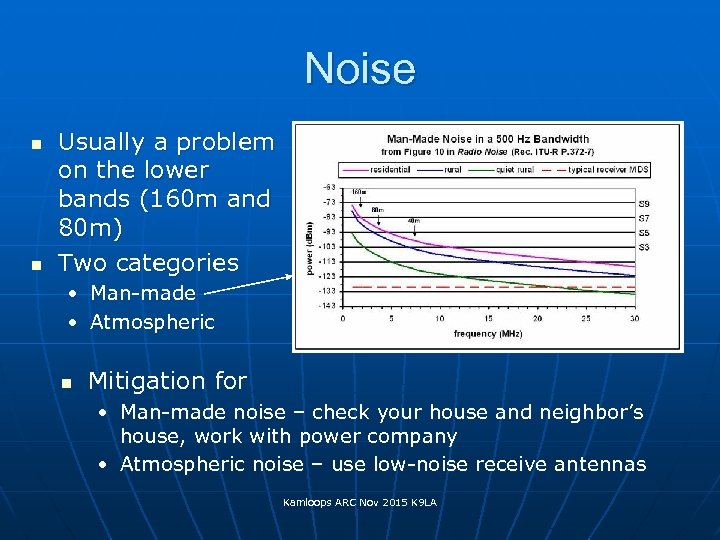 Noise n n Usually a problem on the lower bands (160 m and 80 m) Two categories • Man-made • Atmospheric n Mitigation for • Man-made noise – check your house and neighbor’s house, work with power company • Atmospheric noise – use low-noise receive antennas Kamloops ARC Nov 2015 K 9 LA
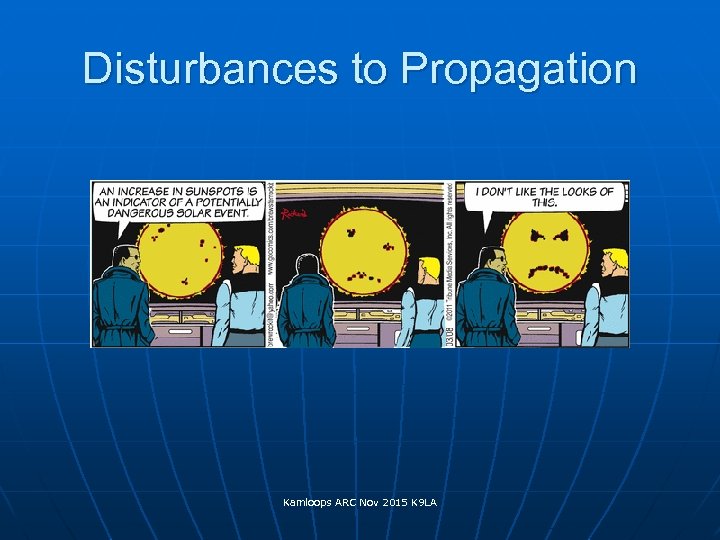 Disturbances to Propagation Kamloops ARC Nov 2015 K 9 LA
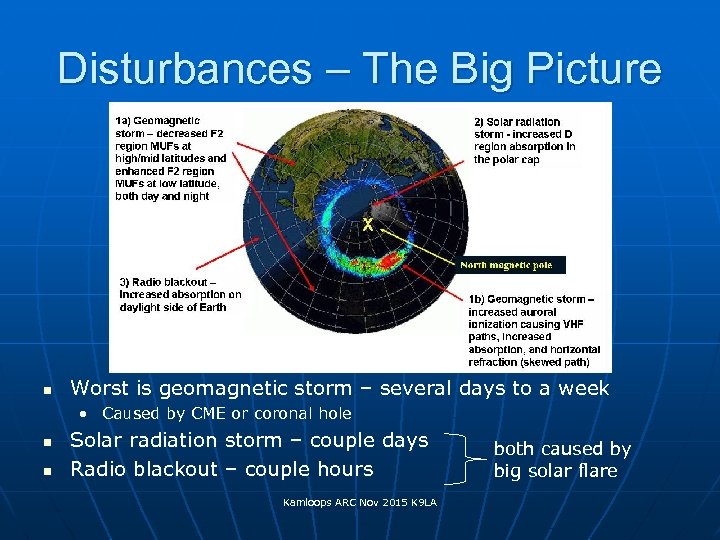 Disturbances – The Big Picture n Worst is geomagnetic storm – several days to a week • Caused by CME or coronal hole n n Solar radiation storm – couple days Radio blackout – couple hours Kamloops ARC Nov 2015 K 9 LA both caused by big solar flare
 Solar Flares n n n Emit lots of radiation at x-ray wavelengths (very short) Biggest is X-Class Next down is M-Class Next down is C-Class Least is B-Class Visit http: //www. swpc. noaa. gov/noaa-scalesexplanation for details of disturbances to propagation Kamloops ARC Nov 2015 K 9 LA
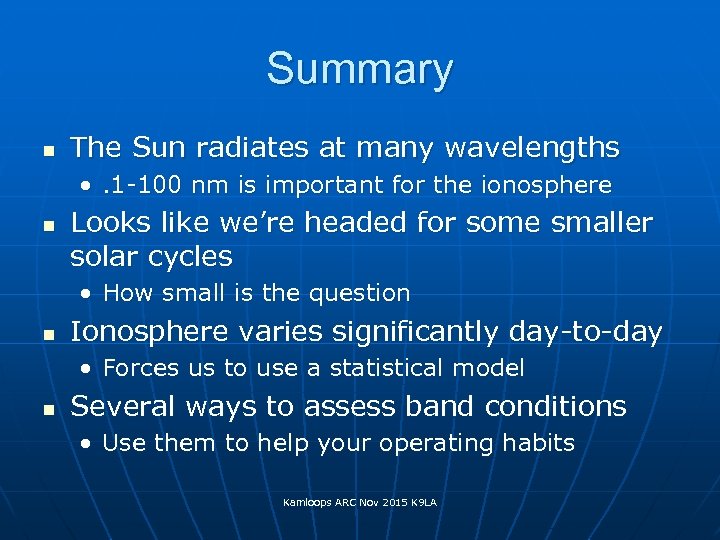 Summary n The Sun radiates at many wavelengths • . 1 -100 nm is important for the ionosphere n Looks like we’re headed for some smaller solar cycles • How small is the question n Ionosphere varies significantly day-to-day • Forces us to use a statistical model n Several ways to assess band conditions • Use them to help your operating habits Kamloops ARC Nov 2015 K 9 LA