


The subject of theoretical Phonetics
§ What does phonetics study? What sciences is phonetics connected with? § How many branches and aspects of phonetics do you know?

§ The word “phonetics” is derived from the Greek “ (fo: ne: ) which is meant sound, voice. § Phonetics is an old science. It was known to the ancient “ Greeks and to the ancient Hindus. In India more than 2000 years ago there flourished a science of phonetics more advanced than any that has since been known until very recent times. The scientists of that time were concerned with speech sounds only
Phonetics is a science which studies speech sounds, their distribution and classification, its aspects and functions, the syllabic structure of words, accentual structure of the words, intonational structure of the word.
Phonetics is divided into 2 components: Segmental( individual sounds/ phonemes) and suprasegmental ( syllables, word, intonation, phrases, texts)
§ phonemes and their distribution in words, § their mutual adaptation, § stress, § syllable formation, § intonation, § the relation between oral and written speech
§ A sound is a product of human activity which shows the speaker s personality and reveals the speaker s physiological and emotional state geographical origin education social status.
§ Articulatory aspect: the study of the production of speech sounds by the vocal tract by the speaker that is how individual sound is articulated ( the position, shape, and movement of speech organs, such as the lips, tongue, and vocal folds) § Acoustic aspect : the study of the physical transmission of speech sounds from the speaker to the listener ( frequency, amplitude, intensity (loudness), duration (quantity of time, length), intonation, tempo, pitch)
§ Auditory phonetics: the study of the reception and perception of speech sounds by the listener ( how a listener understands a sound, in Kazakh/ Russian there is no sound Ө, that’s why our children have to work out a new set of box in their minds for this sound) § Functional aspect its function – to differentiate, e. g. [t] – occlusive, plosive, aspirate, voiceless, fortis; but: twice (labialized variant), try (post-alveolar v. ), little (exploded literally), kitten (exploded nasally), tea (becomes narrower), state (loses aspiration).
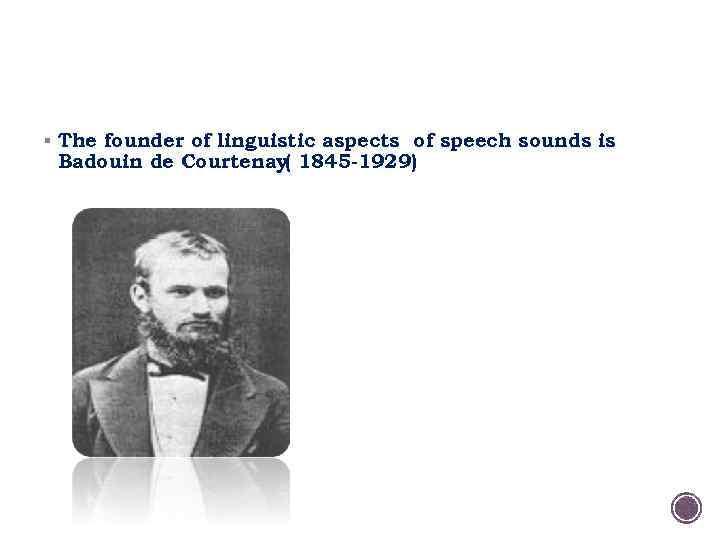
§ The founder of linguistic aspects of speech sounds is Badouin de Courtenay( 1845 -1929)
Is Phonetics connected with other sciences? § Grammar (Through the system of reading rules, correct pronunciation of plural form, tense forms, sound interchange help to differentiate between singular and plural forms, the connection through intonation. Sometimes intonation alone serves to single out the communicative centre of the sentence (e. g. He came home). In affirmative sentences the rising nuclear tone may show that this is a question. ) § Lexicology (distinguishing certain parts of speech ) § Stylistics( distinguishing speaker’s attitudes ) § Non-linguistic sciences: Physics ( movement) Anatomy Physiology( speech organs)
