 Скачать презентацию The subject is the independent member of a
the subject.pptx
- Количество слайдов: 13



The subject is the independent member of a two member predication, containing the person component of predicativity. He sleeps.
The subject is generally defined as a word or a group of words denoting the thing we speak about. This pretty girl is my sister's friend.
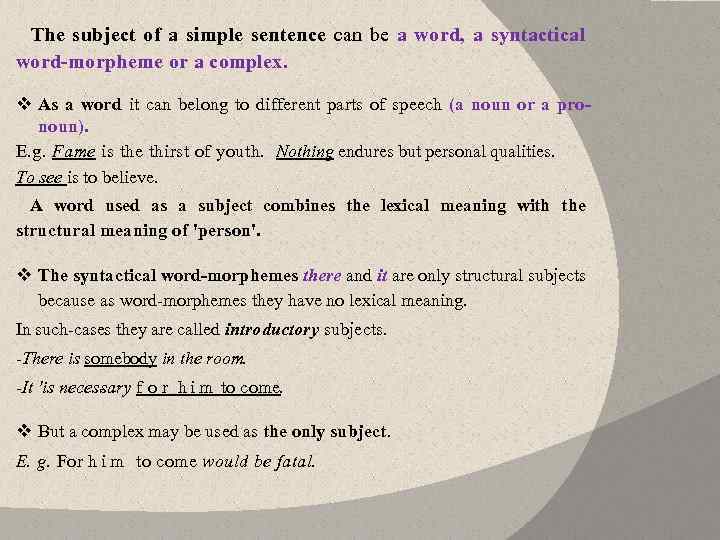
The subject of a simple sentence can be a word, a syntactical word morpheme or a complex. v As a word it can belong to different parts of speech (a noun or a pro noun). E. g. Fame is the thirst of youth. Nothing endures but personal qualities. To see is to believe. A word used as a subject combines the lexical meaning with the structural meaning of 'person'. v The syntactical word morphemes there and it are only structural subjects because as word morphemes they have no lexical meaning. In such cases they are called introductory subjects. There is somebody in the room. It 'is neces ary f o r h i m to come. s v But a complex may be used as the only subject. E. g. For h i m to come would be fatal.
qsecondary subject within a com lex: p Several thousand people went to see the headless statue yesterday before it was removed for a new h e a d to be cast from the original plaster moulds. q The syntactical word morphemes there and it may also function as secondary subjects.
Some authors speak of definite personal, indefinite personal and impersonal sentences in Modern Eng ish. l ü So it’s a semantical classification of subjects, not sentences.
If we compare the subject in English with that of Russian we shall find a considerable difference between them. 1. In Modern Russian the subject is as a rule characterized by a distinct morphological feature — the nominative case, whereas in English it is for case the most part indicated by the position it occupies in the sentence. 2. In Modern Russian the subject is much less obligatory as a part of the sentence than in English. Приду. Пишет. ü In English a finite verb does not, as a rule, make a sentence without a subject. 3. In English the subject may be a syntactical word morpheme, a gerund or a complex, which is, naturally, alien to Russian.

The predicate is the member of a predication containing the mood and tense components of predicativity. E. g. This dictionary employs a pronunciation that is easy to learn. Den has probably had no lunch.
The predicate can be a word or a syntactical word morpheme. Ø When it is a notional word, it is not only the structural but the notional predicate as well. E. g. A picture often shows the meaning of a word more clearly than a description. When the predicate is a semi notional verb or a syntactical word morpheme, it is only a structural predicate and is usually connected with a notional word which makes the notional predicate. E. g. He was strong enough for that. We can assist our oppressed brothers in South Africa in their struggle for freedom.
Predicates may be divided morphologically: • words • word morphemes Semantically • Notional • semi notional • lexically empty (structural)
What is traditionally called a predicate is really the combination of the structural and the notional predicate the combina ion a communicative predicate: t 1)structure q 'simple' q 'com pound‘ 2)morpho ogical composition l q 'verbal' (must see, is to believe) q 'nominal' (is a sudent, became angry).
Ø The absence of syntactical word morphemes used as predicates and the scarcity of mor hological word p morphemes in Russian. So the division into structural and notional predicates is not so essen ial in Russian as it is in t English. Ø There are many more sentences without finite verbs in Russian than in English. Он студент. Она больна. Ему холодно. Кому ехать? Ø Russian predication contains a predicate with ut a subject o much more often than in English.
Скачать презентацию The subject is the independent member of a
the subject.pptx