 Скачать презентацию The Sub-Saharan Africa telecoms market trends and forecasts
08592f5e098cea0868b2aedb91e749f2.ppt
- Количество слайдов: 48



The Sub-Saharan Africa telecoms market: trends and forecasts 2011– 2016 Research Forecast Report The Sub-Saharan Africa telecoms market: trends and forecasts 2011 -2016 February 2012 Roz Roseboro and William Hare © Analysys Mason Limited 2012
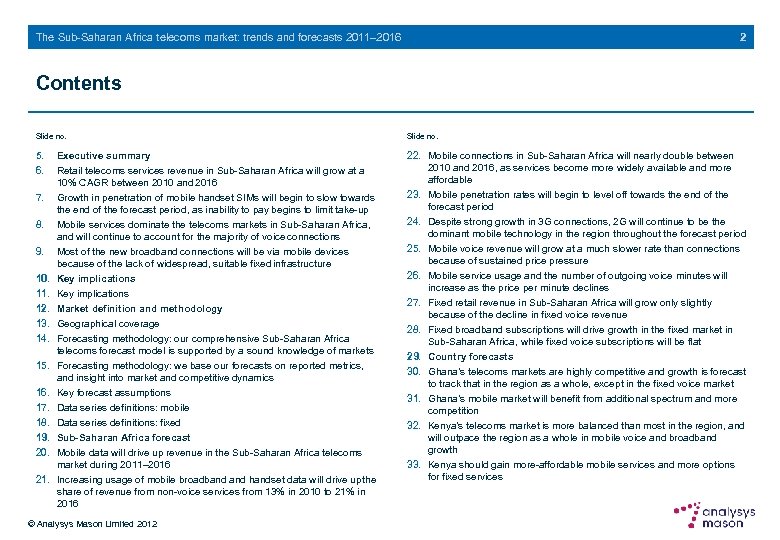
2 The Sub-Saharan Africa telecoms market: trends and forecasts 2011– 2016 Contents Slide no. 5. 6. 22. Mobile connections in Sub-Saharan Africa will nearly double between 2010 and 2016, as services become more widely available and more affordable 23. Mobile penetration rates will begin to level off towards the end of the forecast period 24. Despite strong growth in 3 G connections, 2 G will continue to be the dominant mobile technology in the region throughout the forecast period 25. Mobile voice revenue will grow at a much slower rate than connections because of sustained price pressure 26. Mobile service usage and the number of outgoing voice minutes will increase as the price per minute declines 27. Fixed retail revenue in Sub-Saharan Africa will grow only slightly because of the decline in fixed voice revenue 28. Fixed broadband subscriptions will drive growth in the fixed market in Sub-Saharan Africa, while fixed voice subscriptions will be flat 29. Country forecasts 30. Ghana’s telecoms markets are highly competitive and growth is forecast to track that in the region as a whole, except in the fixed voice market 31. Ghana’s mobile market will benefit from additional spectrum and more competition 32. Kenya’s telecoms market is more balanced than most in the region, and will outpace the region as a whole in mobile voice and broadband growth 33. Kenya should gain more-affordable mobile services and more options for fixed services 7. 8. 9. 10. 11. 12. 13. 14. 15. 16. 17. 18. 19. 20. Executive summary Retail telecoms services revenue in Sub-Saharan Africa will grow at a 10% CAGR between 2010 and 2016 Growth in penetration of mobile handset SIMs will begin to slow towards the end of the forecast period, as inability to pay begins to limit take-up Mobile services dominate the telecoms markets in Sub-Saharan Africa, and will continue to account for the majority of voice connections Most of the new broadband connections will be via mobile devices because of the lack of widespread, suitable fixed infrastructure Key implications Market definition and methodology Geographical coverage Forecasting methodology: our comprehensive Sub-Saharan Africa telecoms forecast model is supported by a sound knowledge of markets Forecasting methodology: we base our forecasts on reported metrics, and insight into market and competitive dynamics Key forecast assumptions Data series definitions: mobile Data series definitions: fixed Sub-Saharan Africa forecast Mobile data will drive up revenue in the Sub-Saharan Africa telecoms market during 2011– 2016 21. Increasing usage of mobile broadband handset data will drive up the share of revenue from non-voice services from 13% in 2010 to 21% in 2016 © Analysys Mason Limited 2012
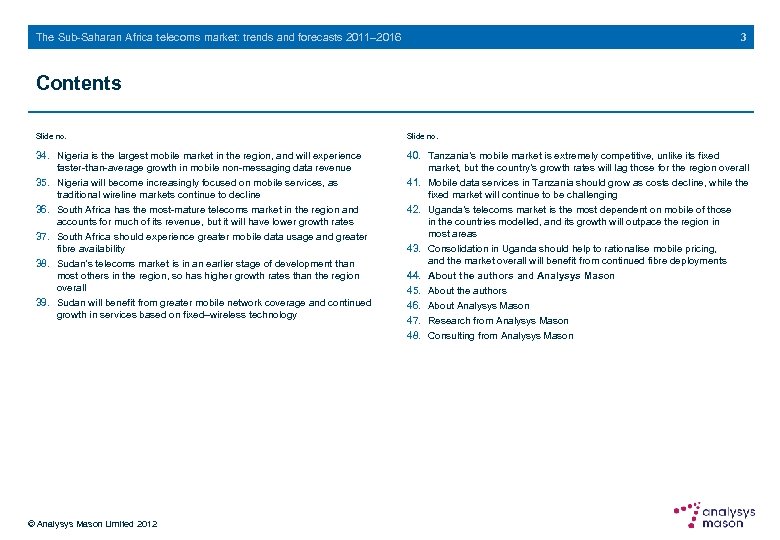
3 The Sub-Saharan Africa telecoms market: trends and forecasts 2011– 2016 Contents Slide no. 34. Nigeria is the largest mobile market in the region, and will experience faster-than-average growth in mobile non-messaging data revenue 35. Nigeria will become increasingly focused on mobile services, as traditional wireline markets continue to decline 36. South Africa has the most-mature telecoms market in the region and accounts for much of its revenue, but it will have lower growth rates 37. South Africa should experience greater mobile data usage and greater fibre availability 38. Sudan’s telecoms market is in an earlier stage of development than most others in the region, so has higher growth rates than the region overall 39. Sudan will benefit from greater mobile network coverage and continued growth in services based on fixed–wireless technology 40. Tanzania’s mobile market is extremely competitive, unlike its fixed market, but the country’s growth rates will lag those for the region overall 41. Mobile data services in Tanzania should grow as costs decline, while the fixed market will continue to be challenging 42. Uganda’s telecoms market is the most dependent on mobile of those in the countries modelled, and its growth will outpace the region in most areas 43. Consolidation in Uganda should help to rationalise mobile pricing, and the market overall will benefit from continued fibre deployments 44. About the authors and Analysys Mason 45. About the authors 46. About Analysys Mason 47. Research from Analysys Mason 48. Consulting from Analysys Mason © Analysys Mason Limited 2012
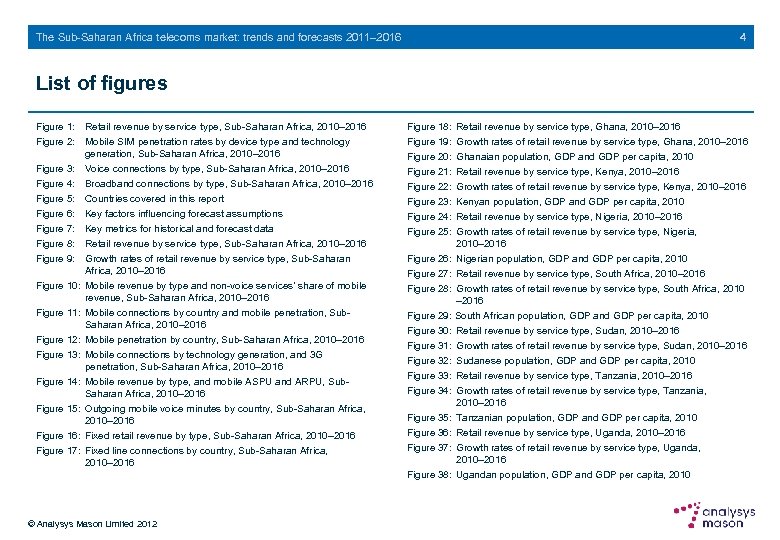
The Sub-Saharan Africa telecoms market: trends and forecasts 2011– 2016 4 List of figures Figure 1: Retail revenue by service type, Sub-Saharan Africa, 2010– 2016 Figure 2: Mobile SIM penetration rates by device type and technology generation, Sub-Saharan Africa, 2010– 2016 Figure 3: Voice connections by type, Sub-Saharan Africa, 2010– 2016 Figure 4: Broadband connections by type, Sub-Saharan Africa, 2010– 2016 Figure 5: Countries covered in this report Figure 6: Key factors influencing forecast assumptions Figure 7: Key metrics for historical and forecast data Figure 8: Retail revenue by service type, Sub-Saharan Africa, 2010– 2016 Figure 9: Growth rates of retail revenue by service type, Sub-Saharan Africa, 2010– 2016 Figure 10: Mobile revenue by type and non-voice services’ share of mobile revenue, Sub-Saharan Africa, 2010– 2016 Figure 11: Mobile connections by country and mobile penetration, Sub. Saharan Africa, 2010– 2016 Figure 12: Mobile penetration by country, Sub-Saharan Africa, 2010– 2016 Figure 13: Mobile connections by technology generation, and 3 G penetration, Sub-Saharan Africa, 2010– 2016 Figure 14: Mobile revenue by type, and mobile ASPU and ARPU, Sub. Saharan Africa‚ 2010– 2016 Figure 15: Outgoing mobile voice minutes by country, Sub-Saharan Africa, 2010– 2016 Figure 16: Fixed retail revenue by type, Sub-Saharan Africa, 2010– 2016 Figure 17: Fixed line connections by country, Sub-Saharan Africa, 2010– 2016 © Analysys Mason Limited 2012 Figure 18: Retail revenue by service type, Ghana, 2010– 2016 Figure 19: Growth rates of retail revenue by service type, Ghana, 2010– 2016 Figure 20: Ghanaian population, GDP and GDP per capita, 2010 Figure 21: Retail revenue by service type, Kenya, 2010– 2016 Figure 22: Growth rates of retail revenue by service type, Kenya, 2010– 2016 Figure 23: Kenyan population, GDP and GDP per capita, 2010 Figure 24: Retail revenue by service type, Nigeria, 2010– 2016 Figure 25: Growth rates of retail revenue by service type, Nigeria, 2010– 2016 Figure 26: Nigerian population, GDP and GDP per capita, 2010 Figure 27: Retail revenue by service type, South Africa, 2010– 2016 Figure 28: Growth rates of retail revenue by service type, South Africa, 2010 – 2016 Figure 29: South African population, GDP and GDP per capita, 2010 Figure 30: Retail revenue by service type, Sudan, 2010– 2016 Figure 31: Growth rates of retail revenue by service type, Sudan, 2010– 2016 Figure 32: Sudanese population, GDP and GDP per capita, 2010 Figure 33: Retail revenue by service type, Tanzania, 2010– 2016 Figure 34: Growth rates of retail revenue by service type, Tanzania, 2010– 2016 Figure 35: Tanzanian population, GDP and GDP per capita, 2010 Figure 36: Retail revenue by service type, Uganda, 2010– 2016 Figure 37: Growth rates of retail revenue by service type, Uganda, 2010– 2016 Figure 38: Ugandan population, GDP and GDP per capita, 2010
The Sub-Saharan Africa telecoms market: trends and forecasts 2011– 2016 Executive summary Key implications Market definition and methodology Sub-Saharan Africa forecast Country forecasts About the authors and Analysys Mason © Analysys Mason Limited 2012 5
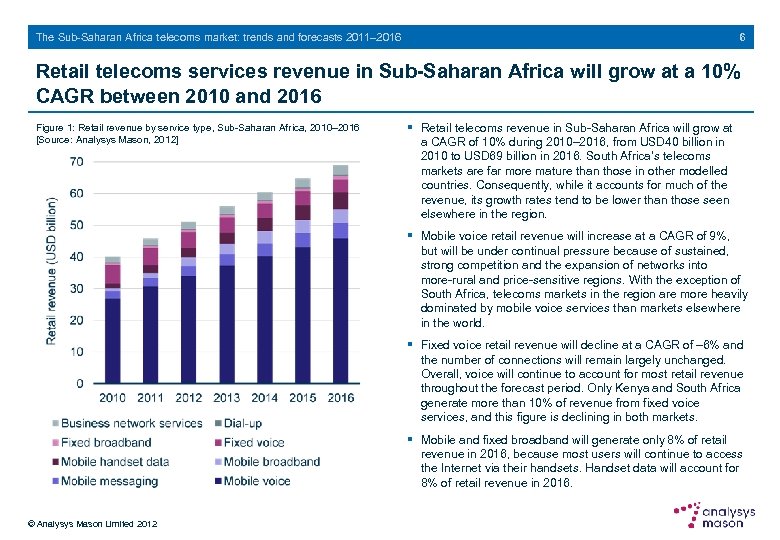
6 The Sub-Saharan Africa telecoms market: trends and forecasts 2011– 2016 Retail telecoms services revenue in Sub-Saharan Africa will grow at a 10% CAGR between 2010 and 2016 Figure 1: Retail revenue by service type, Sub-Saharan Africa, 2010– 2016 [Source: Analysys Mason, 2012] § Retail telecoms revenue in Sub-Saharan Africa will grow at a CAGR of 10% during 2010– 2016, from USD 40 billion in 2010 to USD 69 billion in 2016. South Africa’s telecoms markets are far more mature than those in other modelled countries. Consequently, while it accounts for much of the revenue, its growth rates tend to be lower than those seen elsewhere in the region. § Mobile voice retail revenue will increase at a CAGR of 9%, but will be under continual pressure because of sustained, strong competition and the expansion of networks into more-rural and price-sensitive regions. With the exception of South Africa, telecoms markets in the region are more heavily dominated by mobile voice services than markets elsewhere in the world. § Fixed voice retail revenue will decline at a CAGR of – 6% and the number of connections will remain largely unchanged. Overall, voice will continue to account for most retail revenue throughout the forecast period. Only Kenya and South Africa generate more than 10% of revenue from fixed voice services, and this figure is declining in both markets. § Mobile and fixed broadband will generate only 8% of retail revenue in 2016, because most users will continue to access the Internet via their handsets. Handset data will account for 8% of retail revenue in 2016. © Analysys Mason Limited 2012
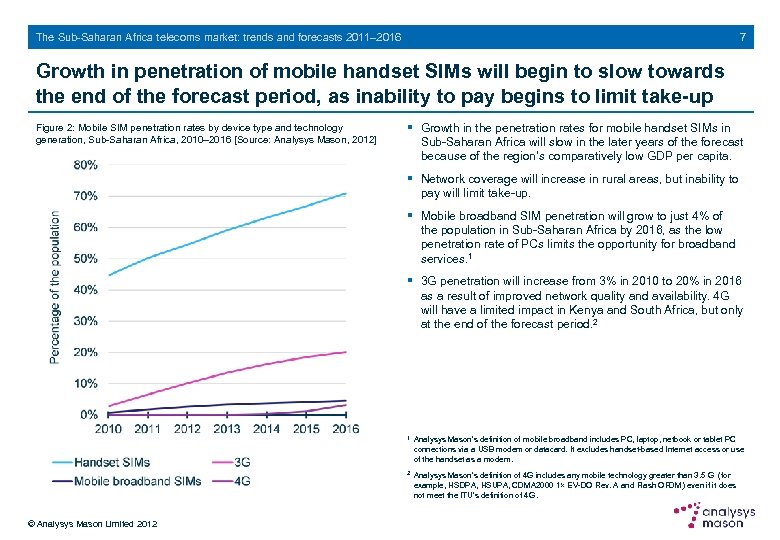
7 The Sub-Saharan Africa telecoms market: trends and forecasts 2011– 2016 Growth in penetration of mobile handset SIMs will begin to slow towards the end of the forecast period, as inability to pay begins to limit take-up Figure 2: Mobile SIM penetration rates by device type and technology generation, Sub-Saharan Africa, 2010– 2016 [Source: Analysys Mason, 2012] § Growth in the penetration rates for mobile handset SIMs in Sub-Saharan Africa will slow in the later years of the forecast because of the region’s comparatively low GDP per capita. § Network coverage will increase in rural areas, but inability to pay will limit take-up. § Mobile broadband SIM penetration will grow to just 4% of the population in Sub-Saharan Africa by 2016, as the low penetration rate of PCs limits the opportunity for broadband services. 1 § 3 G penetration will increase from 3% in 2010 to 20% in 2016 as a result of improved network quality and availability. 4 G will have a limited impact in Kenya and South Africa, but only at the end of the forecast period. 2 1 2 © Analysys Mason Limited 2012 Analysys Mason’s definition of mobile broadband includes PC, laptop, netbook or tablet PC connections via a USB modem or datacard. It excludes handset-based Internet access or use of the handset as a modem. Analysys Mason’s definition of 4 G includes any mobile technology greater than 3. 5 G (for example, HSDPA, HSUPA, CDMA 2000 1× EV-DO Rev. A and Flash OFDM) even if it does not meet the ITU’s definition of 4 G.
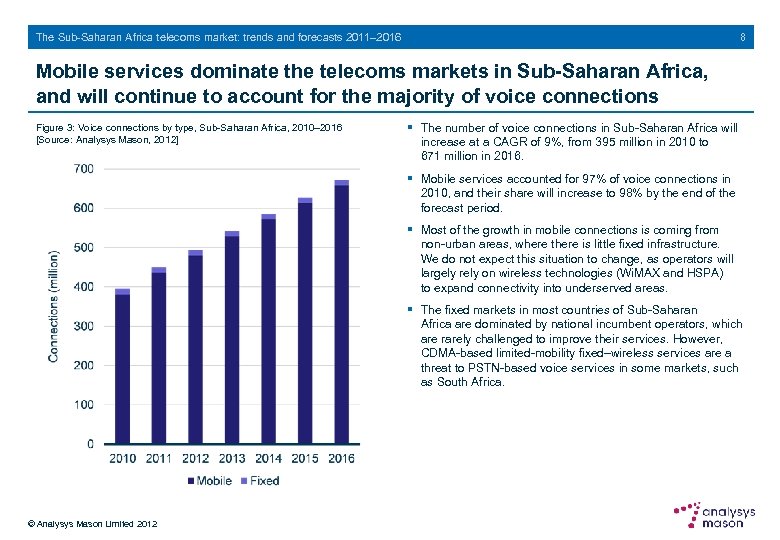
8 The Sub-Saharan Africa telecoms market: trends and forecasts 2011– 2016 Mobile services dominate the telecoms markets in Sub-Saharan Africa, and will continue to account for the majority of voice connections Figure 3: Voice connections by type, Sub-Saharan Africa, 2010– 2016 [Source: Analysys Mason, 2012] § The number of voice connections in Sub-Saharan Africa will increase at a CAGR of 9%, from 395 million in 2010 to 671 million in 2016. § Mobile services accounted for 97% of voice connections in 2010, and their share will increase to 98% by the end of the forecast period. § Most of the growth in mobile connections is coming from non-urban areas, where there is little fixed infrastructure. We do not expect this situation to change, as operators will largely rely on wireless technologies (Wi. MAX and HSPA) to expand connectivity into underserved areas. § The fixed markets in most countries of Sub-Saharan Africa are dominated by national incumbent operators, which are rarely challenged to improve their services. However, CDMA-based limited-mobility fixed–wireless services are a threat to PSTN-based voice services in some markets, such as South Africa. © Analysys Mason Limited 2012
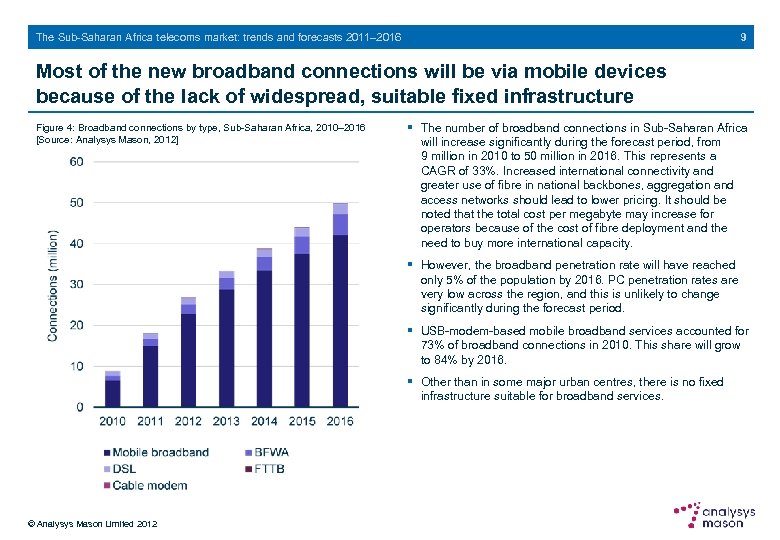
9 The Sub-Saharan Africa telecoms market: trends and forecasts 2011– 2016 Most of the new broadband connections will be via mobile devices because of the lack of widespread, suitable fixed infrastructure Figure 4: Broadband connections by type, Sub-Saharan Africa, 2010– 2016 [Source: Analysys Mason, 2012] § The number of broadband connections in Sub-Saharan Africa will increase significantly during the forecast period, from 9 million in 2010 to 50 million in 2016. This represents a CAGR of 33%. Increased international connectivity and greater use of fibre in national backbones, aggregation and access networks should lead to lower pricing. It should be noted that the total cost per megabyte may increase for operators because of the cost of fibre deployment and the need to buy more international capacity. § However, the broadband penetration rate will have reached only 5% of the population by 2016. PC penetration rates are very low across the region, and this is unlikely to change significantly during the forecast period. § USB-modem-based mobile broadband services accounted for 73% of broadband connections in 2010. This share will grow to 84% by 2016. § Other than in some major urban centres, there is no fixed infrastructure suitable for broadband services. © Analysys Mason Limited 2012
The Sub-Saharan Africa telecoms market: trends and forecasts 2011– 2016 Executive summary Key implications Market definition and methodology Sub-Saharan Africa forecast Country forecasts About the authors and Analysys Mason © Analysys Mason Limited 2012 10
The Sub-Saharan Africa telecoms market: trends and forecasts 2011– 2016 11 Key implications § The mobile markets in Sub-Saharan Africa’s urban areas are approaching saturation, so mobile operators will need to provide services in secondary cities and towns in order to increase subscriber numbers. These newer users will be more price sensitive, making it challenging for operators to achieve attractive ROIs. As a result, mobile operators will be under pressure to reduce their opex and capex. Government-led efforts to make telecoms services more widely available in countries such as Kenya, Nigeria, Tanzania and Uganda will also help to focus efforts away from urban areas. Operators will consider network sharing and outsourcing opportunities as means to reduce their costs. § Mobile operators will need to focus on retaining their high-ARPU customers because newer subscribers have less to spend on telecoms services. In order to capture a larger portion of spend, operators will encourage customers to reduce their use of multiple SIMs. Mobile network operators (MNOs) will be looking for solutions that will support creative customer loyalty schemes. Today, operators mostly use heavily discounted on-net pricing to encourage usage, which has led to high levels of multiple-SIM usage. § Improved network availability and quality will drive increased usage of voice and data services. In the next 2– 3 years, operators will increase network capacity in order to ensure network quality and to fill in coverage gaps, in many cases through network-sharing arrangements. Regulators in Ghana, Kenya, Nigeria and Uganda have been putting significant pressure on operators to increase network quality, and may resort to fining and restricting the commercial activities of operators that do not show sufficient improvement. § Increased international connectivity from new submarine cables should help to reduce broadband pricing. The lighting of the ACE and WACS cables in 2012 should help to reduce operators’ costs and to increase capacity, which should ultimately lead to lower prices for broadband services for end users. However, this effect may take more than 1– 2 years, as indicated by the lack of much movement in broadband pricing since the launch of multiple submarine cables in recent years. Operators will nonetheless also need to focus on reducing costs in national backbones, aggregation and access networks. § Fixed voice services will not be a significant driver of operator revenue. Fixed infrastructure is generally found only in major urban centres in Sub-Saharan Africa, and is often of poor quality. Any new fixed network deployments will be to support backhaul and transport services, rather than voice or broadband services for end users. Telecoms services for non-urban populations will use mobile or fixed–wireless technologies. © Analysys Mason Limited 2012
The Sub-Saharan Africa telecoms market: trends and forecasts 2011– 2016 Executive summary Key implications Market definition and methodology Sub-Saharan Africa forecast Country forecasts About the authors and Analysys Mason © Analysys Mason Limited 2012 12
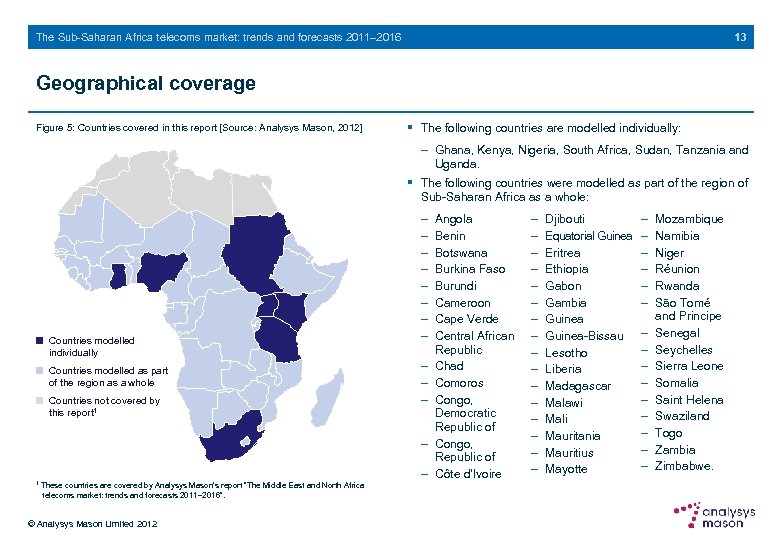
13 The Sub-Saharan Africa telecoms market: trends and forecasts 2011– 2016 Geographical coverage Figure 5: Countries covered in this report [Source: Analysys Mason, 2012] § The following countries are modelled individually: Ghana, Kenya, Nigeria, South Africa, Sudan, Tanzania and Uganda. § The following countries were modelled as part of the region of Sub-Saharan Africa as a whole: ■ Countries modelled individually ■ Countries modelled as part of the region as a whole ■ Countries not covered by this report 1 1 These countries are covered by Analysys Mason’s report “The Middle East and North Africa telecoms market: trends and forecasts 2011– 2016”. © Analysys Mason Limited 2012 Angola Benin Botswana Burkina Faso Burundi Cameroon Cape Verde Central African Republic Chad Comoros Congo, Democratic Republic of Congo, Republic of Côte d'Ivoire Djibouti Equatorial Guinea Eritrea Ethiopia Gabon Gambia Guinea-Bissau Lesotho Liberia Madagascar Malawi Mali Mauritania Mauritius Mayotte Mozambique Namibia Niger Réunion Rwanda São Tomé and Principe Senegal Seychelles Sierra Leone Somalia Saint Helena Swaziland Togo Zambia Zimbabwe.
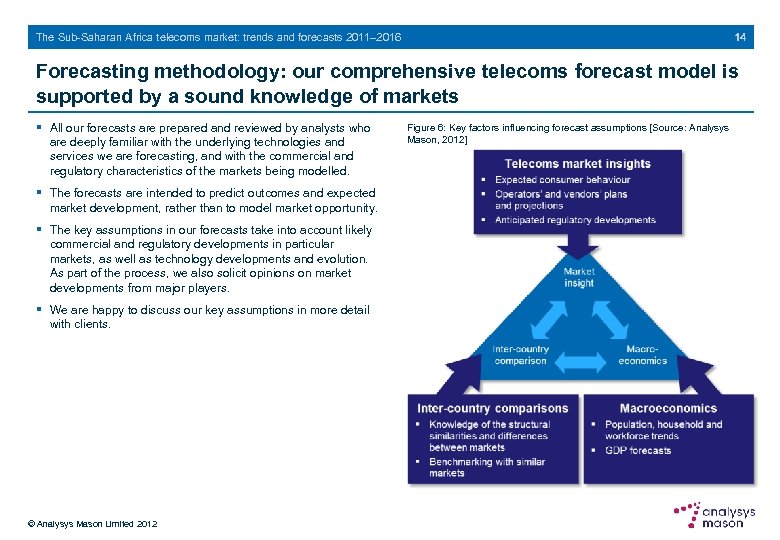
14 The Sub-Saharan Africa telecoms market: trends and forecasts 2011– 2016 Forecasting methodology: our comprehensive telecoms forecast model is supported by a sound knowledge of markets § All our forecasts are prepared and reviewed by analysts who are deeply familiar with the underlying technologies and services we are forecasting, and with the commercial and regulatory characteristics of the markets being modelled. § The forecasts are intended to predict outcomes and expected market development, rather than to model market opportunity. § The key assumptions in our forecasts take into account likely commercial and regulatory developments in particular markets, as well as technology developments and evolution. As part of the process, we also solicit opinions on market developments from major players. § We are happy to discuss our key assumptions in more detail with clients. © Analysys Mason Limited 2012 Figure 6: Key factors influencing forecast assumptions [Source: Analysys Mason, 2012]
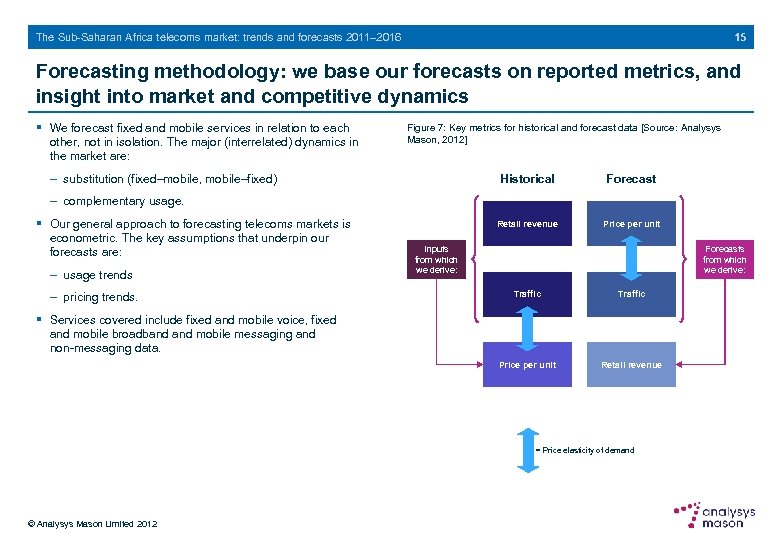
15 The Sub-Saharan Africa telecoms market: trends and forecasts 2011– 2016 Forecasting methodology: we base our forecasts on reported metrics, and insight into market and competitive dynamics § We forecast fixed and mobile services in relation to each other, not in isolation. The major (interrelated) dynamics in the market are: Figure 7: Key metrics for historical and forecast data [Source: Analysys Mason, 2012] substitution (fixed–mobile, mobile–fixed) Historical Forecast Retail revenue Price per unit complementary usage. § Our general approach to forecasting telecoms markets is econometric. The key assumptions that underpin our forecasts are: usage trends pricing trends. Inputs from which we derive: Forecasts from which we derive: Traffic Price per unit Retail revenue § Services covered include fixed and mobile voice, fixed and mobile broadband mobile messaging and non-messaging data. = Price elasticity of demand © Analysys Mason Limited 2012
The Sub-Saharan Africa telecoms market: trends and forecasts 2011– 2016 16 Key forecast assumptions Demographic and economic considerations: § The rising number of more price-sensitive users from outside urban centres will maintain pressure on mobile voice pricing. § The increasing average of the population and rising GDP per capita will expand the size of the addressable market for telecoms services. § Growth in GDP in Sub-Saharan Africa (expected to be faster than that worldwide) will support demand for business network services. Technology considerations: § Operators will expand mobile network coverage, increase capacity and improve quality, partly in response to government initiatives towards universal service, but also as a result of their own need to better support mobile data services. § Increases in international connectivity and fibre availability will help to reduce broadband pricing and increase take-up. This will be reflected mostly in demand for handset data, rather than mobile broadband, given the low PC penetration rates in the region. § LTE roll-outs will not be a factor in most of Sub-Saharan Africa during the forecast period. § Fixed infrastructure will continue to be available only in urban centres, for the most part; new investment in more-rural areas will be to support mobile services, rather than fixed. Commercial considerations: § Fixed voice pricing will be relatively stable because of lack of competition. § Continued demand for fixed voice services from business users will keep the number of fixed voice lines steady during the forecast period. § Consolidation and rationalisation in some mobile markets will mitigate some of the price pressure on mobile voice. © Analysys Mason Limited 2012
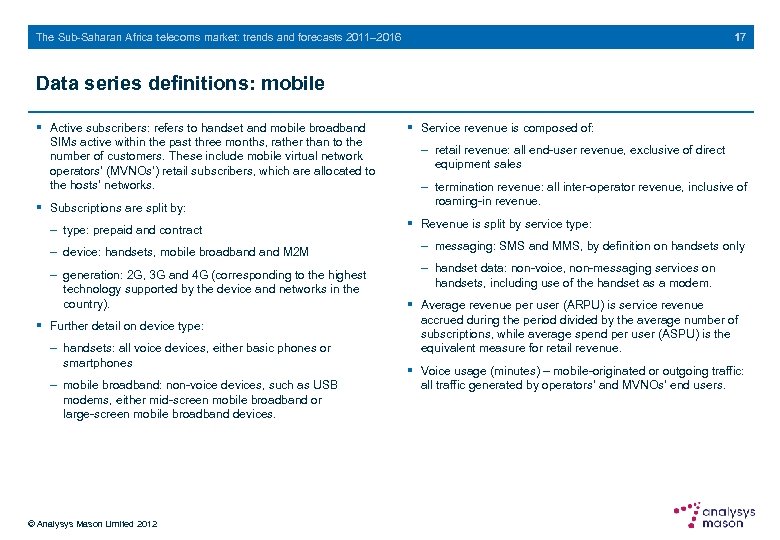
17 The Sub-Saharan Africa telecoms market: trends and forecasts 2011– 2016 Data series definitions: mobile § Active subscribers: refers to handset and mobile broadband SIMs active within the past three months, rather than to the number of customers. These include mobile virtual network operators’ (MVNOs’) retail subscribers, which are allocated to the hosts’ networks. § Subscriptions are split by: type: prepaid and contract device: handsets, mobile broadband M 2 M generation: 2 G, 3 G and 4 G (corresponding to the highest technology supported by the device and networks in the country). § Further detail on device type: handsets: all voice devices, either basic phones or smartphones mobile broadband: non-voice devices, such as USB modems, either mid-screen mobile broadband or large-screen mobile broadband devices. © Analysys Mason Limited 2012 § Service revenue is composed of: retail revenue: all end-user revenue, exclusive of direct equipment sales termination revenue: all inter-operator revenue, inclusive of roaming-in revenue. § Revenue is split by service type: messaging: SMS and MMS, by definition on handsets only handset data: non-voice, non-messaging services on handsets, including use of the handset as a modem. bil § Average revenue per user (ARPU) is service revenue accrued during the period divided by the average number of subscriptions, while average spend per user (ASPU) is the equivalent measure for retail revenue. § Voice usage (minutes) – mobile-originated or outgoing traffic: all traffic generated by operators’ and MVNOs’ end users.
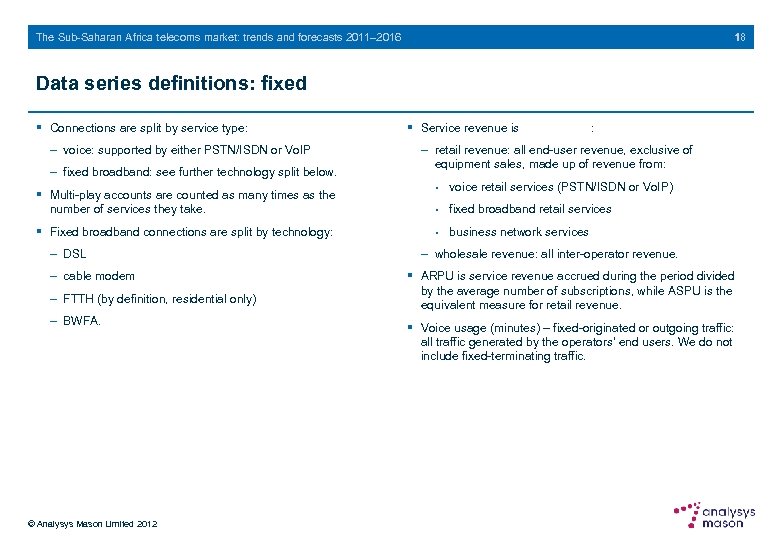
18 The Sub-Saharan Africa telecoms market: trends and forecasts 2011– 2016 Data series definitions: fixed § Connections are split by service type: voice: supported by either PSTN/ISDN or Vo. IP fixed broadband: see further technology split below. § Multi-play accounts are counted as many times as the number of services they take. § Fixed broadband connections are split by technology: DSL cable modem FTTH (by definition, residential only) BWFA. © Analysys Mason Limited 2012 § Service revenue is composed of: retail revenue: all end-user revenue, exclusive of equipment sales, made up of revenue from: § voice retail services (PSTN/ISDN or Vo. IP) § fixed broadband retail services § business network services wholesale revenue: all inter-operator revenue. § ARPU is service revenue accrued during the period divided by the average number of subscriptions, while ASPU is the equivalent measure for retail revenue. § Voice usage (minutes) – fixed-originated or outgoing traffic: all traffic generated by the operators’ end users. We do not include fixed-terminating traffic.
The Sub-Saharan Africa telecoms market: trends and forecasts 2011– 2016 Executive summary Key implications Market definition and methodology Sub-Saharan Africa forecast Country forecasts About the authors and Analysys Mason © Analysys Mason Limited 2012 19
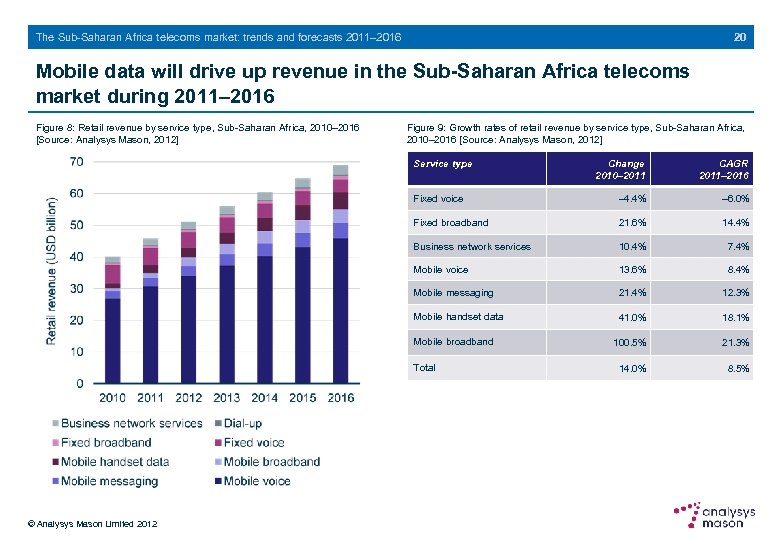
20 The Sub-Saharan Africa telecoms market: trends and forecasts 2011– 2016 Mobile data will drive up revenue in the Sub-Saharan Africa telecoms market during 2011– 2016 Figure 8: Retail revenue by service type, Sub-Saharan Africa, 2010– 2016 [Source: Analysys Mason, 2012] Figure 9: Growth rates of retail revenue by service type, Sub-Saharan Africa, 2010– 2016 [Source: Analysys Mason, 2012] Service type Change 2010– 2011 CAGR 2011– 2016 Fixed voice – 4. 4% – 6. 0% Fixed broadband 21. 6% 14. 4% Business network services 10. 4% 7. 4% Mobile voice 13. 6% 8. 4% Mobile messaging 21. 4% 12. 3% Mobile handset data 41. 0% 18. 1% 100. 5% 21. 3% 14. 0% 8. 5% Mobile broadband Total © Analysys Mason Limited 2012
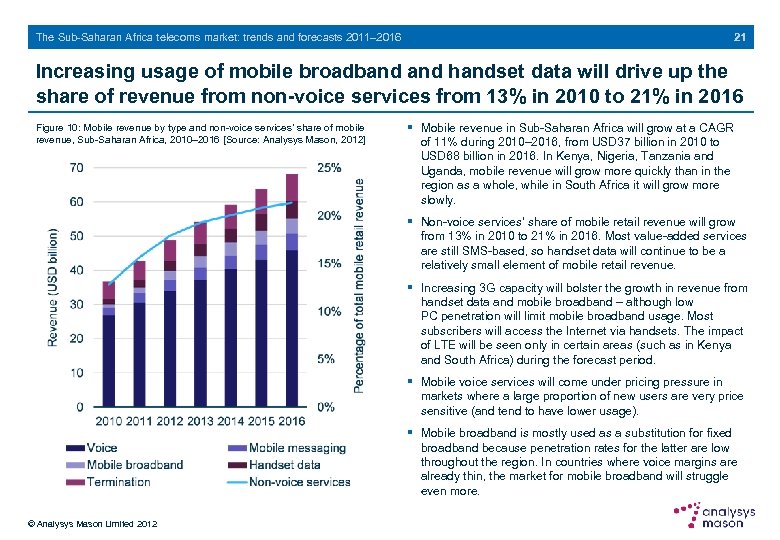
The Sub-Saharan Africa telecoms market: trends and forecasts 2011– 2016 21 Increasing usage of mobile broadband handset data will drive up the share of revenue from non-voice services from 13% in 2010 to 21% in 2016 Figure 10: Mobile revenue by type and non-voice services’ share of mobile revenue, Sub-Saharan Africa, 2010– 2016 [Source: Analysys Mason, 2012] § Mobile revenue in Sub-Saharan Africa will grow at a CAGR of 11% during 2010– 2016, from USD 37 billion in 2010 to USD 68 billion in 2016. In Kenya, Nigeria, Tanzania and Uganda, mobile revenue will grow more quickly than in the region as a whole, while in South Africa it will grow more slowly. § Non-voice services’ share of mobile retail revenue will grow from 13% in 2010 to 21% in 2016. Most value-added services are still SMS-based, so handset data will continue to be a relatively small element of mobile retail revenue. § Increasing 3 G capacity will bolster the growth in revenue from handset data and mobile broadband – although low PC penetration will limit mobile broadband usage. Most subscribers will access the Internet via handsets. The impact of LTE will be seen only in certain areas (such as in Kenya and South Africa) during the forecast period. § Mobile voice services will come under pricing pressure in markets where a large proportion of new users are very price sensitive (and tend to have lower usage). § Mobile broadband is mostly used as a substitution for fixed broadband because penetration rates for the latter are low throughout the region. In countries where voice margins are already thin, the market for mobile broadband will struggle even more. © Analysys Mason Limited 2012
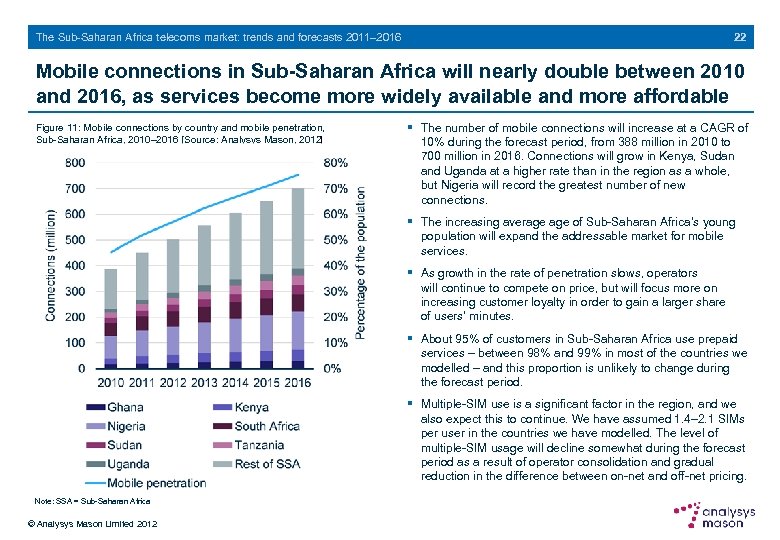
22 The Sub-Saharan Africa telecoms market: trends and forecasts 2011– 2016 Mobile connections in Sub-Saharan Africa will nearly double between 2010 and 2016, as services become more widely available and more affordable Figure 11: Mobile connections by country and mobile penetration, Sub-Saharan Africa, 2010– 2016 [Source: Analysys Mason, 2012] § The number of mobile connections will increase at a CAGR of 10% during the forecast period, from 388 million in 2010 to 700 million in 2016. Connections will grow in Kenya, Sudan and Uganda at a higher rate than in the region as a whole, but Nigeria will record the greatest number of new connections. § The increasing average of Sub-Saharan Africa’s young population will expand the addressable market for mobile services. § As growth in the rate of penetration slows, operators will continue to compete on price, but will focus more on increasing customer loyalty in order to gain a larger share of users’ minutes. § About 95% of customers in Sub-Saharan Africa use prepaid services – between 98% and 99% in most of the countries we modelled – and this proportion is unlikely to change during the forecast period. § Multiple-SIM use is a significant factor in the region, and we also expect this to continue. We have assumed 1. 4– 2. 1 SIMs per user in the countries we have modelled. The level of multiple-SIM usage will decline somewhat during the forecast period as a result of operator consolidation and gradual reduction in the difference between on-net and off-net pricing. Note: SSA = Sub-Saharan Africa © Analysys Mason Limited 2012
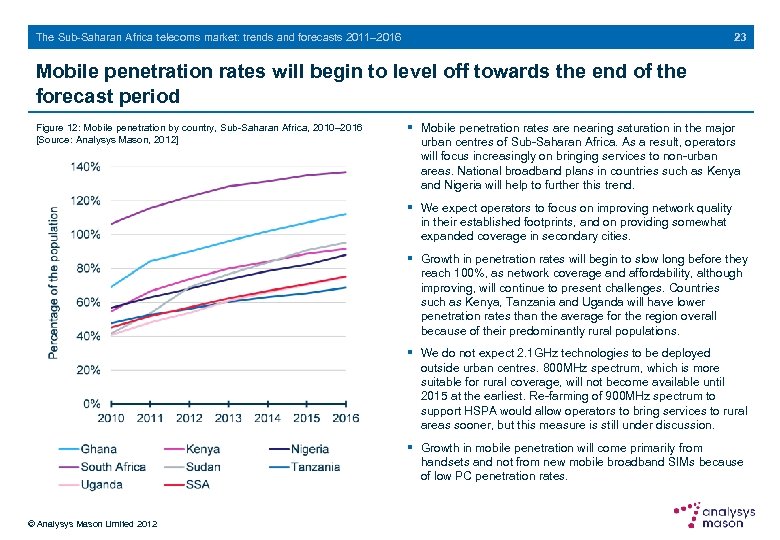
23 The Sub-Saharan Africa telecoms market: trends and forecasts 2011– 2016 Mobile penetration rates will begin to level off towards the end of the forecast period Figure 12: Mobile penetration by country, Sub-Saharan Africa, 2010– 2016 [Source: Analysys Mason, 2012] § Mobile penetration rates are nearing saturation in the major urban centres of Sub-Saharan Africa. As a result, operators will focus increasingly on bringing services to non-urban areas. National broadband plans in countries such as Kenya and Nigeria will help to further this trend. § We expect operators to focus on improving network quality in their established footprints, and on providing somewhat expanded coverage in secondary cities. § Growth in penetration rates will begin to slow long before they reach 100%, as network coverage and affordability, although improving, will continue to present challenges. Countries such as Kenya, Tanzania and Uganda will have lower penetration rates than the average for the region overall because of their predominantly rural populations. § We do not expect 2. 1 GHz technologies to be deployed outside urban centres. 800 MHz spectrum, which is more suitable for rural coverage, will not become available until 2015 at the earliest. Re-farming of 900 MHz spectrum to support HSPA would allow operators to bring services to rural areas sooner, but this measure is still under discussion. § Growth in mobile penetration will come primarily from handsets and not from new mobile broadband SIMs because of low PC penetration rates. © Analysys Mason Limited 2012
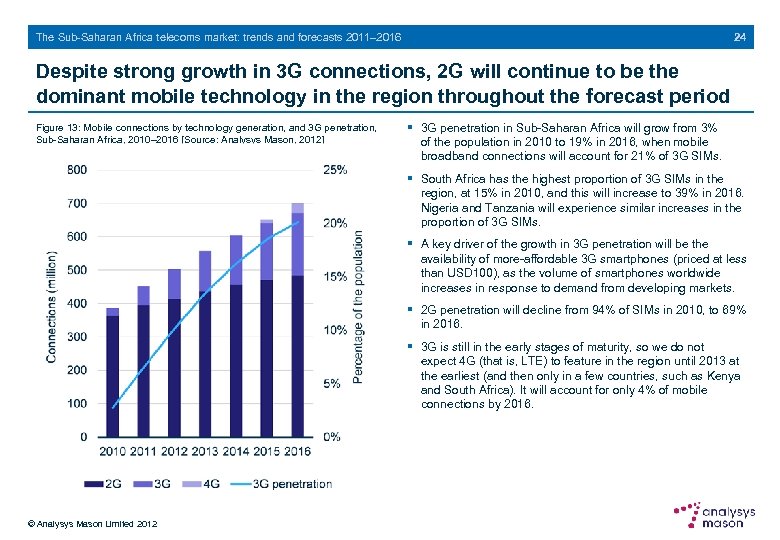
24 The Sub-Saharan Africa telecoms market: trends and forecasts 2011– 2016 Despite strong growth in 3 G connections, 2 G will continue to be the dominant mobile technology in the region throughout the forecast period Figure 13: Mobile connections by technology generation, and 3 G penetration, Sub-Saharan Africa, 2010– 2016 [Source: Analysys Mason, 2012] § 3 G penetration in Sub-Saharan Africa will grow from 3% of the population in 2010 to 19% in 2016, when mobile broadband connections will account for 21% of 3 G SIMs. § South Africa has the highest proportion of 3 G SIMs in the region, at 15% in 2010, and this will increase to 39% in 2016. Nigeria and Tanzania will experience similar increases in the proportion of 3 G SIMs. § A key driver of the growth in 3 G penetration will be the availability of more-affordable 3 G smartphones (priced at less than USD 100), as the volume of smartphones worldwide increases in response to demand from developing markets. § 2 G penetration will decline from 94% of SIMs in 2010, to 69% in 2016. § 3 G is still in the early stages of maturity, so we do not expect 4 G (that is, LTE) to feature in the region until 2013 at the earliest (and then only in a few countries, such as Kenya and South Africa). It will account for only 4% of mobile connections by 2016. © Analysys Mason Limited 2012
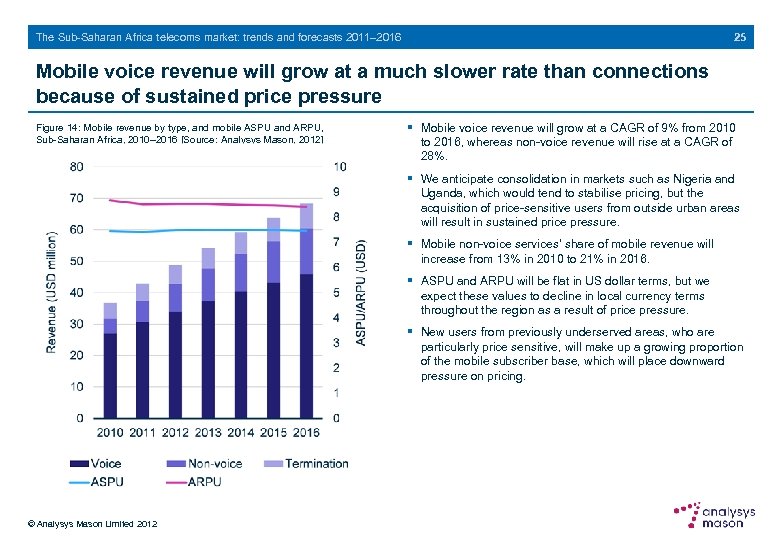
25 The Sub-Saharan Africa telecoms market: trends and forecasts 2011– 2016 Mobile voice revenue will grow at a much slower rate than connections because of sustained price pressure Figure 14: Mobile revenue by type, and mobile ASPU and ARPU, Sub-Saharan Africa‚ 2010– 2016 [Source: Analysys Mason, 2012] § Mobile voice revenue will grow at a CAGR of 9% from 2010 to 2016, whereas non-voice revenue will rise at a CAGR of 28%. § We anticipate consolidation in markets such as Nigeria and Uganda, which would tend to stabilise pricing, but the acquisition of price-sensitive users from outside urban areas will result in sustained price pressure. § Mobile non-voice services’ share of mobile revenue will increase from 13% in 2010 to 21% in 2016. § ASPU and ARPU will be flat in US dollar terms, but we expect these values to decline in local currency terms throughout the region as a result of price pressure. § New users from previously underserved areas, who are particularly price sensitive, will make up a growing proportion of the mobile subscriber base, which will place downward pressure on pricing. © Analysys Mason Limited 2012
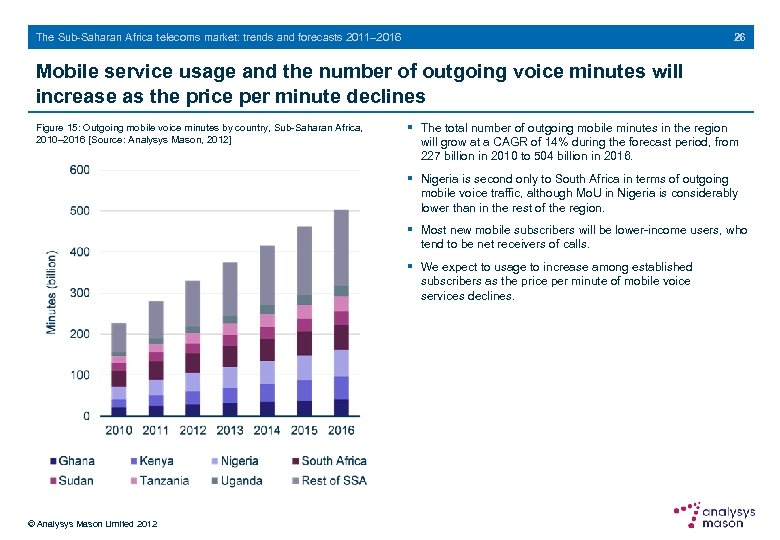
26 The Sub-Saharan Africa telecoms market: trends and forecasts 2011– 2016 Mobile service usage and the number of outgoing voice minutes will increase as the price per minute declines Figure 15: Outgoing mobile voice minutes by country, Sub-Saharan Africa, 2010– 2016 [Source: Analysys Mason, 2012] § The total number of outgoing mobile minutes in the region will grow at a CAGR of 14% during the forecast period, from 227 billion in 2010 to 504 billion in 2016. § Nigeria is second only to South Africa in terms of outgoing mobile voice traffic, although Mo. U in Nigeria is considerably lower than in the rest of the region. § Most new mobile subscribers will be lower-income users, who tend to be net receivers of calls. § We expect to usage to increase among established subscribers as the price per minute of mobile voice services declines. © Analysys Mason Limited 2012
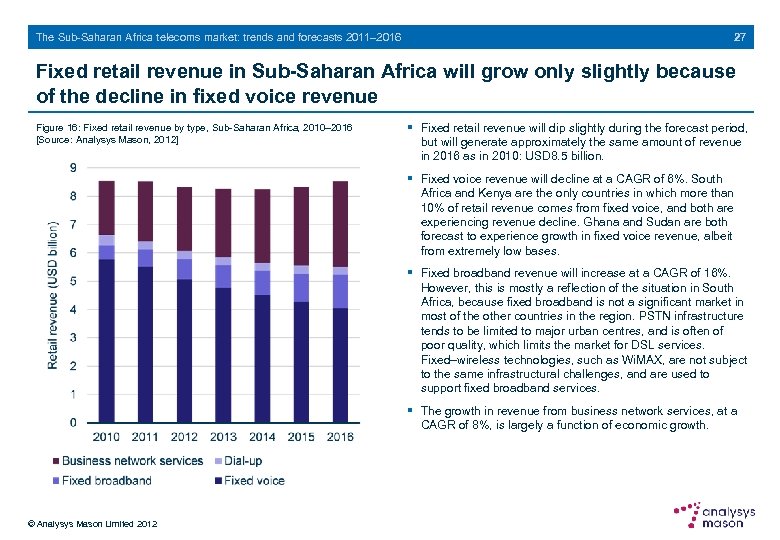
The Sub-Saharan Africa telecoms market: trends and forecasts 2011– 2016 27 Fixed retail revenue in Sub-Saharan Africa will grow only slightly because of the decline in fixed voice revenue Figure 16: Fixed retail revenue by type, Sub-Saharan Africa, 2010– 2016 [Source: Analysys Mason, 2012] § Fixed retail revenue will dip slightly during the forecast period, but will generate approximately the same amount of revenue in 2016 as in 2010: USD 8. 5 billion. § Fixed voice revenue will decline at a CAGR of 6%. South Africa and Kenya are the only countries in which more than 10% of retail revenue comes from fixed voice, and both are experiencing revenue decline. Ghana and Sudan are both forecast to experience growth in fixed voice revenue, albeit from extremely low bases. § Fixed broadband revenue will increase at a CAGR of 16%. However, this is mostly a reflection of the situation in South Africa, because fixed broadband is not a significant market in most of the other countries in the region. PSTN infrastructure tends to be limited to major urban centres, and is often of poor quality, which limits the market for DSL services. Fixed–wireless technologies, such as Wi. MAX, are not subject to the same infrastructural challenges, and are used to support fixed broadband services. § The growth in revenue from business network services, at a CAGR of 8%, is largely a function of economic growth. © Analysys Mason Limited 2012
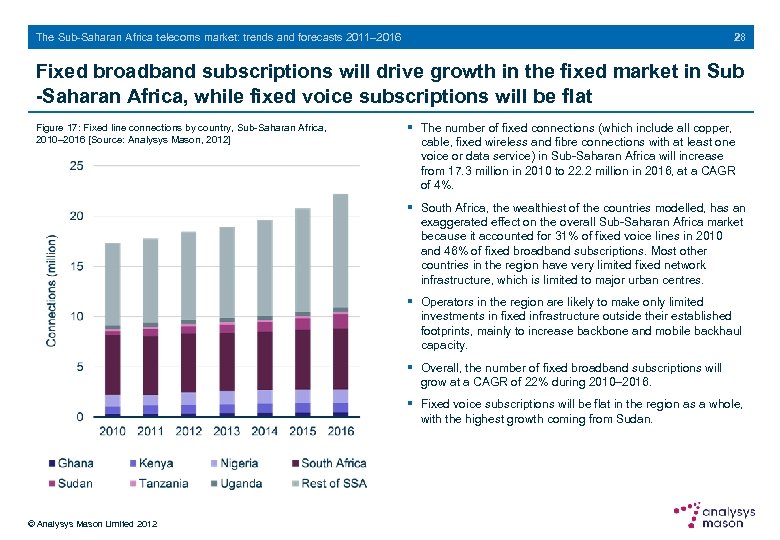
28 The Sub-Saharan Africa telecoms market: trends and forecasts 2011– 2016 Fixed broadband subscriptions will drive growth in the fixed market in Sub -Saharan Africa, while fixed voice subscriptions will be flat Figure 17: Fixed line connections by country, Sub-Saharan Africa, 2010– 2016 [Source: Analysys Mason, 2012] § The number of fixed connections (which include all copper, cable, fixed wireless and fibre connections with at least one voice or data service) in Sub-Saharan Africa will increase from 17. 3 million in 2010 to 22. 2 million in 2016, at a CAGR of 4%. § South Africa, the wealthiest of the countries modelled, has an exaggerated effect on the overall Sub-Saharan Africa market because it accounted for 31% of fixed voice lines in 2010 and 46% of fixed broadband subscriptions. Most other countries in the region have very limited fixed network infrastructure, which is limited to major urban centres. § Operators in the region are likely to make only limited investments in fixed infrastructure outside their established footprints, mainly to increase backbone and mobile backhaul capacity. § Overall, the number of fixed broadband subscriptions will grow at a CAGR of 22% during 2010– 2016. § Fixed voice subscriptions will be flat in the region as a whole, with the highest growth coming from Sudan. © Analysys Mason Limited 2012
The Sub-Saharan Africa telecoms market: trends and forecasts 2011– 2016 Executive summary Key implications Market definition and methodology Sub-Saharan Africa forecast Country forecasts About the authors and Analysys Mason © Analysys Mason Limited 2012 29
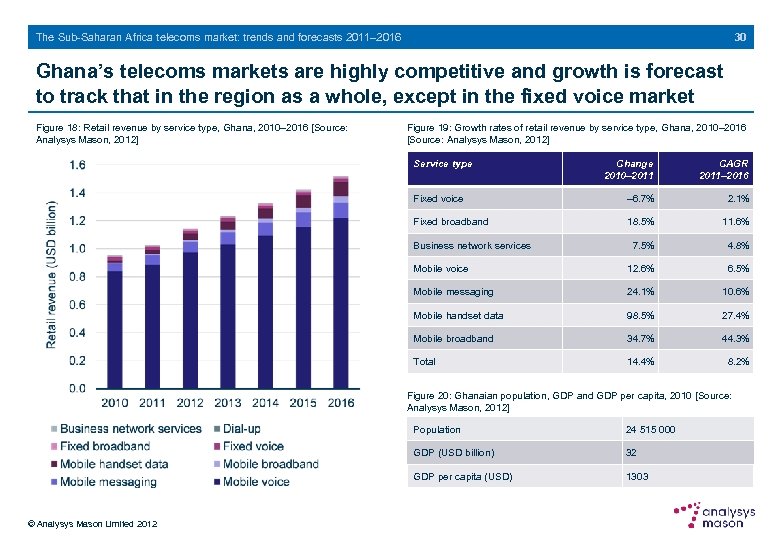
30 The Sub-Saharan Africa telecoms market: trends and forecasts 2011– 2016 Ghana’s telecoms markets are highly competitive and growth is forecast to track that in the region as a whole, except in the fixed voice market Figure 18: Retail revenue by service type, Ghana, 2010– 2016 [Source: Analysys Mason, 2012] Figure 19: Growth rates of retail revenue by service type, Ghana, 2010– 2016 [Source: Analysys Mason, 2012] Service type Change 2010– 2011 CAGR 2011– 2016 Fixed voice – 6. 7% 2. 1% Fixed broadband 18. 5% 11. 6% 7. 5% 4. 8% Mobile voice 12. 6% 6. 5% Mobile messaging 24. 1% 10. 6% Mobile handset data 98. 5% 27. 4% Mobile broadband 34. 7% 44. 3% Total 14. 4% 8. 2% Business network services Figure 20: Ghanaian population, GDP and GDP per capita, 2010 [Source: Analysys Mason, 2012] Population GDP (USD billion) 32 GDP per capita (USD) © Analysys Mason Limited 2012 24 515 000 1303
31 The Sub-Saharan Africa telecoms market: trends and forecasts 2011– 2016 Ghana’s mobile market will benefit from additional spectrum and more competition Mobile market Fixed market § More spectrum will become available during the forecast period to relieve congestion and better support mobile data services. Ghana’s telecoms regulator says that digital dividend spectrum will be released in 2013 – earlier than the original target of 2014 – but we do not anticipate that LTE will become available before 2015. The regulator may also revoke unused licences and re-allocate the spectrum released. § The fixed voice market will stabilise and show slight growth, as Airtel and Vodafone compete against fixed–wireless operators. § Dilution of ARPU will continue, and increasing usage will not be able to offset the decline in prices. The rate of ARPU decline will accelerate as more low-income subscribers adopt mobile services. § Globacom (Glo) was due to launch services in Ghana in January 2012 and will be aggressive on price in order to gain market share quickly. It has already begun a campaign to allow people to reserve Glo phone numbers, and has painted some low-income neighbourhoods green as a marketing ploy. § SIM penetration is expected to reach 100% by population in 2016. However, multiple-SIM usage is high in Ghana (each user has about 1. 8 SIMs), so the actual penetration rate is 54%. § The government is proposing tax incentives and tax holidays for network operators that are willing and able to deploy voice and data services in rural Ghana. © Analysys Mason Limited 2012 § The fixed broadband market will continue to be limited because of low PC penetration and lack of widespread suitable fixed network infrastructure.
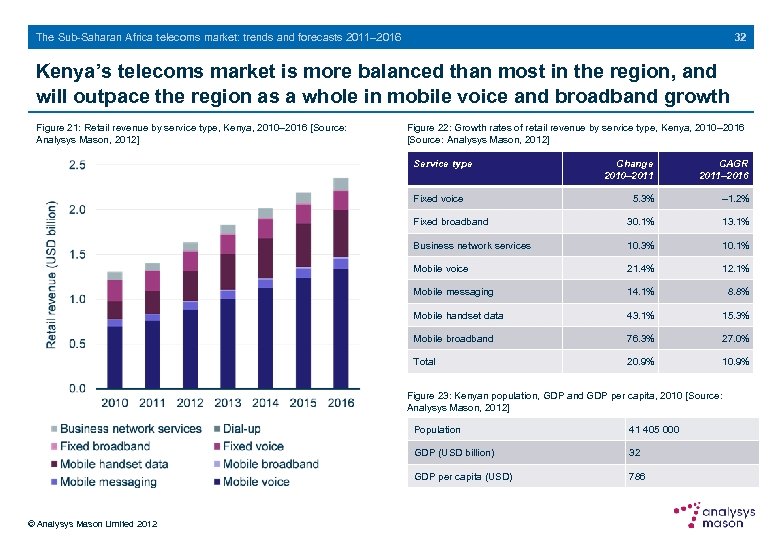
32 The Sub-Saharan Africa telecoms market: trends and forecasts 2011– 2016 Kenya’s telecoms market is more balanced than most in the region, and will outpace the region as a whole in mobile voice and broadband growth Figure 21: Retail revenue by service type, Kenya, 2010– 2016 [Source: Analysys Mason, 2012] Figure 22: Growth rates of retail revenue by service type, Kenya, 2010– 2016 [Source: Analysys Mason, 2012] Service type Change 2010– 2011 CAGR 2011– 2016 5. 3% – 1. 2% Fixed broadband 30. 1% 13. 1% Business network services 10. 3% 10. 1% Mobile voice 21. 4% 12. 1% Mobile messaging 14. 1% 8. 8% Mobile handset data 43. 1% 15. 3% Mobile broadband 76. 3% 27. 0% Total 20. 9% 10. 9% Fixed voice Figure 23: Kenyan population, GDP and GDP per capita, 2010 [Source: Analysys Mason, 2012] Population GDP (USD billion) 32 GDP per capita (USD) © Analysys Mason Limited 2012 41 405 000 786
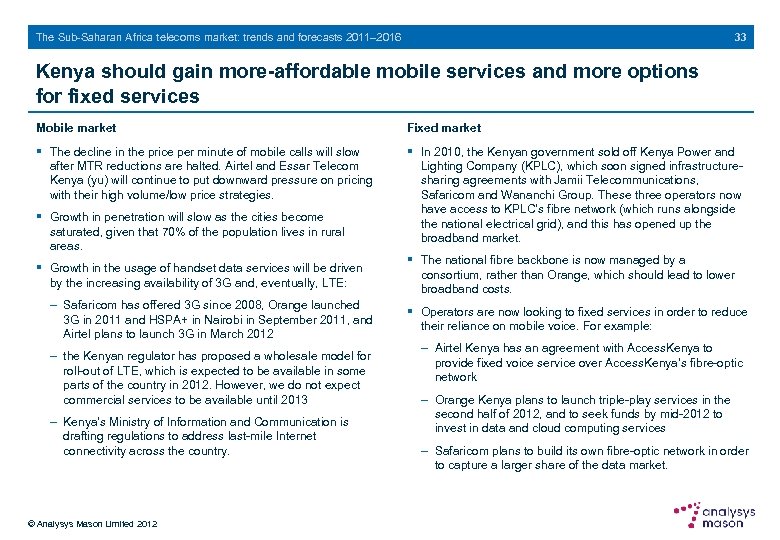
33 The Sub-Saharan Africa telecoms market: trends and forecasts 2011– 2016 Kenya should gain more-affordable mobile services and more options for fixed services Mobile market Fixed market § The decline in the price per minute of mobile calls will slow after MTR reductions are halted. Airtel and Essar Telecom Kenya (yu) will continue to put downward pressure on pricing with their high volume/low price strategies. § In 2010, the Kenyan government sold off Kenya Power and Lighting Company (KPLC), which soon signed infrastructuresharing agreements with Jamii Telecommunications, Safaricom and Wananchi Group. These three operators now have access to KPLC’s fibre network (which runs alongside the national electrical grid), and this has opened up the broadband market. § Growth in penetration will slow as the cities become saturated, given that 70% of the population lives in rural areas. § Growth in the usage of handset data services will be driven by the increasing availability of 3 G and, eventually, LTE: Safaricom has offered 3 G since 2008, Orange launched 3 G in 2011 and HSPA+ in Nairobi in September 2011, and Airtel plans to launch 3 G in March 2012 the Kenyan regulator has proposed a wholesale model for roll-out of LTE, which is expected to be available in some parts of the country in 2012. However, we do not expect commercial services to be available until 2013 Kenya's Ministry of Information and Communication is drafting regulations to address last-mile Internet connectivity across the country. © Analysys Mason Limited 2012 § The national fibre backbone is now managed by a consortium, rather than Orange, which should lead to lower broadband costs. § Operators are now looking to fixed services in order to reduce their reliance on mobile voice. For example: Airtel Kenya has an agreement with Access. Kenya to provide fixed voice service over Access. Kenya’s fibre-optic network Orange Kenya plans to launch triple-play services in the second half of 2012, and to seek funds by mid-2012 to invest in data and cloud computing services Safaricom plans to build its own fibre-optic network in order to capture a larger share of the data market.
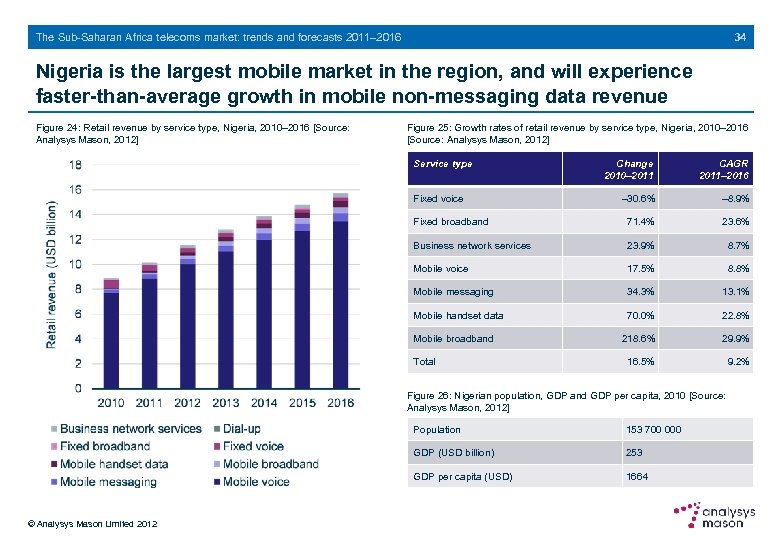
34 The Sub-Saharan Africa telecoms market: trends and forecasts 2011– 2016 Nigeria is the largest mobile market in the region, and will experience faster-than-average growth in mobile non-messaging data revenue Figure 24: Retail revenue by service type, Nigeria, 2010– 2016 [Source: Analysys Mason, 2012] Figure 25: Growth rates of retail revenue by service type, Nigeria, 2010– 2016 [Source: Analysys Mason, 2012] Service type Change 2010– 2011 CAGR 2011– 2016 – 30. 6% – 8. 9% Fixed broadband 71. 4% 23. 6% Business network services 23. 9% 8. 7% Mobile voice 17. 5% 8. 8% Mobile messaging 34. 3% 13. 1% Mobile handset data 70. 0% 22. 8% 218. 6% 29. 9% 16. 5% 9. 2% Fixed voice Mobile broadband Total Figure 26: Nigerian population, GDP and GDP per capita, 2010 [Source: Analysys Mason, 2012] Population GDP (USD billion) 253 GDP per capita (USD) © Analysys Mason Limited 2012 153 700 000 1664
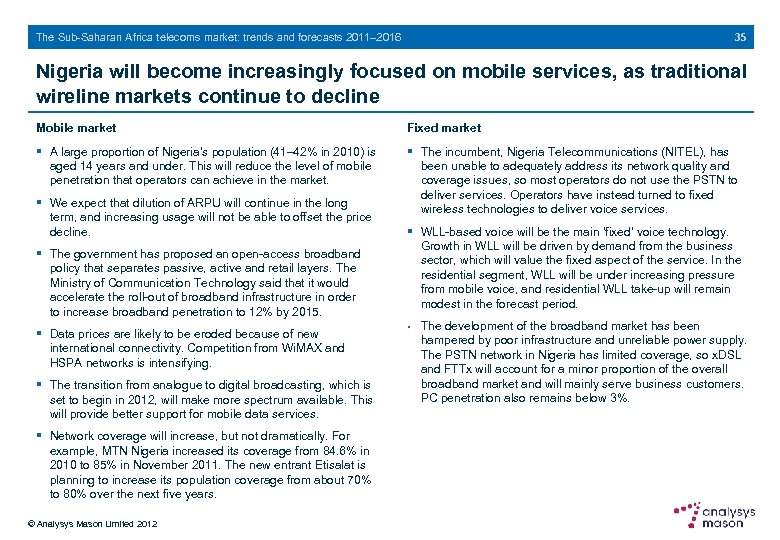
35 The Sub-Saharan Africa telecoms market: trends and forecasts 2011– 2016 Nigeria will become increasingly focused on mobile services, as traditional wireline markets continue to decline Mobile market Fixed market § A large proportion of Nigeria’s population (41– 42% in 2010) is aged 14 years and under. This will reduce the level of mobile penetration that operators can achieve in the market. § The incumbent, Nigeria Telecommunications (NITEL), has been unable to adequately address its network quality and coverage issues, so most operators do not use the PSTN to deliver services. Operators have instead turned to fixed wireless technologies to deliver voice services. § We expect that dilution of ARPU will continue in the long term, and increasing usage will not be able to offset the price decline. § The government has proposed an open-access broadband policy that separates passive, active and retail layers. The Ministry of Communication Technology said that it would accelerate the roll-out of broadband infrastructure in order to increase broadband penetration to 12% by 2015. § Data prices are likely to be eroded because of new international connectivity. Competition from Wi. MAX and HSPA networks is intensifying. § The transition from analogue to digital broadcasting, which is set to begin in 2012, will make more spectrum available. This will provide better support for mobile data services. § Network coverage will increase, but not dramatically. For example, MTN Nigeria increased its coverage from 84. 6% in 2010 to 85% in November 2011. The new entrant Etisalat is planning to increase its population coverage from about 70% to 80% over the next five years. © Analysys Mason Limited 2012 § WLL-based voice will be the main ‘fixed’ voice technology. Growth in WLL will be driven by demand from the business sector, which will value the fixed aspect of the service. In the residential segment, WLL will be under increasing pressure from mobile voice, and residential WLL take-up will remain modest in the forecast period. § The development of the broadband market has been hampered by poor infrastructure and unreliable power supply. The PSTN network in Nigeria has limited coverage, so x. DSL and FTTx will account for a minor proportion of the overall broadband market and will mainly serve business customers. PC penetration also remains below 3%.
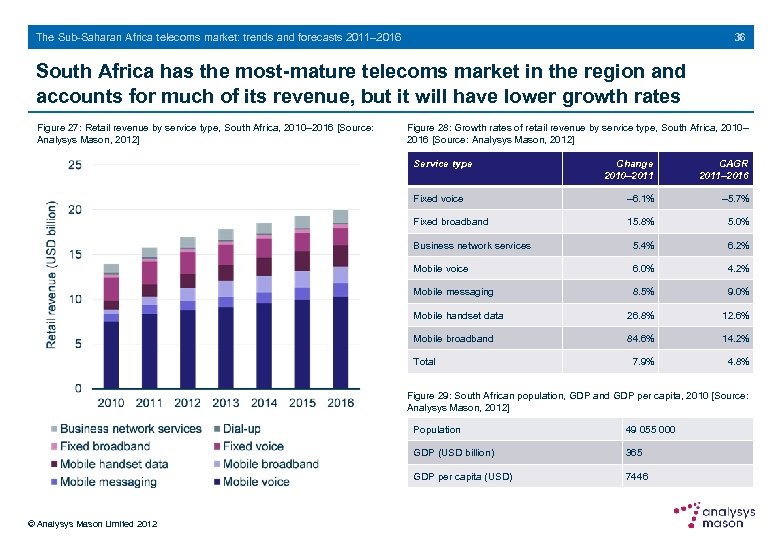
36 The Sub-Saharan Africa telecoms market: trends and forecasts 2011– 2016 South Africa has the most-mature telecoms market in the region and accounts for much of its revenue, but it will have lower growth rates Figure 27: Retail revenue by service type, South Africa, 2010– 2016 [Source: Analysys Mason, 2012] Figure 28: Growth rates of retail revenue by service type, South Africa, 2010– 2016 [Source: Analysys Mason, 2012] Service type Change 2010– 2011 CAGR 2011– 2016 Fixed voice – 6. 1% – 5. 7% Fixed broadband 15. 8% 5. 0% Business network services 5. 4% 6. 2% Mobile voice 6. 0% 4. 2% Mobile messaging 8. 5% 9. 0% Mobile handset data 26. 8% 12. 6% Mobile broadband 84. 6% 14. 2% 7. 9% 4. 8% Total Figure 29: South African population, GDP and GDP per capita, 2010 [Source: Analysys Mason, 2012] Population GDP (USD billion) 365 GDP per capita (USD) © Analysys Mason Limited 2012 49 055 000 7446
37 The Sub-Saharan Africa telecoms market: trends and forecasts 2011– 2016 South Africa should experience greater mobile data usage and greater fibre availability Mobile market Fixed market § Vodacom, MTN and Cell C all have advanced HSPA+ mobile networks and have been pricing mobile broadband services aggressively. § Local loop unbundling issues should be resolved in 2012. This will affect fixed broadband more than fixed voice. MWEB has launched a social media campaign to pressurise Telkom SA into separating voice and data services and to provide ‘naked ADSL’. § We expect Cell C and 8 ta to continue to be aggressive on price, and that 8 ta will also offer fixed–mobile bundles. Operators have not yet reduced prices, despite the introduction of lower MTRs. § Awards of 800 MHz and 2. 6 GHz spectrum for LTE are planned for 2012, including awards to at least two, and possibly three, new operators and to two wholesale mobile broadband operators. However, operators are only expected to launch LTE services in urban centers. Cell C, 8 ta and MTN are currently running LTE trials. § MTN and Vodacom announced spending plans in late 2011. Vodacom will focus on improving network stability and upgrading, while MTN plans to increase the number of 3 G base stations to help to support its goal of doubling its data revenue over the next four years. § ACE and WACS cables, which are planned to come online in 2012, will help to reduce broadband costs. Increasing the number of wholesale capacity providers (backbone and metro) will also help to reduce these costs. © Analysys Mason Limited 2012 § Operators are moving to increase fixed broadband speeds. For example: Internet Solutions is currently running trials of a fibre-to-the-home (FTTH) network solution Telkom SA plans to increase its broadband speeds to 40 Mbps by 2015 and to raise introductory speeds to 2 Mbps. § MTN is investing in and expanding partnerships for fibre connectivity, including agreements with Metrofibre Networx, Neotel and Telkom SA. Other operators with networks that may allow for deployment of fibre-based services to enterprises and consumers include Dark Fibre Africa, BWIRED and Dartcom.
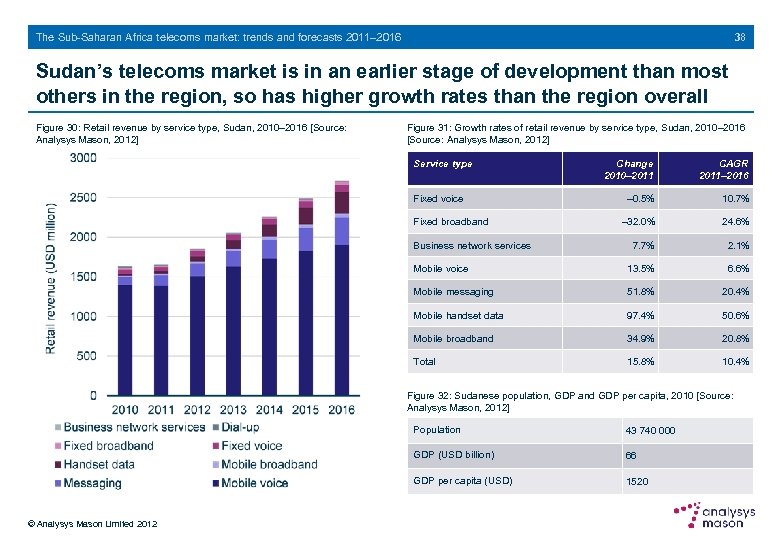
38 The Sub-Saharan Africa telecoms market: trends and forecasts 2011– 2016 Sudan’s telecoms market is in an earlier stage of development than most others in the region, so has higher growth rates than the region overall Figure 30: Retail revenue by service type, Sudan, 2010– 2016 [Source: Analysys Mason, 2012] Figure 31: Growth rates of retail revenue by service type, Sudan, 2010– 2016 [Source: Analysys Mason, 2012] Service type Change 2010– 2011 CAGR 2011– 2016 – 0. 5% 10. 7% – 32. 0% 24. 6% 7. 7% 2. 1% Mobile voice 13. 5% 6. 6% Mobile messaging 51. 8% 20. 4% Mobile handset data 97. 4% 50. 6% Mobile broadband 34. 9% 20. 8% Total 15. 8% 10. 4% Fixed voice Fixed broadband Business network services Figure 32: Sudanese population, GDP and GDP per capita, 2010 [Source: Analysys Mason, 2012] Population GDP (USD billion) 66 GDP per capita (USD) © Analysys Mason Limited 2012 43 740 000 1520
39 The Sub-Saharan Africa telecoms market: trends and forecasts 2011– 2016 Sudan will benefit from greater mobile network coverage and continued growth in services based on fixed–wireless technology Mobile market Fixed market § No new licences are anticipated (at least in the north). Canar Telecommunication wants one, but the regulator has not indicated that there will be any awards. § The PSTN network in Sudan has very limited coverage and is available only in the main cities. As a result, we expect the trend towards fixed–mobile substitution of voice services to continue. § All operators are currently rolling out mobile networks in populated regions that have previously had poor network coverage (such as Darfur). § DSL is the only mode of access to fixed broadband in Sudan, and is limited to the main cities. § Much of the growth will come from low-value subscribers as services become affordable, but strong growth from business segments should be expected. § Vo. IP is illegal. FWT is becoming the dominant access technology and accounted for 84% of Thabit’s fixed lines in 2010. § As penetration increases, ARPU will quickly be eroded because of the adoption of mobile services by low-income subscribers. In the short term, we assume that market competition will force a downward movement in unit prices that will not be compensated for by a commensurate increase in usage. However, in the long term, dilution of ARPU will continue, and increasing usage will not be able to offset the decline in prices. § Given the poor infrastructure, the low penetration and the trend towards fixed–mobile substitution, it is unlikely that either MTN or Zain will enter the fixed market. © Analysys Mason Limited 2012 § Growth in the number of fixed–wireless subscribers has arrested the decline in fixed-line numbers.
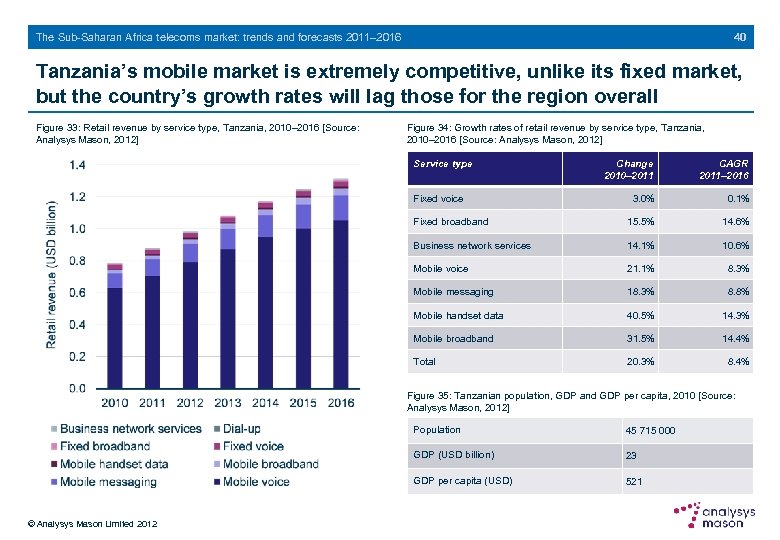
40 The Sub-Saharan Africa telecoms market: trends and forecasts 2011– 2016 Tanzania’s mobile market is extremely competitive, unlike its fixed market, but the country’s growth rates will lag those for the region overall Figure 33: Retail revenue by service type, Tanzania, 2010– 2016 [Source: Analysys Mason, 2012] Figure 34: Growth rates of retail revenue by service type, Tanzania, 2010– 2016 [Source: Analysys Mason, 2012] Service type Change 2010– 2011 CAGR 2011– 2016 3. 0% 0. 1% Fixed broadband 15. 5% 14. 6% Business network services 14. 1% 10. 6% Mobile voice 21. 1% 8. 3% Mobile messaging 18. 3% 8. 8% Mobile handset data 40. 5% 14. 3% Mobile broadband 31. 5% 14. 4% Total 20. 3% 8. 4% Fixed voice Figure 35: Tanzanian population, GDP and GDP per capita, 2010 [Source: Analysys Mason, 2012] Population GDP (USD billion) 23 GDP per capita (USD) © Analysys Mason Limited 2012 45 715 000 521
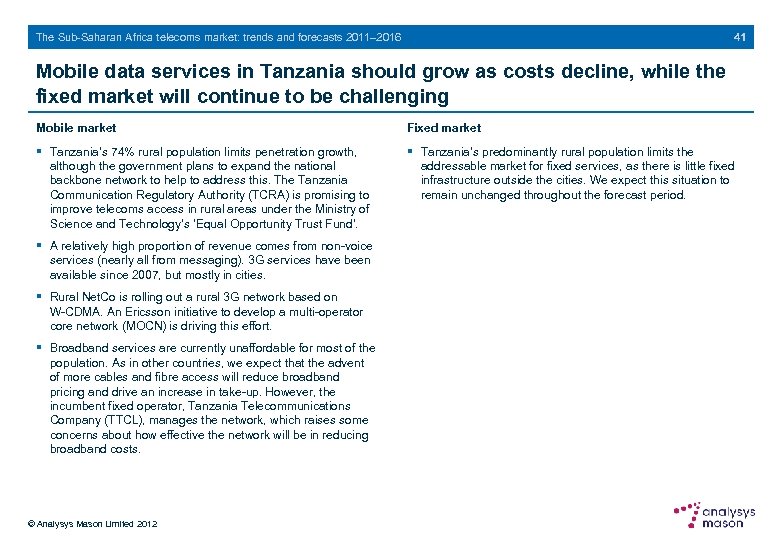
41 The Sub-Saharan Africa telecoms market: trends and forecasts 2011– 2016 Mobile data services in Tanzania should grow as costs decline, while the fixed market will continue to be challenging Mobile market Fixed market § Tanzania’s 74% rural population limits penetration growth, although the government plans to expand the national backbone network to help to address this. The Tanzania Communication Regulatory Authority (TCRA) is promising to improve telecoms access in rural areas under the Ministry of Science and Technology’s ‘Equal Opportunity Trust Fund’. § Tanzania’s predominantly rural population limits the addressable market for fixed services, as there is little fixed infrastructure outside the cities. We expect this situation to remain unchanged throughout the forecast period. § A relatively high proportion of revenue comes from non-voice services (nearly all from messaging). 3 G services have been available since 2007, but mostly in cities. § Rural Net. Co is rolling out a rural 3 G network based on W-CDMA. An Ericsson initiative to develop a multi-operator core network (MOCN) is driving this effort. § Broadband services are currently unaffordable for most of the population. As in other countries, we expect that the advent of more cables and fibre access will reduce broadband pricing and drive an increase in take-up. However, the incumbent fixed operator, Tanzania Telecommunications Company (TTCL), manages the network, which raises some concerns about how effective the network will be in reducing broadband costs. © Analysys Mason Limited 2012
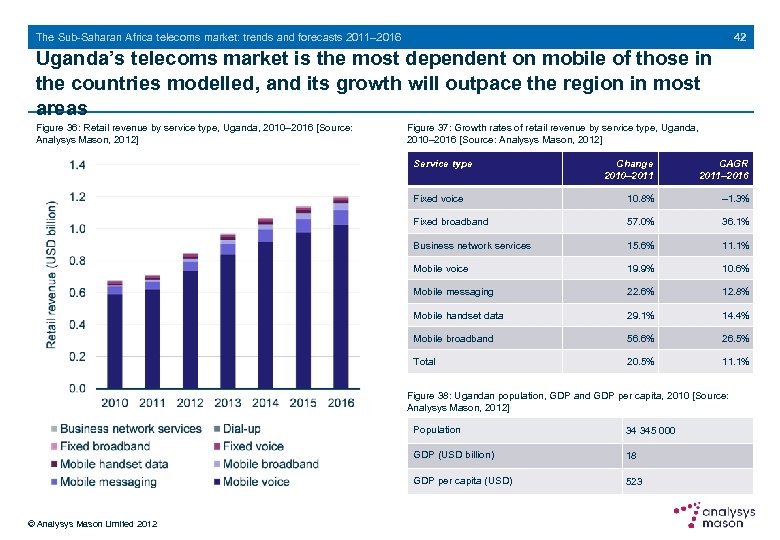
42 The Sub-Saharan Africa telecoms market: trends and forecasts 2011– 2016 Uganda’s telecoms market is the most dependent on mobile of those in the countries modelled, and its growth will outpace the region in most areas Figure 36: Retail revenue by service type, Uganda, 2010– 2016 [Source: Analysys Mason, 2012] Figure 37: Growth rates of retail revenue by service type, Uganda, 2010– 2016 [Source: Analysys Mason, 2012] Service type Change 2010– 2011 CAGR 2011– 2016 Fixed voice 10. 8% – 1. 3% Fixed broadband 57. 0% 36. 1% Business network services 15. 6% 11. 1% Mobile voice 19. 9% 10. 6% Mobile messaging 22. 6% 12. 8% Mobile handset data 29. 1% 14. 4% Mobile broadband 56. 6% 26. 5% Total 20. 5% 11. 1% Figure 38: Ugandan population, GDP and GDP per capita, 2010 [Source: Analysys Mason, 2012] Population GDP (USD billion) 18 GDP per capita (USD) © Analysys Mason Limited 2012 34 345 000 523
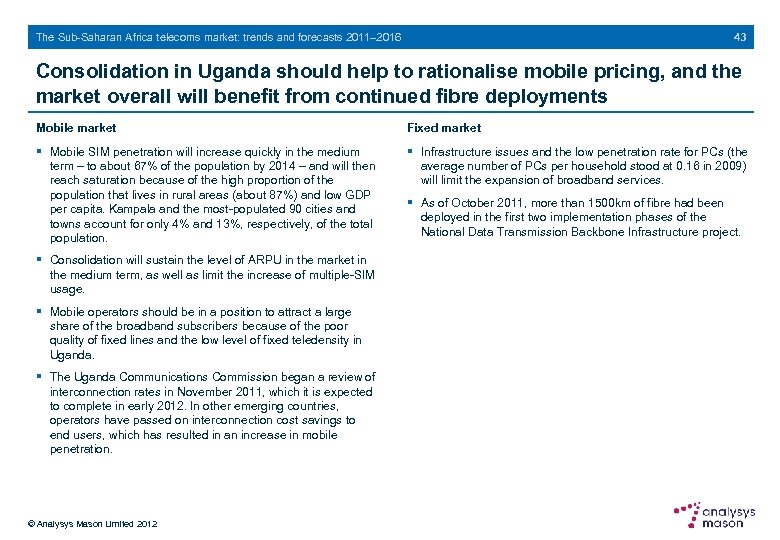
43 The Sub-Saharan Africa telecoms market: trends and forecasts 2011– 2016 Consolidation in Uganda should help to rationalise mobile pricing, and the market overall will benefit from continued fibre deployments Mobile market Fixed market § Mobile SIM penetration will increase quickly in the medium term – to about 67% of the population by 2014 – and will then reach saturation because of the high proportion of the population that lives in rural areas (about 87%) and low GDP per capita. Kampala and the most-populated 90 cities and towns account for only 4% and 13%, respectively, of the total population. § Infrastructure issues and the low penetration rate for PCs (the average number of PCs per household stood at 0. 16 in 2009) will limit the expansion of broadband services. § Consolidation will sustain the level of ARPU in the market in the medium term, as well as limit the increase of multiple-SIM usage. § Mobile operators should be in a position to attract a large share of the broadband subscribers because of the poor quality of fixed lines and the low level of fixed teledensity in Uganda. § The Uganda Communications Commission began a review of interconnection rates in November 2011, which it is expected to complete in early 2012. In other emerging countries, operators have passed on interconnection cost savings to end users, which has resulted in an increase in mobile penetration. © Analysys Mason Limited 2012 § As of October 2011, more than 1500 km of fibre had been deployed in the first two implementation phases of the National Data Transmission Backbone Infrastructure project.
The Sub-Saharan Africa telecoms market: trends and forecasts 2011– 2016 Executive summary Key implications Market definition and methodology Sub-Saharan Africa forecast Country forecasts About the authors and Analysys Mason © Analysys Mason Limited 2012 44
The Sub-Saharan Africa telecoms market: trends and forecasts 2011– 2016 45 About the authors Roz Roseboro (Principal Analyst) is the lead analyst for Analysys Mason’s The Middle East and Africa research programme. Her primary areas of specialisation are market drivers in growth markets and understanding the opportunities for operators and vendors in these markets. She also specialises in professional services needed to deliver infrastructure services and in network equipment manufacturers. Roz has nearly 20 years’ experience in market research, marketing and product management. She spent five years at RHK, where she ran the Switching and Routing programme, and later the Business Communication Services programme. She spent nine years at Motorola, working in IT product development and radio and mobile phone product management. Roz holds a BA in English from the University of Massachusetts, Amherst and an MBA in Marketing, Management and International Business from the J. L. Kellogg Graduate School of Management at Northwestern University. William Hare (Analyst) joined Analysys Mason’s Consulting division in 2007, before transferring to the Research division in 2010. He works primarily on Analysys Mason’s consumer services research, as well as contributing to the modelling behind the Telecoms Market Matrix, wireless traffic forecasting and the Connected Consumer survey. His primary specialisations include business and market modelling and data analysis, for both the mobile and fixed telecoms markets. He read mathematics at the University of Cambridge. Published by Analysys Mason Limited • Bush House • North West Wing • Aldwych • London • WC 2 B 4 PJ • UK Tel: +44 (0)845 600 5244 • Fax: +44 (0)845 528 0760 • Email: research@analysysmason. com • www. analysysmason. com/research • Registered in England No. 5177472 © Analysys Mason Limited 2012. All rights reserved. No part of this publication may be reproduced, stored in a retrieval system or transmitted in any form or by any means – electronic, mechanical, photocopying, recording or otherwise – without the prior written permission of the publisher. Figures and projections contained in this report are based on publicly available information only and are produced by the Research Division of Analysys Mason Limited independently of any clientspecific work within Analysys Mason Limited. The opinions expressed are those of the stated authors only. Analysys Mason Limited recognises that many terms appearing in this report are proprietary; all such trademarks are acknowledged and every effort has been made to indicate them by the normal UK publishing practice of capitalisation. However, the presence of a term, in whatever form, does not affect its legal status as a trademark. Analysys Mason Limited maintains that all reasonable care and skill have been used in the compilation of this publication. However, Analysys Mason Limited shall not be under any liability for loss or damage (including consequential loss) whatsoever or howsoever arising as a result of the use of this publication by the customer, his servants, agents or any third party. © Analysys Mason Limited 2012
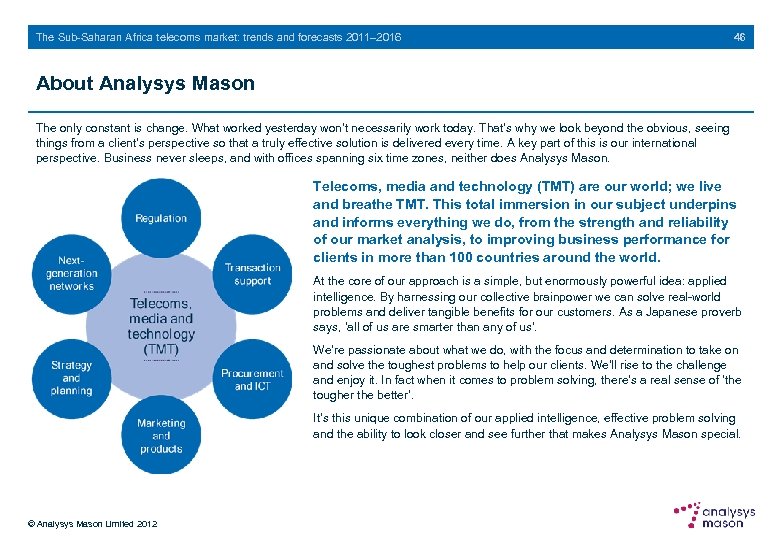
The Sub-Saharan Africa telecoms market: trends and forecasts 2011– 2016 46 About Analysys Mason The only constant is change. What worked yesterday won’t necessarily work today. That’s why we look beyond the obvious, seeing things from a client’s perspective so that a truly effective solution is delivered every time. A key part of this is our international perspective. Business never sleeps, and with offices spanning six time zones, neither does Analysys Mason. Telecoms, media and technology (TMT) are our world; we live and breathe TMT. This total immersion in our subject underpins and informs everything we do, from the strength and reliability of our market analysis, to improving business performance for clients in more than 100 countries around the world. At the core of our approach is a simple, but enormously powerful idea: applied intelligence. By harnessing our collective brainpower we can solve real-world problems and deliver tangible benefits for our customers. As a Japanese proverb says, ‘all of us are smarter than any of us’. We’re passionate about what we do, with the focus and determination to take on and solve the toughest problems to help our clients. We’ll rise to the challenge and enjoy it. In fact when it comes to problem solving, there’s a real sense of ‘the tougher the better’. It’s this unique combination of our applied intelligence, effective problem solving and the ability to look closer and see further that makes Analysys Mason special. © Analysys Mason Limited 2012
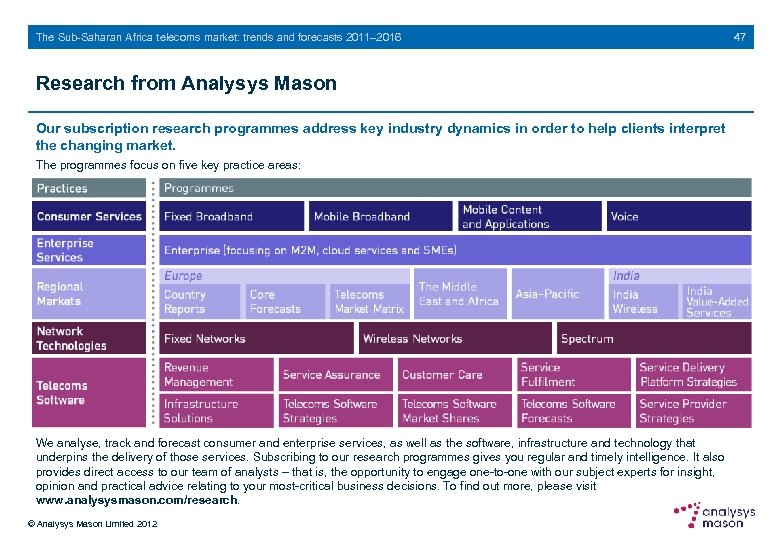
The Sub-Saharan Africa telecoms market: trends and forecasts 2011– 2016 Research from Analysys Mason Our subscription research programmes address key industry dynamics in order to help clients interpret the changing market. The programmes focus on five key practice areas: We analyse, track and forecast consumer and enterprise services, as well as the software, infrastructure and technology that underpins the delivery of those services. Subscribing to our research programmes gives you regular and timely intelligence. It also provides direct access to our team of analysts – that is, the opportunity to engage one-to-one with our subject experts for insight, opinion and practical advice relating to your most-critical business decisions. To find out more, please visit www. analysysmason. com/research. © Analysys Mason Limited 2012 47
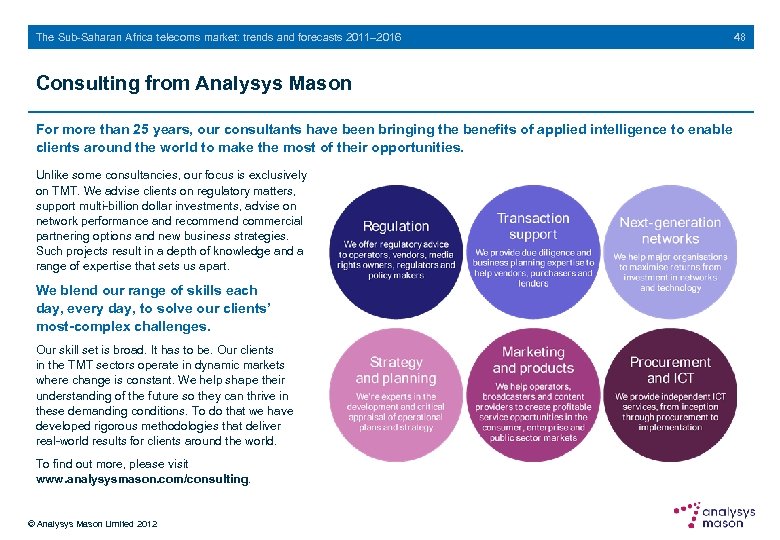
The Sub-Saharan Africa telecoms market: trends and forecasts 2011– 2016 48 Consulting from Analysys Mason For more than 25 years, our consultants have been bringing the benefits of applied intelligence to enable clients around the world to make the most of their opportunities. Unlike some consultancies, our focus is exclusively on TMT. We advise clients on regulatory matters, support multi-billion dollar investments, advise on network performance and recommend commercial partnering options and new business strategies. Such projects result in a depth of knowledge and a range of expertise that sets us apart. We blend our range of skills each day, every day, to solve our clients’ most-complex challenges. Our skill set is broad. It has to be. Our clients in the TMT sectors operate in dynamic markets where change is constant. We help shape their understanding of the future so they can thrive in these demanding conditions. To do that we have developed rigorous methodologies that deliver real-world results for clients around the world. To find out more, please visit www. analysysmason. com/consulting. © Analysys Mason Limited 2012
Скачать презентацию The Sub-Saharan Africa telecoms market trends and forecasts
08592f5e098cea0868b2aedb91e749f2.ppt