


 Скачать презентацию The Study on Improvement of Management Information Systems
55824b6727e35c14951d00d911d55799.ppt
- Количество слайдов: 22
 The Study on Improvement of Management Information Systems in Health Sector in the Islamic Republic of Pakistan District Health Information System (DHIS) Design Steering Committee Meeting, Islamabad 29 August 2005
 Outline of Presentation Rationale Objective of DHIS Specifications Pilot testing DHIS
 Rationale for DHIS After devolution, decision-making and resource management authority transferred to districts District responsible for improving health services from 1 st and 2 nd level facilities & outreach Strengthening the Districts for managing their health systems is a priority Thereby, improving HIS to respond to the information needs of the Districts is a priority
 Objective of DHIS Overall objective: “To provide information for management and performance improvement of primary and secondary healthcare services provided by the public health sector at district level”
 Specific objectives: Provide necessary information for monitoring the performance of district health system by incorporating selected key information from HMIS/FLCF, vertical programs and supportsystems at district level Cater to the important routine health information needs of the federal and provincial levels for monitoring policy implementation
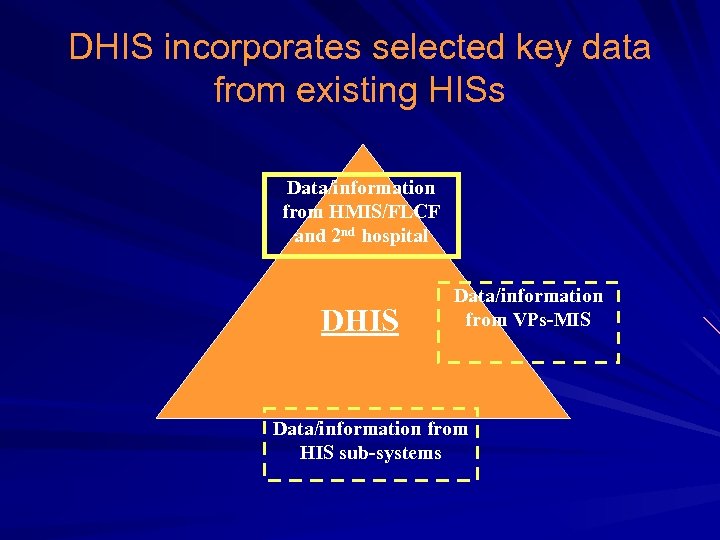 DHIS incorporates selected key data from existing HISs Data/information from HMIS/FLCF and 2 nd hospital DHIS Data/information from VPs-MIS Data/information from HIS sub-systems
 System Specification DHIS is a routine health information system – responds to the information need of the District health system’s performance monitoring function DHIS provides minimum set of indicators – for monitoring of health services from First and Secondary level facilities, Outreach The DHIS indicators are not an exhaustive list of all possible indicators – Provide readily understandable indication of positive or negative deviances
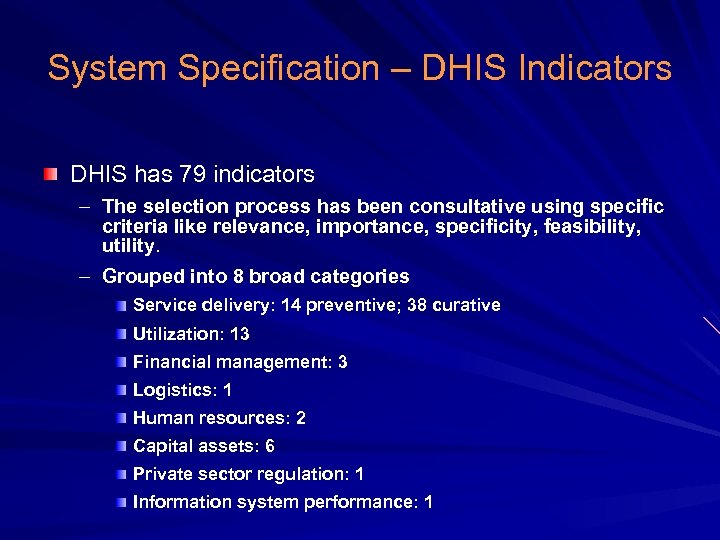 System Specification – DHIS Indicators DHIS has 79 indicators – The selection process has been consultative using specific criteria like relevance, importance, specificity, feasibility, utility. – Grouped into 8 broad categories Service delivery: 14 preventive; 38 curative Utilization: 13 Financial management: 3 Logistics: 1 Human resources: 2 Capital assets: 6 Private sector regulation: 1 Information system performance: 1
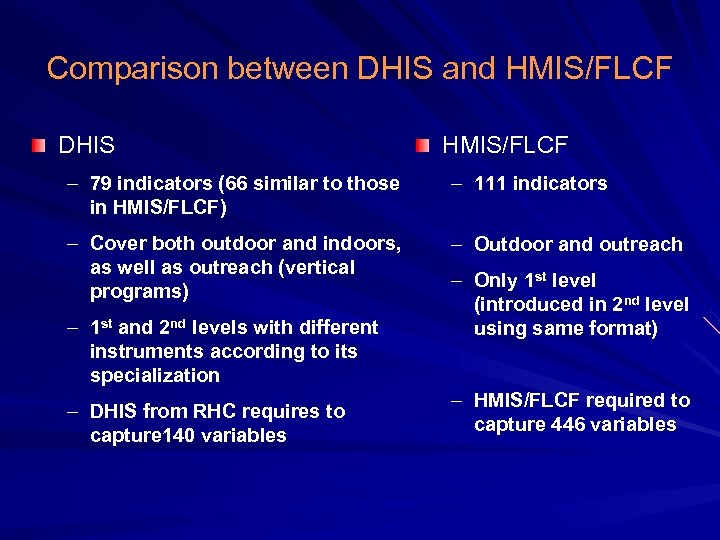 Comparison between DHIS and HMIS/FLCF DHIS HMIS/FLCF – 79 indicators (66 similar to those in HMIS/FLCF) – 111 indicators – Cover both outdoor and indoors, as well as outreach (vertical programs) – Outdoor and outreach – 1 st and 2 nd levels with different instruments according to its specialization – DHIS from RHC requires to capture 140 variables – Only 1 st level (introduced in 2 nd level using same format) – HMIS/FLCF required to capture 446 variables
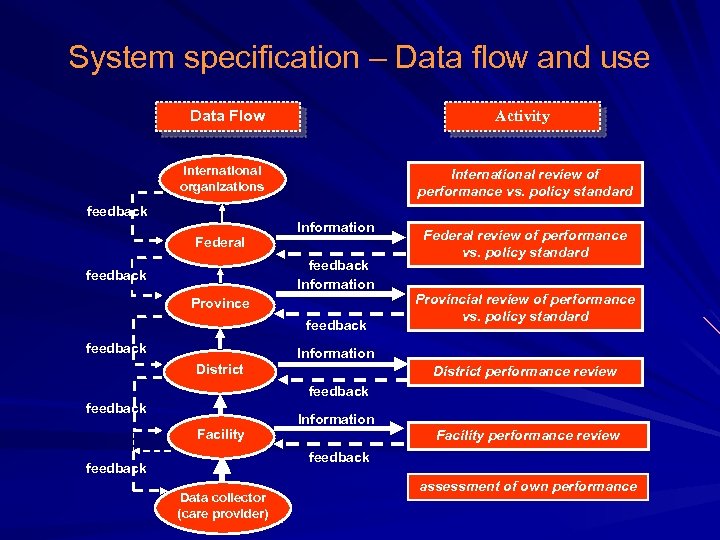 System specification – Data flow and use Data Flow Activity International organizations International review of performance vs. policy standard feedback Federal Information feedback Province feedback Federal review of performance vs. policy standard Provincial review of performance vs. policy standard Information District performance review feedback Facility Information Facility performance review feedback Data collector data (care provider) assessment of own performance
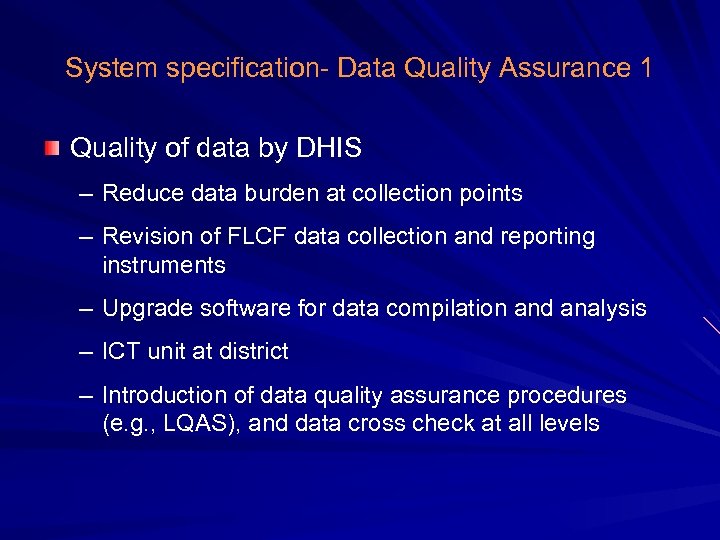 System specification- Data Quality Assurance 1 Quality of data by DHIS – Reduce data burden at collection points – Revision of FLCF data collection and reporting instruments – Upgrade software for data compilation and analysis – ICT unit at district – Introduction of data quality assurance procedures (e. g. , LQAS), and data cross check at all levels
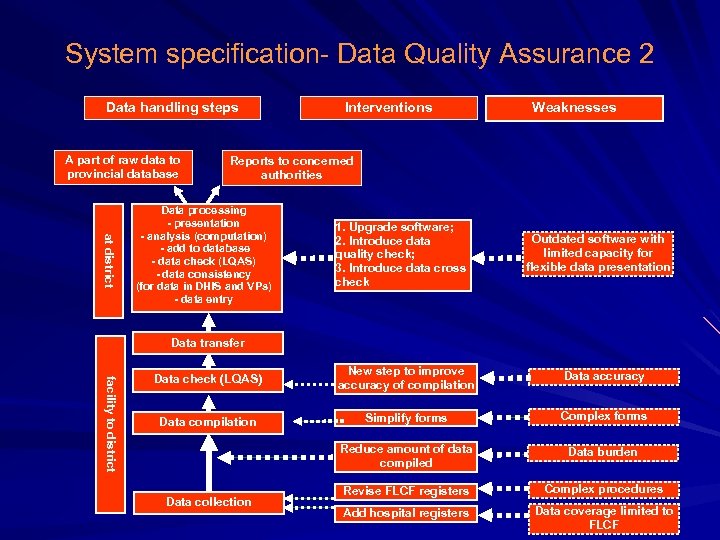 System specification- Data Quality Assurance 2 Data handling steps A part of raw data to provincial database Interventions Weaknesses Reports to concerned authorities at district Data processing - presentation - analysis (computation) - add to database - data check (LQAS) - data consistency (for data in DHIS and VPs) - data entry 1. Upgrade software; 2. Introduce data quality check; 3. Introduce data cross check Outdated software with limited capacity for flexible data presentation Data transfer facility to district Data check (LQAS) New step to improve accuracy of compilation Data accuracy Data compilation Simplify forms Complex forms Reduce amount of data compiled Data burden Revise FLCF registers Complex procedures Add hospital registers Data coverage limited to FLCF Data collection
 System Specification- Continuous Use of Information Strengthening District HMIS cell/ICT unit Strengthening EDOH functions for performance improvement using DHIS information Strengthening Facility functions Enhancing staff/managers’ knowledge and skills (capacity building)
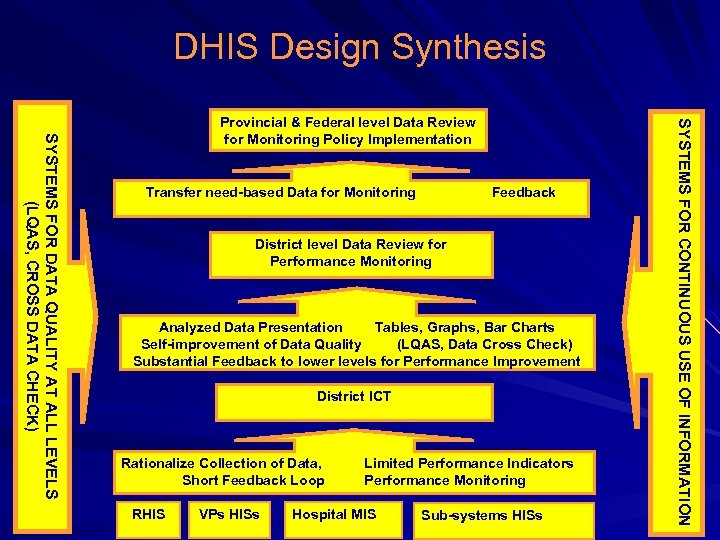 DHIS Design Synthesis Transfer need-based Data for Monitoring Feedback District level Data Review for Performance Monitoring Analyzed Data Presentation Tables, Graphs, Bar Charts Self-improvement of Data Quality (LQAS, Data Cross Check) Substantial Feedback to lower levels for Performance Improvement District ICT Rationalize Collection of Data, Short Feedback Loop RHIS VPs HISs Limited Performance Indicators Performance Monitoring Hospital MIS Sub-systems HISs SYSTEMS FOR CONTINUOUS USE OF INFORMATION SYSTEMS FOR DATA QUALITY AT ALL LEVELS (LQAS, CROSS DATA CHECK) Provincial & Federal level Data Review for Monitoring Policy Implementation
 Benefits of DHIS Design Caters to management needs of devolved district health system Enhanced coverage for performance monitoring – FLCF, Secondary Hospitals, Vertical Programs, & HIS sub-systems, viz. logistics, financial, human resource, capital assets MISs – Flexibility to evolve for future information needs Improved data quality assurance procedures at all levels
 Benefits of DHIS Design 2 Continuous use of information at all levels – Strengthening of feedback loops within the districts and at all levels – Problem identification, implementation of solutions for performance improvement Capacity building of staff on data quality and use of information at all levels Ownership at all level
 Pilot Test of DHIS Model Objectives: – To prove the model DHIS in terms of quality of information and continuous use for the improvement of health management at district level Specific Objectives: – To contribute to the finalization of draft NAP for strengthening of health management capacity through use of DHIS Model – To clarify the cost for expansion across the country during scaling up stage – To transfer relevant skills and technologies to personnel concerned with the DHIS
 Broad Interventions and Activities Examining improvement of government support to DHIS – Examining contents and draw up draft DHIS strategy paper for HIS policy Testing self-evaluation and improvement functions – Periodical review of DHIS activities by PWG Introduction of DHIS design in selected districts and facilities – Revised and improved DHIS tools and instruments – District computer software and manuals – Manuals and guideline material for feedback reports and review meetings – Instruments and guidelines for requesting data from sub-systems – Examining coordinating mechanism among various sub-systems
 Broad Interventions and Activities Strengthening of district HMIS Cell – Establishing district ICT unit and capacity building of relevant staff on IT and data quality assurance systems (LQAS, data cross check etc – Clarification of accountability of ICT unit and HMIS Coordinator Strengthening of EDOH functions – Introduction of regular review meetings at district level – Capacity building on data quality and use of information – Establishing system for monitoring pilot test Strengthening of facility functions – Building coordination between facility in-charge and out reach staff for regular review meetings at facility level – Capacity building on data quality assurance and use of data at facility level – Commitment from EDOH and higher tiers for regular facility review meetings
 Broad Interventions and Activities Capacity building Implementation of education and training to continuously improve knowledge and skills at all levels Capacity building of selected staff at pilot districts – Data quality Assurance – Use of information – ICT
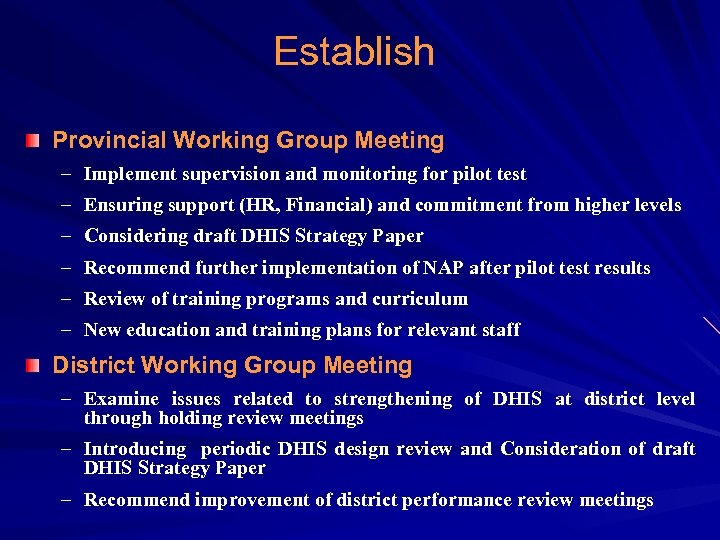 Establish Provincial Working Group Meeting – Implement supervision and monitoring for pilot test – Ensuring support (HR, Financial) and commitment from higher levels – Considering draft DHIS Strategy Paper – Recommend further implementation of NAP after pilot test results – Review of training programs and curriculum – New education and training plans for relevant staff District Working Group Meeting – Examine issues related to strengthening of DHIS at district level through holding review meetings – Introducing periodic DHIS design review and Consideration of draft DHIS Strategy Paper – Recommend improvement of district performance review meetings
 Thank you! End of presentation