


 Скачать презентацию The student will compare and contrast various forms
e4a0817466155fec97822f54161df279.ppt
- Количество слайдов: 18
 The student will compare and contrast various forms of government.
 FIRST FIVE Agenda Message: Before-school tutoring is tomorrow starting at 7: 30 a. Late work must be turned in by Wednesday deadline. Standard: Compare and contrast various forms of government. Describe the ways government systems distribute power. E. Q. Monday, October 1, 2012: What are three forms of governance that distribute power between central and local governments. Warm Up: What are the two questions that must be answered whenever governmental systems are discussed? Today We Will: 1. Distribution of power government models 2. Start Government Worksheets
 Describe the ways government systems distribute power: unitary, confederation, and federal.
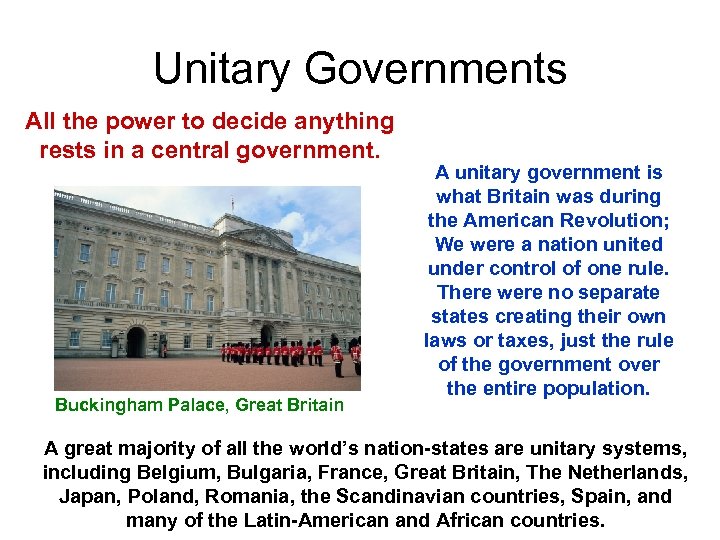 Unitary Governments All the power to decide anything rests in a central government. Buckingham Palace, Great Britain A unitary government is what Britain was during the American Revolution; We were a nation united under control of one rule. There were no separate states creating their own laws or taxes, just the rule of the government over the entire population. A great majority of all the world’s nation-states are unitary systems, including Belgium, Bulgaria, France, Great Britain, The Netherlands, Japan, Poland, Romania, the Scandinavian countries, Spain, and many of the Latin-American and African countries.
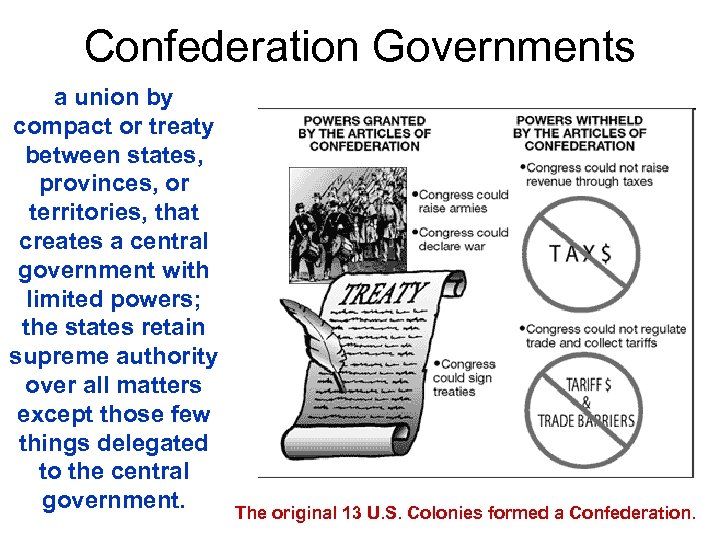 Confederation Governments a union by compact or treaty between states, provinces, or territories, that creates a central government with limited powers; the states retain supreme authority over all matters except those few things delegated to the central government. The original 13 U. S. Colonies formed a Confederation.
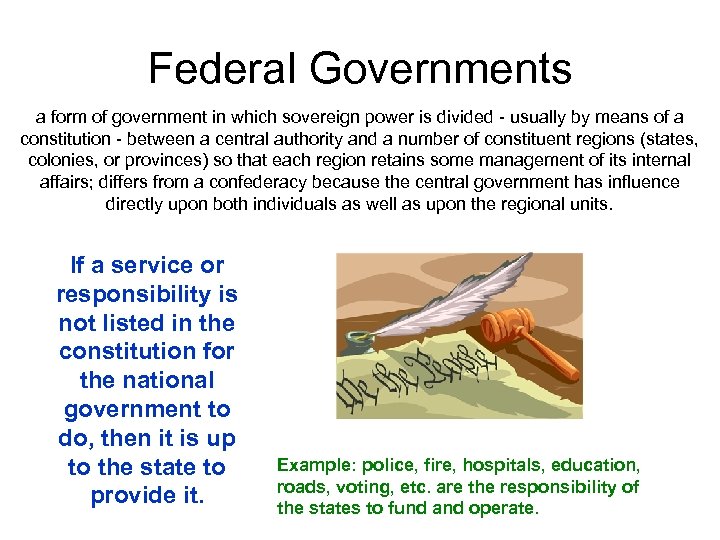 Federal Governments a form of government in which sovereign power is divided - usually by means of a constitution - between a central authority and a number of constituent regions (states, colonies, or provinces) so that each region retains some management of its internal affairs; differs from a confederacy because the central government has influence directly upon both individuals as well as upon the regional units. If a service or responsibility is not listed in the constitution for the national government to do, then it is up to the state to provide it. Example: police, fire, hospitals, education, roads, voting, etc. are the responsibility of the states to fund and operate.
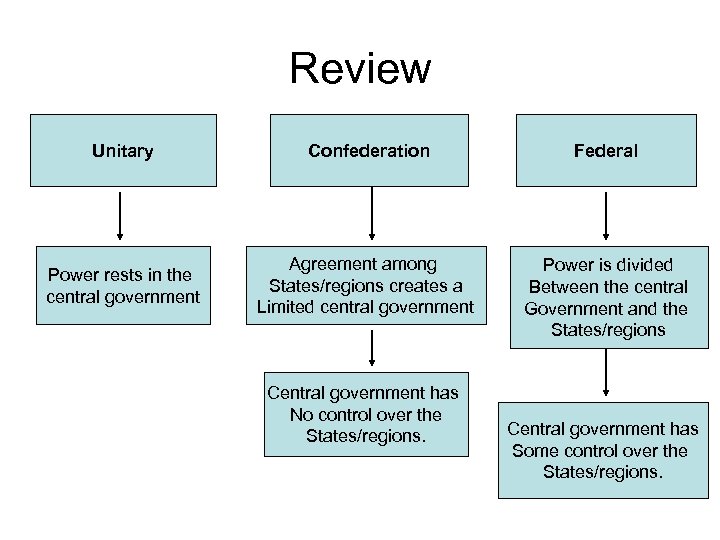 Review Unitary Confederation Federal Power rests in the central government Agreement among States/regions creates a Limited central government Power is divided Between the central Government and the States/regions Central government has No control over the States/regions. Central government has Some control over the States/regions.
 FIRST FIVE Agenda Message: After school tutoring is today starting at 4 – 5 p. Today Message is the last day for late work to be turned in for credit for the current nineweek grading period. Standard: Compare & contrast various forms of government for their ability to distribute power & allow citizens to participate in decision making. E. Q. for Tuesday; October 2 nd: What are three government models that impact citizen participation? Today We Will: 1. Complete overview of government systems/models 2. Introduction to governments of Israel, Iran, & Saudi Arabia
 Explain how governments determine citizen participation: autocratic, oligarchic, and democratic.
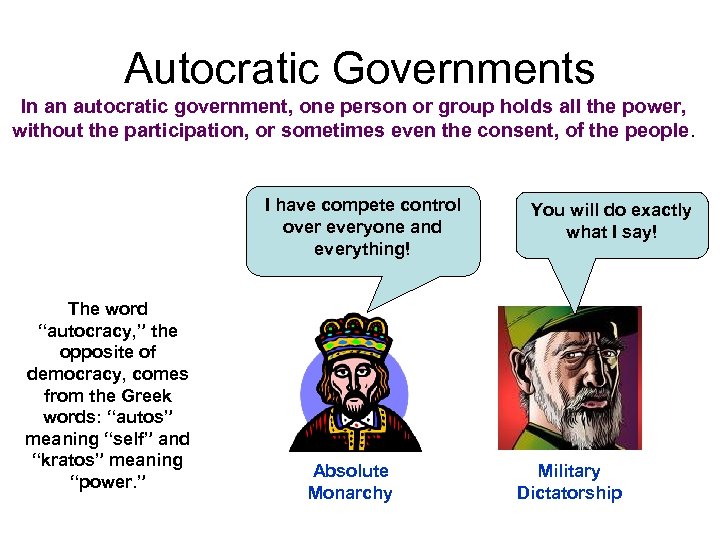 Autocratic Governments In an autocratic government, one person or group holds all the power, without the participation, or sometimes even the consent, of the people. I have compete control over everyone and everything! The word “autocracy, ” the opposite of democracy, comes from the Greek words: “autos” meaning “self” and “kratos” meaning “power. ” Absolute Monarchy You will do exactly what I say! Military Dictatorship
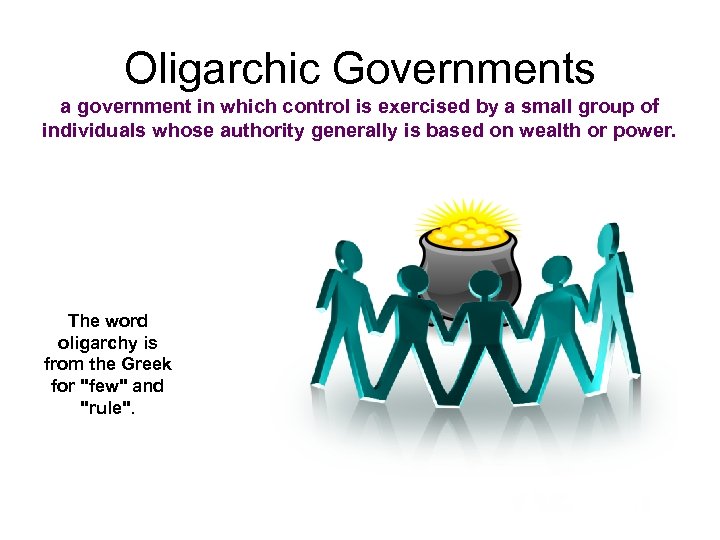 Oligarchic Governments a government in which control is exercised by a small group of individuals whose authority generally is based on wealth or power. The word oligarchy is from the Greek for "few" and "rule".
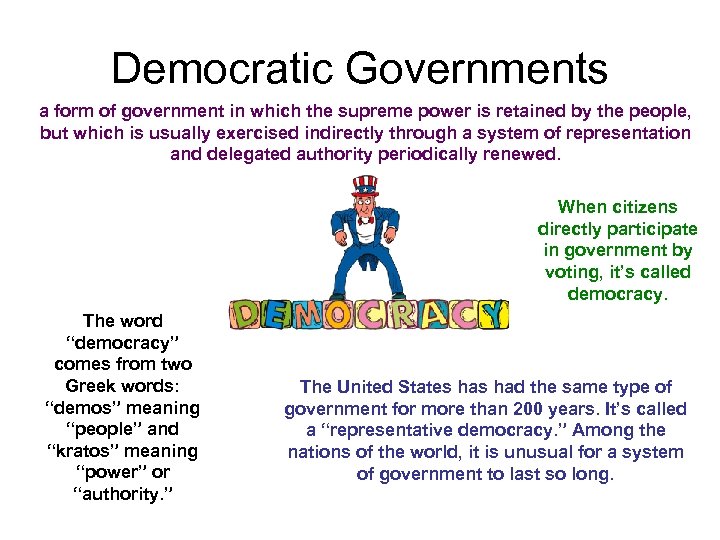 Democratic Governments a form of government in which the supreme power is retained by the people, but which is usually exercised indirectly through a system of representation and delegated authority periodically renewed. When citizens directly participate in government by voting, it’s called democracy. The word “democracy” comes from two Greek words: “demos” meaning “people” and “kratos” meaning “power” or “authority. ” The United States had the same type of government for more than 200 years. It’s called a “representative democracy. ” Among the nations of the world, it is unusual for a system of government to last so long.
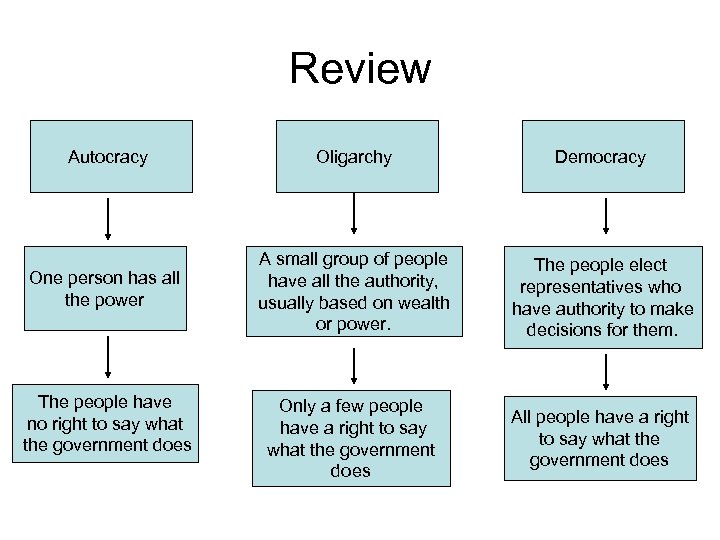 Review Autocracy Oligarchy Democracy One person has all the power A small group of people have all the authority, usually based on wealth or power. The people elect representatives who have authority to make decisions for them. Only a few people have a right to say what the government does All people have a right to say what the government does The people have no right to say what the government does
 FIRST FIVE Agenda Message: After-school tutoring Wednesday from 4 p-5. Late work must be turned in by Wednesday deadline. Standard: Compare and contrast various forms of government. Describe the ways government systems. E. Q. Wednesday, October 3 rd : What are the two forms of democratic governments? Warm Up: Name three governmental models that distribute power and provide a two-word description for each. Today We Will: 1. Compare & contrast Presidential & Parliamentary democratic systems
 Describe the two predominate forms of democratic governments: parliamentary and presidential.
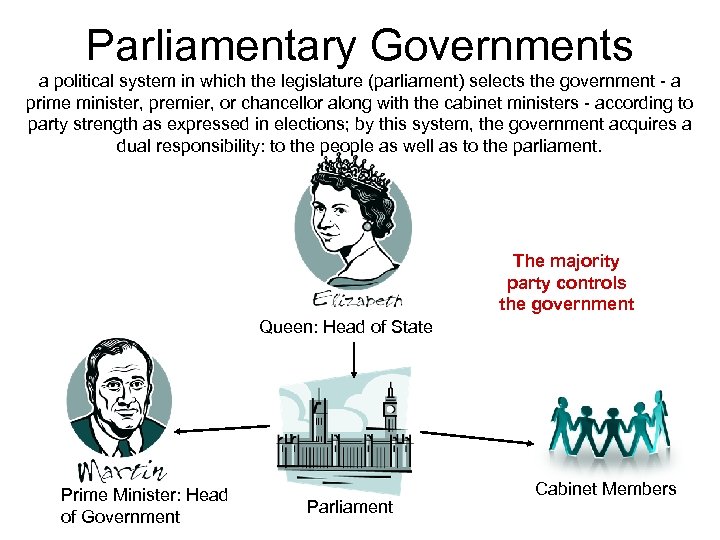 Parliamentary Governments a political system in which the legislature (parliament) selects the government - a prime minister, premier, or chancellor along with the cabinet ministers - according to party strength as expressed in elections; by this system, the government acquires a dual responsibility: to the people as well as to the parliament. The majority party controls the government Queen: Head of State Prime Minister: Head of Government Parliament Cabinet Members
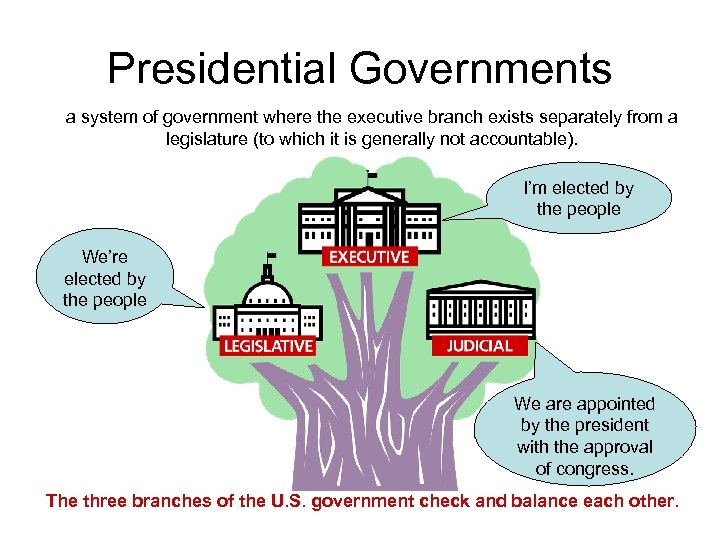 Presidential Governments a system of government where the executive branch exists separately from a legislature (to which it is generally not accountable). I’m elected by the people We’re elected by the people We are appointed by the president with the approval of congress. The three branches of the U. S. government check and balance each other.
 Created by Debra Harrington