


 Скачать презентацию The Statistical Economic and Social Research and Training
8dd520536e723d7c2ea00b394526227a.ppt
- Количество слайдов: 110
 The Statistical Economic and Social Research and Training Centre for Islamic Countries (SESRIC) Regional Workshop on Tourism Statistics and Tourism Satellite Accounts 2 -4 December 2014 at SESRIC Headquarters in Ankara, Turkey 2013 -SESRIC-0111 Project selected for the Project Cycle Management (PCM) Programme Funding of the OIC Standing Committee for Economic and Commercial Cooperation (COMCEC). Oliver Herrmann Director, Tourism Statistics and Tourism Satellite Accounts, United Nations World Tourism Organization (UNWTO) Tadayuki (Tad) Hara UNWTO Consultant, Associate Dean of Finance and Administration, Rosen College of Hospitality Management, University of Central Florida,
![Overview of the Workshop (Total xx pages) [Day 1: Tuesday, 02 December, 2014] •](https://present5.com/presentation/8dd520536e723d7c2ea00b394526227a/image-2.jpg "Overview of the Workshop (Total xx pages) [Day 1: Tuesday, 02 December, 2014] •") Overview of the Workshop (Total xx pages) [Day 1: Tuesday, 02 December, 2014] • 09: 00 -09: 30 Registration • 09: 30 -10: 30 Opening Session • 11: 00 -13: 00 Session 1: System of Tourism Statistics (STS) • 14: 30 -16: 30 Session 2: Inbound Tourism Statistics • 16: 45 -18: 00 Session 2: Inbound Tourism Statistics (cont’d) [Day 2: Wednesday, 03 December, 2014] • 09: 00 -11: 00 Session 3: Outbound Tourism Statistics • 11: 15 -13: 00 Session 4: Tourism Expenditure Statistics • 14: 30 -16: 00 Session 5: Domestic Tourism Statistics • 16: 15 -18: 00 Session 6: Tourism Industries Statistics [Day 3: Thursday, 04 December, 2014] • 09: 00 -11: 00 Session 7: Employment in the Tourism Industries • 11: 15 -13: 00 Session 8: Tourism Satellite Accounts (TSA) • 14: 30 -16: 00 Session 9: General Discussion 2
Overview of the Workshop (Total xx pages) [Day 1: Tuesday, 02 December, 2014] • 09: 00 -09: 30 Registration • 09: 30 -10: 30 Opening Session • 11: 00 -13: 00 Session 1: System of Tourism Statistics (STS) • 14: 30 -16: 30 Session 2: Inbound Tourism Statistics • 16: 45 -18: 00 Session 2: Inbound Tourism Statistics (cont’d) [Day 2: Wednesday, 03 December, 2014] • 09: 00 -11: 00 Session 3: Outbound Tourism Statistics • 11: 15 -13: 00 Session 4: Tourism Expenditure Statistics • 14: 30 -16: 00 Session 5: Domestic Tourism Statistics • 16: 15 -18: 00 Session 6: Tourism Industries Statistics [Day 3: Thursday, 04 December, 2014] • 09: 00 -11: 00 Session 7: Employment in the Tourism Industries • 11: 15 -13: 00 Session 8: Tourism Satellite Accounts (TSA) • 14: 30 -16: 00 Session 9: General Discussion 2
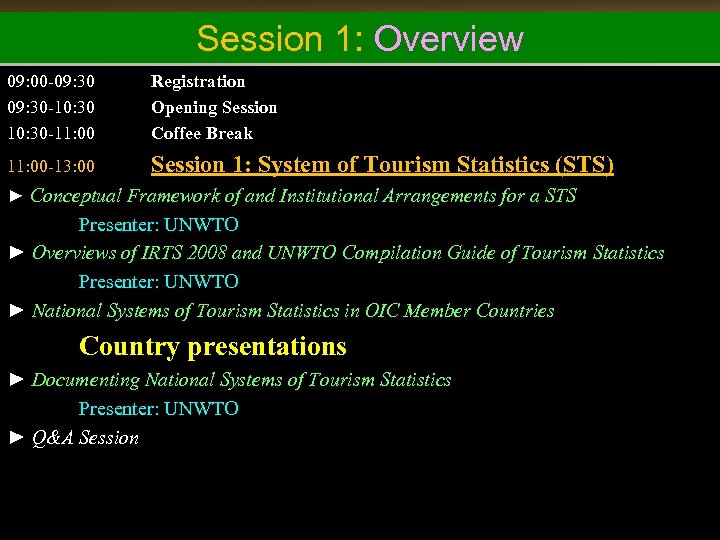 Session 1: Overview 09: 00 -09: 30 -10: 30 -11: 00 Registration Opening Session Coffee Break 11: 00 -13: 00 Session 1: System of Tourism Statistics (STS) ► Conceptual Framework of and Institutional Arrangements for a STS Presenter: UNWTO ► Overviews of IRTS 2008 and UNWTO Compilation Guide of Tourism Statistics Presenter: UNWTO ► National Systems of Tourism Statistics in OIC Member Countries Country presentations ► Documenting National Systems of Tourism Statistics Presenter: UNWTO ► Q&A Session 3
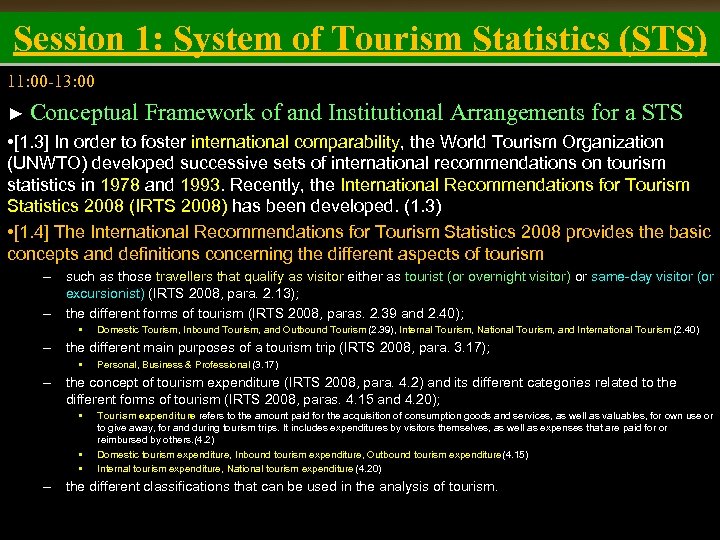 Session 1: System of Tourism Statistics (STS) 11: 00 -13: 00 ► Conceptual Framework of and Institutional Arrangements for a STS • [1. 3] In order to foster international comparability, the World Tourism Organization (UNWTO) developed successive sets of international recommendations on tourism statistics in 1978 and 1993. Recently, the International Recommendations for Tourism Statistics 2008 (IRTS 2008) has been developed. (1. 3) • [1. 4] The International Recommendations for Tourism Statistics 2008 provides the basic concepts and definitions concerning the different aspects of tourism – such as those travellers that qualify as visitor either as tourist (or overnight visitor) or same-day visitor (or excursionist) (IRTS 2008, para. 2. 13); – the different forms of tourism (IRTS 2008, paras. 2. 39 and 2. 40); • Domestic Tourism, Inbound Tourism, and Outbound Tourism (2. 39), Internal Tourism, National Tourism, and International Tourism (2. 40) – the different main purposes of a tourism trip (IRTS 2008, para. 3. 17); • Personal, Business & Professional (3. 17) – the concept of tourism expenditure (IRTS 2008, para. 4. 2) and its different categories related to the different forms of tourism (IRTS 2008, paras. 4. 15 and 4. 20); • • • Tourism expenditure refers to the amount paid for the acquisition of consumption goods and services, as well as valuables, for own use or to give away, for and during tourism trips. It includes expenditures by visitors themselves, as well as expenses that are paid for or reimbursed by others. (4. 2) Domestic tourism expenditure, Inbound tourism expenditure, Outbound tourism expenditure (4. 15) Internal tourism expenditure, National tourism expenditure (4. 20) – the different classifications that can be used in the analysis of tourism. 4
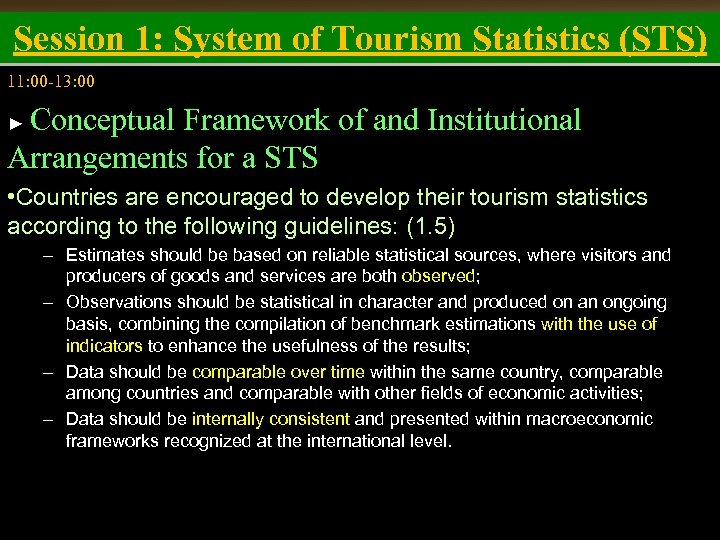 Session 1: System of Tourism Statistics (STS) 11: 00 -13: 00 Conceptual Framework of and Institutional Arrangements for a STS ► • Countries are encouraged to develop their tourism statistics according to the following guidelines: (1. 5) – Estimates should be based on reliable statistical sources, where visitors and producers of goods and services are both observed; – Observations should be statistical in character and produced on an ongoing basis, combining the compilation of benchmark estimations with the use of indicators to enhance the usefulness of the results; – Data should be comparable over time within the same country, comparable among countries and comparable with other fields of economic activities; – Data should be internally consistent and presented within macroeconomic frameworks recognized at the international level. 5
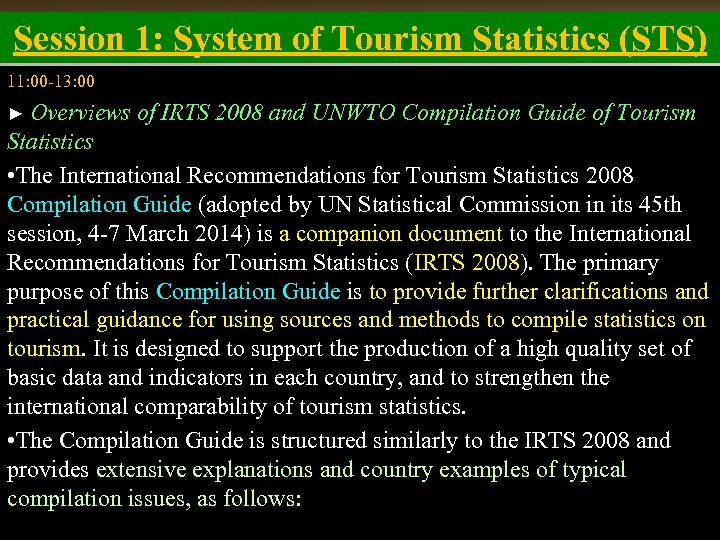 Session 1: System of Tourism Statistics (STS) 11: 00 -13: 00 ► Overviews of IRTS 2008 and UNWTO Compilation Guide of Tourism Statistics • The International Recommendations for Tourism Statistics 2008 Compilation Guide (adopted by UN Statistical Commission in its 45 th session, 4 -7 March 2014) is a companion document to the International Recommendations for Tourism Statistics (IRTS 2008). The primary purpose of this Compilation Guide is to provide further clarifications and practical guidance for using sources and methods to compile statistics on tourism. It is designed to support the production of a high quality set of basic data and indicators in each country, and to strengthen the international comparability of tourism statistics. • The Compilation Guide is structured similarly to the IRTS 2008 and provides extensive explanations and country examples of typical compilation issues, as follows: 6
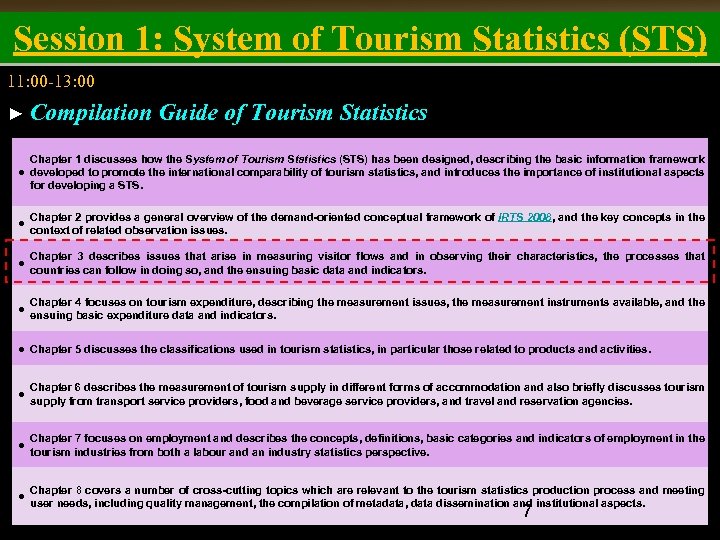 Session 1: System of Tourism Statistics (STS) 11: 00 -13: 00 ► Compilation Guide of Tourism Statistics Chapter 1 discusses how the System of Tourism Statistics (STS) has been designed, describing the basic information framework ● developed to promote the international comparability of tourism statistics, and introduces the importance of institutional aspects for developing a STS. ● Chapter 2 provides a general overview of the demand-oriented conceptual framework of IRTS 2008, and the key concepts in the context of related observation issues. ● Chapter 3 describes issues that arise in measuring visitor flows and in observing their characteristics, the processes that countries can follow in doing so, and the ensuing basic data and indicators. ● Chapter 4 focuses on tourism expenditure, describing the measurement issues, the measurement instruments available, and the ensuing basic expenditure data and indicators. ● Chapter 5 discusses the classifications used in tourism statistics, in particular those related to products and activities. ● Chapter 6 describes the measurement of tourism supply in different forms of accommodation and also briefly discusses tourism supply from transport service providers, food and beverage service providers, and travel and reservation agencies. ● Chapter 7 focuses on employment and describes the concepts, definitions, basic categories and indicators of employment in the tourism industries from both a labour and an industry statistics perspective. ● Chapter 8 covers a number of cross-cutting topics which are relevant to the tourism statistics production process and meeting user needs, including quality management, the compilation of metadata, data dissemination and institutional aspects. 7
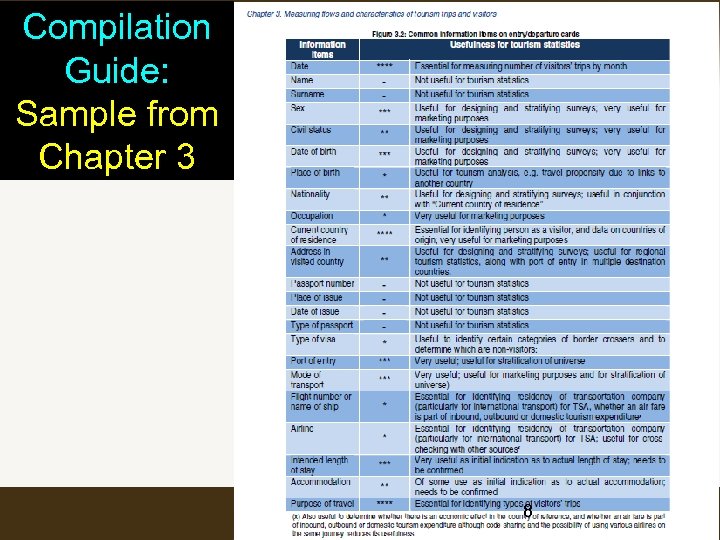 Compilation Guide: Sample from Chapter 3 8
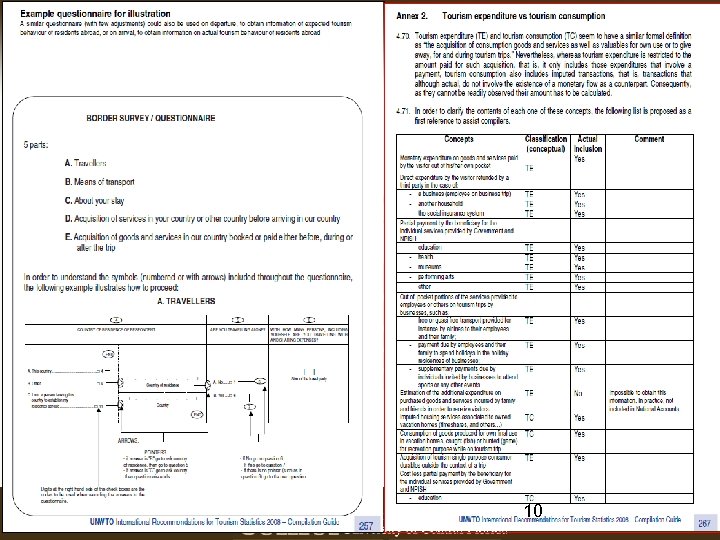
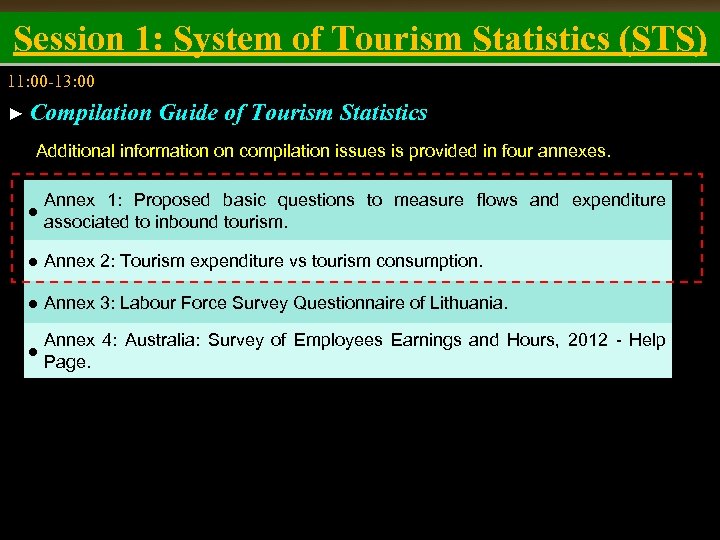 Session 1: System of Tourism Statistics (STS) 11: 00 -13: 00 ► Compilation Guide of Tourism Statistics Additional information on compilation issues is provided in four annexes. ● Annex 1: Proposed basic questions to measure flows and expenditure associated to inbound tourism. ● Annex 2: Tourism expenditure vs tourism consumption. ● Annex 3: Labour Force Survey Questionnaire of Lithuania. ● Annex 4: Australia: Survey of Employees Earnings and Hours, 2012 - Help Page. 9
 10
10
 Session 1 ► Documenting National Systems of Tourism Statistics Presenter: UNWTO • This Compilation Guide deals with the setting up of a national System of Tourism Statistics (STS). Tourism statistics covers data regarding visitors’ activities (such as arrivals/departures, overnight stays, expenditures, main purpose of the trip, etc. ) associated with the different forms of tourism (inbound, domestic and outbound), as well as tourism industries’ activity, infrastructure and employment. Box 1. 1 describes the international Classification of Statistical Activities which categorises tourism statistics as part of the National Statistics System (NSS). • The recommendations set out in IRTS 2008 for national STSs will facilitate international comparisons as well as integration within each country’s NSS (The System of Tourism Statistics: Basic References, Section B). (1. 10) • In the meantime, some countries have to rely on approximate data, where it is the only tourism-related data available. Such data might include: • Balance of Payments data (from the travel and passenger transport items); • Inbound visitors from immigration authorities based on nationality (even though, for tourism purposes, information should be based on country of residence); • Data from hotel associations; • Data from transport companies; and 11 • Data from commercial accommodation establishments.
 Session 1 ► Documenting National Systems of Tourism Statistics Presenter: UNWTO Importance of institutional arrangements in developing a System of Tourism Statistics (STS) • The proper environment for the development of a STS should be a proactive and synergetic Inter-Institutional Platform involving various categories of institutions: – a. Bodies that produce statistics and basic tourism information: • • • i. National Statistical Office (NSO) – as producers of basic statistics and compilers of National Accounts ii. National Tourism Administration (NTA) – as the entity responsible for public policy in tourism and for the coordination of public and private stakeholders iii. Central Bank (CB) - as they often compile the Balance of Payments iv. Immigration and Border protection authorities – as responsible for border procedures v. associations of national tourism enterprises – as they are often providers of information as well as key users of tourism statistics 12
 Session 1 ► Documenting National Systems of Tourism Statistics Presenter: UNWTO • The specific role of the TSA within the STS needs to be highlighted. It should be understood as: – The instrument for identifying and measuring the contribution 2 of tourism to the national economy, in line with the National Accounts framework, and thus allowing comparisons with other economic domains. • For example, the %GDP attributable to tourism derived from the TSA can be compared to the %GDP attributable to agriculture derived from the core National Accounts. – A systematic means to achieve total coverage in terms of visitors, their expenditure, and the industries serving visitors, as well as a reasoned reconciliation of the different statistical sources involved, in order to ensure consistency among the data derived from them. – Part of a system of information in which individual sources are interconnected (for instance, annual data are consistent with monthly or quarterly data; demand data match information on supply; specific analyses are consistent with general ones, etc. ). – A macroeconomic accounting tool with which to develop structural relationships with other macroeconomic frameworks, particularly the Balance of Payments and the National Accounts. This relationship should be conceptual but should also be based on shared analyses of the data and the coordination of overlapping statistical operations, to ensure consistent measurements. 13
 Session 1: Country Presentations ► National Systems of Tourism Statistics in OIC Member Countries • Albania: National System of Tourism Statistics Benin: National System of Tourism Statistics Chad: National Systems of Tourism Statistics Kazakhstan: National System of Tourism Statistics • Palestine: – National Tourism Statistics 14
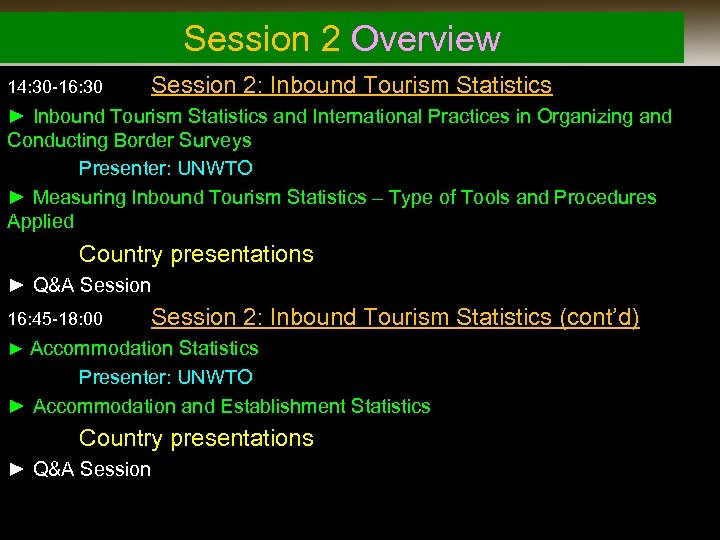 Session 2 Overview 14: 30 -16: 30 Session 2: Inbound Tourism Statistics ► Inbound Tourism Statistics and International Practices in Organizing and Conducting Border Surveys Presenter: UNWTO ► Measuring Inbound Tourism Statistics – Type of Tools and Procedures Applied Country presentations ► Q&A Session 16: 45 -18: 00 Session 2: Inbound Tourism Statistics (cont’d) ► Accommodation Statistics Presenter: UNWTO ► Accommodation and Establishment Statistics Country presentations ► Q&A Session 15
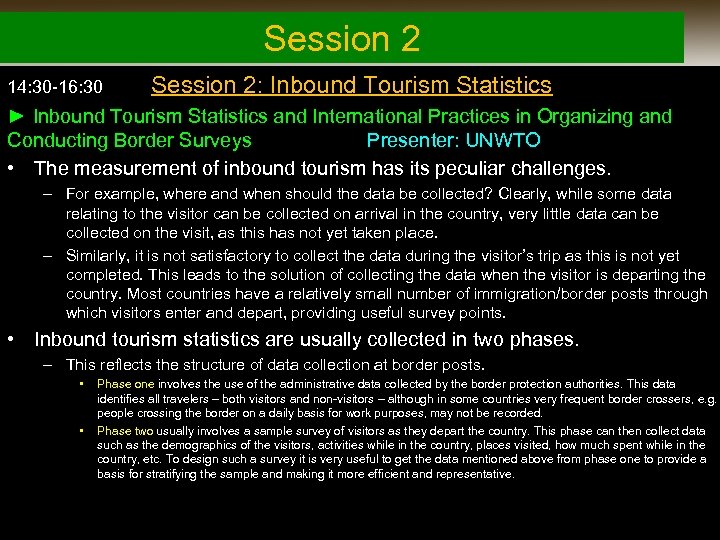 Session 2 14: 30 -16: 30 Session 2: Inbound Tourism Statistics ► Inbound Tourism Statistics and International Practices in Organizing and Conducting Border Surveys Presenter: UNWTO • The measurement of inbound tourism has its peculiar challenges. – For example, where and when should the data be collected? Clearly, while some data relating to the visitor can be collected on arrival in the country, very little data can be collected on the visit, as this has not yet taken place. – Similarly, it is not satisfactory to collect the data during the visitor’s trip as this is not yet completed. This leads to the solution of collecting the data when the visitor is departing the country. Most countries have a relatively small number of immigration/border posts through which visitors enter and depart, providing useful survey points. • Inbound tourism statistics are usually collected in two phases. – This reflects the structure of data collection at border posts. • • Phase one involves the use of the administrative data collected by the border protection authorities. This data identifies all travelers – both visitors and non-visitors – although in some countries very frequent border crossers, e. g. people crossing the border on a daily basis for work purposes, may not be recorded. Phase two usually involves a sample survey of visitors as they depart the country. This phase can then collect data such as the demographics of the visitors, activities while in the country, places visited, how much spent while in the country, etc. To design such a survey it is very useful to get the data mentioned above from phase one to provide a basis for stratifying the sample and making it more efficient and representative. 16
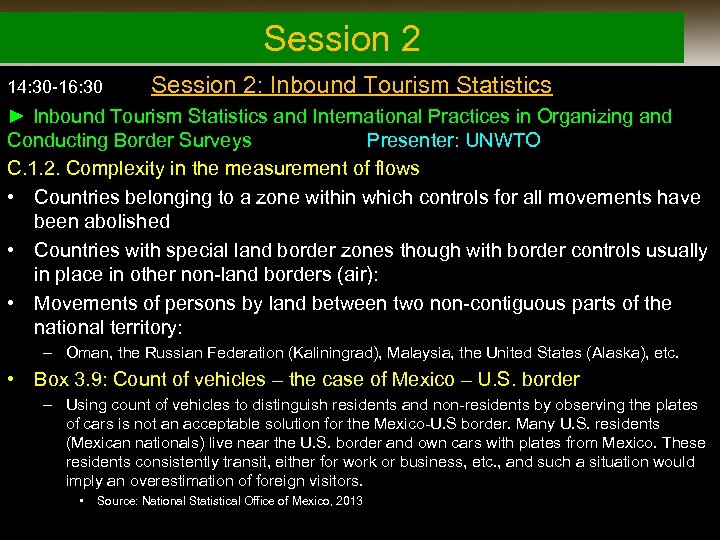 Session 2 14: 30 -16: 30 Session 2: Inbound Tourism Statistics ► Inbound Tourism Statistics and International Practices in Organizing and Conducting Border Surveys Presenter: UNWTO C. 1. 2. Complexity in the measurement of flows • Countries belonging to a zone within which controls for all movements have been abolished • Countries with special land border zones though with border controls usually in place in other non-land borders (air): • Movements of persons by land between two non-contiguous parts of the national territory: – Oman, the Russian Federation (Kaliningrad), Malaysia, the United States (Alaska), etc. • Box 3. 9: Count of vehicles – the case of Mexico – U. S. border – Using count of vehicles to distinguish residents and non-residents by observing the plates of cars is not an acceptable solution for the Mexico-U. S border. Many U. S. residents (Mexican nationals) live near the U. S. border and own cars with plates from Mexico. These residents consistently transit, either for work or business, etc. , and such a situation would imply an overestimation of foreign visitors. • Source: National Statistical Office of Mexico, 2013 17
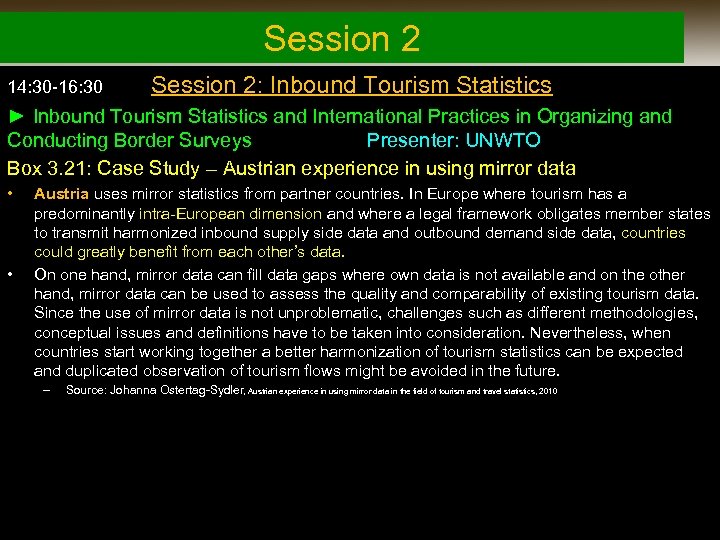 Session 2 14: 30 -16: 30 Session 2: Inbound Tourism Statistics ► Inbound Tourism Statistics and International Practices in Organizing and Conducting Border Surveys Presenter: UNWTO Box 3. 21: Case Study – Austrian experience in using mirror data • • Austria uses mirror statistics from partner countries. In Europe where tourism has a predominantly intra-European dimension and where a legal framework obligates member states to transmit harmonized inbound supply side data and outbound demand side data, countries could greatly benefit from each other’s data. On one hand, mirror data can fill data gaps where own data is not available and on the other hand, mirror data can be used to assess the quality and comparability of existing tourism data. Since the use of mirror data is not unproblematic, challenges such as different methodologies, conceptual issues and definitions have to be taken into consideration. Nevertheless, when countries start working together a better harmonization of tourism statistics can be expected and duplicated observation of tourism flows might be avoided in the future. – Source: Johanna Ostertag-Sydler, Austrian experience in using mirror data in the field of tourism and travel statistics, 2010 18
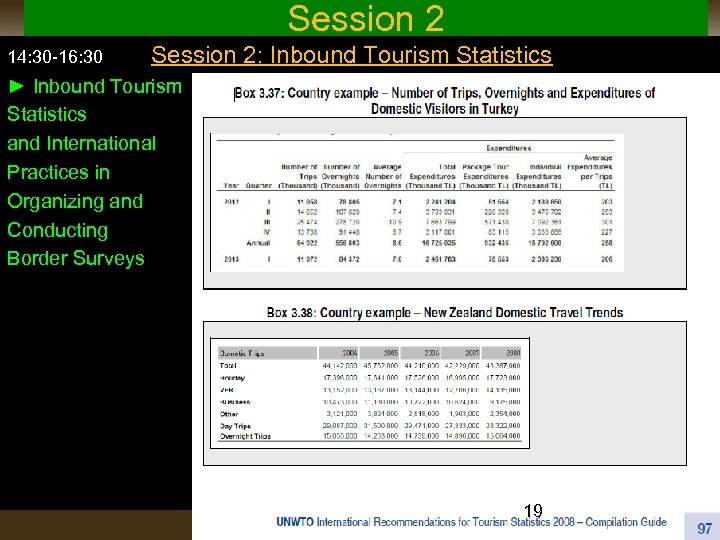 Session 2 14: 30 -16: 30 Session 2: Inbound Tourism Statistics ► Inbound Tourism Statistics and International Practices in Organizing and Conducting Border Surveys 19
 Session 2 14: 30 -16: 30 Session 2: Inbound Tourism Statistics ► Inbound Tourism Statistics and International Practices in Organizing and Conducting Border Surveys Presenter: UNWTO 20
 Session 2 14: 30 -16: 30 Session 2: Inbound Tourism Statistics ► Inbound Tourism Statistics and International Practices in Organizing and Conducting Border Surveys Presenter: UNWTO 21
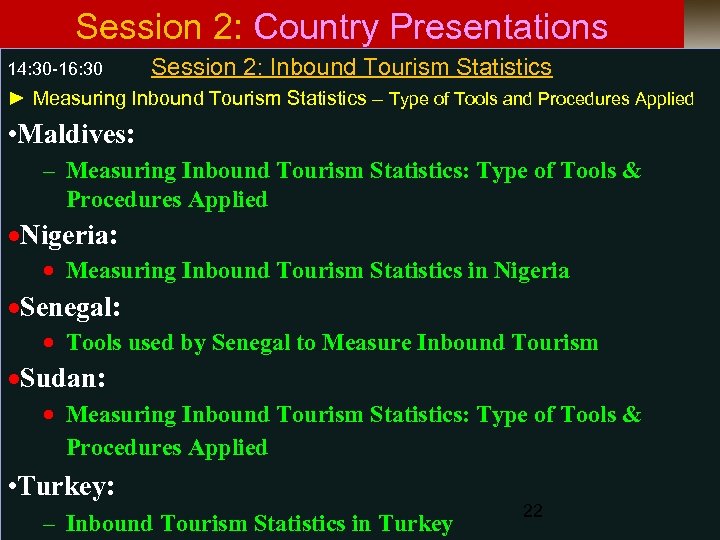 Session 2: Country Presentations 14: 30 -16: 30 Session 2: Inbound Tourism Statistics ► Measuring Inbound Tourism Statistics – Type of Tools and Procedures Applied • Maldives: – Measuring Inbound Tourism Statistics: Type of Tools & Procedures Applied Nigeria: Measuring Inbound Tourism Statistics in Nigeria Senegal: Tools used by Senegal to Measure Inbound Tourism Sudan: Measuring Inbound Tourism Statistics: Type of Tools & Procedures Applied • Turkey: – Inbound Tourism Statistics in Turkey 22
 Session 2 -2 Overview 16: 45 -18: 00 Session 2: Inbound Tourism Statistics (cont’d) ► Accommodation Statistics Presenter: UNWTO ► Accommodation and Establishment Statistics Country presentations ► Q&A Session 23
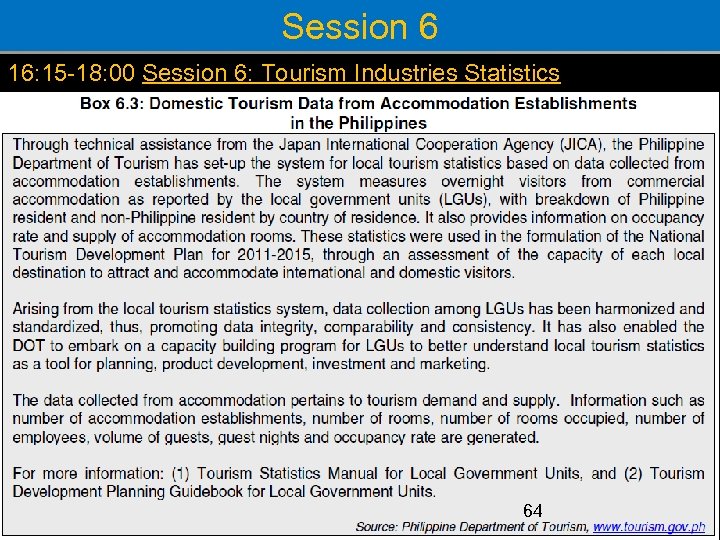
 Session 2 -2 16: 45 -18: 00 Session 2: Inbound Tourism Statistics (cont’d) ► Accommodation Statistics Presenter: UNWTO Tad Hara: If time is available, refer to slides in Section 6 (P 61~P 65) 24
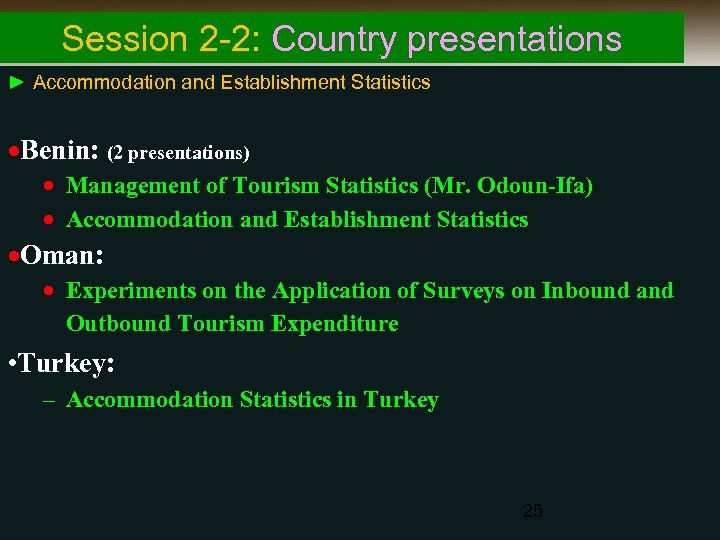 Session 2 -2: Country presentations ► Accommodation and Establishment Statistics Benin: (2 presentations) Management of Tourism Statistics (Mr. Odoun-Ifa) Accommodation and Establishment Statistics Oman: Experiments on the Application of Surveys on Inbound and Outbound Tourism Expenditure • Turkey: – Accommodation Statistics in Turkey 25
 Session 3 Overview 09: 00 -11: 00 Session 3: Outbound Tourism Statistics ► Outbound Tourism Statistics Presenter: UNWTO ► Measuring Outbound Tourism Statistics – Type of Tools and Procedures Applied Country presentations ► Q&A Session 26
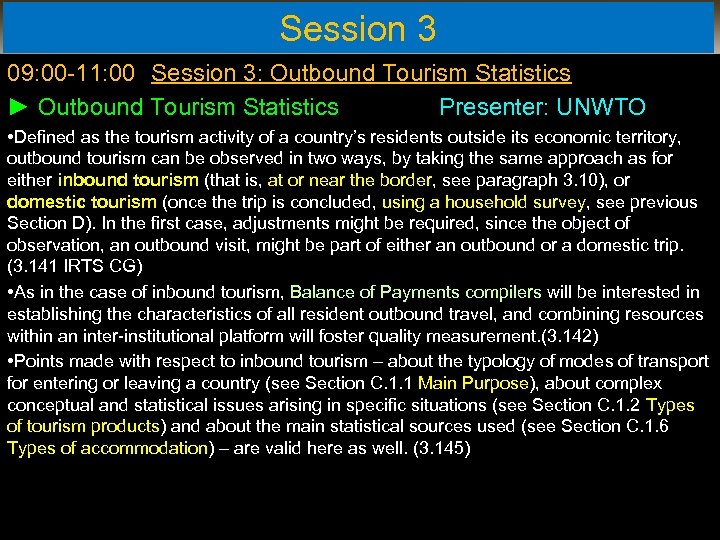 Session 3 09: 00 -11: 00 Session 3: Outbound Tourism Statistics ► Outbound Tourism Statistics Presenter: UNWTO • Defined as the tourism activity of a country’s residents outside its economic territory, outbound tourism can be observed in two ways, by taking the same approach as for either inbound tourism (that is, at or near the border, see paragraph 3. 10), or domestic tourism (once the trip is concluded, using a household survey, see previous Section D). In the first case, adjustments might be required, since the object of observation, an outbound visit, might be part of either an outbound or a domestic trip. (3. 141 IRTS CG) • As in the case of inbound tourism, Balance of Payments compilers will be interested in establishing the characteristics of all resident outbound travel, and combining resources within an inter-institutional platform will foster quality measurement. (3. 142) • Points made with respect to inbound tourism – about the typology of modes of transport for entering or leaving a country (see Section C. 1. 1 Main Purpose), about complex conceptual and statistical issues arising in specific situations (see Section C. 1. 2 Types of tourism products) and about the main statistical sources used (see Section C. 1. 6 Types of accommodation) – are valid here as well. (3. 145) 27
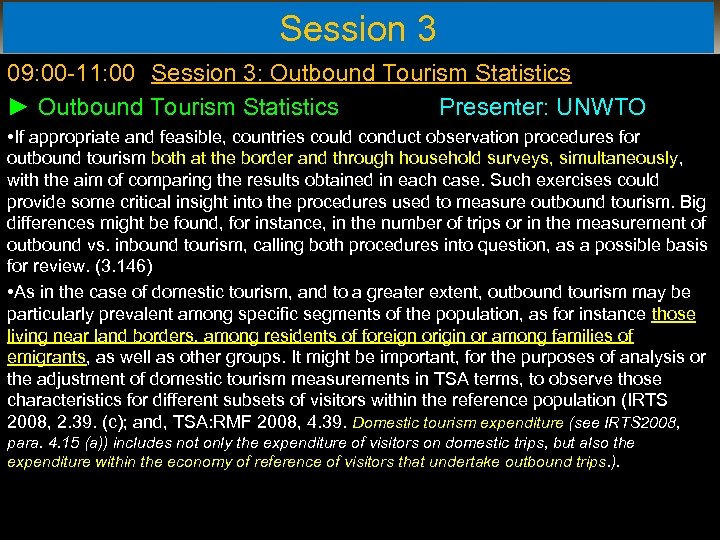 Session 3 09: 00 -11: 00 Session 3: Outbound Tourism Statistics ► Outbound Tourism Statistics Presenter: UNWTO • If appropriate and feasible, countries could conduct observation procedures for outbound tourism both at the border and through household surveys, simultaneously, with the aim of comparing the results obtained in each case. Such exercises could provide some critical insight into the procedures used to measure outbound tourism. Big differences might be found, for instance, in the number of trips or in the measurement of outbound vs. inbound tourism, calling both procedures into question, as a possible basis for review. (3. 146) • As in the case of domestic tourism, and to a greater extent, outbound tourism may be particularly prevalent among specific segments of the population, as for instance those living near land borders, among residents of foreign origin or among families of emigrants, as well as other groups. It might be important, for the purposes of analysis or the adjustment of domestic tourism measurements in TSA terms, to observe those characteristics for different subsets of visitors within the reference population (IRTS 2008, 2. 39. (c); and, TSA: RMF 2008, 4. 39. Domestic tourism expenditure (see IRTS 2008, para. 4. 15 (a)) includes not only the expenditure of visitors on domestic trips, but also the expenditure within the economy of reference of visitors that undertake outbound trips. ). 28
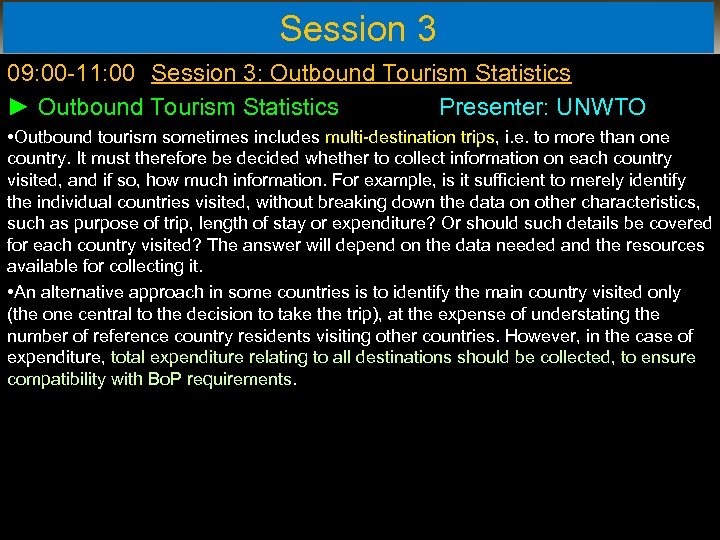 Session 3 09: 00 -11: 00 Session 3: Outbound Tourism Statistics ► Outbound Tourism Statistics Presenter: UNWTO • Outbound tourism sometimes includes multi-destination trips, i. e. to more than one country. It must therefore be decided whether to collect information on each country visited, and if so, how much information. For example, is it sufficient to merely identify the individual countries visited, without breaking down the data on other characteristics, such as purpose of trip, length of stay or expenditure? Or should such details be covered for each country visited? The answer will depend on the data needed and the resources available for collecting it. • An alternative approach in some countries is to identify the main country visited only (the one central to the decision to take the trip), at the expense of understating the number of reference country residents visiting other countries. However, in the case of expenditure, total expenditure relating to all destinations should be collected, to ensure compatibility with Bo. P requirements. 29
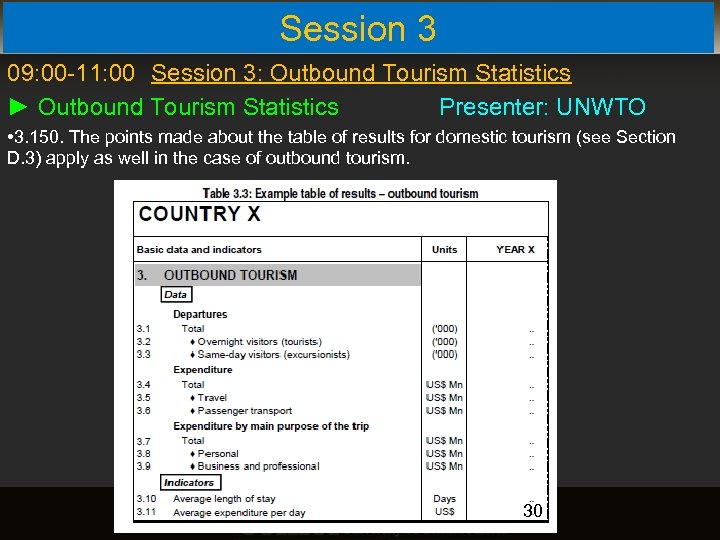 Session 3 09: 00 -11: 00 Session 3: Outbound Tourism Statistics ► Outbound Tourism Statistics Presenter: UNWTO • 3. 150. The points made about the table of results for domestic tourism (see Section D. 3) apply as well in the case of outbound tourism. 30
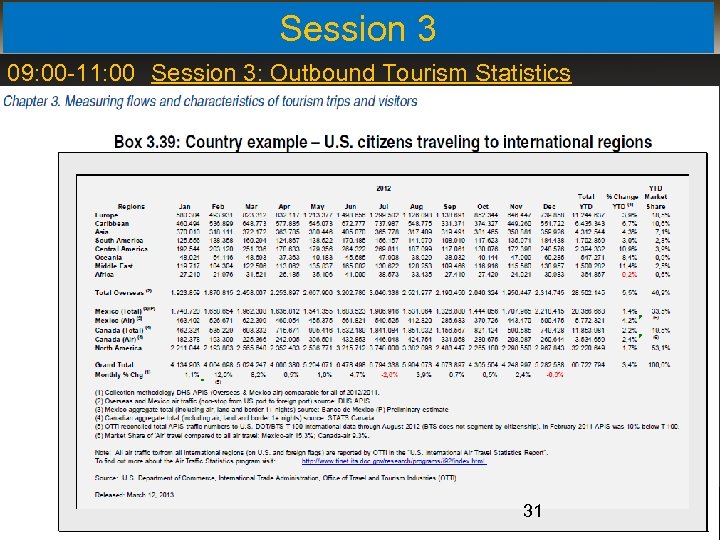 Session 3 09: 00 -11: 00 Session 3: Outbound Tourism Statistics ► Outbound Tourism Statistics Presenter: UNWTO 31
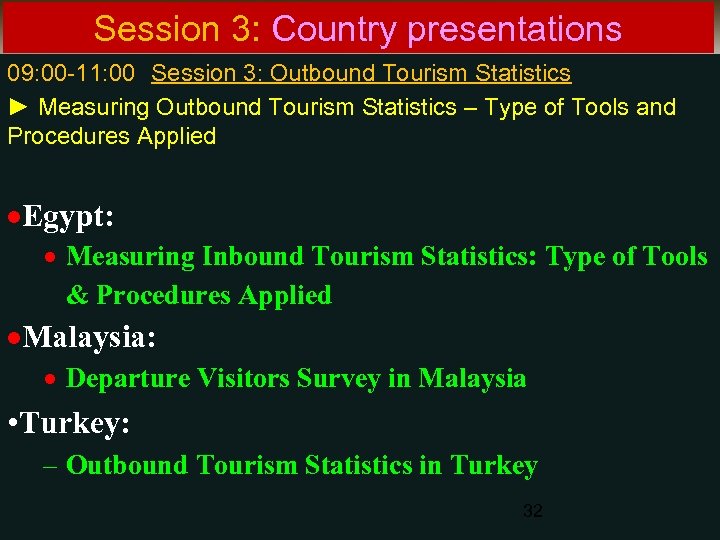 Session 3: Country presentations 09: 00 -11: 00 Session 3: Outbound Tourism Statistics ► Measuring Outbound Tourism Statistics – Type of Tools and Procedures Applied Egypt: Measuring Inbound Tourism Statistics: Type of Tools & Procedures Applied Malaysia: Departure Visitors Survey in Malaysia • Turkey: – Outbound Tourism Statistics in Turkey 32
 Session 4: Overview 11: 15 -13: 00 Session 4: Tourism Expenditure Statistics ► Inbound and Outbound Tourism Expenditure Statistics Presenter: UNWTO ► Experiences on Application of Inbound and Outbound Tourism Expenditure Surveys Country presentations ► Q&A Session 33
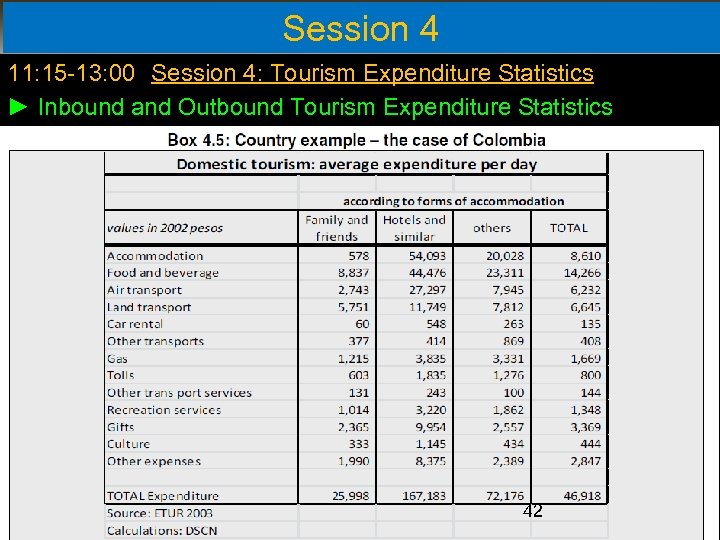
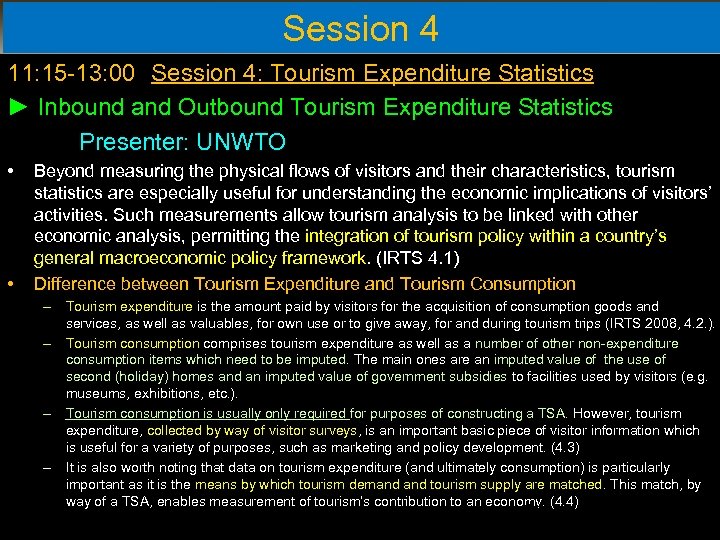 Session 4 11: 15 -13: 00 Session 4: Tourism Expenditure Statistics ► Inbound and Outbound Tourism Expenditure Statistics Presenter: UNWTO • • Beyond measuring the physical flows of visitors and their characteristics, tourism statistics are especially useful for understanding the economic implications of visitors’ activities. Such measurements allow tourism analysis to be linked with other economic analysis, permitting the integration of tourism policy within a country’s general macroeconomic policy framework. (IRTS 4. 1) Difference between Tourism Expenditure and Tourism Consumption – Tourism expenditure is the amount paid by visitors for the acquisition of consumption goods and services, as well as valuables, for own use or to give away, for and during tourism trips (IRTS 2008, 4. 2. ). – Tourism consumption comprises tourism expenditure as well as a number of other non-expenditure consumption items which need to be imputed. The main ones are an imputed value of the use of second (holiday) homes and an imputed value of government subsidies to facilities used by visitors (e. g. museums, exhibitions, etc. ). – Tourism consumption is usually only required for purposes of constructing a TSA. However, tourism expenditure, collected by way of visitor surveys, is an important basic piece of visitor information which is useful for a variety of purposes, such as marketing and policy development. (4. 3) – It is also worth noting that data on tourism expenditure (and ultimately consumption) is particularly important as it is the means by which tourism demand tourism supply are matched. This match, by way of a TSA, enables measurement of tourism’s contribution to an economy. (4. 4) 34
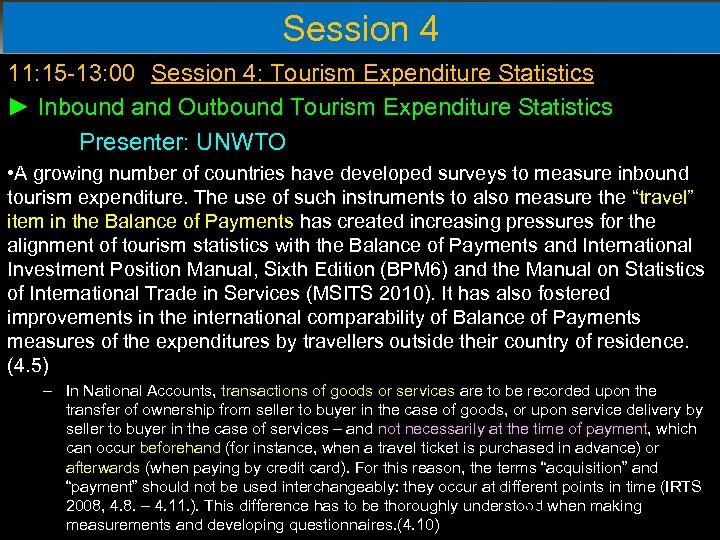 Session 4 11: 15 -13: 00 Session 4: Tourism Expenditure Statistics ► Inbound and Outbound Tourism Expenditure Statistics Presenter: UNWTO • A growing number of countries have developed surveys to measure inbound tourism expenditure. The use of such instruments to also measure the “travel” item in the Balance of Payments has created increasing pressures for the alignment of tourism statistics with the Balance of Payments and International Investment Position Manual, Sixth Edition (BPM 6) and the Manual on Statistics of International Trade in Services (MSITS 2010). It has also fostered improvements in the international comparability of Balance of Payments measures of the expenditures by travellers outside their country of residence. (4. 5) – In National Accounts, transactions of goods or services are to be recorded upon the transfer of ownership from seller to buyer in the case of goods, or upon service delivery by seller to buyer in the case of services – and not necessarily at the time of payment, which can occur beforehand (for instance, when a travel ticket is purchased in advance) or afterwards (when paying by credit card). For this reason, the terms “acquisition” and “payment” should not be used interchangeably: they occur at different points in time (IRTS 2008, 4. 8. – 4. 11. ). This difference has to be thoroughly understood when making 35 measurements and developing questionnaires. (4. 10)
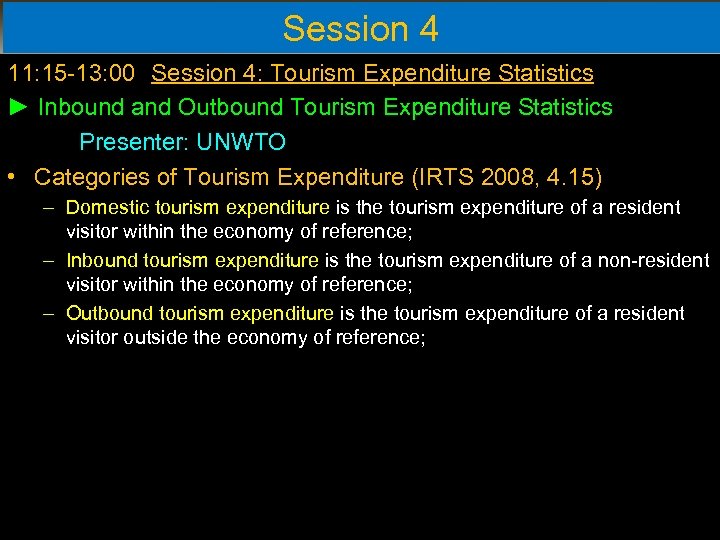 Session 4 11: 15 -13: 00 Session 4: Tourism Expenditure Statistics ► Inbound and Outbound Tourism Expenditure Statistics Presenter: UNWTO • Categories of Tourism Expenditure (IRTS 2008, 4. 15) – Domestic tourism expenditure is the tourism expenditure of a resident visitor within the economy of reference; – Inbound tourism expenditure is the tourism expenditure of a non-resident visitor within the economy of reference; – Outbound tourism expenditure is the tourism expenditure of a resident visitor outside the economy of reference; 36
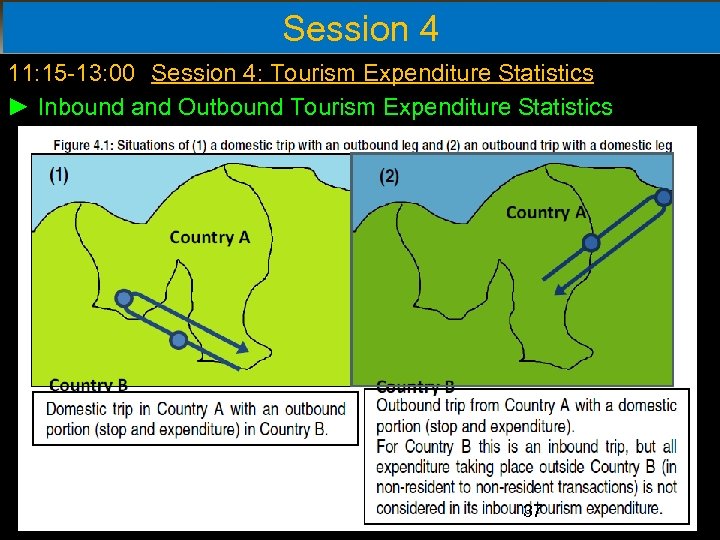 Session 4 11: 15 -13: 00 Session 4: Tourism Expenditure Statistics ► Inbound and Outbound Tourism Expenditure Statistics Presenter: UNWTO 37
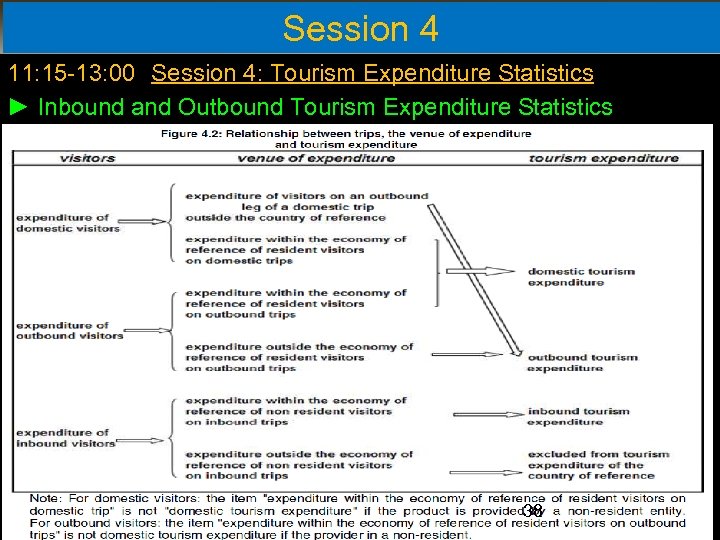 Session 4 11: 15 -13: 00 Session 4: Tourism Expenditure Statistics ► Inbound and Outbound Tourism Expenditure Statistics 38
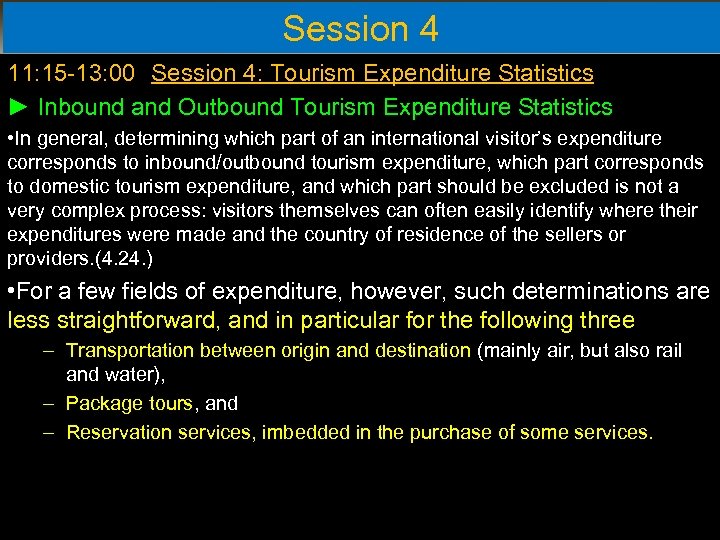 Session 4 11: 15 -13: 00 Session 4: Tourism Expenditure Statistics ► Inbound and Outbound Tourism Expenditure Statistics • In general, determining which part of an international visitor’s expenditure corresponds to inbound/outbound tourism expenditure, which part corresponds to domestic tourism expenditure, and which part should be excluded is not a very complex process: visitors themselves can often easily identify where their expenditures were made and the country of residence of the sellers or providers. (4. 24. ) • For a few fields of expenditure, however, such determinations are less straightforward, and in particular for the following three – Transportation between origin and destination (mainly air, but also rail and water), – Package tours, and – Reservation services, imbedded in the purchase of some services. 39
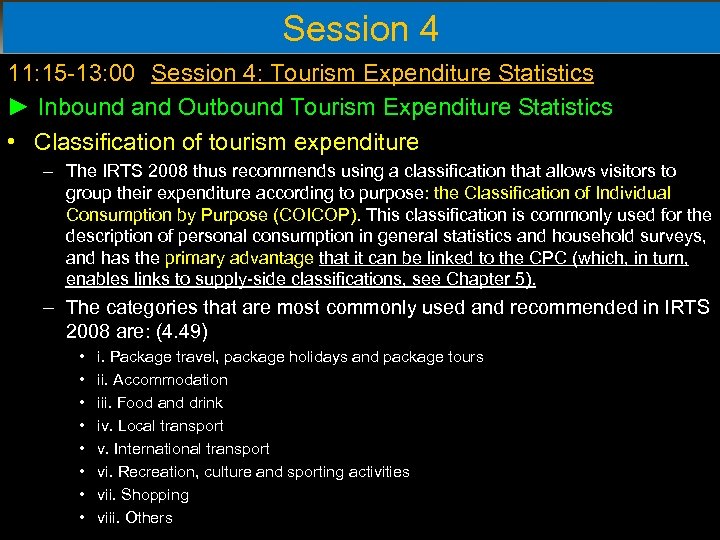 Session 4 11: 15 -13: 00 Session 4: Tourism Expenditure Statistics ► Inbound and Outbound Tourism Expenditure Statistics • Classification of tourism expenditure – The IRTS 2008 thus recommends using a classification that allows visitors to group their expenditure according to purpose: the Classification of Individual Consumption by Purpose (COICOP). This classification is commonly used for the description of personal consumption in general statistics and household surveys, and has the primary advantage that it can be linked to the CPC (which, in turn, enables links to supply-side classifications, see Chapter 5). – The categories that are most commonly used and recommended in IRTS 2008 are: (4. 49) • • i. Package travel, package holidays and package tours ii. Accommodation iii. Food and drink iv. Local transport v. International transport vi. Recreation, culture and sporting activities vii. Shopping viii. Others 40
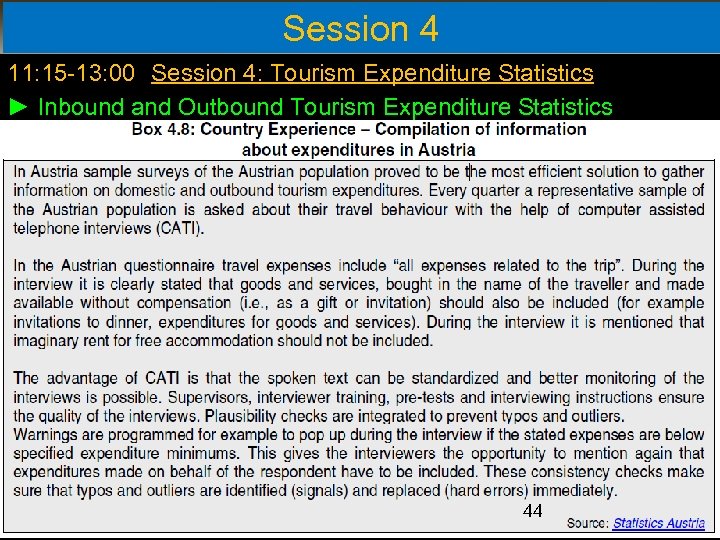
 Session 4 11: 15 -13: 00 Session 4: Tourism Expenditure Statistics ► Inbound and Outbound Tourism Expenditure Statistics • Measuring inbound tourism expenditure (4. 53) – The most common and rigorous method of observing expenditure by non -resident visitors is to survey them as they leave the country (see Chapter 3, Section C. 2. 2. 1). The following methods are used to observe inbound tourism expenditure. It should be noted that the following discussions on border surveys, surveys at accommodation or tourism sites, or the use of electronic prints contain elements of relevance to also the measurement of domestic and outbound tourism expenditure. 41
 Session 4 11: 15 -13: 00 Session 4: Tourism Expenditure Statistics ► Inbound and Outbound Tourism Expenditure Statistics 42
 Session 4 11: 15 -13: 00 Session 4: Tourism Expenditure Statistics ► Inbound and Outbound Tourism Expenditure Statistics • Measuring outbound tourism expenditure (4. 72). – As mentioned in connection with the measurement of visitor flows (Chapter 3), outbound tourism expenditure can be measured at or near the border as outbound visitors return from their trip or, as in the case of domestic tourism expenditure, through the use of household-type surveys. – Under certain conditions, the measurements of a country’s outbound tourism expenditure obtained through a household-type survey can be used directly or as an input for the measurement of inbound tourism expenditure in the countries visited. This is often referred to as the use of mirror statistics (see Chapter 3, Section C. 2. 2. 4). 43
 Session 4 11: 15 -13: 00 Session 4: Tourism Expenditure Statistics ► Inbound and Outbound Tourism Expenditure Statistics 44
 Session 4 11: 15 -13: 00 Session 4: Tourism Expenditure Statistics ► Inbound and Outbound Tourism Expenditure Statistics [Advanced Topic] • Tourism expenditure classified in the National Accounts as intermediate consumption – SNA 2008 all purchases of goods and services by employees on business trips = should be classified as intermediate consumption – IRTS 2008 making no distinction between the macroeconomic concepts of “intermediate consumption” and “final consumption”, as long as the direct beneficiary of the expenditure is the visitor (IRTS 2008, 4. 5. ) • Regarding inbound and outbound tourism expenditure, and because some countries still do not compile tourism data, UNWTO uses data from the Balance of Payments rather than tourism data to support as much as possible international comparisons. However useful in this sense, Balance of Payments data should not be used in the overall tabulation of tourism statistics and should never be considered a substitute for tourism statistics. It is expected that, in time and as countries develop their Systems of Tourism Statistics, it will become possible to collect the countries’ actual inbound and 45 outbound tourism expenditure data.
 Session 4: Country Presentations 11: 15 -13: 00 Session 4: Tourism Expenditure Statistics ► Experiences on Application of Inbound and Outbound Tourism Expenditure Surveys • Suriname: (3 presentations) – Estimating Travel Account in the BOP of Suriname – Process of Data Collection in Suriname – Tourism Data Suriname • Turkey: – Tourism Income and Expense in Turkey 46
 Session 5: Overview 14: 30 -16: 00 Session 5: Domestic Tourism Statistics ► Domestic Tourism Statistics Presenter: UNWTO ► Measuring Domestic Tourism Statistics – Type of Tools and Procedures Applied Country presentations ► Q&A Session 47
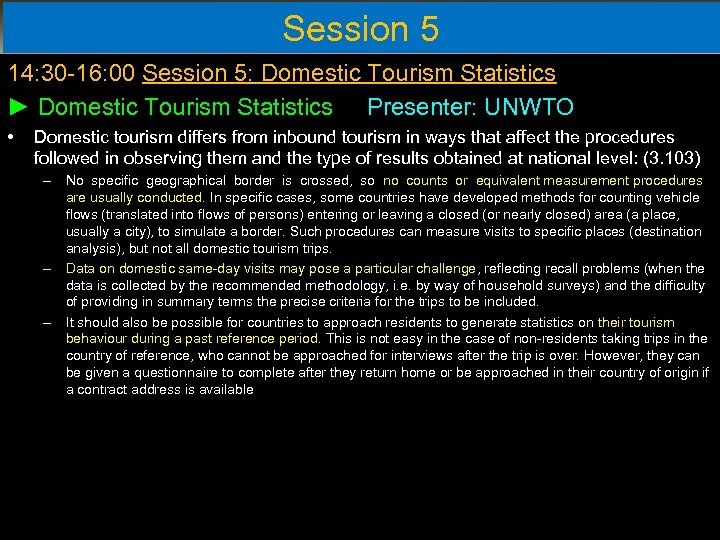 Session 5 14: 30 -16: 00 Session 5: Domestic Tourism Statistics ► Domestic Tourism Statistics Presenter: UNWTO • Domestic tourism differs from inbound tourism in ways that affect the procedures followed in observing them and the type of results obtained at national level: (3. 103) – No specific geographical border is crossed, so no counts or equivalent measurement procedures are usually conducted. In specific cases, some countries have developed methods for counting vehicle flows (translated into flows of persons) entering or leaving a closed (or nearly closed) area (a place, usually a city), to simulate a border. Such procedures can measure visits to specific places (destination analysis), but not all domestic tourism trips. – Data on domestic same-day visits may pose a particular challenge, reflecting recall problems (when the data is collected by the recommended methodology, i. e. by way of household surveys) and the difficulty of providing in summary terms the precise criteria for the trips to be included. – It should also be possible for countries to approach residents to generate statistics on their tourism behaviour during a past reference period. This is not easy in the case of non-residents taking trips in the country of reference, who cannot be approached for interviews after the trip is over. However, they can be given a questionnaire to complete after they return home or be approached in their country of origin if a contract address is available 48
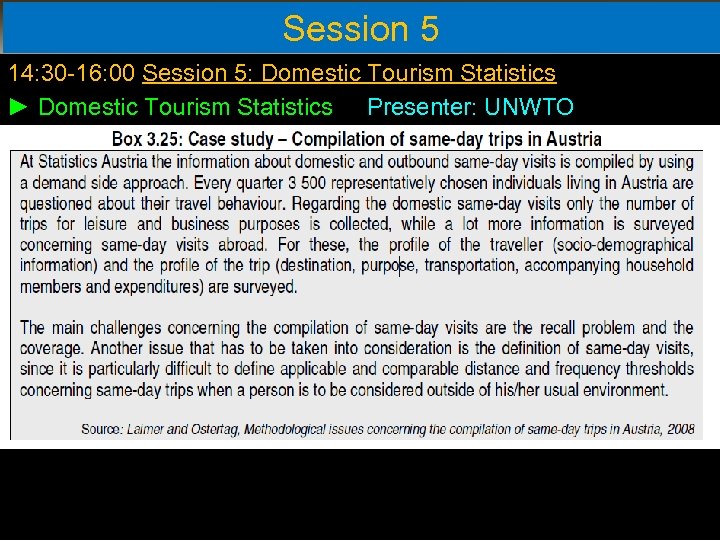 Session 5 14: 30 -16: 00 Session 5: Domestic Tourism Statistics ► Domestic Tourism Statistics Presenter: UNWTO 49
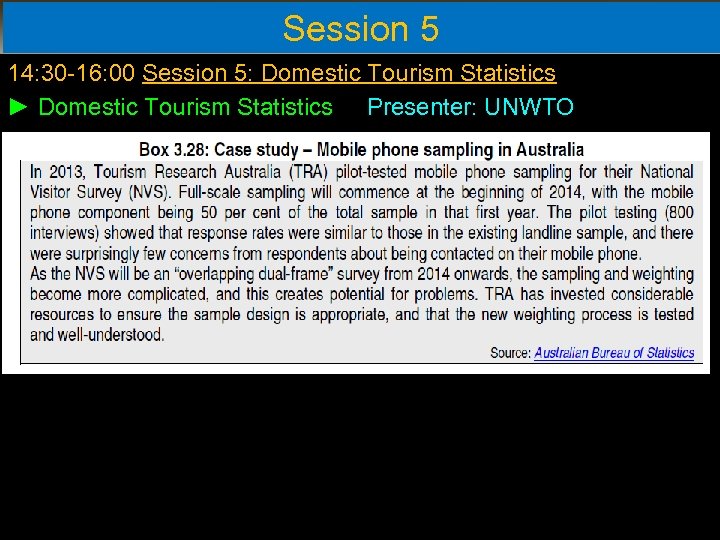 Session 5 14: 30 -16: 00 Session 5: Domestic Tourism Statistics ► Domestic Tourism Statistics Presenter: UNWTO 50
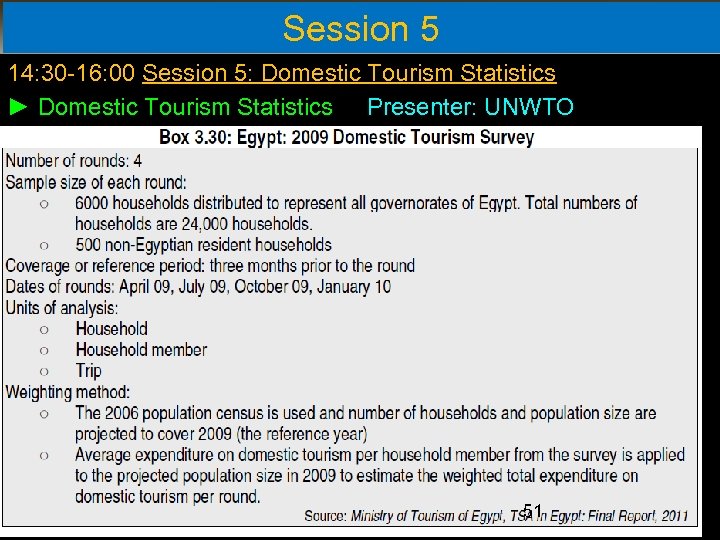 Session 5 14: 30 -16: 00 Session 5: Domestic Tourism Statistics ► Domestic Tourism Statistics Presenter: UNWTO 51
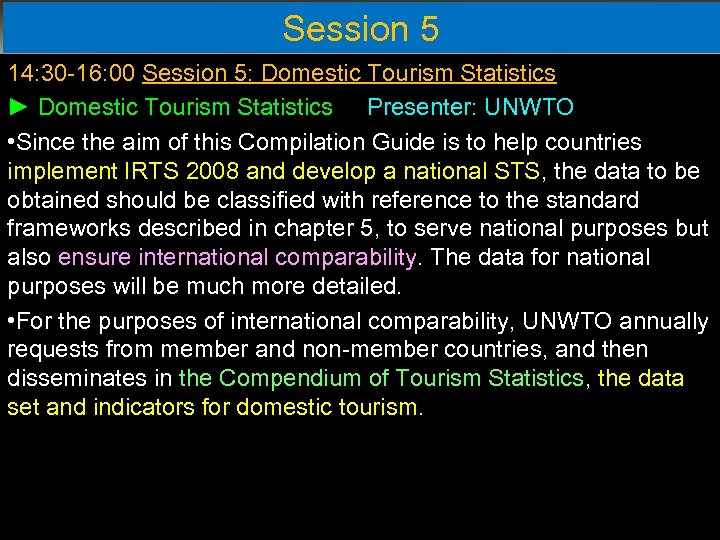 Session 5 14: 30 -16: 00 Session 5: Domestic Tourism Statistics ► Domestic Tourism Statistics Presenter: UNWTO • Since the aim of this Compilation Guide is to help countries implement IRTS 2008 and develop a national STS, the data to be obtained should be classified with reference to the standard frameworks described in chapter 5, to serve national purposes but also ensure international comparability. The data for national purposes will be much more detailed. • For the purposes of international comparability, UNWTO annually requests from member and non-member countries, and then disseminates in the Compendium of Tourism Statistics, the data set and indicators for domestic tourism. 52
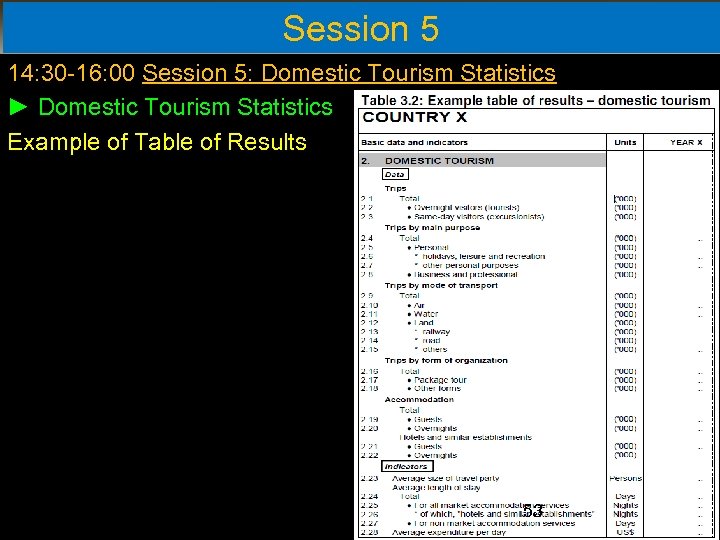 Session 5 14: 30 -16: 00 Session 5: Domestic Tourism Statistics ► Domestic Tourism Statistics Presenter: UNWTO Example of Table of Results 53
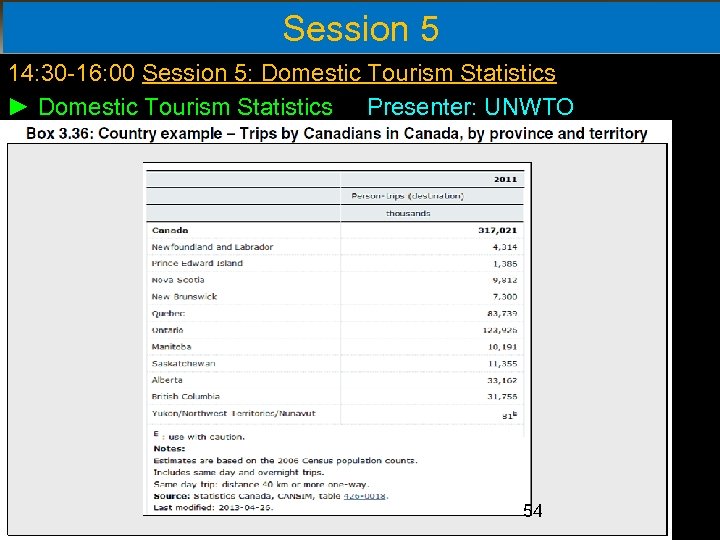 Session 5 14: 30 -16: 00 Session 5: Domestic Tourism Statistics ► Domestic Tourism Statistics Presenter: UNWTO 54
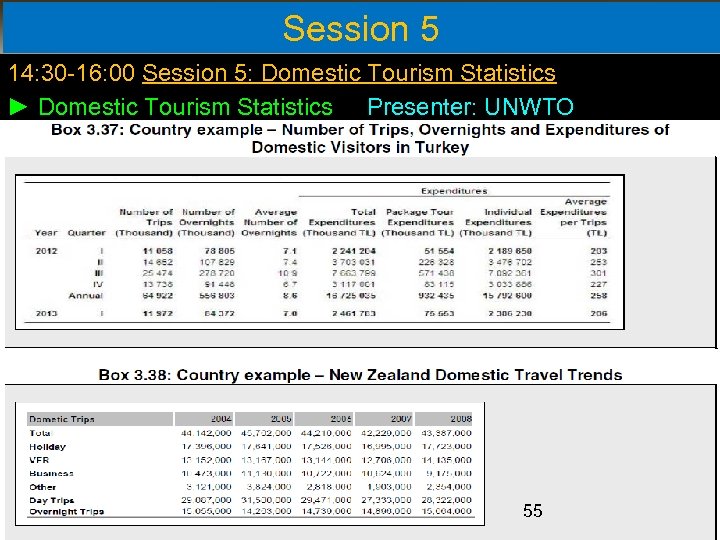 Session 5 14: 30 -16: 00 Session 5: Domestic Tourism Statistics ► Domestic Tourism Statistics Presenter: UNWTO 55
 Session 5: Country Presentations 14: 30 -16: 00 Session 5: Domestic Tourism Statistics ► Measuring Domestic Tourism Statistics – Type of Tools and Procedures Applied • Indonesia: – Domestics Tourism Statistics • Turkey: – Domestic Tourism Statistics in Turkey 56
 Session 6: Overview 16: 15 -18: 00 Session 6: Tourism Industries Statistics ► Measuring the Supply of Tourism Industries Presenter: UNWTO ► Tourism Industries Statistics Country presentations ► Q&A Session 57
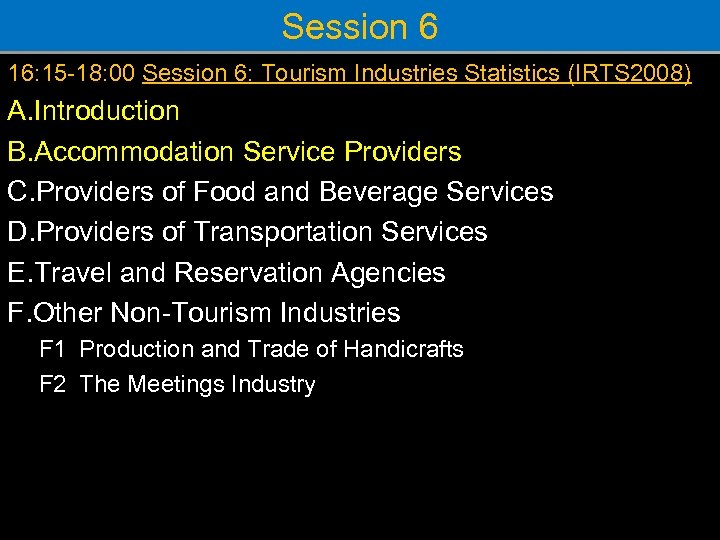 Session 6 16: 15 -18: 00 Session 6: Tourism Industries Statistics (IRTS 2008) A. Introduction B. Accommodation Service Providers C. Providers of Food and Beverage Services D. Providers of Transportation Services E. Travel and Reservation Agencies F. Other Non-Tourism Industries F 1 Production and Trade of Handicrafts F 2 The Meetings Industry 58
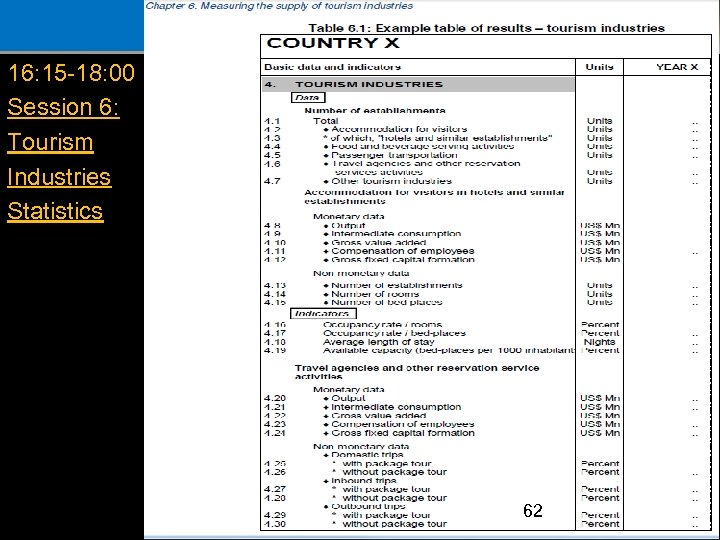
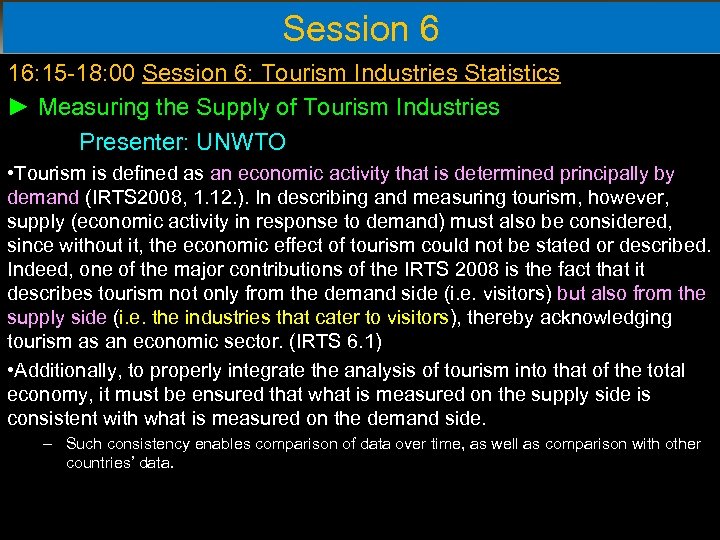 Session 6 16: 15 -18: 00 Session 6: Tourism Industries Statistics ► Measuring the Supply of Tourism Industries Presenter: UNWTO • Tourism is defined as an economic activity that is determined principally by demand (IRTS 2008, 1. 12. ). In describing and measuring tourism, however, supply (economic activity in response to demand) must also be considered, since without it, the economic effect of tourism could not be stated or described. Indeed, one of the major contributions of the IRTS 2008 is the fact that it describes tourism not only from the demand side (i. e. visitors) but also from the supply side (i. e. the industries that cater to visitors), thereby acknowledging tourism as an economic sector. (IRTS 6. 1) • Additionally, to properly integrate the analysis of tourism into that of the total economy, it must be ensured that what is measured on the supply side is consistent with what is measured on the demand side. – Such consistency enables comparison of data over time, as well as comparison with other countries’ data. 59
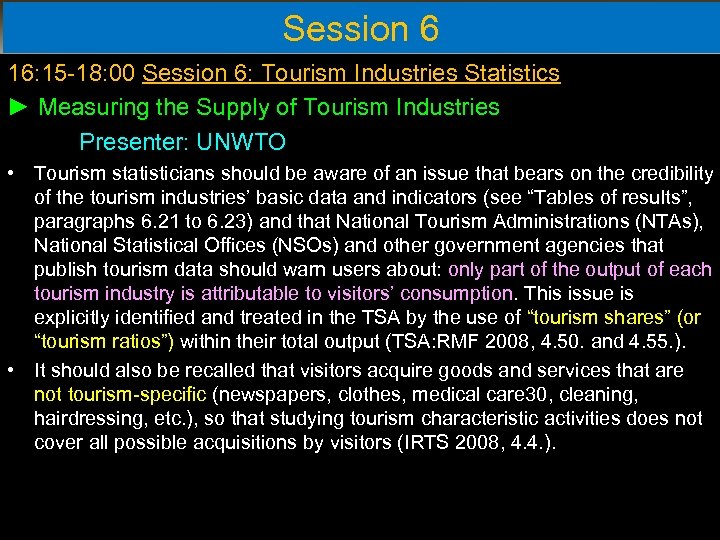 Session 6 16: 15 -18: 00 Session 6: Tourism Industries Statistics ► Measuring the Supply of Tourism Industries Presenter: UNWTO • Tourism statisticians should be aware of an issue that bears on the credibility of the tourism industries’ basic data and indicators (see “Tables of results”, paragraphs 6. 21 to 6. 23) and that National Tourism Administrations (NTAs), National Statistical Offices (NSOs) and other government agencies that publish tourism data should warn users about: only part of the output of each tourism industry is attributable to visitors’ consumption. This issue is explicitly identified and treated in the TSA by the use of “tourism shares” (or “tourism ratios”) within their total output (TSA: RMF 2008, 4. 50. and 4. 55. ). • It should also be recalled that visitors acquire goods and services that are not tourism-specific (newspapers, clothes, medical care 30, cleaning, hairdressing, etc. ), so that studying tourism characteristic activities does not cover all possible acquisitions by visitors (IRTS 2008, 4. 4. ). 60
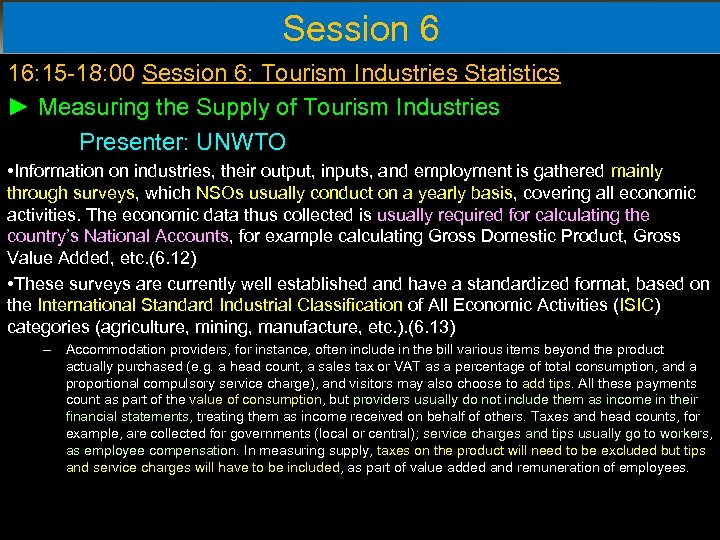 Session 6 16: 15 -18: 00 Session 6: Tourism Industries Statistics ► Measuring the Supply of Tourism Industries Presenter: UNWTO • Information on industries, their output, inputs, and employment is gathered mainly through surveys, which NSOs usually conduct on a yearly basis, covering all economic activities. The economic data thus collected is usually required for calculating the country’s National Accounts, for example calculating Gross Domestic Product, Gross Value Added, etc. (6. 12) • These surveys are currently well established and have a standardized format, based on the International Standard Industrial Classification of All Economic Activities (ISIC) categories (agriculture, mining, manufacture, etc. ). (6. 13) – Accommodation providers, for instance, often include in the bill various items beyond the product actually purchased (e. g. a head count, a sales tax or VAT as a percentage of total consumption, and a proportional compulsory service charge), and visitors may also choose to add tips. All these payments count as part of the value of consumption, but providers usually do not include them as income in their financial statements, treating them as income received on behalf of others. Taxes and head counts, for example, are collected for governments (local or central); service charges and tips usually go to workers, as employee compensation. In measuring supply, taxes on the product will need to be excluded but tips and service charges will have to be included, as part of value added and remuneration of employees. 61
 Session 6 16: 15 -18: 00 Session 6: Tourism Industries Statistics 62
 Session 6 16: 15 -18: 00 Session 6: Tourism Industries Statistics Indicators: Accommodations • Besides the usual economic variables (output, value added, employment, consumption, investment), which are common to most economic activities, various other indicators have been developed over the years and are frequently used to assess the performance of accommodation establishments and of tourism policy: – – – – – Room occupancy rates (gross or net) Bed-place occupancy rates (gross or net) Average number of persons per room Average room rate Average revenue per room night Average revenue per guest night (Average) revenue per available room (REVPAR) Employees per room Average wage per employee Revenue per employee 63
 Session 6 16: 15 -18: 00 Session 6: Tourism Industries Statistics Indicators: Accommodations 64
 Session 6 16: 15 -18: 00 Session 6: Tourism Industries Statistics Providers of non-market accommodation services for own final use: owner-occupied vacation homes and timeshares • Regarding the “classical” owner-occupied vacation home, the first issue for a country is to identify dwellings used for that purpose, a task for tourism statisticians. The second issue is then to associate with such dwellings an imputed annual rent that represents the value of the service. This value would be an estimation of a tourism product. This task is the responsibility of national accountants when developing a TSA. The UN recommendation for housing censuses indicates how countries should identify dwellings not intended for year-round occupancy (see Box 6. 5). • The recommended classification of occupancy status for conventional dwellings is as follows: – 1 Occupied – 2 Vacant – 2. 1 Seasonally vacant • • • 2. 1. 1 Holiday homes 2. 1. 2 Seasonal workers’ quarters 2. 1. 3 Other – 2. 2 Non-seasonally vacant • • • 2. 2. 1 Secondary residences 2. 2. 2 For rent 2. 2. 3 For sale 2. 2. 4 For demolition 2. 2. 5 Other 65
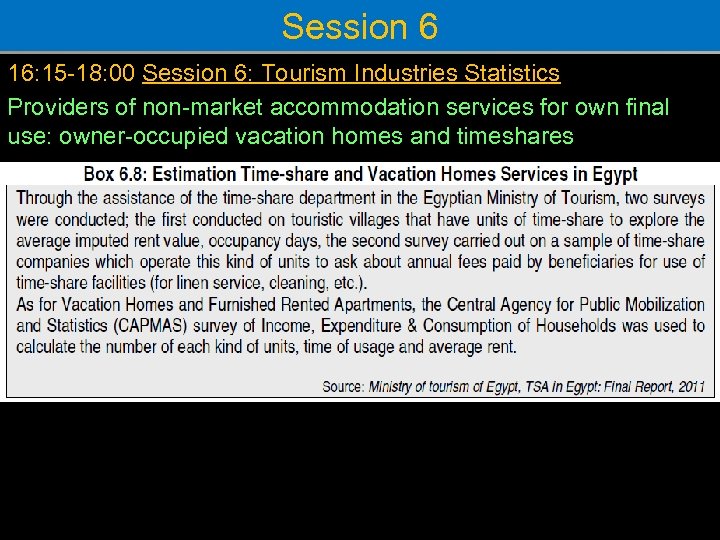 Session 6 16: 15 -18: 00 Session 6: Tourism Industries Statistics Providers of non-market accommodation services for own final use: owner-occupied vacation homes and timeshares 66
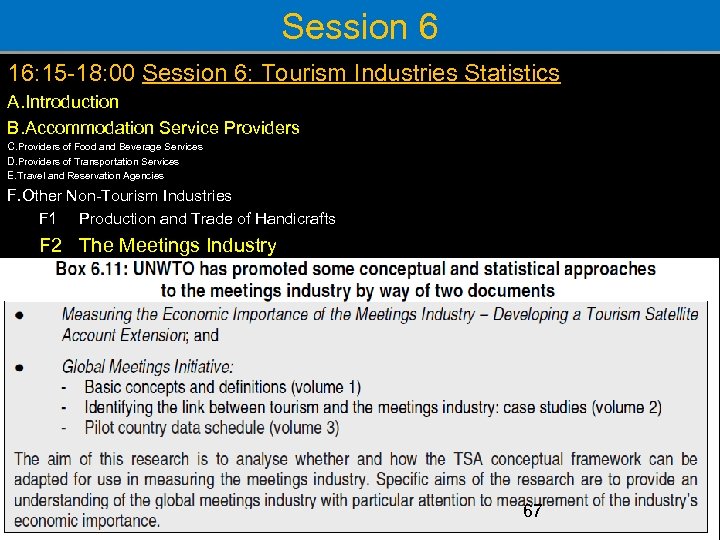 Session 6 16: 15 -18: 00 Session 6: Tourism Industries Statistics A. Introduction B. Accommodation Service Providers C. Providers of Food and Beverage Services D. Providers of Transportation Services E. Travel and Reservation Agencies F. Other Non-Tourism Industries F 1 Production and Trade of Handicrafts F 2 The Meetings Industry 67
 Session 6: Country Presentations 16: 15 -18: 00 Session 6: Tourism Industries Statistics ►Tourism Industries Statistics • Chad: – Tourism Industries Statistics • Egypt: – Tourism Industries Statistics • Iran: – Tourism Industries Statistics • Sudan: – Tourism Industries Statistics 68
 Day 3: The Last Day of Workshop 69
 Session 7: Overview 09: 00 -11: 00 Session 7: Employment in the Tourism Industries ► Measuring Employment in the Tourism Industries Presenter: UNWTO ► Current Country Practices in Measuring Employment in the Tourism Industries Country presentations ► Q&A Session 70
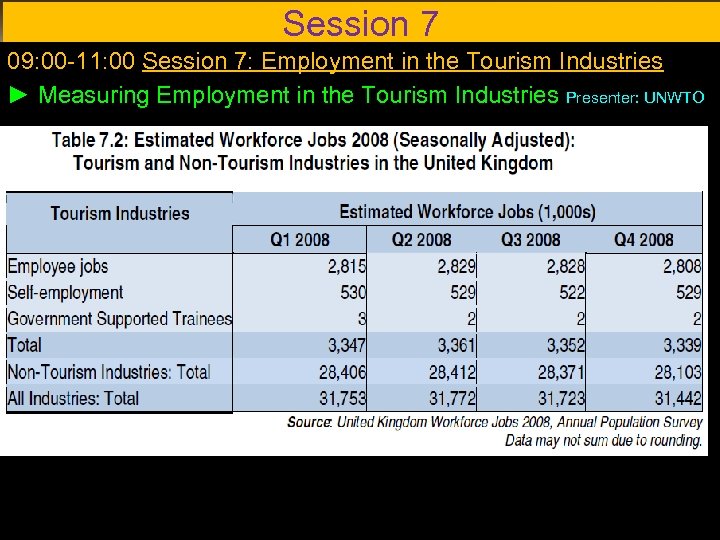
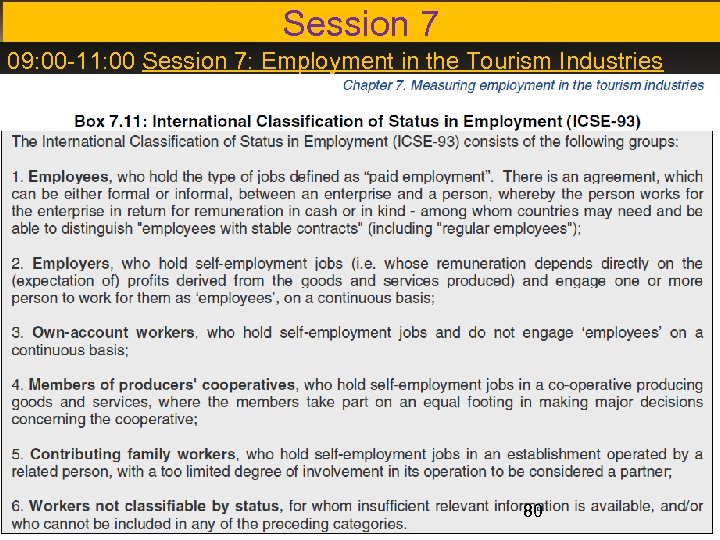
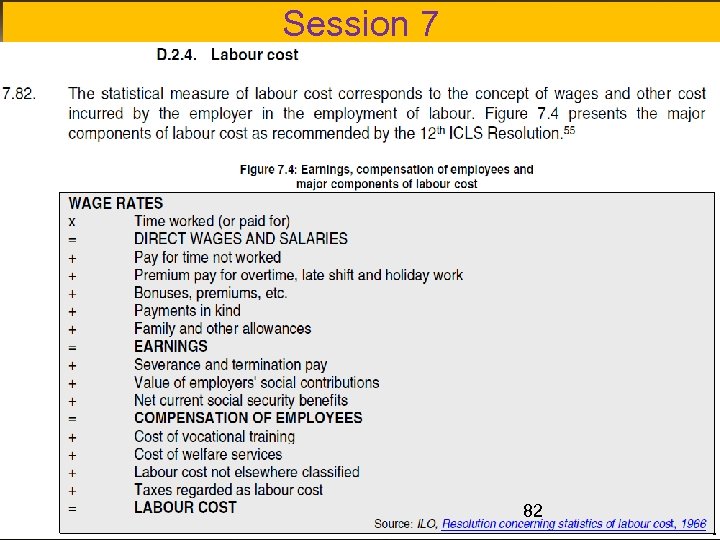
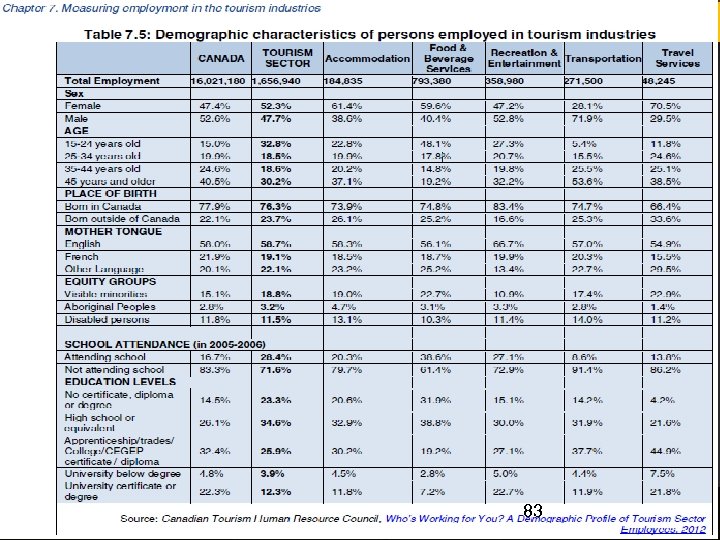
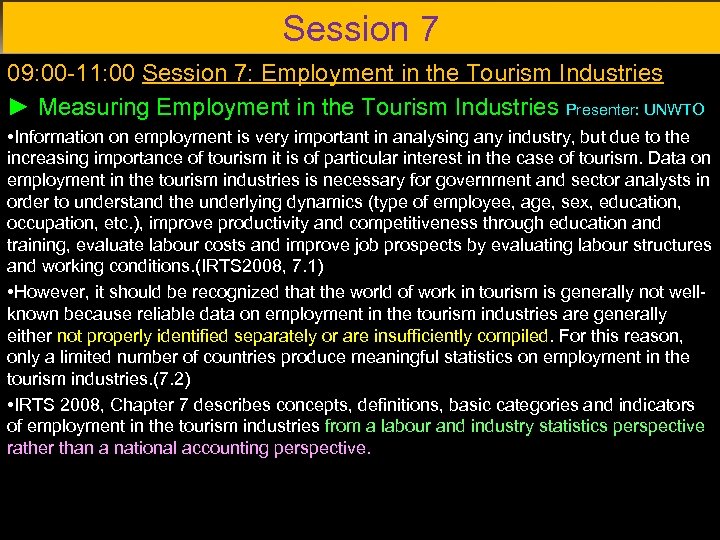 Session 7 09: 00 -11: 00 Session 7: Employment in the Tourism Industries ► Measuring Employment in the Tourism Industries Presenter: UNWTO • Information on employment is very important in analysing any industry, but due to the increasing importance of tourism it is of particular interest in the case of tourism. Data on employment in the tourism industries is necessary for government and sector analysts in order to understand the underlying dynamics (type of employee, age, sex, education, occupation, etc. ), improve productivity and competitiveness through education and training, evaluate labour costs and improve job prospects by evaluating labour structures and working conditions. (IRTS 2008, 7. 1) • However, it should be recognized that the world of work in tourism is generally not wellknown because reliable data on employment in the tourism industries are generally either not properly identified separately or are insufficiently compiled. For this reason, only a limited number of countries produce meaningful statistics on employment in the tourism industries. (7. 2) • IRTS 2008, Chapter 7 describes concepts, definitions, basic categories and indicators of employment in the tourism industries from a labour and industry statistics perspective rather than a national accounting perspective. 71
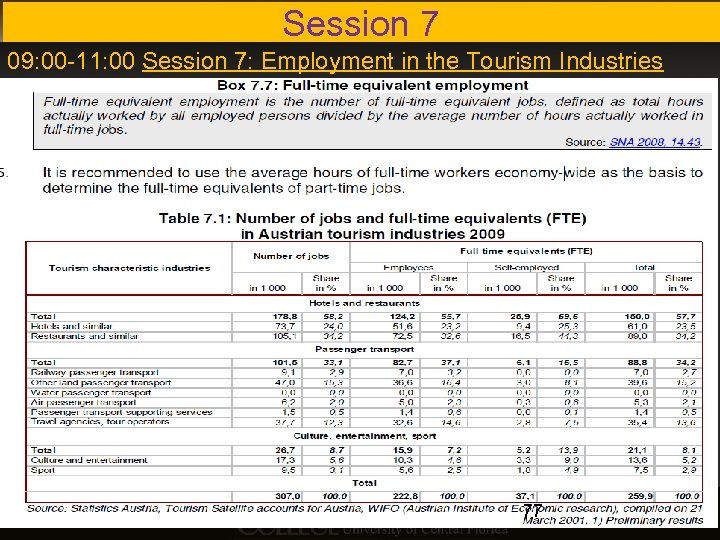
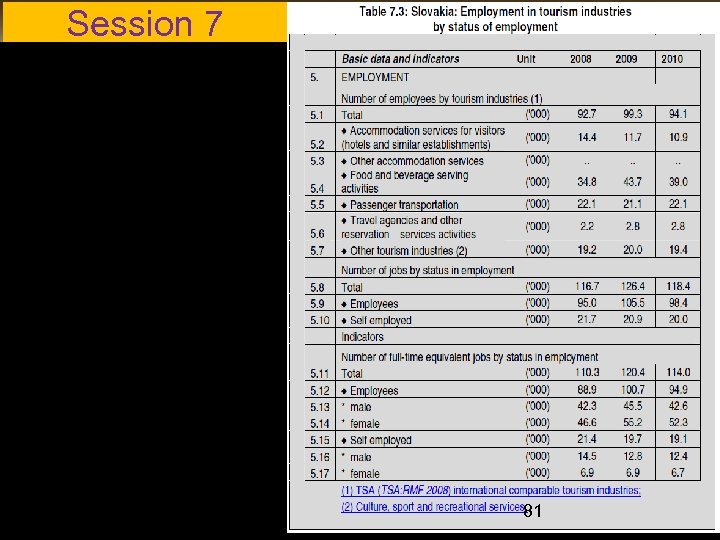
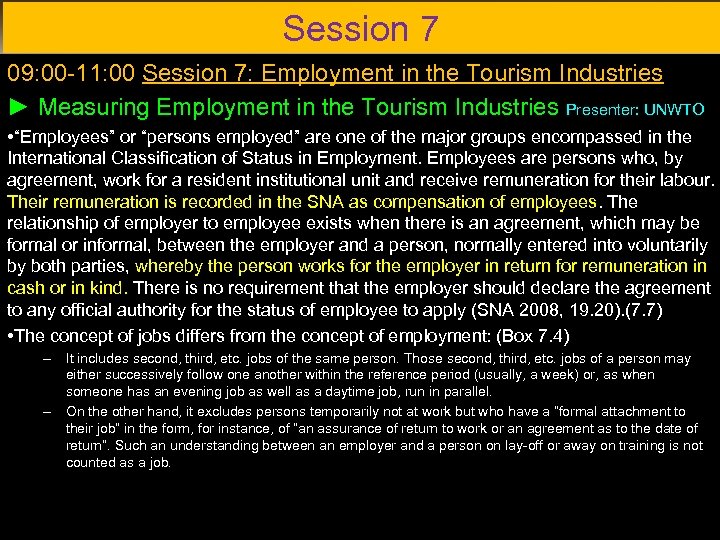 Session 7 09: 00 -11: 00 Session 7: Employment in the Tourism Industries ► Measuring Employment in the Tourism Industries Presenter: UNWTO • “Employees” or “persons employed” are one of the major groups encompassed in the International Classification of Status in Employment. Employees are persons who, by agreement, work for a resident institutional unit and receive remuneration for their labour. Their remuneration is recorded in the SNA as compensation of employees. The relationship of employer to employee exists when there is an agreement, which may be formal or informal, between the employer and a person, normally entered into voluntarily by both parties, whereby the person works for the employer in return for remuneration in cash or in kind. There is no requirement that the employer should declare the agreement to any official authority for the status of employee to apply (SNA 2008, 19. 20). (7. 7) • The concept of jobs differs from the concept of employment: (Box 7. 4) – It includes second, third, etc. jobs of the same person. Those second, third, etc. jobs of a person may either successively follow one another within the reference period (usually, a week) or, as when someone has an evening job as well as a daytime job, run in parallel. – On the other hand, it excludes persons temporarily not at work but who have a “formal attachment to their job” in the form, for instance, of “an assurance of return to work or an agreement as to the date of return”. Such an understanding between an employer and a person on lay-off or away on training is not counted as a job. 72
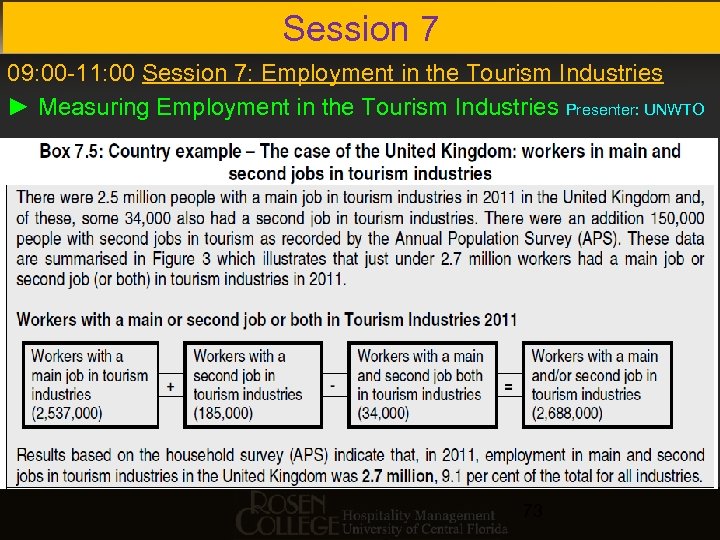 Session 7 09: 00 -11: 00 Session 7: Employment in the Tourism Industries ► Measuring Employment in the Tourism Industries Presenter: UNWTO 73
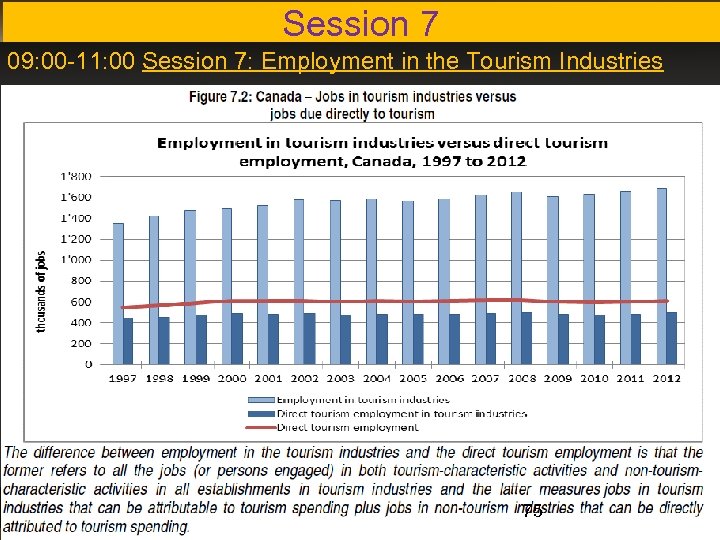
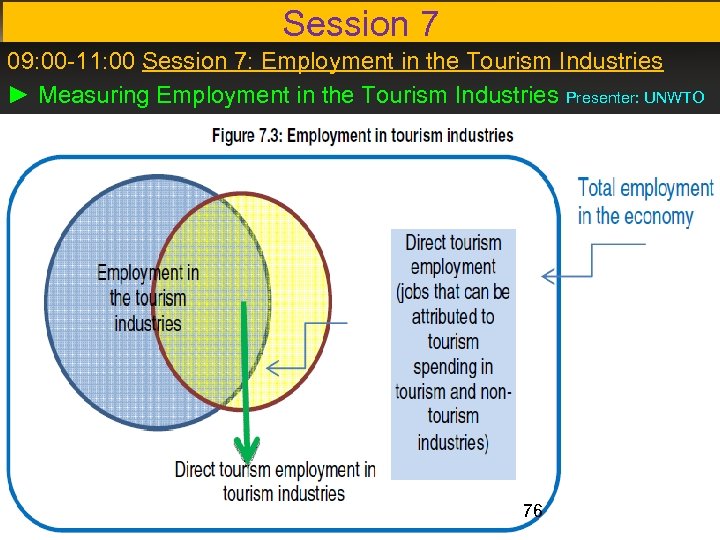
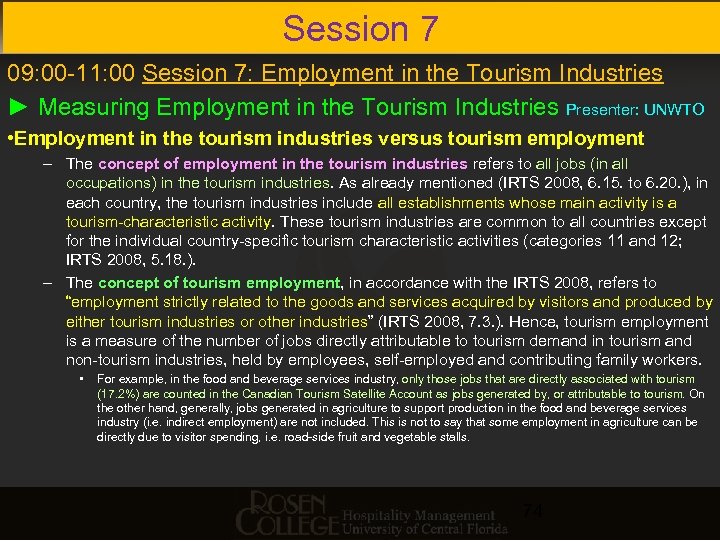 Session 7 09: 00 -11: 00 Session 7: Employment in the Tourism Industries ► Measuring Employment in the Tourism Industries Presenter: UNWTO • Employment in the tourism industries versus tourism employment – The concept of employment in the tourism industries refers to all jobs (in all occupations) in the tourism industries. As already mentioned (IRTS 2008, 6. 15. to 6. 20. ), in each country, the tourism industries include all establishments whose main activity is a tourism-characteristic activity. These tourism industries are common to all countries except for the individual country-specific tourism characteristic activities (categories 11 and 12; IRTS 2008, 5. 18. ). – The concept of tourism employment, in accordance with the IRTS 2008, refers to “employment strictly related to the goods and services acquired by visitors and produced by either tourism industries or other industries” (IRTS 2008, 7. 3. ). Hence, tourism employment is a measure of the number of jobs directly attributable to tourism demand in tourism and non-tourism industries, held by employees, self-employed and contributing family workers. • For example, in the food and beverage services industry, only those jobs that are directly associated with tourism (17. 2%) are counted in the Canadian Tourism Satellite Account as jobs generated by, or attributable to tourism. On the other hand, generally, jobs generated in agriculture to support production in the food and beverage services industry (i. e. indirect employment) are not included. This is not to say that some employment in agriculture can be directly due to visitor spending, i. e. road-side fruit and vegetable stalls. 74
 Session 7 09: 00 -11: 00 Session 7: Employment in the Tourism Industries ► Measuring Employment in the Tourism Industries Presenter: UNWTO 75
 Session 7 09: 00 -11: 00 Session 7: Employment in the Tourism Industries ► Measuring Employment in the Tourism Industries Presenter: UNWTO 76
 Session 7 09: 00 -11: 00 Session 7: Employment in the Tourism Industries ► Measuring Employment in the Tourism Industries Presenter: UNWTO 77
 Session 7 09: 00 -11: 00 Session 7: Employment in the Tourism Industries ► Measuring Employment in the Tourism Industries Presenter: UNWTO • International Standard Classification of Occupations (ISCO-08) – Occupation refers to the kind of work done during the reference period by the person employed (or the kind of work done previously if unemployed). Information on occupation provides a description of a person’s job. In the present context a job is defined as a set of tasks and duties performed, or meant to be performed, by one person, including for an employer or in self-employment. – 7. 39. The International Standard Classification of Occupations (ISCO-08) provides a system for classifying and aggregating occupational information obtained by means of statistical censuses and surveys, as well as from administrative records. – 7. 40. ISCO-08 is a four-level hierarchically structured classification that allows all jobs in the world to be classified into 436 unit groups. These groups form the most detailed level of the classification structure and are aggregated into 130 minor groups, 43 sub-major groups and 10 major groups, based on the similarity of the skill level and skill specialization required. 78
 Session 7 09: 00 -11: 00 Session 7: Employment in the Tourism Industries ► Measuring Employment in the Tourism Industries Presenter: UNWTO 79
 Session 7 09: 00 -11: 00 Session 7: Employment in the Tourism Industries ► Measuring Employment in the Tourism Industries Presenter: UNWTO 80
 Session 7 81
 Session 7 09: 00 -11: 00 Session 7: Employment in the Tourism Industries ► Measuring Employment in the Tourism Industries Presenter: UNWTO 82
 Session 7 09: 00 -11: 00 Session 7: Employment in the Tourism Industries ► Measuring Employment in the Tourism Industries Presenter: UNWTO 83
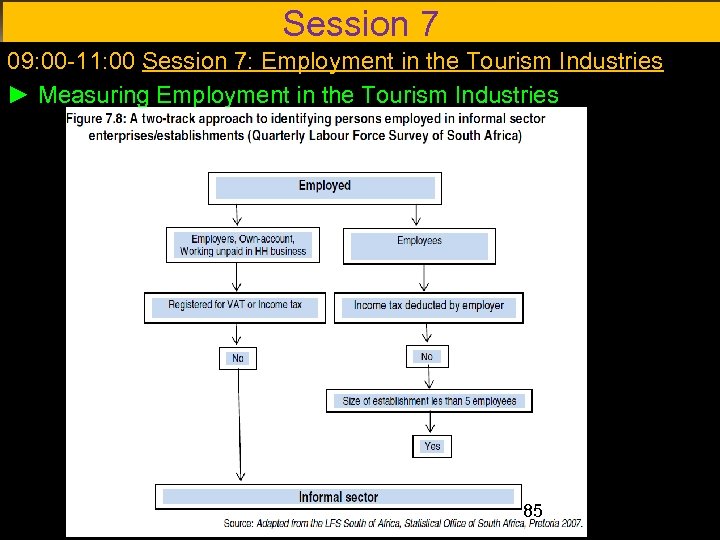
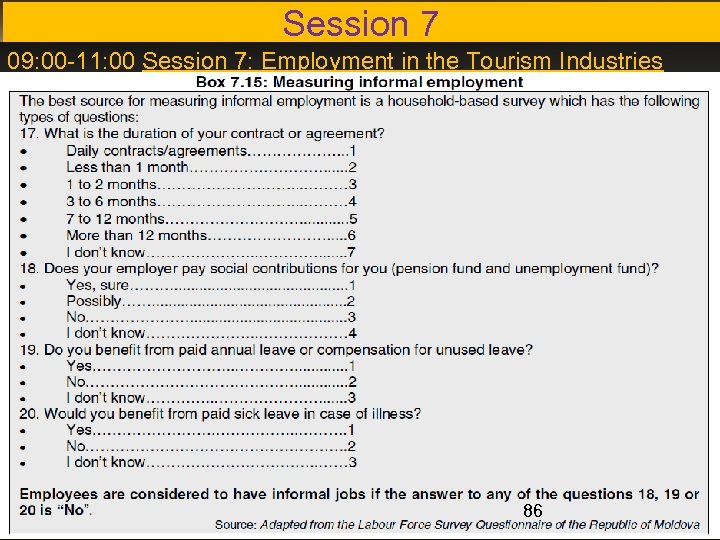
 Session 7 09: 00 -11: 00 Session 7: Employment in the Tourism Industries ► Measuring Employment in the Tourism Industries • Collecting information on working time arrangements, informal employment and employment in the informal sector – Existing surveys of the economically active population and similar household surveys provide a useful and economical means of collecting data on employment in the informal sector in terms of the number and characteristics of the persons concerned and the conditions of their employment and work. Usually such survey can cover all information with regard to the related aspects of working time arrangements, informal employment and employment in the informal sector – By way of illustration Figure 7. 8 below shows a two-track approach to identifying persons employed in informal sector enterprise/establishment and Box 7. 15 show questions from a household survey. 84
 Session 7 09: 00 -11: 00 Session 7: Employment in the Tourism Industries ► Measuring Employment in the Tourism Industries 85
 Session 7 09: 00 -11: 00 Session 7: Employment in the Tourism Industries ► Measuring Employment in the Tourism Industries 86
 Session 7: Country Presentations 09: 00 -11: 00 Session 7: Employment in the Tourism Industries ► Current Country Practices in Measuring Employment in the Tourism Industries • Sudan: – National System of Tourism Statistics • Yemen: – National System of Tourism Statistics 87
 Session 8: Overview 11: 15 -13: 00 Session 8: Tourism Satellite Accounts (TSA) ► Towards TSA – Methodological Aspects and TSA Applications Presenter: UNWTO ► Current Country Practices in TSA Country presentations ► Q&A Session 88
 Session 8 11: 15 -13: 00 Session 8: Tourism Satellite Accounts (TSA) ► Towards TSA – Methodological Aspects and TSA Applications Presenter: UNWTO 89
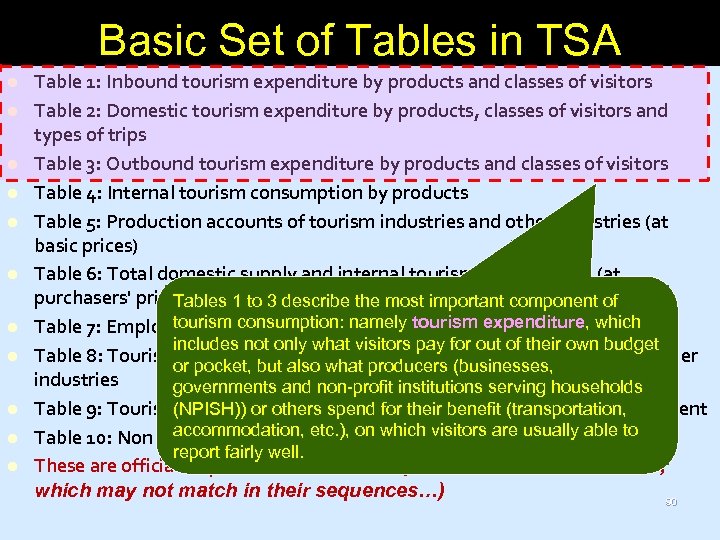 Basic Set of Tables in TSA l l l Table 1: Inbound tourism expenditure by products and classes of visitors Table 2: Domestic tourism expenditure by products, classes of visitors and types of trips Table 3: Outbound tourism expenditure by products and classes of visitors Table 4: Internal tourism consumption by products Table 5: Production accounts of tourism industries and other industries (at basic prices) Table 6: Total domestic supply and internal tourism consumption (at purchasers' prices) Tables 1 to 3 describe the most important component of tourism the tourism namely tourism expenditure, which Table 7: Employment inconsumption: industries includes not only what visitors pay for out of their own budget Table 8: Tourism gross fixed capital formation of (businesses, tourism industries and other or pocket, but also what producers industries governments and non-profit institutions serving households Table 9: Tourism collective consumptionfor their benefit (transportation, (NPISH)) or others spend by products and levels of government accommodation, etc. ), Table 10: Non monetary indicators on which visitors are usually able to report fairly well. These are official sequences of TSA tables! (What I cover is US version, which may not match in their sequences…) 90
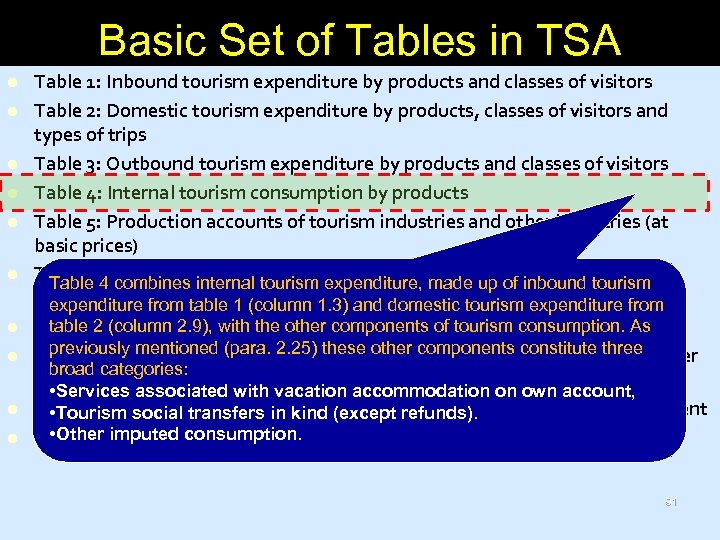 Basic Set of Tables in TSA l l l l l Table 1: Inbound tourism expenditure by products and classes of visitors Table 2: Domestic tourism expenditure by products, classes of visitors and types of trips Table 3: Outbound tourism expenditure by products and classes of visitors Table 4: Internal tourism consumption by products Table 5: Production accounts of tourism industries and other industries (at basic prices) Table 6: 4 Total domestic supply and internal tourism up of inbound tourism Table combines internal tourism expenditure, made consumption (at purchasers' prices)table 1 (column 1. 3) and domestic tourism expenditure from table 2 (column 2. 9), in the tourism industries Table 7: Employmentwith the other components of tourism consumption. As previously mentioned fixed capital formation of tourism industries and Table 8: Tourism gross(para. 2. 25) these other components constitute three other broad categories: industries • Services associated with vacation accommodation on own account, Table 9: Tourism collective consumption by products and levels of government • Tourism social transfers in kind (except refunds). • Other Non monetary indicators Table 10: imputed consumption. 91
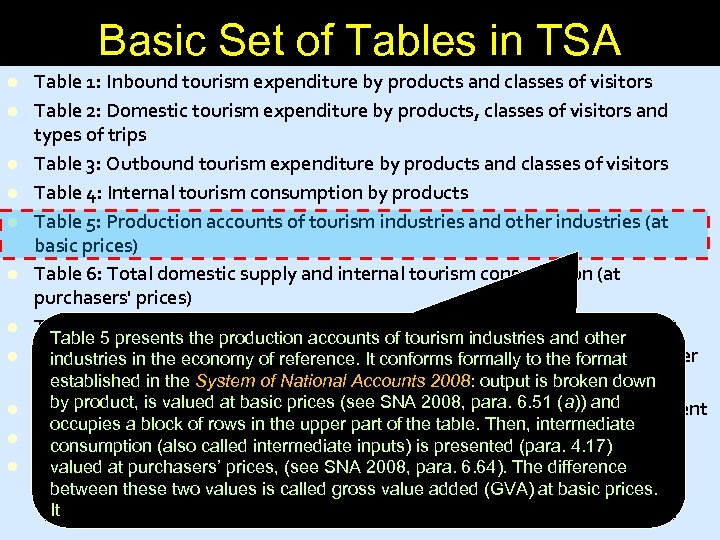 Basic Set of Tables in TSA l l l Table 1: Inbound tourism expenditure by products and classes of visitors Table 2: Domestic tourism expenditure by products, classes of visitors and types of trips Table 3: Outbound tourism expenditure by products and classes of visitors Table 4: Internal tourism consumption by products Table 5: Production accounts of tourism industries and other industries (at basic prices) Table 6: Total domestic supply and internal tourism consumption (at purchasers' prices) Table 7: Employment in the tourism industries Table 5 presents the production accounts of tourism industries and other Table 8: Tourism economy of reference. It conforms tourism industries and other industries in the gross fixed capital formation of formally to the format industries in the System of National Accounts 2008: output is broken down established by product, is valued at basic prices (see by products and levels of government Table 9: Tourism collective consumption. SNA 2008, para. 6. 51 (a)) and occupies a block of rows in the upper part of the table. Then, intermediate Table 10: Non (also calledindicators inputs) is presented (para. 4. 17) consumption monetary intermediate These are official sequences of TSA tables! (What 6. 64). The difference valued at purchasers’ prices, (see SNA 2008, para. I cover is US version, between these match in their sequences…) which may nottwo values is called gross value added (GVA) at basic prices. 92 It
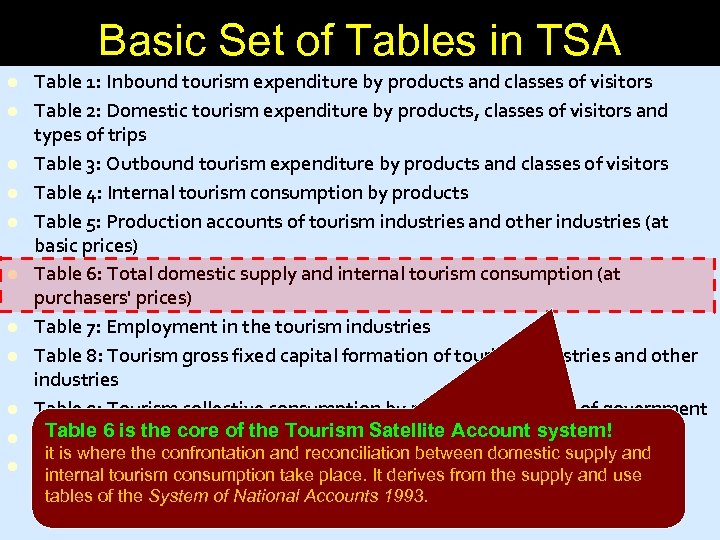 Basic Set of Tables in TSA l l l Table 1: Inbound tourism expenditure by products and classes of visitors Table 2: Domestic tourism expenditure by products, classes of visitors and types of trips Table 3: Outbound tourism expenditure by products and classes of visitors Table 4: Internal tourism consumption by products Table 5: Production accounts of tourism industries and other industries (at basic prices) Table 6: Total domestic supply and internal tourism consumption (at purchasers' prices) Table 7: Employment in the tourism industries Table 8: Tourism gross fixed capital formation of tourism industries and other industries Table 9: Tourism collective consumption by products and levels of government Table 6 is the core of the Tourism Satellite Account system! Table 10: Non monetary indicators it is where the confrontation and reconciliation between domestic supply and These are official sequences of TSA tables! (What I cover is US version, internal tourism consumption take place. It derives from the supply and use which may not match in their sequences…) tables of the System of National Accounts 1993. 93
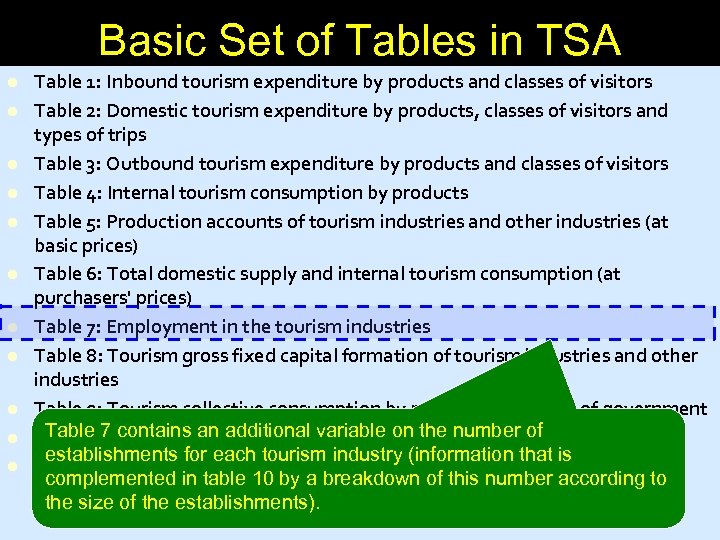 Basic Set of Tables in TSA l l l Table 1: Inbound tourism expenditure by products and classes of visitors Table 2: Domestic tourism expenditure by products, classes of visitors and types of trips Table 3: Outbound tourism expenditure by products and classes of visitors Table 4: Internal tourism consumption by products Table 5: Production accounts of tourism industries and other industries (at basic prices) Table 6: Total domestic supply and internal tourism consumption (at purchasers' prices) Table 7: Employment in the tourism industries Table 8: Tourism gross fixed capital formation of tourism industries and other industries Table 9: Tourism collective consumption by products and levels of government Table 7 contains an additional variable on the number of Table 10: Non monetary indicators establishments for each tourism industry (information that is These are official sequences of TSA tables! (What I cover is US version, complemented in table 10 by a breakdown of this number according to which may not match in their sequences…) 94 the size of the establishments).
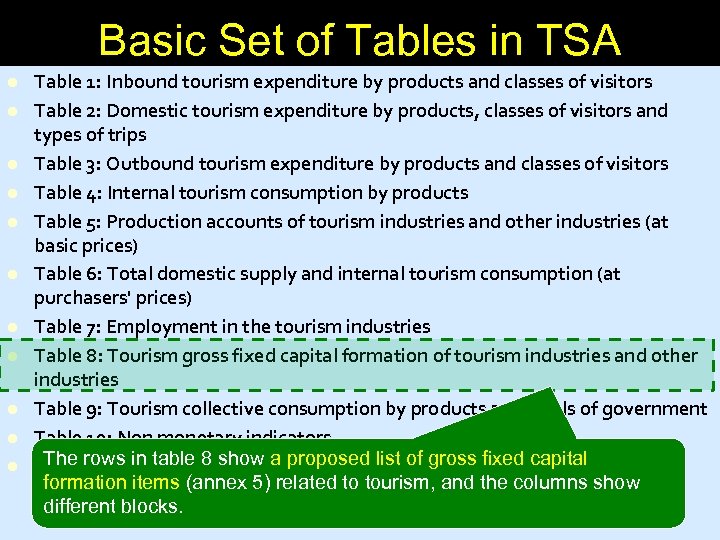 Basic Set of Tables in TSA l l l Table 1: Inbound tourism expenditure by products and classes of visitors Table 2: Domestic tourism expenditure by products, classes of visitors and types of trips Table 3: Outbound tourism expenditure by products and classes of visitors Table 4: Internal tourism consumption by products Table 5: Production accounts of tourism industries and other industries (at basic prices) Table 6: Total domestic supply and internal tourism consumption (at purchasers' prices) Table 7: Employment in the tourism industries Table 8: Tourism gross fixed capital formation of tourism industries and other industries Table 9: Tourism collective consumption by products and levels of government Table 10: Non monetary indicators The are official sequences of TSA tables! of gross fixed is US Theserows in table 8 show a proposed list (What I cover capital version, formation items (annex 5) related to tourism, which may not match in their sequences…)and the columns show 95 different blocks.
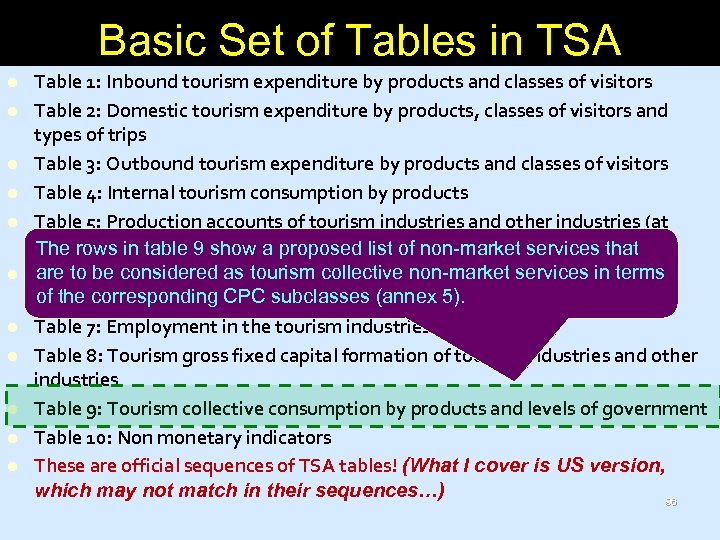 Basic Set of Tables in TSA l l l Table 1: Inbound tourism expenditure by products and classes of visitors Table 2: Domestic tourism expenditure by products, classes of visitors and types of trips Table 3: Outbound tourism expenditure by products and classes of visitors Table 4: Internal tourism consumption by products Table 5: Production accounts of tourism industries and other industries (at basicrows in table 9 show a proposed list of non-market services that The prices) are to be considered as tourism collective tourism consumption (at Table 6: Total domestic supply and internal non-market services in terms of the corresponding CPC subclasses (annex 5). purchasers' prices) Table 7: Employment in the tourism industries Table 8: Tourism gross fixed capital formation of tourism industries and other industries Table 9: Tourism collective consumption by products and levels of government Table 10: Non monetary indicators These are official sequences of TSA tables! (What I cover is US version, which may not match in their sequences…) 96
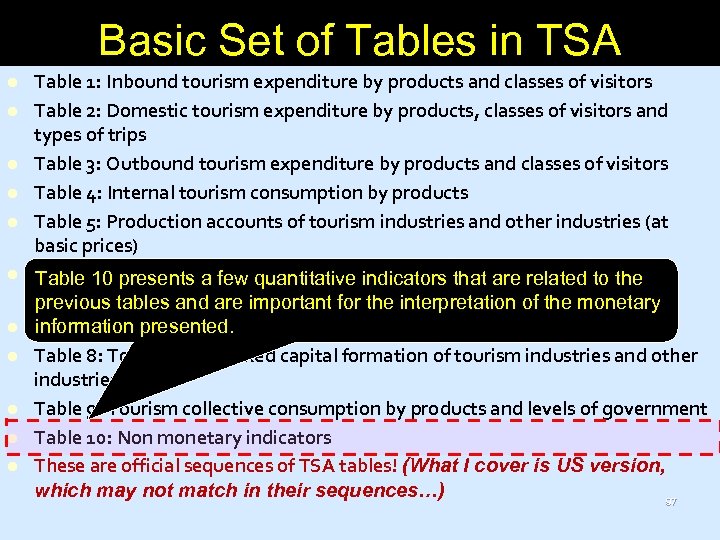 Basic Set of Tables in TSA l l l Table 1: Inbound tourism expenditure by products and classes of visitors Table 2: Domestic tourism expenditure by products, classes of visitors and types of trips Table 3: Outbound tourism expenditure by products and classes of visitors Table 4: Internal tourism consumption by products Table 5: Production accounts of tourism industries and other industries (at basic prices) Table 6: Total domestic supply and internal tourism consumptionto the Table 10 presents a few quantitative indicators that are related (at purchasers' prices) are important for the interpretation of the monetary previous tables and Table 7: Employment in the tourism industries information presented. Table 8: Tourism gross fixed capital formation of tourism industries and other industries Table 9: Tourism collective consumption by products and levels of government Table 10: Non monetary indicators These are official sequences of TSA tables! (What I cover is US version, which may not match in their sequences…) 97
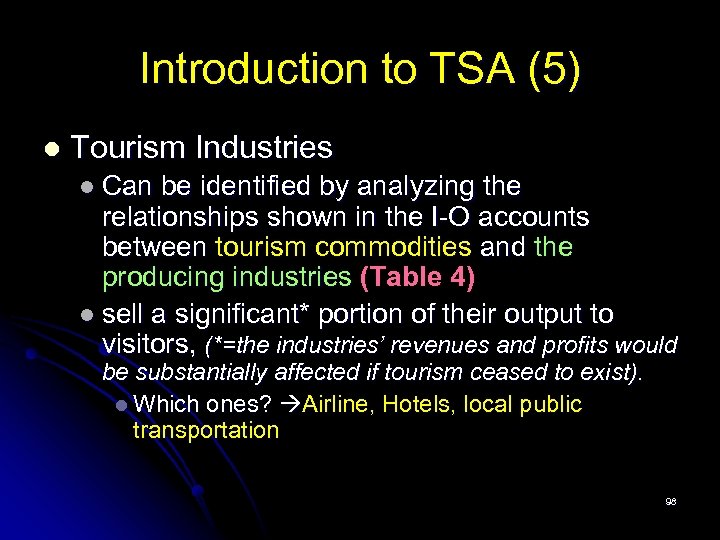 Introduction to TSA (5) l Tourism Industries l Can be identified by analyzing the relationships shown in the I-O accounts between tourism commodities and the producing industries (Table 4) l sell a significant* portion of their output to visitors, (*=the industries’ revenues and profits would be substantially affected if tourism ceased to exist). l Which ones? Airline, Hotels, local public transportation 98
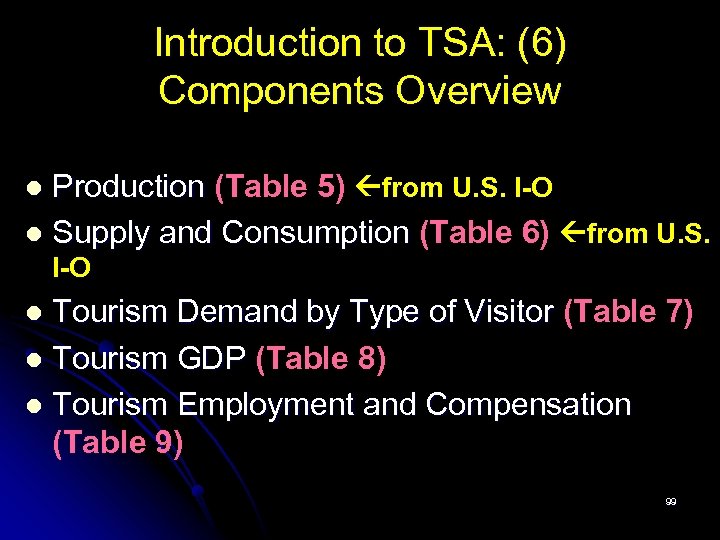 Introduction to TSA: (6) Components Overview Production (Table 5) from U. S. I-O l Supply and Consumption (Table 6) from U. S. l I-O Tourism Demand by Type of Visitor (Table 7) l Tourism GDP (Table 8) l Tourism Employment and Compensation (Table 9) l 99
 Introduction to TSA: (7) Production Table (Table 5) l Similar to I-O, but with 3 modifications 1. 2. 3. l Rows and Columns are modified Detail is shown only for TTSA commodities and industries, others are aggregated. The intermediate inputs and the valueadded components are shown as rows at the bottom of the table. Each cells on the main diagonal shows the value for the commodity produced by the industry designated as its primary producer. 100
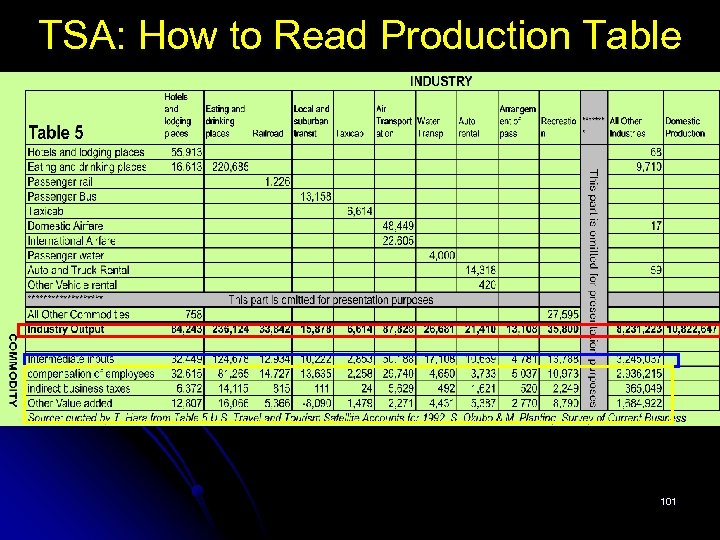 TSA: How to Read Production Table 101
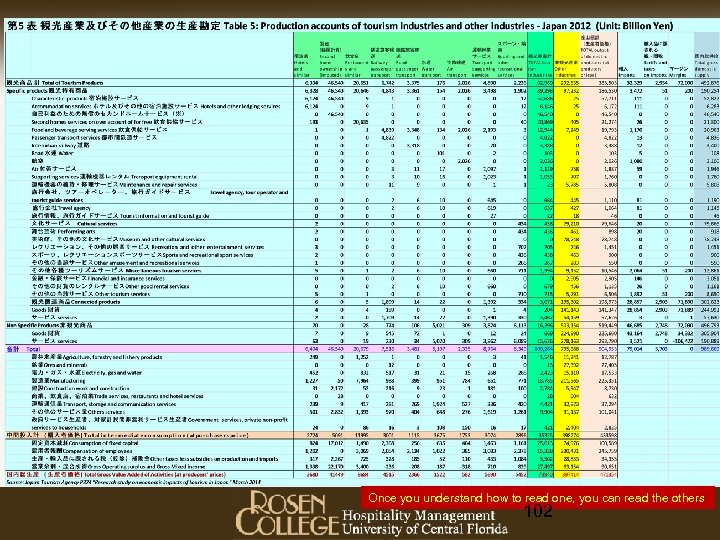 Once you understand how to read one, you can read the others 102
 TSA: How to Read Supply & Consumption Table (Table 6) l Supply and Consumption of Tourismrelated “Commodities” displayed in one table. l Left Side of table = Supply (production) l Domestic l Production + Imports + Others Right Side of table = Consumption l Intermediate needs (AX) + Final Demand (household etc) + others 103
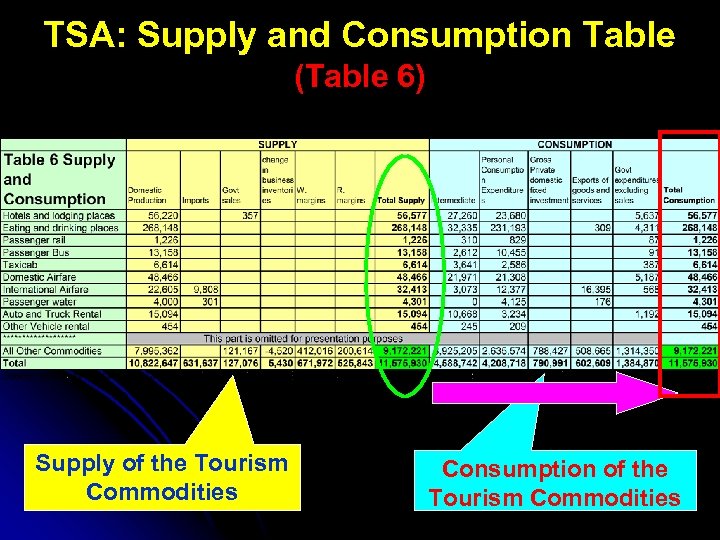 TSA: Supply and Consumption Table (Table 6) Supply of the Tourism Commodities Consumption of the 104 Tourism Commodities
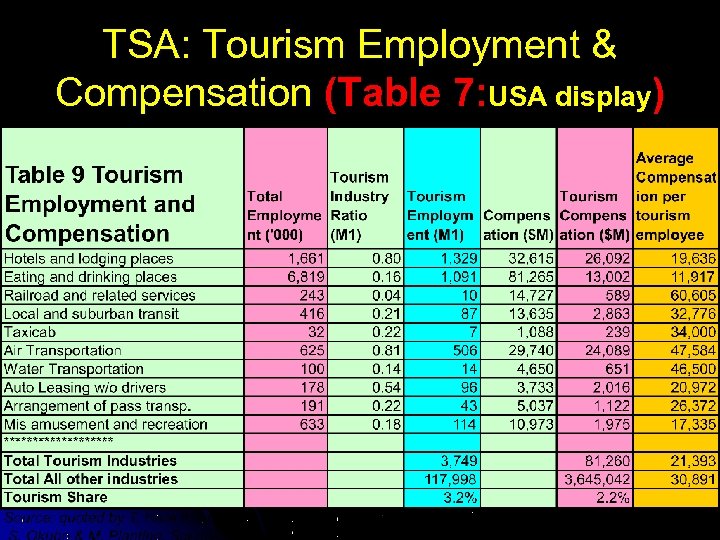 TSA: Tourism Employment & Compensation (Table 7: USA display) 105
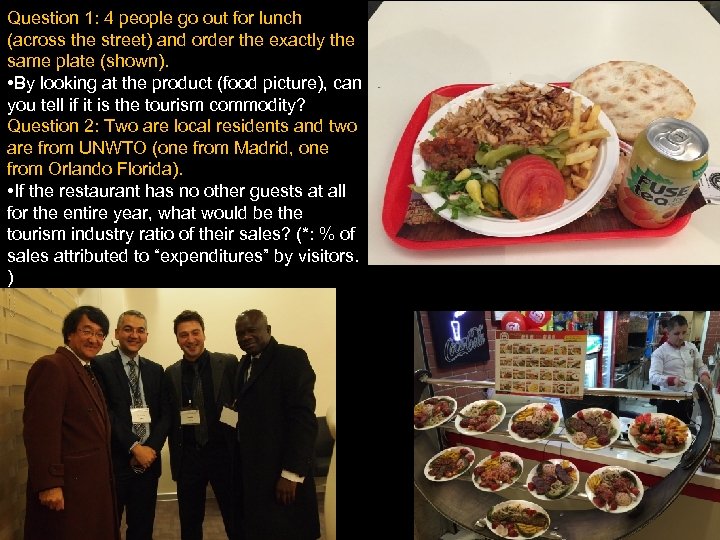 Question 1: 4 people go out for lunch (across the street) and order the exactly the same plate (shown). • By looking at the product (food picture), can you tell if it is the tourism commodity? Question 2: Two are local residents and two are from UNWTO (one from Madrid, one from Orlando Florida). • If the restaurant has no other guests at all for the entire year, what would be the tourism industry ratio of their sales? (*: % of sales attributed to “expenditures” by visitors. ) 106
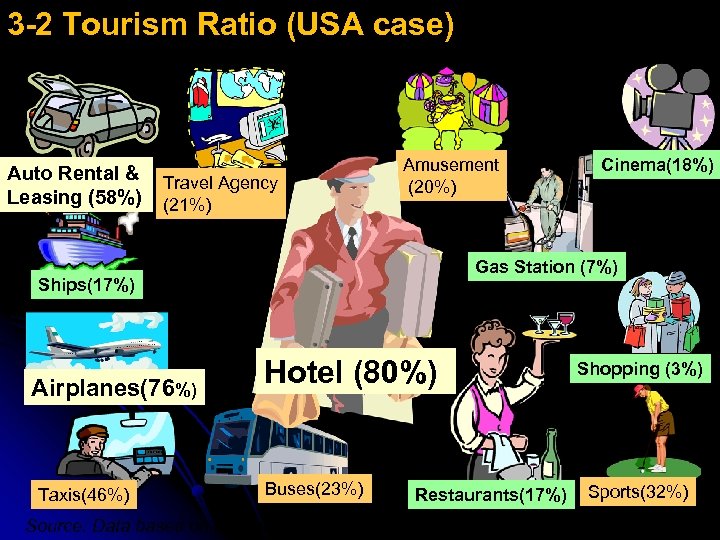 3 -2 Tourism Ratio (USA case) Auto Rental & Leasing (58%) Travel Agency (21%) Amusement (20%) Gas Station (7%) Ships(17%) Airplanes(76%) Taxis(46%) Cinema(18%) Hotel (80%) Buses(23%) Restaurants(17%) Shopping (3%) Sports(32%) Source: Data based on Bureau of Economic Analysis, Commerce Dept, USA
 Session 8: Country Presentations 11: 15 -13: 00 Session 8: Tourism Satellite Accounts (TSA) ► Current Country Practices in TSA • Benin: – Introduction of Tools Used by Benin for Tourism Satellite Accounts • Turkey: – Tourism Satellite Accounts in Turkey 108
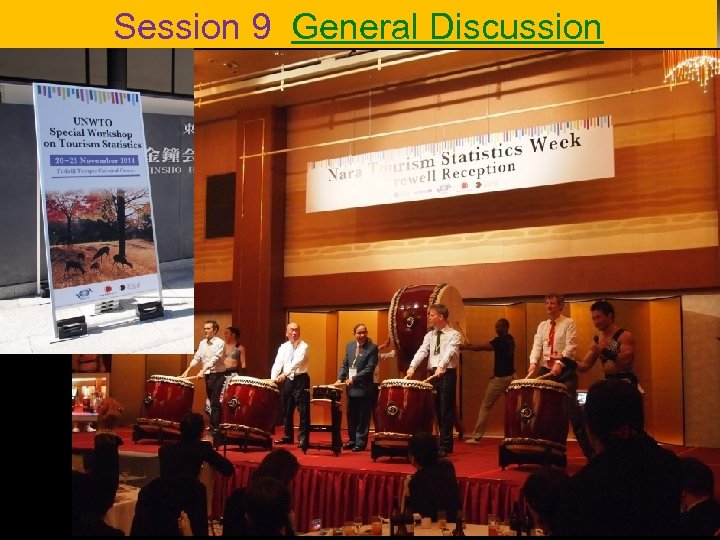 Session 9: General Discussion 109
 Çok teşekkür ederim. Sizinle vakit bir onur için bir zevkti ! Çox təşəkkür edirəm. Bu vaxt sərf bir şərəf üçün bir zövq idi ! ! ﺷﻜﺮﺍ ﺟﺰﻳﻼ. ﻛﺎﻥ ﻣﻦ ﺩﻭﺍﻋﻲ ﺳﺮﻭﺭﻱ ﺃﻦ ﻳﻜﻮﻥ ﻟﻬﺎ ﺷﺮﻑ ﻗﻀﺎﺀ ﺍﻟﻮﻗﺖ ﻣﻌﻚ ! ﺑﺴیﺎﺭ ﻣﺘﺸکﺮﻡ. ﺍیﻦ ﻟﺬﺕ ﺭﺍ ﺑﻬﺎﻓﺘﺨﺎﺭ گﺬﺭﺍﻧﺪﻥ ﻭﻗﺖ ﺑﺎ ﺷﻤﺎ ﺑﻮﺩ Большое спасибо. Это былоудовольствие иметь честь проводить время с тобой! Terima kasih banyak. Byloudovolstvie ini mendapat kehormatan untuk menghabiskan waktu dengan Terima kasih banyak. Ia adalah satu keseronokan untuk mempunyai satu penghormatan menghabiskan masa dengan anda ! Merci beaucoup. Ce fut un plaisir d'avoir un honneur de passer du temps avec vous ! Ju faleminderit shumë. Kjo ishte një kënaqësi që të kemi një nder të kaluar kohë me ju! Thank you very much. It was a pleasure to have an honor of spending time with you! MOOC course on Economic Impact & TSA Now open – Starts on Dec. 1, 2014. FREE to anybody in the world! (link below) https: //www. canvas. net/courses/tourism-industry-analysis-1 Thank you very much. Tad Hara tadayuki. hara@ucf. edu (e-mail) http: //hospitality. ucf. edu/person/dr-tadayuki-hara/ (web)