


 Скачать презентацию The Statement of Cash Flows -Understanding What and
40adbe5fe4c4c9fa3b1c98d607b234fb.ppt
- Количество слайдов: 20
 The Statement of Cash Flows -Understanding What and Why -Learning the Mechanics to Effectively Configure and Analyze Created by Patrick Badolato Doctoral Student Duke University’s Fuqua School of Business
 What and Why… • The Balance Sheet and Income Statement are reported on an accrual basis; therefore, the SCF exists to provide a user of the Financial Statements with more information about how cash has been used (outflows) or received during a period (inflows) – Remember, accrual accounting reflects transactions as they occur in a legal/economic sense, not when the cash is received or paid out. – An accrual (generally defined) is a accounting entry to record an economic event that has no cash impact. • The SCF can assist in the valuation and understanding of a company as it effectively shows how a company’s earnings compare to the cash inflows or outflows. – Earnings, therefore (including both cash and accruals) are subject to managements discretion/expertise. • This additional information is useful in many ways. One way is valuation—a (simplified) valuation model equates a firm to the net present value of its cash flows.
 Indirect Method • The more common method used by academics, covered in textbooks (like yours) and used by nearly all companies • The Direct Method is a different, less common method, but leads to the same result – the processes and line items differ when determining the Cash Flow from Operations – From here on I focus on the Indirect Method
 The Components of the SCF • CFO-Cash Flows from Operating Activities – The cash transactions that result from the company’s day to day business (collecting from customers or paying expenses) – Effectively, a reconciliation of net income (which is determined from the accrual-based income statement) to the net amount of cash received or paid for operations during the reporting period
 The Components of the SCF • CFI-Cash Flows from Investing Activities – The cash transactions from investments (i. e. noncurrent assets) made by the company to further or alter the business (buying a factory, selling land) • CFF-Cash Flows from Financing Activities – The cash transactions that result from exchanges with creditors and owners (issuing stock, borrowing from a bank)
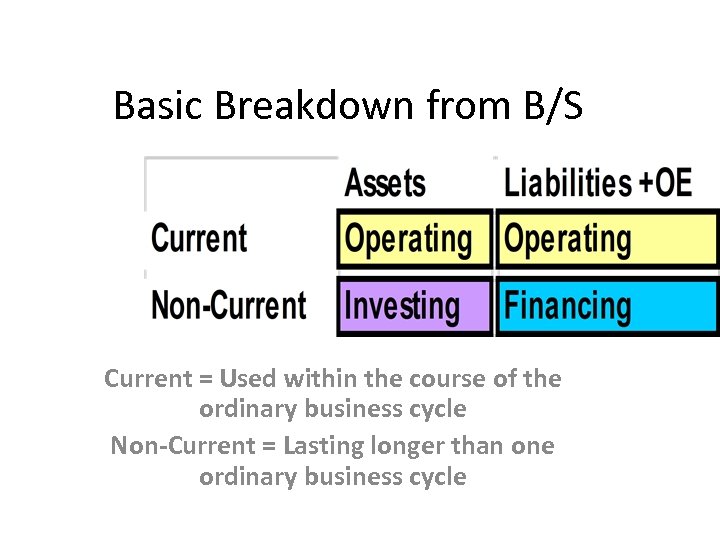 Basic Breakdown from B/S Current = Used within the course of the ordinary business cycle Non-Current = Lasting longer than one ordinary business cycle
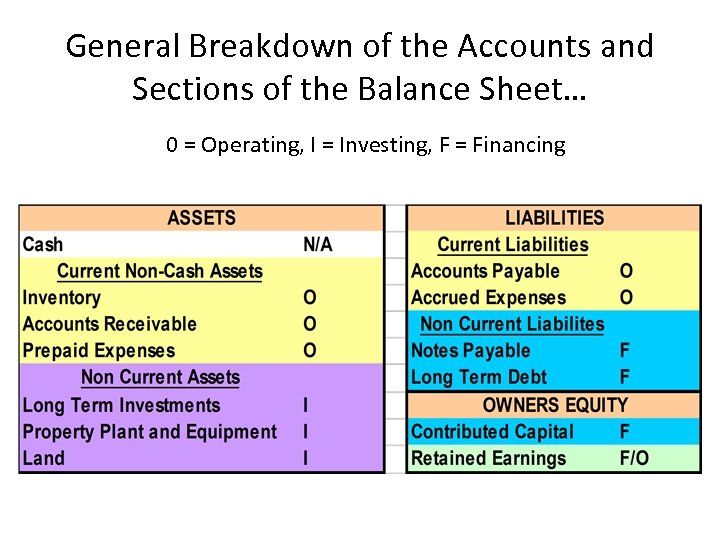 General Breakdown of the Accounts and Sections of the Balance Sheet… 0 = Operating, I = Investing, F = Financing
 CHANGES in ASSETS • An INCREASE in an ASSET is a USE OF CASH and is SUBTRACTED on the SCF • A DECREASE in an ASSET is a SOURCE OF CASH and is ADDED on the SCF • Conceptualize with AR—if AR goes up (down) this represents less (more) cash that your customers have paid to you – Or, to buy an asset you spend cash, to sell an asset you receive cash
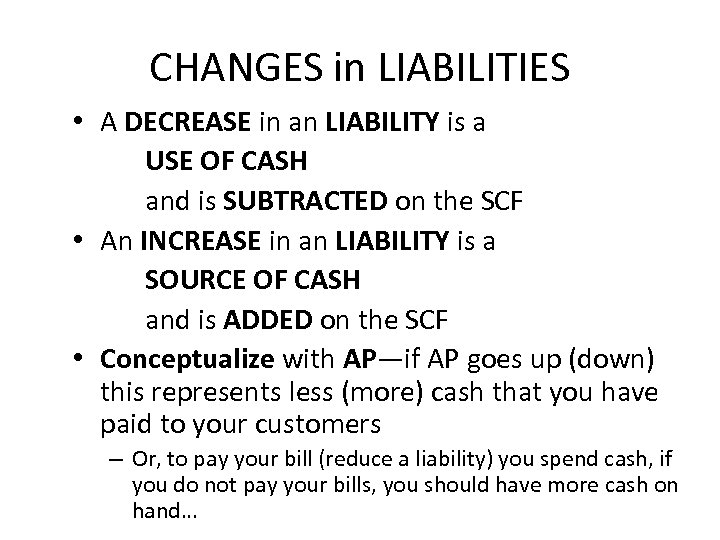 CHANGES in LIABILITIES • A DECREASE in an LIABILITY is a USE OF CASH and is SUBTRACTED on the SCF • An INCREASE in an LIABILITY is a SOURCE OF CASH and is ADDED on the SCF • Conceptualize with AP—if AP goes up (down) this represents less (more) cash that you have paid to your customers – Or, to pay your bill (reduce a liability) you spend cash, if you do not pay your bills, you should have more cash on hand…
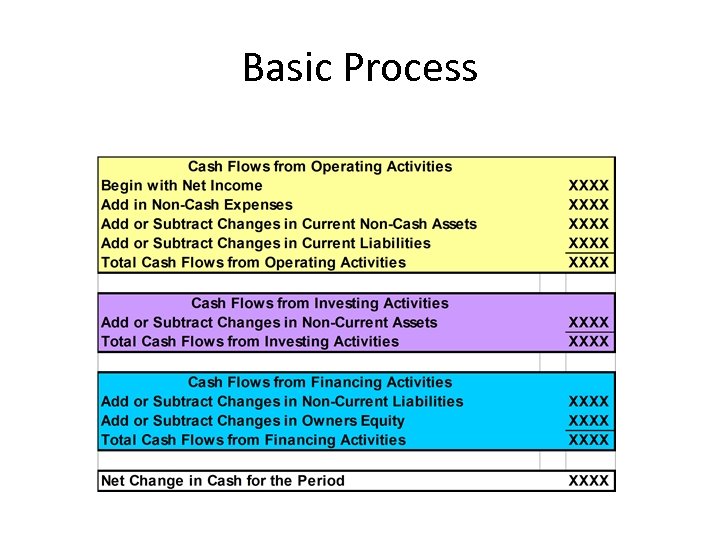
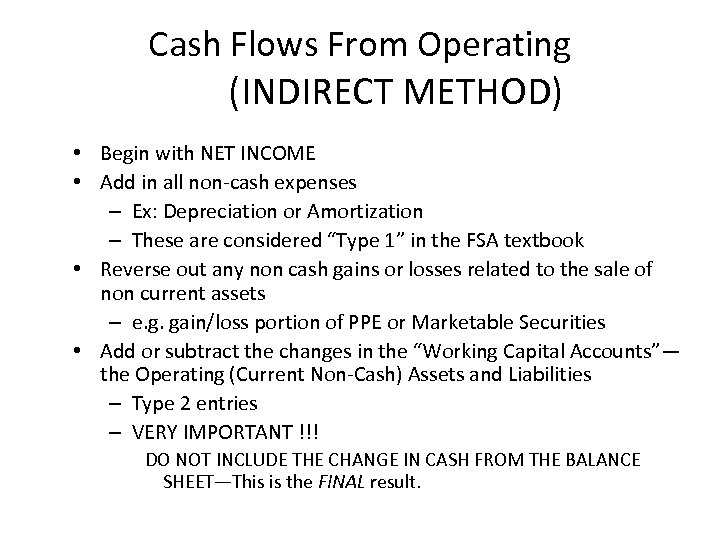 Cash Flows From Operating (INDIRECT METHOD) • Begin with NET INCOME • Add in all non-cash expenses – Ex: Depreciation or Amortization – These are considered “Type 1” in the FSA textbook • Reverse out any non cash gains or losses related to the sale of non current assets – e. g. gain/loss portion of PPE or Marketable Securities • Add or subtract the changes in the “Working Capital Accounts”— the Operating (Current Non-Cash) Assets and Liabilities – Type 2 entries – VERY IMPORTANT !!! DO NOT INCLUDE THE CHANGE IN CASH FROM THE BALANCE SHEET—This is the FINAL result.
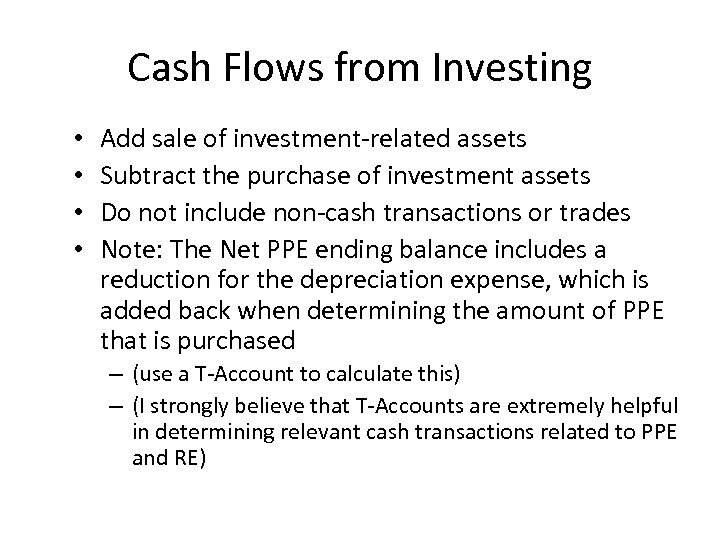 Cash Flows from Investing • • Add sale of investment-related assets Subtract the purchase of investment assets Do not include non-cash transactions or trades Note: The Net PPE ending balance includes a reduction for the depreciation expense, which is added back when determining the amount of PPE that is purchased – (use a T-Account to calculate this) – (I strongly believe that T-Accounts are extremely helpful in determining relevant cash transactions related to PPE and RE)
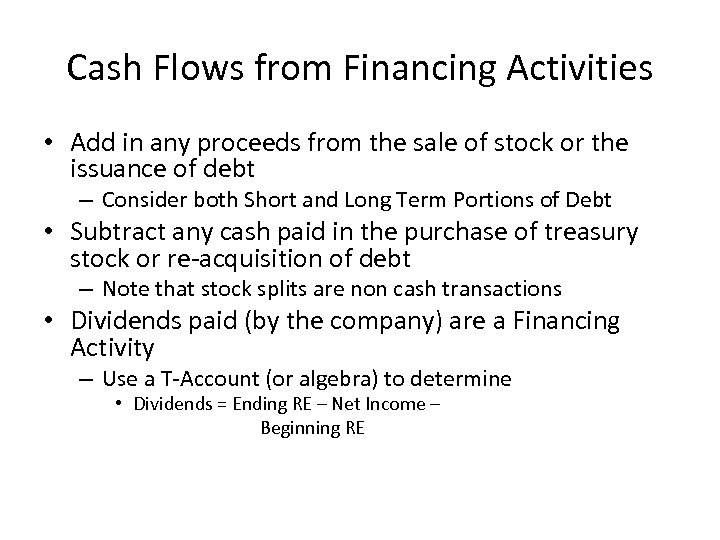 Cash Flows from Financing Activities • Add in any proceeds from the sale of stock or the issuance of debt – Consider both Short and Long Term Portions of Debt • Subtract any cash paid in the purchase of treasury stock or re-acquisition of debt – Note that stock splits are non cash transactions • Dividends paid (by the company) are a Financing Activity – Use a T-Account (or algebra) to determine • Dividends = Ending RE – Net Income – Beginning RE
 Basic Process
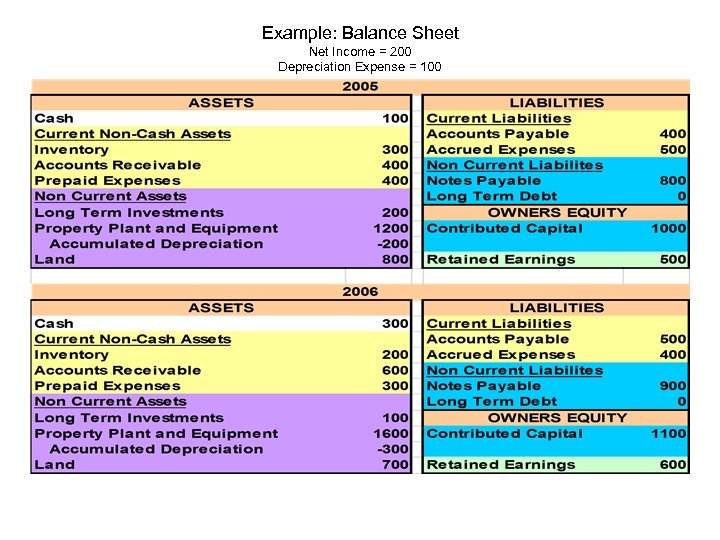 Example: Balance Sheet Net Income = 200 Depreciation Expense = 100
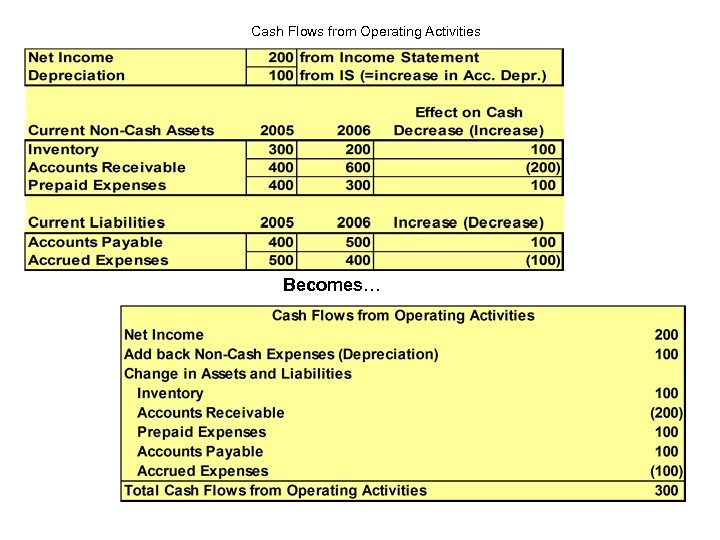 Cash Flows from Operating Activities Becomes…
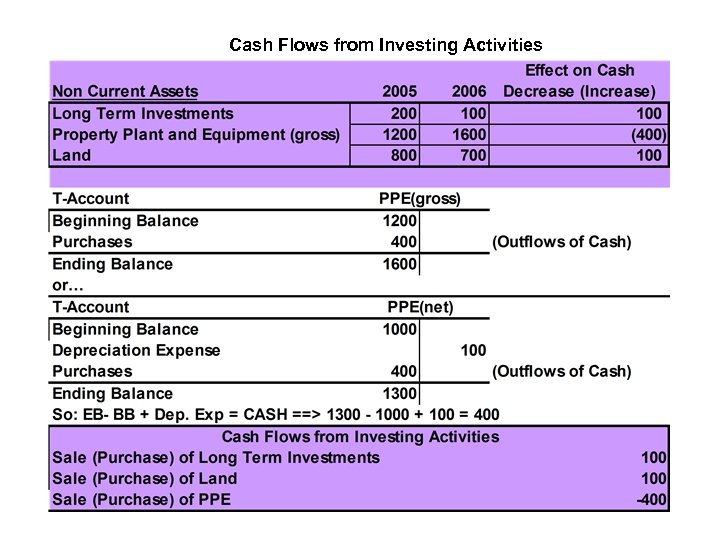 Cash Flows from Investing Activities
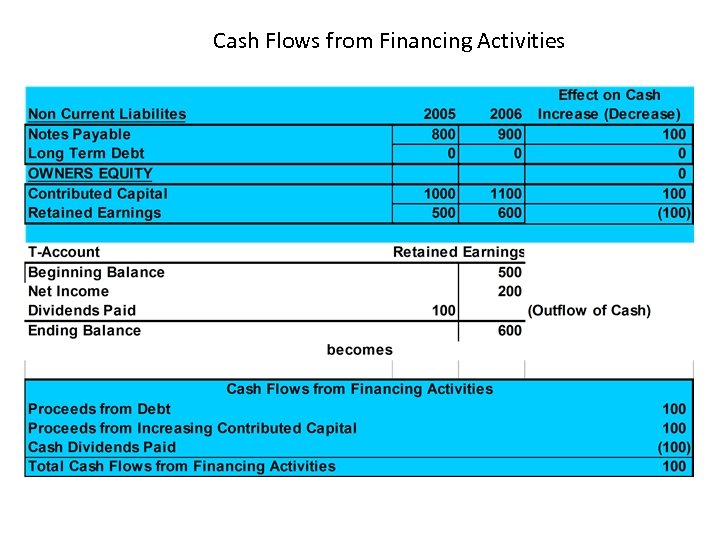 Cash Flows from Financing Activities
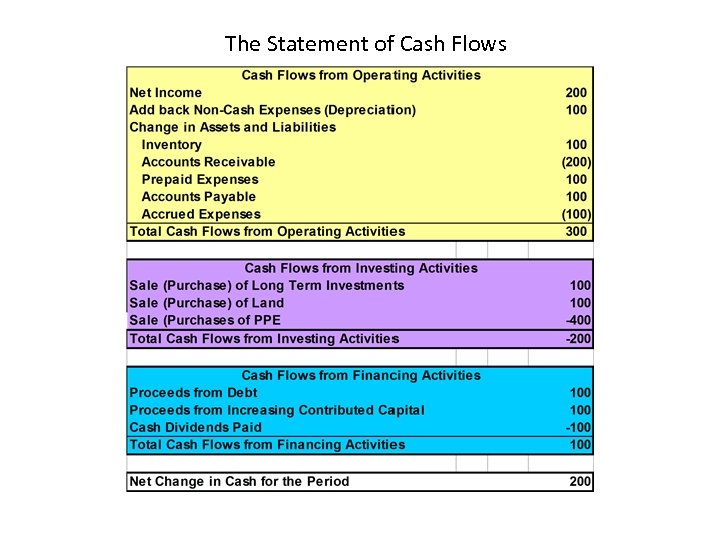 The Statement of Cash Flows
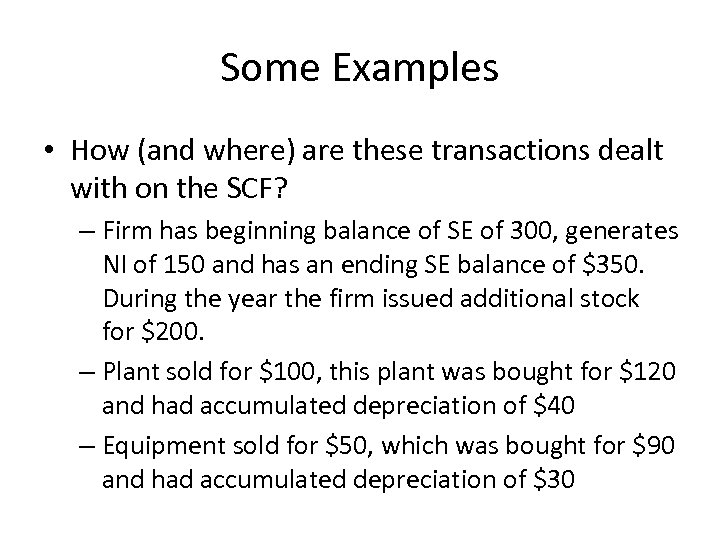 Some Examples • How (and where) are these transactions dealt with on the SCF? – Firm has beginning balance of SE of 300, generates NI of 150 and has an ending SE balance of $350. During the year the firm issued additional stock for $200. – Plant sold for $100, this plant was bought for $120 and had accumulated depreciation of $40 – Equipment sold for $50, which was bought for $90 and had accumulated depreciation of $30
 Tips for making a SCF • When making a statement of cash flows, be sure to account for all Balance Sheet Items – DO NOT include the change in cash—this is the final check – Be aware that the “working capital ratio” is not the same as the source/use of cash from working capital accounts – Use the nature of the account to determine where you put it in the SCF • Be aware of the nature of all transactions: – Consider non cash transactions, and transactions that have a cash portion as well as a book gain or loss • Be careful with PPE and RE accounts – Use T-Accounts for these!