 Скачать презентацию The stages of PR Brought to you by
c15f5aa2cfd729356a270c54b37bc47c.ppt
- Количество слайдов: 38



The stages of PR Brought to you by, Vinay and Kavitha 1
What is PR ? PR is aimed at building the image of an organization. It is the art of establishing a bridge of understanding and goodwill between an organization and its publics It is a management function that tabulates public attitudes, defines policies, procedures and interests of an organization, followed by executing a program of action to earn public understanding and acceptance – Edward Bernays ( father of modern PR ). 2
Why PR? 3
What does PR do ? Basically creates and maintains the image of an organization. Public opinion polls, research to provide inputs to the management. Issues press releases, newsletters, maintains blogs, websites etc. Organizes events, press conferences, product releases, tours etc. Counsels the management and comes out with policies and strategies. 4
5
Continued… It is an economical way to reach the target audience in masses. Stimulates awareness of, and the demand for the company's products or services. Strengthens the company’s image and perception Paints the picture of a company that is active and innovative. Creates more credibility by being visible. 6
7
Continued… Increases search engine visibility. In times of crisis, provides timely solutions and takes corrective steps. Generates publicity material, films etc to highlight achievements. All these functions may be classified into 4 broad steps/stages of the PR process. 8
9
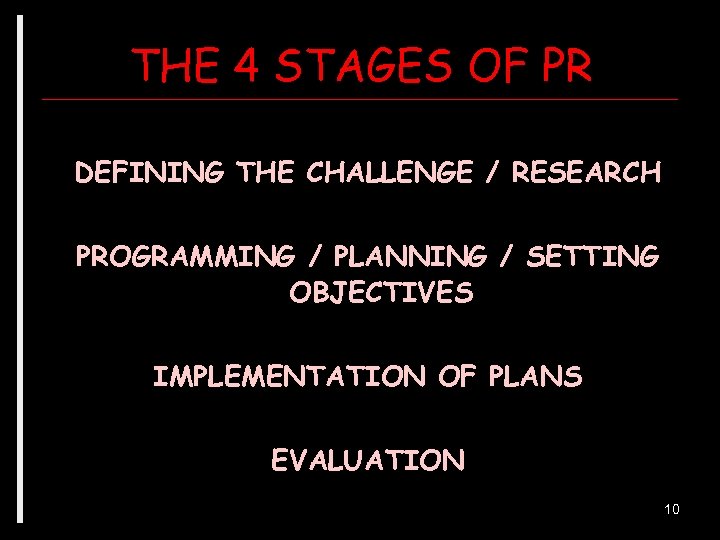
THE 4 STAGES OF PR DEFINING THE CHALLENGE / RESEARCH PROGRAMMING / PLANNING / SETTING OBJECTIVES IMPLEMENTATION OF PLANS EVALUATION 10
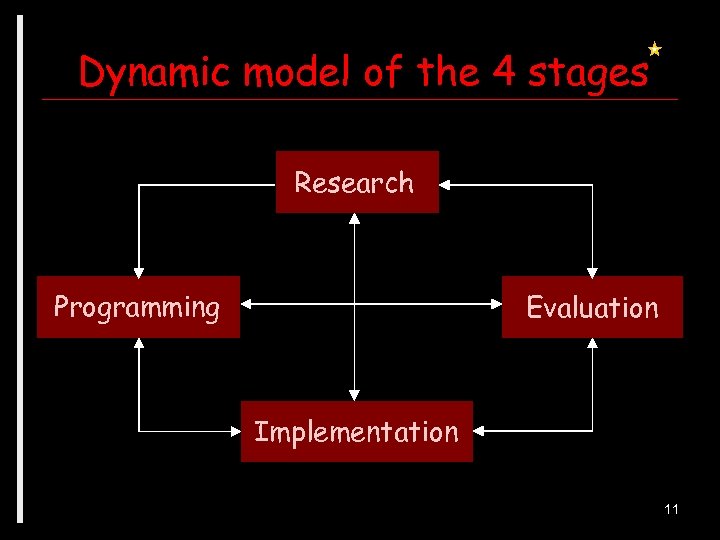
Dynamic model of the 4 stages Research Programming Evaluation Implementation 11
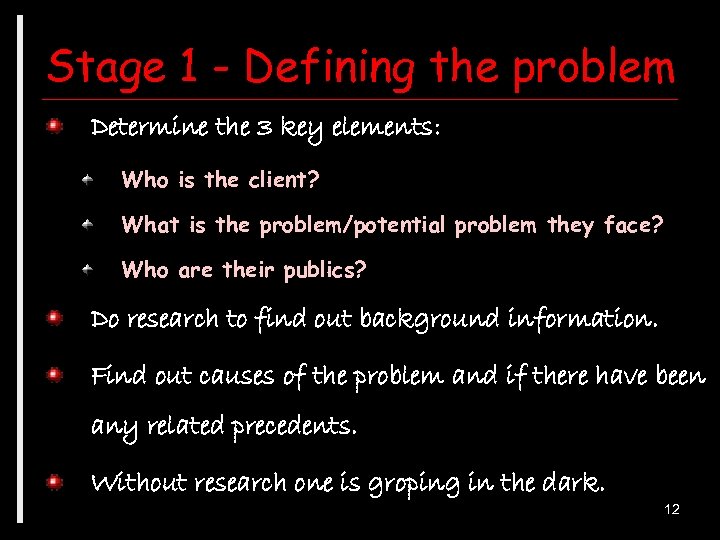
Stage 1 - Defining the problem Determine the 3 key elements: Who is the client? What is the problem/potential problem they face? Who are their publics? Do research to find out background information. Find out causes of the problem and if there have been any related precedents. Without research one is groping in the dark. 12
Stage 2 – Programming & Planning There are broadly 4 steps in this stage: • PROGRAMMING – sequence of action to follow • SCHEDULING – time required to achieve goals • BUDGETING – resources required to carry out plans • FIXING ACCOUNTABILITY – who will oversee the accomplishment of goals 13
Continued… Device a strategy to solve the problem based on findings of research. Set a goal and formulate plans to achieve it. Decide what is to be done, how, in what order and by whom. Determine key result areas, target audiences and measurable factors to set objectives on. Create a theme for the PR campaign. 14
Stage 3 – Implementing plans Action speaks louder than words. Time to put plans and strategies into action. Communication plays crucial role. Need to communicate to publics that things are being done. Use effective communication strategy: Select best suited media and techniques to reach out to publics 15
Continued… Special target audiences to be served using specialized media. E. g. : TV / mobile phones for the youth, in-house magazines and brochures for clients and employees. Using news values will be helpful in effective communication of information. Every situation requires a different communication strategy. 16
Stage 4 - Evaluation After implementation, its time to measure the success of the PR campaign. Identify research methods to evaluate the success of the program/campaign during and after. Determine a way to measure whether the campaign achieved its objectives. Determine extent to which goals have been achieved. Track the organization’s performance in terms of profits and employee turnover. 17
Evaluation methods… Dip stick study Call-ins Contest entries Focus groups Walk in interviews Top 25 searched key-words 18
Case Study - 1 19
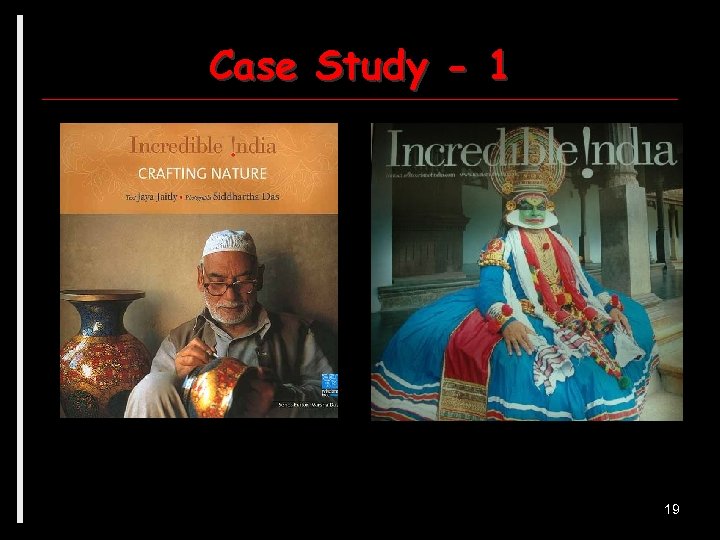
Incredible India DEFINING THE CHALLENGE: Till 2002, Indian tourism was promoted through delegates at the Indian tourist offices located globally. These promotional campaigns were not too effective as the promotional approach was unorganized, varied, and limited by the skills and capabilities of the delegates. 20
Continued… PROGRAMMING: The Tourism Department appointed Ogilvy and Mather (O&M), Delhi, to develop a print campaign and Enterprise Nexus, Mumbai, to create a television commercial. Grey Interactive was appointed to work on the official website www. tourismofindia. com. 21
Continued… IMPLEMENTATION: In September 2002, the Tourism Department unveiled a new campaign called ‘Incredible India’ to promote Indian tourism globally. The first phase of the campaign, for a period of three months, was jointly funded by the Government of India and Experience India Society, an association of travel agents in India. 22
Continued… The campaign focused on the Himalayas, wildlife, yoga, and ayurveda and was widely promoted in the print media, television, and the Internet. The television campaign was telecast on CNN, BBC, and other popular channels across the world. 23
Continued… EVALUATION AND RESULT: Indian tourism got a huge boost. Statistics and research revealed that post the ‘Incredible India’ campaign the tourism industry had done significantly better than before. 24
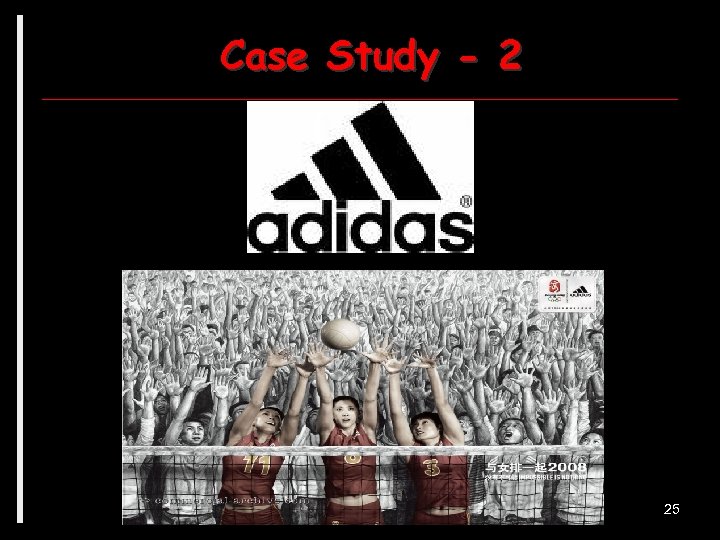
Case Study - 2 25
adidas DEFINING THE CHALLENGE In 1984, the Chinese Women’s Volleyball Team (CWVT) was the toast of the nation after winning at the Olympics. But in the following 20+ years, the team’s image had suffered due to a series of lackluster performances. Volleyball itself, once enormously popular among Chinese youth…. . 26
Continued… …was now seen by as a game primarily for "older people. " Because the client, adidas was both a CWVT sponsor and a partner with the 2008 Beijing Olympics, the goal for Ogilvy PR was to make women’s volleyball as popular as it used to be between the Chinese aged 14 to 24. 27
Continued… PLANNING AND PROGRAMMING: Ogilvy began by reviewing the qualitative findings of All China Strategic Research, which revealed three key points. Needed to create star power for the team, because China's youth culture is heavily influenced by star players and sports icons. 28
Continued… Needed to showcase the power of the game—its speed and ferocity—to boost its coolness factor. The youth target audience is driven by a desire for ownership and participation. Therefore the need was to drive the youth and get them interested in the game. 29
Continued… With the overall rate of Internet use among Chinese young people growing daily digital media were seen as key to boosting the profile of the CWVT. Blogging plus makeovers equaled a major media play. There was little general knowledge of individual team members, so we sought to open a dialogue and bring fans closer to the players by creating the first-ever Chinese Olympic team blog. 30
Continued… IMPLEMENTATION: Each player was also given a professional makeover, captured in glamour shots. The photos were put up on a blog, which drove traffic and resulted in instant pick up by major print media. Short films showed the power of the game - to make volleyball edgy, dangerous and exciting to a young audience. 31
Continued… So six viral films were shown that used creative stunts to show the games’ speed and power. E. g. : a volleyball spike reaching a speed of 92 kmph was shown alongside water gushing from a fire hydrant at the same speed and hitting a passerby. The volleyball chant competition spiked youthful involvement. 32
Continued… adidas became the sponsor of China’s first chant competition. Invited the public to create a national chant, cheer, or jingle that volleyball can own. The forms a "cheer" could take were very wide ranging—including hand motions and dance moves related to volleyball moves. Participants could upload their chants and vote on the entries of others. 33
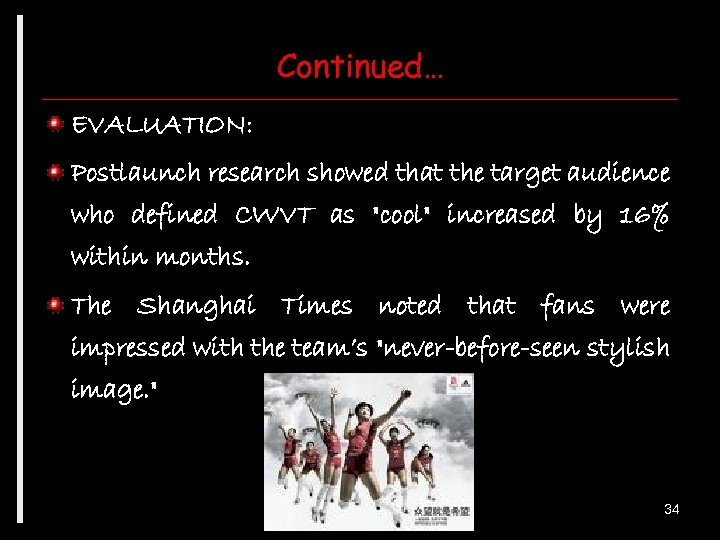
Continued… EVALUATION: Postlaunch research showed that the target audience who defined CWVT as "cool" increased by 16% within months. The Shanghai Times noted that fans were impressed with the team’s "never-before-seen stylish image. " 34
Continued… CWVT members were even featured in youth lifestyle magazines, such as Easy and Touch. The blog attracted nearly 161, 000 unique visits in the first three months, while the chant competition site logged nearly 400, 000 unique visits in the same time period. More than 5. 5 million visitors clicked through and viewed the viral films within the first three months of release. 35
Continued… 73 percent of viewers said the films were "innovative" and stimulating, while 78 percent of viewers forwarded them to friends. The impact of the campaign on the team itself was summed up by Chief Coach Chen Zhonghe, who said, “adidas brought the girls closer to their fans, which is helping to boost the team's morale and their performance" 36
37

38
Скачать презентацию The stages of PR Brought to you by
c15f5aa2cfd729356a270c54b37bc47c.ppt