


 Скачать презентацию The st 1 A Decade of Operations
b475e751434307156bf62807812e545e.ppt
- Количество слайдов: 9
 The st 1 ✓ A Decade of Operations ⌃ ARC 3. 5 -meter Telescope 20 -year Anniversary Celebration 13 May 2014 Bruce Gillespie
 The situation in early 1993 • Telescope and site structures completed, but – primary mirror in box, PMSS under construction – 2 ndary and tertiary mirrors being polished – no instruments yet at site • SDSS construction started, but full funding commitments pending • Arranged for [Margon? ] solar eclipse on 10 May 1994, use occasion to hold dedication of 3. 5 -meter telescope • Left about a year to bring the telescope and instruments into operational state
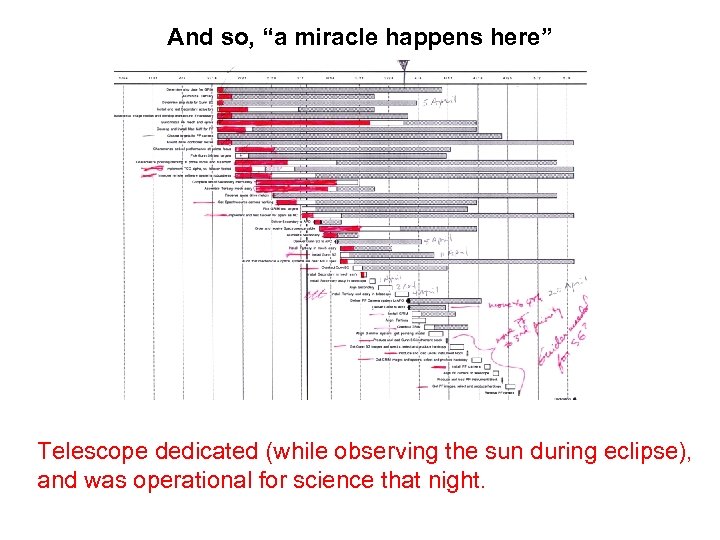 And so, “a miracle happens here” Telescope dedicated (while observing the sun during eclipse), and was operational for science that night.
![Vision, reality Remote hands-on internet operation: [still] works great Fast-change multi-instrument capability: manual at](https://present5.com/presentation/b475e751434307156bf62807812e545e/image-4.jpg "Vision, reality Remote hands-on internet operation: [still] works great Fast-change multi-instrument capability: manual at") Vision, reality Remote hands-on internet operation: [still] works great Fast-change multi-instrument capability: manual at first; heading toward multi-port fast change capability [got it] Excellent pointing and tracking: 1 arcsec goal; can usually point to within ~few arcsec [or better] Excellent delivered image quality: 0. 5 arcsec goal; often subarcsecond, but still feel we could improve about. 3 arcsec [median seeing still about 1 arcsec] Full suite of science instruments: Got them, upgraded them, have plans and paths to replace aging instruments [and continuing to this day] [“Partner” user support model; high priority on telescope and facility maintenance; recruit and retain an excellent staff]
Vision, reality Remote hands-on internet operation: [still] works great Fast-change multi-instrument capability: manual at first; heading toward multi-port fast change capability [got it] Excellent pointing and tracking: 1 arcsec goal; can usually point to within ~few arcsec [or better] Excellent delivered image quality: 0. 5 arcsec goal; often subarcsecond, but still feel we could improve about. 3 arcsec [median seeing still about 1 arcsec] Full suite of science instruments: Got them, upgraded them, have plans and paths to replace aging instruments [and continuing to this day] [“Partner” user support model; high priority on telescope and facility maintenance; recruit and retain an excellent staff]
 Ten years of improvements, e. g. , • 1994 -96: adaptive optics tests, added offset guider, calibration lamps, laser guide star tests, replaced enclosure wheels • 1997 -98: commissioned SPIcam, new M 1 support servo, 2 ndary bracing and stiffening, DIS slit viewer, commissioned Echelle, thermal management program, automated cal lamps • 1999 -2000: New 2 ndary mirror, rotation and tilt of tertiary, telescope monitoring telemetry system, S-H optics tester and collimation procedures, new gratings for DIS, 100 -base. T LAN • 2001 -04: aluminum flooring, DIS upgrades, new remote observing software, stray-light baffles completed, NIC-FPS delivered • [Annual site operations meetings organized over 10 years] • Future: fast guiding [nope], more instrument rotators [one], mirror coating facility [nope], new axis controllers [yes], auto-focus [yes], 2 ndary/tertiary supports & actuators [yes]
![Visiting Instruments [in first decade] • • • • 10 -micron array - Dan](https://present5.com/presentation/b475e751434307156bf62807812e545e/image-7.jpg "Visiting Instruments [in first decade] • • • • 10 -micron array - Dan") Visiting Instruments [in first decade] • • • • 10 -micron array - Dan Gazari 12 -micron spectrograph - Don Jennings Drift-scan Camera - Tim Mc. Kay, Jim Annis SPIcam - Chris Stubbs Goddard Fabrey-Perot imager - Bruce Woodgate AOTF - John Hillman, Nancy Chanover Ch. AOS, Ch. ILE - Ed Kibblewhite In. SB IR Camera - Bruce Woodgate LLNL FTS - Chris Stubbs Amber Camera - Dick Newton In. SB IR Camera - Sean Casey APOLLO Lunar Ranging- Chris Stubbs Cor. MASS - Mike Skrutskie, John Wilson
Visiting Instruments [in first decade] • • • • 10 -micron array - Dan Gazari 12 -micron spectrograph - Don Jennings Drift-scan Camera - Tim Mc. Kay, Jim Annis SPIcam - Chris Stubbs Goddard Fabrey-Perot imager - Bruce Woodgate AOTF - John Hillman, Nancy Chanover Ch. AOS, Ch. ILE - Ed Kibblewhite In. SB IR Camera - Bruce Woodgate LLNL FTS - Chris Stubbs Amber Camera - Dick Newton In. SB IR Camera - Sean Casey APOLLO Lunar Ranging- Chris Stubbs Cor. MASS - Mike Skrutskie, John Wilson
![Future roles, challenges for our mid-sized telescope [as seen in 2004] • 4 -m](https://present5.com/presentation/b475e751434307156bf62807812e545e/image-8.jpg "Future roles, challenges for our mid-sized telescope [as seen in 2004] • 4 -m") Future roles, challenges for our mid-sized telescope [as seen in 2004] • 4 -m telescopes now considered “small”* • put priority and resources toward dedicated and specialized projects uniquely matched to the telescope and its instrumentation • remote observing access + fast instrument change enables innovative observing modes, opening new kinds of scientific exploration and educational experiences, most not well suited for largest telescopes *see T. Oswalt’s Science in the Shadow of Giants: The Future of Small Telescopes
Future roles, challenges for our mid-sized telescope [as seen in 2004] • 4 -m telescopes now considered “small”* • put priority and resources toward dedicated and specialized projects uniquely matched to the telescope and its instrumentation • remote observing access + fast instrument change enables innovative observing modes, opening new kinds of scientific exploration and educational experiences, most not well suited for largest telescopes *see T. Oswalt’s Science in the Shadow of Giants: The Future of Small Telescopes
![New roles, observing modes [as seen in 2004] • Niche science opportunities: – fast-response](https://present5.com/presentation/b475e751434307156bf62807812e545e/image-9.jpg "New roles, observing modes [as seen in 2004] • Niche science opportunities: – fast-response") New roles, observing modes [as seen in 2004] • Niche science opportunities: – fast-response observations of transient phenomena – remote-control, queue-scheduled observations – large (and backup) programs – synergy with other telescopes, follow-up observations – surveys, synoptic and temporal monitoring programs – solar system programs – new instrument testing • General-purpose programs • Outreach and teaching
New roles, observing modes [as seen in 2004] • Niche science opportunities: – fast-response observations of transient phenomena – remote-control, queue-scheduled observations – large (and backup) programs – synergy with other telescopes, follow-up observations – surveys, synoptic and temporal monitoring programs – solar system programs – new instrument testing • General-purpose programs • Outreach and teaching