


 Скачать презентацию The Speech Mechanism z Speech is an overlaid
5.0. Speech Mechanism.ppt
- Количество слайдов: 18
 The Speech Mechanism z. Speech is an overlaid function ythere are no organs whose primary function is to produce speech z. Articulators - parts of the speech mechanism that serve to produce different configuartions which make up different sounds
 Four Parts of the Speech Mechanism z. Oral Cavity z. Nasal Cavity z. Pharynx z. Larynx
 Oral Cavity (oro/oral) z Lips (labio/labial) - bounded by the cheeks, chin, and nose yorbicularis oris - “lip muscle” that can contract to round, protrude, or spread the lips to make various speech sounds yphiltrum - grooved indentation in the center of the upper lip yvermilion - adaptation of the mucous membrane that lines the mouth; reddish color ysounds produced at lips xbilabial /p, b, m, w/ xlabio-dental /f, v/
 Oral Cavity (con’t) z Teeth (dento/dental)- important for sounds involving “lip & teeth” and “tongue & teeth” ylabio-dental sounds /f, v/ (“lip + teeth”) ylingua-dental sounds / , / (“tongue + teeth”) y. Dental occlusion - how the teeth fit together when you bite down yabnormal bite is a “malocclusion” xneutrocclusion (normal jaw relationship) xdistocclusion (retruded mandible) xmesiocclusion (protruded mandible)
 Oral Cavity (con’t) z. Alveolar ridge (alveolo/alveolar) - gum ridge ysounds made at alveolar ridge x/t, d, l, n, s, z/
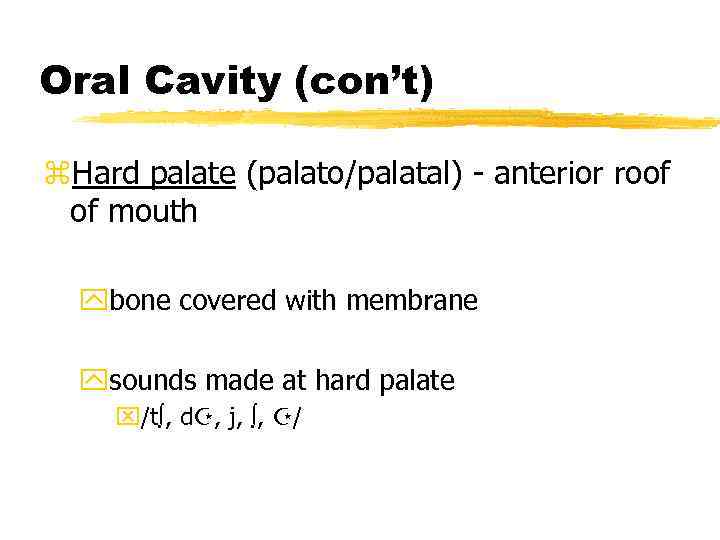 Oral Cavity (con’t) z. Hard palate (palato/palatal) - anterior roof of mouth ybone covered with membrane ysounds made at hard palate x/t , d , j, , /
 Oral Cavity (con’t) z. Velum (velo/velar) - soft palate ymovable fold of mucuous membrane that is continous with hard palate ydivides oral cavity from nasal for non-nasal sounds --> is LOWERED for nasal sounds ysounds made at velum - /k, g, / yuvula - “little grape” xserves little function in humans
 Oral Cavity (con’t) z Tongue (lingua/lingual) - most important of the articulators ymuscular organ capable of intrinsic (finer shapes) and extrinsic movements (responsible for up/down; backward/forward) ydivided into parts: xtip xfront or blade - beneath alveolar ridge xmiddle - beneath hard palate xback - beneath velum xroot - most posterior part of tongue
 Oral Cavity (con’t) z. Mandible (mandibulo/mandibular) - lower jaw yregulates the size of opening beneath teeth ytongue is connected to mandible by the lingual frenum which attaches tip and blade of tongue to floor of mouth
 Oral Cavity (con’t) z. Facial muscles - important in controlling cheeks and size of mouth yaids in building intra-oral breath pressure
 Nasal Cavity (naso/nasal) z. Extends from the nostrils (nares) to pharynx (throat) zimportant in resonance by opening or closing of velopharyngeal port yvelopharyngeal valve or port is formed by the soft palate making contact with the pharyngeal wall ymust be closed for vowels and non-nasal consonants
 Pharynx (pharyngo/pharyngeal) z. Throat zextends from the posterior portion of the nasal cavity downward through the back of the oral cavity to the larynx zpharynx is a vertical tube with 3 parts
 Pharynx (con’t) z Nasopharynx - continuation of the nasal cavity yuppermost part of pharynx; directly behind nasal cavity ynasopharynx can be closed off from the oropharynx where they join at the velopharyngeal port z Oropharynx - continuation of the oral cavity yopens to mouth yvery versatile in assuming a variety of configurations z Laryngopharynx - area just above larynx yvibrating mechanism that houses the vocal folds ysits on top of trachea
 Larynx z. Two purposes of larynx y. Prevent food from going into trachea xepiglottis -- leaf-like cartilage below root of tongue and at junction of oropharynx and laryngopharynx xcovers glottis during eating and drinking to prevent food and liquids from going into lungs y. Create a constriction in vocal tract which produces a sound source for communication
 Anatomy of Larynx zcricoid cartilage - bottom ring of larynx that sits on top of trachea ylooks like a signet ring zartynoid cartilages - mobile, paired, pyramid-shaped cartilages that sit on top of cricoid cartilage ythey attach to the vocal folds so that movement of the arytenoid cartilages moves the vocal folds
 Anatomy of Larynx (con’t) zthyroid cartilage - largest structure of larynx yshield-shaped cartilage that protects vocal folds yreferred to as “Adam’s apple” zhyoid bone - only bone in body not connected to other bones yattached to muscles and ligaments involved in swallowing and phonation yis a horse-shoe or “U”-shaped bone just above thyroid cartilage
 Anatomy of Larynx (con’t) z. Vocal folds - mucous membranes that attach separately to the arytenoid cartilages in back of larynx and come together in front at angle of thyroid cartilage z. Positions of vocal folds yopen (abducted) - for normal inhalation/ exhalation yclosed (adducted) - for phonation
 Anatomy of Larynx (con’t) z. Glottis -- opening in the vocal folds ytwo sounds produced at level of glottis /h, / zvocal folds vibrate to produce voicing zmiddle of vocal folds vibrate to produce voicing