 Скачать презентацию The spatial distribution of crop types from MODIS
987.ppt
- Количество слайдов: 16



The spatial distribution of crop types from MODIS data: Temporal unmixing using Independent Component Analysis Remote Sensing Term Project Presentation Gauhar Meldebekova ID 2015321666
Contents Introduction: 01 - Objective -Independent Component Analysis 02 Methodology 03 Results 04 Conclusion
I. INTRODUCTION: m Motive: accurate and timely information on the location and area of crops are of a great importance; m Challenge: crop acreage assessment using RS has not been widely operational because of the mixed pixel issue; m Objective: unmix observed RS signals in a coarse resolution pixel in order to extract source signals (crop temporal signature);
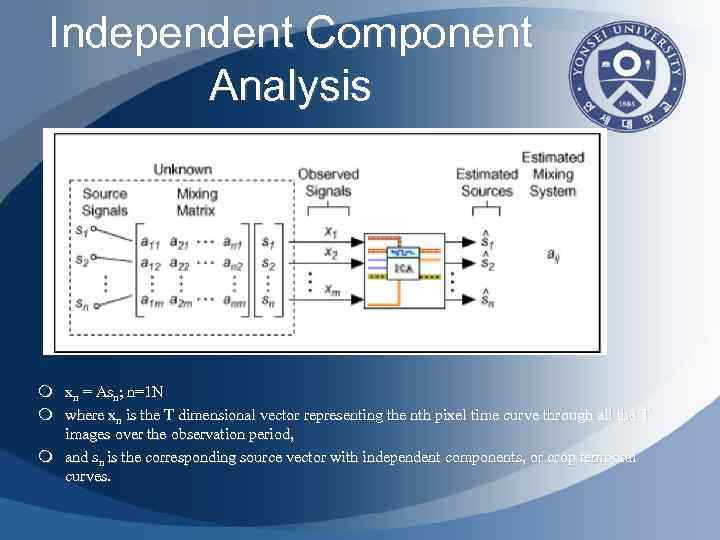
Independent Component Analysis m xn = Asn; n=1 N m where xn is the T dimensional vector representing the nth pixel time curve through all the T images over the observation period, m and sn is the corresponding source vector with independent components, or crop temporal curves.
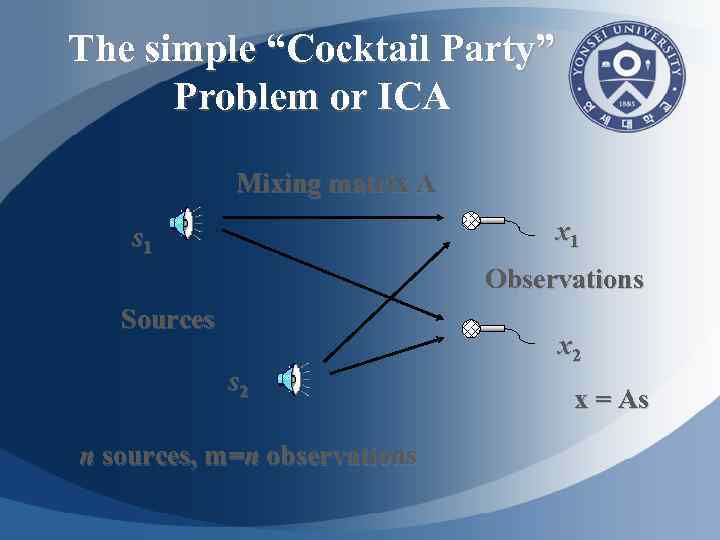
The simple “Cocktail Party” Problem or ICA Mixing matrix A x 1 s 1 Observations Sources s 2 n sources, m=n observations x 2 x = As
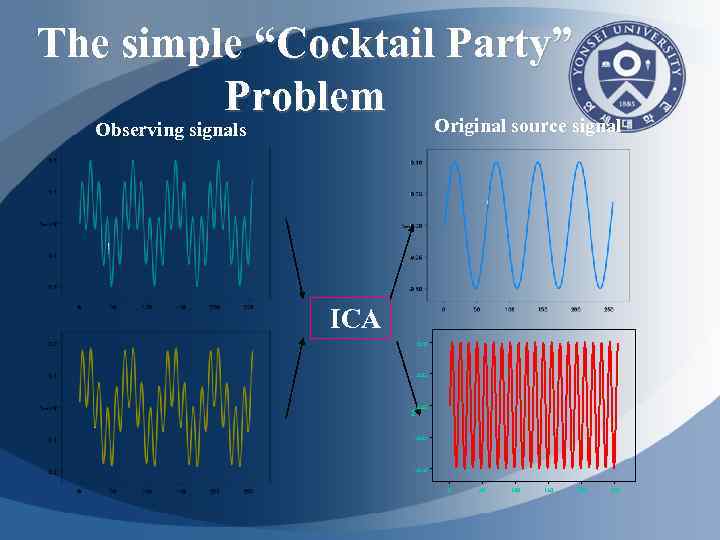
The simple “Cocktail Party” Problem Original source signal Observing signals ICA 0. 10 0. 05 V 4 0. 00 -0. 05 -0. 10 0 50 100 150 200 250
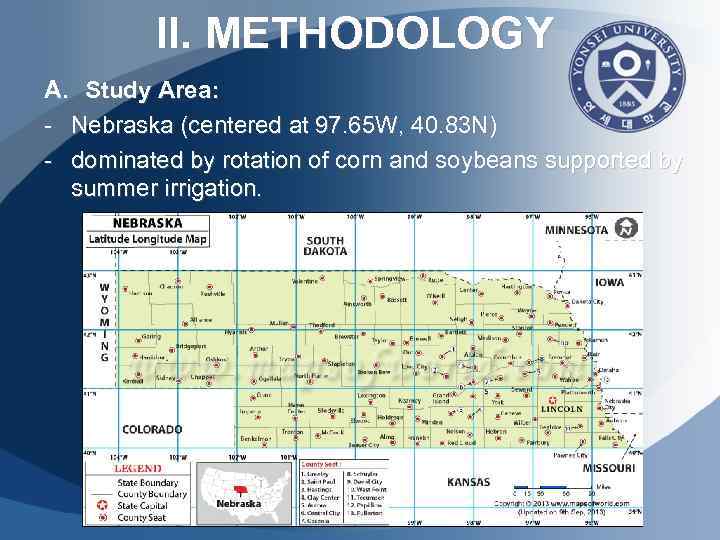
II. METHODOLOGY A. Study Area: - Nebraska (centered at 97. 65 W, 40. 83 N) - dominated by rotation of corn and soybeans supported by summer irrigation.
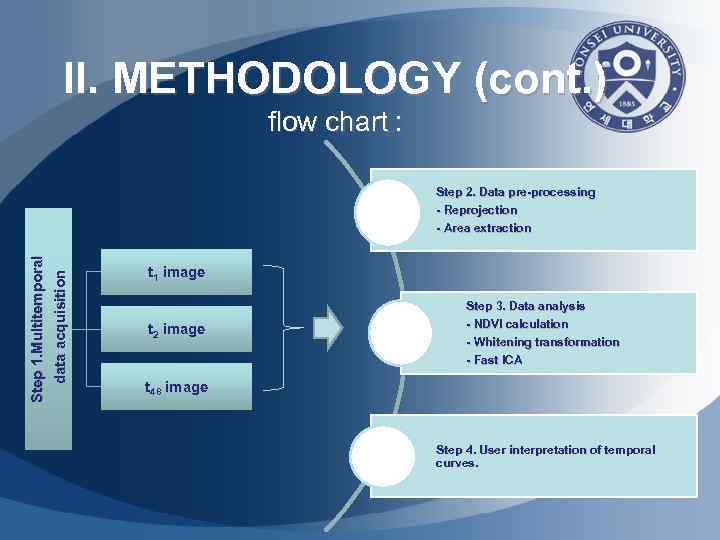
II. METHODOLOGY (cont. ) flow chart : Step 1. Multitemporal data acquisition Step 2. Data pre-processing - Reprojection - Area extraction t 1 image t 2 image Step 3. Data analysis - NDVI calculation - Whitening transformation - Fast ICA t 48 image Step 4. User interpretation of temporal curves.
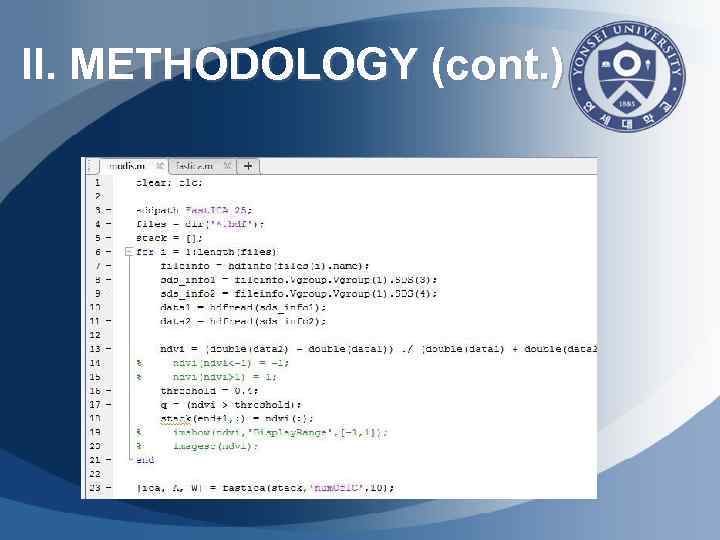
II. METHODOLOGY (cont. ) B. Data Acquisition, Processing, and Analysis - MODIS data (48 images) Nadir Bidirectional Reflectance Distribution (BRDF) – Adjusted Reflectance (NBAR) (MOD 43 B 4) product was downloaded from http: //earthexplorer. usgs. gov/ - Reprojected to the UTM reference system using MRT MODIS Reprojection Tool - 10, 000 km 2 sub-scene was extracted (48 -layer image) - Fast. ICA using MATLAB (input: NDVI)
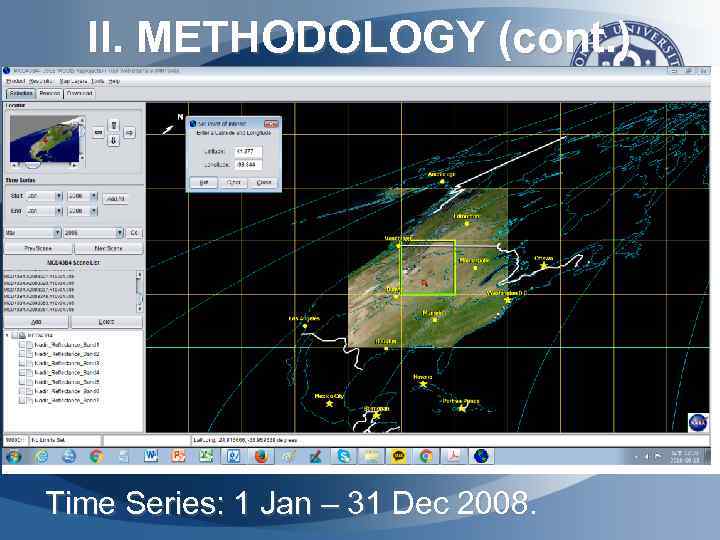
II. METHODOLOGY (cont. ) Time Series: 1 Jan – 31 Dec 2008.
II. METHODOLOGY (cont. )
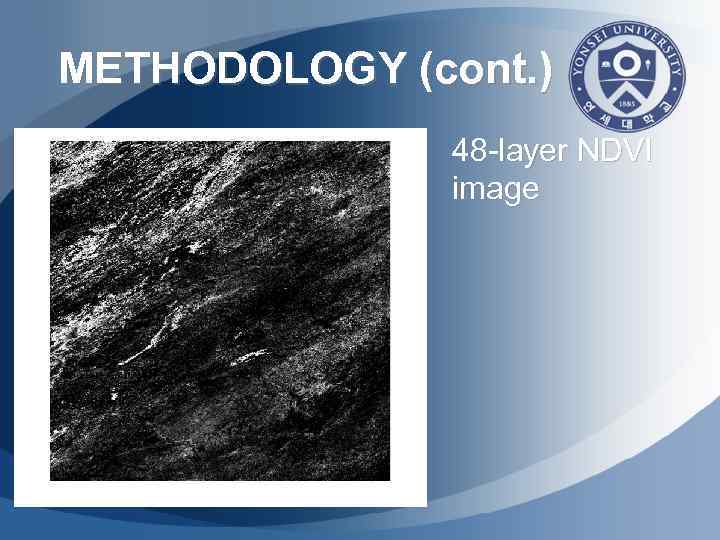
METHODOLOGY (cont. ) 48 -layer NDVI image

II. METHODOLOGY (cont. ) Fast. ICA using MATLAB:
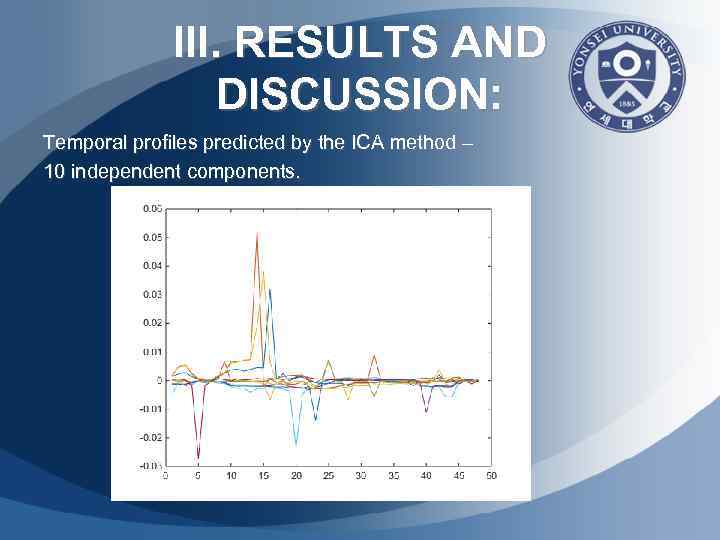
III. RESULTS AND DISCUSSION: Temporal profiles predicted by the ICA method – 10 independent components.
IV. CONCLUSION: m MODIS-derived observations of mixed crop types were temporally unmixed into individual crop fractions by means of the Independent Component Analysis. m The primary input from the user comes at the end of the mapping process, that is, the identification of these independent components.

THANK YOU FOR YOUR ATTENTION! HA 3 APЛAPЫҢЫЗҒА YЛKEH PAXMET!
Скачать презентацию The spatial distribution of crop types from MODIS
987.ppt