


 Скачать презентацию The Space Efficiency of OSHL Swaha Miller David
008e1ece76e5fc9eb4b77e0592721d39.ppt
- Количество слайдов: 39
 The Space Efficiency of OSHL Swaha Miller David A. Plaisted UNC Chapel Hill
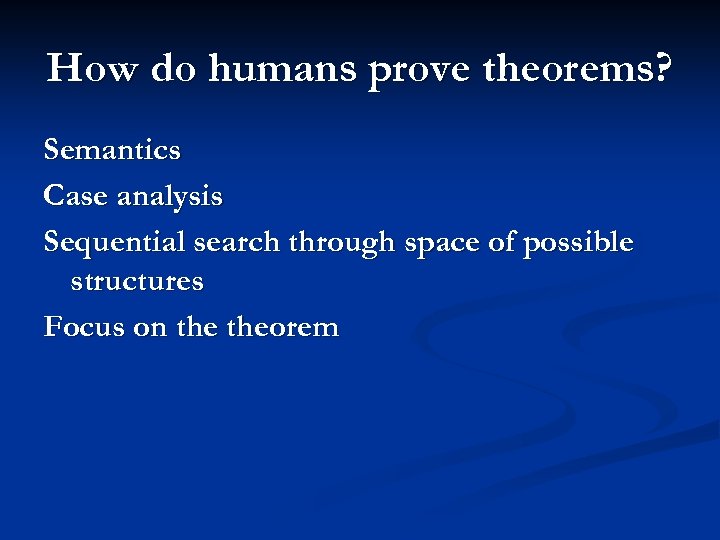 How do humans prove theorems? Semantics Case analysis Sequential search through space of possible structures Focus on theorem
 “Systematic methods can now routinely solve verification problems with thousands or tens of thousands of variables, while local search methods can solve hard random 3 SAT problems with millions of variables. ” (from a conference announcement)
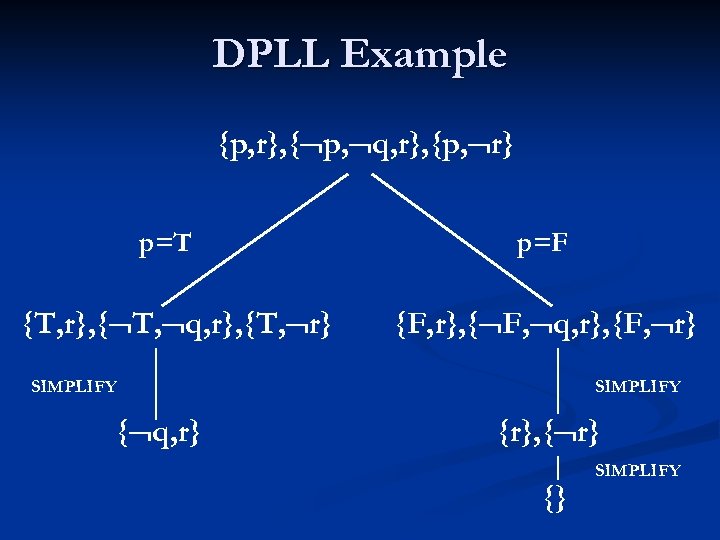 DPLL Example {p, r}, { p, q, r}, {p, r} p=T {T, r}, { T, q, r}, {T, r} p=F {F, r}, { F, q, r}, {F, r} SIMPLIFY { q, r} SIMPLIFY {r}, { r} {} SIMPLIFY
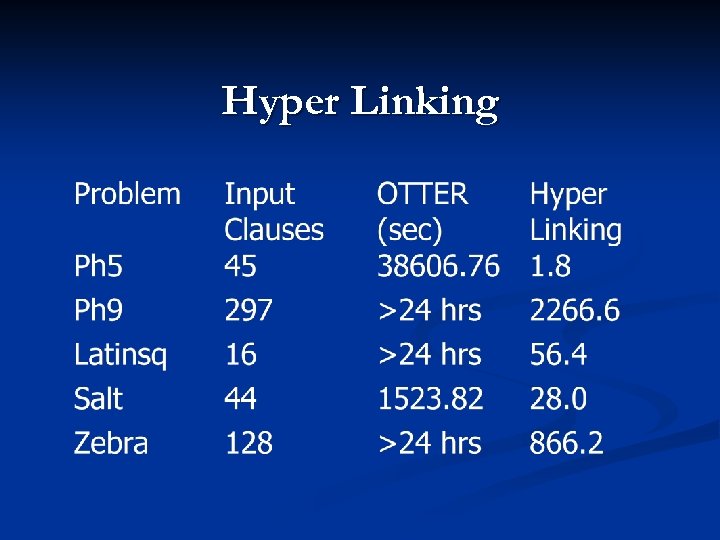 Hyper Linking
 Eliminating Duplication with the Hyper. Linking Strategy, Shie-Jue Lee and David A. Plaisted, Journal of Automated Reasoning 9 (1992) 25 -42.
 Later propositional strategies Billon’s disconnection calculus, derived from hyper-linking Disconnection calculus theorem prover (DCTP), derived from Billon’s work FDPLL
 Performance of DCTP on TPTP, 2003 DCTP 1. 3 first in EPS and EPR (largely propositional) DCTP 10. 2 p third in FNE (first-order, no equality) solving same number as best provers DCTP 10. 2 p fourth in FOF and FEQ (all firstorder formulae, and formulae with equality) DCTP 1. 3 is a single strategy prover.
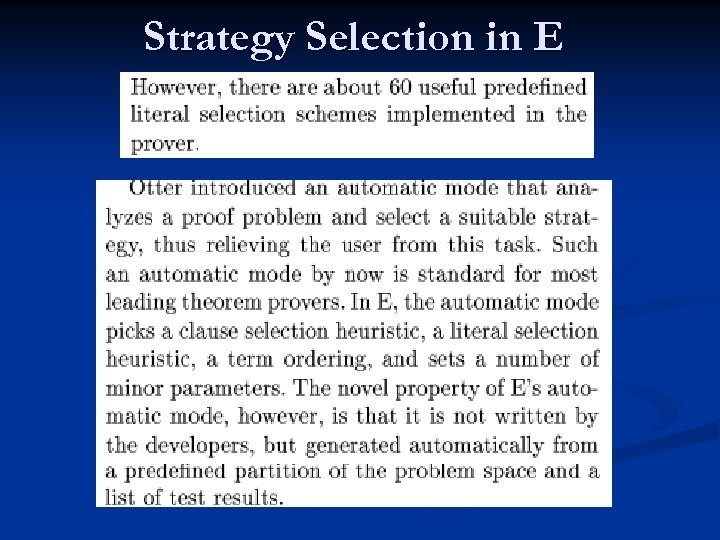 Strategy Selection in E
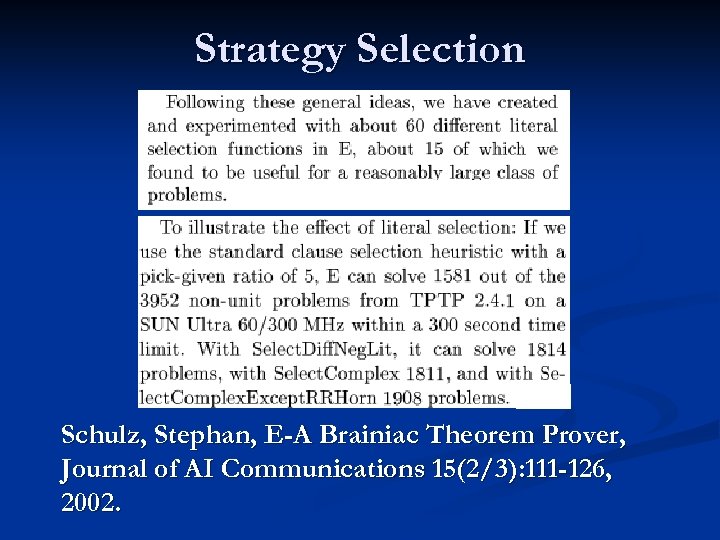 Strategy Selection Schulz, Stephan, E-A Brainiac Theorem Prover, Journal of AI Communications 15(2/3): 111 -126, 2002.
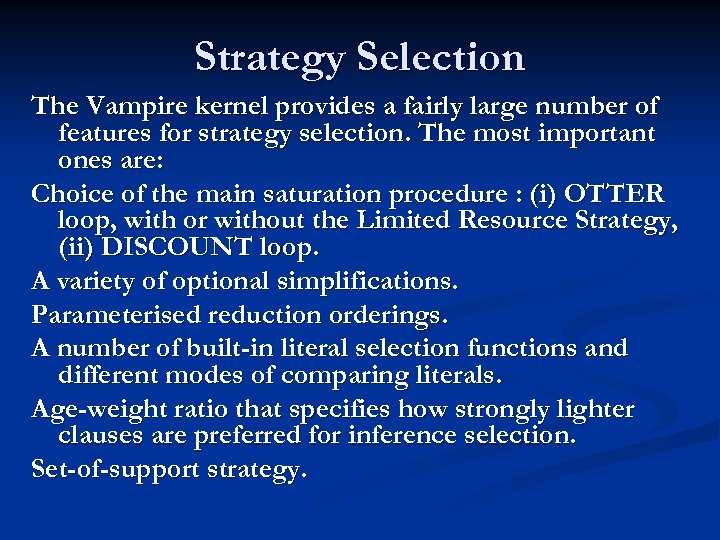 Strategy Selection The Vampire kernel provides a fairly large number of features for strategy selection. The most important ones are: Choice of the main saturation procedure : (i) OTTER loop, with or without the Limited Resource Strategy, (ii) DISCOUNT loop. A variety of optional simplifications. Parameterised reduction orderings. A number of built-in literal selection functions and different modes of comparing literals. Age-weight ratio that specifies how strongly lighter clauses are preferred for inference selection. Set-of-support strategy.
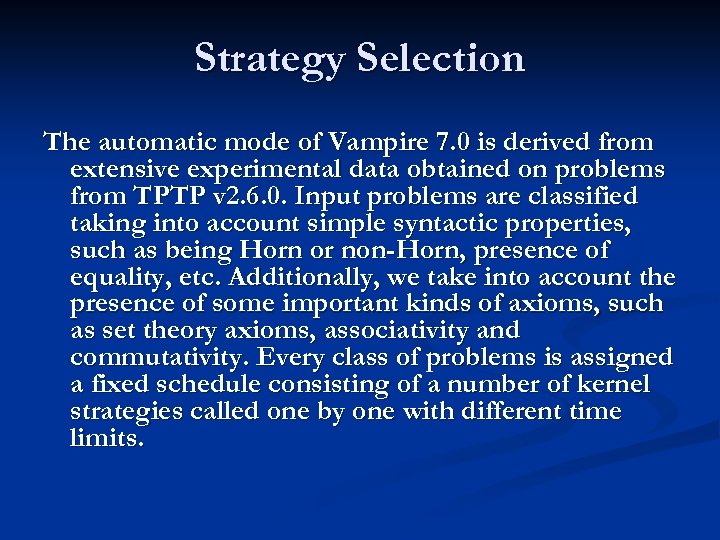 Strategy Selection The automatic mode of Vampire 7. 0 is derived from extensive experimental data obtained on problems from TPTP v 2. 6. 0. Input problems are classified taking into account simple syntactic properties, such as being Horn or non-Horn, presence of equality, etc. Additionally, we take into account the presence of some important kinds of axioms, such as set theory axioms, associativity and commutativity. Every class of problems is assigned a fixed schedule consisting of a number of kernel strategies called one by one with different time limits.
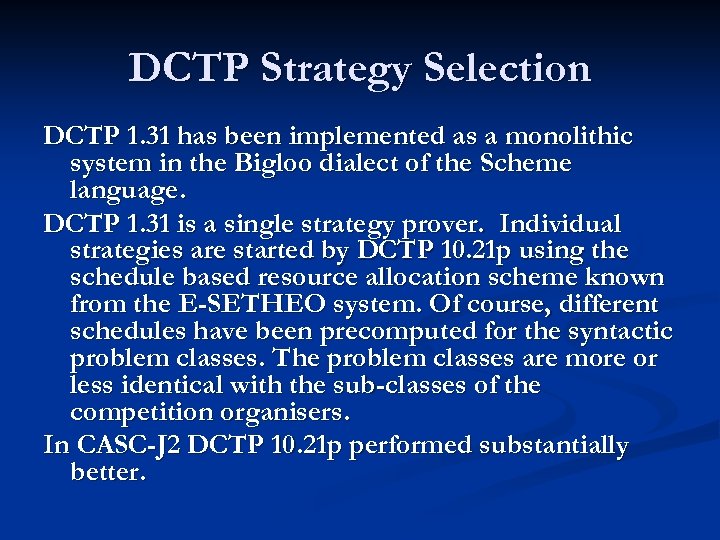 DCTP Strategy Selection DCTP 1. 31 has been implemented as a monolithic system in the Bigloo dialect of the Scheme language. DCTP 1. 31 is a single strategy prover. Individual strategies are started by DCTP 10. 21 p using the schedule based resource allocation scheme known from the E-SETHEO system. Of course, different schedules have been precomputed for the syntactic problem classes. The problem classes are more or less identical with the sub-classes of the competition organisers. In CASC-J 2 DCTP 10. 21 p performed substantially better.
 Goal of OSHL First-order logic Clause form Propositional efficiency Semantics Requires ground decidability
 Structure of OSHL Goal sensitivity if semantics chosen properly Choose initial semantics to satisfy axioms Use of natural semantics For group theory problems, can specify a group Sequential search through possible interpretations Thus similar to Davis and Putnam’s method Propositional Efficiency Constructs a semantic tree
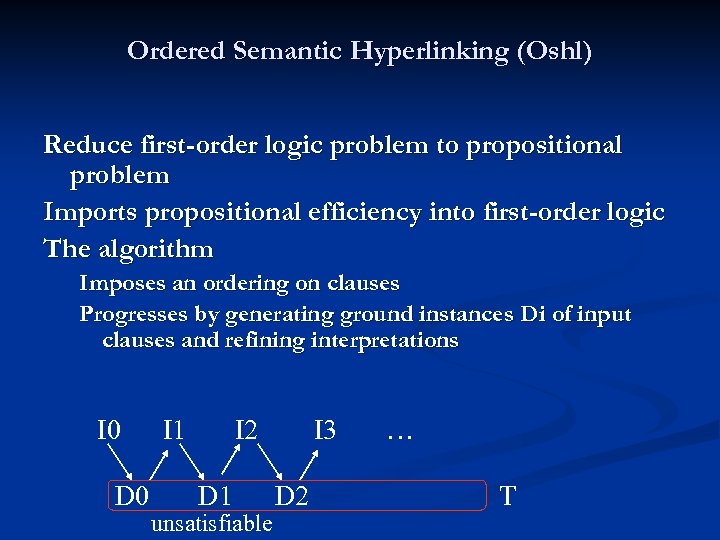 Ordered Semantic Hyperlinking (Oshl) Reduce first-order logic problem to propositional problem Imports propositional efficiency into first-order logic The algorithm Imposes an ordering on clauses Progresses by generating ground instances Di of input clauses and refining interpretations I 0 D 0 I 1 I 2 D 1 unsatisfiable I 3 D 2 … T
 Semantics Trivial semantics: Positive: Choose I 0 to falsify all atoms, first D is all positive. Forward chaining. Negative: Choose I 0 to satisfy all atoms, first D is all negative. Backward chaining. Natural semantics: I 0 chosen by user
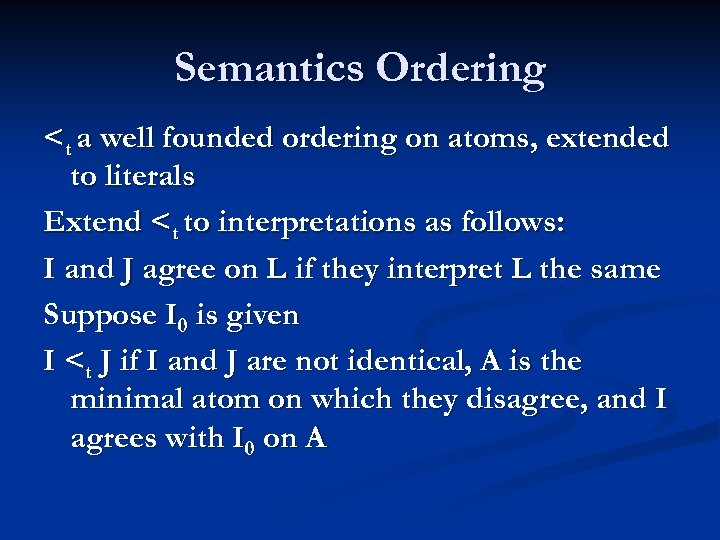 Semantics Ordering
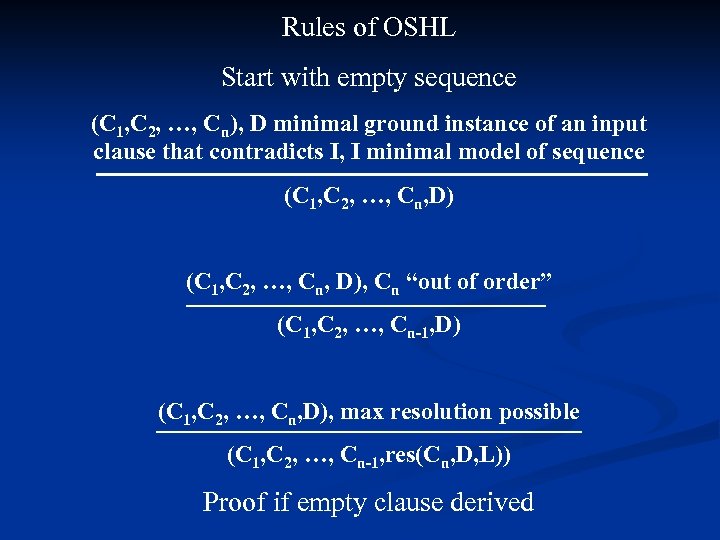 Rules of OSHL Start with empty sequence (C 1, C 2, …, Cn), D minimal ground instance of an input clause that contradicts I, I minimal model of sequence (C 1, C 2, …, Cn, D), Cn “out of order” (C 1, C 2, …, Cn-1, D) (C 1, C 2, …, Cn, D), max resolution possible (C 1, C 2, …, Cn-1, res(Cn, D, L)) Proof if empty clause derived
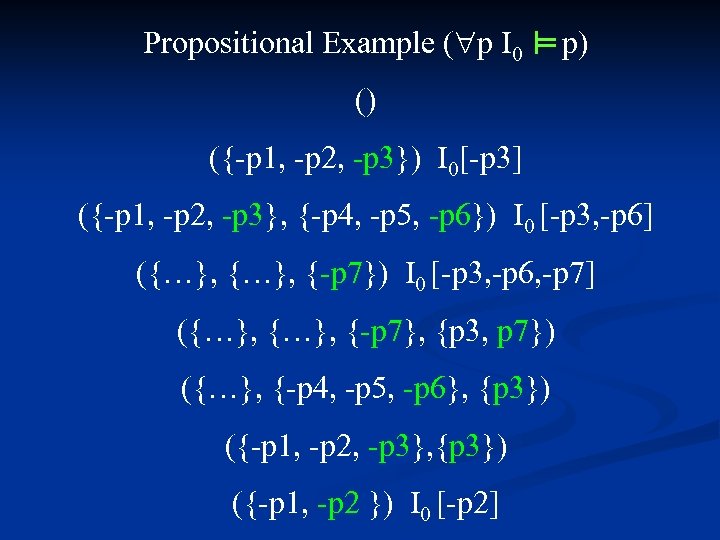 ╨ Propositional Example ( p I 0 p) () ({-p 1, -p 2, -p 3}) I 0[-p 3] ({-p 1, -p 2, -p 3}, {-p 4, -p 5, -p 6}) I 0 [-p 3, -p 6] ({…}, {-p 7}) I 0 [-p 3, -p 6, -p 7] ({…}, {-p 7}, {p 3, p 7}) ({…}, {-p 4, -p 5, -p 6}, {p 3}) ({-p 1, -p 2, -p 3}, {p 3}) ({-p 1, -p 2 }) I 0 [-p 2]
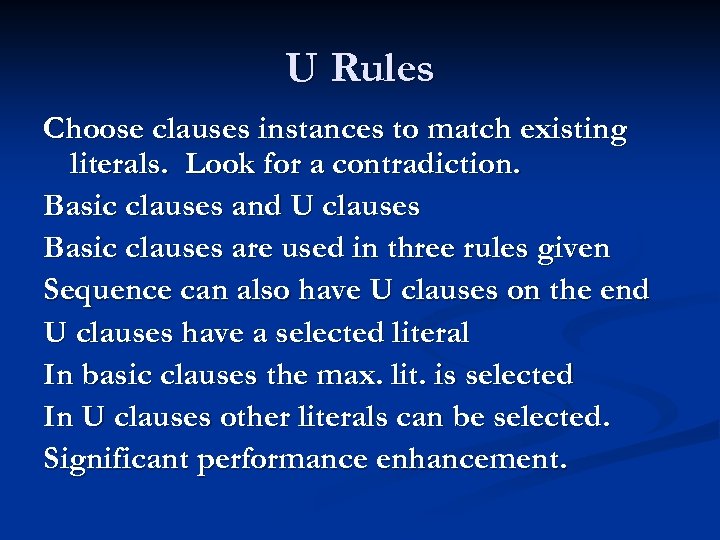 U Rules Choose clauses instances to match existing literals. Look for a contradiction. Basic clauses and U clauses Basic clauses are used in three rules given Sequence can also have U clauses on the end U clauses have a selected literal In basic clauses the max. lit. is selected In U clauses other literals can be selected. Significant performance enhancement.
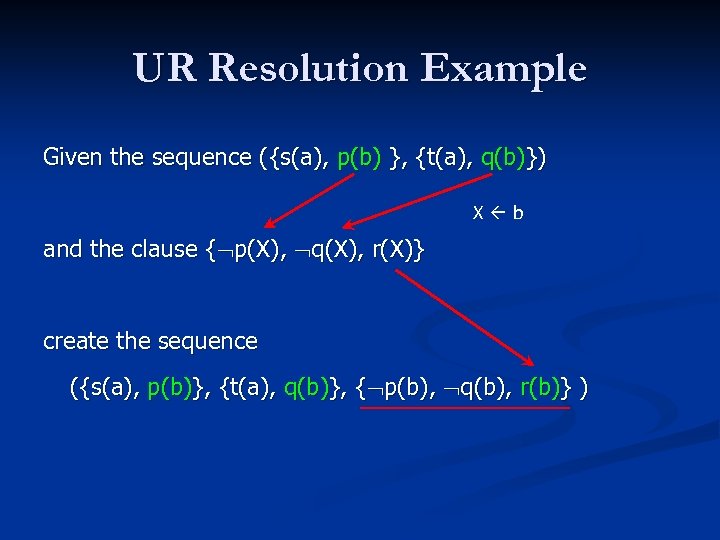 UR Resolution Example Given the sequence ({s(a), p(b) }, {t(a), q(b)}) X b and the clause { p(X), q(X), r(X)} create the sequence ({s(a), p(b)}, {t(a), q(b)}, { p(b), q(b), r(b)} )
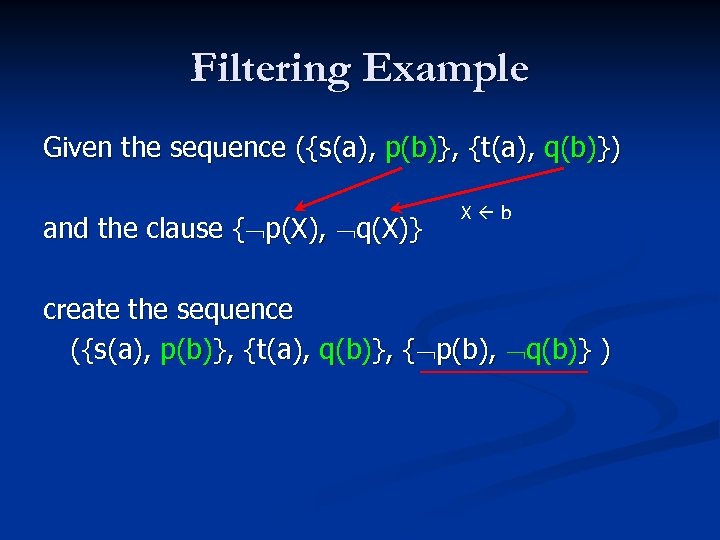 Filtering Example Given the sequence ({s(a), p(b)}, {t(a), q(b)}) and the clause { p(X), q(X)} X b create the sequence ({s(a), p(b)}, {t(a), q(b)}, { p(b), q(b)} )
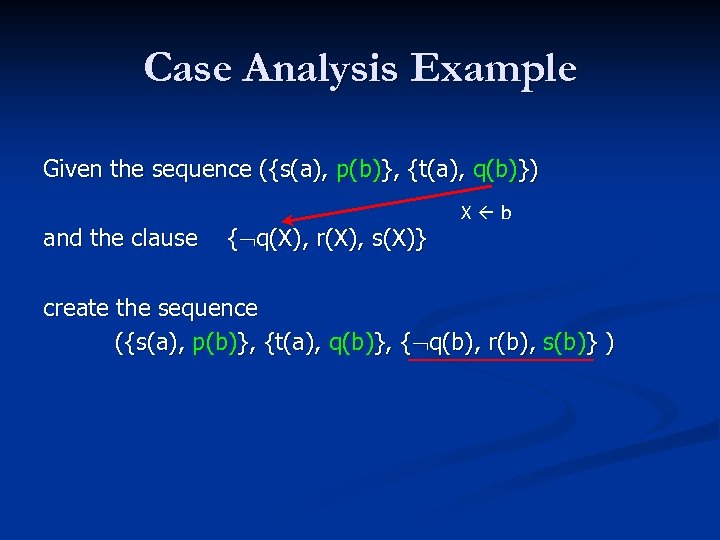 Case Analysis Example Given the sequence ({s(a), p(b)}, {t(a), q(b)}) and the clause { q(X), r(X), s(X)} X b create the sequence ({s(a), p(b)}, {t(a), q(b)}, { q(b), r(b), s(b)} )
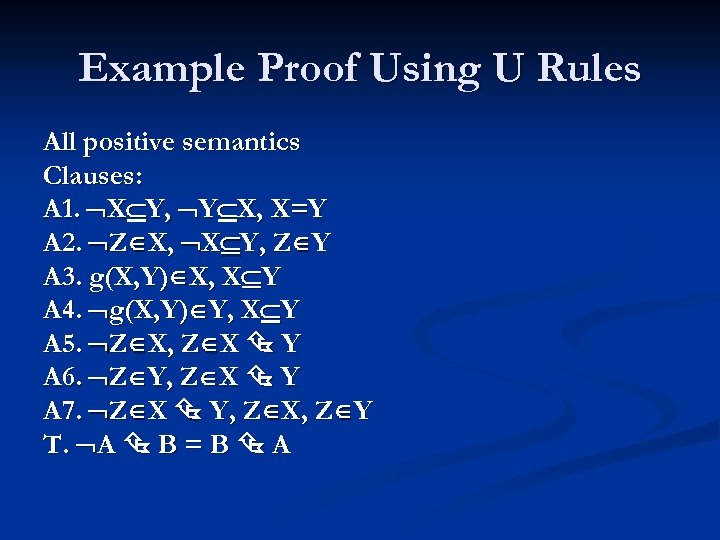 Example Proof Using U Rules All positive semantics Clauses: A 1. X Y, Y X, X=Y A 2. Z X, X Y, Z Y A 3. g(X, Y) X, X Y A 4. g(X, Y) Y, X Y A 5. Z X, Z X Y A 6. Z Y, Z X Y A 7. Z X Y, Z X, Z Y T. A B = B A
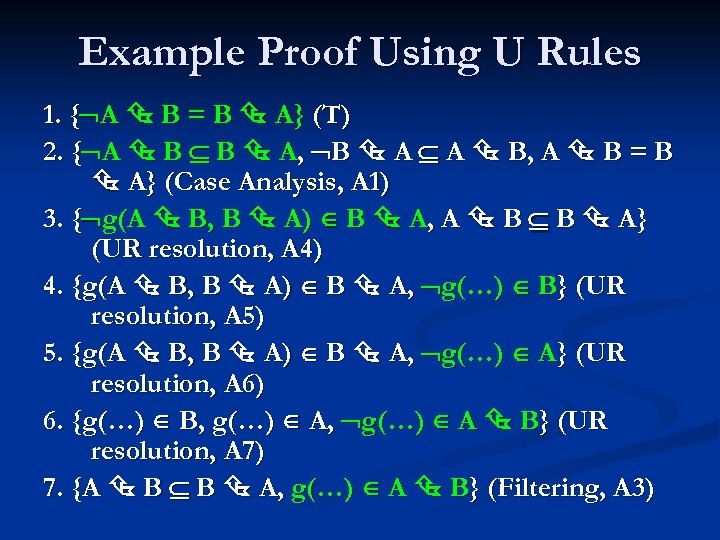 Example Proof Using U Rules 1. { A B = B A} (T) 2. { A B B A, B A A B, A B = B A} (Case Analysis, A 1) 3. { g(A B, B A) B A, A B B A} (UR resolution, A 4) 4. {g(A B, B A) B A, g(…) B} (UR resolution, A 5) 5. {g(A B, B A) B A, g(…) A} (UR resolution, A 6) 6. {g(…) B, g(…) A, g(…) A B} (UR resolution, A 7) 7. {A B B A, g(…) A B} (Filtering, A 3)
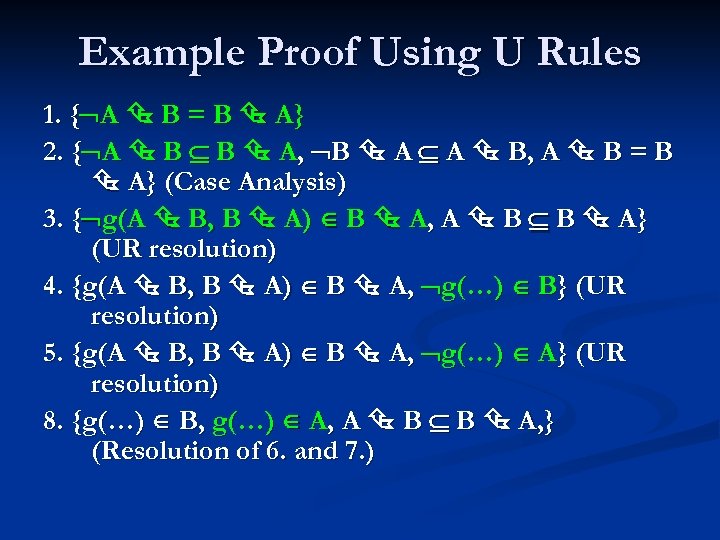 Example Proof Using U Rules 1. { A B = B A} 2. { A B B A, B A A B, A B = B A} (Case Analysis) 3. { g(A B, B A) B A, A B B A} (UR resolution) 4. {g(A B, B A) B A, g(…) B} (UR resolution) 5. {g(A B, B A) B A, g(…) A} (UR resolution) 8. {g(…) B, g(…) A, A B B A, } (Resolution of 6. and 7. )
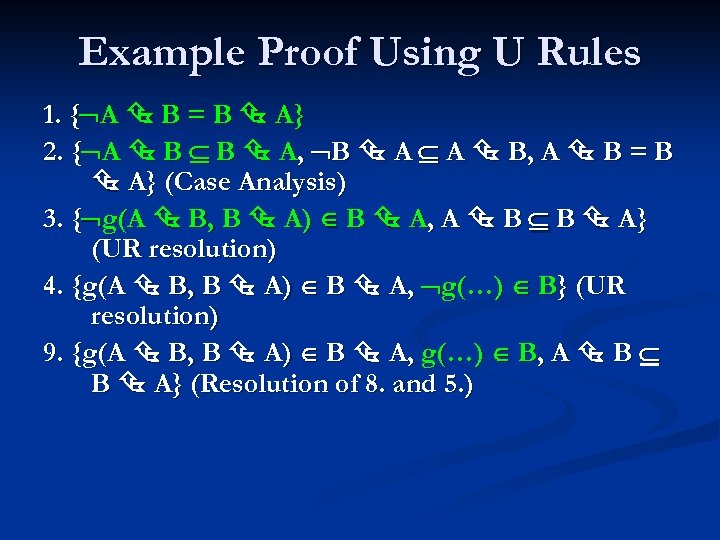 Example Proof Using U Rules 1. { A B = B A} 2. { A B B A, B A A B, A B = B A} (Case Analysis) 3. { g(A B, B A) B A, A B B A} (UR resolution) 4. {g(A B, B A) B A, g(…) B} (UR resolution) 9. {g(A B, B A) B A, g(…) B, A B B A} (Resolution of 8. and 5. )
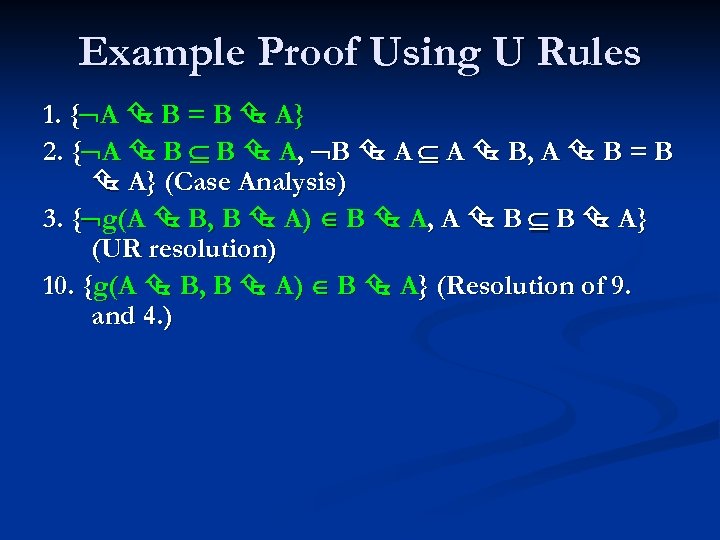 Example Proof Using U Rules 1. { A B = B A} 2. { A B B A, B A A B, A B = B A} (Case Analysis) 3. { g(A B, B A) B A, A B B A} (UR resolution) 10. {g(A B, B A) B A} (Resolution of 9. and 4. )
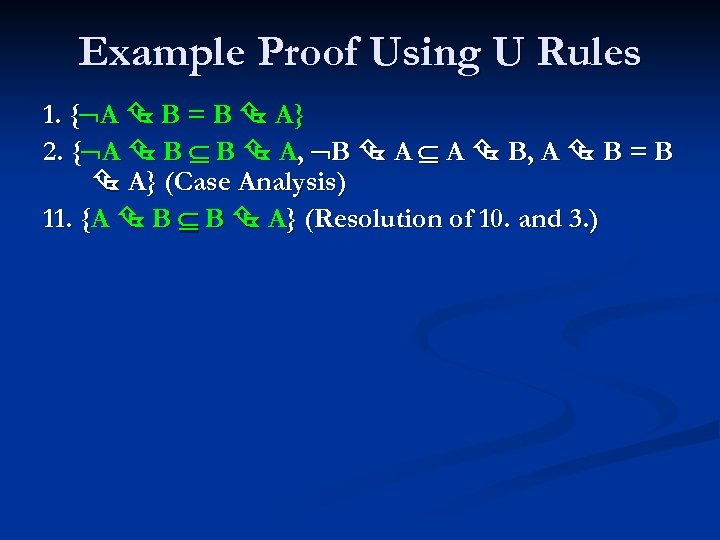 Example Proof Using U Rules 1. { A B = B A} 2. { A B B A, B A A B, A B = B A} (Case Analysis) 11. {A B B A} (Resolution of 10. and 3. )
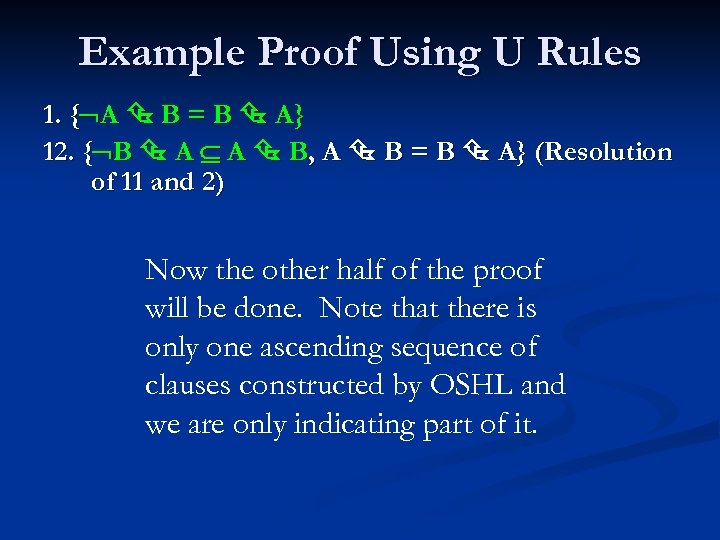 Example Proof Using U Rules 1. { A B = B A} 12. { B A A B, A B = B A} (Resolution of 11 and 2) Now the other half of the proof will be done. Note that there is only one ascending sequence of clauses constructed by OSHL and we are only indicating part of it.
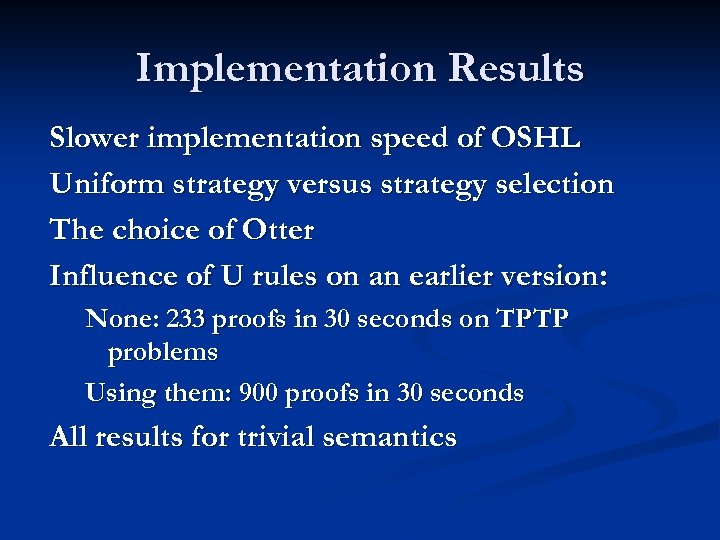 Implementation Results Slower implementation speed of OSHL Uniform strategy versus strategy selection The choice of Otter Influence of U rules on an earlier version: None: 233 proofs in 30 seconds on TPTP problems Using them: 900 proofs in 30 seconds All results for trivial semantics
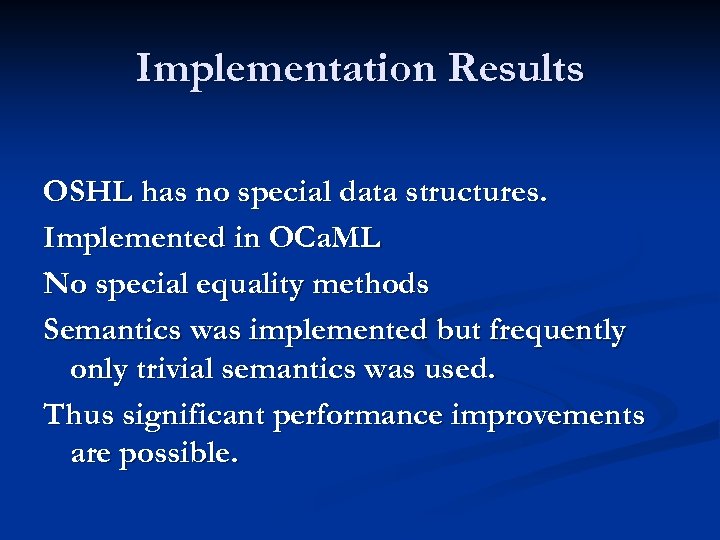 Implementation Results OSHL has no special data structures. Implemented in OCa. ML No special equality methods Semantics was implemented but frequently only trivial semantics was used. Thus significant performance improvements are possible.
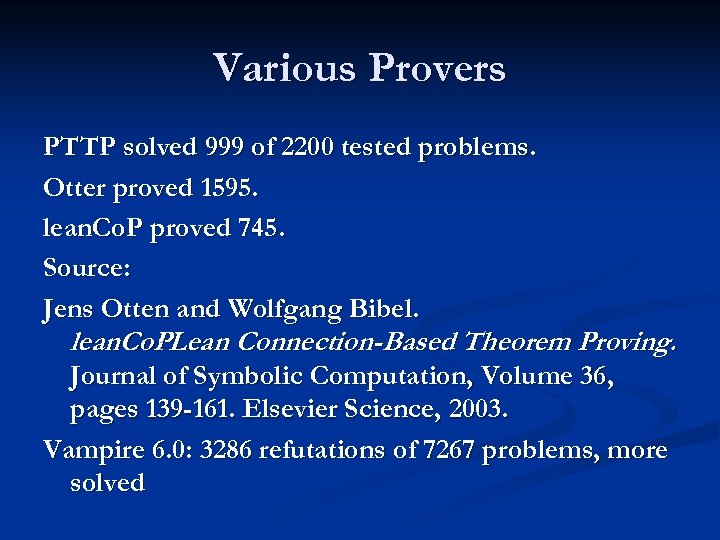 Various Provers PTTP solved 999 of 2200 tested problems. Otter proved 1595. lean. Co. P proved 745. Source: Jens Otten and Wolfgang Bibel. lean. Co. PLean Connection-Based Theorem Proving. : Journal of Symbolic Computation, Volume 36, pages 139 -161. Elsevier Science, 2003. Vampire 6. 0: 3286 refutations of 7267 problems, more solved
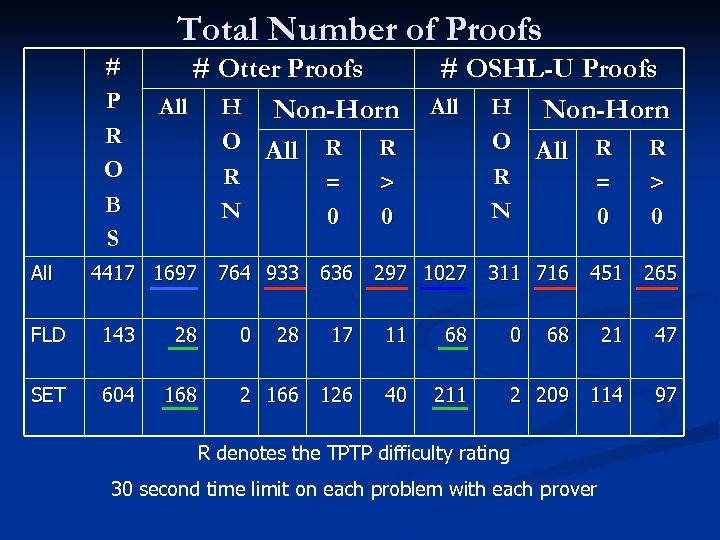 Total Number of Proofs # P R O B S All # Otter Proofs All H Non-Horn O All R R # OSHL-U Proofs All H Non-Horn O All R R R N 4417 1697 FLD 143 28 SET 604 168 = 0 > 0 R N = 0 > 0 764 933 636 297 1027 311 716 451 265 68 21 47 2 209 114 97 0 28 17 11 68 2 166 126 40 211 0 R denotes the TPTP difficulty rating 30 second time limit on each problem with each prover
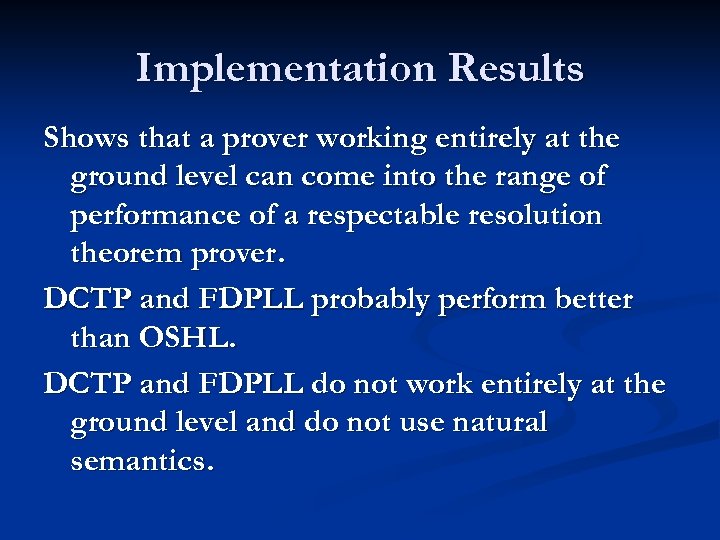 Implementation Results Shows that a prover working entirely at the ground level can come into the range of performance of a respectable resolution theorem prover. DCTP and FDPLL probably perform better than OSHL. DCTP and FDPLL do not work entirely at the ground level and do not use natural semantics.
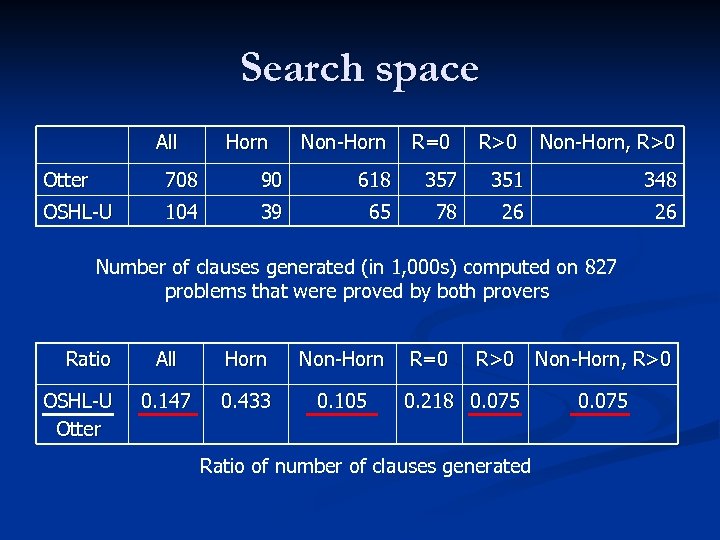 Search space All Horn Non-Horn R=0 R>0 Non-Horn, R>0 Otter 708 90 618 357 351 348 OSHL-U 104 39 65 78 26 26 Number of clauses generated (in 1, 000 s) computed on 827 problems that were proved by both provers Ratio OSHL-U Otter All Horn Non-Horn 0. 147 0. 433 0. 105 R=0 R>0 0. 218 0. 075 Ratio of number of clauses generated Non-Horn, R>0 0. 075
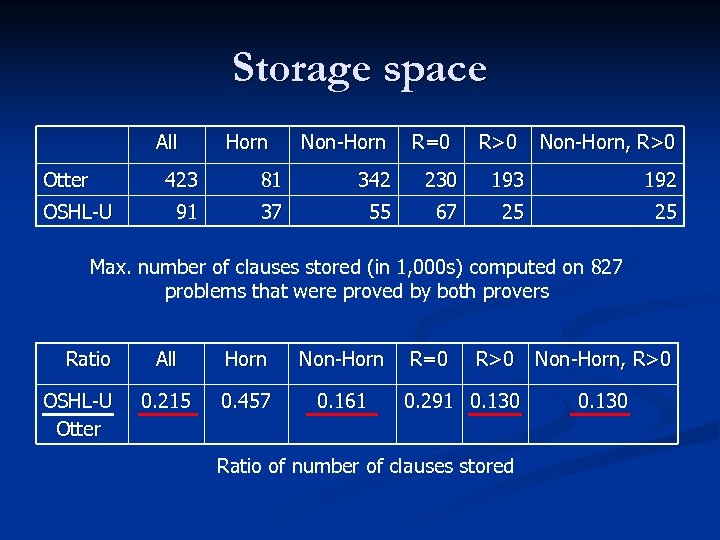 Storage space All Otter Horn Non-Horn R=0 R>0 Non-Horn, R>0 423 OSHL-U 81 342 230 193 192 91 37 55 67 25 25 Max. number of clauses stored (in 1, 000 s) computed on 827 problems that were proved by both provers Ratio OSHL-U Otter All Horn Non-Horn 0. 215 0. 457 0. 161 R=0 R>0 0. 291 0. 130 Ratio of number of clauses stored Non-Horn, R>0 0. 130
 Implementation Results In a given number of inferences OSHL finds more proofs than Otter for non Horn problems