


 Скачать презентацию The Source_er s Apprentice Powerful Tips Techniques in
a90a1e131557b992353fe935ce9a9523.ppt
- Количество слайдов: 36
 The Source_er’s Apprentice: Powerful Tips & Techniques in Perl you can start using today Matthew Heusser xndev. com - matt@xndev. com Presented to the West Michigan Perl Mongrels – 8/25/2006
 Techniques … there is a distinct difference between learning to use Perl, and learning to use it well. In my opinion, the best way to learn any language well is to see how others have used it to solve problems - Some Dude on Amazon. com
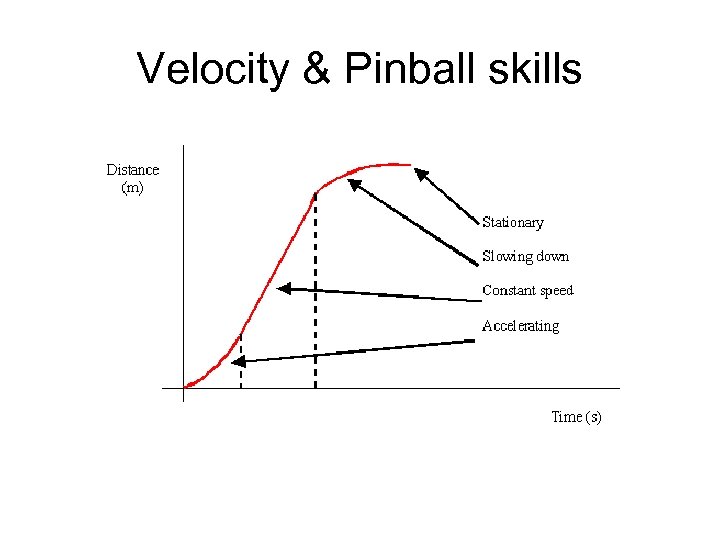 Velocity & Pinball skills
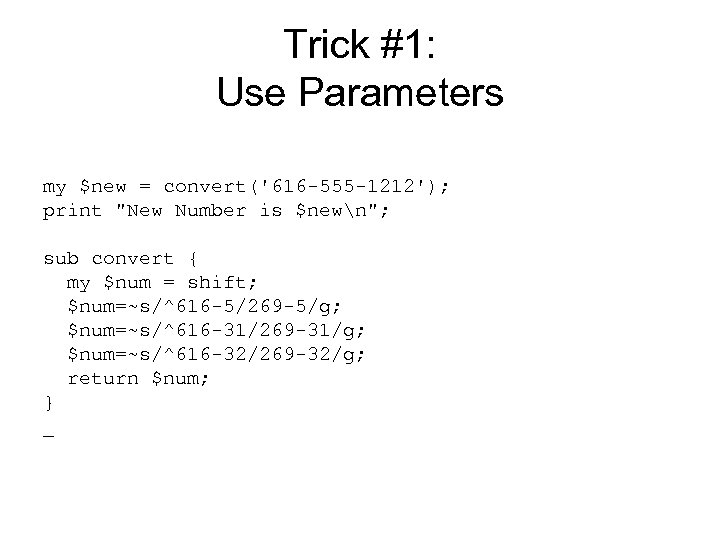 Trick #1: Use Parameters my $new = convert('616 -555 -1212'); print "New Number is $newn"; sub convert { my $num = shift; $num=~s/^616 -5/269 -5/g; $num=~s/^616 -31/269 -31/g; $num=~s/^616 -32/269 -32/g; return $num; } _
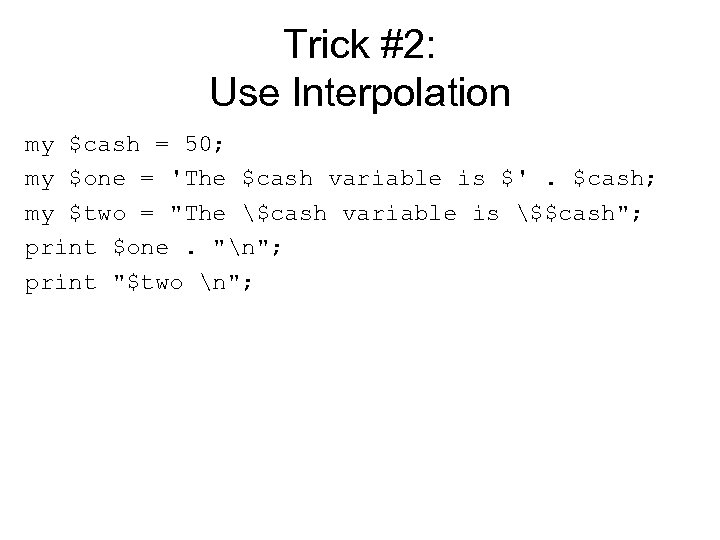 Trick #2: Use Interpolation my $cash = 50; my $one = 'The $cash variable is $'. $cash; my $two = "The $cash variable is $$cash"; print $one. "n"; print "$two n";
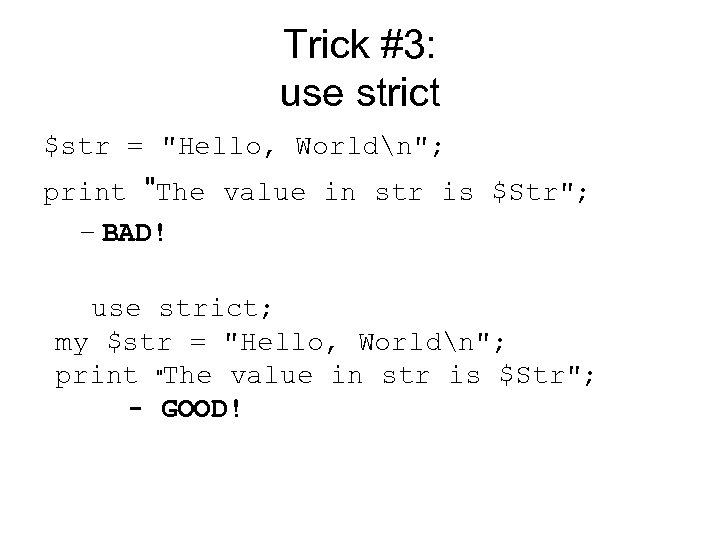 Trick #3: use strict $str = "Hello, Worldn"; print "The value in str is $Str"; – BAD! use strict; my $str = "Hello, Worldn"; print "The value in str is $Str"; - GOOD!
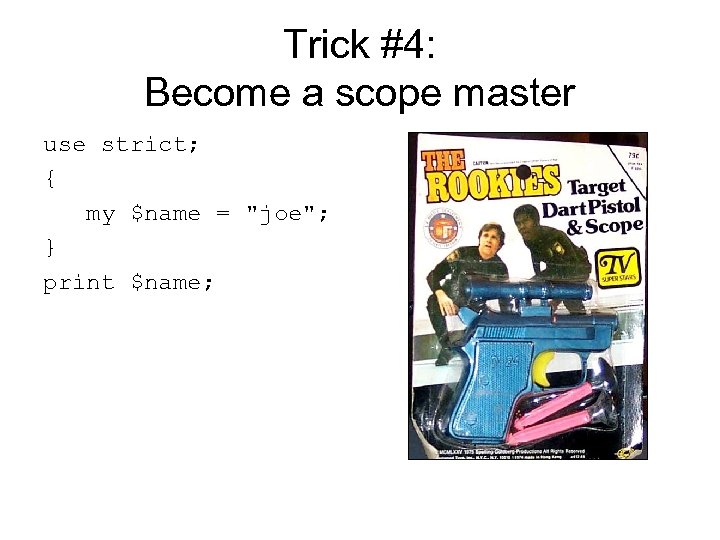 Trick #4: Become a scope master use strict; { my $name = "joe"; } print $name;
) { print" src="https://present5.com/presentation/a90a1e131557b992353fe935ce9a9523/image-8.jpg" alt="Trick #5: File Handles my $f = open_file("TRICK 1. TXT"); while (<$f>) { print" />
Trick #5: File Handles my $f = open_file("TRICK 1. TXT"); while (<$f>) { print $_; } sub open_file { my $file = shift; open INFILE, $file || die "Could not open $f for read"; return(*INFILE); }
)" src="https://present5.com/presentation/a90a1e131557b992353fe935ce9a9523/image-9.jpg" alt="Trick #6: use croak use Carp; my $f = open_file("TRICK 2. TXT"); while (<$f>)" />
Trick #6: use croak use Carp; my $f = open_file("TRICK 2. TXT"); while (<$f>) { print $_; } sub open_file { my $file = shift; open INFILE, $file or croak "Could not open $file for read"; return(*INFILE); }
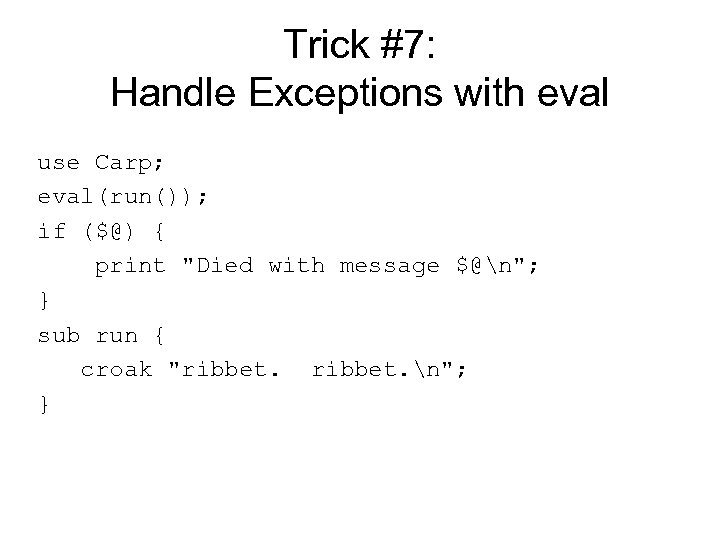 Trick #7: Handle Exceptions with eval use Carp; eval(run()); if ($@) { print "Died with message $@n"; } sub run { croak "ribbet. n"; }
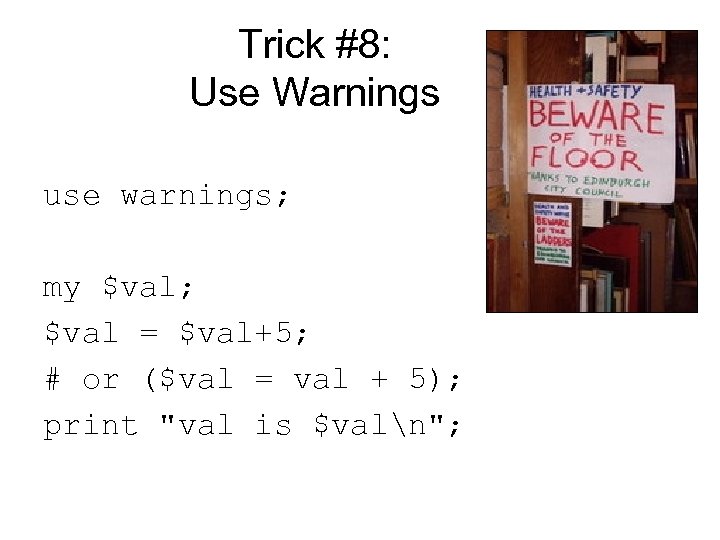 Trick #8: Use Warnings use warnings; my $val; $val = $val+5; # or ($val = val + 5); print "val is $valn";
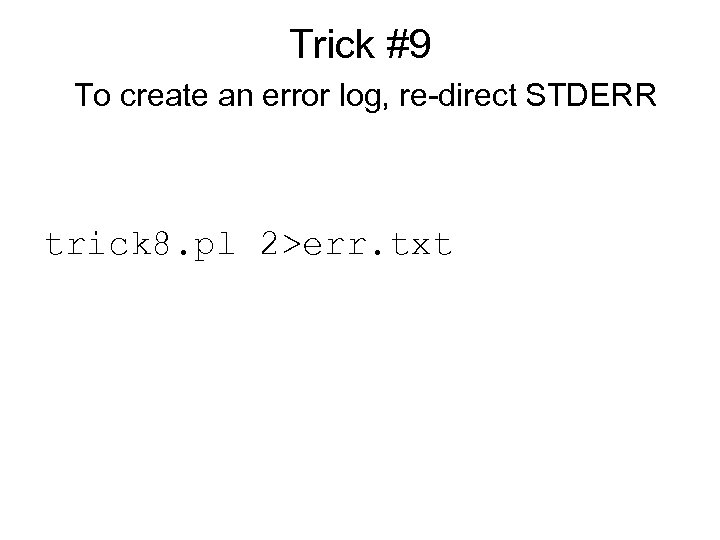 Trick #9 To create an error log, re-direct STDERR trick 8. pl 2>err. txt
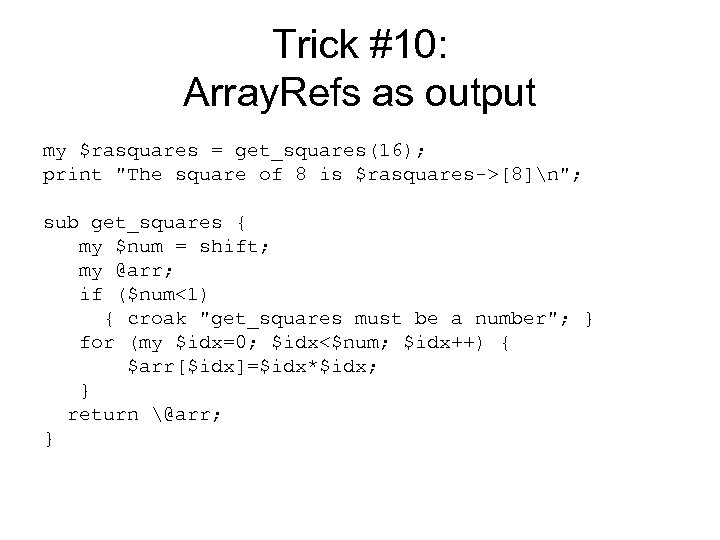 Trick #10: Array. Refs as output my $rasquares = get_squares(16); print "The square of 8 is $rasquares->[8]n"; sub get_squares { my $num = shift; my @arr; if ($num<1) { croak "get_squares must be a number"; } for (my $idx=0; $idx<$num; $idx++) { $arr[$idx]=$idx*$idx; } return @arr; }
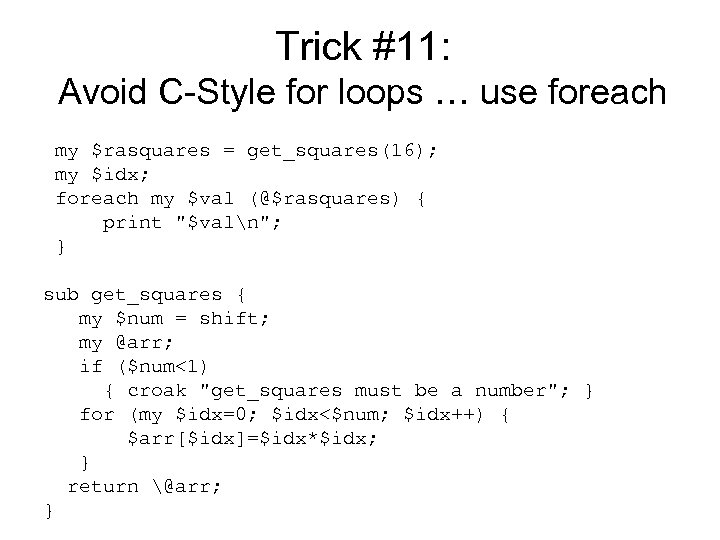 Trick #11: Avoid C-Style for loops … use foreach my $rasquares = get_squares(16); my $idx; foreach my $val (@$rasquares) { print "$valn"; } sub get_squares { my $num = shift; my @arr; if ($num<1) { croak "get_squares must be a number"; } for (my $idx=0; $idx<$num; $idx++) { $arr[$idx]=$idx*$idx; } return @arr; }
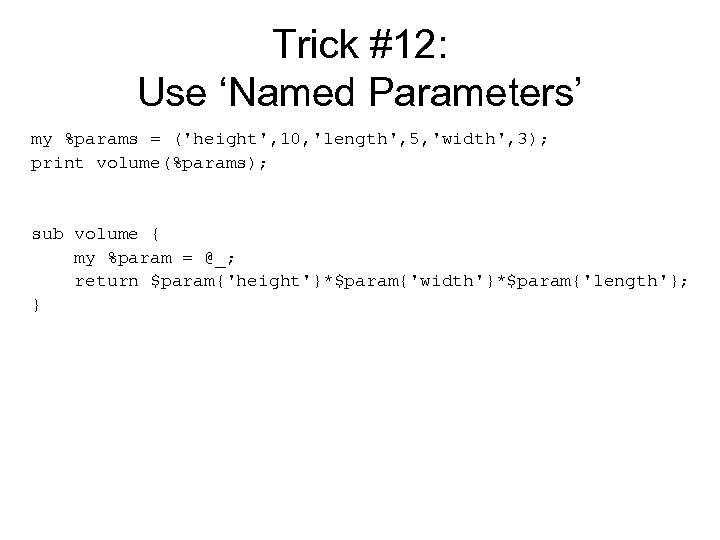 Trick #12: Use ‘Named Parameters’ my %params = ('height', 10, 'length', 5, 'width', 3); print volume(%params); sub volume { my %param = @_; return $param{'height'}*$param{'width'}*$param{'length'}; }
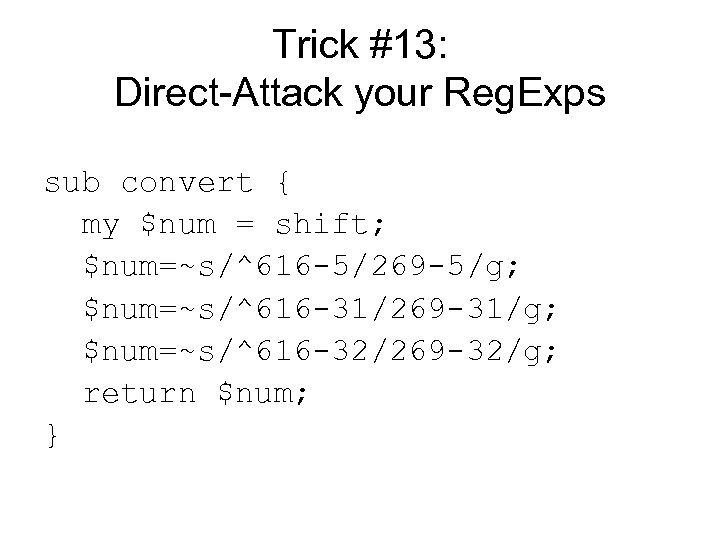 Trick #13: Direct-Attack your Reg. Exps sub convert { my $num = shift; $num=~s/^616 -5/269 -5/g; $num=~s/^616 -31/269 -31/g; $num=~s/^616 -32/269 -32/g; return $num; }
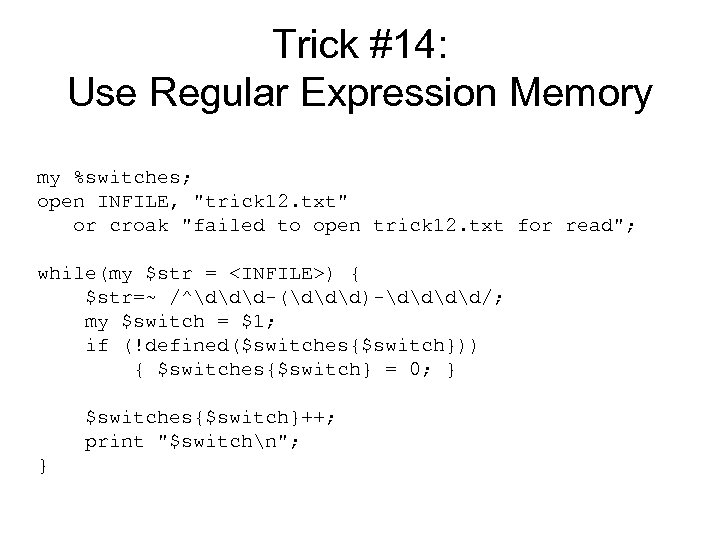 Trick #14: Use Regular Expression Memory my %switches; open INFILE, "trick 12. txt" or croak "failed to open trick 12. txt for read"; while(my $str =
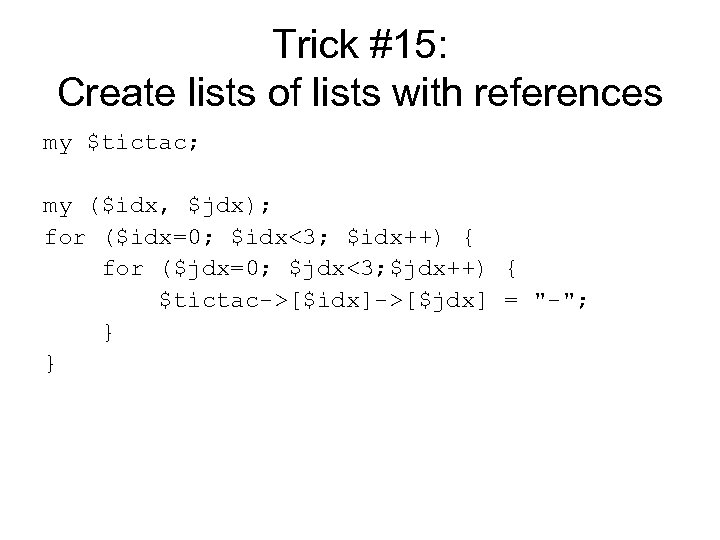 Trick #15: Create lists of lists with references my $tictac; my ($idx, $jdx); for ($idx=0; $idx<3; $idx++) { for ($jdx=0; $jdx<3; $jdx++) { $tictac->[$idx]->[$jdx] = "-"; } }
 Trick #16: Read a file into an array chomp(my @data =
![Trick #17: Turn off Warnings when you want use warnings; my @arr; $arr[0] =](https://present5.com/presentation/a90a1e131557b992353fe935ce9a9523/image-20.jpg "Trick #17: Turn off Warnings when you want use warnings; my @arr; $arr[0] =") Trick #17: Turn off Warnings when you want use warnings; my @arr; $arr[0] = 'Some'; $arr[1] = 'Values'; $arr[3] = 'And some whitespace'; $arr[5] = 'To be Concatenated'; my $str = join(', ', @arr); print $str. "n"; { no warnings; my $str = join(', ', @arr); print $str. "n"; }
Trick #17: Turn off Warnings when you want use warnings; my @arr; $arr[0] = 'Some'; $arr[1] = 'Values'; $arr[3] = 'And some whitespace'; $arr[5] = 'To be Concatenated'; my $str = join(', ', @arr); print $str. "n"; { no warnings; my $str = join(', ', @arr); print $str. "n"; }
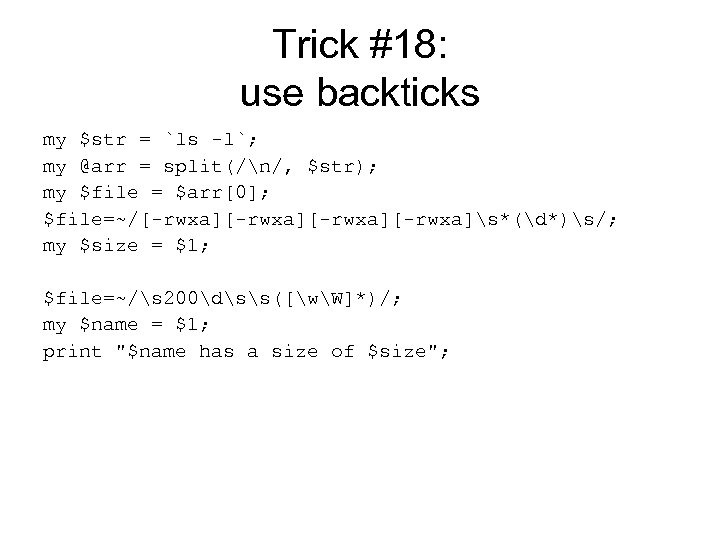 Trick #18: use backticks my $str = `ls -l`; my @arr = split(/n/, $str); my $file = $arr[0]; $file=~/[-rwxa][-rwxa]s*(d*)s/; my $size = $1; $file=~/s 200dss([wW]*)/; my $name = $1; print "$name has a size of $size";
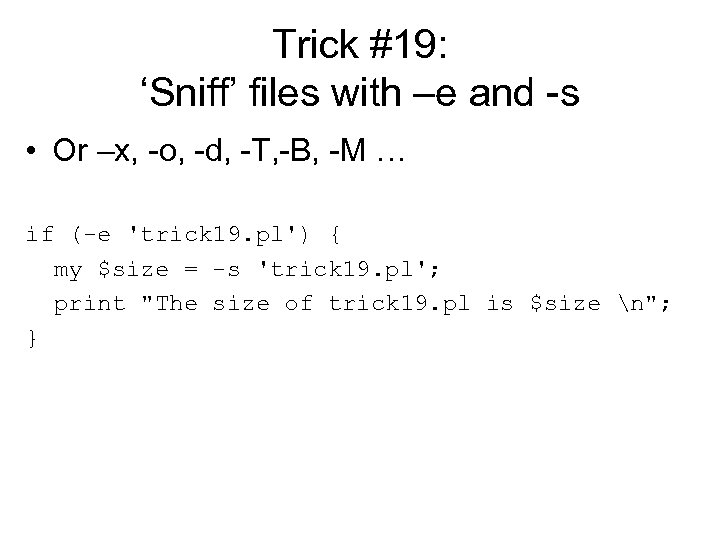 Trick #19: ‘Sniff’ files with –e and -s • Or –x, -o, -d, -T, -B, -M … if (-e 'trick 19. pl') { my $size = -s 'trick 19. pl'; print "The size of trick 19. pl is $size n"; }
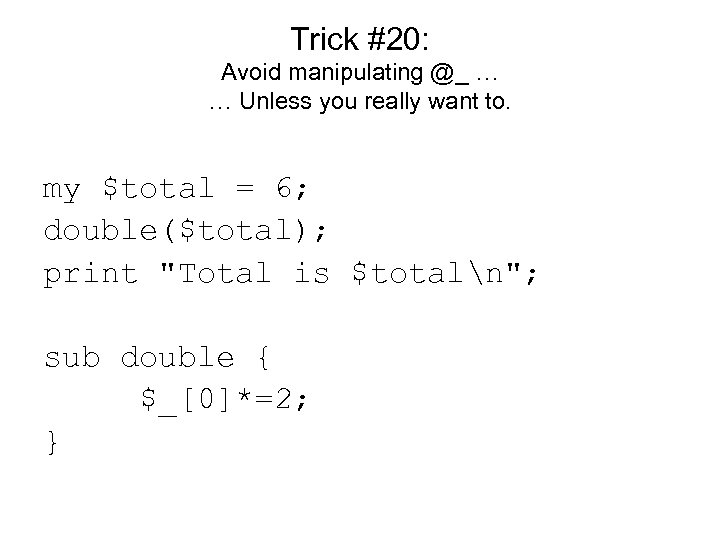 Trick #20: Avoid manipulating @_ … … Unless you really want to. my $total = 6; double($total); print "Total is $totaln"; sub double { $_[0]*=2; }
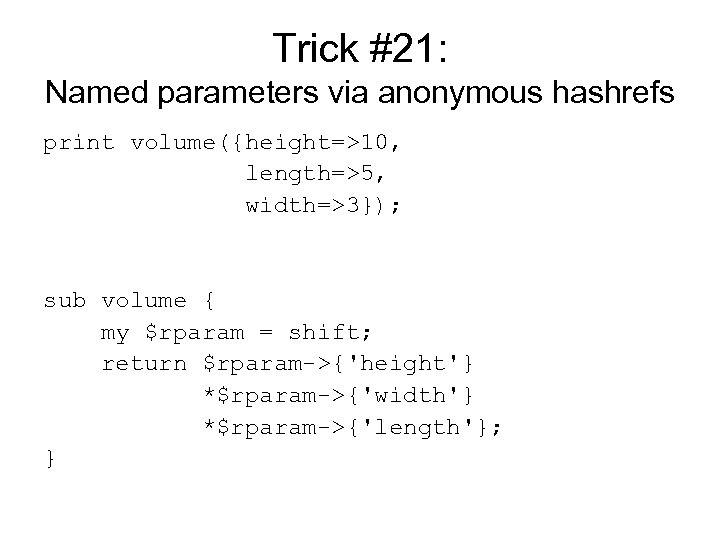 Trick #21: Named parameters via anonymous hashrefs print volume({height=>10, length=>5, width=>3}); sub volume { my $rparam = shift; return $rparam->{'height'} *$rparam->{'width'} *$rparam->{'length'}; }
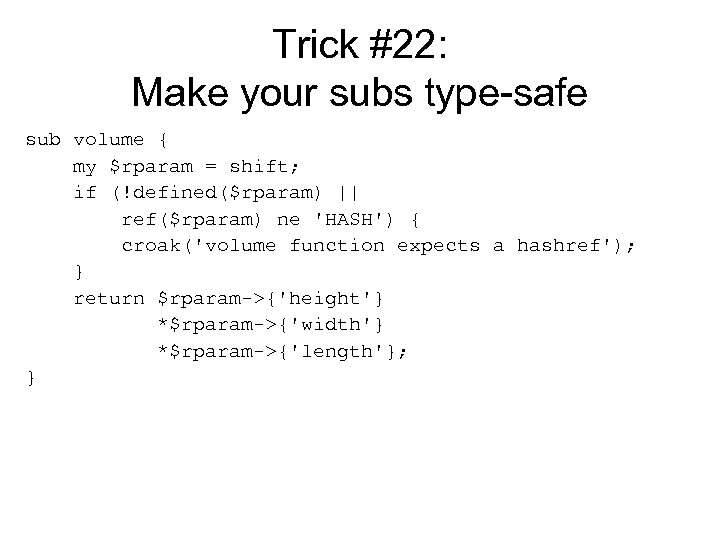 Trick #22: Make your subs type-safe sub volume { my $rparam = shift; if (!defined($rparam) || ref($rparam) ne 'HASH') { croak('volume function expects a hashref'); } return $rparam->{'height'} *$rparam->{'width'} *$rparam->{'length'}; }
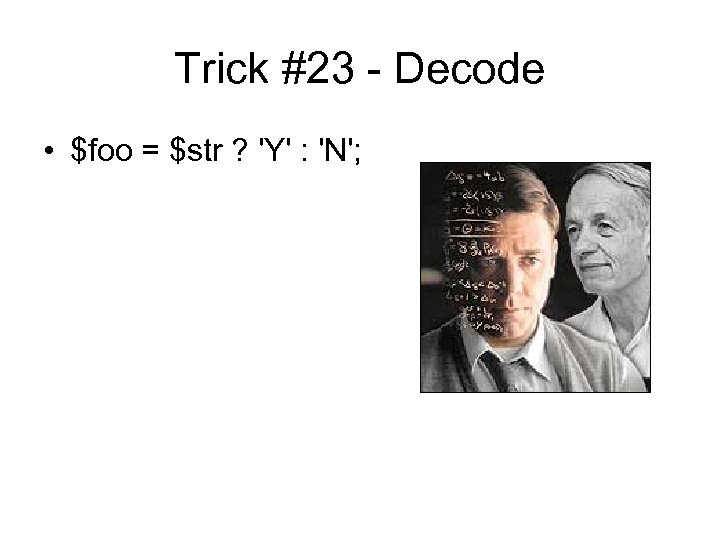 Trick #23 - Decode • $foo = $str ? 'Y' : 'N';
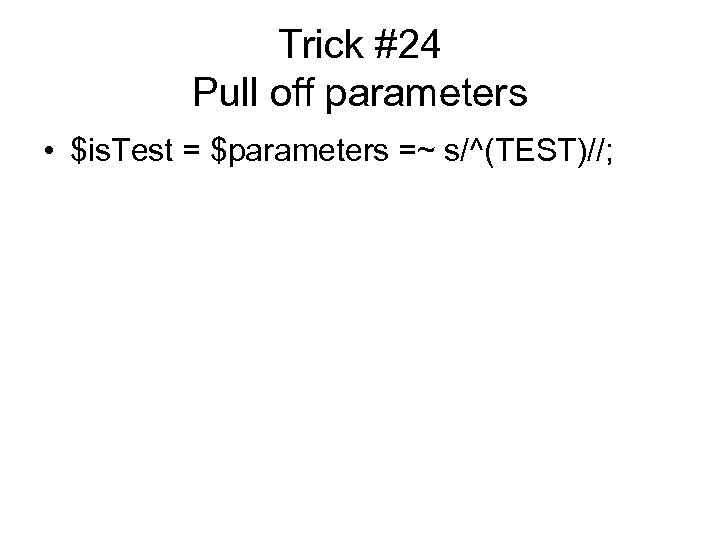 Trick #24 Pull off parameters • $is. Test = $parameters =~ s/^(TEST)//;
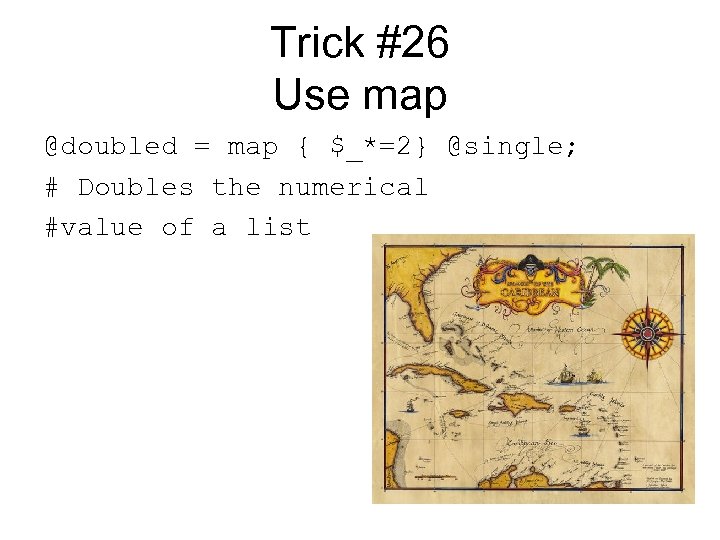 Trick #26 Use map @doubled = map { $_*=2} @single; # Doubles the numerical #value of a list
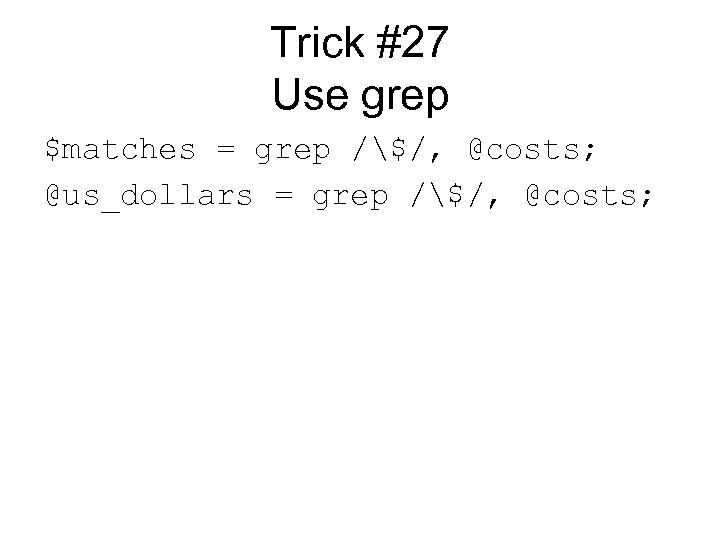 Trick #27 Use grep $matches = grep /$/, @costs; @us_dollars = grep /$/, @costs;
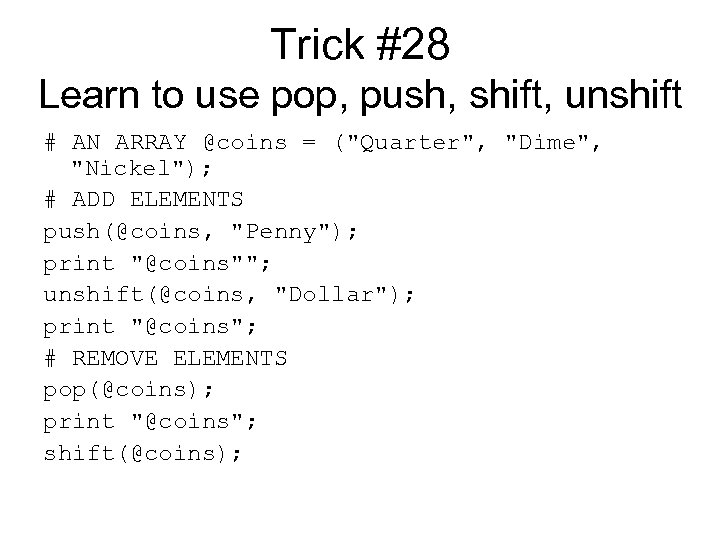 Trick #28 Learn to use pop, push, shift, unshift # AN ARRAY @coins = ("Quarter", "Dime", "Nickel"); # ADD ELEMENTS push(@coins, "Penny"); print "@coins""; unshift(@coins, "Dollar"); print "@coins"; # REMOVE ELEMENTS pop(@coins); print "@coins"; shift(@coins);
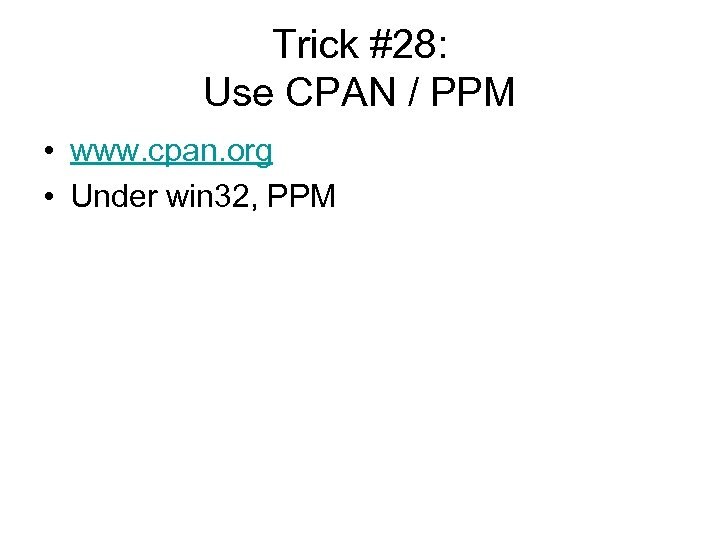 Trick #28: Use CPAN / PPM • www. cpan. org • Under win 32, PPM
 Trick #29: Use a tight-feedback-loop environment • putty / vim
 What to do tomorrow • Go to xndev. com • Get this powerpoint • Print it … read it … apply it
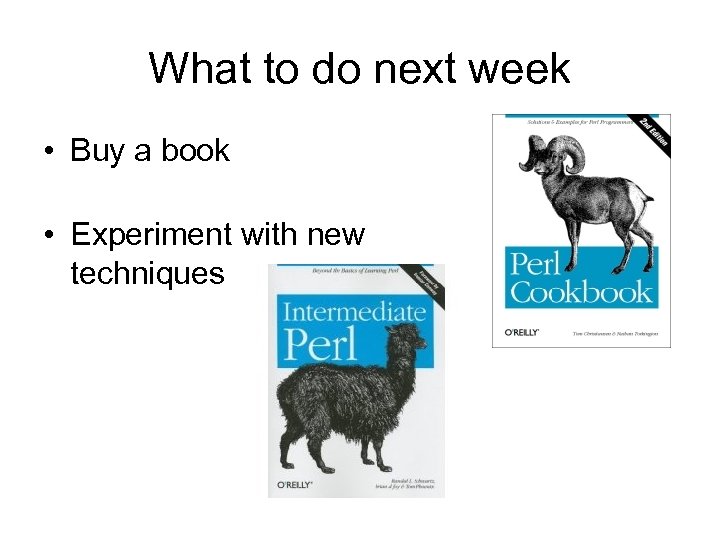 What to do next week • Buy a book • Experiment with new techniques
 What to do next year • Give a lightning talk • Speak at PM’s? • Attend a conference – YAPC: : NA is cheap
 Bonus: What are your favs? • Discuss the favorite tips & techniques of the audience.