


 Скачать презентацию The Sociology of the Family l Aim
923c40e31f0918e3f446b7ba3386625a.ppt
- Количество слайдов: 30
 The Sociology of the Family
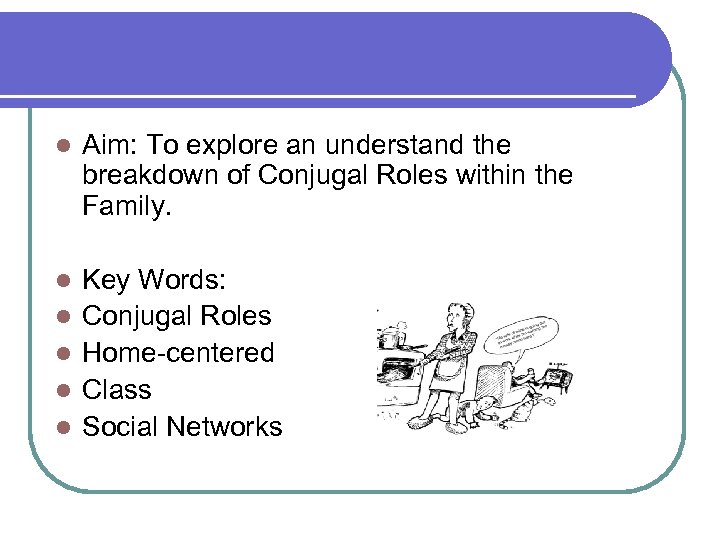 l Aim: To explore an understand the breakdown of Conjugal Roles within the Family. l Key Words: Conjugal Roles Home-centered Class Social Networks l l
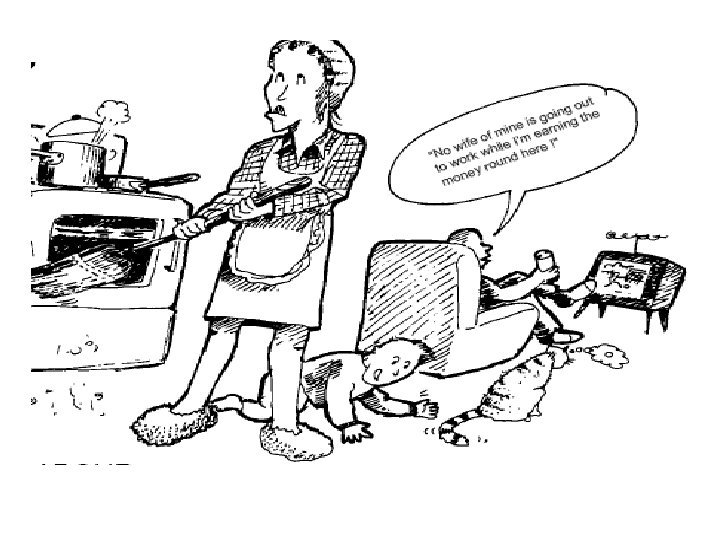
 What are conjugal roles? Roles played by men and women within a marriage, with particular reference to the domestic division of labour. Roles can be joint or separated
 Focus On……………… a) b) c) d) The distribution of Housework Decision Making Violence Emotional Work
 Why are Women housewives? l Oakley – due to industrial revolution, women were banned from factories l Parsons l Women – expressive role were needed at home to look after children
 Characteristics Oakley, Housework is seen as being a predominantly female role; ‘non-work, unpaid, isolated and makes women economically dependent on men’
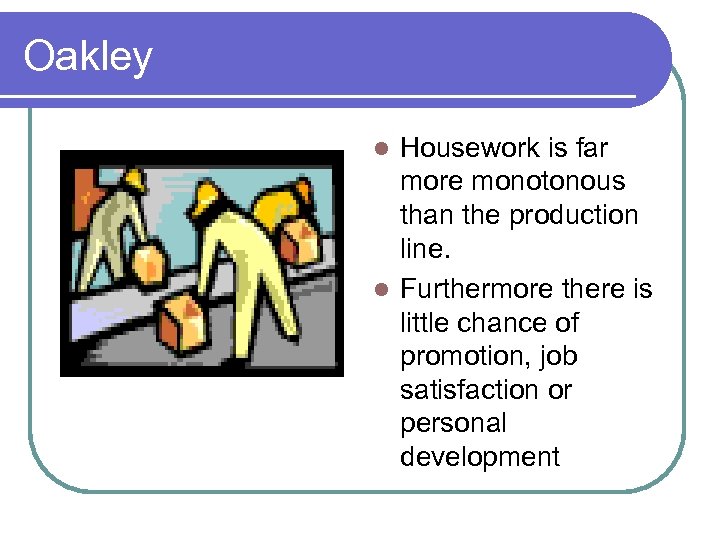 Oakley Housework is far more monotonous than the production line. l Furthermore there is little chance of promotion, job satisfaction or personal development l
 However……. l Martin suggests that housework is in fact liberating for women as it allows them to create their own sense of power
 Equality Wilmott and Young (1973) l Move from segregated to joint l Move towards greater equality as spouses share domestic and leisure activities l Study in Bethnal Green found 72% of husbands did housework other than washing up
 Other Explanations More working wives…………. . . . 2. Changes in the status of women……… ………………………. 3. Move from extended to nuclear………………………. . 4. Breakdown of kin based groups………. . ………………………… 1.
 Vs Inequality l l Oakley Criticises Wilmott and Young’s methodology Backed by British Social Attitudes Survey Showed 88% of women were solely responsible for washing and ironing compared to 1% of men! HOWEVER her methodology was also questionable
 Class Differences THE WORKING CLASSES F Dennis et al – segregated working class roles in mining community F Men out at pub, female housewife at home F Women seen as inferior as they couldn’t work down the mines However not all sociologists agree with this l Wilmott and Young – w. c roles became more joint as the family became more privatized l Gavron – w. c were more home-centred and family orientated l
 The Middle Classes Wilmott and Young – m. c showed joint conjugal roles due to greater mobility l However – Wilmott and Young’s study of Managerial directors showed inequalities Rapoport et al – dual -career families more segregated l Edgell’s work on professional families supported this
 Paid Employment Rapoport’s found that l Elston’s study on dual-working families female doctors – had shared conjugal husbands still did roles little housework l However – Devine l Family Studies (92) men were only Centre 1987 study involved in childcare women in paid and that was due to employment still do financial reasons the majority of housework. l
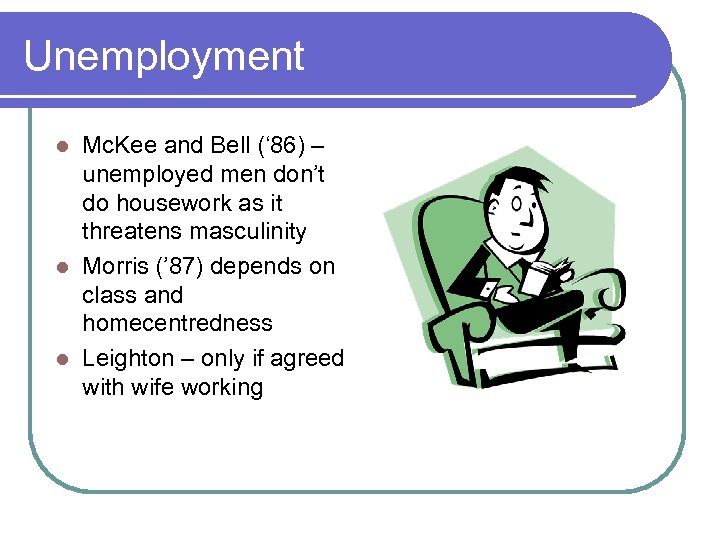 Unemployment Mc. Kee and Bell (‘ 86) – unemployed men don’t do housework as it threatens masculinity l Morris (’ 87) depends on class and homecentredness l Leighton – only if agreed with wife working l
 Social Networks Elizabeth Bott l Study of 20 families in London l Found a link between conjugal roles and class l However more importantly in terms of social relationships l Those with close-knit networks (lots of friends) are more likely to have segregated roles and those with looseknit are more likely to have joint roles
 Evaluation Many of the studies are dated l Measuring housework is reliant on the researchers opinion l Researchers don’t usually include DIY and gardening in their research l Are we seeing a new wave of New Men as the media would like use to believe l Realistically women are still doing the majority of the housework l
 Decision-Making
 Decision Making l Who makes the decisions in the family? l Who makes the key decisions? l Who makes the day-to-day decisions l If decision making equals power who holds power?
 Decision Making: Men Vs Women l Edgell ’ 80 interviewed 38 MC couples l Found women made the decisions in three areas: 1. 2. 3. l decorating Children’s clothes Spending in terms of food Hardill et al ’ 97 found women are making more and more important decisions
 Men: Hunt Decisions made by women are day-to-day decisions but they are only minor l Men make less frequent decisions but they are more important and therefore the major ones. These are: l 1. 2. 3. Important financial decisions Maritial debates What is made for tea
 Non-Decision Making l DM is criticised for failing to take into account NDM. This falls into three categories: l l l Washing, cleaning, ironing Childcare Emotional Work
 Mansfield and Collard Men seen as more important than women l Study of newly weds found: 1. Around time of marriage 1/3 of men changed career for better 2. 2/3 of women changed career for worse l
 Control of Money: Men Vs Women l Inadequate money keepers l Hunt: Women’s wages are seen to buy luxury items l Pahl three types of money distribution: l l l Husband hands over wage packet & wife gives him “pocket money” Husband keeps wage packet & gives wife “housekeeping” Resources pooled & spending decisions made jointly.
 Men Pahl – only ¼ of her study had a fair system of managing money l This financial power meant it was harder for women to leave men l
 Evaluation Dated studies l Varies by class l How is it measured? l Women do hold power but in subtle ways l
 Domestic Violence l Another aspect of power – studied mainly by radical feminists l Dobash and Dobash: domestic violence is carried out by males as a way of extending their patriarchal power l Creates a power relationship where men are in control
 Domestic Violence Pahl: link between alcohol and wife beating l Feminists: rape in marriage & wife beating are acts of violence and domination allowing men to exercise more control over women. l The New Right: violence in the home is a result a decline in moral standards and family values this century l
 Evaluation Status for women has improved and we have seen a decrease in DV over the years l Domestic violence appears to support Oakley’s claim that “Symmetry remains a myth”. l Assumes that all men are the perpetrators and all women are the victims, this is not necessarily the case l