


 Скачать презентацию The Social Uses of Personal Photography Projecting Future
3e9aa60e9684830ac14c78a7bbcd69be.ppt
- Количество слайдов: 42
 The Social Uses of Personal Photography: Projecting Future Imaging Applications Prof. Nancy Van House University of California at Berkeley School of Information Management and Systems http: //www. sims. berkeley. edu/~vanhouse This is a condensed version of a presentation I gave in October, with many of the images removed Nancy Van House Oct 3, 2004
 The problem • In general: user-centered design for technology without users – Method? – Can we use the post hoc methods of Science and Technology Studies? • Specifically: networked image capture devices – New technologies – Near-universality of engagement with personal photos – Great importance of photos to consumers Nancy Van House Oct 3, 2004
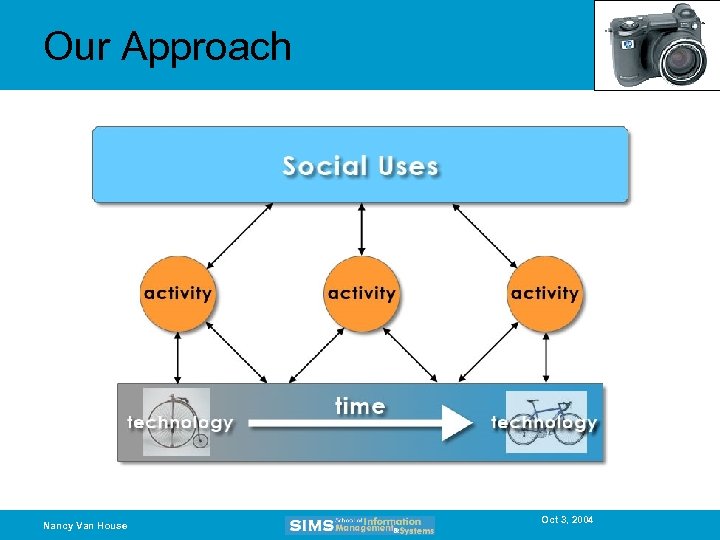
 Our Approach • Adapting/combining other approaches: – to understanding uses of technology: • Activity theory (Engestrom, Nardi…) • Social construction of technology (SCOT) (Pinch, Bijker) – To understanding photos: • Visual studies • Investigating empirically current uses of photos and photographic technologies • Projecting future uses • Designing and testing prototypes Nancy Van House Oct 3, 2004
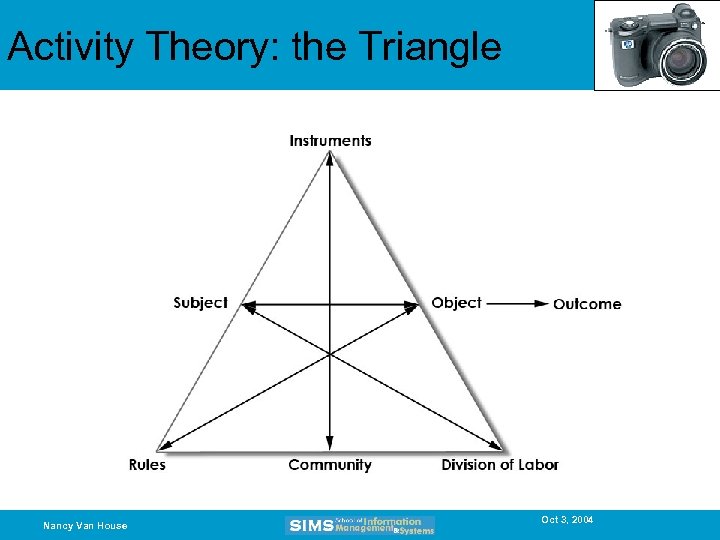 Activity Theory: the Triangle Nancy Van House Oct 3, 2004
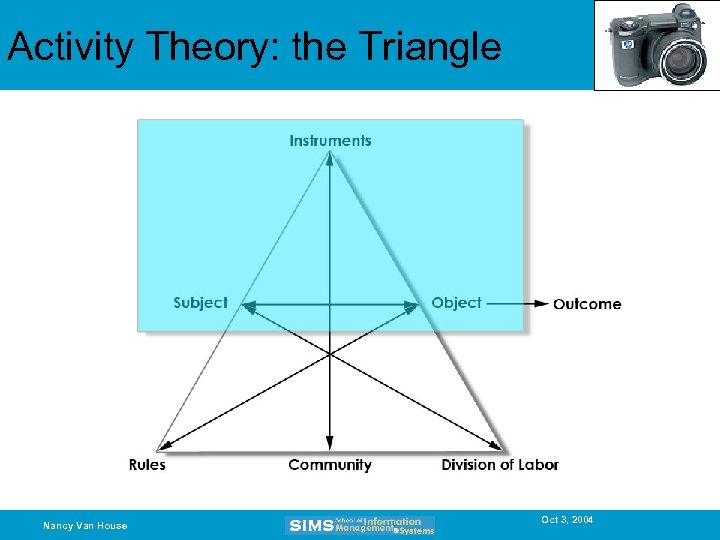 Activity Theory: the Triangle Nancy Van House Oct 3, 2004
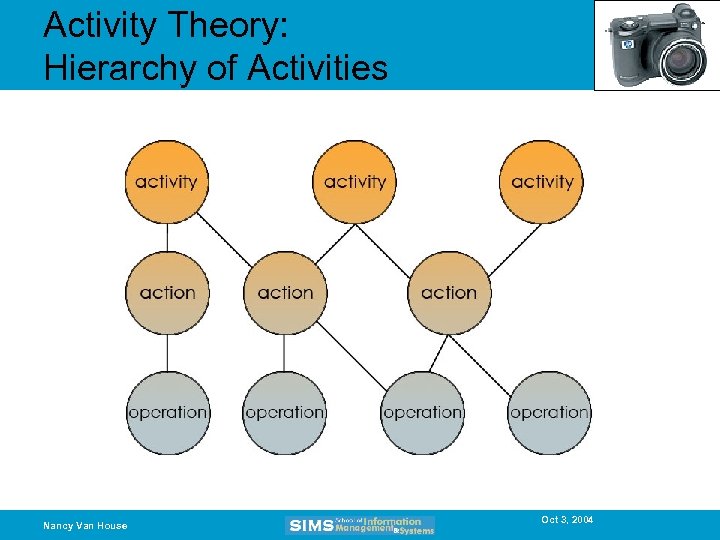 Activity Theory: Hierarchy of Activities Nancy Van House Oct 3, 2004
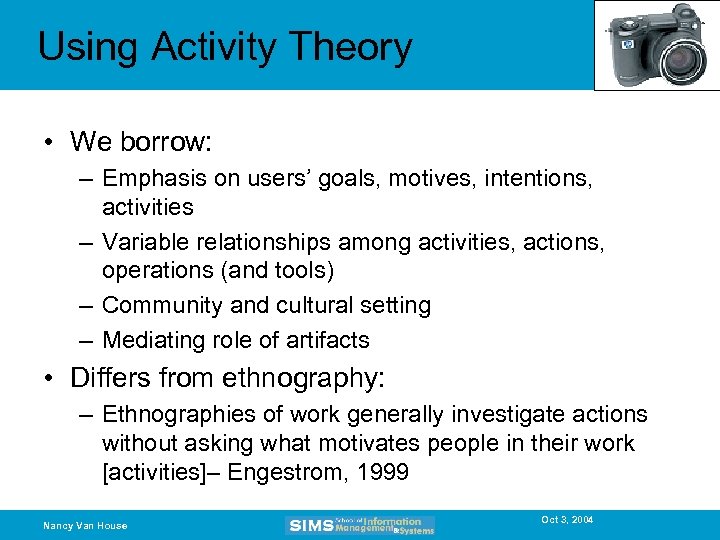 Using Activity Theory • We borrow: – Emphasis on users’ goals, motives, intentions, activities – Variable relationships among activities, actions, operations (and tools) – Community and cultural setting – Mediating role of artifacts • Differs from ethnography: – Ethnographies of work generally investigate actions without asking what motivates people in their work [activities]– Engestrom, 1999 Nancy Van House Oct 3, 2004
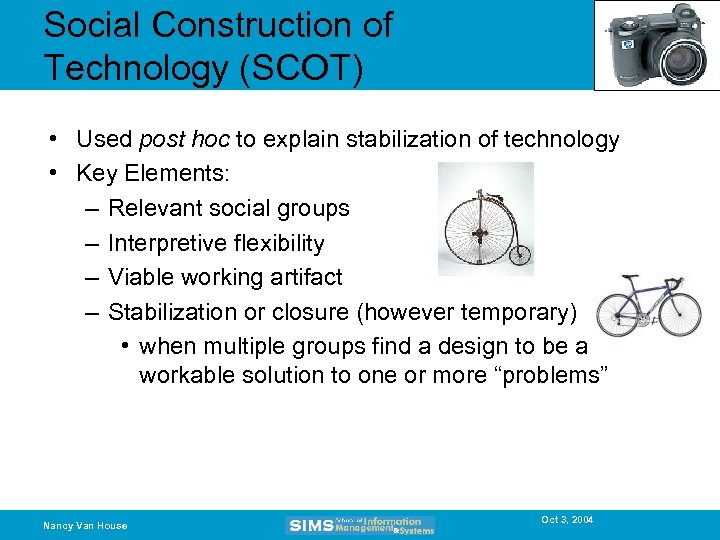 Social Construction of Technology (SCOT) • Used post hoc to explain stabilization of technology • Key Elements: – Relevant social groups – Interpretive flexibility – Viable working artifact – Stabilization or closure (however temporary) • when multiple groups find a design to be a workable solution to one or more “problems” Nancy Van House Oct 3, 2004
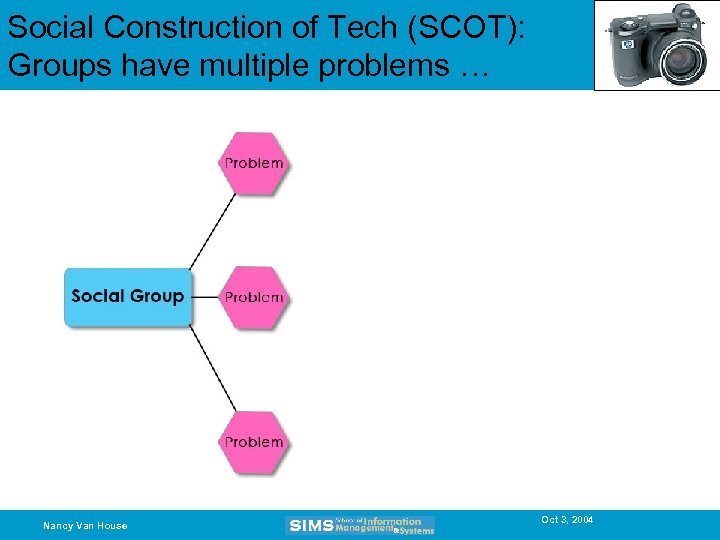 Social Construction of Tech (SCOT): Groups have multiple problems … Nancy Van House Oct 3, 2004
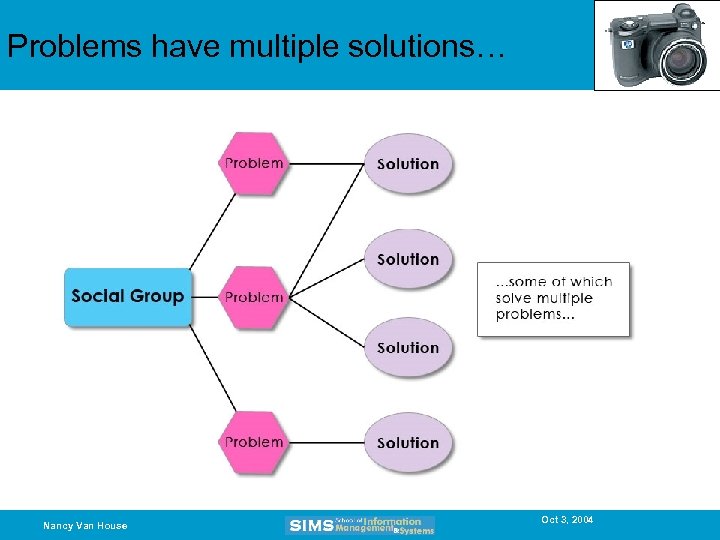 Problems have multiple solutions… Nancy Van House Oct 3, 2004
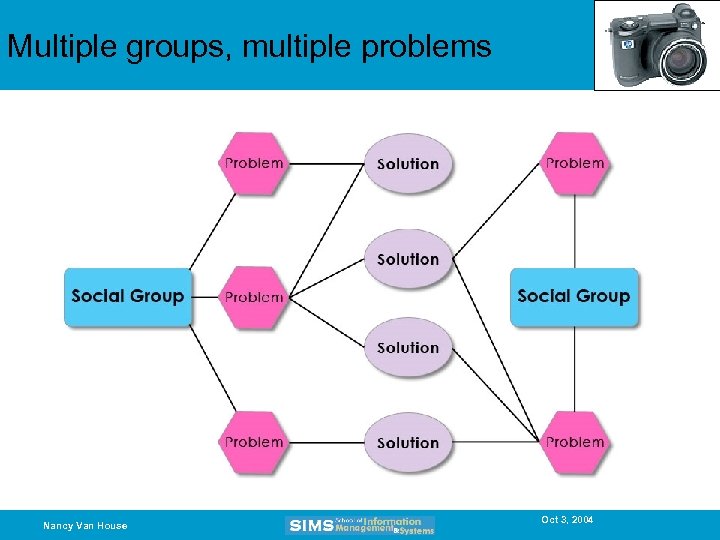 Multiple groups, multiple problems Nancy Van House Oct 3, 2004
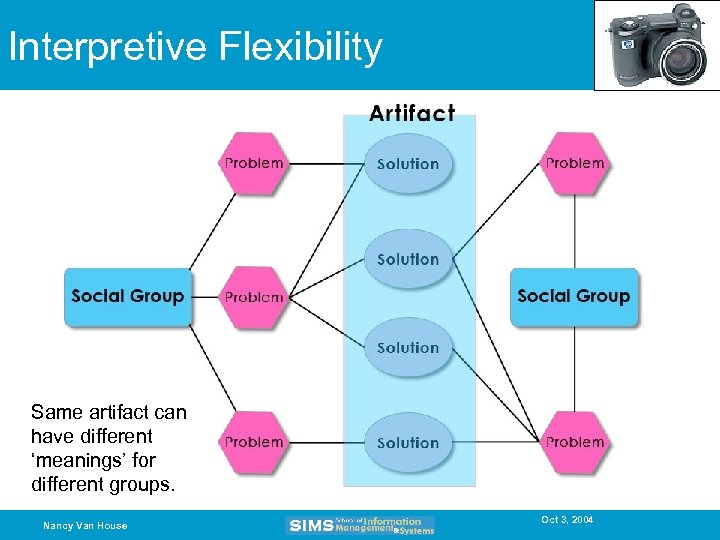 Interpretive Flexibility Same artifact can have different ‘meanings’ for different groups. Nancy Van House Oct 3, 2004
 We borrow from SCOT • • Relevant social groups Interpretive flexibility Viable working artifact Stabilization or closure (however temporary) when multiple groups find a design to be a workable solution to one or more “problems” Nancy Van House Oct 3, 2004
 Our Approach Nancy Van House Oct 3, 2004
 The “social uses” approach • What are the high-order, enduring goals (activities) for which photos, photo technology, and the process of photography currently used? • How are photos, photo technology, the process of photography interpreted differently under different circumstances? • What do the emerging uses of photography and new photographic technology reveal about current and emerging social uses? • Can we identify high-order, enduring goals for which photos will/can be used? Nancy Van House Oct 3, 2004
 Subjects of photos Photography Nancy Van House Oct 3, 2004
 Our Methods • Empirical work – – – Interviews – photographers of many kinds Examination of people’s photos, albums, etc. Photos on the web, photoblogs Observations (pictures of people taking pictures) Gave 40 students cameraphones for a semester+ • Literature – HCI –mostly design, some ethnographic studies • Mostly focused on actions; we’re interested in activities – Visual studies (visual sociology, visual anthropology, cultural studies) • A small area concerned with personal photos (e. g. , Chalfen) • Not addressing digital revolution – Art history/criticism – long history of discussion/reflection on photography (Sontag, On Photography) Nancy Van House Oct 3, 2004
 Findings to Explain • People vary in their adoption of digital technology Photos are for own use and for sharing • People place high value on photos – And are concerned about (1) usability and (2) preservation • People are strongly attached to prints • Many are resistance to annotation • Photos are exploding on the web – And other new uses of new technology are emerging • However, story-telling is critically important to photo sharing • Cameras and cameraphones seem to be used differently Nancy Van House Oct 3, 2004
 Adoption • Most used both film and digital technology – Film for “important” photos – digital for more casual pictures: • frustrated by low digital image quality and technical limitations such as shutter lag • waiting for the price of high-quality digital cameras to come down. • digital cameras were generally smaller and lighter, more portable Nancy Van House Oct 3, 2004
 Adopter types • “Photogeeks, ” interest is (photo) technology more than process of photography or artifacts of photos. • Avid photographers exploit wide range of photographic technologies. • Lackadaisical adopters: not exactly resistant but not energetic – Any barrier is too much – those who have invested serious time and money in film photography are reluctant to re-invest in a new technology and practice that they see as changing, unstable, inaccessible. • Avoiders – Low tech: feared losing valued images due to their own or the technology’s failings • Often only moderately tech savvy; uncertain – Demanding: found digital seriously inadequate, because of image quality and/or technology requirements • E. g. travelers in underdeveloped countries Nancy Van House Oct 3, 2004
 Strong Emotions about Photos: Subjects of Photos Nancy Van House Oct 3, 2004
 Attachment to Prints Nancy Van House Oct 3, 2004
 Proliferation of Photos on the Web Nancy Van House Oct 3, 2004
 New Technology, New Uses of Photos Nancy Van House Oct 3, 2004
![Orality – Storytelling and Photos: “Communicative Remembering” “[The personal photo] seems heavily reliant on](https://present5.com/presentation/3e9aa60e9684830ac14c78a7bbcd69be/image-25.jpg "Orality – Storytelling and Photos: “Communicative Remembering” “[The personal photo] seems heavily reliant on") Orality – Storytelling and Photos: “Communicative Remembering” “[The personal photo] seems heavily reliant on verbal accompaniment for the transmission of personal significances. Photographs presented to others are typically embedded in a verbal context delineating what should be attended to and what significances are located in the image, and providing contextual data necessary for understanding them. ” --Musello 1980 p. 39 Nancy Van House Oct 3, 2004
Orality – Storytelling and Photos: “Communicative Remembering” “[The personal photo] seems heavily reliant on verbal accompaniment for the transmission of personal significances. Photographs presented to others are typically embedded in a verbal context delineating what should be attended to and what significances are located in the image, and providing contextual data necessary for understanding them. ” --Musello 1980 p. 39 Nancy Van House Oct 3, 2004
 The Social Uses of Personal Photos • Constructing personal and group memory and identity • Creating and maintaining social relationships • Self-expression; self-presentation Nancy Van House Oct 3, 2004
 The Social Uses • Constructing personal and group memory – Constructing personal and group identity • Creating and maintaining social relationships • Self-expression; self-presentation Nancy Van House Oct 3, 2004
 Memory and identity • Memory as construction of self – History, narrative arch to our lives – Identity – “I’m the kind of person who goes to these places…” • Collective construction of the group’s identity – Collective narrative – Shared experiences – Identity: the happy family… • Resistance to annotation – Reliving the experience – Control over the narrative Nancy Van House Oct 3, 2004
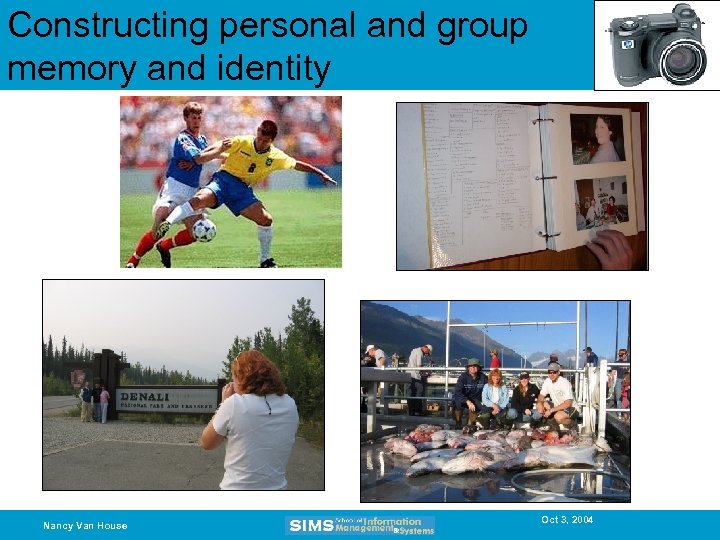 Constructing personal and group memory and identity Nancy Van House Oct 3, 2004
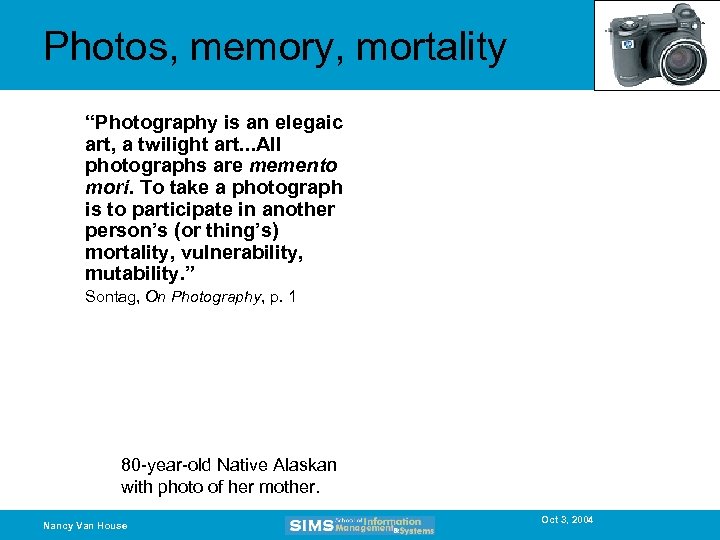 Photos, memory, mortality “Photography is an elegaic art, a twilight art. . . All photographs are memento mori. To take a photograph is to participate in another person’s (or thing’s) mortality, vulnerability, mutability. ” Sontag, On Photography, p. 1 80 -year-old Native Alaskan with photo of her mother. Nancy Van House Oct 3, 2004
![[A photo] is also a trace, something stenciled off the real, like a footprint](https://present5.com/presentation/3e9aa60e9684830ac14c78a7bbcd69be/image-31.jpg "[A photo] is also a trace, something stenciled off the real, like a footprint") [A photo] is also a trace, something stenciled off the real, like a footprint or a death mask. ” Sontag, On Photography Nancy Van House
[A photo] is also a trace, something stenciled off the real, like a footprint or a death mask. ” Sontag, On Photography Nancy Van House
 The Social Uses • Constructing personal and group memory – Constructing personal and group identity • Creating and maintaining social relationships • Self-expression; self-presentation Nancy Van House Oct 3, 2004
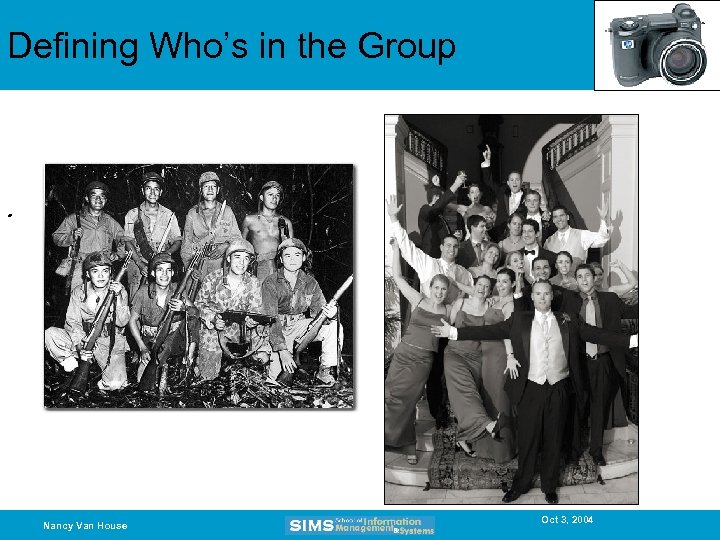 Defining Who’s in the Group . Nancy Van House Oct 3, 2004
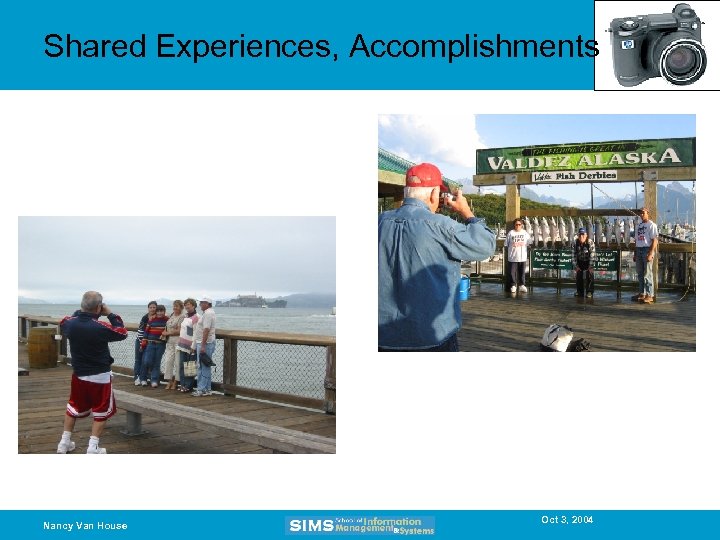 Shared Experiences, Accomplishments Nancy Van House Oct 3, 2004
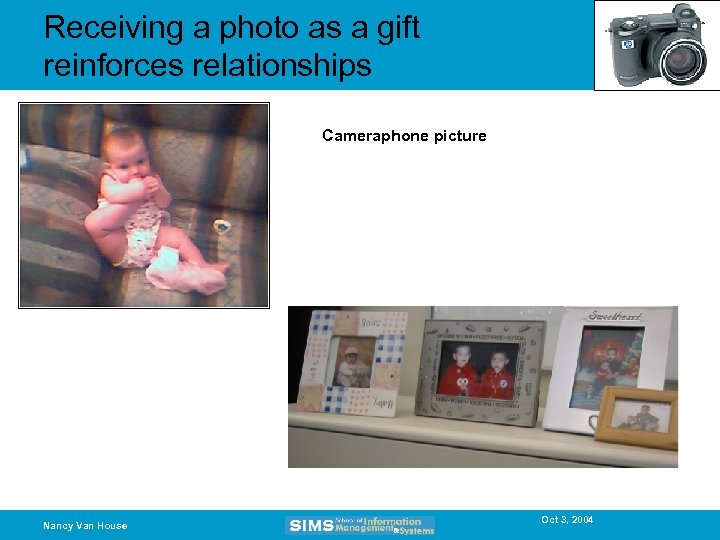 Receiving a photo as a gift reinforces relationships Cameraphone picture Nancy Van House Oct 3, 2004
![Self-expression, self-representation • Self-representation, impression management – “it will be in his [sic] interests](https://present5.com/presentation/3e9aa60e9684830ac14c78a7bbcd69be/image-36.jpg "Self-expression, self-representation • Self-representation, impression management – “it will be in his [sic] interests") Self-expression, self-representation • Self-representation, impression management – “it will be in his [sic] interests to control the conduct of others, especially their responsive treatment of him. This control is achieved largely by …expressing himself in such a way as to give them the kind of impression that will lead them to act voluntarily in accordance with his own plan” (Goffman, The Presentation of Self, p. 3 -4) – Expressions “given” and “given off” • Self-expression – Photos as expressions of one’s sensibility – Art as expression vs. art as communication Nancy Van House Oct 3, 2004
Self-expression, self-representation • Self-representation, impression management – “it will be in his [sic] interests to control the conduct of others, especially their responsive treatment of him. This control is achieved largely by …expressing himself in such a way as to give them the kind of impression that will lead them to act voluntarily in accordance with his own plan” (Goffman, The Presentation of Self, p. 3 -4) – Expressions “given” and “given off” • Self-expression – Photos as expressions of one’s sensibility – Art as expression vs. art as communication Nancy Van House Oct 3, 2004
![Art: Photography as Self-Expression “…[P]hotographers describe photography as an heroic act of attention, an](https://present5.com/presentation/3e9aa60e9684830ac14c78a7bbcd69be/image-37.jpg "Art: Photography as Self-Expression “…[P]hotographers describe photography as an heroic act of attention, an") Art: Photography as Self-Expression “…[P]hotographers describe photography as an heroic act of attention, an ascetic discipline, a mystic receptivity to the world… “To take a good photograph, one must already see it…. “Weston insists…that photography is a supreme opportunity for selfexpression… originality being equated with the stamp of a unique, forceful sensibility. “What is exciting ‘are photographs that say something in a new manner…not for the sake of being different, but because the individual is different and the individual expresses himself. ’ “ For Ansel Adams ‘a great photograph’ has to be ‘a full expression of what one feels about what is being photographed in the deepest sense and is, thereby, a true expression of what one feels about life in its entirety. ’” Sontag, On Photography Nancy Van House Oct 3, 2004
Art: Photography as Self-Expression “…[P]hotographers describe photography as an heroic act of attention, an ascetic discipline, a mystic receptivity to the world… “To take a good photograph, one must already see it…. “Weston insists…that photography is a supreme opportunity for selfexpression… originality being equated with the stamp of a unique, forceful sensibility. “What is exciting ‘are photographs that say something in a new manner…not for the sake of being different, but because the individual is different and the individual expresses himself. ’ “ For Ansel Adams ‘a great photograph’ has to be ‘a full expression of what one feels about what is being photographed in the deepest sense and is, thereby, a true expression of what one feels about life in its entirety. ’” Sontag, On Photography Nancy Van House Oct 3, 2004
 Some Cameraphone Findings Nokia presentation Oct 3, 2004
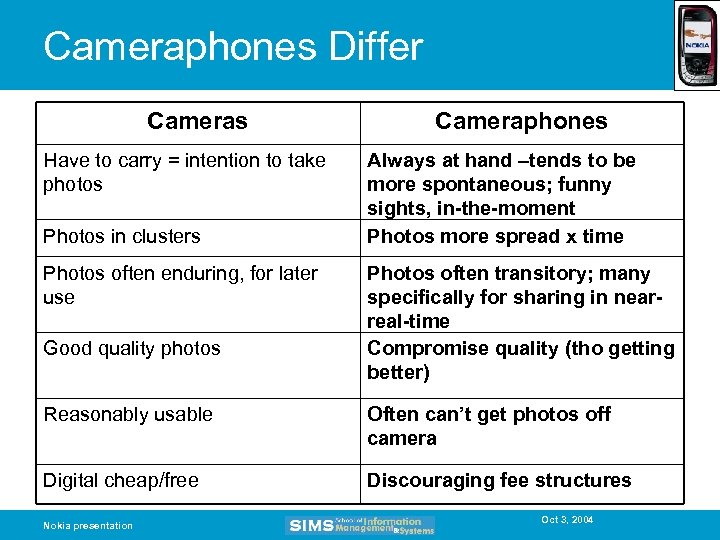 Cameraphones Differ Cameras Have to carry = intention to take photos Photos in clusters Photos often enduring, for later use Good quality photos Cameraphones Always at hand –tends to be more spontaneous; funny sights, in-the-moment Photos more spread x time Photos often transitory; many specifically for sharing in nearreal-time Compromise quality (tho getting better) Reasonably usable Often can’t get photos off camera Digital cheap/free Discouraging fee structures Nokia presentation Oct 3, 2004
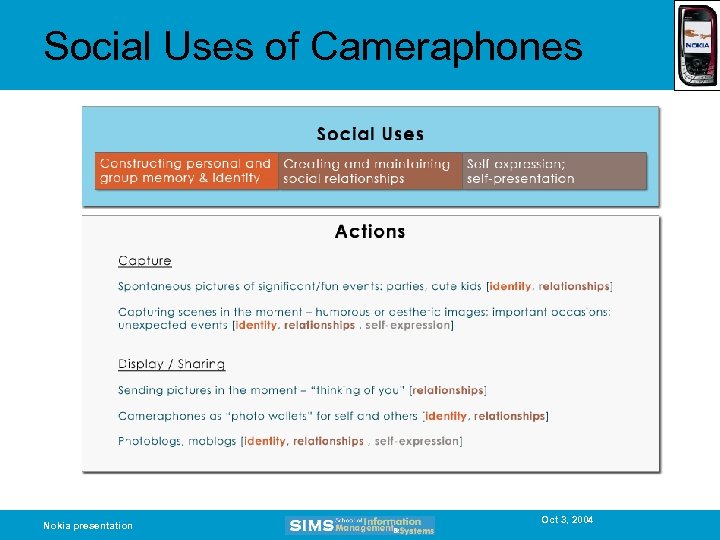 Social Uses of Cameraphones Nokia presentation Oct 3, 2004
 Future Directions for Cameraphones I – extending previous photo technology • Convergence with digital cameras – The cameraphone as an always-at-hand digital camera – For spontaneous, transitory images – For unpredictable opportunities for enduring images • Convergence with framed photos – Favored images ready at hand • Convergence with photo albums – Face-to-face: An always-at-hand collection of photos for self and others – Distant: • synchronous sharing: image and oral narrative • Asynchronous: image and oral/textual message • Convergence with internet/email – Networked sharing Nokia presentation Oct 3, 2004
 Future Directions II – Social Uses • Constructing personal and group memory and identity – – Spontaneous, flexible capture and use Organization, annotation Preservation of images and associated information Narrative structure, narrative control • Creating and maintaining social relationships – Powerful sharing including networking and preservation – Oral as well as textual and image-based sharing – Media “production” • Self-expression; self-presentation – Flexibility, power – Networking, re-use – “Art gallery”, audience for performance Nokia presentation Oct 3, 2004