


 Скачать презентацию The Social Self NO TOPIC IS MORE
Lecture_4_Soc_Self-2017-_2.pptx
- Количество слайдов: 84
 The Social Self
 “NO TOPIC IS MORE INTERESTING TO PEOPLE THAN PEOPLE. FOR MOST PEOPLE, MOREOVER, THE MOST INTERESTING IS THE SELF. ” —ROY F. BAUMEISTER, THE SELF IN SOCIAL PSYCHOLOGY, 1999
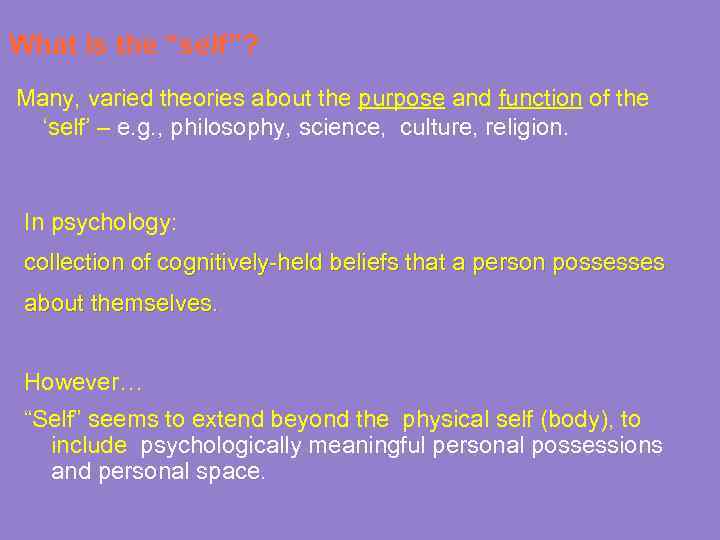 What is the “self”? Many, varied theories about the purpose and function of the ‘self’ – e. g. , philosophy, science, culture, religion. In psychology: collection of cognitively-held beliefs that a person possesses about themselves. However… “Self” seems to extend beyond the physical self (body), to include psychologically meaningful personal possessions and personal space.
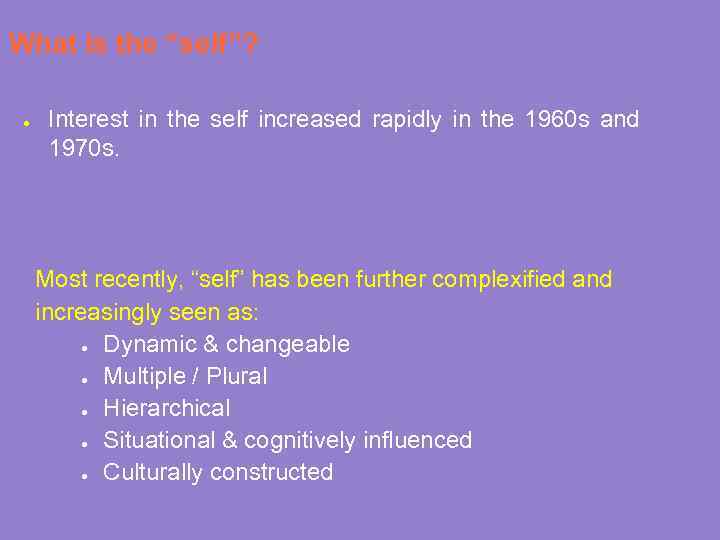 What is the “self”? ● Interest in the self increased rapidly in the 1960 s and 1970 s. Most recently, “self” has been further complexified and increasingly seen as: ● Dynamic & changeable ● Multiple / Plural ● Hierarchical ● Situational & cognitively influenced ● Culturally constructed
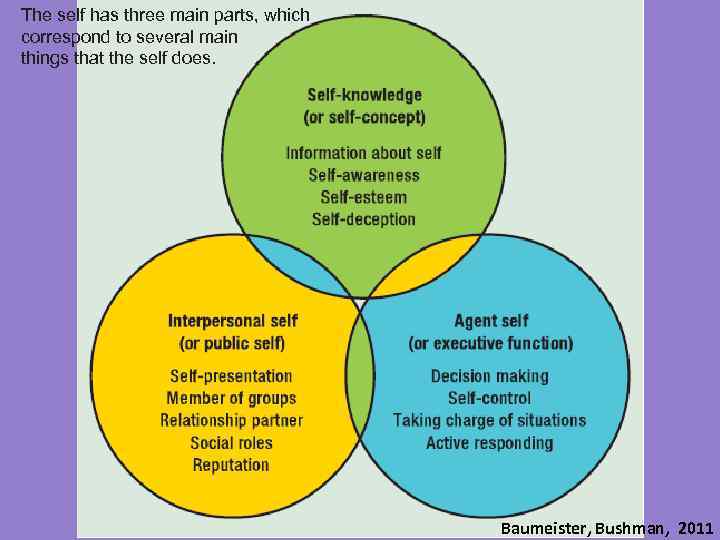 The self has three main parts, which correspond to several main things that the self does. Baumeister, Bushman, 2011
 Self-concept ● ● . Human beings have self-awareness, and this awareness enables them to develop elaborate sets of beliefs about themselves. If someone says “Tell me something about yourself, ” you can probably furnish 15 or 20 specific answers without having to think very hard. You check your hair in a mirror or your weight on a scale. You read your horoscope or the results of some medical tests. Such moments show the self reflecting on itself and on its store of information about itself.
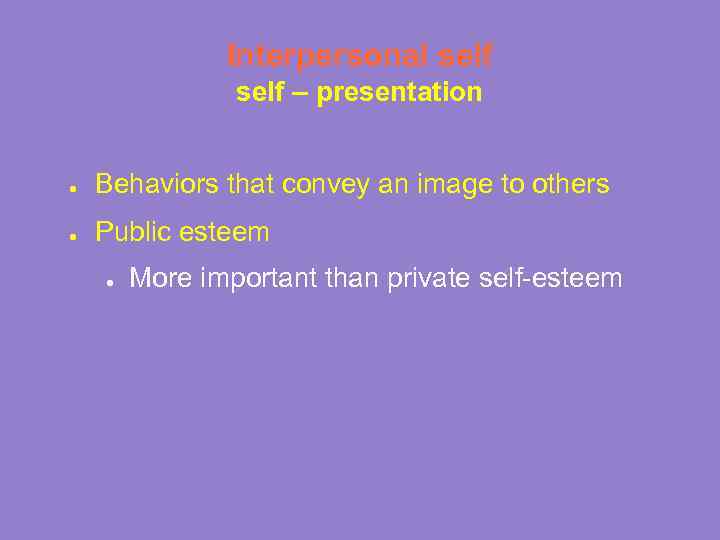
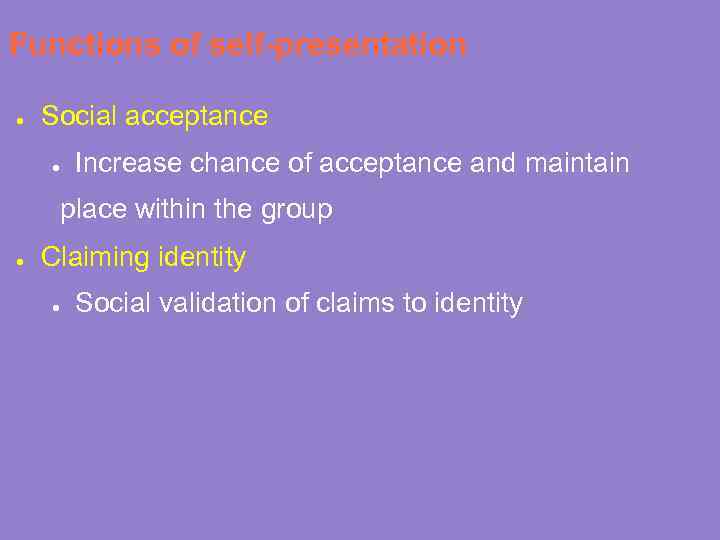
 Interpersonal self ● ● ● A second part of the self that helps the person connect socially to other people. Most people have a certain image that they try to convey to others. This public self bears some resemblance to the self-concept, but the two are not the same. Often, people work hard to present a particular image others even if it is not exactly the full, precise truth as they know it. Furthermore, many emotions indicate concern over how one appears to others: You feel embarrassed because someone saw you do something stupid, or even just because your underwear was showing. You feel guilty if you forgot your romantic partner’s birthday. You are delighted when your boss compliments you on your good work. These episodes reveal that the self is often working in complex ways to gain social acceptance and maintain good interpersonal relationships.
 Agent Self ● ● The third important part of the self, the agent self, or executive function, is the part that gets things done. It enables the self to make choices and exert control, including both self-control and control over other people (and things). Sometimes you decide not to eat something because it is unhealthy or fattening. Sometimes you make a promise and later exert yourself to keep it. Sometimes you decide what courses to take or what job to take. Perhaps you cast a vote in an election. Perhaps you sign a lease for an apartment. Perhaps you place a bet on a sports event. All these actions reveal the self as not just a knower but also as a doer. .
 Self-concept Self-awareness ● Self-esteem ● Self-deception ● Self-efficacy ●
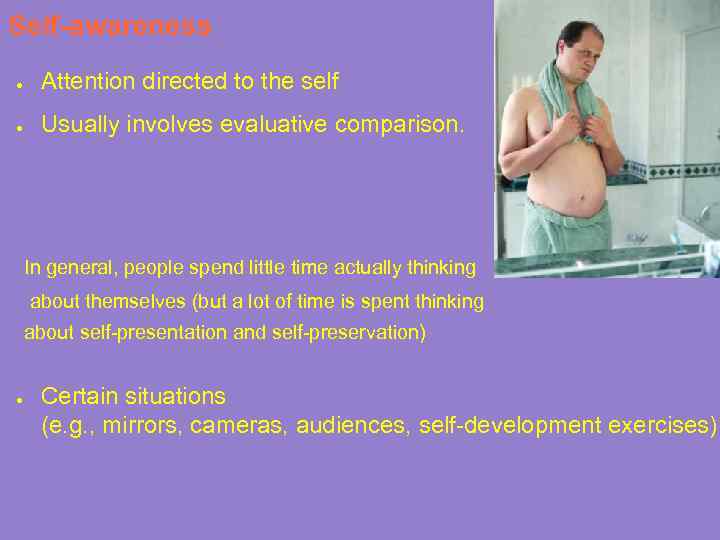 Self-awareness ● Attention directed to the self ● Usually involves evaluative comparison. In general, people spend little time actually thinking about themselves (but a lot of time is spent thinking about self-presentation and self-preservation) ● Certain situations (e. g. , mirrors, cameras, audiences, self-development exercises)
 Self-awareness ● ● Early in the 1970 s social psychologists began studying the difference between being and not being self-aware. They developed several clever procedures to increase self-awareness, such as having people work while seated in front of a mirror, or telling people that they were being videotaped.
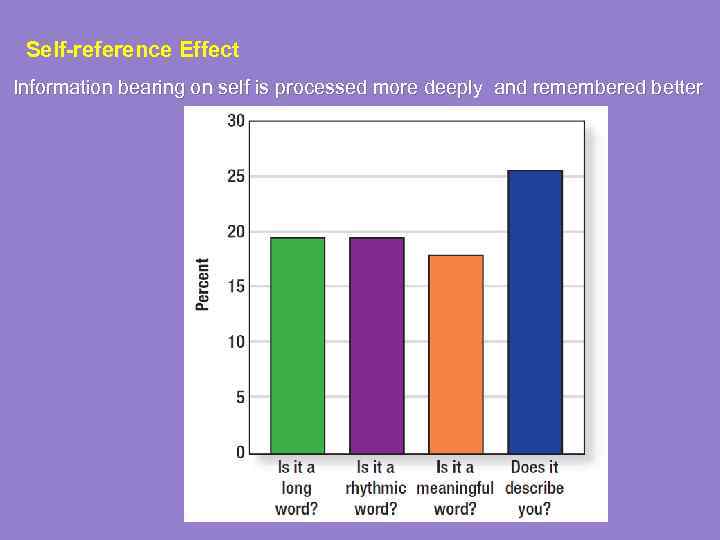 Self-reference Effect Information bearing on self is processed more deeply and remembered better
 Social Comparison Theory • Festinger suggested that people compare themselves to others because, for many domains and attributes, there is no objective yardstick with which to evaluate the self, so other people are highly informative.


 Social Comparison Theory • Festinger suggested that people compare themselves to others because, for many domains and attributes, there is no objective yardstick with which to evaluate the self, so other people are highly informative. - Desire to see self-positively appears more powerful that desire to see self-accurately – In-group comparisons “my salary is pretty good for a woman. ” Suls, J. E. , & Wills, T. A. E. (1991). Social comparison: Contemporary theory and research. Lawrence Erlbaum Associates, Inc.

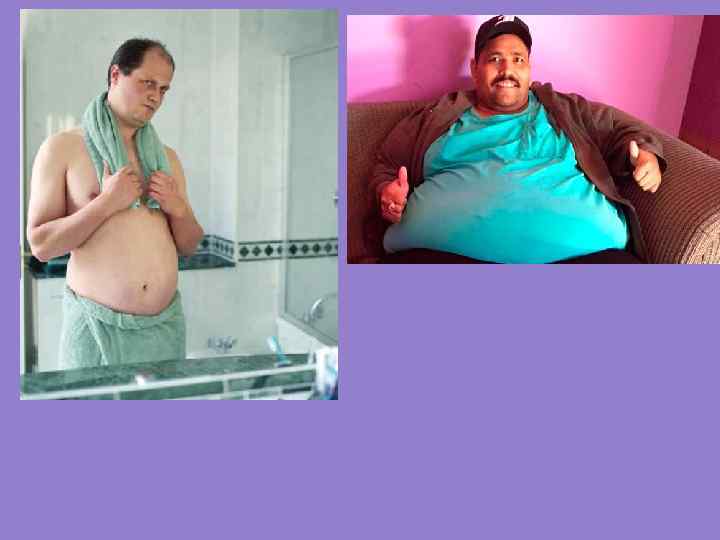
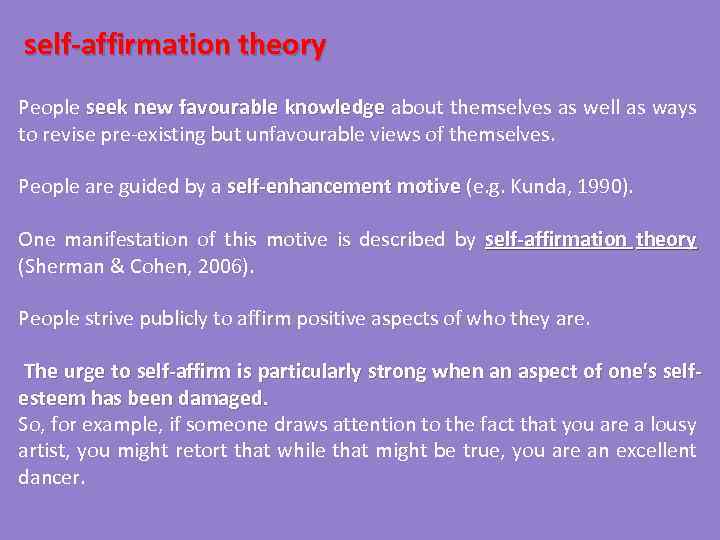 self-affirmation theory People seek new favourable knowledge about themselves as well as ways to revise pre-existing but unfavourable views of themselves. People are guided by a self-enhancement motive (e. g. Kunda, 1990). One manifestation of this motive is described by self-affirmation theory (Sherman & Cohen, 2006). People strive publicly to affirm positive aspects of who they are. The urge to self-affirm is particularly strong when an aspect of one's selfesteem has been damaged. So, for example, if someone draws attention to the fact that you are a lousy artist, you might retort that while that might be true, you are an excellent dancer.
 Self-Evaluation Maintenance Model • In order to maintain a positive view of the self, we distance ourselves from others who perform better than we do on valued dimensions, but move closer to others who perform worse, to protect our self-esteem. Tesser, A. (1988). Toward a self-evaluation maintenance model of social behavior. Advances in experimental social psychology, 21, 181 -227.
 Self-deception strategies ● Self Serving Bias (mentioned in the previous lecture) ● More skeptical of bad feedback ● Comparisons to those slightly worse ● Skew impressions of others to highlight own good traits as unusual
 Self-awareness Private self-awareness refers to attending to your inner states, including emotions, thoughts, desires, and traits. It is a matter of looking inward. Рublic self-awareness means attending to how you are perceived by others, including what others might think of you.
 Self-Monitoring ● ● Self-monitoring is the degree to which you are aware of how your actions and behaviors affect others and monitoring those behaviors to “fit in” or adapt to the situation you’re in. Observing one’s own behavior and adapting it to the situation
 Self-Monitoring ● What are the dangers of being a: ● High Self-Monitor (adjusts behavior to situation; monitors situation) High self-monitors regulate their expressive self-presentation in order to present the desired public appearance. These individuals may be considered to be insincere chameleons. ● Low Self-Monitor (principled attitudes guide behaviour) Low self-monitors lack either the ability or the motivation to regulate their expressive selfpresentations. These individuals may be viewed as insensitive.
 Is high or low-self-monitoring related to job success? Research (meta-analysis) has shown that high selfmonitoring is positively related to career success and relates to more promotions than low self-monitoring.
 Benefits of high self-esteem ● Feels good Helps one to overcome bad feelings If they fail, they are more likely to try again
 Self-esteem ● ● Self-esteem reflects a person's overall subjective emotional evaluation of his or her own worth. It is a judgment of oneself as well as an attitude toward the self. Self-esteem encompasses beliefs about oneself. "The self-concept is what we think about the self; selfesteem, is the positive or negative evaluations of the self, as in how we feel about it” (Smith, E. R. ; Mackie, D. M. (2007). Social Psychology (Third ed. ). Hove: Psychology Press)
 Benefits of high self-esteem ● Feels good Helps one to overcome bad feelings If they fail, they are more likely to try again
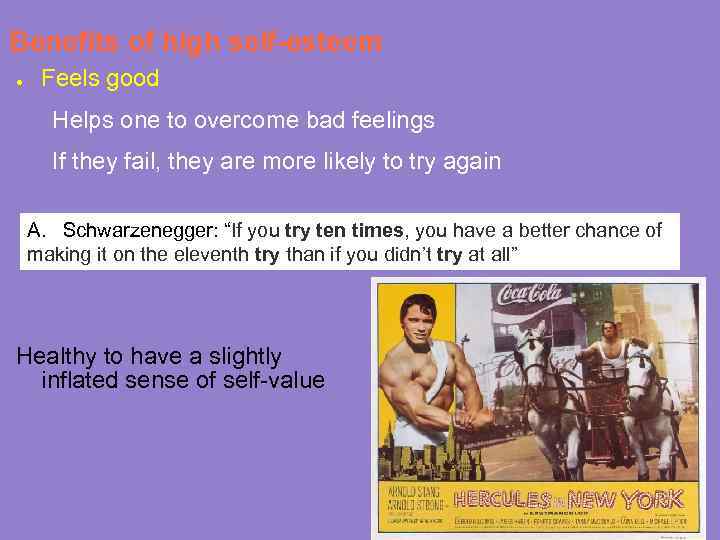 Benefits of high self-esteem ● Feels good Helps one to overcome bad feelings If they fail, they are more likely to try again A. Schwarzenegger: “If you try ten times, you have a better chance of making it on the eleventh try than if you didn’t try at all” Healthy to have a slightly inflated sense of self-value
 Self-esteem serves as a sociometer for one’s standing in a group. ● Sociometer theory This theoretical perspective was first introduced by Mark Leary and colleagues in 1995 and later expanded on by Kirkpatrick and Ellis (2001).
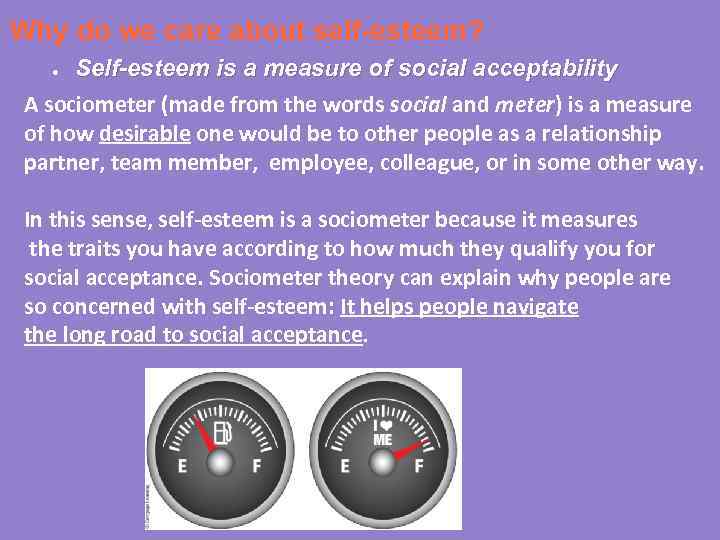 Why do we care about self-esteem? Self-esteem is a measure of social acceptability A sociometer (made from the words social and meter) is a measure of how desirable one would be to other people as a relationship partner, team member, employee, colleague, or in some other way. ● In this sense, self-esteem is a sociometer because it measures the traits you have according to how much they qualify you for social acceptance. Sociometer theory can explain why people are so concerned with self-esteem: It helps people navigate the long road to social acceptance.
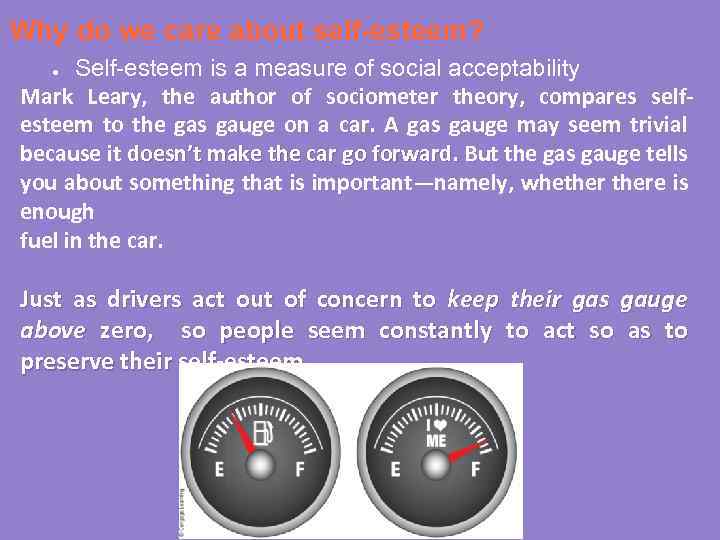 Why do we care about self-esteem? Self-esteem is a measure of social acceptability Mark Leary, the author of sociometer theory, compares selfesteem to the gas gauge on a car. A gas gauge may seem trivial because it doesn’t make the car go forward. But the gas gauge tells you about something that is important—namely, whethere is enough fuel in the car. ● Just as drivers act out of concern to keep their gas gauge above zero, so people seem constantly to act so as to preserve their self-esteem.
 A common view is that self-esteem is based mainly on feeling competent rather than on social acceptance. However, recent evidence suggests that feeling accepted has a bigger impact on self-esteem than does feeling competent (though both matter).
 Negative aspects of highest self-esteem ● Narcissism ● ● ● Subset of high self-esteem Tend to be more aggressive and violent Higher prejudice ● Tend to think their group is better
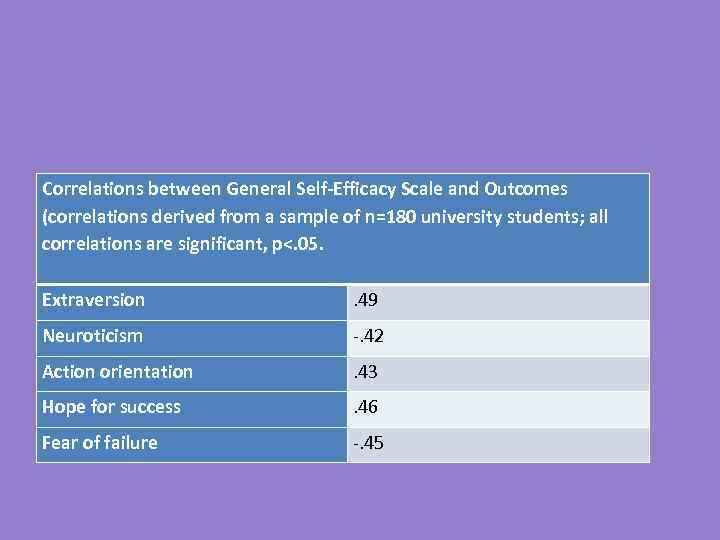
 Self-efficacy ● Belief in one’s capacity to succeed at a given task. e. g. Public Speaking Self-Efficacy Bandura recommended specific rather than general measures of Self-efficacy. ● Bandura, A. (1994). Self‐efficacy. John Wiley & Sons, Inc. .
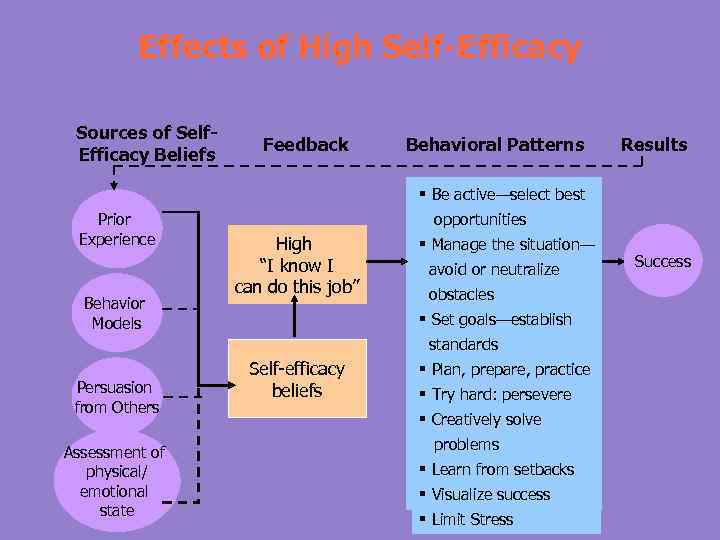
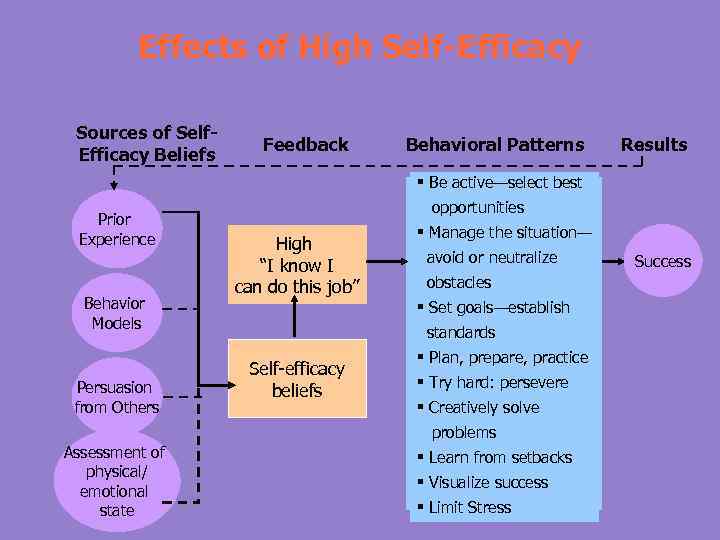 Effects of High Self-Efficacy Sources of Self. Efficacy Beliefs Feedback Behavioral Patterns Results § Be active—select best Prior Experience Behavior Models Persuasion from Others opportunities High “I know I can do this job” § Manage the situation— avoid or neutralize obstacles § Set goals—establish standards Self-efficacy beliefs § Plan, prepare, practice § Try hard: persevere § Creatively solve problems Assessment of physical/ emotional state § Learn from setbacks § Visualize success § Limit Stress Success
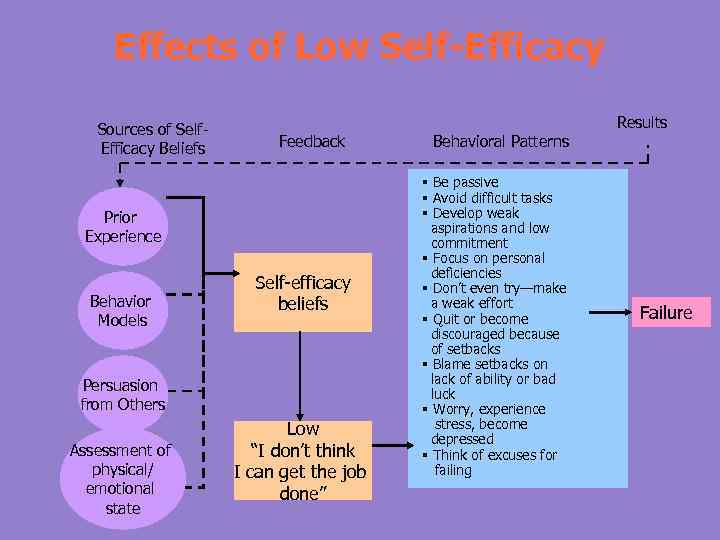
 People can program themselves for success or failure by enacting their self-efficacy expectations. Let’s use a work-related example. Let’s say your company has asked you to take on an international assignment for two years. Let’s analyze the sources of your selfefficacy in accomplishing that assignment successfully. a. Prior experience – have you done this before and been successful? This is the most important driver of your self-efficacy. What past experiences would be relevant in our example? Prior assignments, traveling abroad, having good experiences, knowledge of the language. b. Behavior models – success or failure of others who have done this. Have coworkers you know enjoyed their experiences and been successful? c. Persuasion from others – what kind of support does your organization provide, for example, will they help your spouse get a job, will they help you plan your reentry back into the country? Do they present it as you are really the right person for the job or do you more have the feeling that they just needed someone to go. d. Assessment of physical or emotional states – would you miss home and everything that is familiar to you? Maybe you have a health condition that you feel may prohibit your ability to perform well.
 Effects of High Self-Efficacy Sources of Self. Efficacy Beliefs Feedback Behavioral Patterns Results § Be active—select best Prior Experience Behavior Models opportunities High “I know I can do this job” § Manage the situation— avoid or neutralize obstacles § Set goals—establish standards Persuasion from Others Assessment of physical/ emotional state Self-efficacy beliefs § Plan, prepare, practice § Try hard: persevere § Creatively solve problems § Learn from setbacks § Visualize success § Limit Stress Success
 Effects of Low Self-Efficacy Sources of Self. Efficacy Beliefs Results Feedback Prior Experience Behavior Models Self-efficacy beliefs Persuasion from Others Assessment of physical/ emotional state Low “I don’t think I can get the job done” Behavioral Patterns § Be passive § Avoid difficult tasks § Develop weak aspirations and low commitment § Focus on personal deficiencies § Don’t even try—make a weak effort § Quit or become discouraged because of setbacks § Blame setbacks on lack of ability or bad luck § Worry, experience stress, become depressed § Think of excuses for failing Failure
 Correlations between General Self-Efficacy Scale and Outcomes (correlations derived from a sample of n=180 university students; all correlations are significant, p<. 05. Extraversion . 49 Neuroticism -. 42 Action orientation . 43 Hope for success . 46 Fear of failure -. 45
 The General Self-Efficacy Scale (GSE)
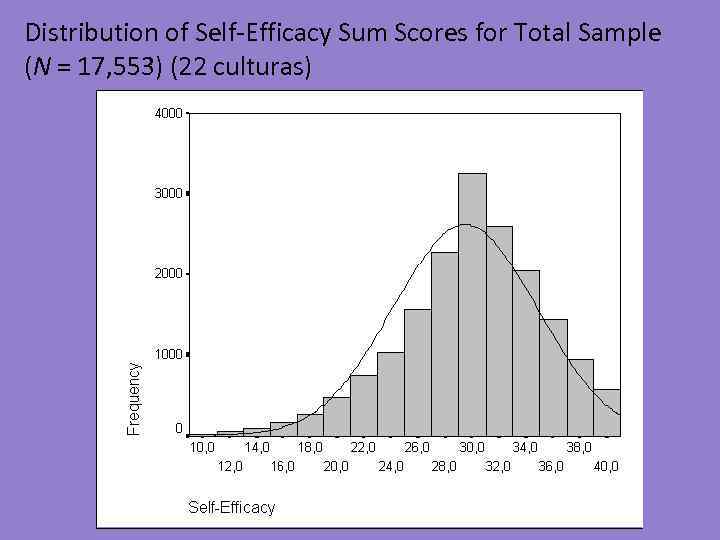 Distribution of Self-Efficacy Sum Scores for Total Sample (N = 17, 553) (22 culturas)
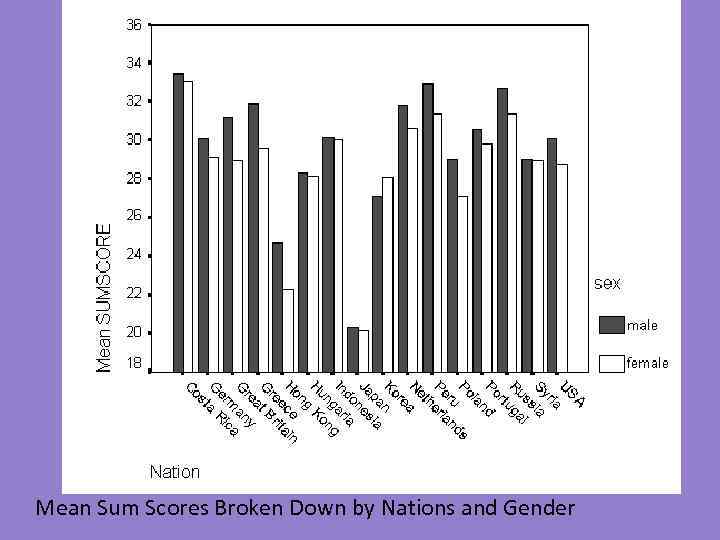 Mean Sum Scores Broken Down by Nations and Gender
 Interpersonal self – presentation ● Behaviors that convey an image to others ● Public esteem ● More important than private self-esteem
 Functions of self-presentation ● Social acceptance ● Increase chance of acceptance and maintain place within the group ● Claiming identity ● Social validation of claims to identity
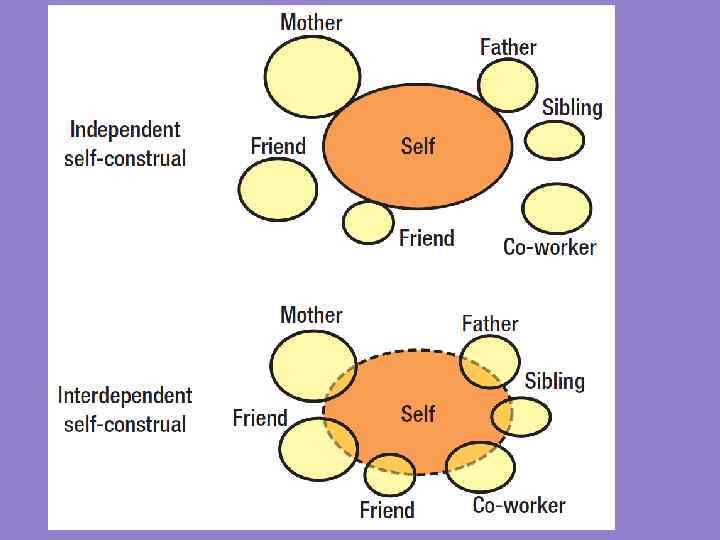
 Interpersonal Self The idea that cultural styles of selfhood differ along the dimension of independence was introduced by Hazel Markus (American) and Shinobu Kitayama (Japanese). They proposed that Asians differ from North Americans and Europeans in how they think of themselves and how they seek to construct the self in relation to others. To avoid the overused term self-concept, they introduced the term self -construal, which means a way of thinking about the self. -construal
 self-construal ● Markus and Kitayama (1991) published their classic article on culture and the self, proposing that people in different parts of the world tend to construe themselves in two fundamentally different ways.
 self-construal ● ● They argued that Western cultures are unusual in promoting an independent view of the self as bounded, unitary, stable, and separate from the social context, whereas cultures in other parts of the world emphasize an interdependent view of the self as closely connected to others, fluid, and contextually embedded.
 Interdependent of Self-Concept • • In individualistic cultures it is expected that people will develop a self-concept separate from others or independent from others. Men are expected to have an independent self-concept more than women. In collectivist cultures it is expected that people will develop a self-concept in terms of their connections or relationships with others. Women are expected to have an interdependent selfconcept more than men.
 self-construal ● They proposed that people with independent self-construals would strive for self-expression, uniqueness, and self-actualization, basing their actions on personal thoughts, feelings, and goals. ● In contrast, people with interdependent self-construals would strive to fit in and maintain social harmony, basing their actions on situationally defined norms and expectations.
 self-construal ● Markus and Kitayama’s (1991) proposals had a dramatic impact on social, personality and developmental psychology, challenging ethnocentric assumptions, drawing attention to cultural diversity, and providing conceptual tools for theorizing about it. Social and personality psychologists used measure sand manipulations of self-construals to predict numerous outcomes: cognitive styles, well-being, self-regulation, self-esteem, communication styles, social anxiety, and prosocial behavior, to name just a few (reviewed by Cross, Hardin, &Gercek-Swing, 2011; Gudykunst & Lee, 2003; Smith, Fischer, Vignoles, & Bond, 2013). Developmental psychologists sought to identify the prevailing theories, styles, and practices of parenting that foster development of independent or interdependent selves in different cultures (reviewed by Greenfield, Keller, Fuligni, & Maynard, 2003; Kağıtçıbaşı, 2007; Keller, 2007). Neuroscientists have begun to identify differences in brain activity that correlate with measures of independence and interdependence (reviewed by Kitayama &Uskul, 2011).
 self-construal ● ● ● Their work may have added scientific legitimacy to a common tendency to understand culture in terms of binary oppositions that differentiate “Western” cultures from “Other” cultures, while saying little about how the majority of cultures that are “non-Western” may differ from each other (Hermans & Kempen, 1998; for a recent example: Henrich, Heine, & Norenzayan, 2010). Concurrently, an empirical focus on comparing “Western” (usually North American) and “Eastern” usually East Asian) samples has often left the cultural systems of other world regions relatively marginalized within the scientific discourse on culture and self (for an example, see Yamaguchi et al. , 2007). This narrow focus may have restricted theorizing and thus limited the explanatory potential of self-construals.
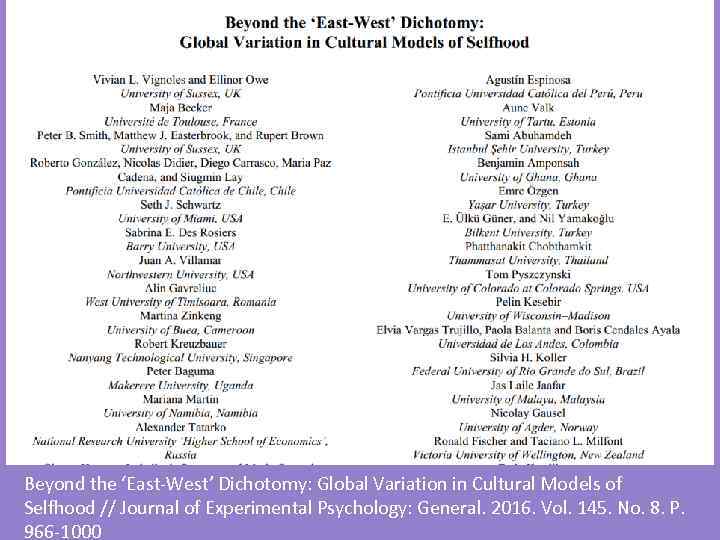 Beyond the ‘East-West’ Dichotomy: Global Variation in Cultural Models of Selfhood // Journal of Experimental Psychology: General. 2016. Vol. 145. No. 8. P. 966 -1000
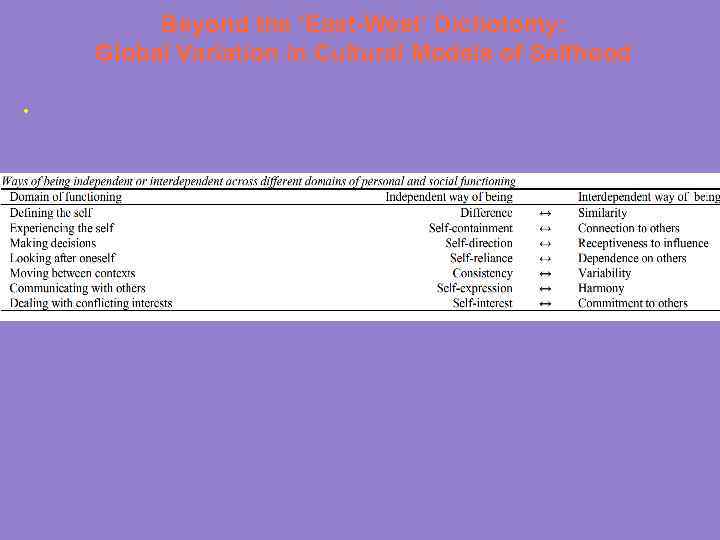
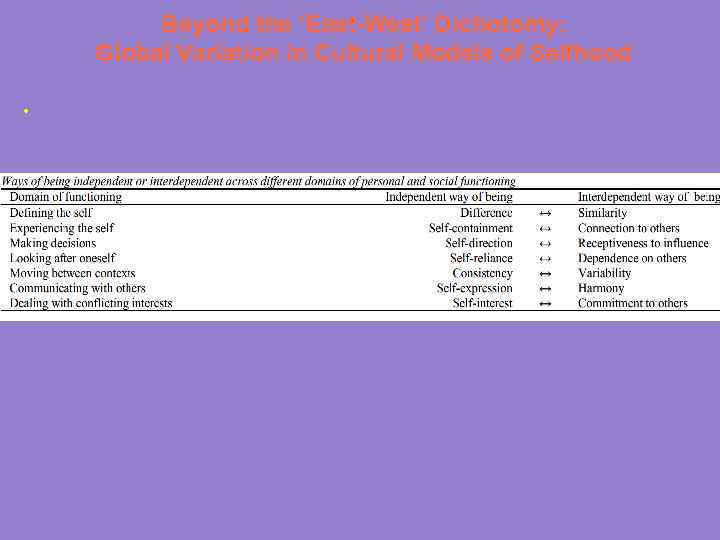
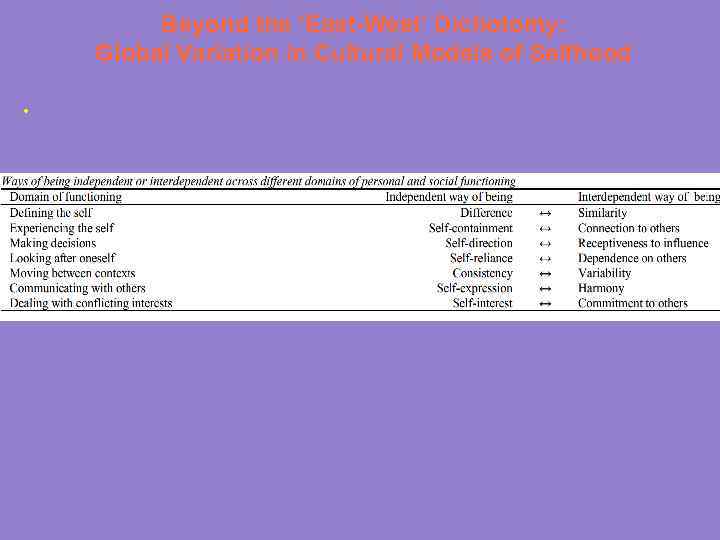
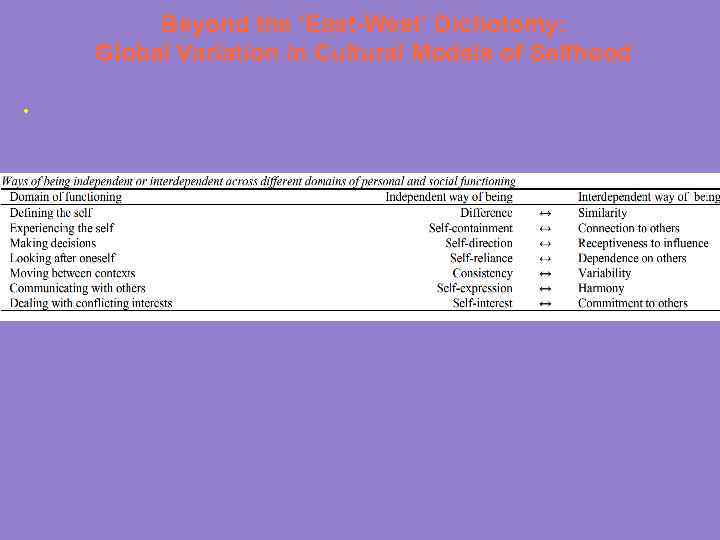
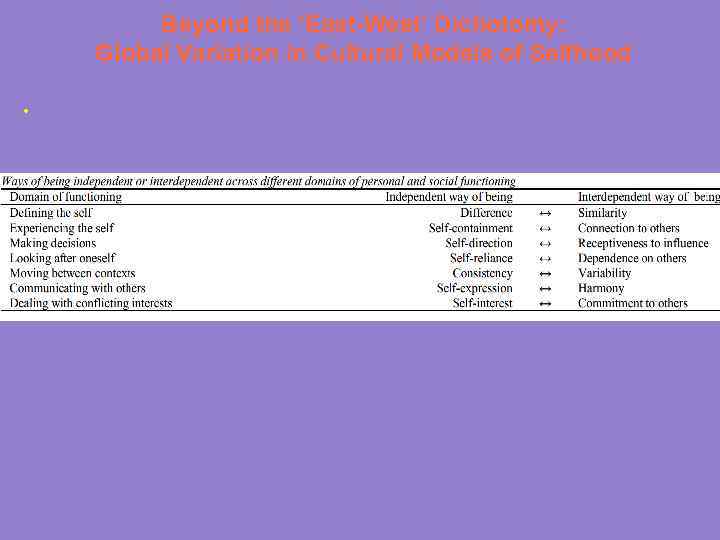
 Beyond the ‘East-West’ Dichotomy: Global Variation in Cultural Models of Selfhood ● Markus and Kitayama’s original characterization of North American and East Asian cultural models of selfhood was partly accurate, but that it does not adequately capture the complexity of global variation in models of selfhood: Depending on prevailing values and beliefs, socioeconomic development, and religious heritage, societies promote different ways of being independent and of being interdependent.
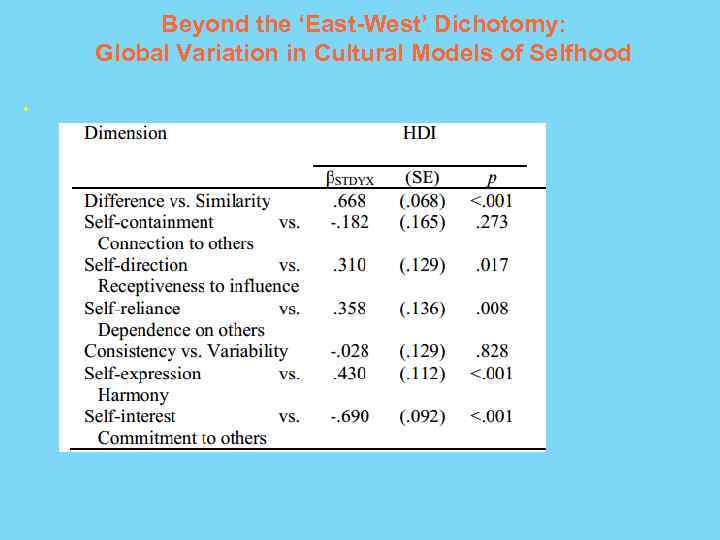
 ● ● ● Beyond the ‘East-West’ Dichotomy: Global Variation in Cultural Models of Selfhood We sampled participants from 16 cultural contexts, used a more extensive pool of items than in previous exploratory studies, adjusted ratings for acquiescent response style, and used appropriate statistical procedures for individual-level analysis of pancultural data (Leung & Bond, 1989). This informed the development of a new, sevendimensional model of individual differences in self-construals, extending Markus and Kitayama’s (1991 ) original theory. In Study 2, we tested and confirmed this new theoretical model among adult participants from over 50 cultural contexts
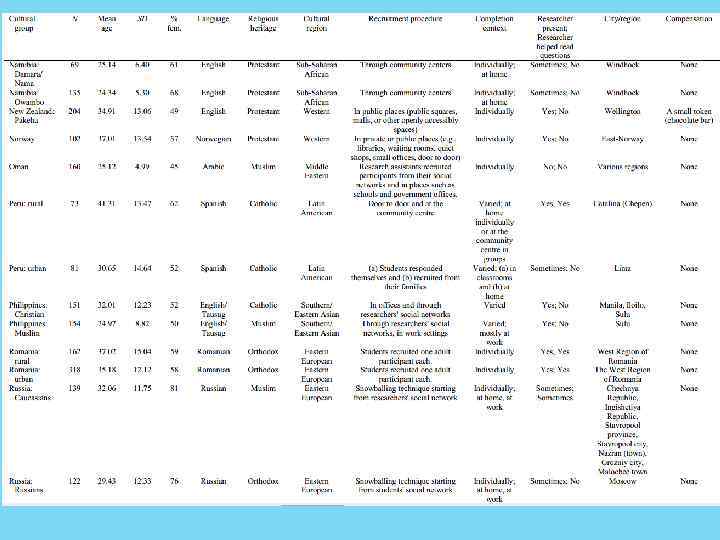
 Beyond the ‘East-West’ Dichotomy: Global Variation in Cultural Models of Selfhood We tested our seven-dimensional model among even more diverse samples and using an improved set of items. Data were collected within a second multinational study into culture and identity processes (Owe et al. , 2013; Vignoles & Brown, 2011), among non-student adults across a much larger number of cultural groups than Study 1. Rather than equating ‘culture’ with ‘nation’, we targeted several cultural groups within each nation where relevant and feasible. The nature of the groups varied from nation to nation, such that the differences might be regional (e. g. , Eastern and Western Germany), religious (e. g. , Baptists and Orthodox Christians in Georgia) or ethnic (e. g. , Damara and Owambo in Namibia). We collected data from over 7, 000 adult members of 55 cultural groups in 33 nations, spanning all inhabited continents.
 Beyond the ‘East-West’ Dichotomy: Global Variation in Cultural Models of Selfhood ●
 Beyond the ‘East-West’ Dichotomy: Global Variation in Cultural Models of Selfhood ●
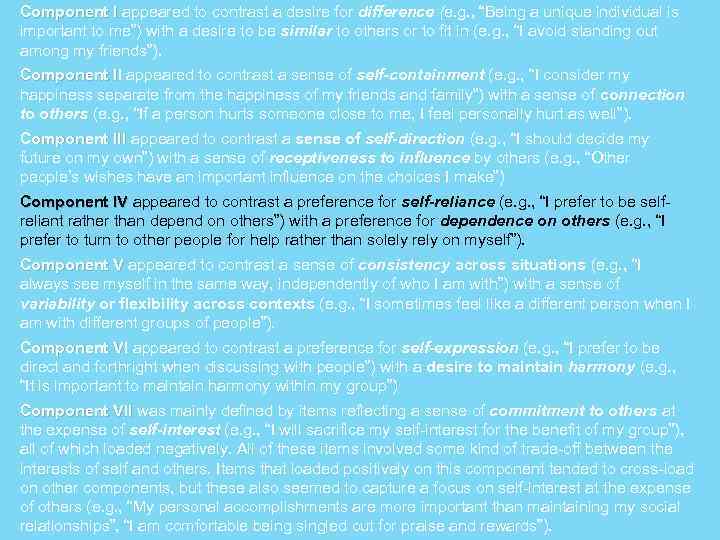
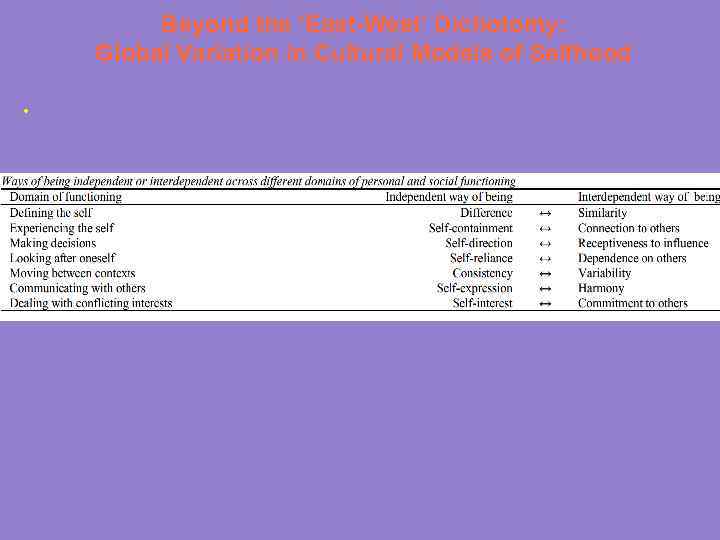
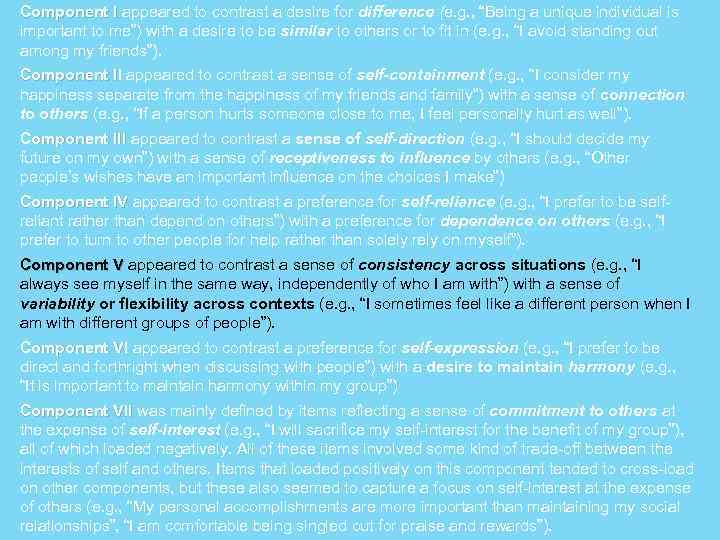
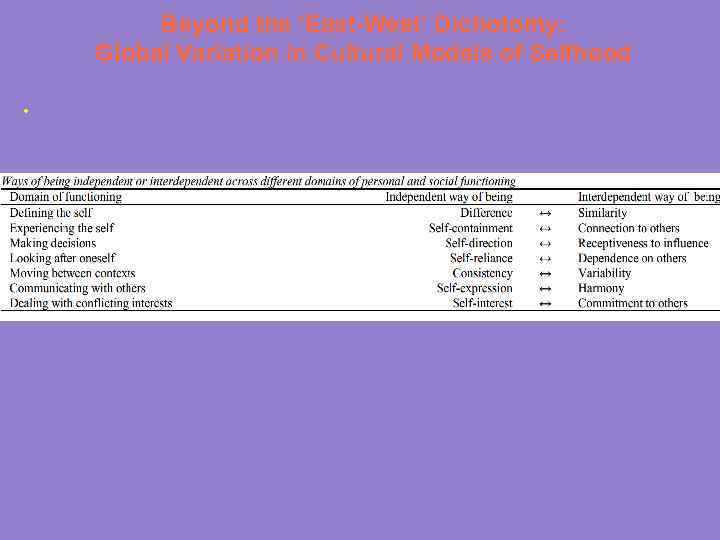
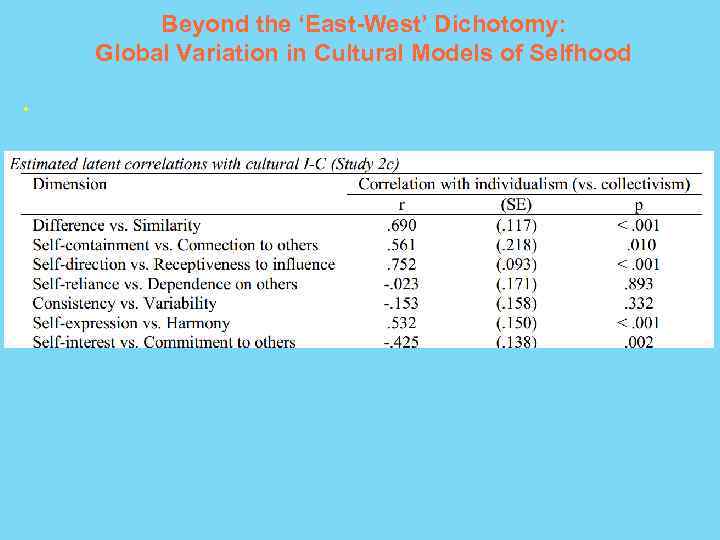
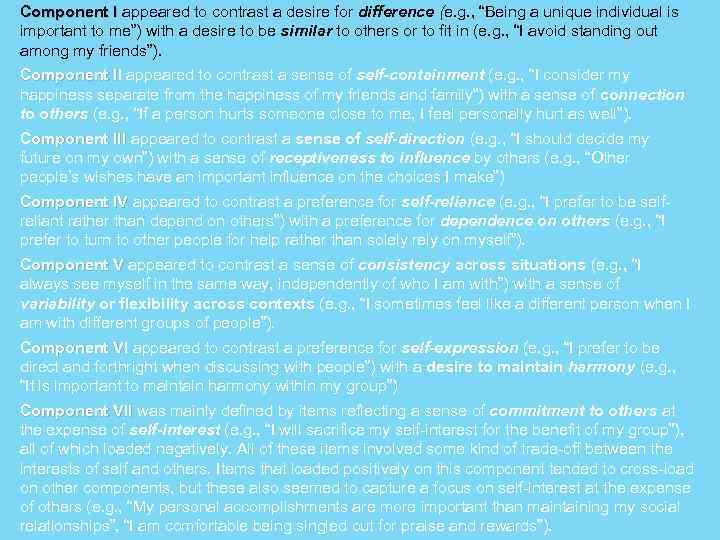 Component I appeared to contrast a desire for difference (e. g. , “Being a unique individual is important to me”) with a desire to be similar to others or to fit in (e. g. , “I avoid standing out among my friends”). Component II appeared to contrast a sense of self-containment (e. g. , “I consider my happiness separate from the happiness of my friends and family”) with a sense of connection to others (e. g. , “If a person hurts someone close to me, I feel personally hurt as well”). Component III appeared to contrast a sense of self-direction (e. g. , “I should decide my future on my own”) with a sense of receptiveness to influence by others (e. g. , “Other people’s wishes have an important influence on the choices I make”) Component IV appeared to contrast a preference for self-reliance (e. g. , “I prefer to be selfreliant rather than depend on others”) with a preference for dependence on others (e. g. , “I prefer to turn to other people for help rather than solely rely on myself”). Component V appeared to contrast a sense of consistency across situations (e. g. , “I always see myself in the same way, independently of who I am with”) with a sense of variability or flexibility across contexts (e. g. , “I sometimes feel like a different person when I am with different groups of people”). Component VI appeared to contrast a preference for self-expression (e. g. , “I prefer to be direct and forthright when discussing with people”) with a desire to maintain harmony (e. g. , “It is important to maintain harmony within my group”) Component VII was mainly defined by items reflecting a sense of commitment to others at the expense of self-interest (e. g. , “I will sacrifice my self-interest for the benefit of my group”), all of which loaded negatively. All of these items involved some kind of trade-off between the interests of self and others. Items that loaded positively on this component tended to cross-load on other components, but these also seemed to capture a focus on self-interest at the expense of others (e. g. , “My personal accomplishments are more important than maintaining my social relationships”, “I am comfortable being singled out for praise and rewards”).
 Beyond the ‘East-West’ Dichotomy: Global Variation in Cultural Models of Selfhood ●
 Component I appeared to contrast a desire for difference (e. g. , “Being a unique individual is important to me”) with a desire to be similar to others or to fit in (e. g. , “I avoid standing out among my friends”). Component II appeared to contrast a sense of self-containment (e. g. , “I consider my happiness separate from the happiness of my friends and family”) with a sense of connection to others (e. g. , “If a person hurts someone close to me, I feel personally hurt as well”). Component III appeared to contrast a sense of self-direction (e. g. , “I should decide my future on my own”) with a sense of receptiveness to influence by others (e. g. , “Other people’s wishes have an important influence on the choices I make”) Component IV appeared to contrast a preference for self-reliance (e. g. , “I prefer to be selfreliant rather than depend on others”) with a preference for dependence on others (e. g. , “I prefer to turn to other people for help rather than solely rely on myself”). Component V appeared to contrast a sense of consistency across situations (e. g. , “I always see myself in the same way, independently of who I am with”) with a sense of variability or flexibility across contexts (e. g. , “I sometimes feel like a different person when I am with different groups of people”). Component VI appeared to contrast a preference for self-expression (e. g. , “I prefer to be direct and forthright when discussing with people”) with a desire to maintain harmony (e. g. , “It is important to maintain harmony within my group”) Component VII was mainly defined by items reflecting a sense of commitment to others at the expense of self-interest (e. g. , “I will sacrifice my self-interest for the benefit of my group”), all of which loaded negatively. All of these items involved some kind of trade-off between the interests of self and others. Items that loaded positively on this component tended to cross-load on other components, but these also seemed to capture a focus on self-interest at the expense of others (e. g. , “My personal accomplishments are more important than maintaining my social relationships”, “I am comfortable being singled out for praise and rewards”).
 Beyond the ‘East-West’ Dichotomy: Global Variation in Cultural Models of Selfhood ●
 Component I appeared to contrast a desire for difference (e. g. , “Being a unique individual is important to me”) with a desire to be similar to others or to fit in (e. g. , “I avoid standing out among my friends”). Component II appeared to contrast a sense of self-containment (e. g. , “I consider my happiness separate from the happiness of my friends and family”) with a sense of connection to others (e. g. , “If a person hurts someone close to me, I feel personally hurt as well”). Component III appeared to contrast a sense of self-direction (e. g. , “I should decide my future on my own”) with a sense of receptiveness to influence by others (e. g. , “Other people’s wishes have an important influence on the choices I make”) Component IV appeared to contrast a preference for self-reliance (e. g. , “I prefer to be selfreliant rather than depend on others”) with a preference for dependence on others (e. g. , “I prefer to turn to other people for help rather than solely rely on myself”). Component V appeared to contrast a sense of consistency across situations (e. g. , “I always see myself in the same way, independently of who I am with”) with a sense of variability or flexibility across contexts (e. g. , “I sometimes feel like a different person when I am with different groups of people”). Component VI appeared to contrast a preference for self-expression (e. g. , “I prefer to be direct and forthright when discussing with people”) with a desire to maintain harmony (e. g. , “It is important to maintain harmony within my group”) Component VII was mainly defined by items reflecting a sense of commitment to others at the expense of self-interest (e. g. , “I will sacrifice my self-interest for the benefit of my group”), all of which loaded negatively. All of these items involved some kind of trade-off between the interests of self and others. Items that loaded positively on this component tended to cross-load on other components, but these also seemed to capture a focus on self-interest at the expense of others (e. g. , “My personal accomplishments are more important than maintaining my social relationships”, “I am comfortable being singled out for praise and rewards”).
 Beyond the ‘East-West’ Dichotomy: Global Variation in Cultural Models of Selfhood ●
 Component I appeared to contrast a desire for difference (e. g. , “Being a unique individual is important to me”) with a desire to be similar to others or to fit in (e. g. , “I avoid standing out among my friends”). Component II appeared to contrast a sense of self-containment (e. g. , “I consider my happiness separate from the happiness of my friends and family”) with a sense of connection to others (e. g. , “If a person hurts someone close to me, I feel personally hurt as well”). Component III appeared to contrast a sense of self-direction (e. g. , “I should decide my future on my own”) with a sense of receptiveness to influence by others (e. g. , “Other people’s wishes have an important influence on the choices I make”) Component IV appeared to contrast a preference for self-reliance (e. g. , “I prefer to be selfreliant rather than depend on others”) with a preference for dependence on others (e. g. , “I prefer to turn to other people for help rather than solely rely on myself”). Component V appeared to contrast a sense of consistency across situations (e. g. , “I always see myself in the same way, independently of who I am with”) with a sense of variability or flexibility across contexts (e. g. , “I sometimes feel like a different person when I am with different groups of people”). Component VI appeared to contrast a preference for self-expression (e. g. , “I prefer to be direct and forthright when discussing with people”) with a desire to maintain harmony (e. g. , “It is important to maintain harmony within my group”) Component VII was mainly defined by items reflecting a sense of commitment to others at the expense of self-interest (e. g. , “I will sacrifice my self-interest for the benefit of my group”), all of which loaded negatively. All of these items involved some kind of trade-off between the interests of self and others. Items that loaded positively on this component tended to cross-load on other components, but these also seemed to capture a focus on self-interest at the expense of others (e. g. , “My personal accomplishments are more important than maintaining my social relationships”, “I am comfortable being singled out for praise and rewards”).
 Beyond the ‘East-West’ Dichotomy: Global Variation in Cultural Models of Selfhood ●
 Component I appeared to contrast a desire for difference (e. g. , “Being a unique individual is important to me”) with a desire to be similar to others or to fit in (e. g. , “I avoid standing out among my friends”). Component II appeared to contrast a sense of self-containment (e. g. , “I consider my happiness separate from the happiness of my friends and family”) with a sense of connection to others (e. g. , “If a person hurts someone close to me, I feel personally hurt as well”). Component III appeared to contrast a sense of self-direction (e. g. , “I should decide my future on my own”) with a sense of receptiveness to influence by others (e. g. , “Other people’s wishes have an important influence on the choices I make”) Component IV appeared to contrast a preference for self-reliance (e. g. , “I prefer to be selfreliant rather than depend on others”) with a preference for dependence on others (e. g. , “I prefer to turn to other people for help rather than solely rely on myself”). Component V appeared to contrast a sense of consistency across situations (e. g. , “I always see myself in the same way, independently of who I am with”) with a sense of variability or flexibility across contexts (e. g. , “I sometimes feel like a different person when I am with different groups of people”). Component VI appeared to contrast a preference for self-expression (e. g. , “I prefer to be direct and forthright when discussing with people”) with a desire to maintain harmony (e. g. , “It is important to maintain harmony within my group”) Component VII was mainly defined by items reflecting a sense of commitment to others at the expense of self-interest (e. g. , “I will sacrifice my self-interest for the benefit of my group”), all of which loaded negatively. All of these items involved some kind of trade-off between the interests of self and others. Items that loaded positively on this component tended to cross-load on other components, but these also seemed to capture a focus on self-interest at the expense of others (e. g. , “My personal accomplishments are more important than maintaining my social relationships”, “I am comfortable being singled out for praise and rewards”).
 Beyond the ‘East-West’ Dichotomy: Global Variation in Cultural Models of Selfhood ●
 Component I appeared to contrast a desire for difference (e. g. , “Being a unique individual is important to me”) with a desire to be similar to others or to fit in (e. g. , “I avoid standing out among my friends”). Component II appeared to contrast a sense of self-containment (e. g. , “I consider my happiness separate from the happiness of my friends and family”) with a sense of connection to others (e. g. , “If a person hurts someone close to me, I feel personally hurt as well”). Component III appeared to contrast a sense of self-direction (e. g. , “I should decide my future on my own”) with a sense of receptiveness to influence by others (e. g. , “Other people’s wishes have an important influence on the choices I make”) Component IV appeared to contrast a preference for self-reliance (e. g. , “I prefer to be selfreliant rather than depend on others”) with a preference for dependence on others (e. g. , “I prefer to turn to other people for help rather than solely rely on myself”). Component V appeared to contrast a sense of consistency across situations (e. g. , “I always see myself in the same way, independently of who I am with”) with a sense of variability or flexibility across contexts (e. g. , “I sometimes feel like a different person when I am with different groups of people”). Component VI appeared to contrast a preference for self-expression (e. g. , “I prefer to be direct and forthright when discussing with people”) with a desire to maintain harmony (e. g. , “It is important to maintain harmony within my group”) Component VII was mainly defined by items reflecting a sense of commitment to others at the expense of self-interest (e. g. , “I will sacrifice my self-interest for the benefit of my group”), all of which loaded negatively. All of these items involved some kind of trade-off between the interests of self and others. Items that loaded positively on this component tended to cross-load on other components, but these also seemed to capture a focus on self-interest at the expense of others (e. g. , “My personal accomplishments are more important than maintaining my social relationships”, “I am comfortable being singled out for praise and rewards”).
 Beyond the ‘East-West’ Dichotomy: Global Variation in Cultural Models of Selfhood ●
 Component I appeared to contrast a desire for difference (e. g. , “Being a unique individual is important to me”) with a desire to be similar to others or to fit in (e. g. , “I avoid standing out among my friends”). Component II appeared to contrast a sense of self-containment (e. g. , “I consider my happiness separate from the happiness of my friends and family”) with a sense of connection to others (e. g. , “If a person hurts someone close to me, I feel personally hurt as well”). Component III appeared to contrast a sense of self-direction (e. g. , “I should decide my future on my own”) with a sense of receptiveness to influence by others (e. g. , “Other people’s wishes have an important influence on the choices I make”) Component IV appeared to contrast a preference for self-reliance (e. g. , “I prefer to be selfreliant rather than depend on others”) with a preference for dependence on others (e. g. , “I prefer to turn to other people for help rather than solely rely on myself”). Component V appeared to contrast a sense of consistency across situations (e. g. , “I always see myself in the same way, independently of who I am with”) with a sense of variability or flexibility across contexts (e. g. , “I sometimes feel like a different person when I am with different groups of people”). Component VI appeared to contrast a preference for self-expression (e. g. , “I prefer to be direct and forthright when discussing with people”) with a desire to maintain harmony (e. g. , “It is important to maintain harmony within my group”) Component VII was partly defined by items reflecting a sense of commitment to others at the expense of self-interest (e. g. , “I will sacrifice my self-interest for the benefit of my group”) and items describing a focus on self-interest at the expense of others (e. g. , “My personal accomplishments are more important than maintaining my social relationships”, “I am comfortable being singled out for praise and rewards”).
 Beyond the ‘East-West’ Dichotomy: Global Variation in Cultural Models of Selfhood ●
 Beyond the ‘East-West’ Dichotomy: Global Variation in Cultural Models of Selfhood ●
 Beyond the ‘East-West’ Dichotomy: Global Variation in Cultural Models of Selfhood ● In closing, we have argued that previous confusions in the self-construal literature are due in no small measure to researchers’ premature convergence on an over-simplified dimensional model of self-construals (independent and interdependent) and cultures (Western and non-Western), without having passed through a prior phase of systematic exploration to identify the nature and cross-cultural distribution of these constructs.
 Self-Interest
 Self-interest THE “FORER EFFECT” (Barnum effect)
 THE “FORER EFFECT” (Barnum effect) The Forer effect (also called the Barnum effect after P. T. Barnum's observation that "we've got something for everyone") is the observation that individuals will give high accuracy ratings to descriptions of their personality that supposedly are tailored specifically for them, but are in fact vague and general enough to apply to a wide range of people.
 THE “FORER EFFECT” (Barnum effect) This effect can provide a partial explanation for the widespread acceptance of some beliefs and practices, such as astrology, fortune telling, graphology, aura reading. A related and more general phenomenon is that of subjective validation. Subjective validation occurs when two unrelated or even random events are perceived to be related because a belief, expectation, or hypothesis demands a relationship. Thus people seek a correspondence between their perception of their personality and the contents of a horoscope.
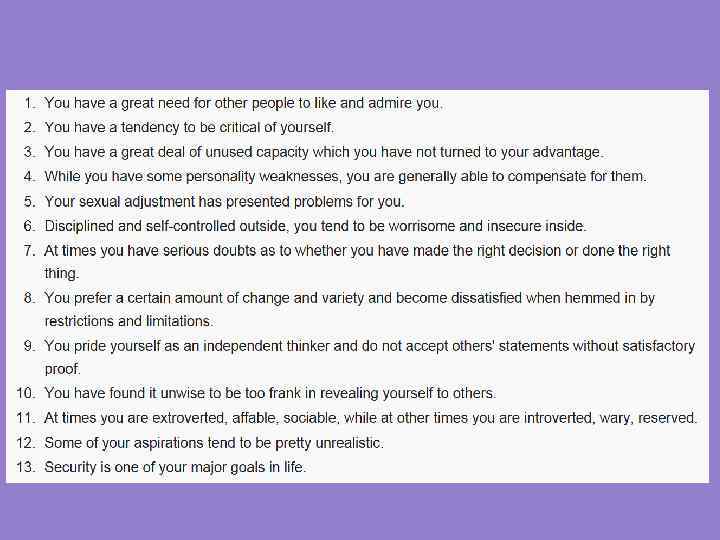
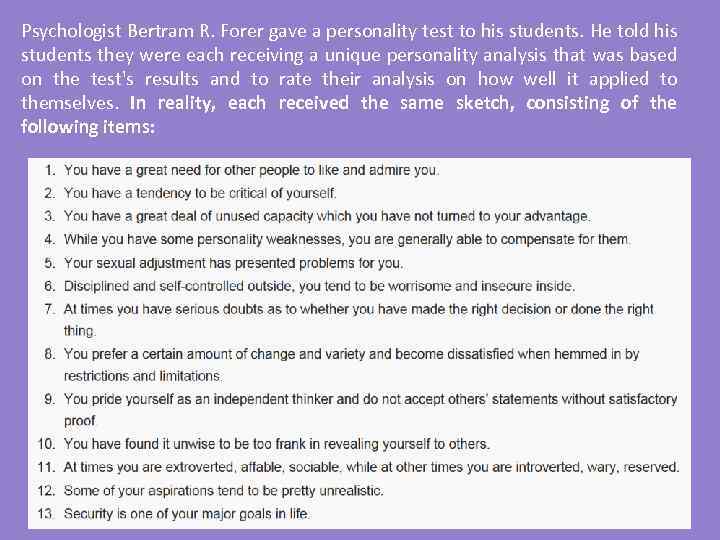 Psychologist Bertram R. Forer gave a personality test to his students. He told his students they were each receiving a unique personality analysis that was based on the test's results and to rate their analysis on how well it applied to themselves. In reality, each received the same sketch, consisting of the following items:
 THE “FORER EFFECT” (Barnum effect) On average, the students rated its accuracy as 4. 26 on a scale of 0 (very poor) to 5 (excellent). Only after the ratings were turned in was it revealed that each student had received identical copies assembled by Forer from a newsstand astrology book. The quote contains a number of statements that are vague and general enough to apply to a wide range of people.
 THE “FORER EFFECT” (Barnum effect) Subjects give higher accuracy ratings if. . . ○ The subject believes analysis applies only to him/her ○ The subject believes in the authority of the evaluator ○ The analysis lists mostly positive traits, or turns weaknesses into strengths (more positive more acceptable)
 This effect exists due to our self interest. Just someone who exploits our self interest. )