


 Скачать презентацию The Social Protection Floor Initiative from concept to
0618c6643dffd05756d44aa9b2eb0dea.ppt
- Количество слайдов: 43
 The Social Protection Floor. Initiative: from concept to practical implementation Celine Felix ILO Decent Work Team, Bangkok Brunei, 21 November 2010 Decent Work for All ASIAN DECENT WORK DECADE 2006 -2015
 Table of contents 1. 2. 3. 4. 5. Make sure we are talking the same language: Social protection, social security What is the issue? The level of social protection coverage remains low, despite many arguments to justify the extension The Social Protection Floor-Initiative and concept Relevance of the SPF & Staircase: from concept to practical implementation The way forward: key messages
 Table of contents 1. 2. 3. 4. 5. Make sure we are talking the same language: Social protection, social security What is the issue? The level of social protection coverage remains low, despite many arguments to justify the extension The Social Protection Floor-Initiative and concept Relevance of the SPF & Staircase: from concept to practical implementation The way forward: key messages
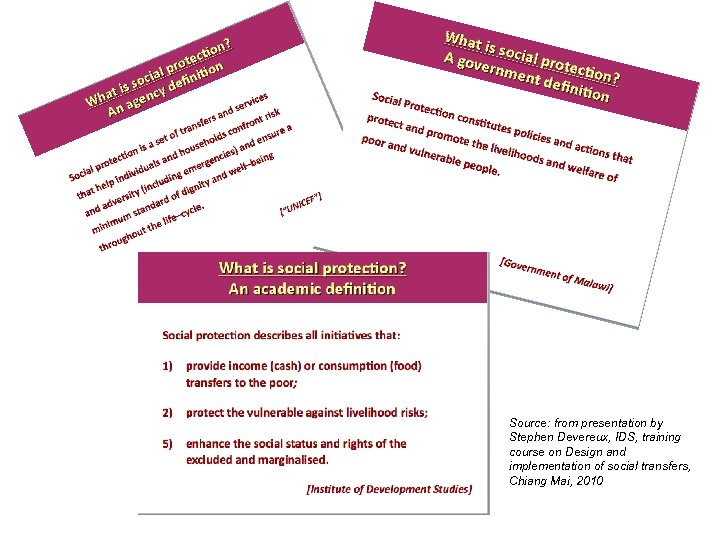 Source: from presentation by Stephen Devereux, IDS, training course on Design and implementation of social transfers, Chiang Mai, 2010
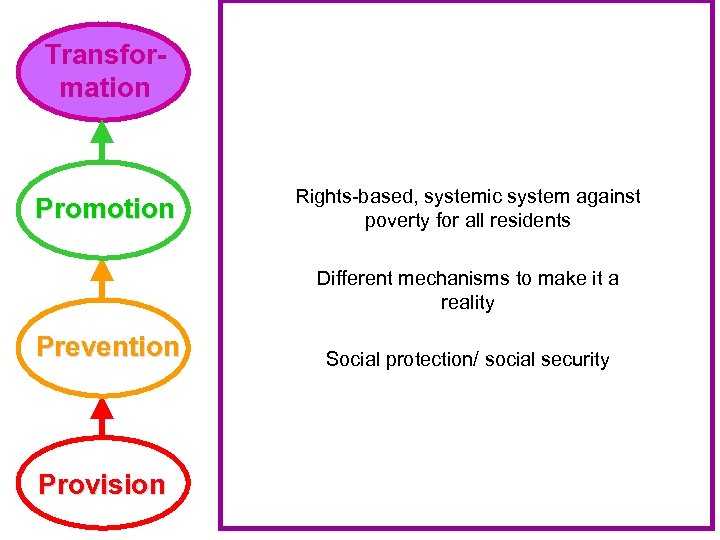 Transformation Promotion Rights-based, systemic system against poverty for all residents Different mechanisms to make it a reality Prevention Provision Social protection/ social security
 Table of contents 1. 2. 3. 4. Make sure we are talking the same language: Social protection, social security What is the issue? The level of social protection coverage remains low, despite many arguments to justify the extension The Social Protection Floor-Initiative and concept The way forward: key messages
 The issue of coverage gap… • Only about 20 per cent of the world’s working-age population (and their families) have effective access to comprehensive social protection • In many countries the number of social security branches to which the population has access is limited. . Scope • For those schemes which are available only a limited percentage of the population is legally covered (e. g. formal sector). . Extent • These few legally covered are not all effectively covered • The levels of benefits are often limited, providing therefore a coverage which is not adequate. . Level • Countries in Asia don’t invest enough in social security (choice of society more than a question of affordability) …
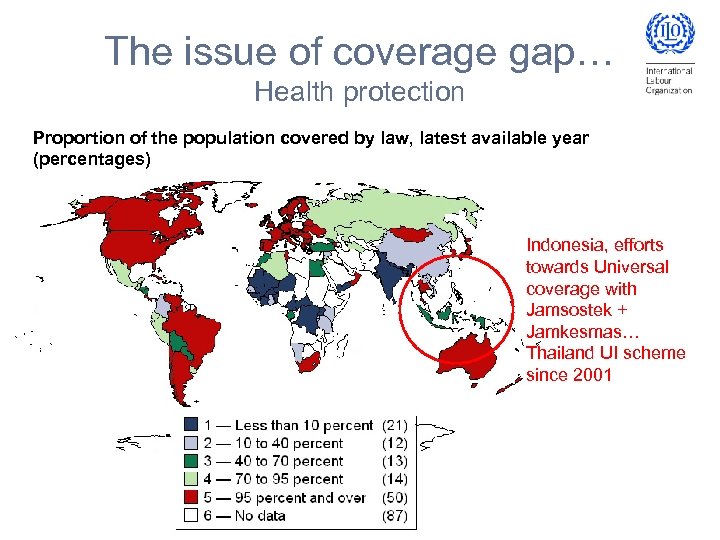 The issue of coverage gap… Health protection Proportion of the population covered by law, latest available year (percentages) Indonesia, efforts towards Universal coverage with Jamsostek + Jamkesmas… Thailand UI scheme since 2001
 The issue of low coverage… Countries don’t invest sufficiently in Social Protection • Over the past ten years, the benefits of growth in Asia have not been equitably shared, levels of poverty remain very high and inequalities are increasing in most countries …
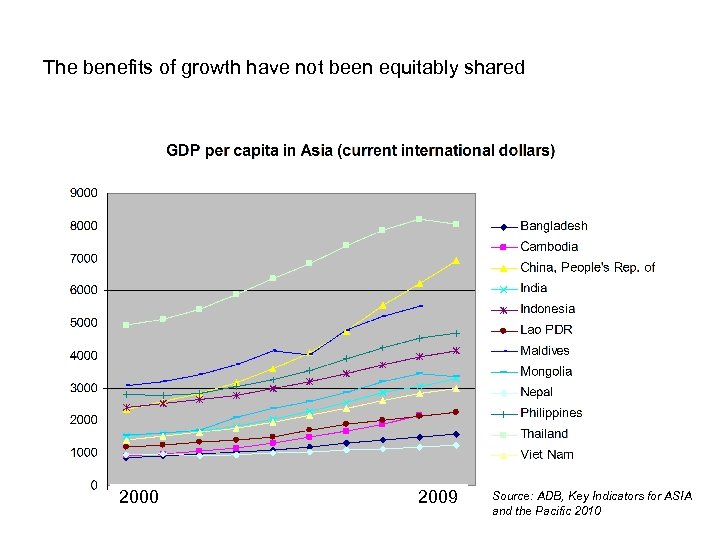 The benefits of growth have not been equitably shared 2000 2009 Source: ADB, Key Indicators for ASIA and the Pacific 2010
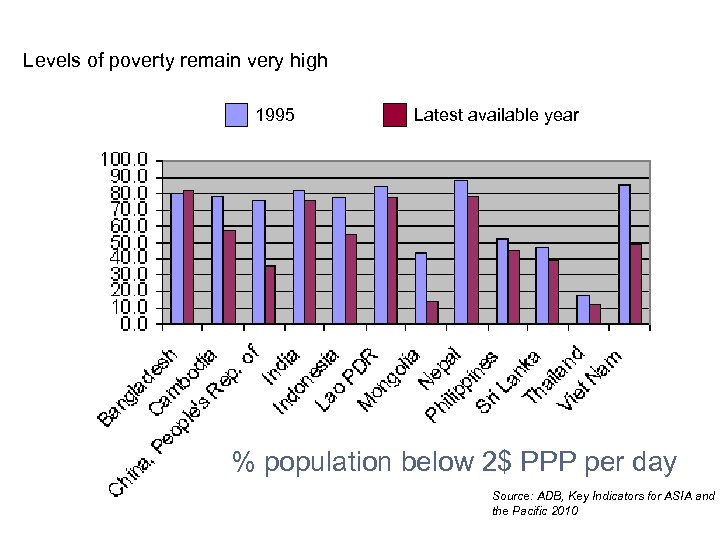 Levels of poverty remain very high 1995 Latest available year % population below 2$ PPP per day Source: ADB, Key Indicators for ASIA and the Pacific 2010
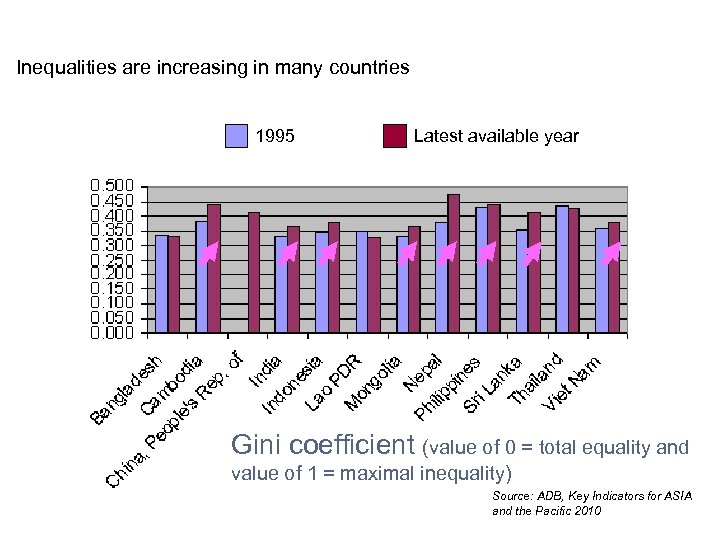 Inequalities are increasing in many countries 1995 Latest available year Gini coefficient (value of 0 = total equality and value of 1 = maximal inequality) Source: ADB, Key Indicators for ASIA and the Pacific 2010
 … Despite many arguments in favor of the L R AL extension… (1/3) O HT F • A RIG Social security is a basic human right : - Universal Declaration of Human Rights (1948), Article 22: Everyone, as a member of society, has the right to social security -International Covenant on Economic, Social and Cultural Rights (1966), Article 9: « recognize the right of everyone to social security, including social insurance » • As a Consequence : -States and international community have the obligation to take appropriate measures to guarantee this right (legal, administrative, budgetary …) - Each individual is entitled to a minimum level of social protection, without exception or discrimination It is a rights-based entitlement rather than welfare safety nets It is about social protection (equity) rather than social assistance; It is about social justice rather than livelihoods;
 … Despite many arguments in favor of the extension… (2/3) IAL O ND S A OMIC SITY N ECO ECES N N • Through a redistribution function, A • C – SP contributes to protect people from economic and social shocks – SP contributes to reduce poverty and inequalities : Income transfers through social security have a short term and a longer term effect on income inequality & moving out of poverty Contributes to boost consumption of households & contributes to the development of domestic markets, and a more balanced economy – Boost economic growth by raising domestic demand / internal markets • Enhance human capital and productive employment - a better educated, healthy and well nourished workforce • Reduce poverty FASTER => Progress towards MDGs • Reduction of economic inequalities and political instability
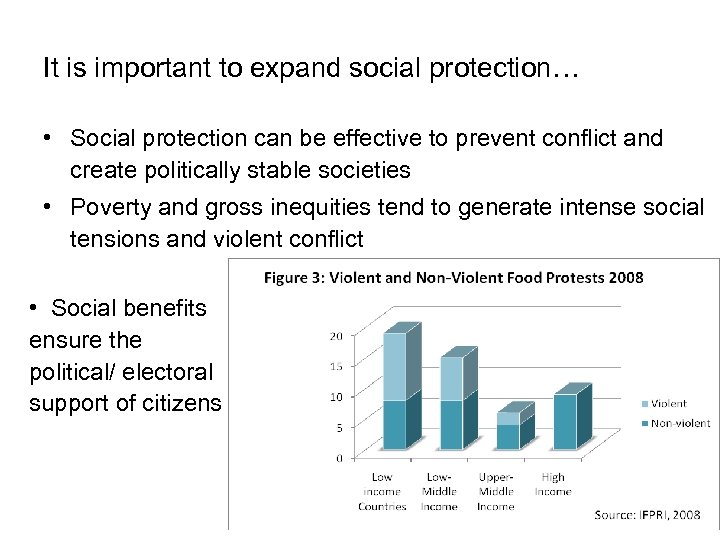 It is important to expand social protection… • Social protection can be effective to prevent conflict and create politically stable societies • Poverty and gross inequities tend to generate intense social tensions and violent conflict • Social benefits ensure the political/ electoral support of citizens
 I. Despite many arguments in favor of the OVERY C IS/RE IS extension… (3/3) TI CR OL AN AN TO • In times of crisis, social protection systems act as social and economic stabilizers – They mitigate the economic and financial impact of Unemployment and Under-Employment on workers and their families social stability • Most of the fiscal stimulus packages adopted by the governments included social protection components – They support aggregate domestic demand facilitate recovery. … Coverage remains low
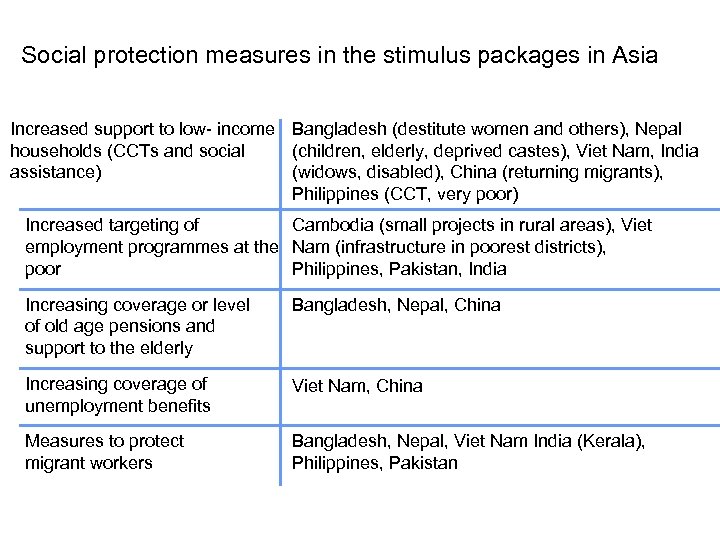 Social protection measures in the stimulus packages in Asia Increased support to low- income Bangladesh (destitute women and others), Nepal households (CCTs and social (children, elderly, deprived castes), Viet Nam, India assistance) (widows, disabled), China (returning migrants), Philippines (CCT, very poor) Increased targeting of Cambodia (small projects in rural areas), Viet employment programmes at the Nam (infrastructure in poorest districts), poor Philippines, Pakistan, India Increasing coverage or level of old age pensions and support to the elderly Bangladesh, Nepal, China Increasing coverage of unemployment benefits Viet Nam, China Measures to protect migrant workers Bangladesh, Nepal, Viet Nam India (Kerala), Philippines, Pakistan
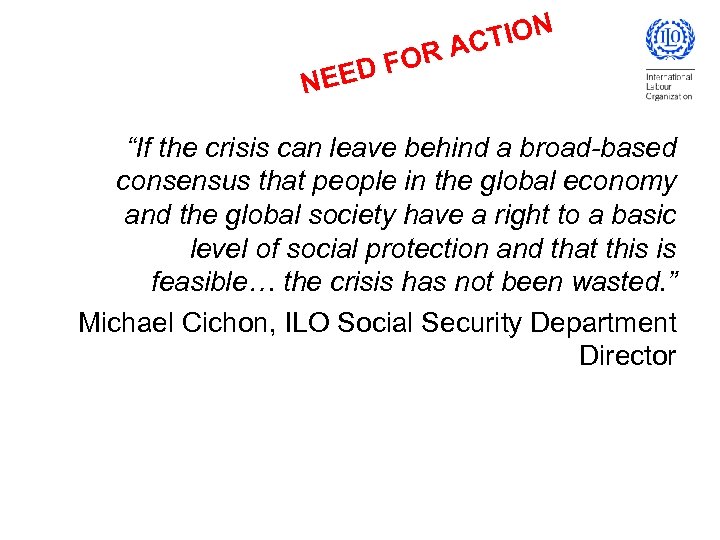 FOR ED TION AC NE “If the crisis can leave behind a broad-based consensus that people in the global economy and the global society have a right to a basic level of social protection and that this is feasible… the crisis has not been wasted. ” Michael Cichon, ILO Social Security Department Director
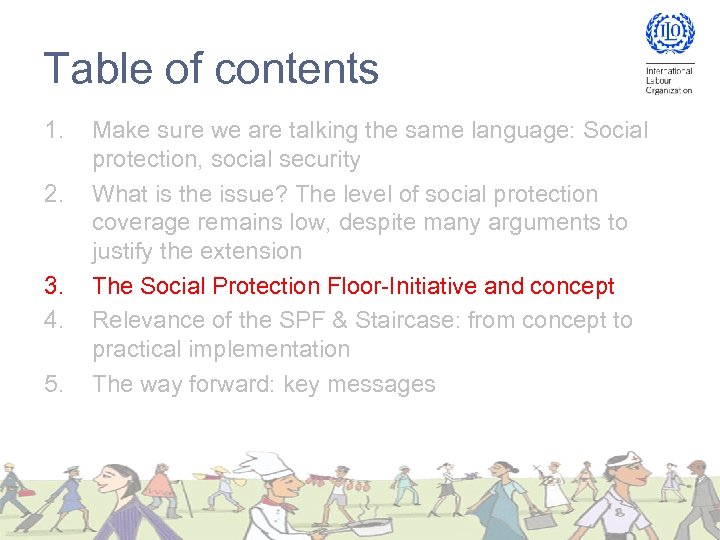 Table of contents 1. 2. 3. 4. 5. Make sure we are talking the same language: Social protection, social security What is the issue? The level of social protection coverage remains low, despite many arguments to justify the extension The Social Protection Floor-Initiative and concept Relevance of the SPF & Staircase: from concept to practical implementation The way forward: key messages
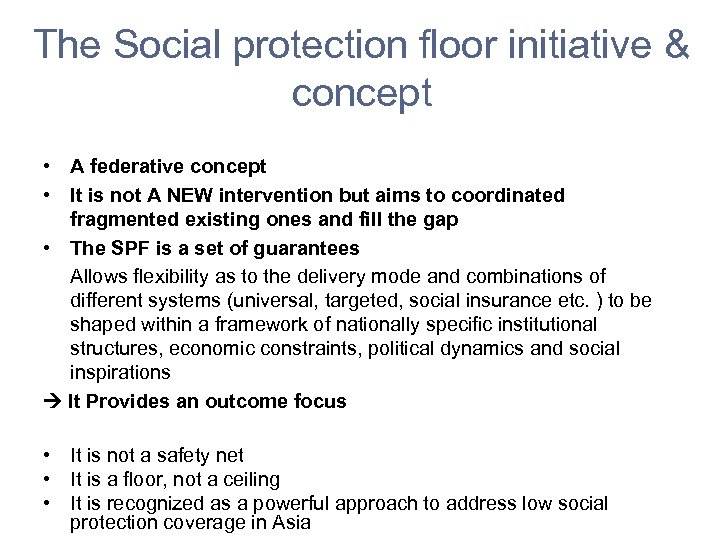 The Social protection floor initiative & concept • A federative concept • It is not A NEW intervention but aims to coordinated fragmented existing ones and fill the gap • The SPF is a set of guarantees Allows flexibility as to the delivery mode and combinations of different systems (universal, targeted, social insurance etc. ) to be shaped within a framework of nationally specific institutional structures, economic constraints, political dynamics and social inspirations It Provides an outcome focus • It is not a safety net • It is a floor, not a ceiling • It is recognized as a powerful approach to address low social protection coverage in Asia
 The Social Protection Floor Initiative (SPF-I) • The concept emerged in the midst of the crisis and initiatives were developed to confront it: On April 2009, the UN Chief Executives Board (CEB) have agreed on nine joint initiatives to confront the crisis, accelerate recovery and pave the way for a fairer and more sustainable globalization A window opportunity open: a consensus was reached that people in the global economy and society have a right to basic level of social protection and that it is a feasible option. Response the global financial crisis developmental instrument
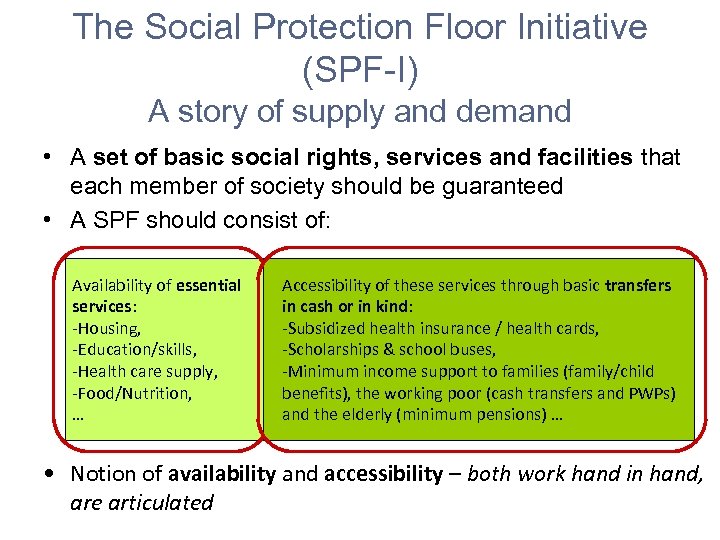 The Social Protection Floor Initiative (SPF-I) A story of supply and demand • A set of basic social rights, services and facilities that each member of society should be guaranteed • A SPF should consist of: Availability of essential services: -Housing, -Education/skills, -Health care supply, -Food/Nutrition, … Accessibility of these services through basic transfers in cash or in kind: -Subsidized health insurance / health cards, -Scholarships & school buses, -Minimum income support to families (family/child benefits), the working poor (cash transfers and PWPs) and the elderly (minimum pensions) … • Notion of availability and accessibility – both work hand in hand, are articulated
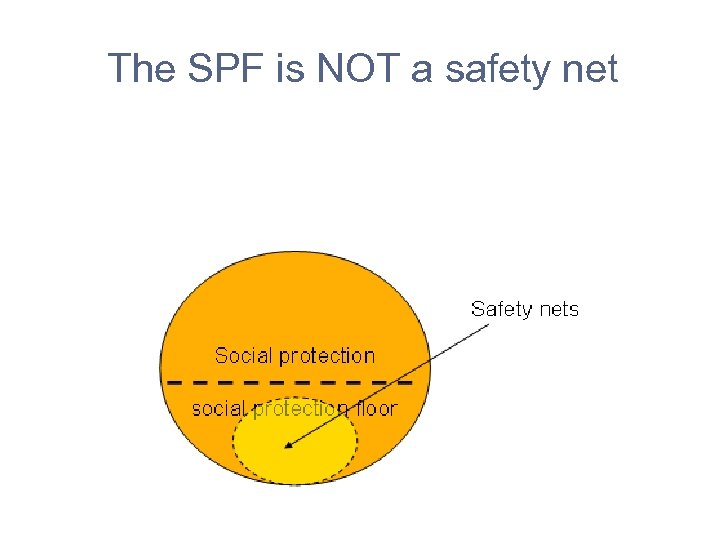 The SPF is NOT a safety net
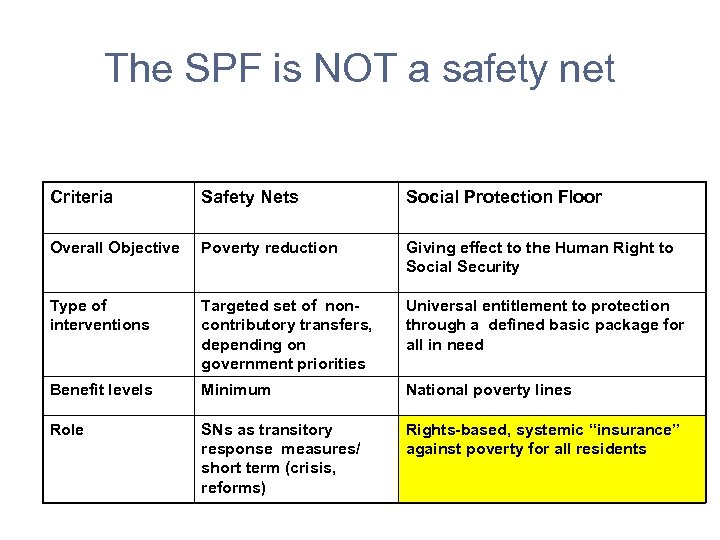 The SPF is NOT a safety net Criteria Safety Nets Social Protection Floor Overall Objective Poverty reduction Giving effect to the Human Right to Social Security Type of interventions Targeted set of noncontributory transfers, depending on government priorities Universal entitlement to protection through a defined basic package for all in need Benefit levels Minimum National poverty lines Role SNs as transitory response measures/ short term (crisis, reforms) Rights-based, systemic “insurance” against poverty for all residents
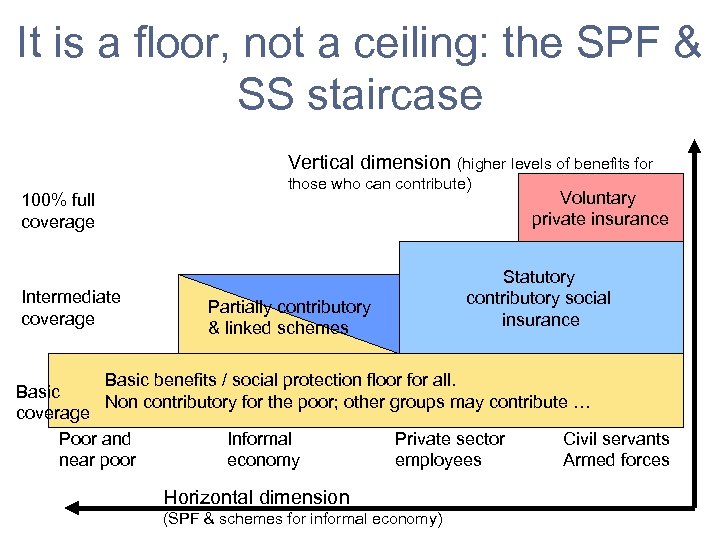 It is a floor, not a ceiling: the SPF & SS staircase Vertical dimension (higher levels of benefits for 100% full coverage Intermediate coverage those who can contribute) Partially contributory & linked schemes Voluntary private insurance Statutory contributory social insurance Basic benefits / social protection floor for all. Basic Non contributory for the poor; other groups may contribute … coverage Poor and Informal Private sector Civil servants near poor economy employees Armed forces Horizontal dimension (SPF & schemes for informal economy)
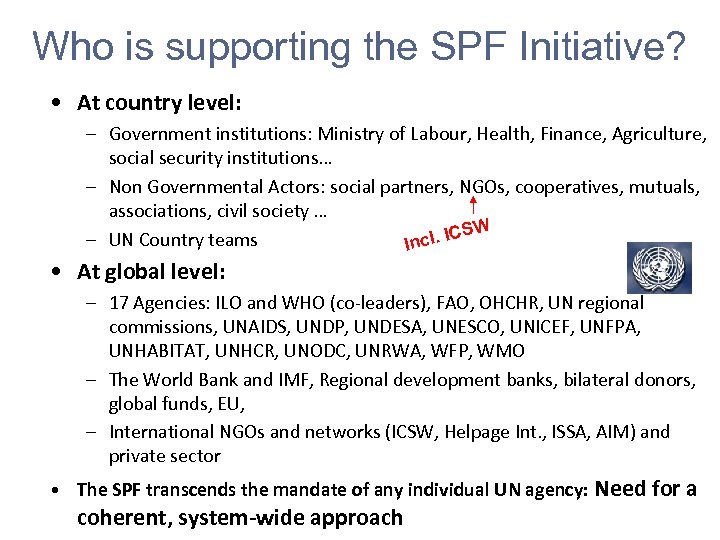 Who is supporting the SPF Initiative? • At country level: – Government institutions: Ministry of Labour, Health, Finance, Agriculture, social security institutions… – Non Governmental Actors: social partners, NGOs, cooperatives, mutuals, associations, civil society … SW – UN Country teams cl. IC In • At global level: – 17 Agencies: ILO and WHO (co-leaders), FAO, OHCHR, UN regional commissions, UNAIDS, UNDP, UNDESA, UNESCO, UNICEF, UNFPA, UNHABITAT, UNHCR, UNODC, UNRWA, WFP, WMO – The World Bank and IMF, Regional development banks, bilateral donors, global funds, EU, – International NGOs and networks (ICSW, Helpage Int. , ISSA, AIM) and private sector • The SPF transcends the mandate of any individual UN agency: Need for a coherent, system-wide approach
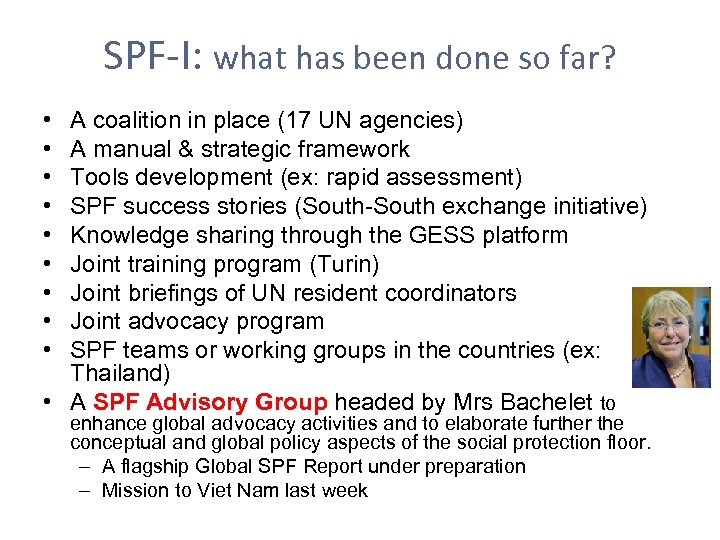 SPF-I: what has been done so far? • • • A coalition in place (17 UN agencies) A manual & strategic framework Tools development (ex: rapid assessment) SPF success stories (South-South exchange initiative) Knowledge sharing through the GESS platform Joint training program (Turin) Joint briefings of UN resident coordinators Joint advocacy program SPF teams or working groups in the countries (ex: Thailand) • A SPF Advisory Group headed by Mrs Bachelet to enhance global advocacy activities and to elaborate further the conceptual and global policy aspects of the social protection floor. – A flagship Global SPF Report under preparation – Mission to Viet Nam last week
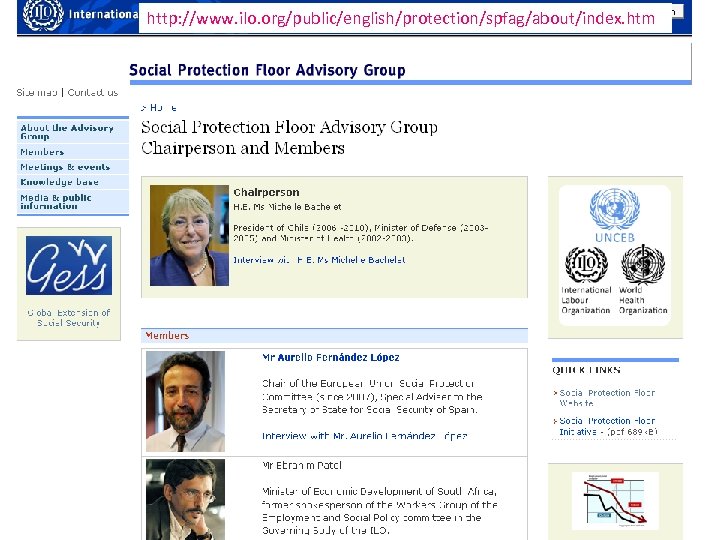 http: //www. ilo. org/public/english/protection/spfag/about/index. htm
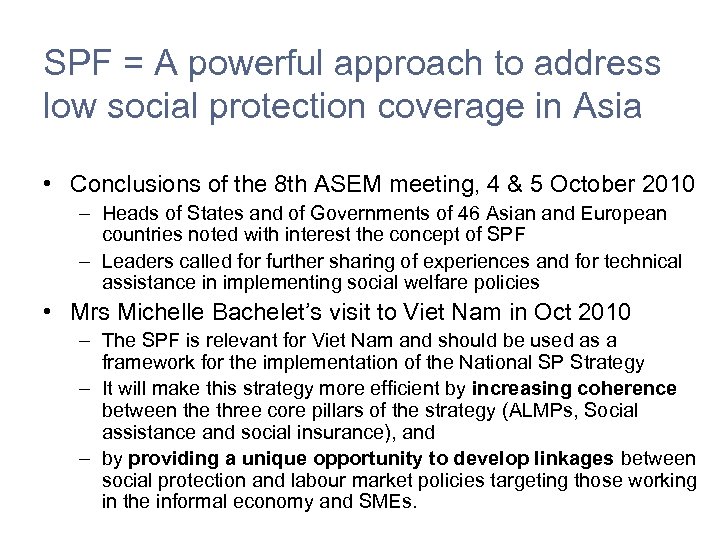 SPF = A powerful approach to address low social protection coverage in Asia • Conclusions of the 8 th ASEM meeting, 4 & 5 October 2010 – Heads of States and of Governments of 46 Asian and European countries noted with interest the concept of SPF – Leaders called for further sharing of experiences and for technical assistance in implementing social welfare policies • Mrs Michelle Bachelet’s visit to Viet Nam in Oct 2010 – The SPF is relevant for Viet Nam and should be used as a framework for the implementation of the National SP Strategy – It will make this strategy more efficient by increasing coherence between the three core pillars of the strategy (ALMPs, Social assistance and social insurance), and – by providing a unique opportunity to develop linkages between social protection and labour market policies targeting those working in the informal economy and SMEs.
 Table of contents 1. 2. 3. 4. 5. Make sure we are talking the same language: Social protection, social security and social transfers What is the issue? The level of social protection coverage remains low, despite many arguments to justify the extension The Social Protection Floor Initiative (SPF-I) Relevance of the SPF & Staircase: From concept to practical implementation key messages
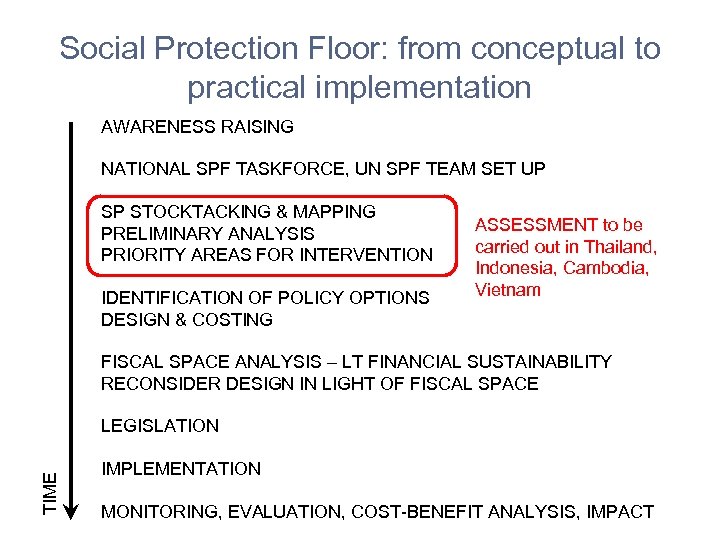 Social Protection Floor: from conceptual to practical implementation AWARENESS RAISING NATIONAL SPF TASKFORCE, UN SPF TEAM SET UP SP STOCKTACKING & MAPPING PRELIMINARY ANALYSIS PRIORITY AREAS FOR INTERVENTION IDENTIFICATION OF POLICY OPTIONS DESIGN & COSTING ASSESSMENT to be carried out in Thailand, Indonesia, Cambodia, Vietnam FISCAL SPACE ANALYSIS – LT FINANCIAL SUSTAINABILITY RECONSIDER DESIGN IN LIGHT OF FISCAL SPACE TIME LEGISLATION IMPLEMENTATION MONITORING, EVALUATION, COST-BENEFIT ANALYSIS, IMPACT
 Have we talked about the Social Protection Floor Initiative in your country?
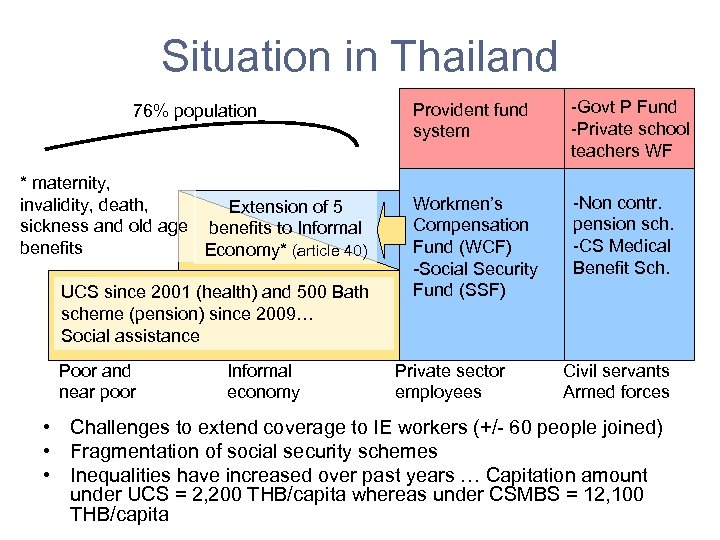 Situation in Thailand 76% population * maternity, invalidity, death, Extension of 5 sickness and old age benefits to Informal benefits Economy* (article 40) UCS since 2001 (health) and 500 Bath scheme (pension) since 2009… Social assistance Poor and near poor Informal economy Provident fund system -Govt P Fund -Private school teachers WF Workmen’s Compensation Fund (WCF) -Social Security Fund (SSF) -Non contr. pension sch. -CS Medical Benefit Sch. Private sector employees Civil servants Armed forces • Challenges to extend coverage to IE workers (+/- 60 people joined) • Fragmentation of social security schemes • Inequalities have increased over past years … Capitation amount under UCS = 2, 200 THB/capita whereas under CSMBS = 12, 100 THB/capita
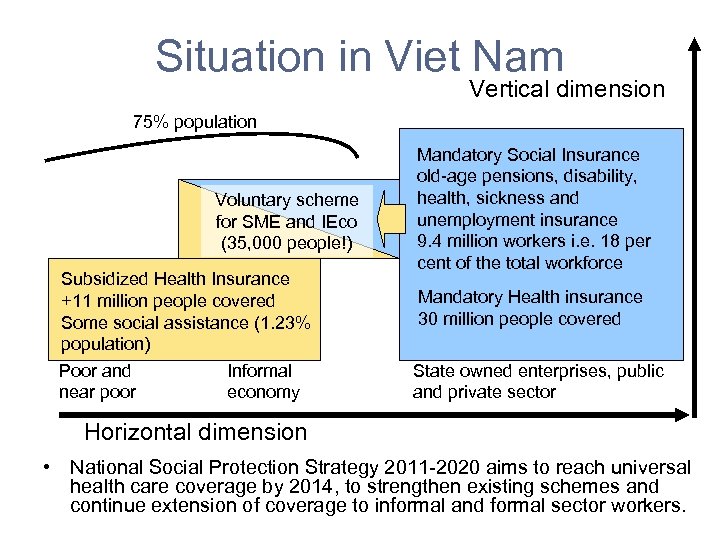 Situation in Viet Nam Vertical dimension 75% population Voluntary scheme for SME and IEco (35, 000 people!) Subsidized Health Insurance +11 million people covered Some social assistance (1. 23% population) Poor and Informal near poor economy Mandatory Social Insurance old-age pensions, disability, health, sickness and unemployment insurance 9. 4 million workers i. e. 18 per cent of the total workforce Mandatory Health insurance 30 million people covered State owned enterprises, public and private sector Horizontal dimension • National Social Protection Strategy 2011 -2020 aims to reach universal health care coverage by 2014, to strengthen existing schemes and continue extension of coverage to informal and formal sector workers.
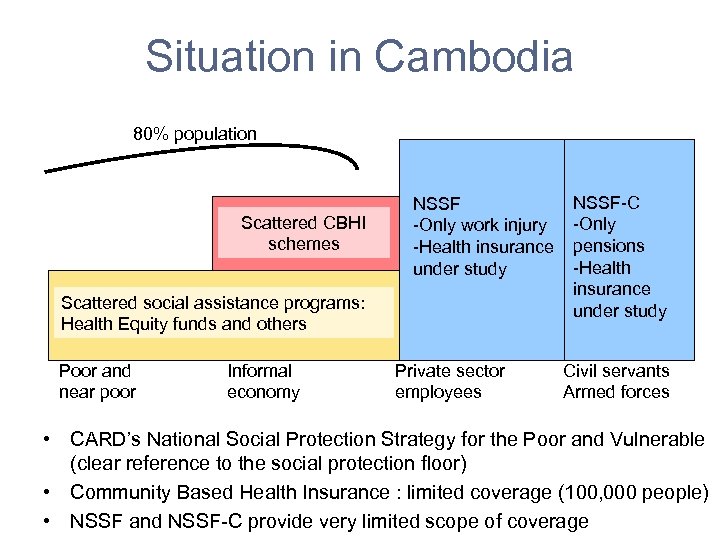 Situation in Cambodia 80% population Scattered CBHI schemes NSSF -Only work injury -Health insurance under study Scattered social assistance programs: Health Equity funds and others Poor and near poor Informal economy Private sector employees NSSF-C -Only pensions -Health insurance under study Civil servants Armed forces • CARD’s National Social Protection Strategy for the Poor and Vulnerable (clear reference to the social protection floor) • Community Based Health Insurance : limited coverage (100, 000 people) • NSSF and NSSF-C provide very limited scope of coverage
 Table of contents 1. 2. 3. 4. 5. Make sure we are talking the same language: Social protection, social security and social transfers What is the issue? The level of social protection coverage remains low, despite many arguments to justify the extension The Social Protection Floor Initiative (SPF-I) Relevance of the SPF & Staircase key messages
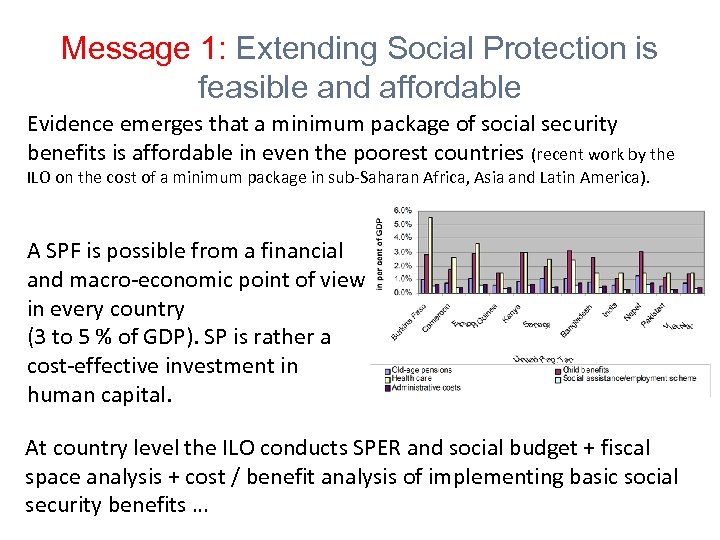 Message 1: Extending Social Protection is feasible and affordable Evidence emerges that a minimum package of social security benefits is affordable in even the poorest countries (recent work by the ILO on the cost of a minimum package in sub-Saharan Africa, Asia and Latin America). A SPF is possible from a financial and macro-economic point of view in every country (3 to 5 % of GDP). SP is rather a cost-effective investment in human capital. At country level the ILO conducts SPER and social budget + fiscal space analysis + cost / benefit analysis of implementing basic social security benefits …
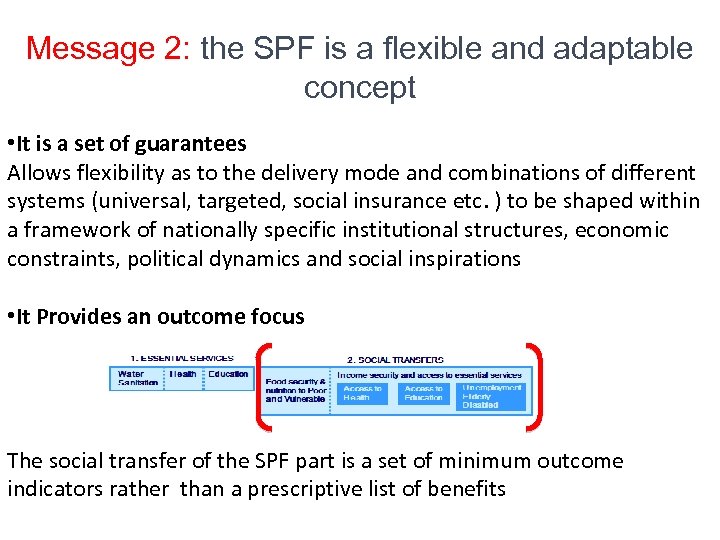 Message 2: the SPF is a flexible and adaptable concept • It is a set of guarantees Allows flexibility as to the delivery mode and combinations of different systems (universal, targeted, social insurance etc. ) to be shaped within a framework of nationally specific institutional structures, economic constraints, political dynamics and social inspirations • It Provides an outcome focus The social transfer of the SPF part is a set of minimum outcome indicators rather than a prescriptive list of benefits
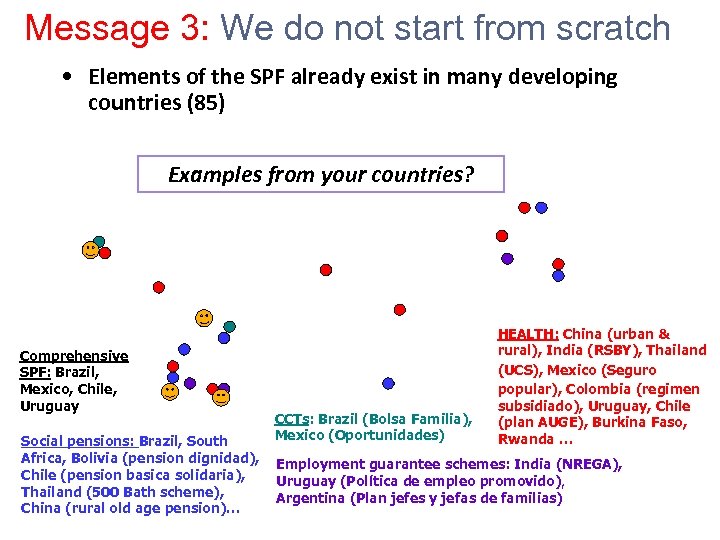 Message 3: We do not start from scratch • Elements of the SPF already exist in many developing countries (85) Examples from your countries? Comprehensive SPF: Brazil, Mexico, Chile, Uruguay Social pensions: Brazil, South Africa, Bolivia (pension dignidad), Chile (pension basica solidaria), Thailand (500 Bath scheme), China (rural old age pension)… CCTs: Brazil (Bolsa Familia), Mexico (Oportunidades) HEALTH: China (urban & rural), India (RSBY), Thailand (UCS), Mexico (Seguro popular), Colombia (regimen subsidiado), Uruguay, Chile (plan AUGE), Burkina Faso, Rwanda … Employment guarantee schemes: India (NREGA), Uruguay (Política de empleo promovido), Argentina (Plan jefes y jefas de familias)
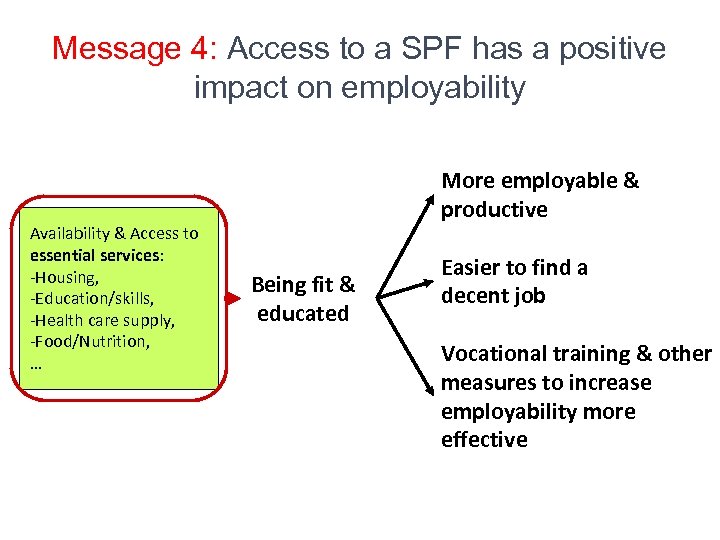 Message 4: Access to a SPF has a positive impact on employability Availability & Access to essential services: -Housing, -Education/skills, -Health care supply, -Food/Nutrition, … More employable & productive Being fit & educated Easier to find a decent job Vocational training & other measures to increase employability more effective
 Message 5: Access to a SPF should facilitate beneficiaries in WA’s return to employment • The SPF is based on solidarity principles since basic levels of benefits and services are to be provided by society as a whole to those who, most in need, will use them. • The SPF programs are meant to be at all times available but they should be designed in such a way that their beneficiaries in working age progressively graduate (access to higher levels of benefits and sustainable employment) • Therefore, it is not a “hand-out”. By linking SPF with active labour market policies targeting vulnerable groups, informal economy workers and the self-employed, it facilitates return to employment.
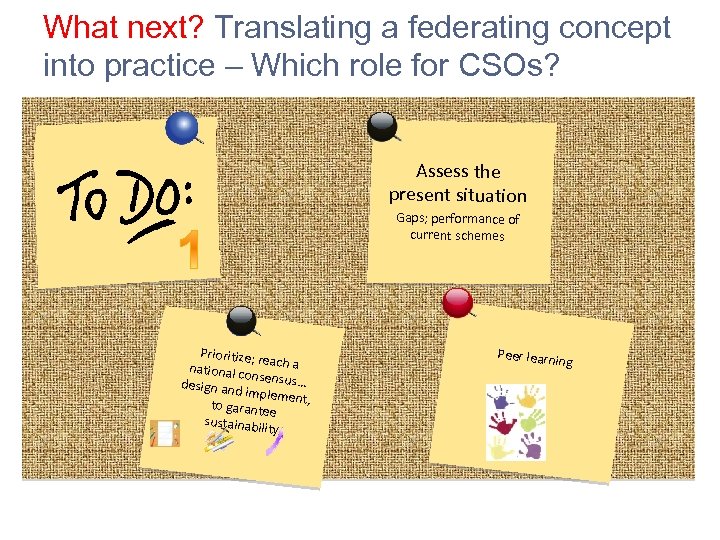 What next? Translating a federating concept into practice – Which role for CSOs? Assess the present situation Gaps; performance of current schemes Prioritize; reach a national co nsensus… design and implement , to garante e sustainabil ity Peer learn ing
 http: //www. socialsecurityextension. org Thank you! felix@ilo. org