


 Скачать презентацию The smartphone market in India Research Viewpoint The
298a74416fc642ac492cbb17c7ca5ad7.ppt
- Количество слайдов: 11
 The smartphone market in India Research Viewpoint The smartphone market in India December 2011 Sourabh Kaushal © Analysys Mason Limited 2011
 The smartphone market in India 2 Executive summary § The number of smartphones sold in India has steadily increased to account for 5. 6% of total handset sales in 2 Q 2011 from about 2. 1% in 1 Q 2010. This increase is a result of users’ growing dependence on the mobile Internet for information, entertainment and utility services, and the reduced cost of devices. - End users are migrating to smartphones for the enhanced experience of social networking, apps and other data-intensive value-added services. - The average selling price of smartphones has declined to about USD 220 in 2 Q 2011 from about USD 360 in 4 Q 2009. § The level of penetration of smartphones in India is less than 5%, which is low compared with other countries where penetration has exceeded 15%, indicating significant potential for growth in this segment § We expect three main factors to drive the growth of the number of smartphones in India: - The increasing penetration of 3 G services is leading consumers to upgrade from feature phones to smartphones - The launch of Android-based smartphones at affordable prices, especially by Indian vendors such as Micromax, is bringing the smartphone segment within reach of the lower middle and middle income segment of the Indian population - The increasing use of m. VAS for entertainment, business and utility services will lead to a demand for a better user experience. § These factors are expected to drive the number of smartphones to about 70 million by 2014, accounting for about 20% of the total handset sales in India. © Analysys Mason Limited 2011
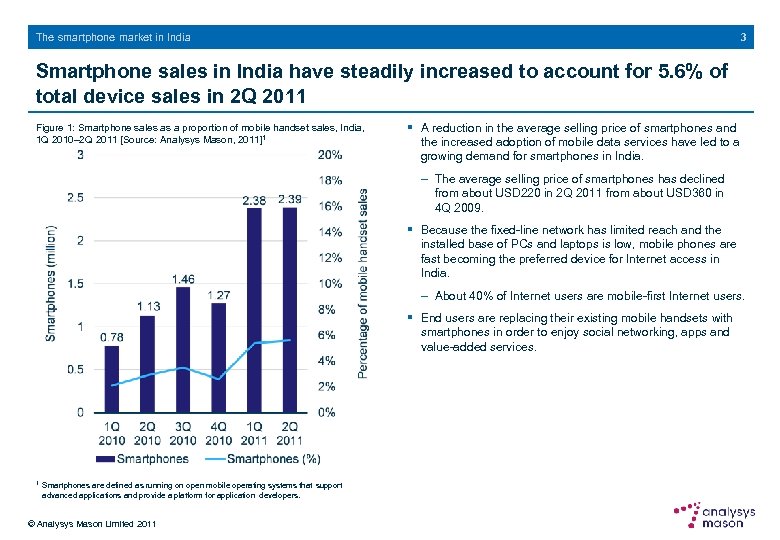 3 The smartphone market in India Smartphone sales in India have steadily increased to account for 5. 6% of total device sales in 2 Q 2011 Figure 1: Smartphone sales as a proportion of mobile handset sales, India, 1 Q 2010– 2 Q 2011 [Source: Analysys Mason, 2011]1 § A reduction in the average selling price of smartphones and the increased adoption of mobile data services have led to a growing demand for smartphones in India. - The average selling price of smartphones has declined from about USD 220 in 2 Q 2011 from about USD 360 in 4 Q 2009. § Because the fixed-line network has limited reach and the installed base of PCs and laptops is low, mobile phones are fast becoming the preferred device for Internet access in India. - About 40% of Internet users are mobile-first Internet users. § End users are replacing their existing mobile handsets with smartphones in order to enjoy social networking, apps and value-added services. 1 Smartphones are defined as running on open mobile operating systems that support advanced applications and provide a platform for application developers. © Analysys Mason Limited 2011
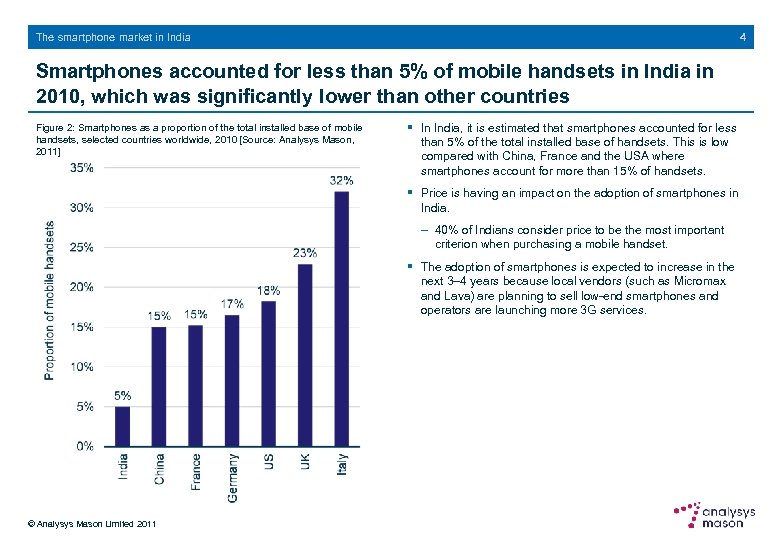 4 The smartphone market in India Smartphones accounted for less than 5% of mobile handsets in India in 2010, which was significantly lower than other countries Figure 2: Smartphones as a proportion of the total installed base of mobile handsets, selected countries worldwide, 2010 [Source: Analysys Mason, 2011] § In India, it is estimated that smartphones accounted for less than 5% of the total installed base of handsets. This is low compared with China, France and the USA where smartphones account for more than 15% of handsets. § Price is having an impact on the adoption of smartphones in India. - 40% of Indians consider price to be the most important criterion when purchasing a mobile handset. § The adoption of smartphones is expected to increase in the next 3– 4 years because local vendors (such as Micromax and Lava) are planning to sell low-end smartphones and operators are launching more 3 G services. © Analysys Mason Limited 2011
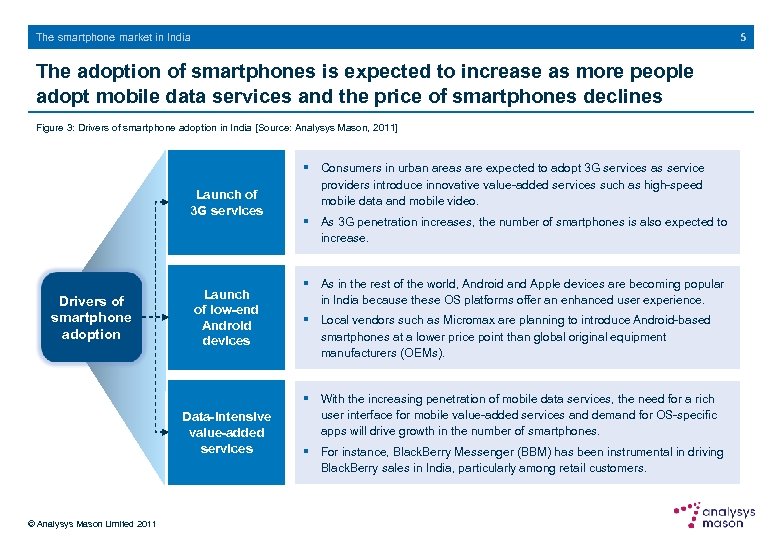 5 The smartphone market in India The adoption of smartphones is expected to increase as more people adopt mobile data services and the price of smartphones declines Figure 3: Drivers of smartphone adoption in India [Source: Analysys Mason, 2011] Launch of 3 G services Drivers of smartphone adoption Launch of low-end Android devices Data-intensive value-added services © Analysys Mason Limited 2011 § Consumers in urban areas are expected to adopt 3 G services as service providers introduce innovative value-added services such as high-speed mobile data and mobile video. § As 3 G penetration increases, the number of smartphones is also expected to increase. § As in the rest of the world, Android and Apple devices are becoming popular in India because these OS platforms offer an enhanced user experience. § Local vendors such as Micromax are planning to introduce Android-based smartphones at a lower price point than global original equipment manufacturers (OEMs). § With the increasing penetration of mobile data services, the need for a rich user interface for mobile value-added services and demand for OS-specific apps will drive growth in the number of smartphones. § For instance, Black. Berry Messenger (BBM) has been instrumental in driving Black. Berry sales in India, particularly among retail customers.
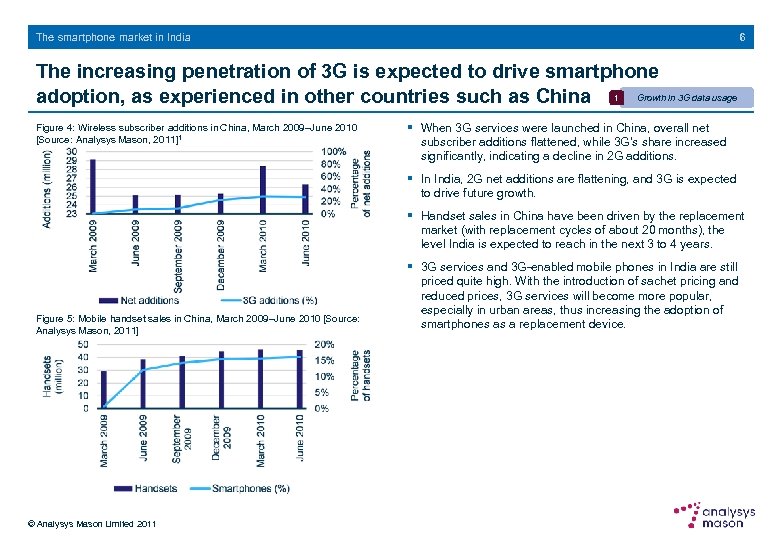 6 The smartphone market in India The increasing penetration of 3 G is expected to drive smartphone adoption, as experienced in other countries such as China 1 Growth in 3 G data usage Figure 4: Wireless subscriber additions in China, March 2009–June 2010 [Source: Analysys Mason, 2011]1 § When 3 G services were launched in China, overall net subscriber additions flattened, while 3 G’s share increased significantly, indicating a decline in 2 G additions. § In India, 2 G net additions are flattening, and 3 G is expected to drive future growth. § Handset sales in China have been driven by the replacement market (with replacement cycles of about 20 months), the level India is expected to reach in the next 3 to 4 years. Figure 5: Mobile handset sales in China, March 2009–June 2010 [Source: Analysys Mason, 2011] © Analysys Mason Limited 2011 § 3 G services and 3 G-enabled mobile phones in India are still priced quite high. With the introduction of sachet pricing and reduced prices, 3 G services will become more popular, especially in urban areas, thus increasing the adoption of smartphones as a replacement device.
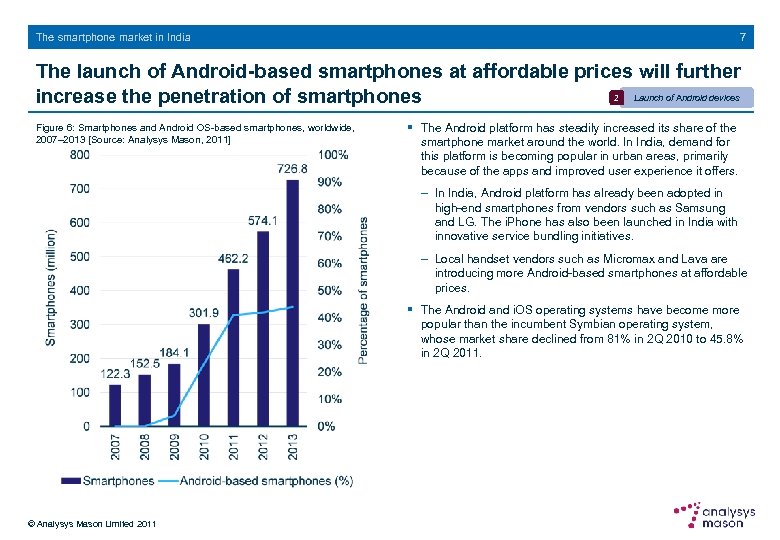 7 The smartphone market in India The launch of Android-based smartphones at affordable prices will further Launch of Android devices 2 increase the penetration of smartphones Figure 6: Smartphones and Android OS-based smartphones, worldwide, 2007– 2013 [Source: Analysys Mason, 2011] § The Android platform has steadily increased its share of the smartphone market around the world. In India, demand for this platform is becoming popular in urban areas, primarily because of the apps and improved user experience it offers. - In India, Android platform has already been adopted in high-end smartphones from vendors such as Samsung and LG. The i. Phone has also been launched in India with innovative service bundling initiatives. - Local handset vendors such as Micromax and Lava are introducing more Android-based smartphones at affordable prices. § The Android and i. OS operating systems have become more popular than the incumbent Symbian operating system, whose market share declined from 81% in 2 Q 2010 to 45. 8% in 2 Q 2011. © Analysys Mason Limited 2011
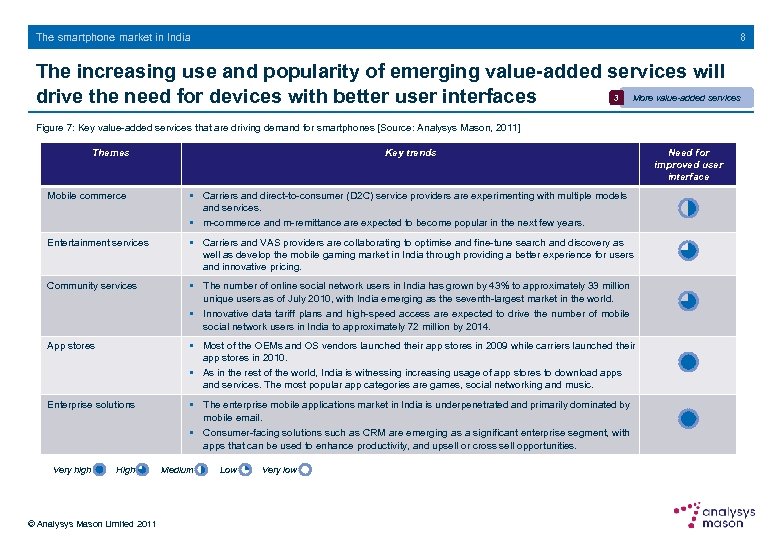 8 The smartphone market in India The increasing use and popularity of emerging value-added services will 3 More value-added services drive the need for devices with better user interfaces Figure 7: Key value-added services that are driving demand for smartphones [Source: Analysys Mason, 2011] Themes Key trends Mobile commerce § Carriers and direct-to-consumer (D 2 C) service providers are experimenting with multiple models and services. § m-commerce and m-remittance are expected to become popular in the next few years. Entertainment services § Carriers and VAS providers are collaborating to optimise and fine-tune search and discovery as well as develop the mobile gaming market in India through providing a better experience for users and innovative pricing. Community services § The number of online social network users in India has grown by 43% to approximately 33 million unique users as of July 2010, with India emerging as the seventh-largest market in the world. § Innovative data tariff plans and high-speed access are expected to drive the number of mobile social network users in India to approximately 72 million by 2014. App stores § Most of the OEMs and OS vendors launched their app stores in 2009 while carriers launched their app stores in 2010. § As in the rest of the world, India is witnessing increasing usage of app stores to download apps and services. The most popular app categories are games, social networking and music. Enterprise solutions § The enterprise mobile applications market in India is underpenetrated and primarily dominated by mobile email. § Consumer-facing solutions such as CRM are emerging as a significant enterprise segment, with apps that can be used to enhance productivity, and upsell or cross sell opportunities. Very high High © Analysys Mason Limited 2011 Medium Low Very low Need for improved user interface
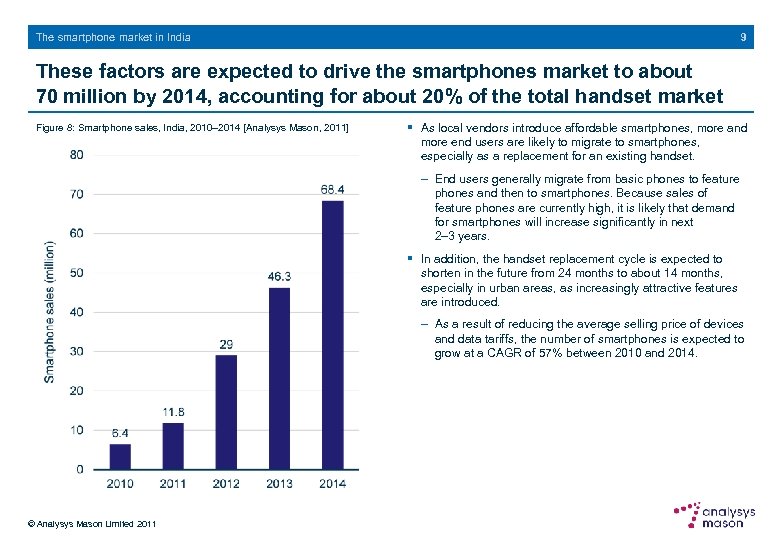 9 The smartphone market in India These factors are expected to drive the smartphones market to about 70 million by 2014, accounting for about 20% of the total handset market Figure 8: Smartphone sales, India, 2010– 2014 [Analysys Mason, 2011] § As local vendors introduce affordable smartphones, more and more end users are likely to migrate to smartphones, especially as a replacement for an existing handset. - End users generally migrate from basic phones to feature phones and then to smartphones. Because sales of feature phones are currently high, it is likely that demand for smartphones will increase significantly in next 2– 3 years. § In addition, the handset replacement cycle is expected to shorten in the future from 24 months to about 14 months, especially in urban areas, as increasingly attractive features are introduced. - As a result of reducing the average selling price of devices and data tariffs, the number of smartphones is expected to grow at a CAGR of 57% between 2010 and 2014. © Analysys Mason Limited 2011
 The smartphone market in India 10 About the author Sourabh Kaushal (Lead Consultant) Sourabh has more than eleven years of consulting experience in market, financial and quantitative analysis in the information and communication technology space. He has worked on numerous telecoms and technology assignments with a major focus on telecoms services, such as the evaluation of addressable enterprise markets, analysis of broadband services opportunities and expected business return scenarios for major operators in South Asia. Sourabh has led multiple studies on enterprise telecoms services (data, voice and managed services) and go-to-market strategies for leading operators in India and Sri Lanka. He has also led a total cost of ownership whitepaper project for proprietary and open source operating systems for a global IT giant. Sourabh has an MBA in Marketing from the University of Mumbai and a BSc from the University of Allahabad. Published by Analysys Mason Limited • Bush House • North West Wing • Aldwych • London • WC 2 B 4 PJ • UK Tel: +44 (0)845 600 5244 • Fax: +44 (0)845 528 0760 • Email: research@analysysmason. com • www. analysysmason. com/research • Registered in England No. 5177472 © Analysys Mason Limited 2011. All rights reserved. No part of this publication may be reproduced, stored in a retrieval system or transmitted in any form or by any means – electronic, mechanical, photocopying, recording or otherwise – without the prior written permission of the publisher. Figures and projections contained in this report are based on publicly available information only and are produced by the Research Division of Analysys Mason Limited independently of any clientspecific work within Analysys Mason Limited. The opinions expressed are those of the stated authors only. Analysys Mason Limited recognises that many terms appearing in this report are proprietary; all such trademarks are acknowledged and every effort has been made to indicate them by the normal UK publishing practice of capitalisation. However, the presence of a term, in whatever form, does not affect its legal status as a trademark. Analysys Mason Limited maintains that all reasonable care and skill have been used in the compilation of this publication. However, Analysys Mason Limited shall not be under any liability for loss or damage (including consequential loss) whatsoever or howsoever arising as a result of the use of this publication by the customer, his servants, agents or any third party. © Analysys Mason Limited 2011
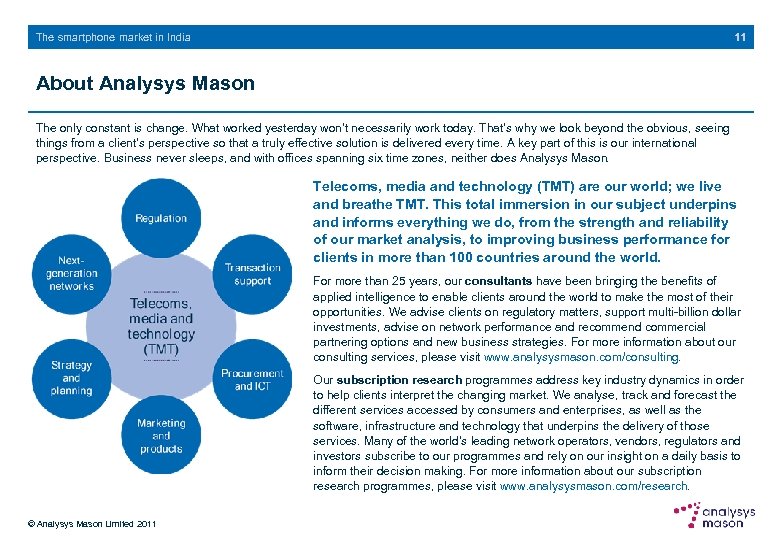 11 The smartphone market in India About Analysys Mason The only constant is change. What worked yesterday won’t necessarily work today. That’s why we look beyond the obvious, seeing things from a client’s perspective so that a truly effective solution is delivered every time. A key part of this is our international perspective. Business never sleeps, and with offices spanning six time zones, neither does Analysys Mason. Telecoms, media and technology (TMT) are our world; we live and breathe TMT. This total immersion in our subject underpins and informs everything we do, from the strength and reliability of our market analysis, to improving business performance for clients in more than 100 countries around the world. For more than 25 years, our consultants have been bringing the benefits of applied intelligence to enable clients around the world to make the most of their opportunities. We advise clients on regulatory matters, support multi-billion dollar investments, advise on network performance and recommend commercial partnering options and new business strategies. For more information about our consulting services, please visit www. analysysmason. com/consulting. Our subscription research programmes address key industry dynamics in order to help clients interpret the changing market. We analyse, track and forecast the different services accessed by consumers and enterprises, as well as the software, infrastructure and technology that underpins the delivery of those services. Many of the world’s leading network operators, vendors, regulators and investors subscribe to our programmes and rely on our insight on a daily basis to inform their decision making. For more information about our subscription research programmes, please visit www. analysysmason. com/research. © Analysys Mason Limited 2011