 Скачать презентацию The Situation Calculus and the Frame Problem Using
7acfdbccbc52ed9913c2c75c9868887b.ppt
- Количество слайдов: 52



The Situation Calculus and the Frame Problem Using Theorem Proving to Generate Plans The Situation Calculus and the Frame Problem
Literature l l l Malik Ghallab, Dana Nau, and Paolo Traverso. Automated Planning – Theory and Practice, section 12. 2. Elsevier/Morgan Kaufmann, 2004. Murray Shanahan. Solving the Frame Problem, chapter 1. The MIT Press, 1997. Chin-Liang Chang and Richard Char-Tung Lee. Symbolic Logic and Mechanical Theorem Proving, chapters 2 and 3. Academic Press, 1973. The Situation Calculus and the Frame Problem 2
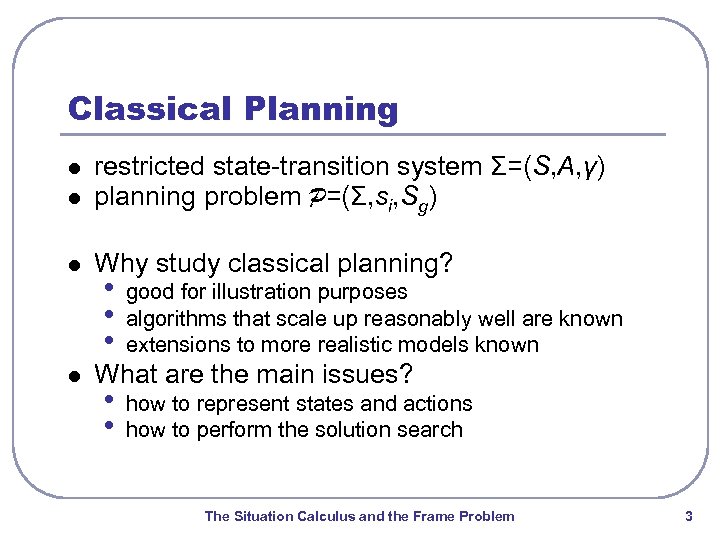
Classical Planning l restricted state-transition system Σ=(S, A, γ) planning problem P=(Σ, si, Sg) l Why study classical planning? l l • • • good for illustration purposes algorithms that scale up reasonably well are known extensions to more realistic models known • • how to represent states and actions how to perform the solution search What are the main issues? The Situation Calculus and the Frame Problem 3
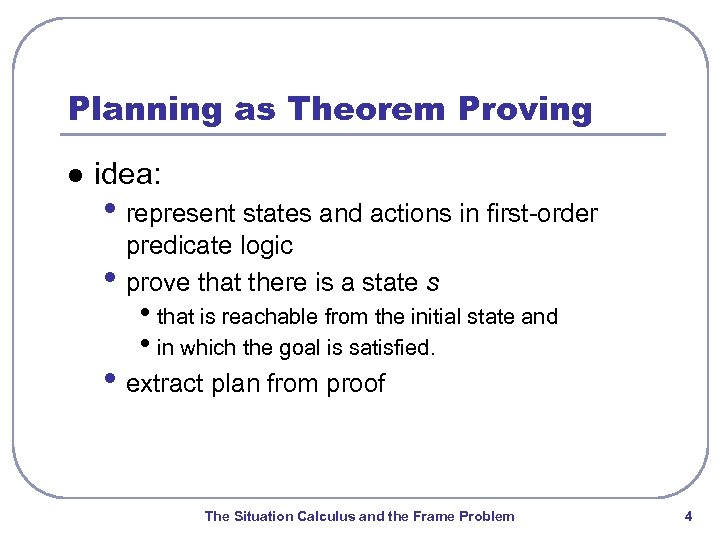
Planning as Theorem Proving l idea: • represent states and actions in first-order • predicate logic prove that there is a state s • that is reachable from the initial state and • in which the goal is satisfied. • extract plan from proof The Situation Calculus and the Frame Problem 4
Overview l l Propositional Logic First-Order Predicate Logic Representing Actions The Frame Problem Solving the Frame Problem The Situation Calculus and the Frame Problem 5
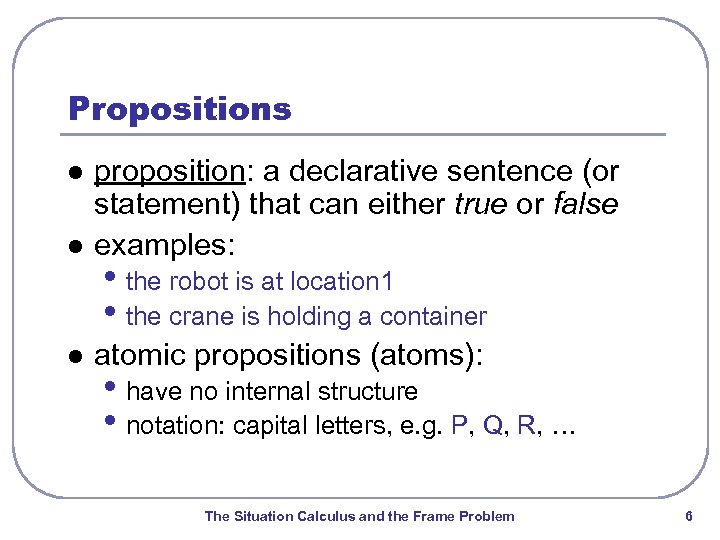
Propositions l proposition: a declarative sentence (or statement) that can either true or false examples: l atomic propositions (atoms): l • the robot is at location 1 • the crane is holding a container • have no internal structure • notation: capital letters, e. g. P, Q, R, … The Situation Calculus and the Frame Problem 6
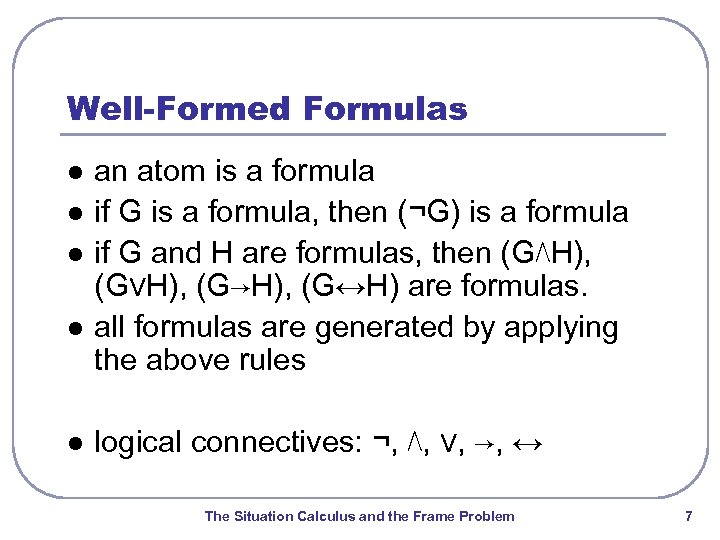
Well-Formed Formulas l l l an atom is a formula if G is a formula, then (¬G) is a formula if G and H are formulas, then (G⋀H), (G⋁H), (G→H), (G↔H) are formulas. all formulas are generated by applying the above rules logical connectives: ¬, ⋀, ⋁, →, ↔ The Situation Calculus and the Frame Problem 7
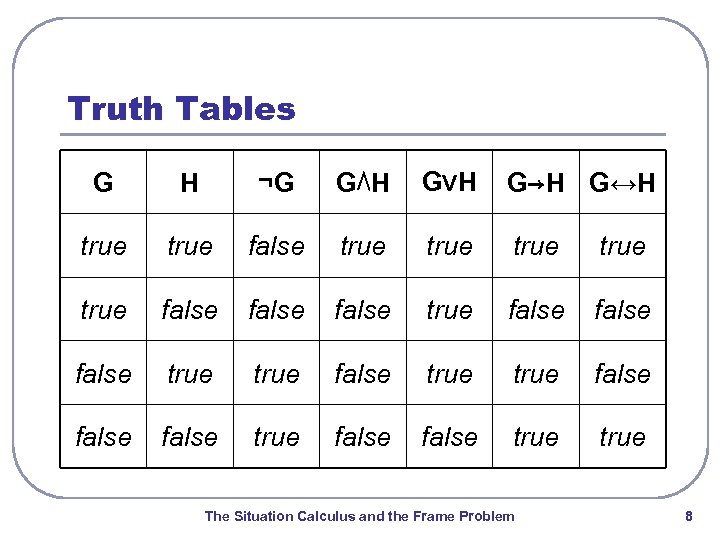
Truth Tables G H ¬G G⋀H G⋁H G→H G↔H true false true true false false false true true The Situation Calculus and the Frame Problem 8
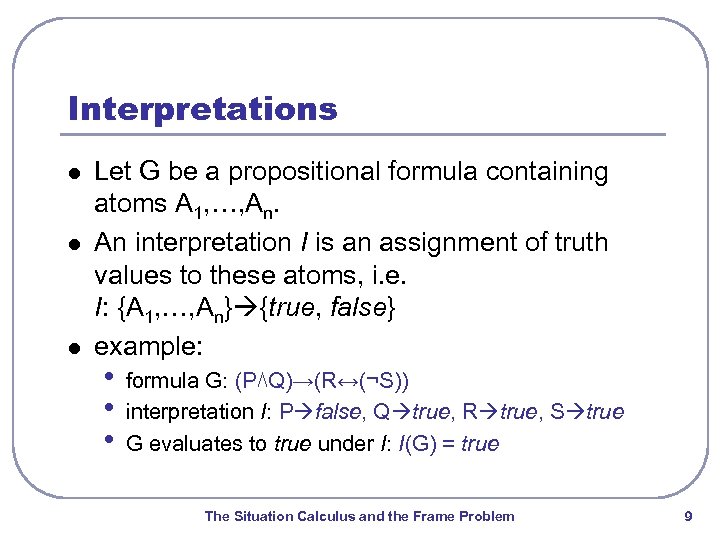
Interpretations l l l Let G be a propositional formula containing atoms A 1, …, An. An interpretation I is an assignment of truth values to these atoms, i. e. I: {A 1, …, An} {true, false} example: • • • formula G: (P⋀Q)→(R↔(¬S)) interpretation I: P false, Q true, R true, S true G evaluates to true under I: I(G) = true The Situation Calculus and the Frame Problem 9
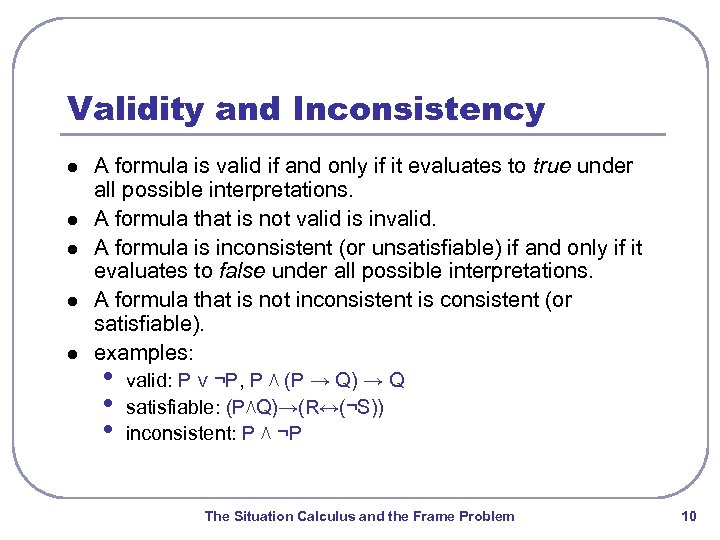
Validity and Inconsistency l l l A formula is valid if and only if it evaluates to true under all possible interpretations. A formula that is not valid is invalid. A formula is inconsistent (or unsatisfiable) if and only if it evaluates to false under all possible interpretations. A formula that is not inconsistent is consistent (or satisfiable). examples: • • • valid: P ⋁ ¬P, P ⋀ (P → Q) → Q satisfiable: (P⋀Q)→(R↔(¬S)) inconsistent: P ⋀ ¬P The Situation Calculus and the Frame Problem 10
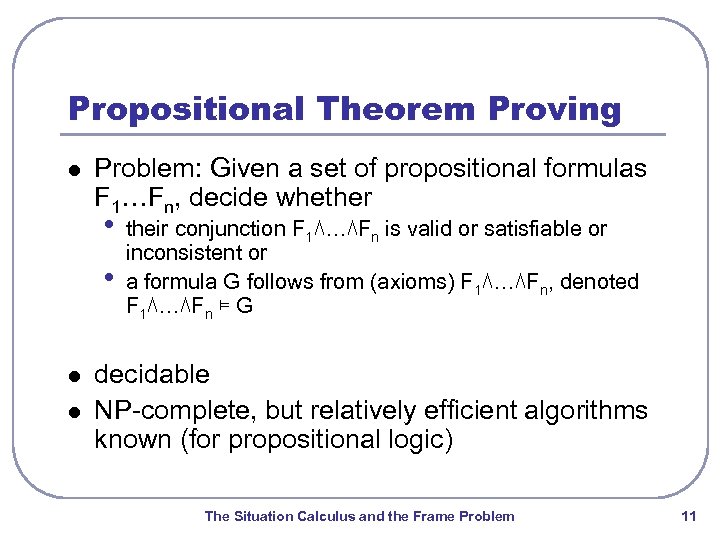
Propositional Theorem Proving l Problem: Given a set of propositional formulas F 1…Fn, decide whether • • l l their conjunction F 1⋀…⋀Fn is valid or satisfiable or inconsistent or a formula G follows from (axioms) F 1⋀…⋀Fn, denoted F 1⋀…⋀Fn ⊨ G decidable NP-complete, but relatively efficient algorithms known (for propositional logic) The Situation Calculus and the Frame Problem 11
Overview l l Propositional Logic First-Order Predicate Logic Representing Actions The Frame Problem Solving the Frame Problem The Situation Calculus and the Frame Problem 12
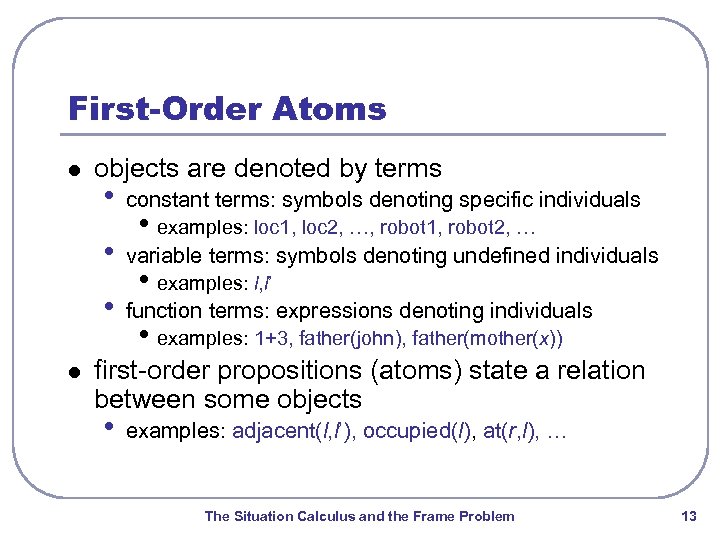
First-Order Atoms l objects are denoted by terms constant terms: symbols denoting specific individuals • variable terms: symbols denoting undefined individuals • l • function terms: expressions denoting individuals • examples: loc 1, loc 2, …, robot 1, robot 2, … • examples: l, l’ • examples: 1+3, father(john), father(mother(x)) first-order propositions (atoms) state a relation between some objects • examples: adjacent(l, l’), occupied(l), at(r, l), … The Situation Calculus and the Frame Problem 13
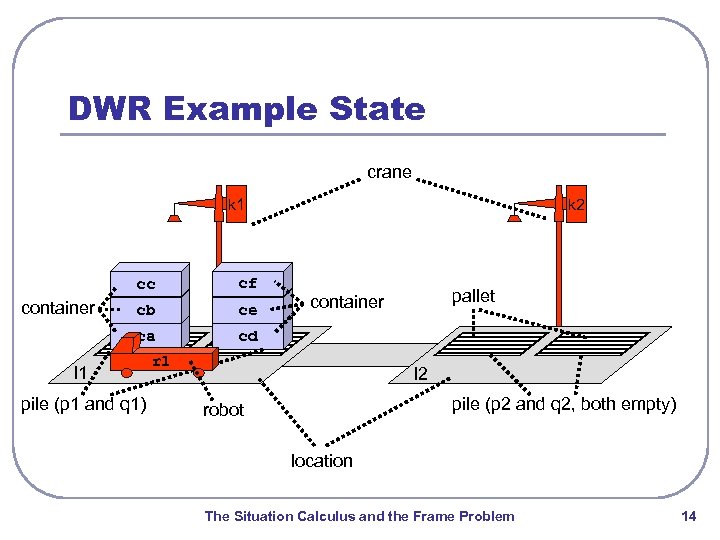
DWR Example State crane k 1 cc cb ce ca container cf k 2 cd l 1 pile (p 1 and q 1) pallet container r 1 l 2 pile (p 2 and q 2, both empty) robot location The Situation Calculus and the Frame Problem 14
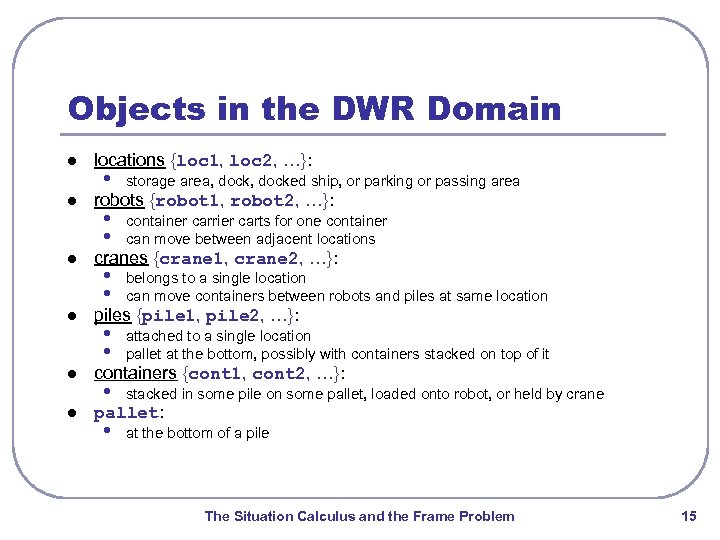
Objects in the DWR Domain l l l locations {loc 1, loc 2, …}: • storage area, docked ship, or parking or passing area • • container carrier carts for one container can move between adjacent locations • • belongs to a single location can move containers between robots and piles at same location • • attached to a single location pallet at the bottom, possibly with containers stacked on top of it • stacked in some pile on some pallet, loaded onto robot, or held by crane • at the bottom of a pile robots {robot 1, robot 2, …}: cranes {crane 1, crane 2, …}: piles {pile 1, pile 2, …}: containers {cont 1, cont 2, …}: pallet: The Situation Calculus and the Frame Problem 15
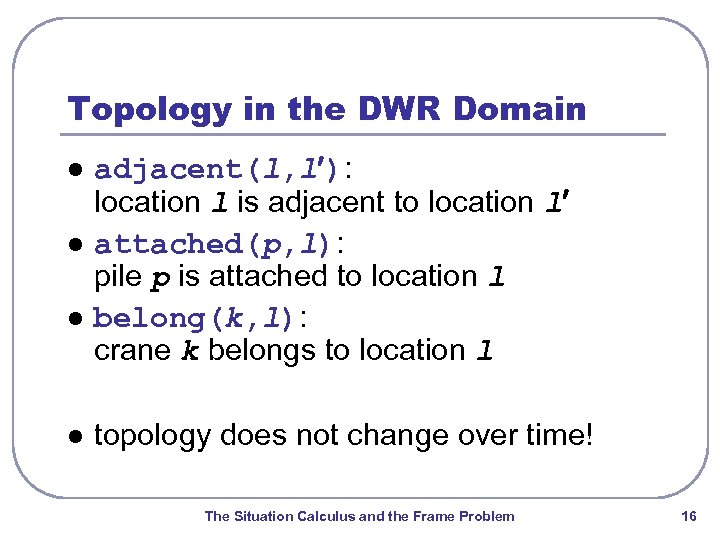
Topology in the DWR Domain l l adjacent(l, l ): location l is adjacent to location l attached(p, l): pile p is attached to location l belong(k, l): crane k belongs to location l topology does not change over time! The Situation Calculus and the Frame Problem 16
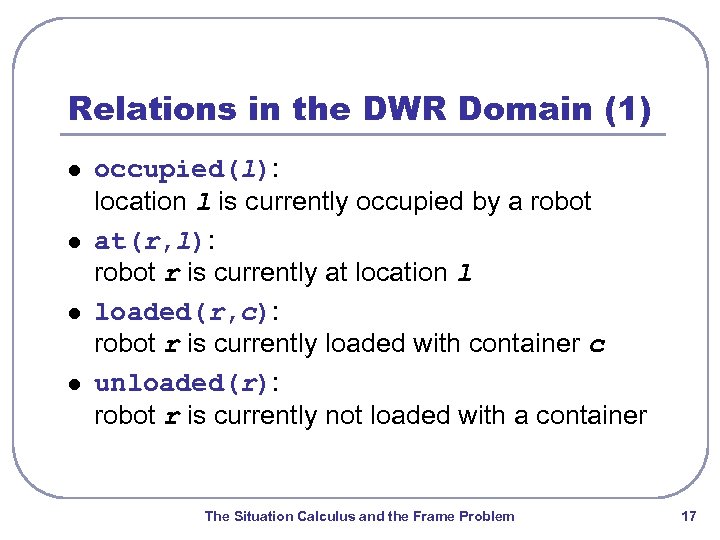
Relations in the DWR Domain (1) l l occupied(l): location l is currently occupied by a robot at(r, l): robot r is currently at location l loaded(r, c): robot r is currently loaded with container c unloaded(r): robot r is currently not loaded with a container The Situation Calculus and the Frame Problem 17
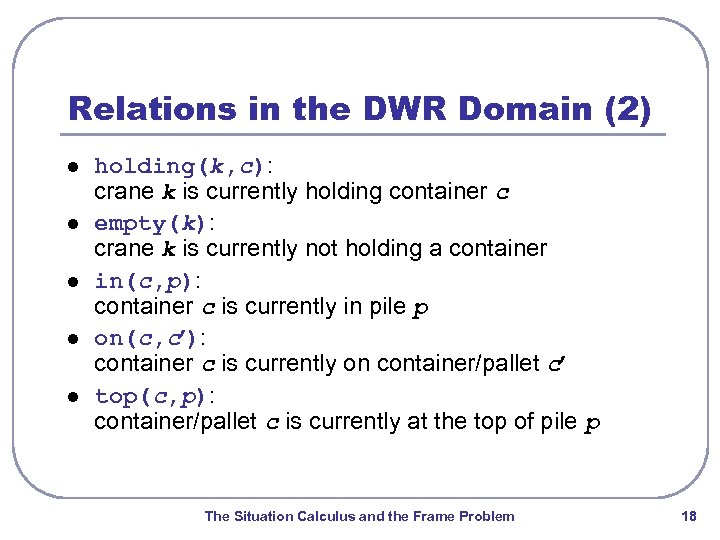
Relations in the DWR Domain (2) l l l holding(k, c): crane k is currently holding container c empty(k): crane k is currently not holding a container in(c, p): container c is currently in pile p on(c, c ): container c is currently on container/pallet c top(c, p): container/pallet c is currently at the top of pile p The Situation Calculus and the Frame Problem 18
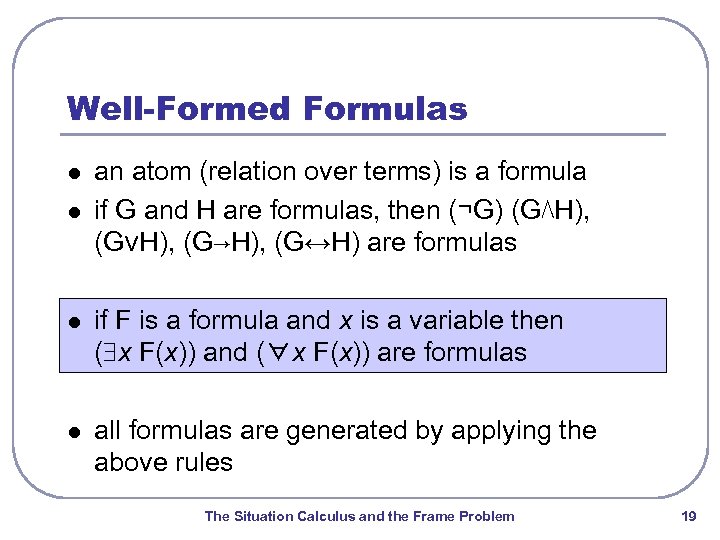
Well-Formed Formulas l l an atom (relation over terms) is a formula if G and H are formulas, then (¬G) (G⋀H), (G⋁H), (G→H), (G↔H) are formulas l if F is a formula and x is a variable then ( x F(x)) and (∀x F(x)) are formulas l all formulas are generated by applying the above rules The Situation Calculus and the Frame Problem 19
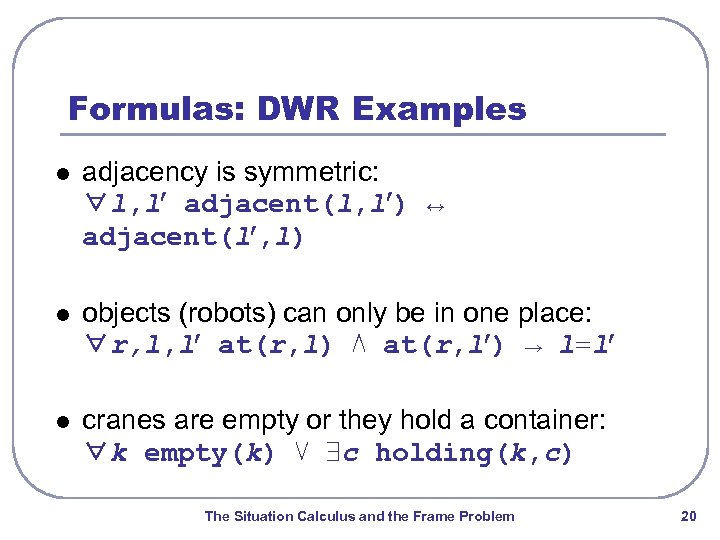
Formulas: DWR Examples l adjacency is symmetric: ∀l, l adjacent(l, l ) ↔ adjacent(l , l) l objects (robots) can only be in one place: ∀r, l, l at(r, l) ⋀ at(r, l ) → l=l l cranes are empty or they hold a container: ∀k empty(k) ⋁ c holding(k, c) The Situation Calculus and the Frame Problem 20
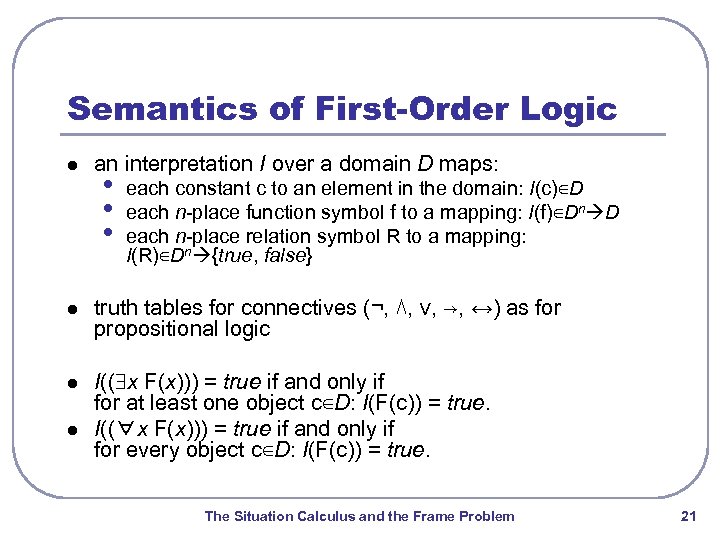
Semantics of First-Order Logic l l an interpretation I over a domain D maps: • • • each constant c to an element in the domain: I(c)∈D each n-place function symbol f to a mapping: I(f)∈Dn D each n-place relation symbol R to a mapping: I(R)∈Dn {true, false} truth tables for connectives (¬, ⋀, ⋁, →, ↔) as for propositional logic I(( x F(x))) = true if and only if for at least one object c∈D: I(F(c)) = true. I((∀x F(x))) = true if and only if for every object c∈D: I(F(c)) = true. The Situation Calculus and the Frame Problem 21
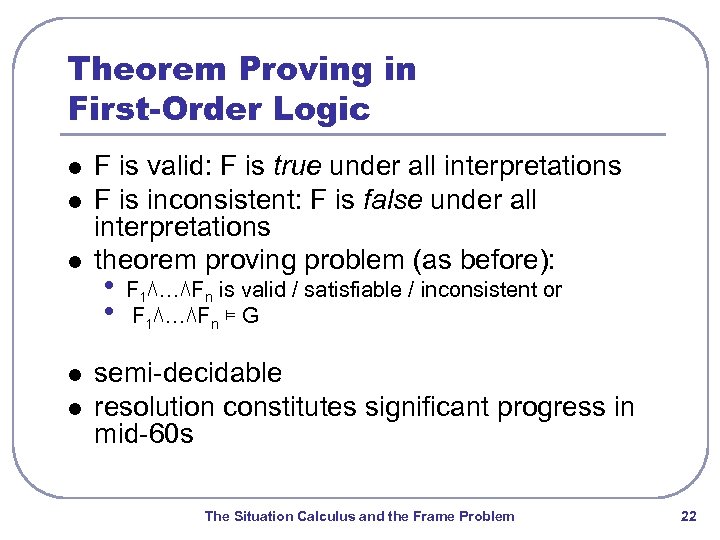
Theorem Proving in First-Order Logic l l l F is valid: F is true under all interpretations F is inconsistent: F is false under all interpretations theorem proving problem (as before): • • F 1⋀…⋀Fn is valid / satisfiable / inconsistent or F 1⋀…⋀Fn ⊨ G semi-decidable resolution constitutes significant progress in mid-60 s The Situation Calculus and the Frame Problem 22
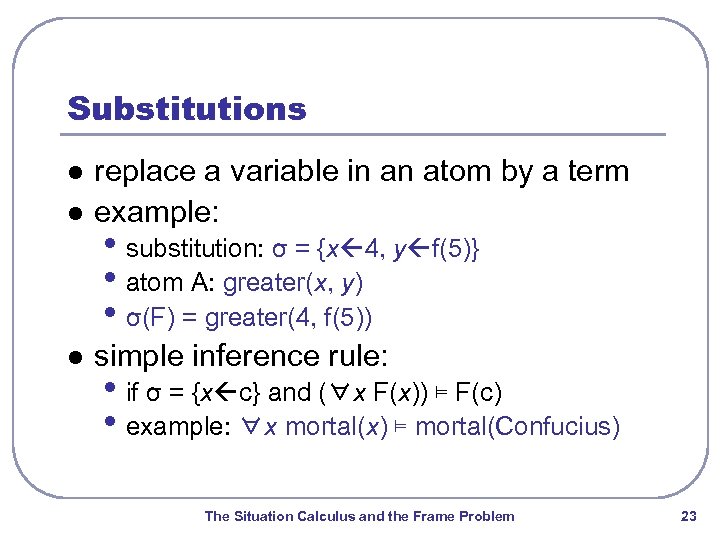
Substitutions l replace a variable in an atom by a term example: l simple inference rule: l • substitution: σ = {x 4, y f(5)} • atom A: greater(x, y) • σ(F) = greater(4, f(5)) • if σ = {x c} and (∀x F(x)) ⊨ F(c) • example: ∀x mortal(x) ⊨ mortal(Confucius) The Situation Calculus and the Frame Problem 23
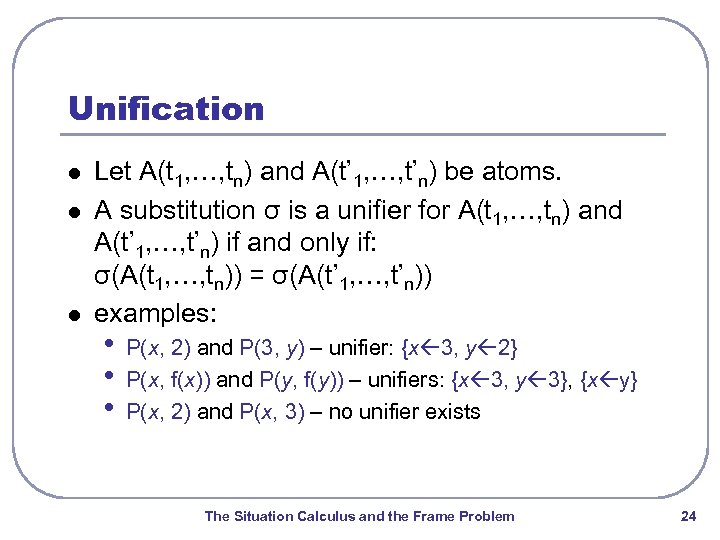
Unification l l l Let A(t 1, …, tn) and A(t’ 1, …, t’n) be atoms. A substitution σ is a unifier for A(t 1, …, tn) and A(t’ 1, …, t’n) if and only if: σ(A(t 1, …, tn)) = σ(A(t’ 1, …, t’n)) examples: • • • P(x, 2) and P(3, y) – unifier: {x 3, y 2} P(x, f(x)) and P(y, f(y)) – unifiers: {x 3, y 3}, {x y} P(x, 2) and P(x, 3) – no unifier exists The Situation Calculus and the Frame Problem 24
Overview l l Propositional Logic First-Order Predicate Logic Representing States and Actions The Frame Problem Solving the Frame Problem The Situation Calculus and the Frame Problem 25
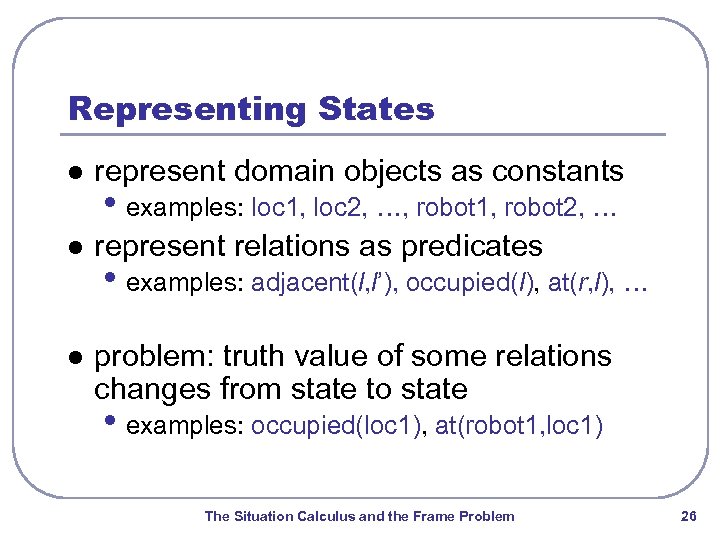
Representing States l represent domain objects as constants l represent relations as predicates l problem: truth value of some relations changes from state to state • examples: loc 1, loc 2, …, robot 1, robot 2, … • examples: adjacent(l, l’), occupied(l), at(r, l), … • examples: occupied(loc 1), at(robot 1, loc 1) The Situation Calculus and the Frame Problem 26
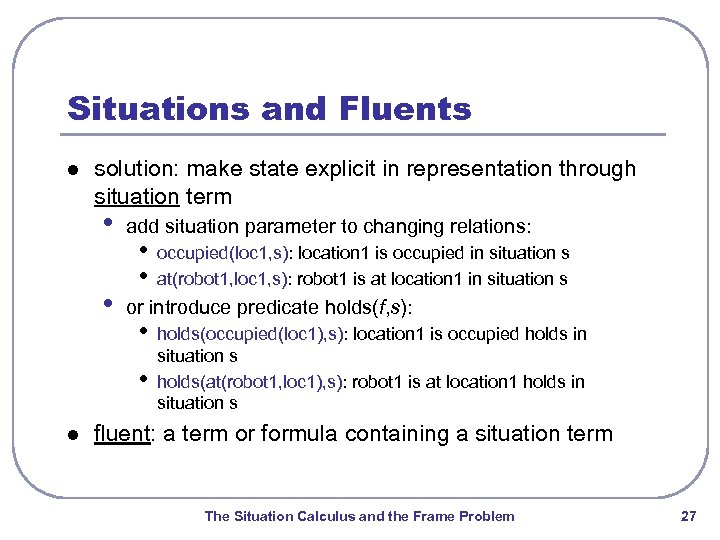
Situations and Fluents l solution: make state explicit in representation through situation term • • add situation parameter to changing relations: • • or introduce predicate holds(f, s): • • l occupied(loc 1, s): location 1 is occupied in situation s at(robot 1, loc 1, s): robot 1 is at location 1 in situation s holds(occupied(loc 1), s): location 1 is occupied holds in situation s holds(at(robot 1, loc 1), s): robot 1 is at location 1 holds in situation s fluent: a term or formula containing a situation term The Situation Calculus and the Frame Problem 27
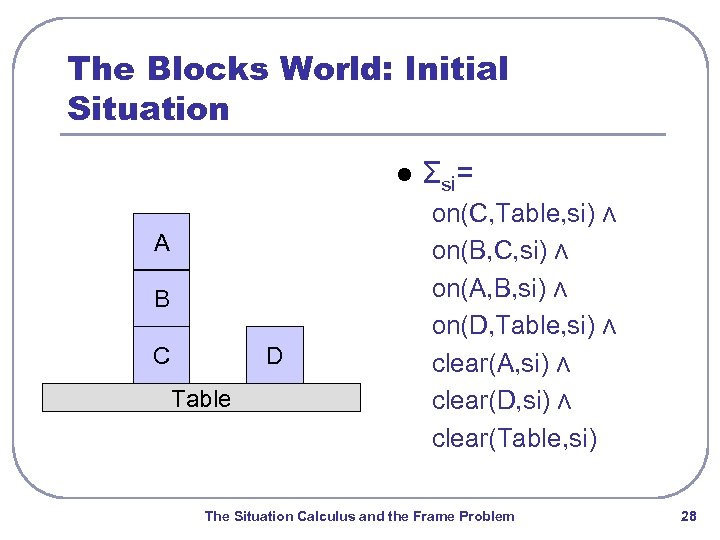
The Blocks World: Initial Situation l A B C D Table Σsi= on(C, Table, si) ⋀ on(B, C, si) ⋀ on(A, B, si) ⋀ on(D, Table, si) ⋀ clear(A, si) ⋀ clear(D, si) ⋀ clear(Table, si) The Situation Calculus and the Frame Problem 28
Actions l actions are non-tangible objects in the domain denoted by function terms • example: move(robot 1, loc 2): move robot 1 from location loc 1 to location loc 2 l definition of an action through • a set of formulas defining applicability • conditions a set of formulas defining changes in the state brought about by the action The Situation Calculus and the Frame Problem 29
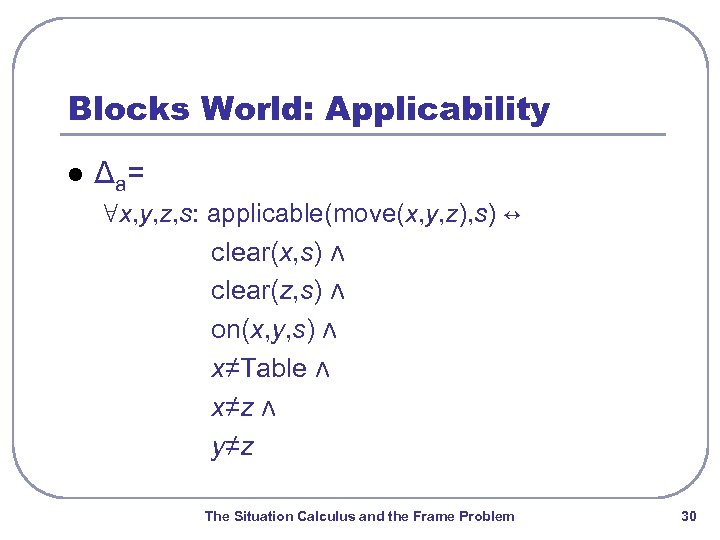
Blocks World: Applicability l Δa= ∀x, y, z, s: applicable(move(x, y, z), s) ↔ clear(x, s) ⋀ clear(z, s) ⋀ on(x, y, s) ⋀ x≠Table ⋀ x≠z ⋀ y≠z The Situation Calculus and the Frame Problem 30
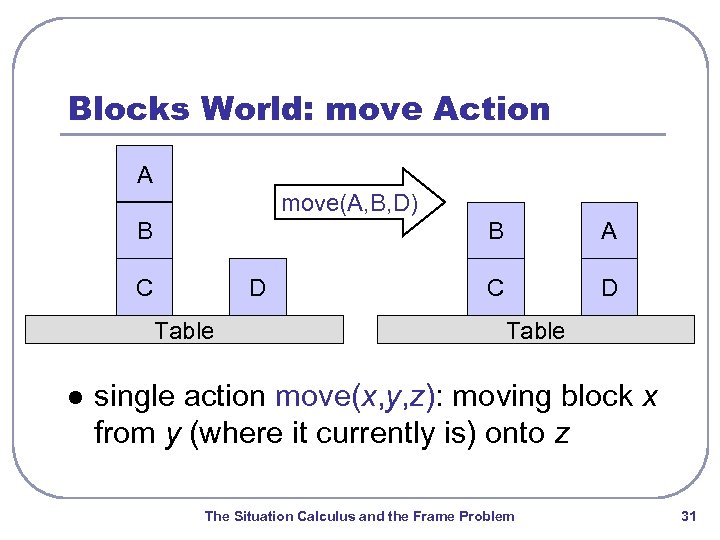
Blocks World: move Action A move(A, B, D) B B C D Table l A C D Table single action move(x, y, z): moving block x from y (where it currently is) onto z The Situation Calculus and the Frame Problem 31
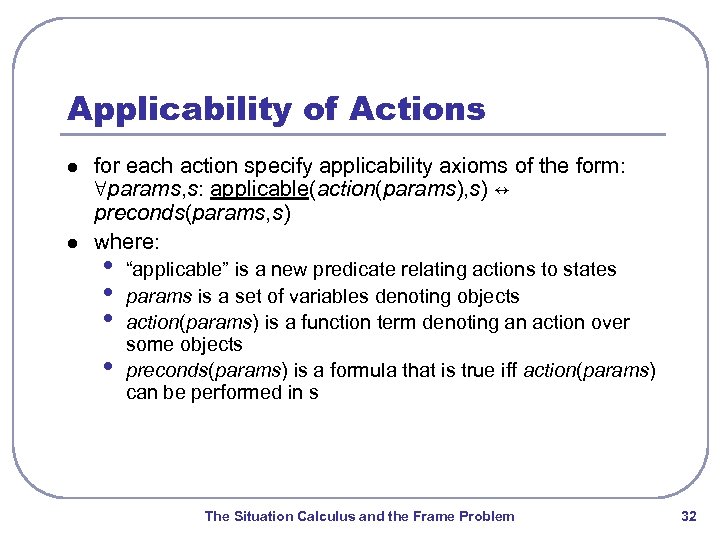
Applicability of Actions l l for each action specify applicability axioms of the form: ∀params, s: applicable(action(params), s) ↔ preconds(params, s) where: • • “applicable” is a new predicate relating actions to states params is a set of variables denoting objects action(params) is a function term denoting an action over some objects preconds(params) is a formula that is true iff action(params) can be performed in s The Situation Calculus and the Frame Problem 32
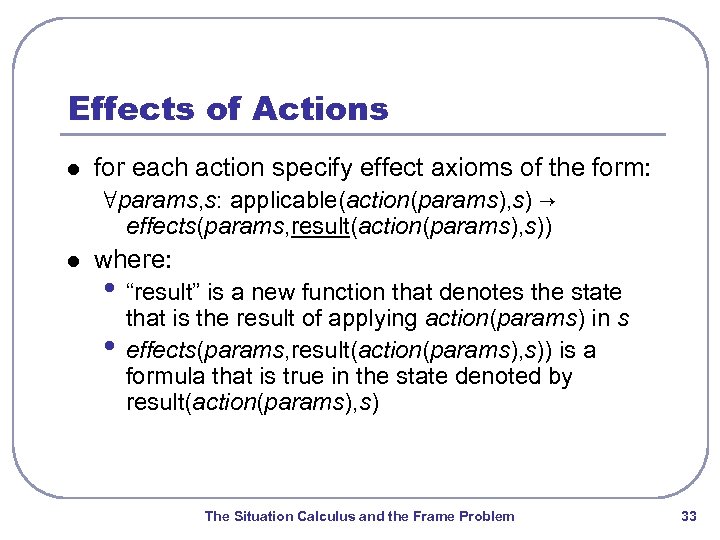
Effects of Actions l for each action specify effect axioms of the form: ∀params, s: applicable(action(params), s) → effects(params, result(action(params), s)) l where: • “result” is a new function that denotes the state • that is the result of applying action(params) in s effects(params, result(action(params), s)) is a formula that is true in the state denoted by result(action(params), s) The Situation Calculus and the Frame Problem 33
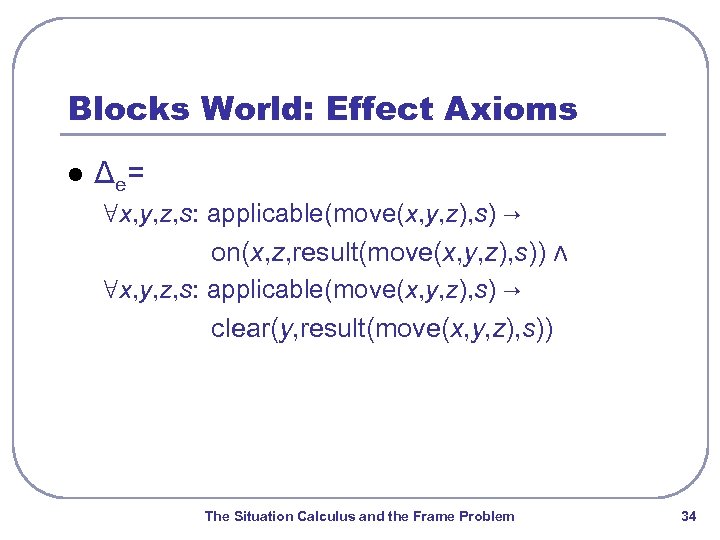
Blocks World: Effect Axioms l Δe= ∀x, y, z, s: applicable(move(x, y, z), s) → on(x, z, result(move(x, y, z), s)) ⋀ ∀x, y, z, s: applicable(move(x, y, z), s) → clear(y, result(move(x, y, z), s)) The Situation Calculus and the Frame Problem 34
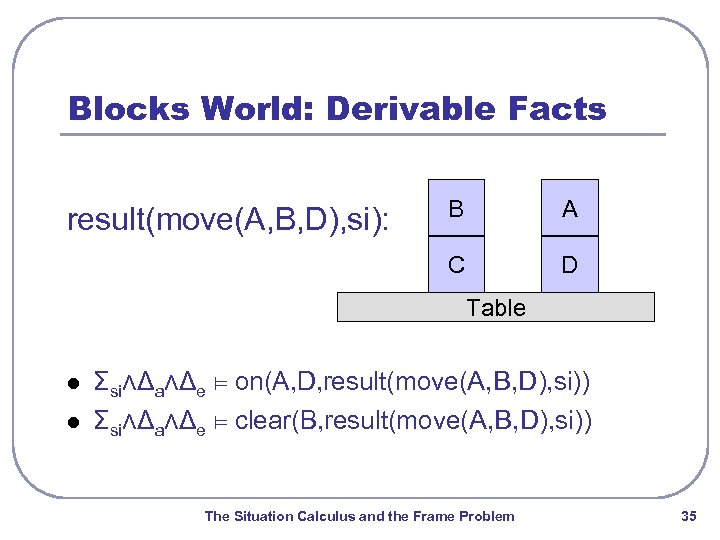
Blocks World: Derivable Facts B A C result(move(A, B, D), si): D Table l l Σsi⋀Δa⋀Δe ⊨ on(A, D, result(move(A, B, D), si)) Σsi⋀Δa⋀Δe ⊨ clear(B, result(move(A, B, D), si)) The Situation Calculus and the Frame Problem 35
Overview l l Propositional Logic First-Order Predicate Logic Representing States and Actions The Frame Problem Solving the Frame Problem The Situation Calculus and the Frame Problem 36
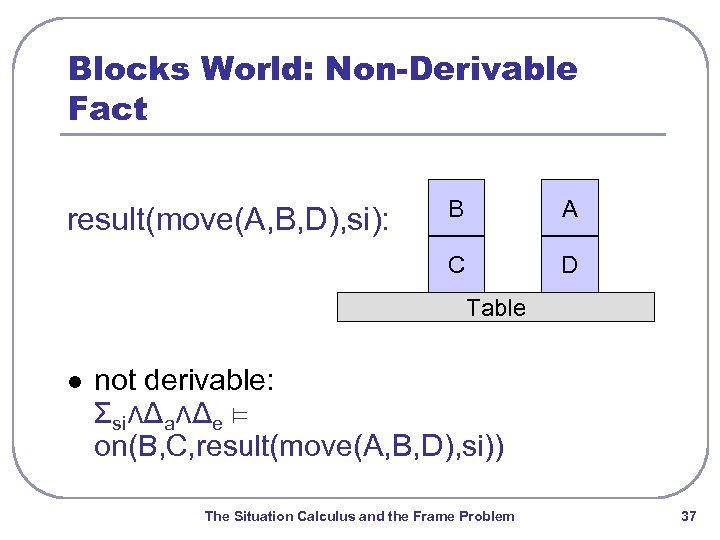
Blocks World: Non-Derivable Fact B A C result(move(A, B, D), si): D Table l not derivable: Σsi⋀Δa⋀Δe ⊨ on(B, C, result(move(A, B, D), si)) The Situation Calculus and the Frame Problem 37
The Non-Effects of Actions l l effect axioms describe what changes when an action is applied, but not what does not change example: move robot • • does not change the colour of the robot does not change the size of the robot does not change the political system in the UK does not change the laws of physics The Situation Calculus and the Frame Problem 38
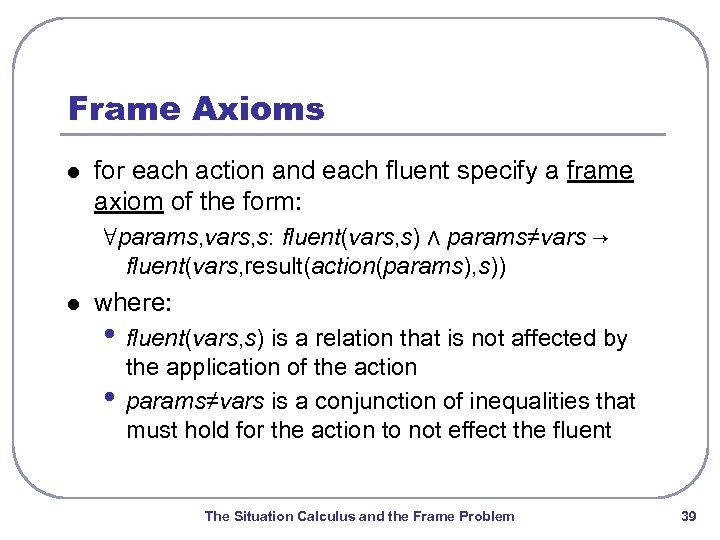
Frame Axioms l for each action and each fluent specify a frame axiom of the form: ∀params, vars, s: fluent(vars, s) ⋀ params≠vars → fluent(vars, result(action(params), s)) l where: • fluent(vars, s) is a relation that is not affected by • the application of the action params≠vars is a conjunction of inequalities that must hold for the action to not effect the fluent The Situation Calculus and the Frame Problem 39
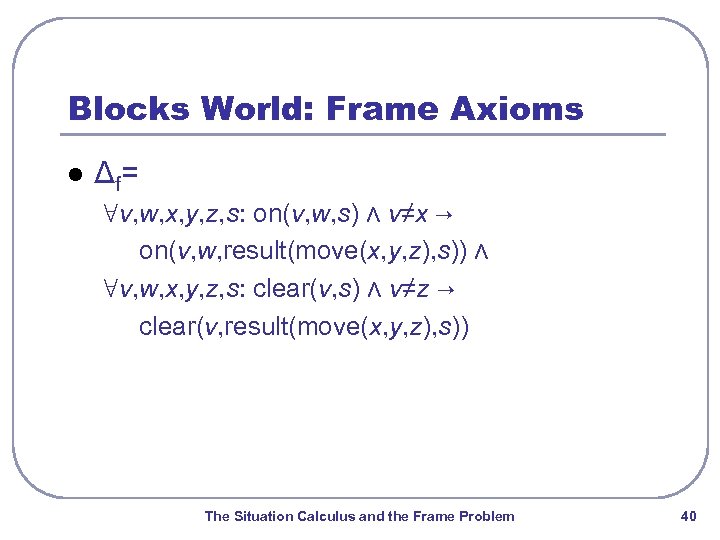
Blocks World: Frame Axioms l Δf = ∀v, w, x, y, z, s: on(v, w, s) ⋀ v≠x → on(v, w, result(move(x, y, z), s)) ⋀ ∀v, w, x, y, z, s: clear(v, s) ⋀ v≠z → clear(v, result(move(x, y, z), s)) The Situation Calculus and the Frame Problem 40
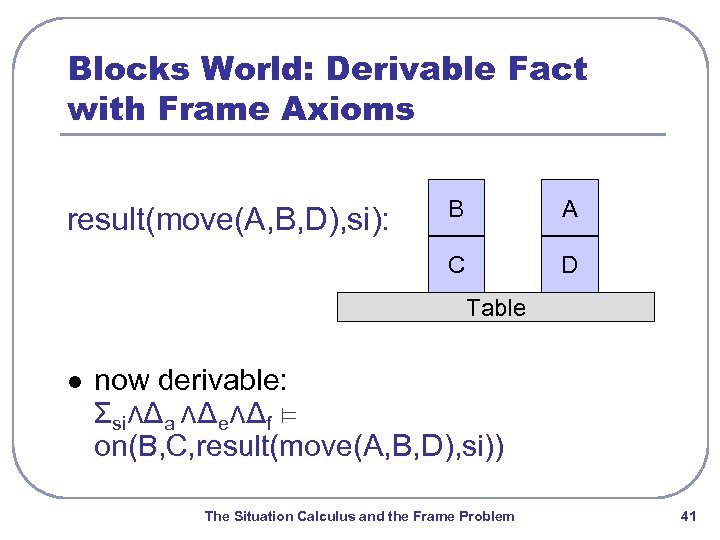
Blocks World: Derivable Fact with Frame Axioms B A C result(move(A, B, D), si): D Table l now derivable: Σsi⋀Δa ⋀Δe⋀Δf ⊨ on(B, C, result(move(A, B, D), si)) The Situation Calculus and the Frame Problem 41
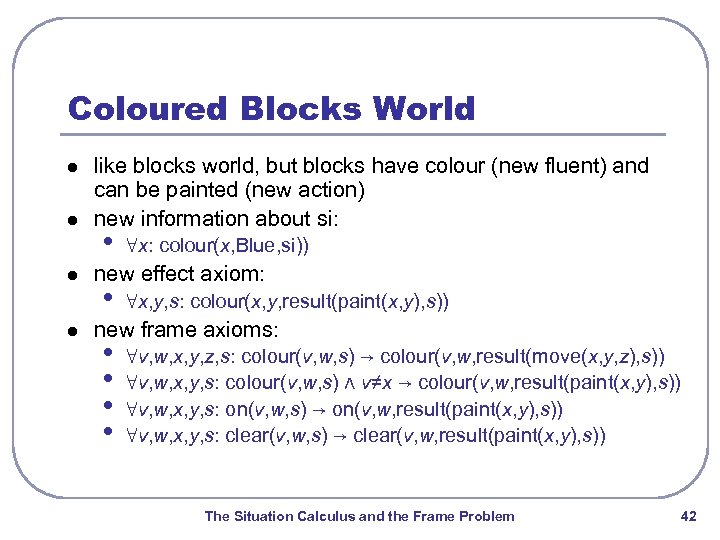
Coloured Blocks World l l like blocks world, but blocks have colour (new fluent) and can be painted (new action) new information about si: • ∀x: colour(x, Blue, si)) new effect axiom: • ∀x, y, s: colour(x, y, result(paint(x, y), s)) new frame axioms: • • ∀v, w, x, y, z, s: colour(v, w, s) → colour(v, w, result(move(x, y, z), s)) ∀v, w, x, y, s: colour(v, w, s) ⋀ v≠x → colour(v, w, result(paint(x, y), s)) ∀v, w, x, y, s: on(v, w, s) → on(v, w, result(paint(x, y), s)) ∀v, w, x, y, s: clear(v, w, s) → clear(v, w, result(paint(x, y), s)) The Situation Calculus and the Frame Problem 42
The Frame Problem l problem: need to represent a long list of facts that are not changed by an action l the frame problem: • construct a formal framework • for reasoning about actions and change • in which the non-effects of actions do not have to be enumerated explicitly The Situation Calculus and the Frame Problem 43
Overview l l Propositional Logic First-Order Predicate Logic Representing States and Actions The Frame Problem Solving the Frame Problem The Situation Calculus and the Frame Problem 44
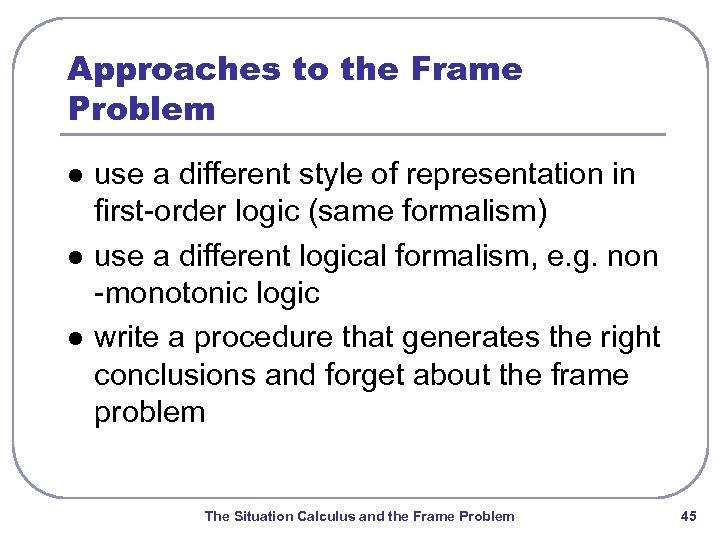
Approaches to the Frame Problem l l l use a different style of representation in first-order logic (same formalism) use a different logical formalism, e. g. non -monotonic logic write a procedure that generates the right conclusions and forget about the frame problem The Situation Calculus and the Frame Problem 45
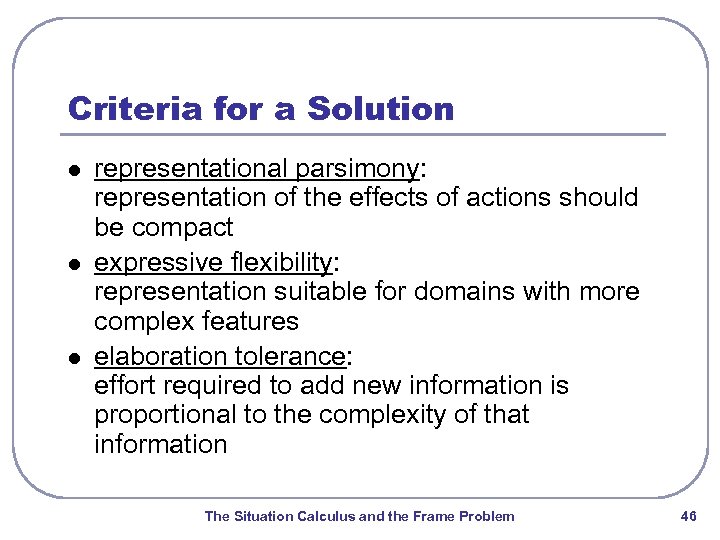
Criteria for a Solution l l l representational parsimony: representation of the effects of actions should be compact expressive flexibility: representation suitable for domains with more complex features elaboration tolerance: effort required to add new information is proportional to the complexity of that information The Situation Calculus and the Frame Problem 46
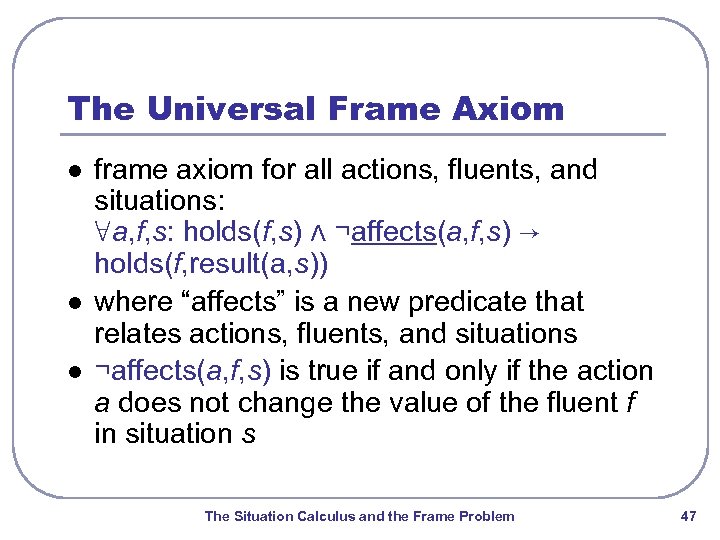
The Universal Frame Axiom l l l frame axiom for all actions, fluents, and situations: ∀a, f, s: holds(f, s) ⋀ ¬affects(a, f, s) → holds(f, result(a, s)) where “affects” is a new predicate that relates actions, fluents, and situations ¬affects(a, f, s) is true if and only if the action a does not change the value of the fluent f in situation s The Situation Calculus and the Frame Problem 47
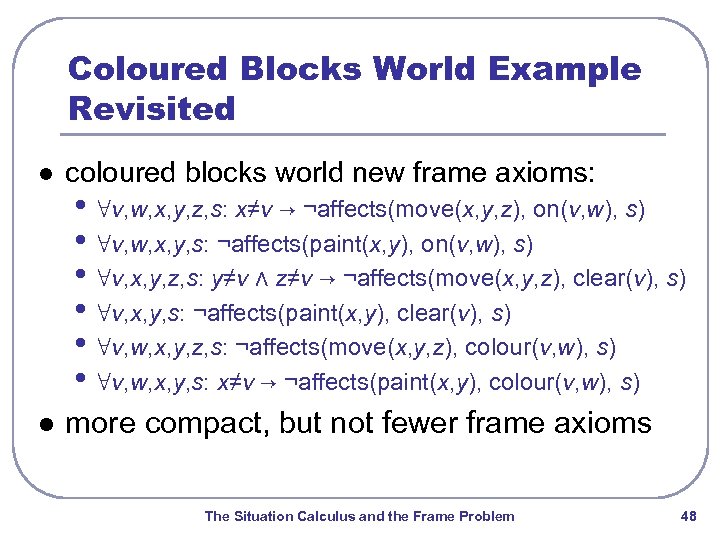
Coloured Blocks World Example Revisited l coloured blocks world new frame axioms: l more compact, but not fewer frame axioms • ∀v, w, x, y, z, s: x≠v → ¬affects(move(x, y, z), on(v, w), s) • ∀v, w, x, y, s: ¬affects(paint(x, y), on(v, w), s) • ∀v, x, y, z, s: y≠v ⋀ z≠v → ¬affects(move(x, y, z), clear(v), s) • ∀v, x, y, s: ¬affects(paint(x, y), clear(v), s) • ∀v, w, x, y, z, s: ¬affects(move(x, y, z), colour(v, w), s) • ∀v, w, x, y, s: x≠v → ¬affects(paint(x, y), colour(v, w), s) The Situation Calculus and the Frame Problem 48
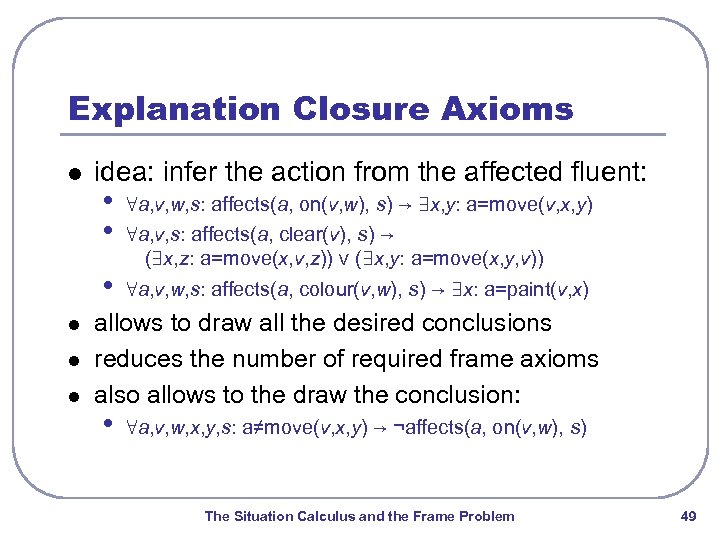
Explanation Closure Axioms l idea: infer the action from the affected fluent: • • • l l l ∀a, v, w, s: affects(a, on(v, w), s) → ∃x, y: a=move(v, x, y) ∀a, v, s: affects(a, clear(v), s) → (∃x, z: a=move(x, v, z)) ⋁ (∃x, y: a=move(x, y, v)) ∀a, v, w, s: affects(a, colour(v, w), s) → ∃x: a=paint(v, x) allows to draw all the desired conclusions reduces the number of required frame axioms also allows to the draw the conclusion: • ∀a, v, w, x, y, s: a≠move(v, x, y) → ¬affects(a, on(v, w), s) The Situation Calculus and the Frame Problem 49
The Limits of Classical Logic l l monotonic consequence relation: Δ ⊨ ϕ implies Δ⋀δ ⊨ ϕ problem: • need to infer when a fluent is not affected by • l an action want to be able to add actions that affect existing fluents monotonicity: if ¬affects(a, f, s) holds in a theory it must also hold in any extension The Situation Calculus and the Frame Problem 50
Using Non-Monotonic Logics l non-monotonic logics rely on default reasoning: • • • l jumping to conclusions in the absence of information to the contrary conclusions are assumed to be true by default additional information may invalidate them application to frame problem: • • explanation closure axioms are default knowledge effect axioms are certain knowledge The Situation Calculus and the Frame Problem 51
Overview l l l Propositional Logic First-Order Predicate Logic Representing States and Actions The Frame Problem Solving the Frame Problem The Situation Calculus and the Frame Problem 52
Скачать презентацию The Situation Calculus and the Frame Problem Using
7acfdbccbc52ed9913c2c75c9868887b.ppt