Скачать презентацию The SIP Templates Forms The Secrets of How
6378a3c944a525dc373ec3758df2bf82.ppt
- Количество слайдов: 57
 The SIP Templates/Forms
 The Secrets of How to Improve v. Greet each new day with bright, positive attitude v. Put always a new bulb of trust in yourself that there are ways of glowing brightly. v. Concentrate upon simple things in life, afterall, they are the important that help us strengthen our personal faith in God and lead us to greater joy and inner peace.
 Rational Objectives • Understand the templates/forms that may help in the exploring possible strategies to implement SIP process. • Determine how sustained participation is critical to program/project success • Identify concrete steps to ensure stakeholders’ participation in programs/projects implementation
 Experiential Objectives • Accept the challenges of reinventing and undergoing SIP reformulation for proactive organization. • Feel responsible and accountable for assigned tasks as part of the system.
 Activity 1. Using the SBM Assessment tool, the participants are grouped into four to take responsibility for a. Leadership and Governance b. Curriculum and Instruction c. Accountability and Continuous Improvement d. Management of Resources
 Answer the following questions under your group: Ø In what ways would you do the right things to accomplish the highest level of practice under the principle assign to you? Ø What do you expect to do to get the rating of 3? Ø What indicator did your rate 1? Why?
 Reporting time!
 Objective of SIP To achieve the desired outcomes through the enhancement of delivery of educational services and the organizational health & performance >by competent, committed and caring teachers >by creating a safe and nurturing environment for learning; and >by increasing the stakeholders’ participation in the entire school improvement process
 Leadership and Governance • A network of leadership and governance guides education system to achieve its shared vision, mission and goals making them responsive and relevant to the context of diverse environments
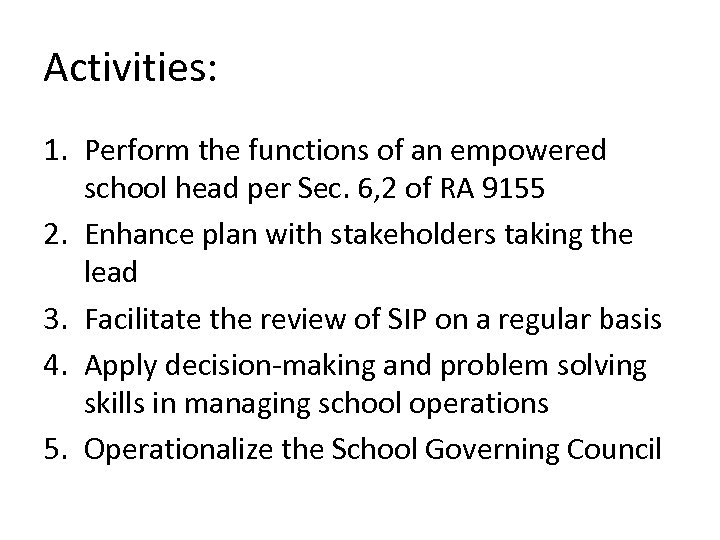 Activities: 1. Perform the functions of an empowered school head per Sec. 6, 2 of RA 9155 2. Enhance plan with stakeholders taking the lead 3. Facilitate the review of SIP on a regular basis 4. Apply decision-making and problem solving skills in managing school operations 5. Operationalize the School Governing Council
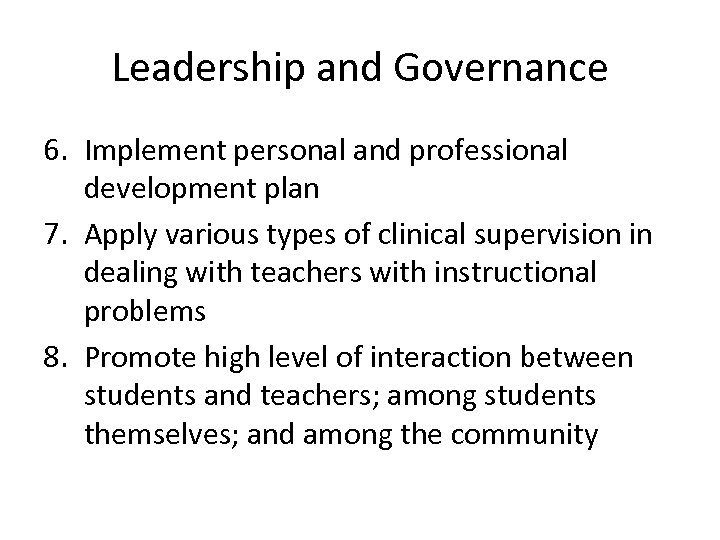 Leadership and Governance 6. Implement personal and professional development plan 7. Apply various types of clinical supervision in dealing with teachers with instructional problems 8. Promote high level of interaction between students and teachers; among students themselves; and among the community
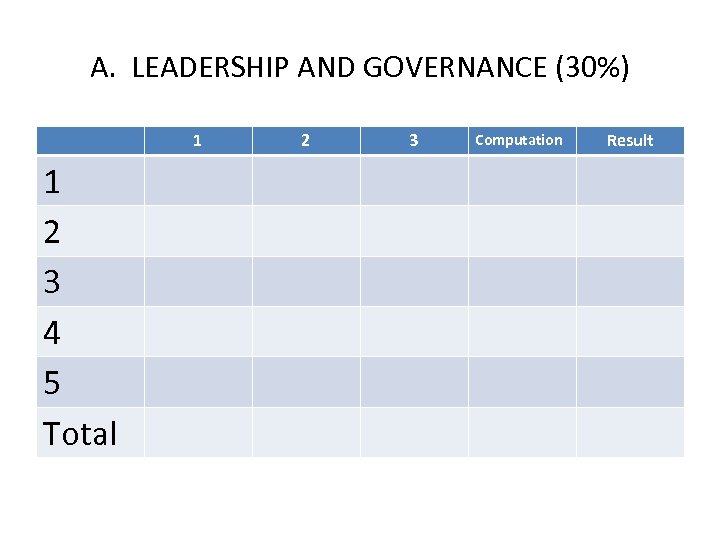 A. LEADERSHIP AND GOVERNANCE (30%) 1 1 2 3 4 5 Total 2 3 Computation Result
 Curriculum and Instruction • The curriculum learning systems anchored on the community and learners’ contexts and aspirations are collaboratively developed and continuously improved.
 Activities: 1. Implement the curriculum, and other Dep. Ed programs 2. Use localized instructional materials designed by teachers for better learning outcomes 3. Create networks to support learning linkages and partnerships 4. Utilize materials and approaches in developing creative and critical thinking skills 5. Organize M & E that take care of the information and analysis for improvement
 Activities: 6. Conduct ORVs in English and Filipino determining the remedial and enhancement programs for learners. 7. Design the curriculum in structuring the learning environment. 8. Share information, expertise, and materials among schools, home and community for developing self-directed learners. 9. Innovate programs for improving performance of different types of learners and teachers.
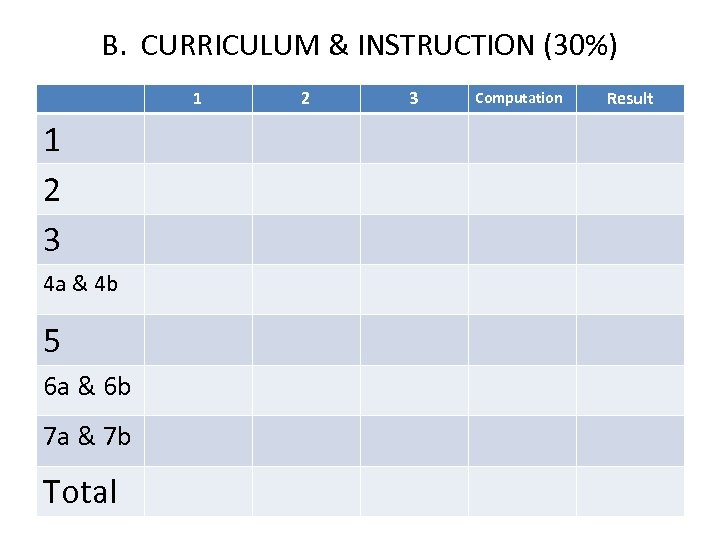 B. CURRICULUM & INSTRUCTION (30%) 1 1 2 3 4 a & 4 b 5 6 a & 6 b 7 a & 7 b Total 2 3 Computation Result
 Accountability and Continuous Improvement • A clear and transparent, inclusive and responsive accountability system is in place, collaboratively developed by the school community which monitors performance and acts appropriately on gaps and gains.
 Activities: 1. Conduct early enrolment campaign, advocacy, information dissemination in managing and supporting education 2. Practice community-accepted performance accountability system 3. Ensure performance accountability system is place using M & E 4. Review systems’ processes, mechanisms and tools regularly.
 Activities: 5. Provide adequate resources for programs and projects 6. Utilize appropriately the resources 7. Have proper care of available materials, equipment and facilities 8. Improve the learning environment. 9. Implement work plans effectively and efficiently.
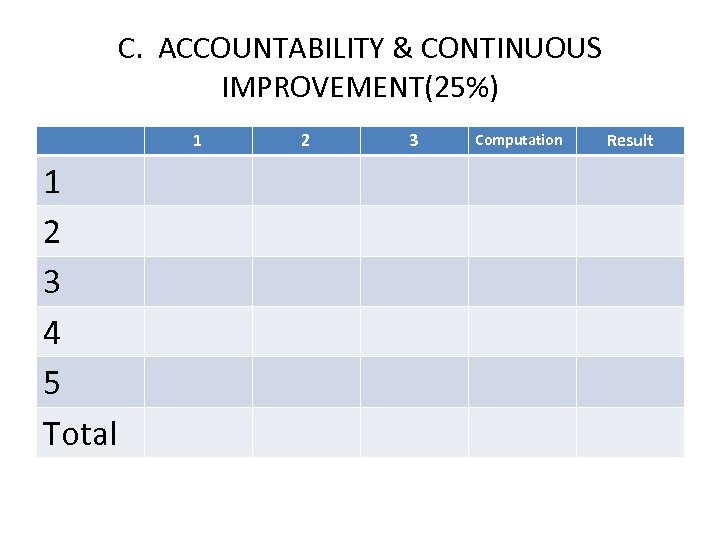 C. ACCOUNTABILITY & CONTINUOUS IMPROVEMENT(25%) 1 1 2 3 4 5 Total 2 3 Computation Result
 Management of Resources • Resources are collectively and judiciously mobilized and managed with transparency, effectiveness and efficiency.
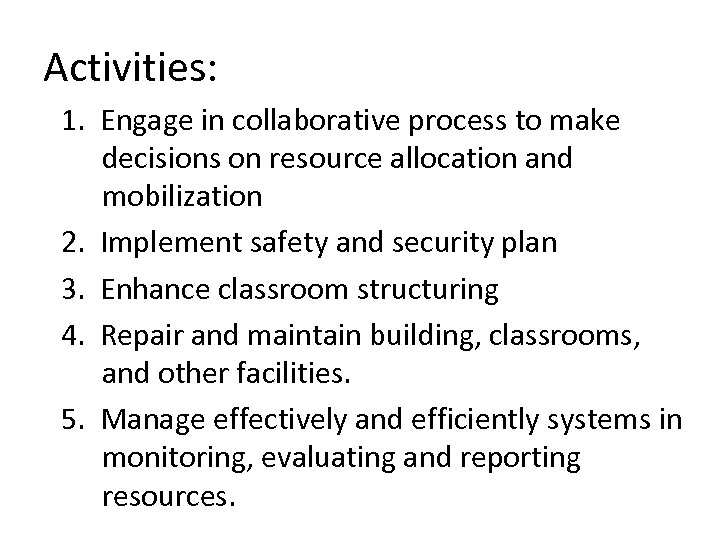 Activities: 1. Engage in collaborative process to make decisions on resource allocation and mobilization 2. Implement safety and security plan 3. Enhance classroom structuring 4. Repair and maintain building, classrooms, and other facilities. 5. Manage effectively and efficiently systems in monitoring, evaluating and reporting resources.
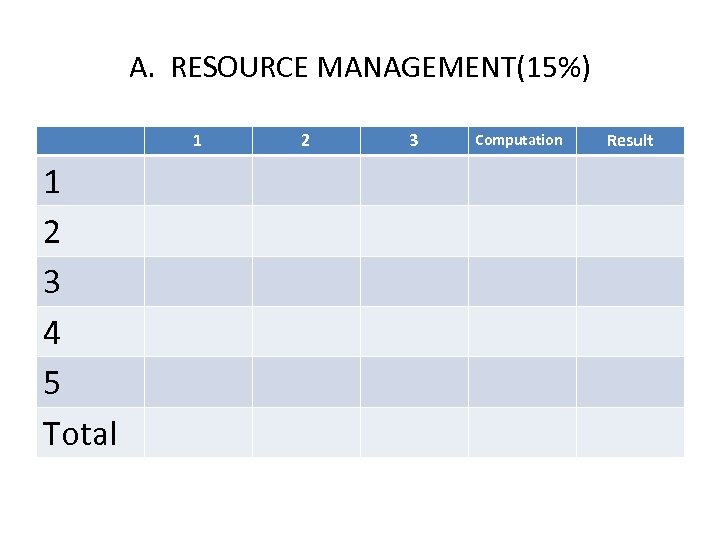 A. RESOURCE MANAGEMENT(15%) 1 1 2 3 4 5 Total 2 3 Computation Result
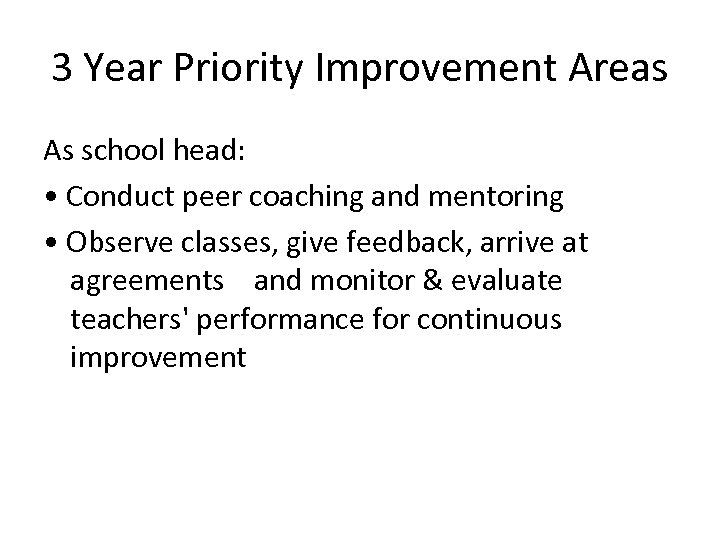 3 Year Priority Improvement Areas As school head: • Conduct peer coaching and mentoring • Observe classes, give feedback, arrive at agreements and monitor & evaluate teachers' performance for continuous improvement
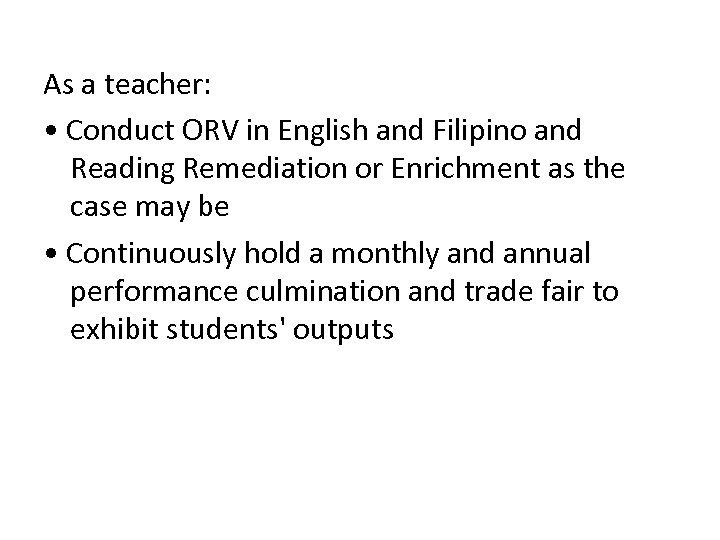 As a teacher: • Conduct ORV in English and Filipino and Reading Remediation or Enrichment as the case may be • Continuously hold a monthly and annual performance culmination and trade fair to exhibit students' outputs
 As parent/LGU/other stakeholder • Conduct annual enrolment campaign particularly during the early enrolment period • Involve stakeholders in resource allocation and budgetting in MOOE, SEF, SPED and other funds
 Linking the End Results to SIP • What is the expected outcomes: ü Goal: Our after-school program will help children read better. ü Objective: Our after-school remedial education program will assist 50 children in improving their reading scores by one grade level as demonstrated on standardized reading tests administered after participating in the 6 -month program.
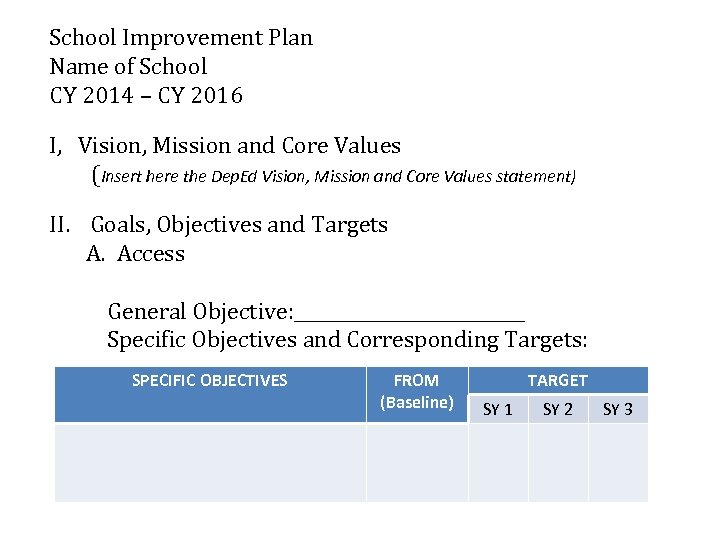 School Improvement Plan Name of School CY 2014 – CY 2016 I, Vision, Mission and Core Values (Insert here the Dep. Ed Vision, Mission and Core Values statement) II. Goals, Objectives and Targets A. Access General Objective: _____________ Specific Objectives and Corresponding Targets: SPECIFIC OBJECTIVES FROM (Baseline) TARGET SY 1 SY 2 SY 3
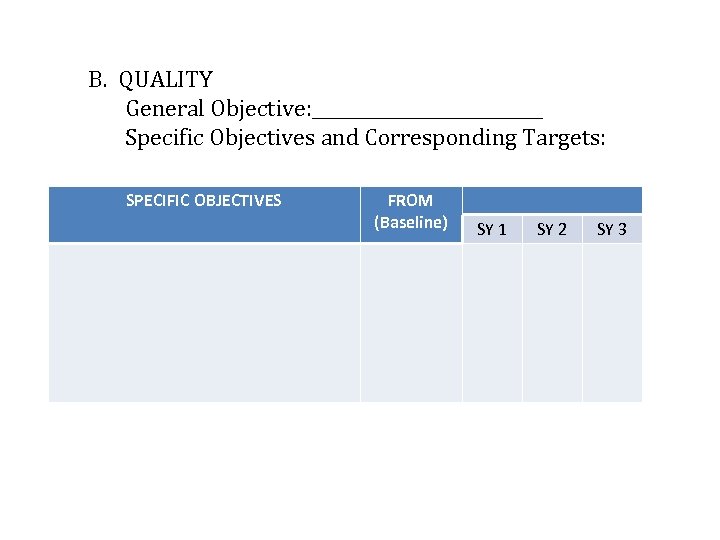 B. QUALITY General Objective: _____________ Specific Objectives and Corresponding Targets: SPECIFIC OBJECTIVES FROM (Baseline) SY 1 SY 2 SY 3
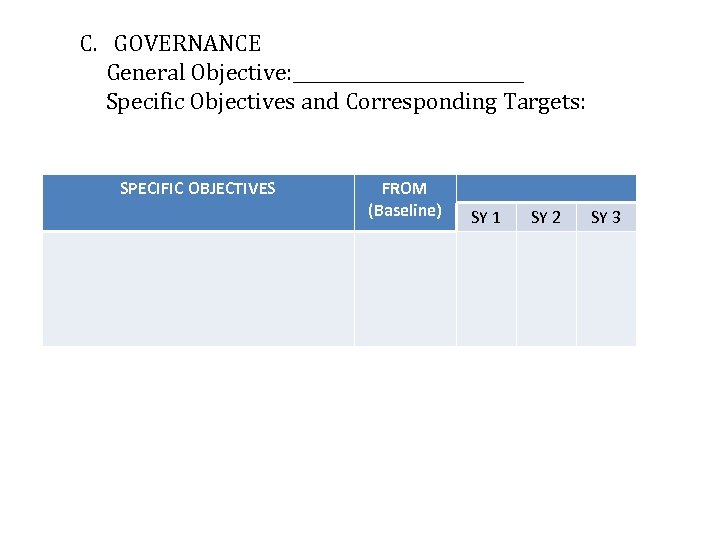 C. GOVERNANCE General Objective: _____________ Specific Objectives and Corresponding Targets: SPECIFIC OBJECTIVES FROM (Baseline) SY 1 SY 2 SY 3
 Situational Analysis (State of the School) A. Situation of Children/Learners – Use the data/output on Access to develop the text
 Situational Analysis (State of the School) B. External Analysis – Use the outputs/data presented under social, demographic, cultural factors, political, economic, ecological & environmental and technological aspects
 Situational Analysis (State of the School) C. Internal Analysis Use the data/information on physical infrastructure (classrooms, seats, library, toilets, etc. ), teacher (number & quality), textbooks and other learning materials, existing education programs and projects, nonteaching/administrative personnel and financial resources
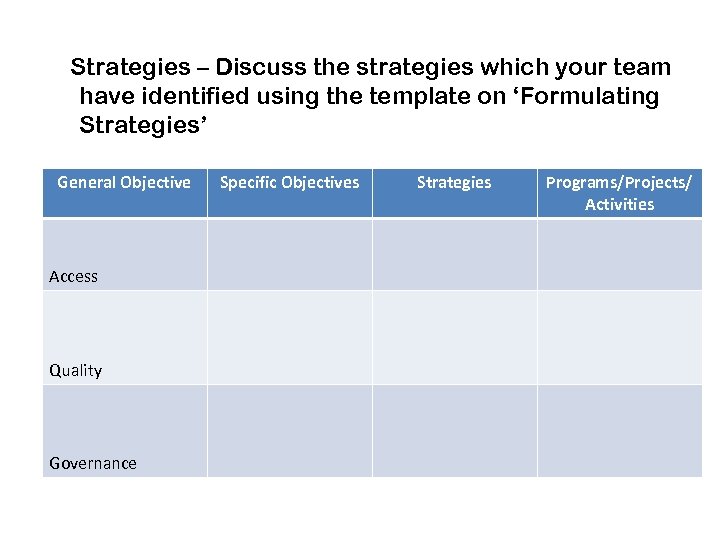 Strategies – Discuss the strategies which your team have identified using the template on ‘Formulating Strategies’ General Objective Access Quality Governance Specific Objectives Strategies Programs/Projects/ Activities
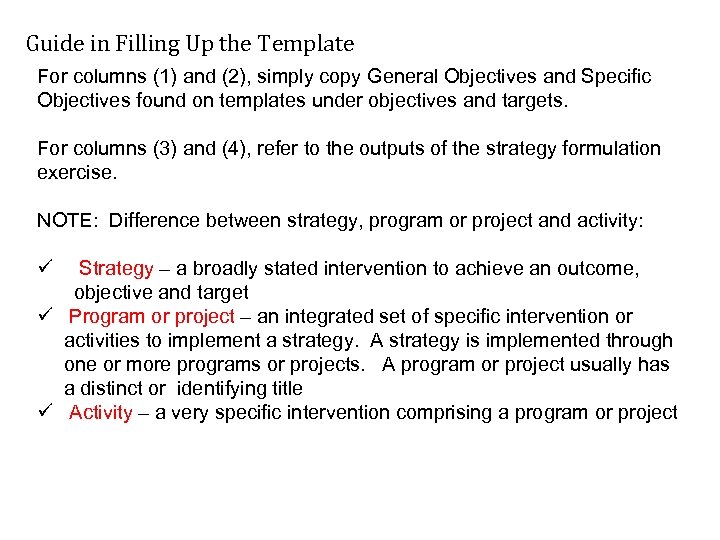 Guide in Filling Up the Template For columns (1) and (2), simply copy General Objectives and Specific Objectives found on templates under objectives and targets. For columns (3) and (4), refer to the outputs of the strategy formulation exercise. NOTE: Difference between strategy, program or project and activity: ü Strategy – a broadly stated intervention to achieve an outcome, objective and target ü Program or project – an integrated set of specific intervention or activities to implement a strategy. A strategy is implemented through one or more programs or projects. A program or project usually has a distinct or identifying title ü Activity – a very specific intervention comprising a program or project
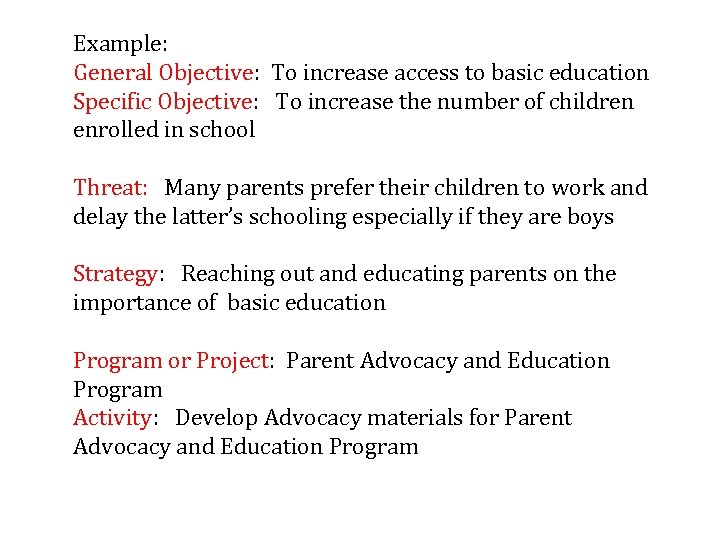 Example: General Objective: To increase access to basic education Specific Objective: To increase the number of children enrolled in school Threat: Many parents prefer their children to work and delay the latter’s schooling especially if they are boys Strategy: Reaching out and educating parents on the importance of basic education Program or Project: Parent Advocacy and Education Program Activity: Develop Advocacy materials for Parent Advocacy and Education Program
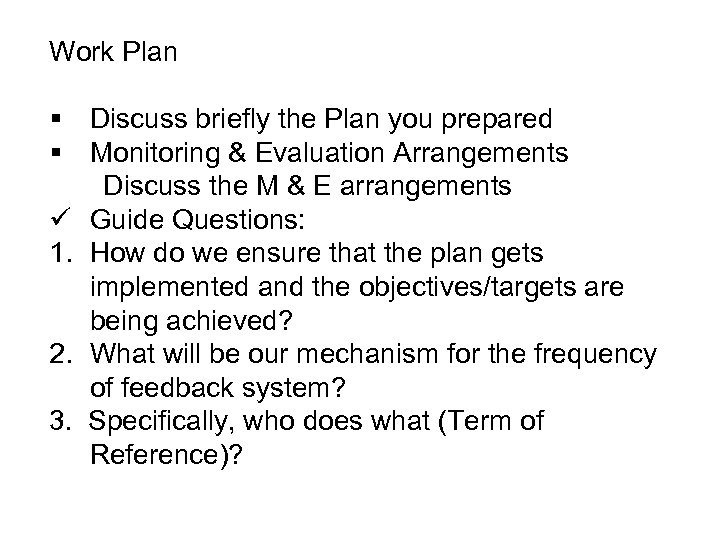 Work Plan § Discuss briefly the Plan you prepared § Monitoring & Evaluation Arrangements Discuss the M & E arrangements ü Guide Questions: 1. How do we ensure that the plan gets implemented and the objectives/targets are being achieved? 2. What will be our mechanism for the frequency of feedback system? 3. Specifically, who does what (Term of Reference)?
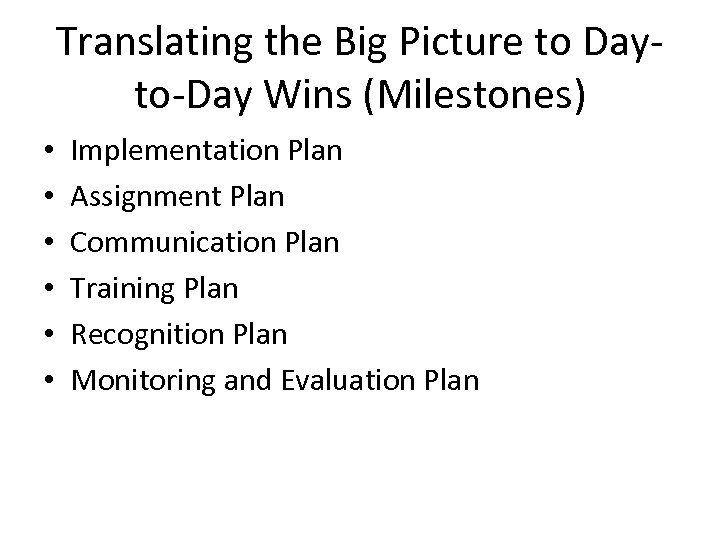 Translating the Big Picture to Dayto-Day Wins (Milestones) • • • Implementation Plan Assignment Plan Communication Plan Training Plan Recognition Plan Monitoring and Evaluation Plan
 NOTE: I. In the final packaging of the SIP the following shall be included (Based on Division Memorandum No. 150, s. 2014 dated April 4, 2014 entitled “Organization of Division/ District/School SIP Review Team)
 • The forms are provided to you to facilitate your accomplishment of SIP
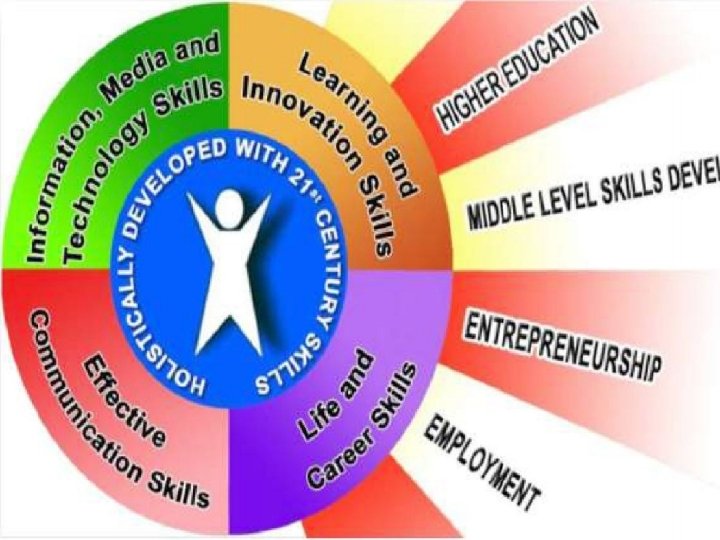
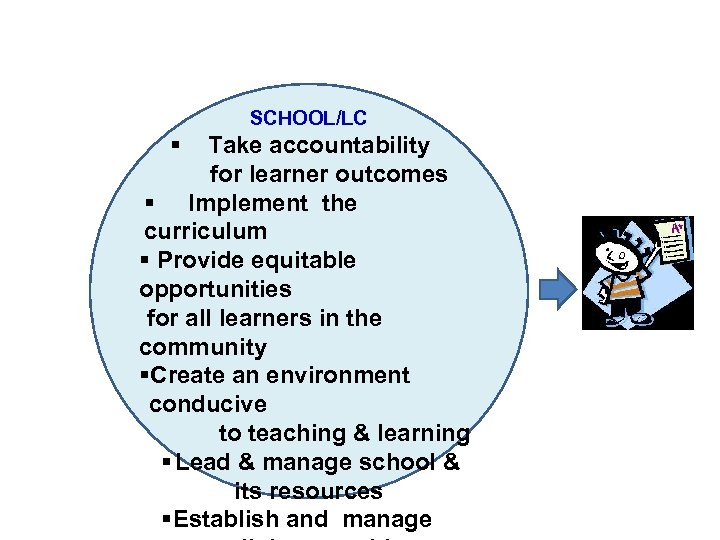 SCHOOL/LC § Take accountability for learner outcomes § Implement the curriculum § Provide equitable opportunities for all learners in the community §Create an environment conducive to teaching & learning § Lead & manage school & its resources §Establish and manage
 Reminders: • • • PAST – Form 5 – SBM forms 1 a to 1 c Clearances SIPs properly endorsed by SPT, School SIP Review Team, District SIP Review Team
 Application: Accomplish the forms as a team, have in mind the 3 -year priority improvement areas based on the existing needs of the school and the calendar of activities done in session 1.
 The Beautiful Old Lamp Once there were two ladies who lived in houses side by side. They were friendly neighbors and often times would visit with one another.
 Whenever Mrs. Wilson went to Mrs. Morgan’s house she would admire a beautiful old lamp on the living room table.
 One day Mrs. Morgan told her that she was getting some new furniture for the living room, and if Mrs. Wilson wanted to buy the lamp she would be glad to sell it to her for a very modest price.
 Mrs. Wilson was delighted, and she bought the lamp right then and there. Happily she took the lamp home, but that night she called her neighbor in a rage!
 Mrs. Wilson was delighted, and she bought the lamp right then and there. Happily she took the lamp home, but that night she called her neighbor in a rage!
 “This old lamp doesn’t even work! No wonder you wanted to get rid of it! You’ve cheated me, and I’m terribly upset!”
 Mrs. Morgan waited until Mrs. Wilson had finished complaining about the lamp, and then she told her that she would come over to her house and see what was wrong. She was confident that the lamp was in excellent condition when she sold it.
 Sure enough! When she examined the lamp she found that it simply needed a new bulb! In a second the beautiful old lamp was glowing brightly.
 Mrs. Wilson had been too hasty. She had overlooked the obvious. A burned out light bulb was to blame, not the lamp itself!
 Aren’t all of us like that at times? That is the purpose of this story …to remind us that God is our lamp. . . but we must provide the “bulbs” if there is to be light! Instead of electrical bulbs, we must have “bulbs of faith and trust!
 For those are the “bulbs” that make Our Heavenly Father’s Lamp to shine Forth the answers to our prayers!
 As Mrs. Wilson learned, it was not the beautiful old lamp that was at fault, She had neglected to put a new bulb! God’s lamp is never at fault either so long as all of us remember to keep fresh and new “bulbs” of faith and trust with that Lamp! For God is light, and in Him is no darkness at all!