


 Скачать презентацию The Seven Indicators Every Resource Investor Needs to
681ba786e371fb8cafdac82911c58163.ppt
- Количество слайдов: 10
 The Seven Indicators Every Resource Investor Needs to Know Presented by Peter Krauth
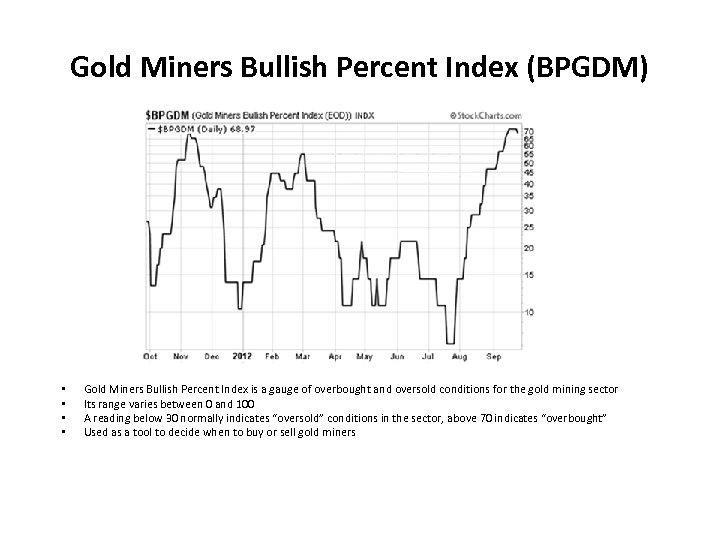 Gold Miners Bullish Percent Index (BPGDM) • • Gold Miners Bullish Percent Index is a gauge of overbought and oversold conditions for the gold mining sector Its range varies between 0 and 100 A reading below 30 normally indicates “oversold” conditions in the sector, above 70 indicates “overbought” Used as a tool to decide when to buy or sell gold miners
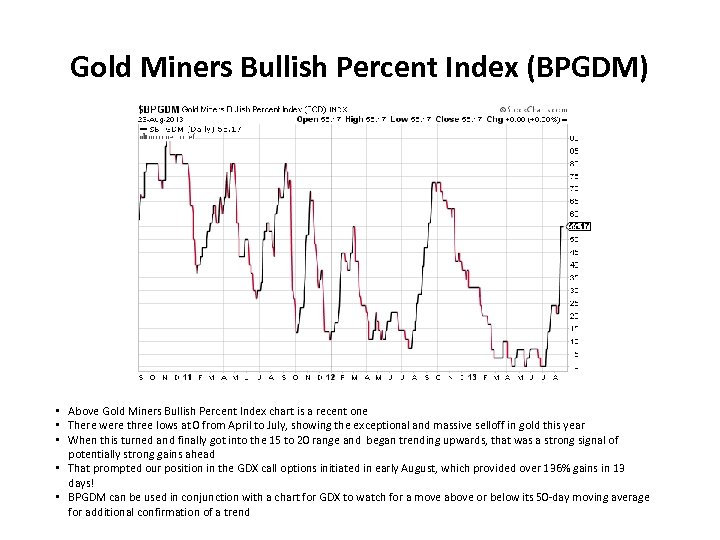 Gold Miners Bullish Percent Index (BPGDM) • Above Gold Miners Bullish Percent Index chart is a recent one • There were three lows at 0 from April to July, showing the exceptional and massive selloff in gold this year • When this turned and finally got into the 15 to 20 range and began trending upwards, that was a strong signal of potentially strong gains ahead • That prompted our position in the GDX call options initiated in early August, which provided over 136% gains in 13 days! • BPGDM can be used in conjunction with a chart for GDX to watch for a move above or below its 50 -day moving average for additional confirmation of a trend
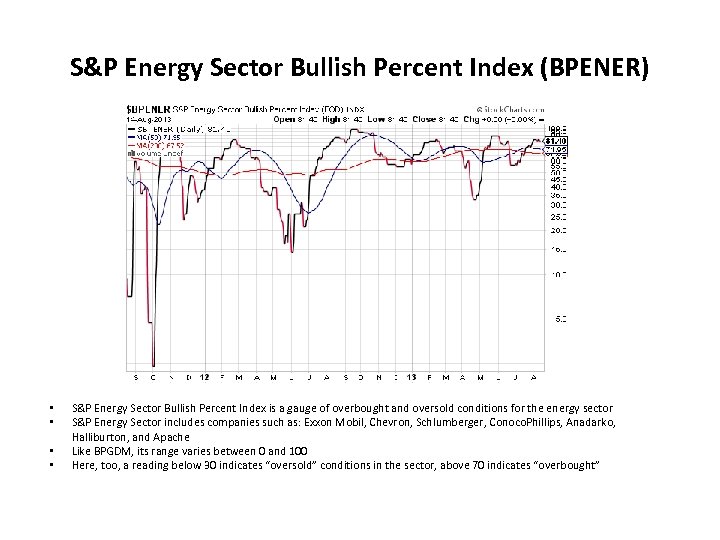 S&P Energy Sector Bullish Percent Index (BPENER) • • S&P Energy Sector Bullish Percent Index is a gauge of overbought and oversold conditions for the energy sector S&P Energy Sector includes companies such as: Exxon Mobil, Chevron, Schlumberger, Conoco. Phillips, Anadarko, Halliburton, and Apache Like BPGDM, its range varies between 0 and 100 Here, too, a reading below 30 indicates “oversold” conditions in the sector, above 70 indicates “overbought”
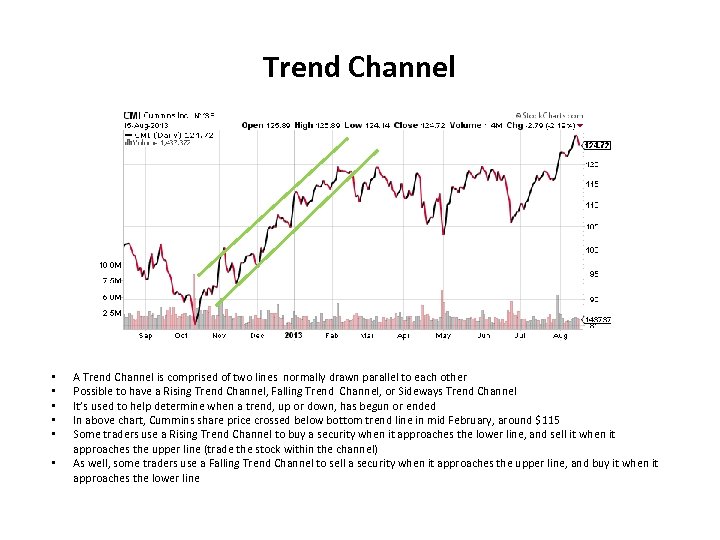 Trend Channel • • • A Trend Channel is comprised of two lines normally drawn parallel to each other Possible to have a Rising Trend Channel, Falling Trend Channel, or Sideways Trend Channel It’s used to help determine when a trend, up or down, has begun or ended In above chart, Cummins share price crossed below bottom trend line in mid February, around $115 Some traders use a Rising Trend Channel to buy a security when it approaches the lower line, and sell it when it approaches the upper line (trade the stock within the channel) As well, some traders use a Falling Trend Channel to sell a security when it approaches the upper line, and buy it when it approaches the lower line
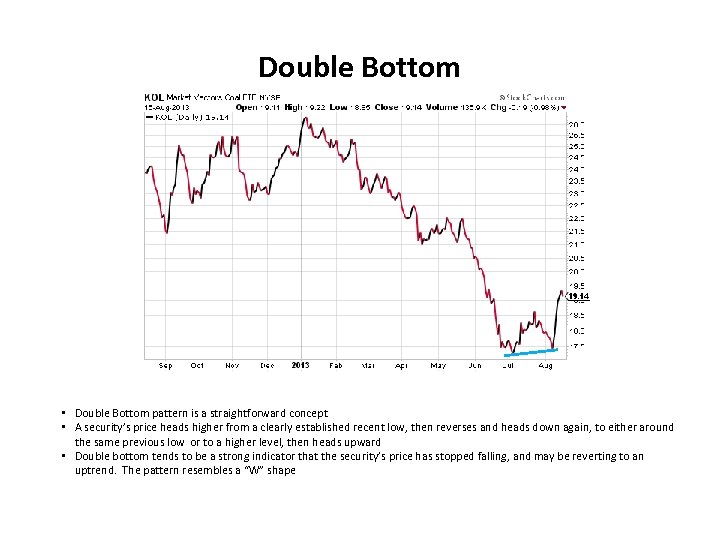 Double Bottom • Double Bottom pattern is a straightforward concept • A security’s price heads higher from a clearly established recent low, then reverses and heads down again, to either around the same previous low or to a higher level, then heads upward • Double bottom tends to be a strong indicator that the security’s price has stopped falling, and may be reverting to an uptrend. The pattern resembles a “W” shape
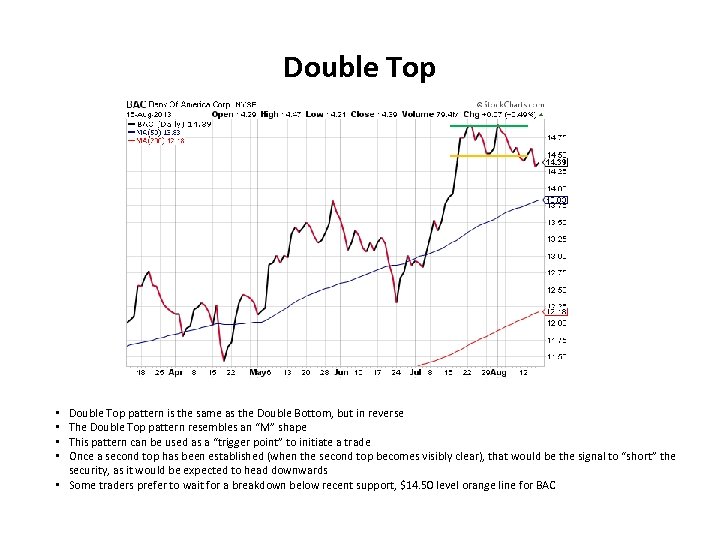 Double Top pattern is the same as the Double Bottom, but in reverse The Double Top pattern resembles an “M” shape This pattern can be used as a “trigger point” to initiate a trade Once a second top has been established (when the second top becomes visibly clear), that would be the signal to “short” the security, as it would be expected to head downwards • Some traders prefer to wait for a breakdown below recent support, $14. 50 level orange line for BAC • •
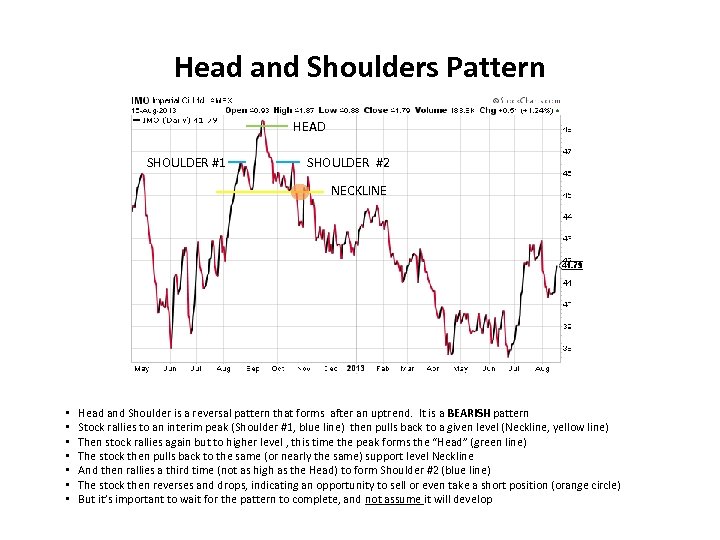 Head and Shoulders Pattern HEAD SHOULDER #1 SHOULDER #2 NECKLINE • • Head and Shoulder is a reversal pattern that forms after an uptrend. It is a BEARISH pattern Stock rallies to an interim peak (Shoulder #1, blue line) then pulls back to a given level (Neckline, yellow line) Then stock rallies again but to higher level , this time the peak forms the “Head” (green line) The stock then pulls back to the same (or nearly the same) support level Neckline And then rallies a third time (not as high as the Head) to form Shoulder #2 (blue line) The stock then reverses and drops, indicating an opportunity to sell or even take a short position (orange circle) But it’s important to wait for the pattern to complete, and not assume it will develop
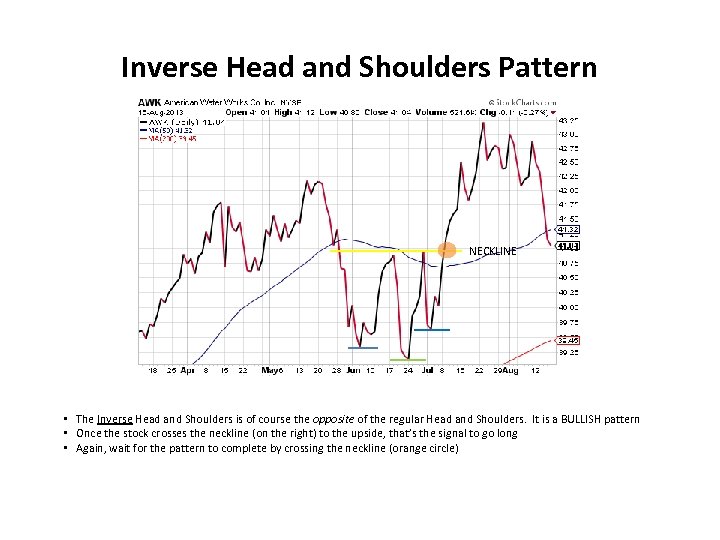 Inverse Head and Shoulders Pattern NECKLINE • The Inverse Head and Shoulders is of course the opposite of the regular Head and Shoulders. It is a BULLISH pattern • Once the stock crosses the neckline (on the right) to the upside, that’s the signal to go long • Again, wait for the pattern to complete by crossing the neckline (orange circle)
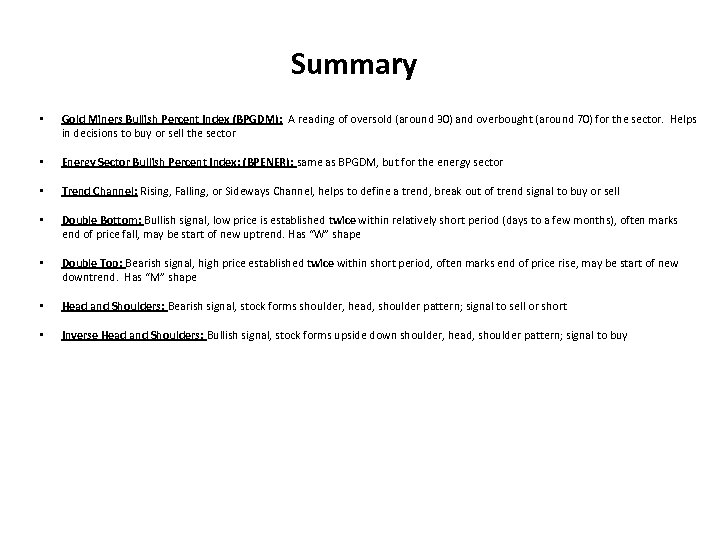 Summary • Gold Miners Bullish Percent Index (BPGDM): A reading of oversold (around 30) and overbought (around 70) for the sector. Helps in decisions to buy or sell the sector • Energy Sector Bullish Percent Index: (BPENER): same as BPGDM, but for the energy sector • Trend Channel: Rising, Falling, or Sideways Channel, helps to define a trend, break out of trend signal to buy or sell • Double Bottom: Bullish signal, low price is established twice within relatively short period (days to a few months), often marks end of price fall, may be start of new uptrend. Has “W” shape • Double Top: Bearish signal, high price established twice within short period, often marks end of price rise, may be start of new downtrend. Has “M” shape • Head and Shoulders: Bearish signal, stock forms shoulder, head, shoulder pattern; signal to sell or short • Inverse Head and Shoulders: Bullish signal, stock forms upside down shoulder, head, shoulder pattern; signal to buy