


 Скачать презентацию The SESAR Concept of Operations in Detail Andy
a82e88faeecca08d4a5c9f193c93fd0f.ppt
- Количество слайдов: 39
 The SESAR Concept of Operations in Detail Andy Barff, EUROCONTROL Philip Hogge, Airspace Users 8 th October, 2007 - NLR
 The SESAR CONOPS is Performance Driven Process Orientated Date: 05/11//07 Trajectory Based Founded on SWIM Page: 2
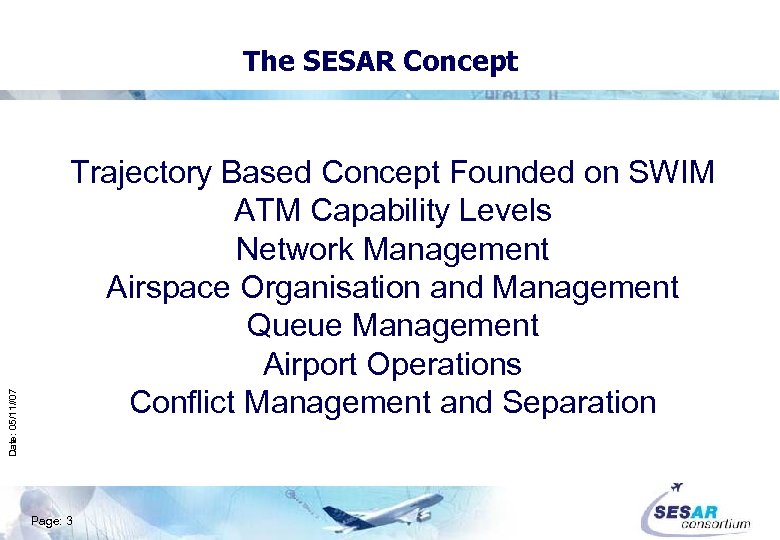 Date: 05/11//07 The SESAR Concept Trajectory Based Concept Founded on SWIM ATM Capability Levels Network Management Airspace Organisation and Management Queue Management Airport Operations Conflict Management and Separation Page: 3
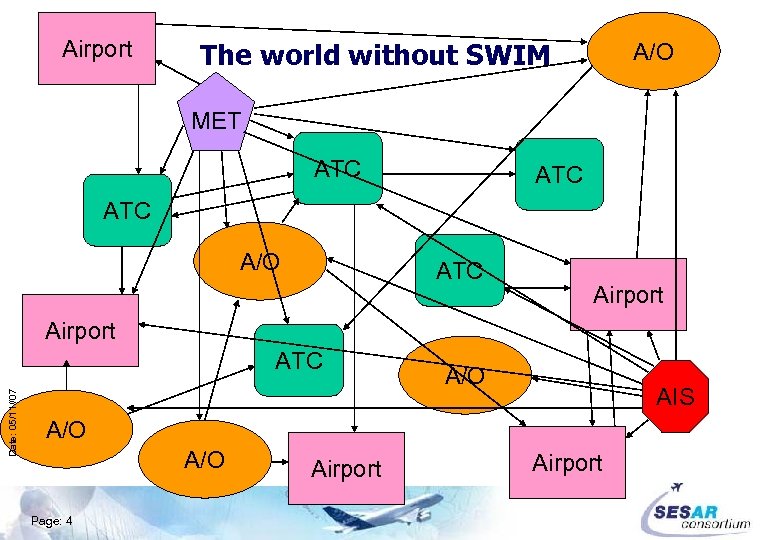 Airport The world without SWIM A/O MET ATC ATC A/O ATC Airport Date: 05/11//07 ATC A/O AIS A/O Page: 4 Airport
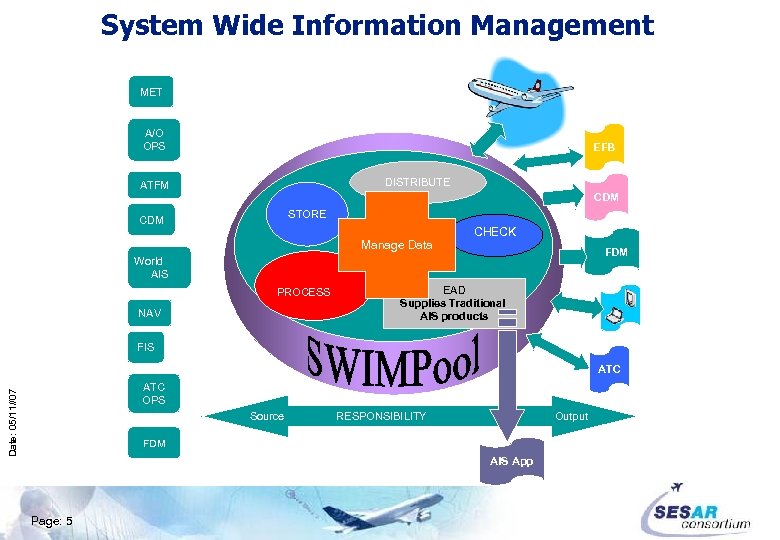 System Wide Information Management MET A/O OPS EFB DISTRIBUTE ATFM CDM STORE CHECK Manage Data FDM World AIS PROCESS NAV EAD Supplies Traditional AIS products FIS ATC Date: 05/11//07 ATC OPS Source RESPONSIBILITY Output FDM AIS App Page: 5
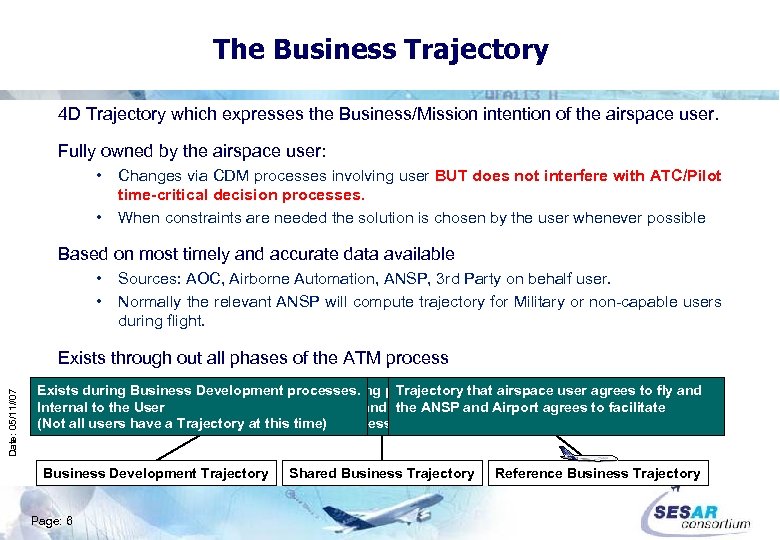 The Business Trajectory 4 D Trajectory which expresses the Business/Mission intention of the airspace user. Fully owned by the airspace user: • • Changes via CDM processes involving user BUT does not interfere with ATC/Pilot time-critical decision processes. When constraints are needed the solution is chosen by the user whenever possible Based on most timely and accurate data available • • Sources: AOC, Airborne Automation, ANSP, 3 rd Party on behalf user. Normally the relevant ANSP will compute trajectory for Military or non-capable users during flight. Date: 05/11//07 Exists through out all phases of the ATM process Exists during Business Development processes. Exists during the planning phase Trajectory that airspace user agrees to fly and Internal to the User ‘Published’ by the user and shared by all participants the ANSP and Airport agrees to facilitate (Not all users have a Trajectoryentry point to process will vary) (User at this time) Business Development Trajectory Page: 6 Shared Business Trajectory Reference Business Trajectory
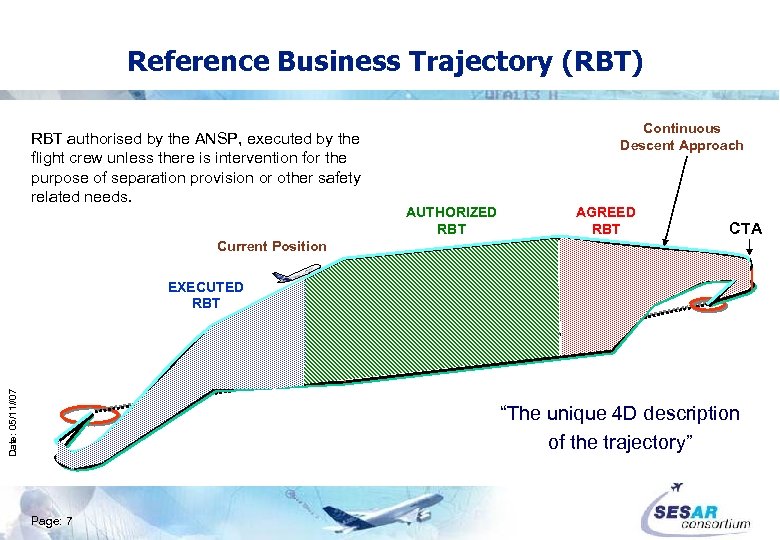 Reference Business Trajectory (RBT) RBT authorised by the ANSP, executed by the flight crew unless there is intervention for the purpose of separation provision or other safety related needs. Continuous Descent Approach AUTHORIZED RBT AGREED RBT CTA Current Position Date: 05/11//07 EXECUTED RBT “The unique 4 D description of the trajectory” Page: 7
 Date: 05/11//07 ATM Capability Levels Page: 8
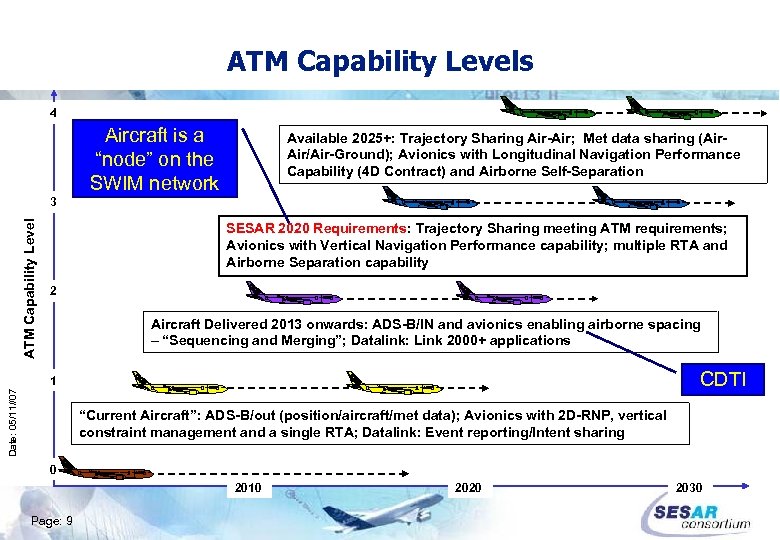 ATM Capability Levels 4 Aircraft is a “node” on the SWIM network Available 2025+: Trajectory Sharing Air-Air; Met data sharing (Air. Air/Air-Ground); Avionics with Longitudinal Navigation Performance Capability (4 D Contract) and Airborne Self-Separation ATM Capability Level 3 SESAR 2020 Requirements: Trajectory Sharing meeting ATM requirements; Avionics with Vertical Navigation Performance capability; multiple RTA and Airborne Separation capability 2 Aircraft Delivered 2013 onwards: ADS-B/IN and avionics enabling airborne spacing – “Sequencing and Merging”; Datalink: Link 2000+ applications CDTI Date: 05/11//07 1 “Current Aircraft”: ADS-B/out (position/aircraft/met data); Avionics with 2 D-RNP, vertical constraint management and a single RTA; Datalink: Event reporting/Intent sharing 0 2010 Page: 9 2020 2030
 Date: 05/11//07 Managing the Network Page: 10
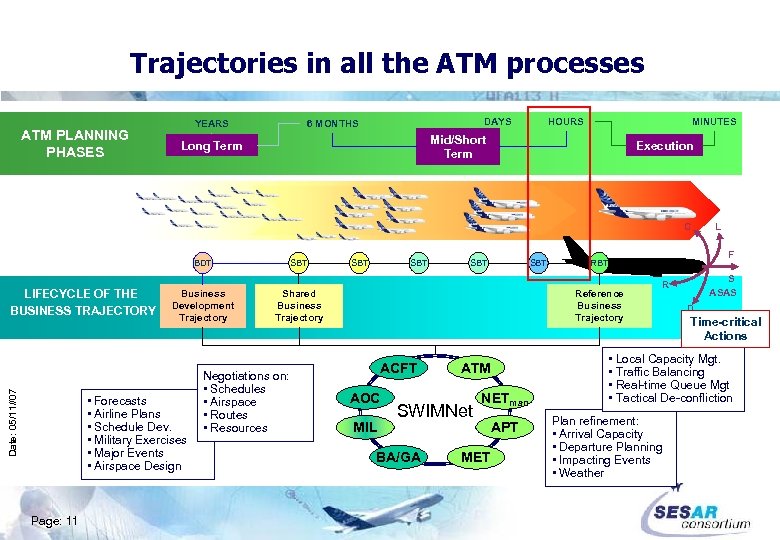 Trajectories in all the ATM processes ATM PLANNING PHASES YEARS DAYS 6 MONTHS HOURS MINUTES Mid/Short Term Long Term Execution C BDT Date: 05/11//07 LIFECYCLE OF THE BUSINESS TRAJECTORY Business Development Trajectory • Forecasts • Airline Plans • Schedule Dev. • Military Exercises • Major Events • Airspace Design Page: 11 SBT SBT SBT Shared Business Trajectory Negotiations on: • Schedules • Airspace • Routes • Resources F RBT Reference Business Trajectory ACFT AOC MIL ATM SWIMNet BA/GA NETman MET APT L S ASAS R D Time-critical Actions • Local Capacity Mgt. • Traffic Balancing • Real-time Queue Mgt • Tactical De-confliction Plan refinement: • Arrival Capacity • Departure Planning • Impacting Events • Weather
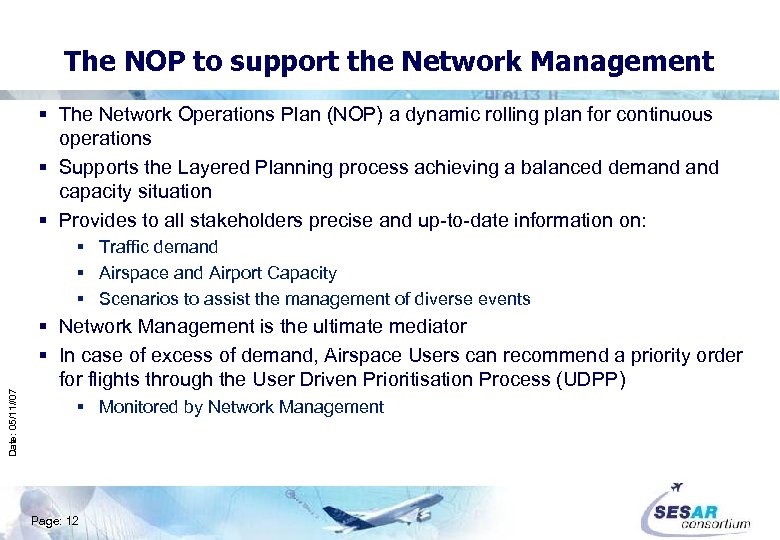 The NOP to support the Network Management § The Network Operations Plan (NOP) a dynamic rolling plan for continuous operations § Supports the Layered Planning process achieving a balanced demand capacity situation § Provides to all stakeholders precise and up-to-date information on: Date: 05/11//07 § Traffic demand § Airspace and Airport Capacity § Scenarios to assist the management of diverse events § Network Management is the ultimate mediator § In case of excess of demand, Airspace Users can recommend a priority order for flights through the User Driven Prioritisation Process (UDPP) § Monitored by Network Management Page: 12
 Date: 05/11//07 Airspace Organisation and Management Page: 13
 Airspace Organisation and Management • • European Airspace a Single Continuum Two types of airspace – managed and unmanaged • • Date: 05/11//07 • Managed: • All information on all traffic is shared • Pre-determined separator is the ANSP (may be delegated) Unmanaged: • Traffic may not share information • Pre-determined separator in the Flight Crew Full application of Flexible Use of Airspace (FUA) by 2020 and the gradual abandonment of fixed dimensions for special airspace activities • • Page: 14 New airspace types (dynamic, variable, mobile) Improved airspace management and simulation
 Airspace Organisation and Management • Needs of Trajectory Management determine the dynamic adjustment of airspace • Distortions to the business/mission trajectory kept to an absolute minimum • • In Managed airspace user preferred routing will apply with no need to adhere to a fixed route structure • • Date: 05/11//07 Potential distortions at points of transfer (Lo. A etc. ) eliminated through trajectory sharing • Page: 15 Route structures will be available Trade off between flight efficiency and capacity will mean that route structures may be deployed to maximise capacity and suspended when no longer needed In vicinity of major airports route structures may be essential and may extend to/from cruising levels
 Date: 05/11//07 Queue Management Page: 16
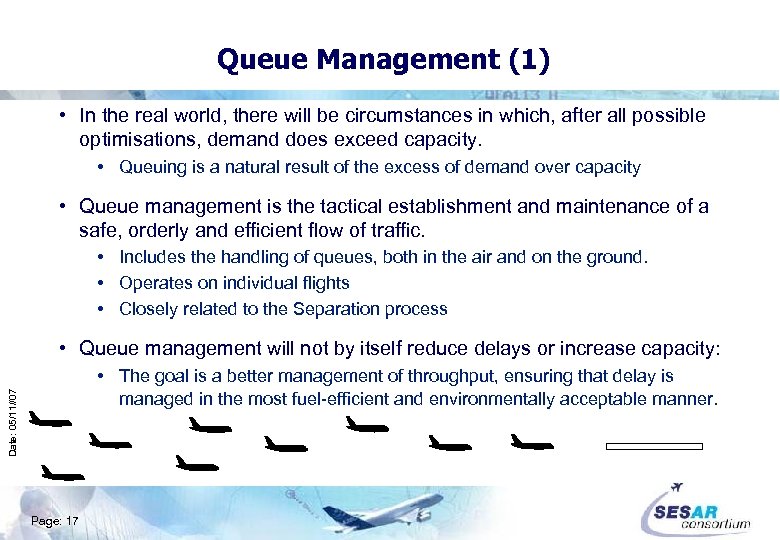 Queue Management (1) • In the real world, there will be circumstances in which, after all possible optimisations, demand does exceed capacity. • Queuing is a natural result of the excess of demand over capacity • Queue management is the tactical establishment and maintenance of a safe, orderly and efficient flow of traffic. • Includes the handling of queues, both in the air and on the ground. • Operates on individual flights • Closely related to the Separation process • Queue management will not by itself reduce delays or increase capacity: Date: 05/11//07 • The goal is a better management of throughput, ensuring that delay is managed in the most fuel-efficient and environmentally acceptable manner. Page: 17
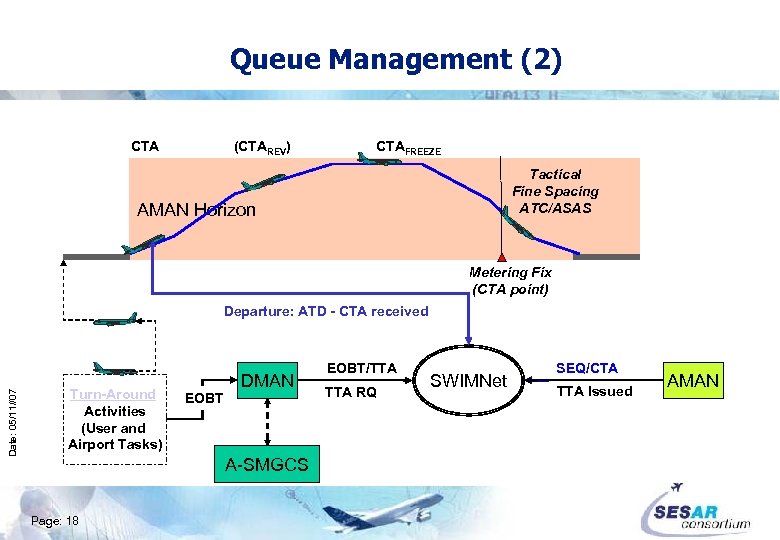 Queue Management (2) (CTAREV) CTAFREEZE Tactical Fine Spacing ATC/ASAS AMAN Horizon Metering Fix (CTA point) Date: 05/11//07 Departure: ATD - CTA received Turn-Around Activities (User and Airport Tasks) DMAN EOBT A-SMGCS Page: 18 EOBT/TTA RQ SWIMNet SEQ/CTA TTA Issued AMAN
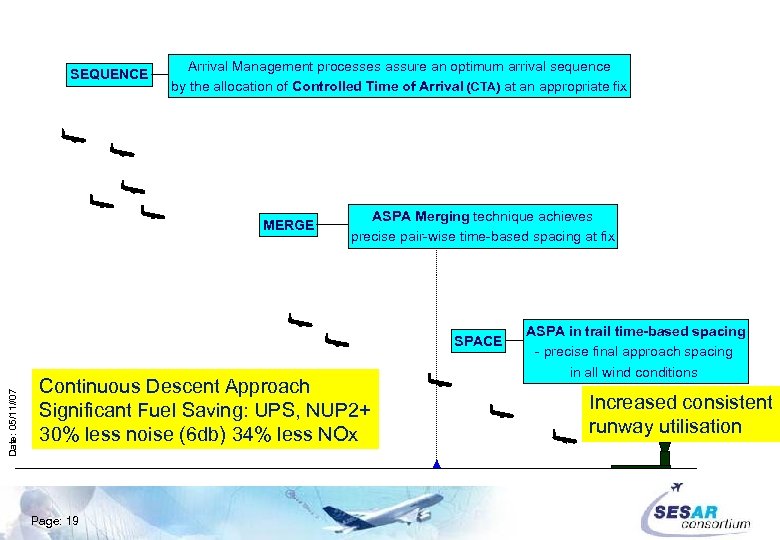 SEQUENCE Arrival Management processes assure an optimum arrival sequence by the allocation of Controlled Time of Arrival (CTA) at an appropriate fix MERGE ASPA Merging technique achieves precise pair-wise time-based spacing at fix Date: 05/11//07 SPACE Continuous Descent Approach Significant Fuel Saving: UPS, NUP 2+ 30% less noise (6 db) 34% less NOx Page: 19 ASPA in trail time-based spacing - precise final approach spacing in all wind conditions Increased consistent runway utilisation
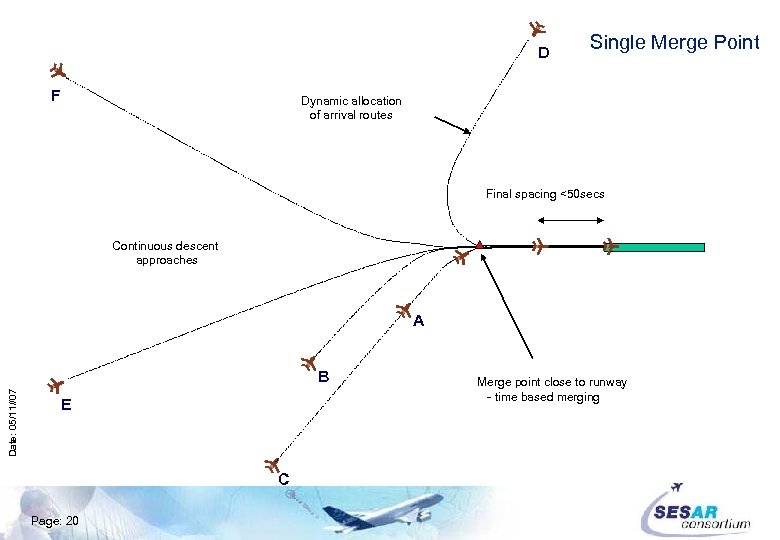 D F Single Merge Point Dynamic allocation of arrival routes Final spacing <50 secs Continuous descent approaches A Date: 05/11//07 B E C Page: 20 Merge point close to runway - time based merging
 Date: 05/11//07 Airport Operations Page: 21
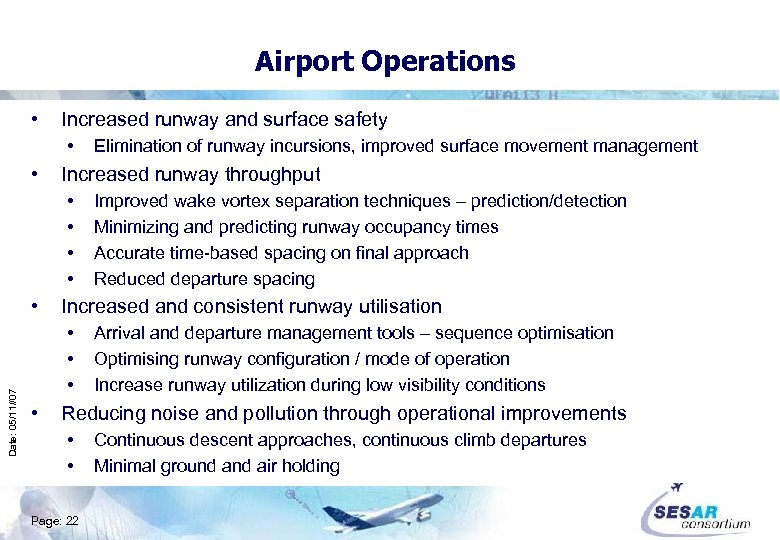 Airport Operations • Increased runway and surface safety • • Increased runway throughput • • Date: 05/11//07 • Improved wake vortex separation techniques – prediction/detection Minimizing and predicting runway occupancy times Accurate time-based spacing on final approach Reduced departure spacing Increased and consistent runway utilisation • • Elimination of runway incursions, improved surface movement management Arrival and departure management tools – sequence optimisation Optimising runway configuration / mode of operation Increase runway utilization during low visibility conditions Reducing noise and pollution through operational improvements • • Page: 22 Continuous descent approaches, continuous climb departures Minimal ground air holding
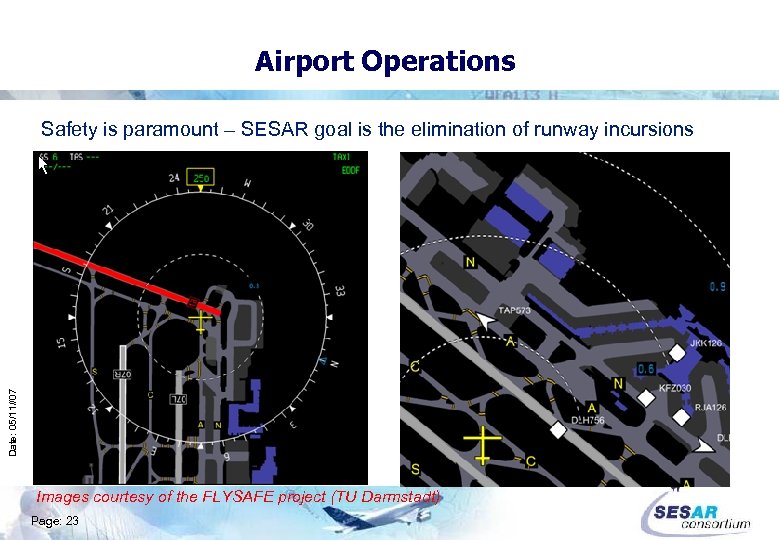 Airport Operations Date: 05/11//07 Safety is paramount – SESAR goal is the elimination of runway incursions Images courtesy of the FLYSAFE project (TU Darmstadt) Page: 23
 Date: 05/11//07 Conflict Management and Separation Page: 24
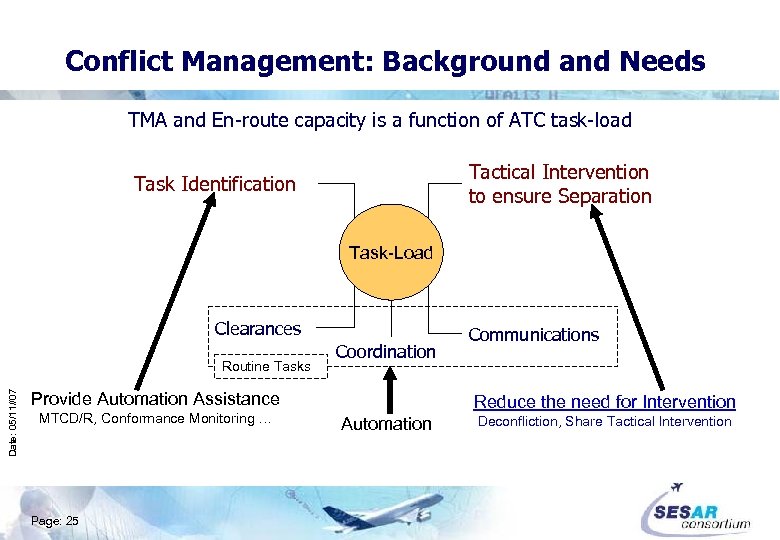 Conflict Management: Background and Needs TMA and En-route capacity is a function of ATC task-load Tactical Intervention to ensure Separation Task Identification Task-Load Clearances Date: 05/11//07 Routine Tasks Coordination Provide Automation Assistance MTCD/R, Conformance Monitoring … Page: 25 Communications Reduce the need for Intervention Automation Deconfliction, Share Tactical Intervention
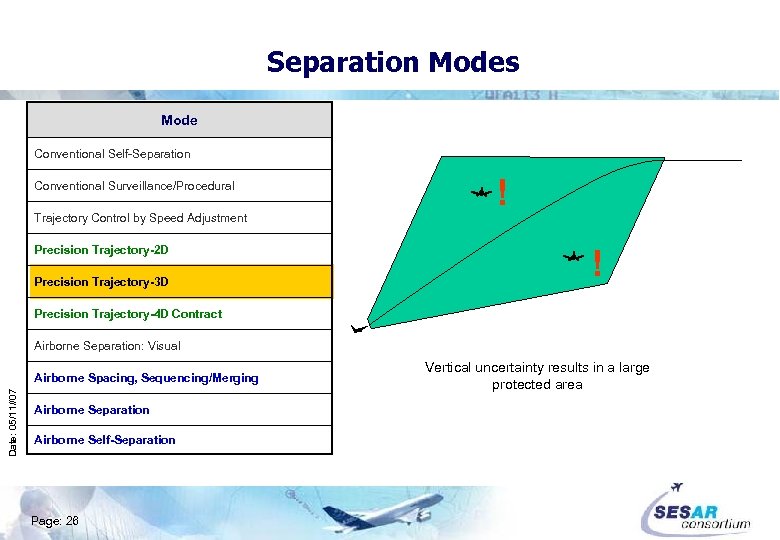 Separation Modes Mode Conventional Self-Separation Conventional Surveillance/Procedural Trajectory Control by Speed Adjustment Precision Trajectory-2 D Precision Trajectory-3 D ! ! Precision Trajectory-4 D Contract Airborne Separation: Visual Date: 05/11//07 Airborne Spacing, Sequencing/Merging Airborne Separation Airborne Self-Separation Page: 26 Vertical uncertainty results in a large protected area
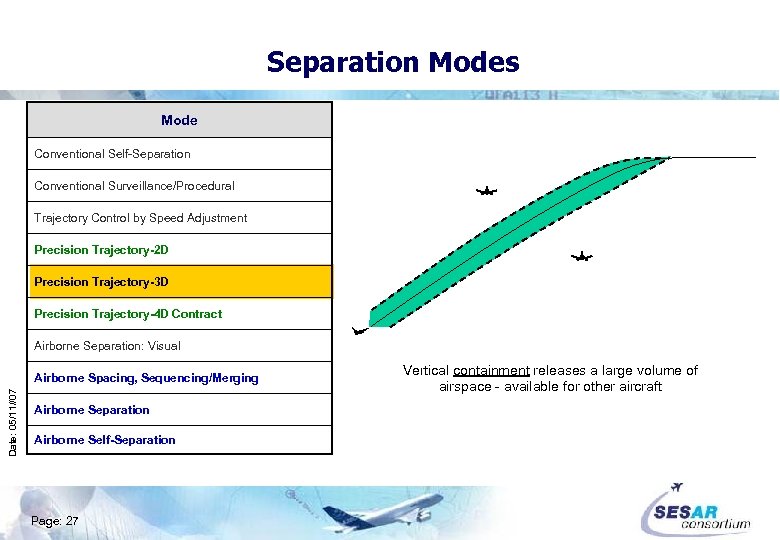 Separation Modes Mode Conventional Self-Separation Conventional Surveillance/Procedural Trajectory Control by Speed Adjustment Precision Trajectory-2 D Precision Trajectory-3 D Precision Trajectory-4 D Contract Airborne Separation: Visual Date: 05/11//07 Airborne Spacing, Sequencing/Merging Airborne Separation Airborne Self-Separation Page: 27 Vertical containment releases a large volume of airspace - available for other aircraft
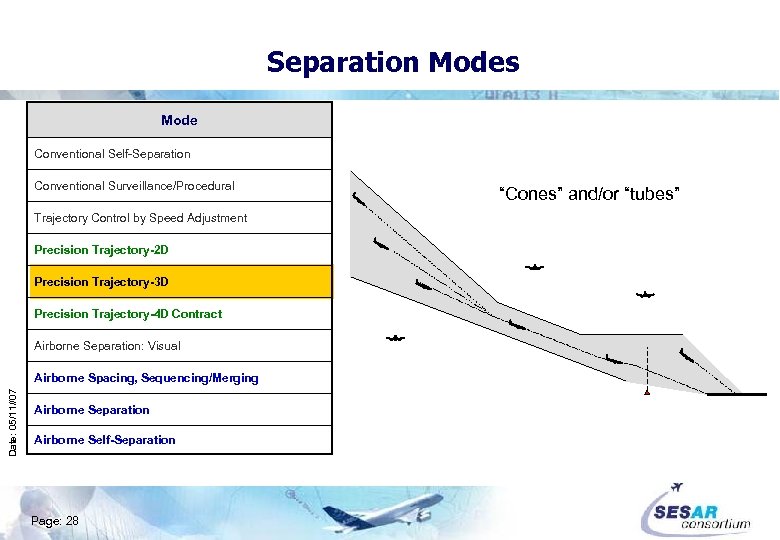 Separation Modes Mode Conventional Self-Separation Conventional Surveillance/Procedural Trajectory Control by Speed Adjustment Precision Trajectory-2 D Precision Trajectory-3 D Precision Trajectory-4 D Contract Airborne Separation: Visual Date: 05/11//07 Airborne Spacing, Sequencing/Merging Airborne Separation Airborne Self-Separation Page: 28 “Cones” and/or “tubes”
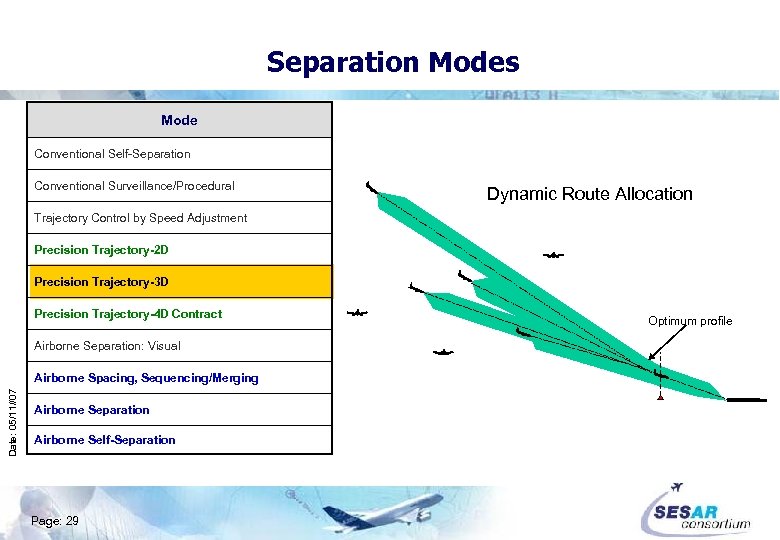 Separation Modes Mode Conventional Self-Separation Conventional Surveillance/Procedural Dynamic Route Allocation Trajectory Control by Speed Adjustment Precision Trajectory-2 D Precision Trajectory-3 D Precision Trajectory-4 D Contract Airborne Separation: Visual Date: 05/11//07 Airborne Spacing, Sequencing/Merging Airborne Separation Airborne Self-Separation Page: 29 Optimum profile
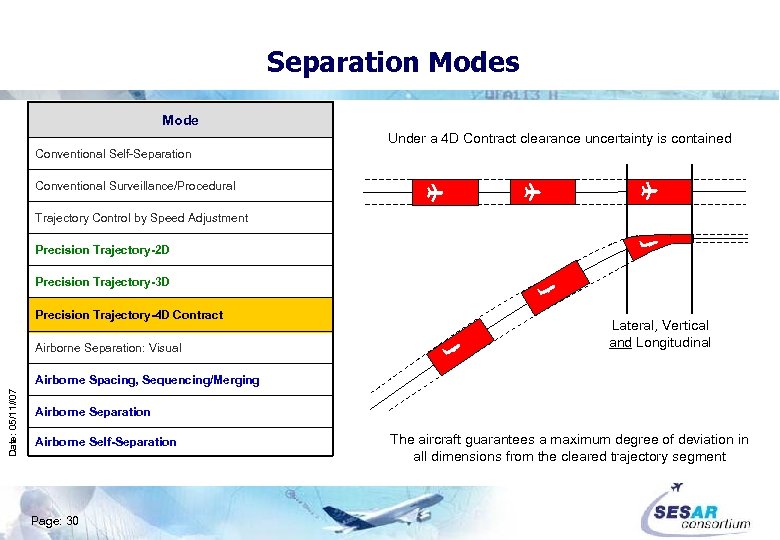 Separation Modes Mode Under a 4 D Contract clearance uncertainty is contained Conventional Self-Separation Conventional Surveillance/Procedural Trajectory Control by Speed Adjustment Precision Trajectory-2 D Precision Trajectory-3 D Precision Trajectory-4 D Contract Airborne Separation: Visual Lateral, Vertical and Longitudinal Date: 05/11//07 Airborne Spacing, Sequencing/Merging Airborne Separation Airborne Self-Separation Page: 30 The aircraft guarantees a maximum degree of deviation in all dimensions from the cleared trajectory segment
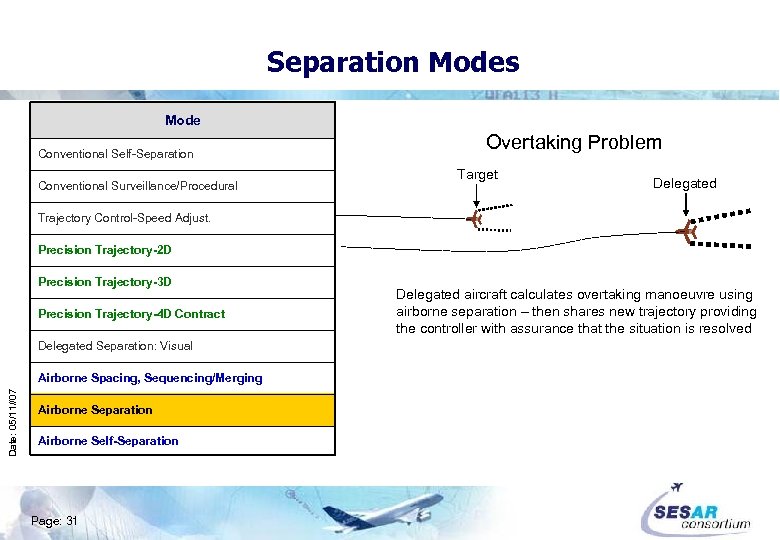 Separation Modes Mode Conventional Self-Separation Conventional Surveillance/Procedural Overtaking Problem Target Delegated Trajectory Control-Speed Adjust. Precision Trajectory-2 D Precision Trajectory-3 D Precision Trajectory-4 D Contract Delegated Separation: Visual Date: 05/11//07 Airborne Spacing, Sequencing/Merging Airborne Separation Airborne Self-Separation Page: 31 Delegated aircraft calculates overtaking manoeuvre using airborne separation – then shares new trajectory providing the controller with assurance that the situation is resolved
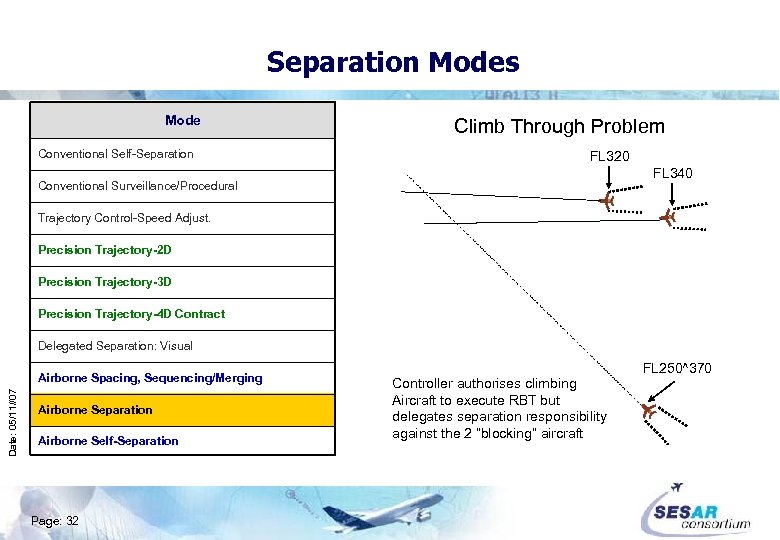 Separation Modes Mode Conventional Self-Separation Climb Through Problem FL 320 FL 340 Conventional Surveillance/Procedural Trajectory Control-Speed Adjust. Precision Trajectory-2 D Precision Trajectory-3 D Precision Trajectory-4 D Contract Delegated Separation: Visual Date: 05/11//07 Airborne Spacing, Sequencing/Merging Airborne Separation Airborne Self-Separation Page: 32 Controller authorises climbing Aircraft to execute RBT but delegates separation responsibility against the 2 “blocking” aircraft FL 250^370
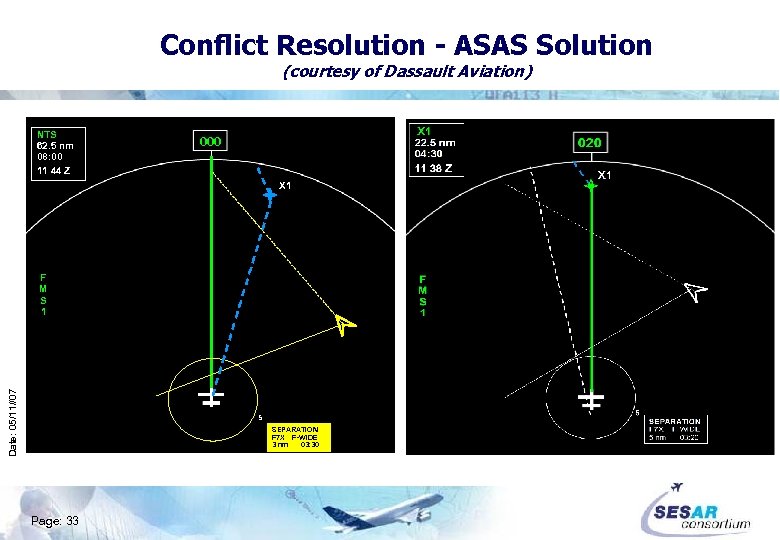 Conflict Resolution - ASAS Solution (courtesy of Dassault Aviation) NTS 62. 5 nm 08: 00 11 44 Z 000 X 1 ADS-B will provide : An accurate position of the Intruder The Track of the Intruder The Ground Speed of the Intruder F M S 1 and so the intruder relative course Appropriated route change Date: 05/11//07 might be proposed to the pilot 5 SEPARATION F 7 X F-WIDE 3 nm 03: 30 Page: 33
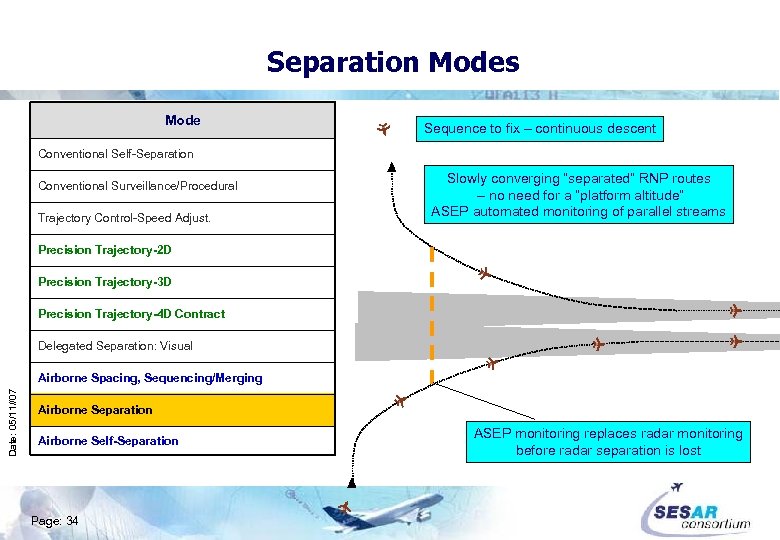 Separation Modes Mode Sequence to fix – continuous descent Conventional Self-Separation Conventional Surveillance/Procedural Trajectory Control-Speed Adjust. Slowly converging “separated” RNP routes – no need for a “platform altitude” ASEP automated monitoring of parallel streams Precision Trajectory-2 D Precision Trajectory-3 D Precision Trajectory-4 D Contract Delegated Separation: Visual Date: 05/11//07 Airborne Spacing, Sequencing/Merging Airborne Separation Airborne Self-Separation Page: 34 ASEP monitoring replaces radar monitoring before radar separation is lost
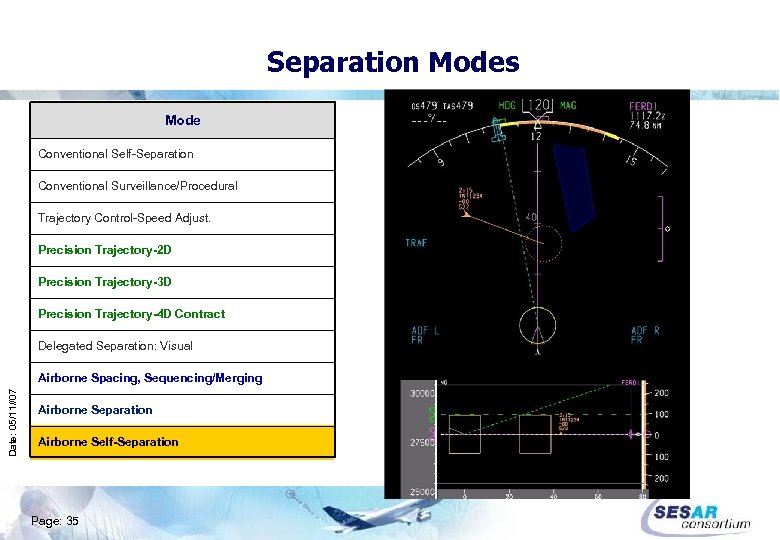 Separation Modes Mode Conventional Self-Separation Conventional Surveillance/Procedural Trajectory Control-Speed Adjust. Precision Trajectory-2 D Precision Trajectory-3 D Precision Trajectory-4 D Contract Delegated Separation: Visual Date: 05/11//07 Airborne Spacing, Sequencing/Merging Airborne Separation Airborne Self-Separation Page: 35
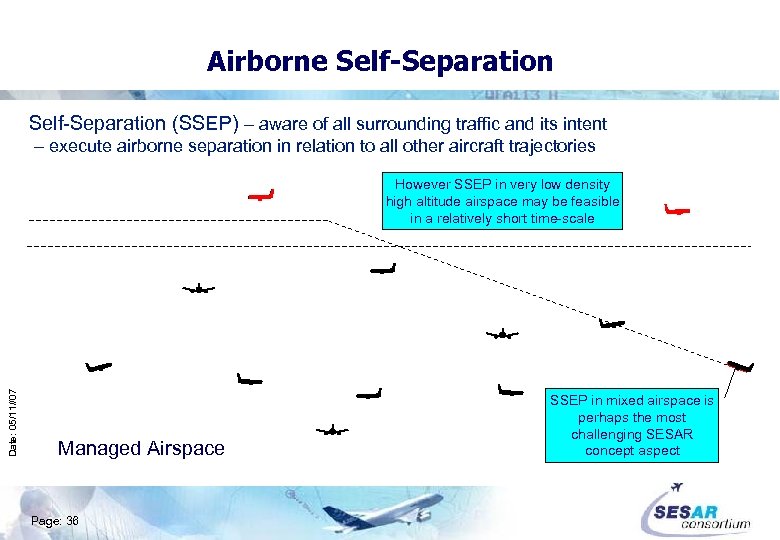 Airborne Self-Separation (SSEP) – aware of all surrounding traffic and its intent – execute airborne separation in relation to all other aircraft trajectories Date: 05/11//07 However SSEP in very low density high altitude airspace may be feasible in a relatively short time-scale Managed Airspace Page: 36 SSEP in mixed airspace is perhaps the most challenging SESAR concept aspect
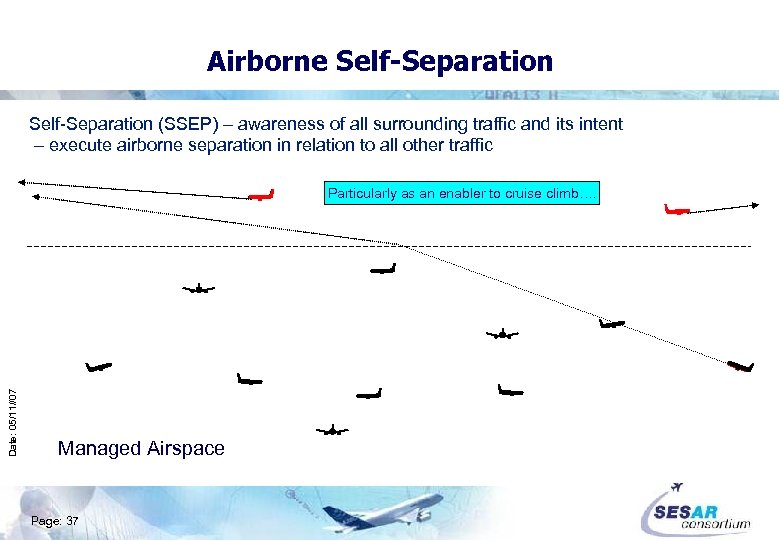 Airborne Self-Separation (SSEP) – awareness of all surrounding traffic and its intent – execute airborne separation in relation to all other traffic Date: 05/11//07 Particularly as an enabler to cruise climb…. Managed Airspace Page: 37
 IN CONCLUSION • SESAR stakeholders have risen to the challenge and have developed this new Concept of Operations. • We now respect each others positions much more! • There is a high level of agreement – and any disagreements or caveats will be respected on the way ahead. • SESAR will now use this Concept of Operations as the basis of the ATM Master Plan and will test and validate the ideas it contains. Date: 05/11//07 Main themes of SESAR are very similar to those of Next. Gen The SESAR Concept of Operations is fully compliant with the ICAO OCD Page: 38
 The SESAR Concept of Operations in Detail Questions? 8 th October, 2007 - NLR