


 Скачать презентацию The Security Council Counter-Terrorism Committee and its Executive
f8471714cca33cc0d2bbbba6636d86ce.ppt
- Количество слайдов: 26
 The Security Council Counter-Terrorism Committee and its Executive Directorate (CTED) Counter-Terrorism Committee Executive Directorate (CTED) United Nations 2 nd International Psy. Ops Conference Baghdad, 10 -11 August 2016
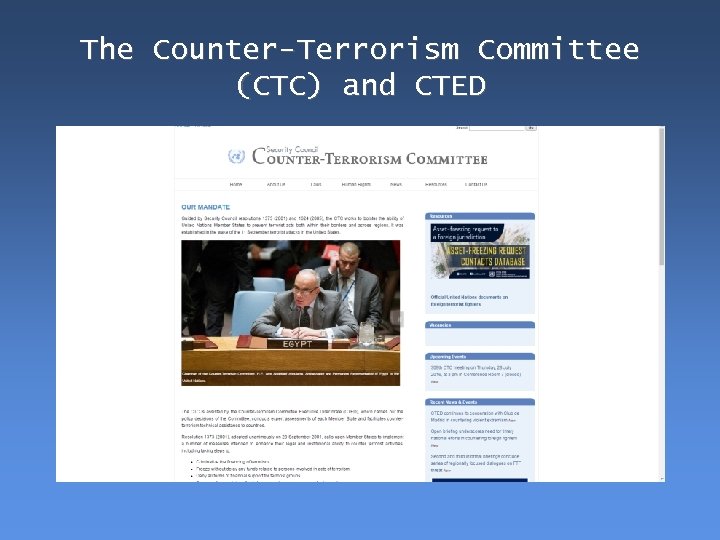 The Counter-Terrorism Committee (CTC) and CTED
 CTED’s primary mandate Ø Primary mandate to assist the CTC: Ø in monitoring the implementation by MS of SC resolutions 1373 (2001), 1624 (2005), and 2178 (2014); Ø in identifying shortfalls in implementation; Ø in facilitating the provision of technical assistance. Ø Promoting international cooperation and information sharing Ø Promoting awareness of and adherence to international human rights
 UNSC resolution 2178 (2014) on stemming FTFs: Outline I. II. SC resolution 2178 (2014) § Member States’ obligations § New elements (compared to SC resolutions 1373 (2001) and 1624 (2005) and others) § Comprehensive approach CTED’s mandate and role III. Implications for Law Enforcement Community I. Key human rights issues
![UNSC resolution 2178 (2014) [continued] § SC resolution 2178 (2014) unanimously adopted on 24](https://present5.com/presentation/f8471714cca33cc0d2bbbba6636d86ce/image-5.jpg "UNSC resolution 2178 (2014) [continued] § SC resolution 2178 (2014) unanimously adopted on 24") UNSC resolution 2178 (2014) [continued] § SC resolution 2178 (2014) unanimously adopted on 24 September 2014 § First SC resolution on countering terrorism under Chapter VII of the UN Charter since SC resolution 1373 (2001) § Chapter VII = mandatory action by UN Member States § Co-sponsored by 104 UN Member States § Foreign Terrorist Fighters (FTF) not a new phenomenon, however, unprecedented scale (More than 30, 000 from more than 100 countries*) § Unusually high level of pre-adoption buy-in * Estimated as of July 2016
UNSC resolution 2178 (2014) [continued] § SC resolution 2178 (2014) unanimously adopted on 24 September 2014 § First SC resolution on countering terrorism under Chapter VII of the UN Charter since SC resolution 1373 (2001) § Chapter VII = mandatory action by UN Member States § Co-sponsored by 104 UN Member States § Foreign Terrorist Fighters (FTF) not a new phenomenon, however, unprecedented scale (More than 30, 000 from more than 100 countries*) § Unusually high level of pre-adoption buy-in * Estimated as of July 2016
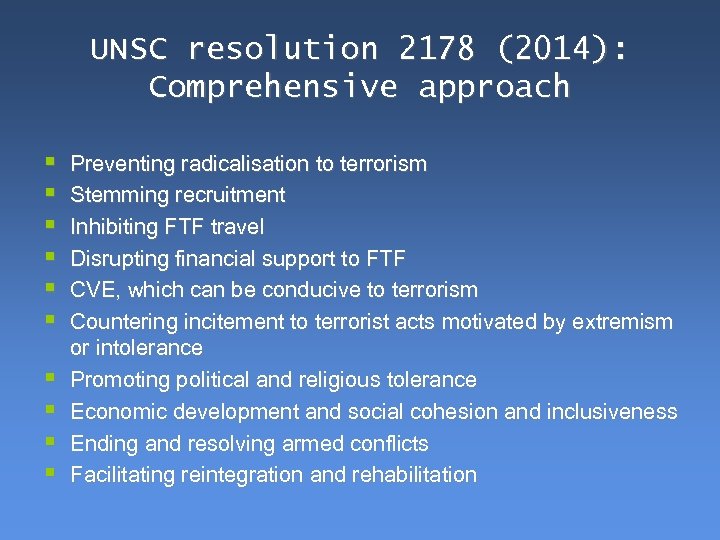 UNSC resolution 2178 (2014): Comprehensive approach § § § § § Preventing radicalisation to terrorism Stemming recruitment Inhibiting FTF travel Disrupting financial support to FTF CVE, which can be conducive to terrorism Countering incitement to terrorist acts motivated by extremism or intolerance Promoting political and religious tolerance Economic development and social cohesion and inclusiveness Ending and resolving armed conflicts Facilitating reintegration and rehabilitation
 FTFs: Definition Foreign terrorist fighters (FTFs) are “individuals who travel to a State other than their States of residence or nationality for the purpose of the perpetration, planning, or preparation of, or participation in, terrorist acts or the providing or receiving of terrorist training, including in connection with armed conflict” (United Nations Security Council resolution 2178)
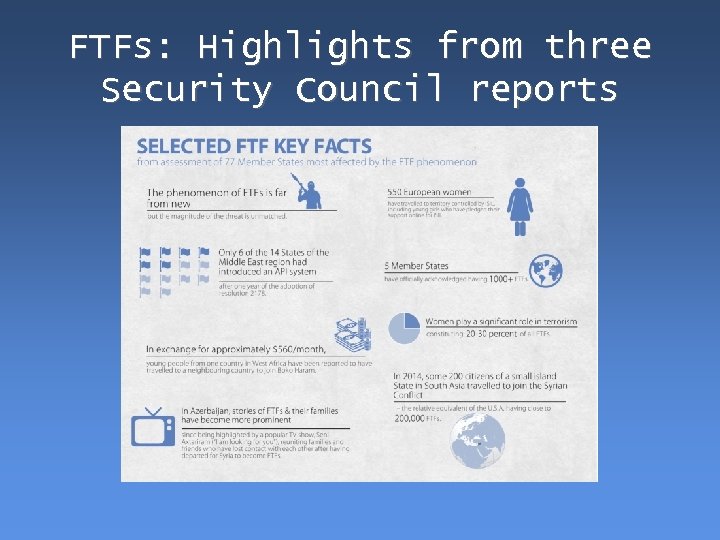 FTFs: Highlights from three Security Council reports
![[Highlights fr 3 SC reports, cont’d] Scope of the threat: 30 K+ FTFs from](https://present5.com/presentation/f8471714cca33cc0d2bbbba6636d86ce/image-9.jpg "[Highlights fr 3 SC reports, cont’d] Scope of the threat: 30 K+ FTFs from") [Highlights fr 3 SC reports, cont’d] Scope of the threat: 30 K+ FTFs from over 100 MS
[Highlights fr 3 SC reports, cont’d] Scope of the threat: 30 K+ FTFs from over 100 MS
![[Highlights fr 3 SC reports, cont’d] FTFs: Women and girls](https://present5.com/presentation/f8471714cca33cc0d2bbbba6636d86ce/image-10.jpg "[Highlights fr 3 SC reports, cont’d] FTFs: Women and girls") [Highlights fr 3 SC reports, cont’d] FTFs: Women and girls
[Highlights fr 3 SC reports, cont’d] FTFs: Women and girls
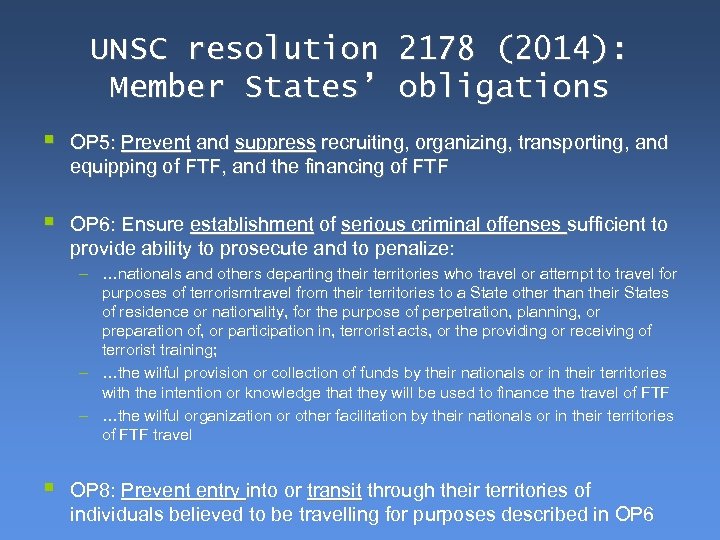 UNSC resolution 2178 (2014): Member States’ obligations § OP 5: Prevent and suppress recruiting, organizing, transporting, and equipping of FTF, and the financing of FTF § OP 6: Ensure establishment of serious criminal offenses sufficient to provide ability to prosecute and to penalize: – …nationals and others departing their territories who travel or attempt to travel for purposes of terrorismtravel from their territories to a State other than their States of residence or nationality, for the purpose of perpetration, planning, or preparation of, or participation in, terrorist acts, or the providing or receiving of terrorist training; – …the wilful provision or collection of funds by their nationals or in their territories with the intention or knowledge that they will be used to finance the travel of FTF – …the wilful organization or other facilitation by their nationals or in their territories of FTF travel § OP 8: Prevent entry into or transit through their territories of individuals believed to be travelling for purposes described in OP 6
 UNSC resolution 2178 (2014): Further elements International cooperation § International and (sub-)regional cooperation to prevent FTF travel § International and (sub-)regional cooperation in terrorism-related investigations and prosecution § MS assist each other in building capacity to address FTF threat Countering violent extremism (CVE) § Enhance CVE efforts; decrease risk of radicalization to terrorism § Engage local communities and NGO actors to develop CVE narratives and strategies
![UNSC resolution 2178 (2014): Further elements [continued] Technical requirements § Require airlines operating in](https://present5.com/presentation/f8471714cca33cc0d2bbbba6636d86ce/image-13.jpg "UNSC resolution 2178 (2014): Further elements [continued] Technical requirements § Require airlines operating in") UNSC resolution 2178 (2014): Further elements [continued] Technical requirements § Require airlines operating in their territories to provide advance passenger information
UNSC resolution 2178 (2014): Further elements [continued] Technical requirements § Require airlines operating in their territories to provide advance passenger information
 UNSC resolution 2178 (2014): New elements § OP 1: DEMANDS that FTF disarm and cease all terrorist acts and participation in armed conflict § OP 2: Collection and analysis of travel data for evidence-based traveller risk assessment and screening (cf. SC Resolution 1624 (2005)) without resorting to profiling based on stereotypes founded on grounds of discrimination prohibited by international law – LIMITATION ON RELIGIOUS OR RACIAL PROFILING § OP 3: movement of terrorists or terrorist networks § OP 4: preventing the radicalization to terrorism (cf. SC Resolution 2170 (2014)) § OP 4: prevent the recruitment of FTF including children (cf. SC Resolution 1373 (2001)) § OP 4: “prevent FTF from crossing their borders” (cf. SC Resolution 1373 (2001))
![UNSC resolution 2178 (2014): New elements [continued] §OP 4: disrupting and preventing financial support](https://present5.com/presentation/f8471714cca33cc0d2bbbba6636d86ce/image-15.jpg "UNSC resolution 2178 (2014): New elements [continued] §OP 4: disrupting and preventing financial support") UNSC resolution 2178 (2014): New elements [continued] §OP 4: disrupting and preventing financial support (cf. SC Resolution 1373 (2001)) §OP 4: developing and implementing prosecution, rehabilitation and reintegration strategies for returning fighters §OP 5: criminalizing receiving (in addition to the provision) of terrorist training §OP 6: criminalization of organization or facilitation of travel for terrorism purposes, or attempt thereto §OP 6: other facilitation (not defined) §OP 8: MS to require airlines providing advance passenger information to detect UN-listed terrorists §OP 15 -19: CVE featured in a Chapter VII SC resolution
UNSC resolution 2178 (2014): New elements [continued] §OP 4: disrupting and preventing financial support (cf. SC Resolution 1373 (2001)) §OP 4: developing and implementing prosecution, rehabilitation and reintegration strategies for returning fighters §OP 5: criminalizing receiving (in addition to the provision) of terrorist training §OP 6: criminalization of organization or facilitation of travel for terrorism purposes, or attempt thereto §OP 6: other facilitation (not defined) §OP 8: MS to require airlines providing advance passenger information to detect UN-listed terrorists §OP 15 -19: CVE featured in a Chapter VII SC resolution
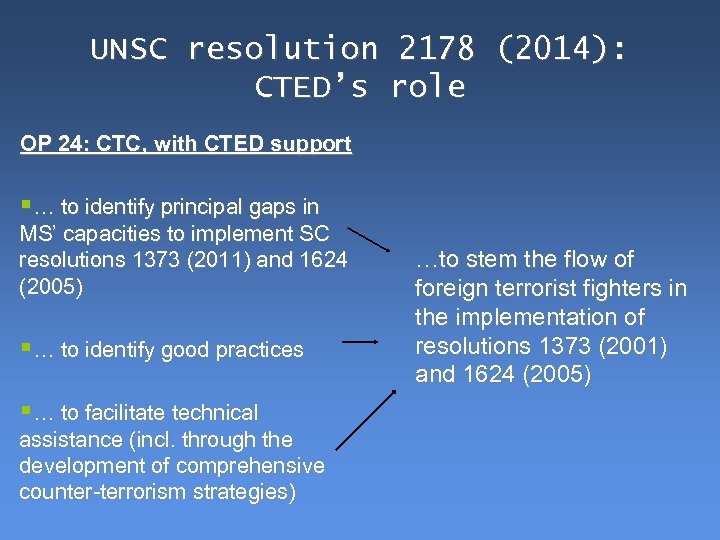 UNSC resolution 2178 (2014): CTED’s role OP 24: CTC, with CTED support §… to identify principal gaps in MS’ capacities to implement SC resolutions 1373 (2011) and 1624 (2005) §… to identify good practices §… to facilitate technical assistance (incl. through the development of comprehensive counter-terrorism strategies) …to stem the flow of foreign terrorist fighters in the implementation of resolutions 1373 (2001) and 1624 (2005)
![UNSC resolution 2178 (2014): CTED’s role [continued] §Conducting country visits to MS most affected](https://present5.com/presentation/f8471714cca33cc0d2bbbba6636d86ce/image-17.jpg "UNSC resolution 2178 (2014): CTED’s role [continued] §Conducting country visits to MS most affected") UNSC resolution 2178 (2014): CTED’s role [continued] §Conducting country visits to MS most affected by FTF §Compiling recommendations for CTC and SC follow-up §Gathering and disseminating good practices §Sharing information collected to facilitate technical assistance §Inviting MS to provide relevant information §Produced a gap analyses of MS’ legal frameworks and capacities o Gaps in Legal Frameworks, Financial Regulations, Law Enforcement and Border Control, and other areas o Detailed analysis available in UN Security Council Report S/2014/807
UNSC resolution 2178 (2014): CTED’s role [continued] §Conducting country visits to MS most affected by FTF §Compiling recommendations for CTC and SC follow-up §Gathering and disseminating good practices §Sharing information collected to facilitate technical assistance §Inviting MS to provide relevant information §Produced a gap analyses of MS’ legal frameworks and capacities o Gaps in Legal Frameworks, Financial Regulations, Law Enforcement and Border Control, and other areas o Detailed analysis available in UN Security Council Report S/2014/807
 UNSC resolution 2178 (2014): Implications for global law enforcement community § Greater IT capabilities needed to be able to harvest information from open sources and create counter-narratives in the social media sphere; § Improved capacity to control borders, control the production and use of travel documents, and properly identify travellers; § Increased collection and analysis of traveller data for risk assessments and screenings -- without prejudicial profiling;
![UNSC resolution 2178 (2014): Implications for global law enforcement community [cont’d] §Countries need to](https://present5.com/presentation/f8471714cca33cc0d2bbbba6636d86ce/image-19.jpg "UNSC resolution 2178 (2014): Implications for global law enforcement community [cont’d] §Countries need to") UNSC resolution 2178 (2014): Implications for global law enforcement community [cont’d] §Countries need to be able to send, receive and process API – law enforcement community needs related technical skills, enhanced cross-agency cooperation, and rapid action procedures in cooperation with airport managers and airlines; §Creation and Inclusion of rehabilitation and reintegration programmes; §Greater ability to conduct community policing – both to build information and trust;
UNSC resolution 2178 (2014): Implications for global law enforcement community [cont’d] §Countries need to be able to send, receive and process API – law enforcement community needs related technical skills, enhanced cross-agency cooperation, and rapid action procedures in cooperation with airport managers and airlines; §Creation and Inclusion of rehabilitation and reintegration programmes; §Greater ability to conduct community policing – both to build information and trust;
![UNSC resolution 2178 (2014): Implications for global law enforcement community [cont’d] §Entitlement to use](https://present5.com/presentation/f8471714cca33cc0d2bbbba6636d86ce/image-20.jpg "UNSC resolution 2178 (2014): Implications for global law enforcement community [cont’d] §Entitlement to use") UNSC resolution 2178 (2014): Implications for global law enforcement community [cont’d] §Entitlement to use special investigative techniques to identify and track FTF and terrorist actors (within the boundaries of human rights and international law); §Enhanced capacity to disrupt FTF and terrorism financing – better legal and administrative procedures to track financial flows, identify terrorist and FTF financing, and freeze/sieze assets; §Increased use of existing databases and tools; §Greater cooperation between police, intelligence, border control, immigration, customs and other national security agencies – within country and regionally/internationally
UNSC resolution 2178 (2014): Implications for global law enforcement community [cont’d] §Entitlement to use special investigative techniques to identify and track FTF and terrorist actors (within the boundaries of human rights and international law); §Enhanced capacity to disrupt FTF and terrorism financing – better legal and administrative procedures to track financial flows, identify terrorist and FTF financing, and freeze/sieze assets; §Increased use of existing databases and tools; §Greater cooperation between police, intelligence, border control, immigration, customs and other national security agencies – within country and regionally/internationally
 UNSC resolution 2178 (2014): Key human rights issues § § § Right to Freedom of Movement – denial of travel – revocation or confiscation of passports Right to Nationality – revocation of citizenship Right to Privacy and Non-discrimination – profiling – exit interviews Principle of Legality/Due Process – criminalization – control orders Right to Liberty – administrative detention Economic, Social and Cultural Rights
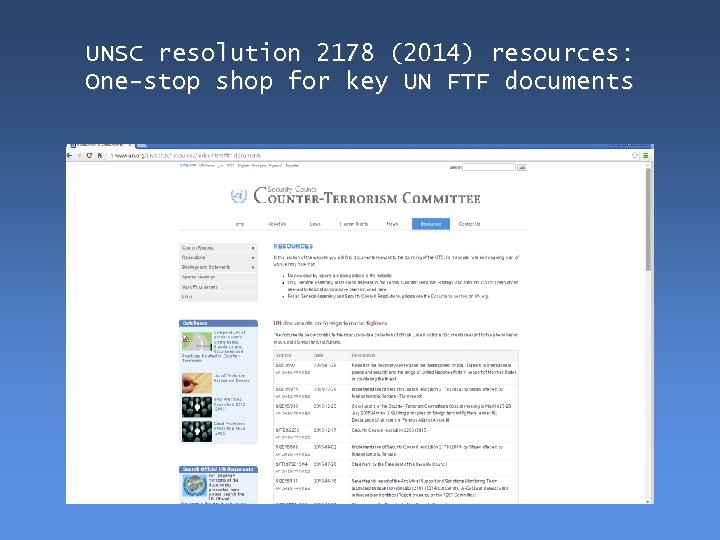 UNSC resolution 2178 (2014) resources: One-stop shop for key UN FTF documents
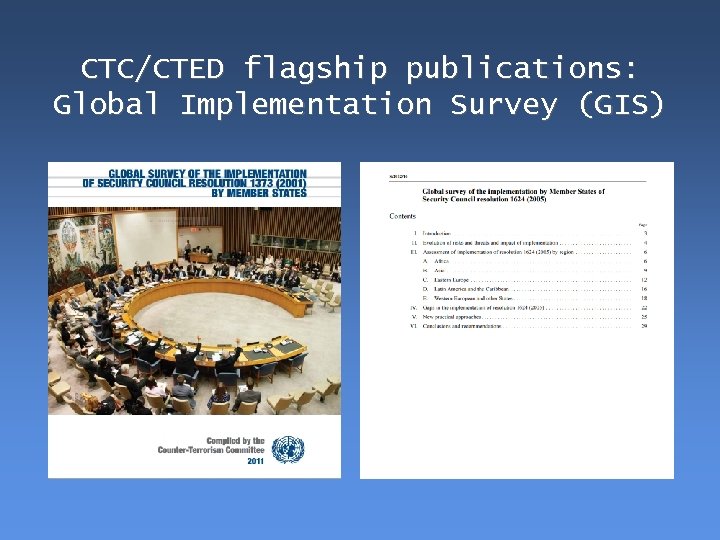 CTC/CTED flagship publications: Global Implementation Survey (GIS)
 CTC/CTED outreach to media
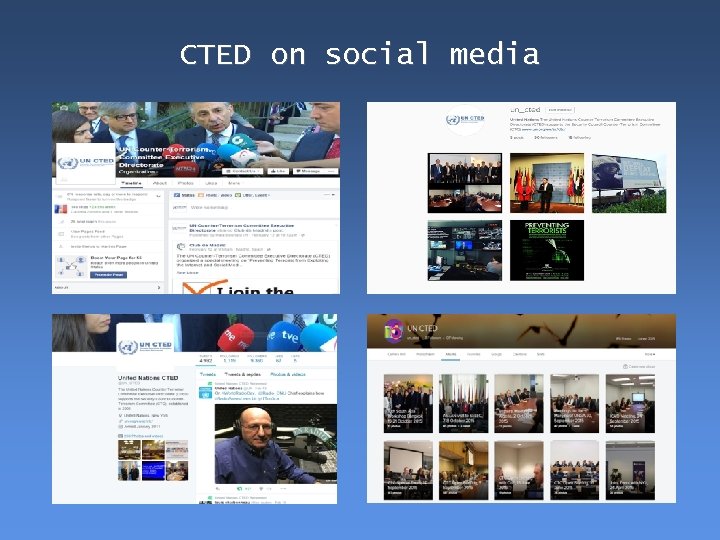 CTED on social media
 Thank Comments or you! questions?