


 Скачать презентацию The Secure Programming Skills Assessment SPSA Initiative 6
4cd766dadda3adc96ce0946efcfe69e0.ppt
- Количество слайдов: 14
 The Secure Programming Skills Assessment (SPSA) Initiative 6 th OWASP App. Sec Conference Milan - May 2007 Dave Wichers, OWASP Conferences Chair COO, Aspect Security dave. wichers@aspectsecurity. com 443 745 -6268 Copyright © 2007 - The OWASP Foundation Permission is granted to copy, distribute and/or modify this document under the terms of the Creative Commons Attribution-Share. Alike 2. 5 License. To view this license, visit http: //creativecommons. org/licenses/by-sa/2. 5/ The OWASP Foundation http: //www. owasp. org/
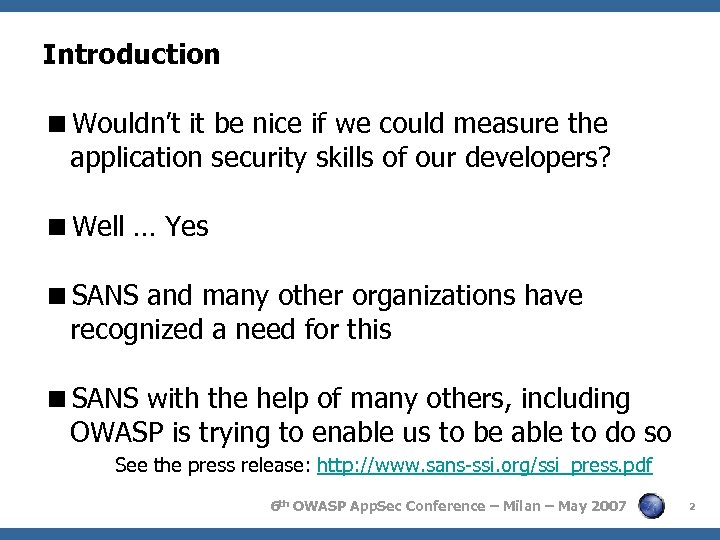 Introduction
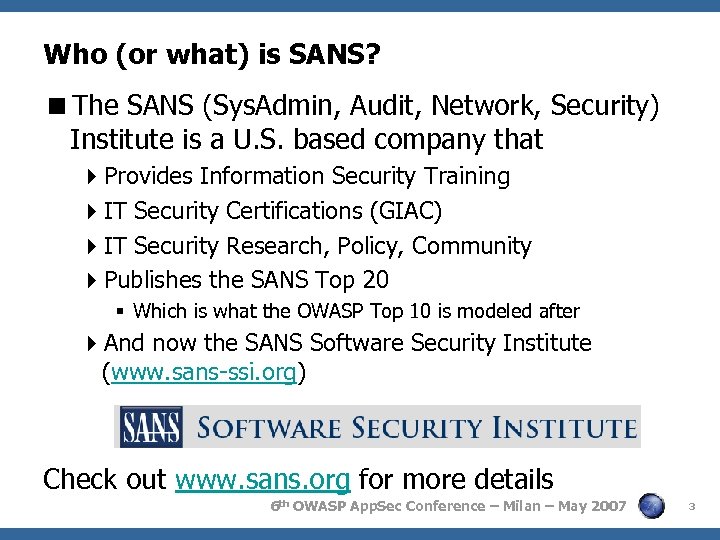 Who (or what) is SANS?
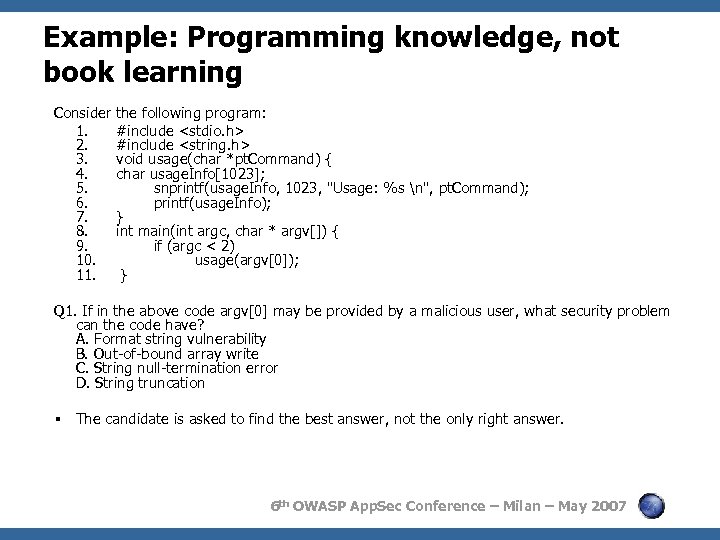 Example: Programming knowledge, not book learning Consider 1. 2. 3. 4. 5. 6. 7. 8. 9. 10. 11. the following program: #include
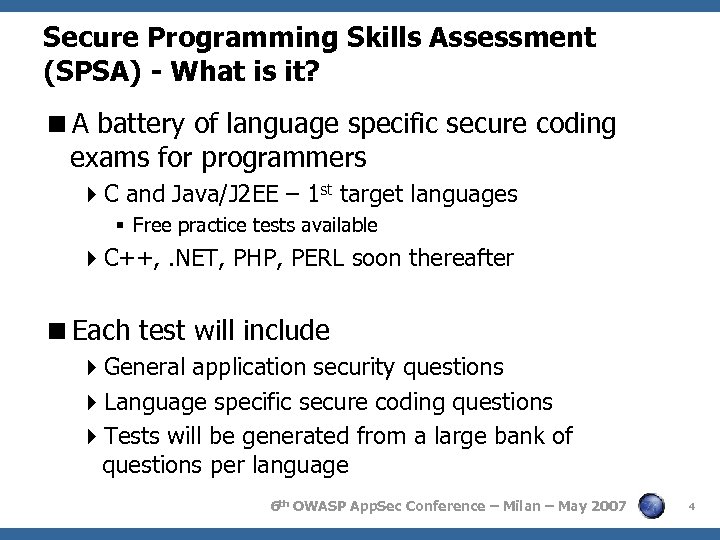
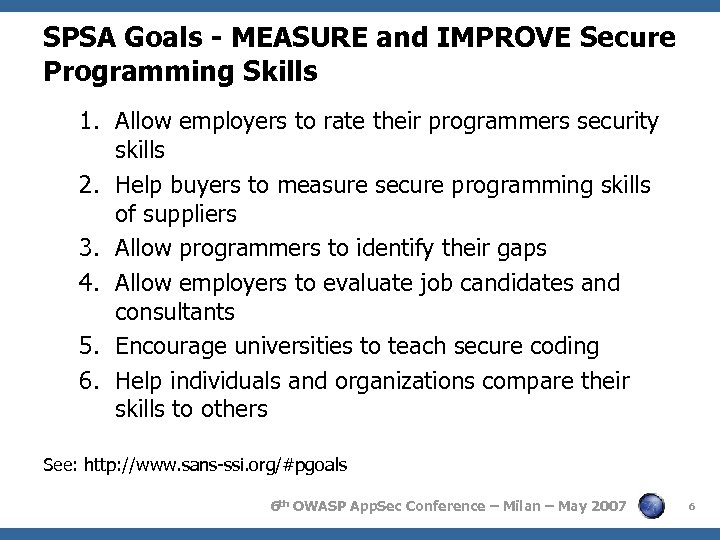 SPSA Goals - MEASURE and IMPROVE Secure Programming Skills 1. Allow employers to rate their programmers security skills 2. Help buyers to measure secure programming skills of suppliers 3. Allow programmers to identify their gaps 4. Allow employers to evaluate job candidates and consultants 5. Encourage universities to teach secure coding 6. Help individuals and organizations compare their skills to others See: http: //www. sans-ssi. org/#pgoals 6 th OWASP App. Sec Conference – Milan – May 2007 6
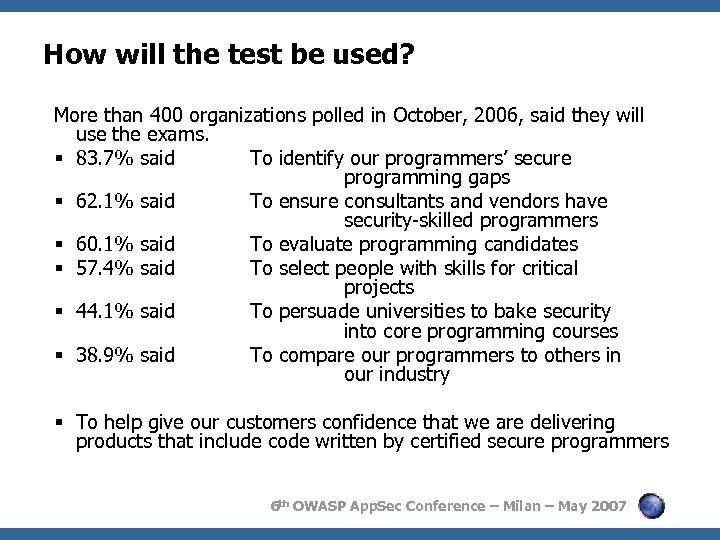 How will the test be used? More than 400 organizations polled in October, 2006, said they will use the exams. 83. 7% said To identify our programmers’ secure programming gaps 62. 1% said To ensure consultants and vendors have security-skilled programmers 60. 1% said To evaluate programming candidates 57. 4% said To select people with skills for critical projects 44. 1% said To persuade universities to bake security into core programming courses 38. 9% said To compare our programmers to others in our industry To help give our customers confidence that we are delivering products that include code written by certified secure programmers 6 th OWASP App. Sec Conference – Milan – May 2007
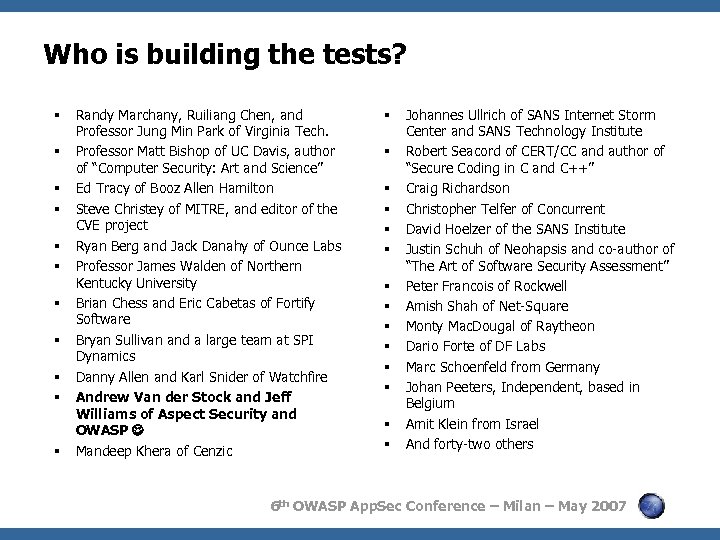 Who is building the tests? Randy Marchany, Ruiliang Chen, and Professor Jung Min Park of Virginia Tech. Professor Matt Bishop of UC Davis, author of “Computer Security: Art and Science” Ed Tracy of Booz Allen Hamilton Steve Christey of MITRE, and editor of the CVE project Ryan Berg and Jack Danahy of Ounce Labs Professor James Walden of Northern Kentucky University Brian Chess and Eric Cabetas of Fortify Software Bryan Sullivan and a large team at SPI Dynamics Danny Allen and Karl Snider of Watchfire Andrew Van der Stock and Jeff Williams of Aspect Security and OWASP Mandeep Khera of Cenzic Johannes Ullrich of SANS Internet Storm Center and SANS Technology Institute Robert Seacord of CERT/CC and author of “Secure Coding in C and C++” Craig Richardson Christopher Telfer of Concurrent David Hoelzer of the SANS Institute Justin Schuh of Neohapsis and co-author of “The Art of Software Security Assessment” Peter Francois of Rockwell Amish Shah of Net-Square Monty Mac. Dougal of Raytheon Dario Forte of DF Labs Marc Schoenfeld from Germany Johan Peeters, Independent, based in Belgium Amit Klein from Israel And forty-two others 6 th OWASP App. Sec Conference – Milan – May 2007
 How are they built? Identify the key vulnerabilities and the programming errors that caused them Draft rules that would have avoided them Group the rules into categories/tasks Rank the tasks on criticality, importance, and frequency to determine question counts Draft questions Vet questions Work with MITRE and the CWE program to keep them current 6 th OWASP App. Sec Conference – Milan – May 2007
 OWASP Participation in the SPSA
 How are the tests delivered? For certification: proctored three times a year, partnering with colleges around the world (pilot in August in Washington) For assessment in large organizations – the enterprise edition – online For assessment for all others – the open edition – online See: http: //www. sans-ssi. org/#deployment How do we avoid disclosure? Thousands of questions, constantly changing 6 th OWASP App. Sec Conference – Milan – May 2007
 How to participate?
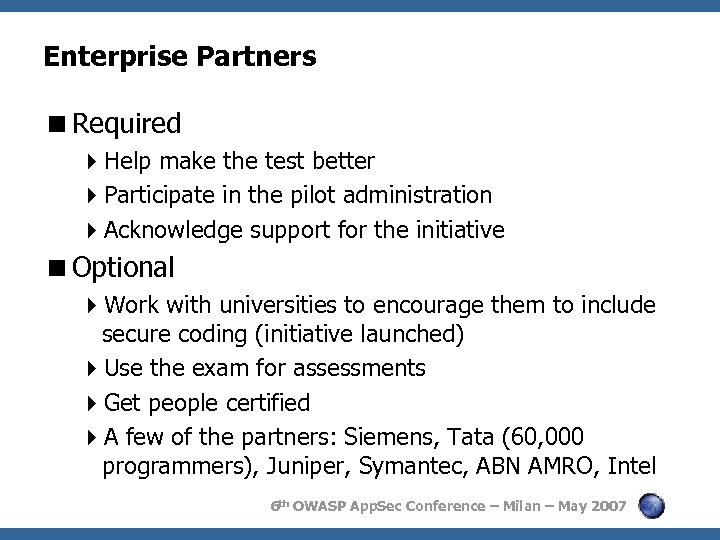 Enterprise Partners
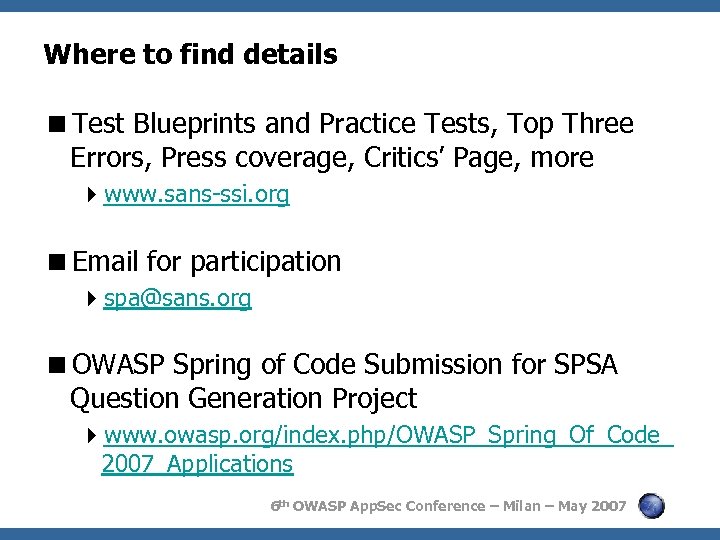 Where to find details