 Скачать презентацию The Sector Skills Council for Business and Information
93a6927a3159688cd3b2a97645a6dd0e.ppt
- Количество слайдов: 22



The Sector Skills Council for Business and Information Technology Skilling the Nation to respond to the needs of the Service Economy Patrick Beasley
Agenda • • Introduction and background Research indications & globalisation Employer requirements & skills needs Programmes of change
Leitch review of skills “In the 19 th Century, the UK had the natural resources, the labour force and the inspiration to lead the world into the Industrial Revolution. Today, we are witnessing a different type of revolution. For developed countries who cannot compete on natural resources and low labour costs, success demands a more service-led economy and high value-added industry”. The Leitch review of skills. ISBN: 978 -0 -11 -840486 -0
Changing economy “The UK economy has changed significantly over time. Today the service sector accounts for around three quarters of the UK economy. ” Leitch review of skills
Service sector problem • The service sector is 69% of the UK’s economy and is at least one third less productive than manufacturing, according to the UK Treasury. • Financial intermediation (savings/investments) has little more than 50% of the productivity per head of the US. • The heart of the problem is that services have simply evolved. They have not been designed with the rigour applied to activities such as engineering.
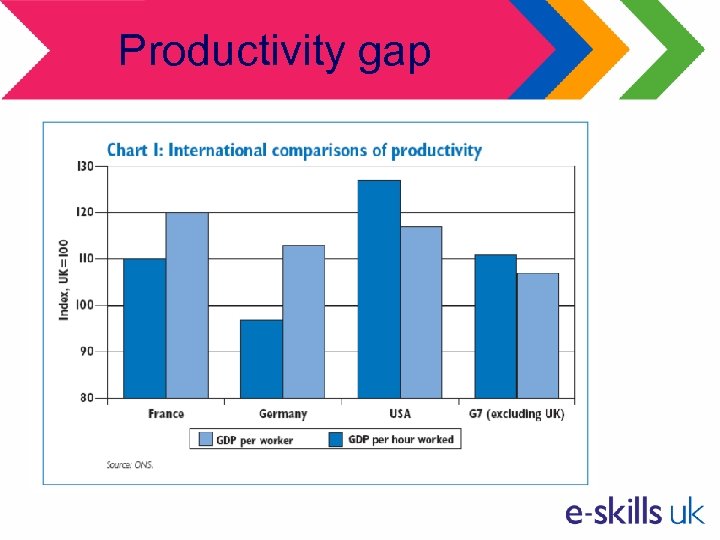
Productivity gap
The need for skills • Manufactured goods, and increasingly services, are traded across the world. • Developed nations are relying more and more on their capacity to innovate to drive economic growth. • The ability to do this depends upon the skills and knowledge of their people. Leitch review of skills
The importance of skills “In this expanding and more deeply integrated global economy, the comparative advantage of the UK must lie in the skills of its people…. ” Leitch review of skills
Globalisation pressure “The IT and Telecommunications industry is challenged to build the advanced and business-intensive technology skills needed to deliver premium services as basic technology skills and jobs are increasingly automated or handled offshore. ” e-skills UK IT & Telecoms Insights 2008: Trends and UK Skills Implications
Globalisation in the UK • Technology delivery has become industrialised through adoption of frameworks such as ITIL* • This standardisation of IT practices is driving continued commoditisation, outsourcing and off shoring of IT and business process activities. • Technology skills need to become more business intensive to create value in a standardising world. *ITIL = Information Technology Infrastructure Library
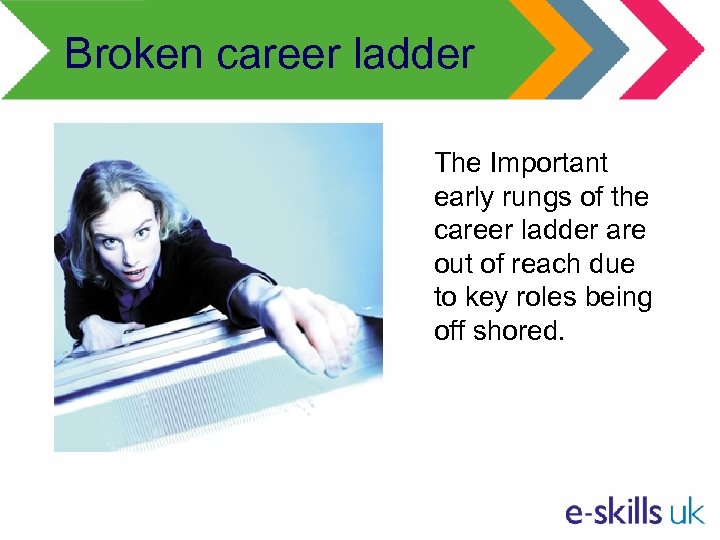
Broken career ladder The Important early rungs of the career ladder are out of reach due to key roles being off shored.
Reported skills needs • • • Leadership and relationship management skills Business process analysis and design skills Project and program management skills Portfolio management skills Business intelligence and information analytics skills • Design skills • Architecture skills e-skills UK IT & Telecoms Insights 2008: Trends and UK Skills Implications
What employers say • Better skilled entrants to the workforce from university • Skills development options to deal with missing rungs of career ladder • Skill mix which makes employees more effective to the business much quicker • Employer recognised skills and qualifications
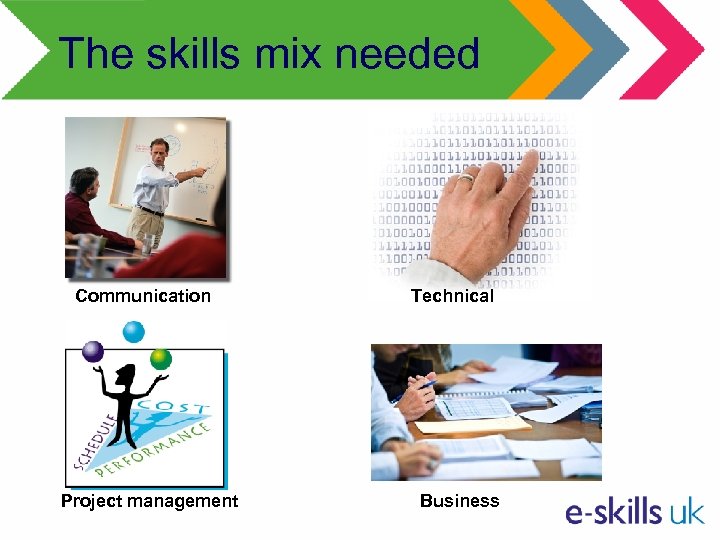
The skills mix needed Communication Project management Technical Business
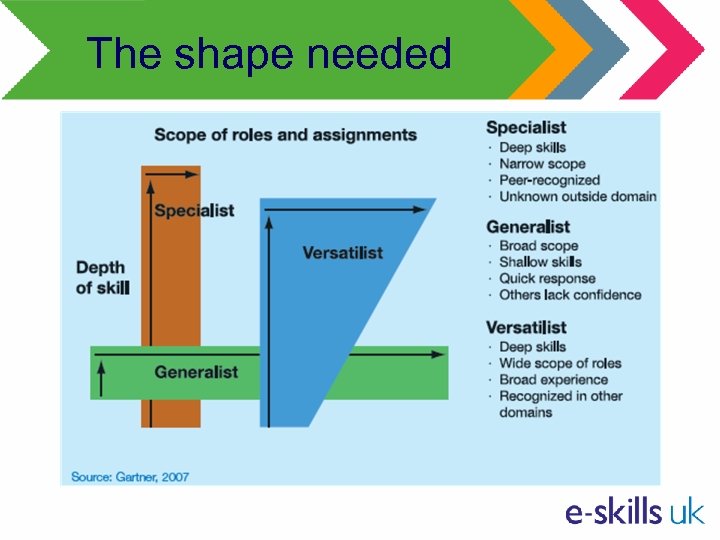
The shape needed
Programmes of change e-skills programmes which work towards the employer requirements…. 1. Right skill mix and depth 2. More rapid value add to the business 3. Deal with missing rungs on the ladder • • IT Management for Business BSc IT Professional Development MSc
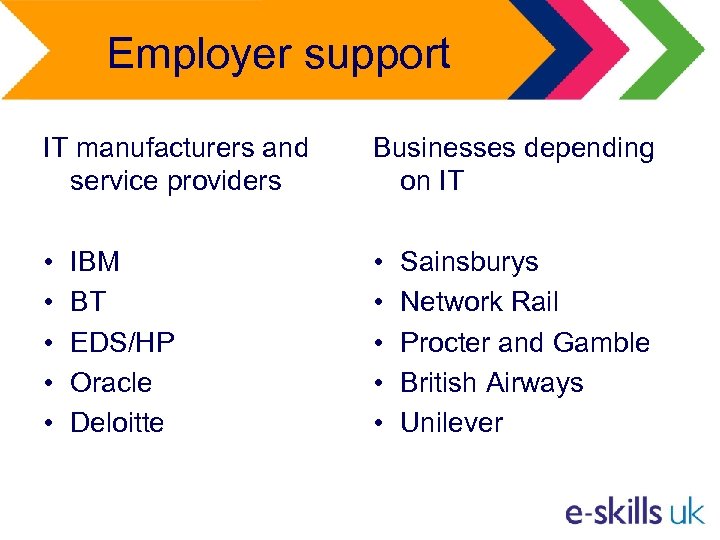
Employer support IT manufacturers and service providers Businesses depending on IT • • • IBM BT EDS/HP Oracle Deloitte Sainsburys Network Rail Procter and Gamble British Airways Unilever
IT Management for Business • BSc at 11 universities including Manchester Business School • All based on the employer defined skills profile – – ¼ technical skills ¼ business skills ¼ project management skills ¼ personal and communications skills • Employer provided lectures on key subjects • Annual employer sponsored student conference to compete in business games and take part in joint learning
IT Professional Development • Post graduate study offered through – Lancaster University Management School – The Open University • Three stages certificate/diploma/MSc • Developed in conjunction with corporate employers both manufactures and users • Now in pilot with British Airways • General release in October with subsidised places available
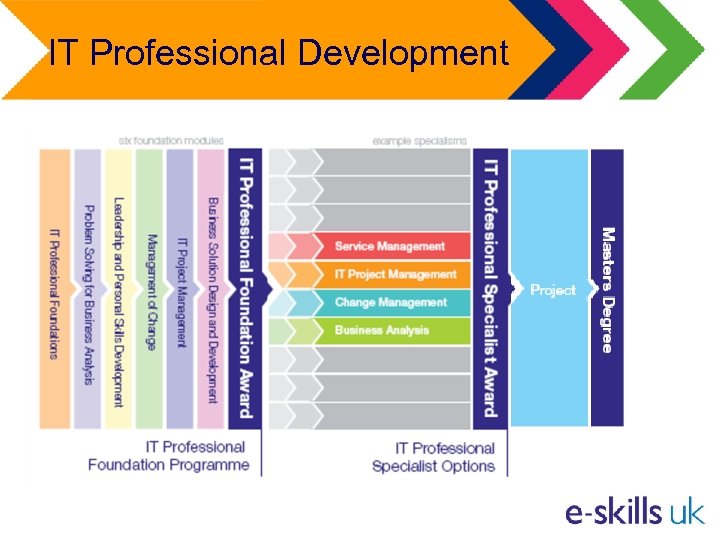
IT Professional Development
e-skills UK aims to • Pilot and develop skills interventions which employers in IT and Telecoms need • Work with providers and stakeholders to evaluate change to meet employer needs • Provide the evidence base for change in the skills system for IT and Telecoms
Conclusion • Use employers to assist creating the solutions • Setting out new models for skills development is vital to engage demand • The skill requirement to enable the UK to compete makes ever greater demands on the education system and the workforce
Скачать презентацию The Sector Skills Council for Business and Information
93a6927a3159688cd3b2a97645a6dd0e.ppt