


 Скачать презентацию The Search for the Holy Grail of Investing
b7bc36fe71dd78d244cab29395a79764.ppt
- Количество слайдов: 61
 The Search for the Holy Grail of Investing Future Alpha Generators Larry Swedroe Author of seven investment books, including The Only Guide to Alternative Investments You’ll Ever Need (2008) and Wise Investing Made Simple (2007) January 12, 2010 Green Wealth Management, LLC
 Important Disclosures Regarding Simulated Strategies The following pages include illustrations of returns for the types of portfolios we design for clients. The Simulated Strategies may or may not be the actual allocation determined to be appropriate for any individual clients, and a client may or may not follow the Simulated Strategies. Clients with the allocations shown may have different results based on capital flows, timing of rebalancing decisions, fees charged or other factors. Our investment strategy is based on the principles of Modern Portfolio Theory (MPT). The tenets of MPT provide for a passive, long-term, buy-and-hold strategy implemented through globally diversified portfolios. Mutual funds representing asset classes where academic research has demonstrated higher expected returns for the level of risk taken are combined into a single portfolio. Portfolios are constructed with low-correlating components to provide diversification for the purpose of reducing the risk caused by volatility. Commodities may be added to some client portfolios for the purpose of additional risk reduction and not necessarily to provide higher expected returns in such portfolios. Portfolios are rebalanced to maintain agreed-upon asset allocations. The historical performance information that follows is provided to demonstrate the methodology used in building portfolios using the aforementioned investment strategy. This information should not be considered as a demonstration of actual performance results or actual trading using client assets and should not be interpreted as such. The results are based on the retroactive application of a back-tested model that was designed with the benefit of hindsight and should not be interpreted as the performance of actual accounts. Past performance is not a guarantee of future results. The Simulated Strategies started in 1996 and have evolved over the years. Commodities, when shown in a portfolio, were added in 2004. Core funds, when shown in a portfolio, were added in 2007. International real estate, when shown in a portfolio, was added in 2008. All should be considered material changes to the Simulated Strategies. The differences in demonstrated returns can be seen by comparing Simulated Strategies with and without each of these. The investment returns and principal value of mutual funds recommended by our firm will fluctuate and may be worth more or less than their original cost when sold. A client may experience a loss when implementing an investment strategy. In 1999, tax-managed funds became available for several different asset classes. We now use tax-managed funds extensively for taxable entities. While the taxmanaged funds are consistent with the passive approach we follow, they should not be expected to regularly track the performance of corresponding taxable funds in the same or similar asset classes. As such, the performance of portfolios using tax-managed funds will vary from portfolios that do not use these funds. Back-tested data does not represent the impact that material economic and market factors might have on an investment advisor’s decision-making process if the advisor were actually advising an investor and should not be considered indicative of the skill of the advisor. The back-testing of performance differs from actual account performance because an investment strategy may be adjusted at any time and for any reason, and can continue to be changed until desired or better performance results are achieved. The back-tested results assume ordinary income and capital gains distributions are reinvested, annual rebalancing and no income taxes. If performance reflects the deduction of an advisory fee (1. 85 percent or less) billed quarterly in advance, it is indicated on the page. More information about mutual fund fees and expenses is available in the prospectus for each mutual fund. Any back-tested data used in creating the Simulated Strategies includes only live funds. All funds are live for 10 years or more except the commodities fund, core funds and the international real estate fund. 2
 Two Theories Conventional wisdom: Markets are inefficient • Add value by stock selection and market timing • Winning strategy: identify past persistent alpha Modern Portfolio Theory: Markets are efficient • Market price of security is the best estimate of the correct price • Efforts to outperform are unlikely to be productive after expenses • Winning strategy: focus on diversification of risk, fund construction, costs and tax efficiency 3
 Are Markets Inefficient? • If markets are inefficient, we should see evidence of persistent ability to outperform risk-adjusted benchmarks. • Persistence should be greater than randomly expected. • It is easy to identify past outperformance. • But is the past prologue? 4
 The Evidence • Mutual funds • Pension plans • Hedge funds • Venture capital • Individual investors • Behavioral finance 5
 Mutual Funds “On Persistence in Mutual-Fund Performance” • Analyzed 1, 892 funds for the period of 1961– 93 – Average actively managed fund underperformed appropriate passive benchmark by 1. 8 percent p. a. 1 “Mutual-Fund Performance: An Empirical Decomposition Into Stock-Picking Talent, Style, Transaction Costs, and Expenses” • Analyzed 1, 788 funds for the period of 1975– 94 – Average risk-adjusted underperformance was 2. 2 percent p. a. 2 • Both studies found no outperformance beyond the randomly expected. 1 Mark Carhart, On Persistence in Mutual-Fund Performance. Journal of Finance, March 1997. Performance: An Empirical Decomposition Into Stock-Picking Talent, Style, Transaction Costs, and Expenses. The Journal of Finance, August 2000. 2 Russ Wermers, Mutual-Fund 6
 Mutual Funds On Mutual Fund Managers “I have become increasingly convinced that the past records of mutual fund managers are essentially worthless in predicting future success. The few examples of consistently superior performance occur no more frequently than can be expected by chance. ” — Burton G. Malkiel Author of A Random Walk Down Wall Street, professor of economics at Princeton Source: Burton G. Malkiel, A Random Walk Down Wall Street. 1996. 7
 Mutual Funds On Mutual Fund Fees “Overwhelmingly, mutual funds extract enormous sums from investors in exchange for providing a shocking disservice. ” — David Swensen CIO of the Yale Endowment Fund Source: David Swensen, Unconventional Success: A Fundamental Approach to Personal Investment. 2005. 8
 Mutual Funds “For professional investors like myself, a sense of humor is essential. We are very aware that we are competing not only against the market averages but also against one another. It's an intense rivalry. We are each claiming that, ‘The stocks in my fund today will perform better than what you own in your fund. ’ That implies we think we can predict the future, which is the occupation of charlatans. If you believe you or anyone else has a system that can predict the future of the stock market, the joke is on you. ” — Ralph Wanger Source: Ralph Wanger, Zebra in Lion Country. Touchstone, 1999. 9
 Pension Plans • Logically, if anyone could beat the market, it should be large pension plans. – Control large sums and pay lower fees than retail investors – Have access to the best performing portfolio managers – Only hire managers with records of outperformance – Most hire gatekeepers (SEI, Russell, Goldman) to perform extensive due diligence 10
 Using Past Performance of Active Managers as a Predictor of Future Performance U. S. Pension Plans “Performance of U. S. Pension Plans” • 716 defined benefit plans (1992– 2004) and 238 defined contribution plans (1997– 2004)1 “Selection and Termination of Investment Management Firms by Plan Sponsors” • 1994– 2003: About 3, 600 plans and more than 9, 000 hiring and firing decisions 2 1 Rob Bauer and Rik Frehen, The Performance of U. S. Pension Funds. January 28, 2008. Selection and Termination of Investment Management Firms by Plan Sponsors. May 2005. 2 Amit Goyal and Sunil Wahal, The 11
 Using Past Performance of Active Managers as a Predictor of Future Performance U. S. Pension Plans Findings: • Prior to hiring, managers produced large excess returns 1 • Post-hiring returns relative to benchmarks were about zero (before transition costs)1 • No persistence in performance beyond randomly expected 2 • Neither fund size, degree of outsourcing, nor company stock holdings were factors driving performance 2 – Refutes claim that large pension plans are handicapped by size 1 Amit Goyal and Sunil Wahal, The 2 Rob Bauer and Rik Frehen, The Selection and Termination of Investment Management Firms by Plan Sponsors. May 2005. Performance of U. S. Pension Funds. January 28, 2008. 12
 Using Past Performance of Active Managers as a Predictor of Future Performance U. S. Pension Plans Conclusion: • “The striking similarities in net performance patterns over time makes skill differences highly unlikely. ” Source: Rob Bauer and Rik Frehen, The Performance of U. S. Pension Funds. January 28, 2008. 13
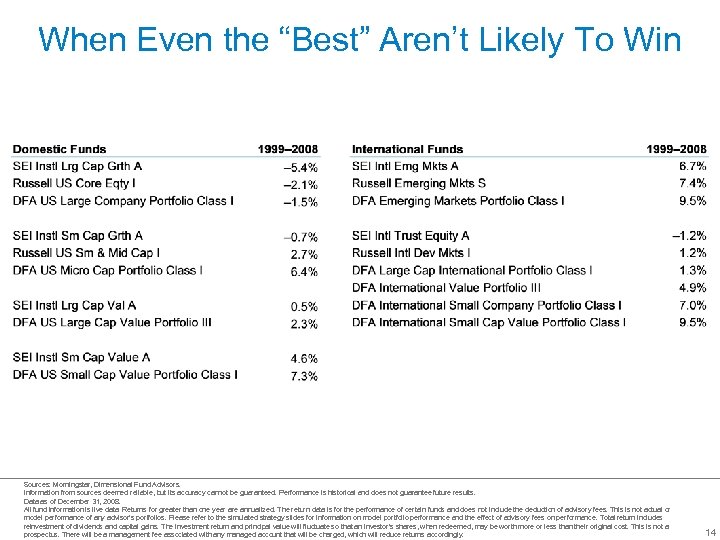 When Even the “Best” Aren’t Likely To Win Sources: Morningstar, Dimensional Fund Advisors. Information from sources deemed reliable, but its accuracy cannot be guaranteed. Performance is historical and does not guarantee future results. Data as of December 31, 2008. All fund information is live data. Returns for greater than one year are annualized. The return data is for the performance of certain funds and does not include the deduction of advisory fees. This is not actual or model performance of any advisor’s portfolios. Please refer to the simulated strategy slides for information on model portfolio performance and the effect of advisory fees on performance. Total return includes reinvestment of dividends and capital gains. The investment return and principal value will fluctuate so that an investor’s shares, when redeemed, may be worth more or less than their original cost. This is not a prospectus. There will be a management fee associated with any managed account that will be charged, which will reduce returns accordingly. 14
 Hedge Funds • No persistent outperformance beyond randomly expected • Risk-adjusted returns similar to Treasury bills • Highly illiquid • Tax inefficient • Lack transparency so investors lose control of risk • Incentive structure creates agency risk 15
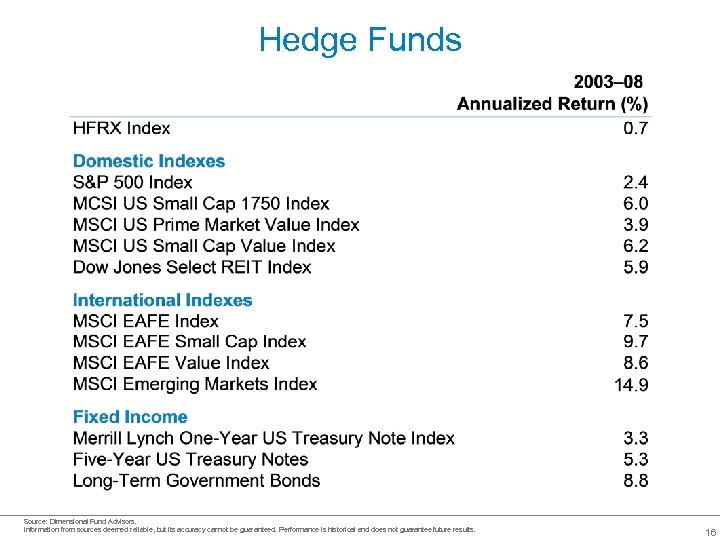 Hedge Funds Source: Dimensional Fund Advisors. Information from sources deemed reliable, but its accuracy cannot be guaranteed. Performance is historical and does not guarantee future results. 16
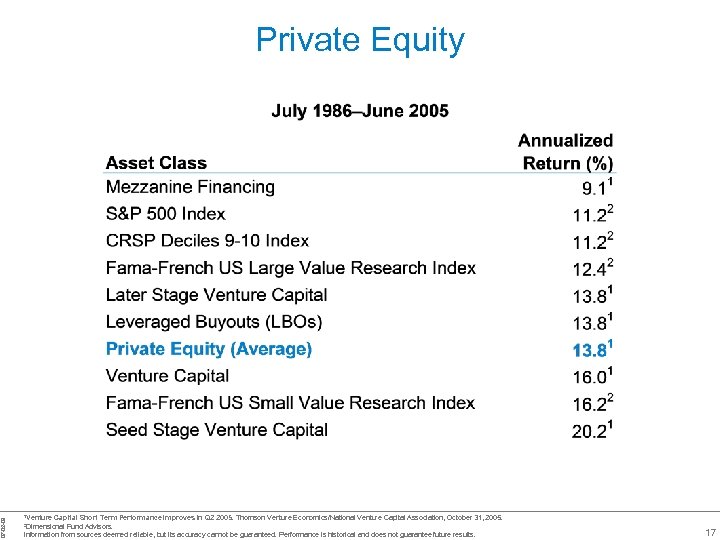 07 -02 -09 Private Equity 1 Venture Capital Short Term Performance Improves in Q 2 2005. Thomson Venture Economics/National Venture Capital Association, October 31, 2005. 2 Dimensional Fund Advisors. Information from sources deemed reliable, but its accuracy cannot be guaranteed. Performance is historical and does not guarantee future results. 17
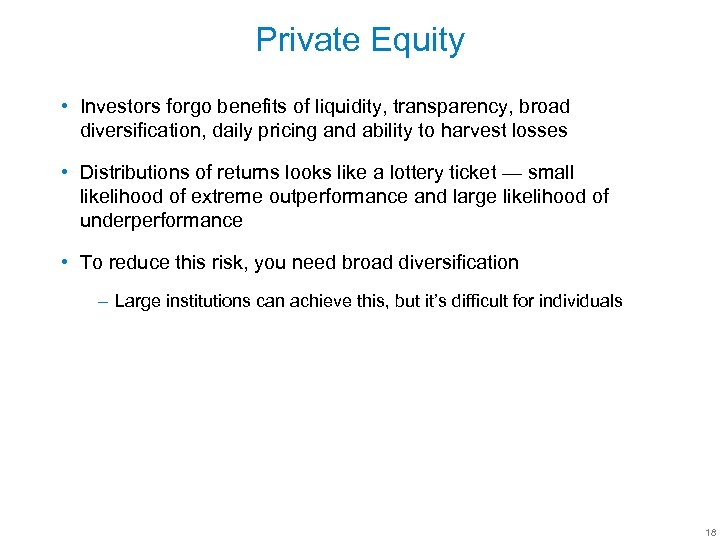 Private Equity • Investors forgo benefits of liquidity, transparency, broad diversification, daily pricing and ability to harvest losses • Distributions of returns looks like a lottery ticket — small likelihood of extreme outperformance and large likelihood of underperformance • To reduce this risk, you need broad diversification – Large institutions can achieve this, but it’s difficult for individuals 18
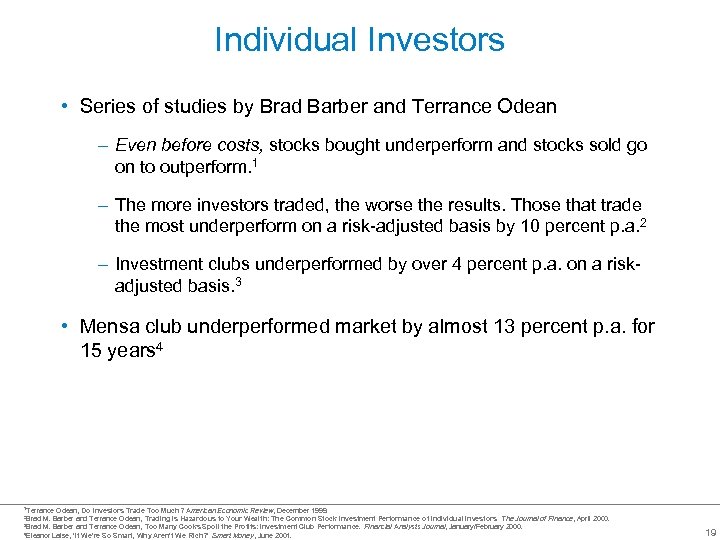 Individual Investors • Series of studies by Brad Barber and Terrance Odean – Even before costs, stocks bought underperform and stocks sold go on to outperform. 1 – The more investors traded, the worse the results. Those that trade the most underperform on a risk-adjusted basis by 10 percent p. a. 2 – Investment clubs underperformed by over 4 percent p. a. on a riskadjusted basis. 3 • Mensa club underperformed market by almost 13 percent p. a. for 15 years 4 1 Terrance Odean, Do Investors Trade Too Much? American Economic Review, December 1999. Is Hazardous to Your Wealth: The Common Stock Investment Performance of Individual Investors. The Journal of Finance, April 2000. Many Cooks Spoil the Profits: Investment Club Performance. Financial Analysts Journal, January/February 2000. 4 Eleanor Laise, ‘If We’re So Smart, Why Aren’t We Rich? ’ Smart Money, June 2001. 2 Brad M. Barber and Terrance Odean, Trading 3 Brad M. Barber and Terrance Odean, Too 19
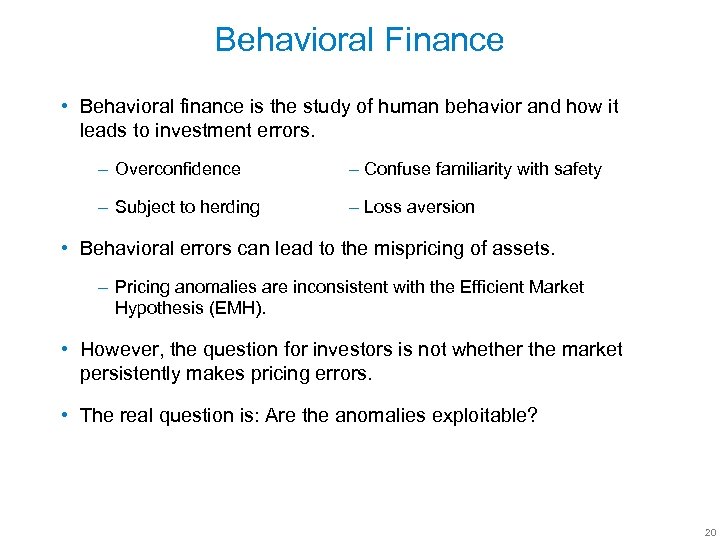 Behavioral Finance • Behavioral finance is the study of human behavior and how it leads to investment errors. – Overconfidence – Confuse familiarity with safety – Subject to herding – Loss aversion • Behavioral errors can lead to the mispricing of assets. – Pricing anomalies are inconsistent with the Efficient Market Hypothesis (EMH). • However, the question for investors is not whether the market persistently makes pricing errors. • The real question is: Are the anomalies exploitable? 20
 “Behavioral Finance: Are the Disciples Profiting From the Doctrine? ” • Behavioral funds are successfully attracting investment dollars at a significantly greater rate than index and matched actively managed nonbehavioral funds. • Investors believe that the pricing errors are exploitable. • While the behavioral funds do outperform S&P 500 Index funds, they do so because they have significant exposure to value stocks. – After adjusting for risk, they do not earn abnormal returns. • Conclusion: “Behavioral mutual funds are tantamount to value investing. ” Source: Prithviraj Banerjee, Vaneesha R. Boney and Colby Wright, Behavioral Finance: Are the Disciples Profiting From the Doctrine? Journal of Investing, Winter 2008. 21
![Behavioral Finance “He [Richard Thaler] concedes that most of his retirement assets are held](https://present5.com/presentation/b7bc36fe71dd78d244cab29395a79764/image-22.jpg "Behavioral Finance “He [Richard Thaler] concedes that most of his retirement assets are held") Behavioral Finance “He [Richard Thaler] concedes that most of his retirement assets are held in index funds. . He also concedes that ‘it is not easy to beat the market, and most people don't. ’" — Jon E. Hilsenrath Source: Jon E. Hilsenrath, As Two Economists Debate, The Tide Shifts. The Wall Street Journal, October 18, 2004. 22
Behavioral Finance “He [Richard Thaler] concedes that most of his retirement assets are held in index funds. . He also concedes that ‘it is not easy to beat the market, and most people don't. ’" — Jon E. Hilsenrath Source: Jon E. Hilsenrath, As Two Economists Debate, The Tide Shifts. The Wall Street Journal, October 18, 2004. 22
 “Behavioral Finance: Are the Disciples Profiting From the Doctrine? ” “I have personally tried to invest money, my client’s and my own, in every single anomaly and predictive result that academics have dreamed up. And I have yet to make a nickel on any of these supposed market inefficiencies. An inefficiency ought to be an exploitable opportunity. If there’s nothing investors can exploit in a systematic way, time in and time out, then it’s very hard to say that information is not being properly incorporated into stock prices. Real money investment strategies don’t produce the results that academic papers say they should. ” — Richard Roll, financial economist Source: Burton G. Malkiel, Are Markets Efficient — Yes, Even if They Make Errors. The Wall Street Journal, December 28, 2000. 23
 Why Is Persistent Outperformance So Hard to Find? • It is easy to identify the managers with great track records. However, there is no evidence of the ability to do this ex-ante. • The EMH explains why this outcome is expected — only by random luck should a fund persistently outperform. AND • Even if markets are inefficient, successful active management sows the seeds of its own destruction. 24
 Who Gets the Money to Manage? • Money flows to the top-performing manager. 1 • Eventually, the manager receives so much money it impacts the ability to generate alpha and returns will be driven down to the second best manager’s expected return. 2 • The process continues until the expected return of investing with any manager is the benchmark expected return. 3 • Inflows eliminate return persistence because fund managers face diminishing returns to scale. 1 Jonathan B. Berk, Five 2 Ibid. 3 Ibid. Myths of Active Portfolio Management. The Journal of Portfolio Management, Spring 2005. 25
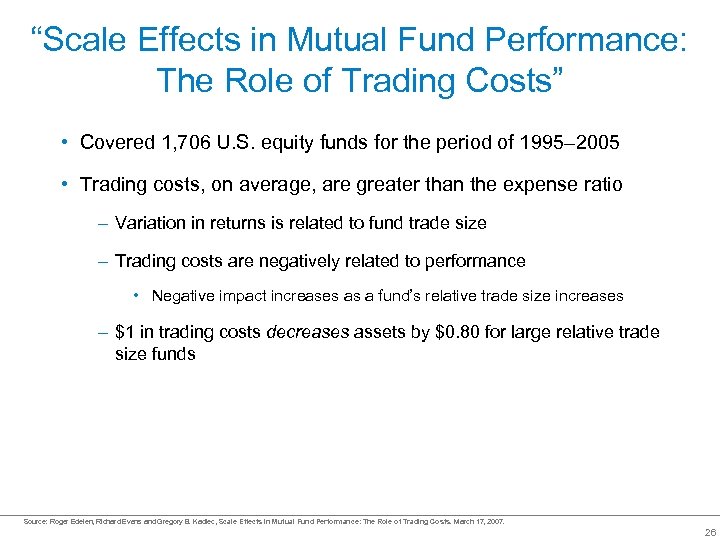 “Scale Effects in Mutual Fund Performance: The Role of Trading Costs” • Covered 1, 706 U. S. equity funds for the period of 1995– 2005 • Trading costs, on average, are greater than the expense ratio – Variation in returns is related to fund trade size – Trading costs are negatively related to performance • Negative impact increases as a fund’s relative trade size increases – $1 in trading costs decreases assets by $0. 80 for large relative trade size funds Source: Roger Edelen, Richard Evans and Gregory B. Kadlec, Scale Effects in Mutual Fund Performance: The Role of Trading Costs. March 17, 2007. 26
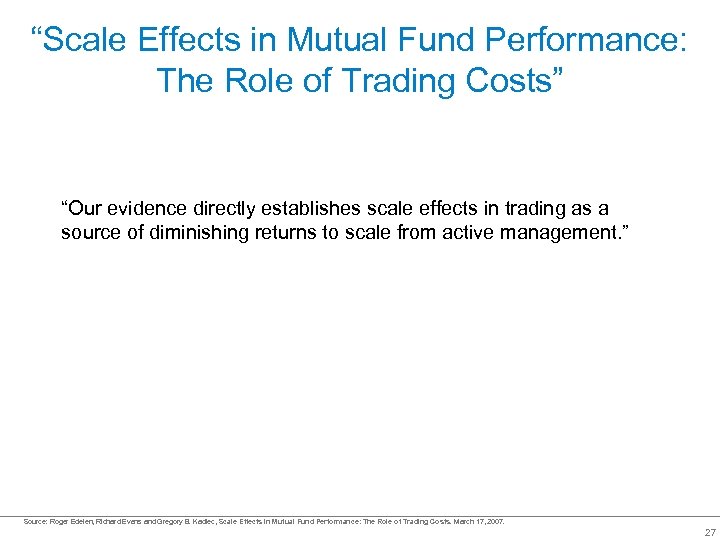 “Scale Effects in Mutual Fund Performance: The Role of Trading Costs” “Our evidence directly establishes scale effects in trading as a source of diminishing returns to scale from active management. ” Source: Roger Edelen, Richard Evans and Gregory B. Kadlec, Scale Effects in Mutual Fund Performance: The Role of Trading Costs. March 17, 2007. 27
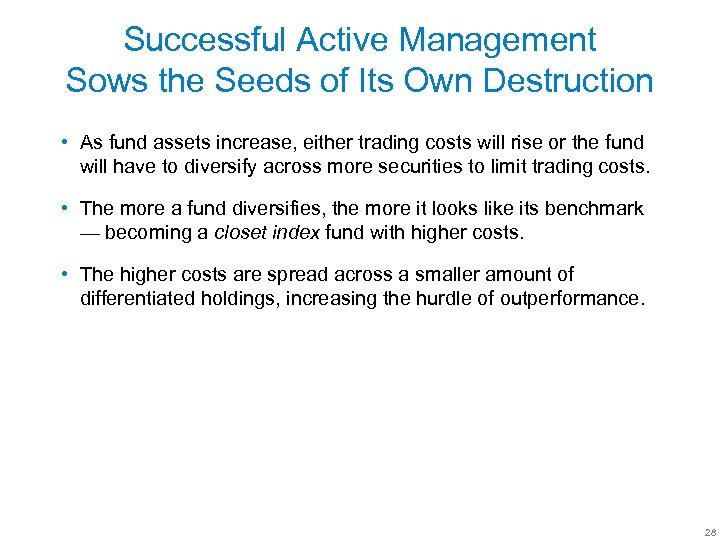 Successful Active Management Sows the Seeds of Its Own Destruction • As fund assets increase, either trading costs will rise or the fund will have to diversify across more securities to limit trading costs. • The more a fund diversifies, the more it looks like its benchmark — becoming a closet index fund with higher costs. • The higher costs are spread across a smaller amount of differentiated holdings, increasing the hurdle of outperformance. 28
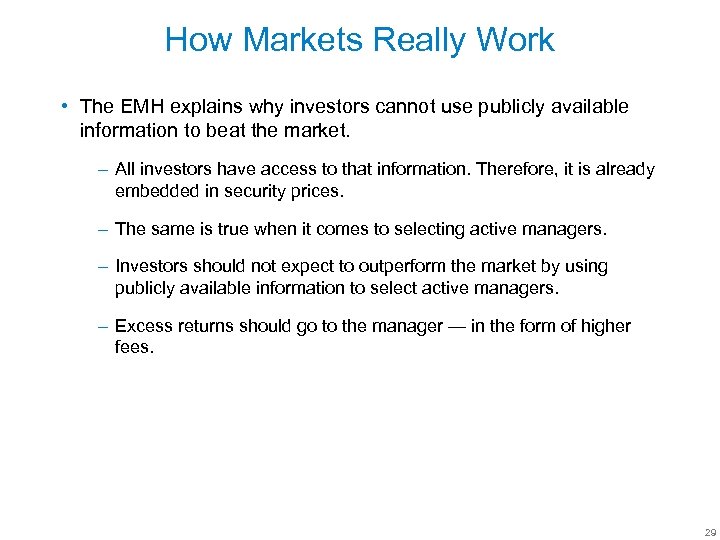 How Markets Really Work • The EMH explains why investors cannot use publicly available information to beat the market. – All investors have access to that information. Therefore, it is already embedded in security prices. – The same is true when it comes to selecting active managers. – Investors should not expect to outperform the market by using publicly available information to select active managers. – Excess returns should go to the manager — in the form of higher fees. 29
 Which Is the Scarce Resource? The Ability to Generate Alpha OR Investor Capital 30
 How Markets Really Work • “When capital is supplied competitively by investors but ability is scarce only participants with the skill in short supply can earn economic rents. ” • “Investors who choose to invest with active managers cannot expect to receive positive excess returns on a risk-adjusted basis. ” • “If they did, there would be an excess supply of capital to those managers. ” — Jonathan Berk Source: Jonathan B. Berk, Five Myths of Active Portfolio Management. The Journal of Portfolio Management, Spring 2005. 31
 Why Is Persistent Outperformance So Hard to Find? The Value of Economic Forecasts The underlying basis for equity forecasts is economic forecasts. Do they have value? – William Sherden, author of The Fortune Sellers, reviewed the leading research on forecasting accuracy from 1979 to 1995 and covering forecasts made from 1970 to 1995. 1 1 William Sherden, The Fortune Sellers. 32
 William Sherden: The Value of Economic Forecasts • “Economists cannot predict the turning points in the economy. ” • “There are no economic forecasters who consistently lead the pack in forecasting accuracy. ” • “There are no economic ideologies that produce consistently superior economic forecasts. ” • “Increased sophistication provides no improvement in economic forecast accuracy. ” • “Consensus forecasts offer little improvement. ” Source: William Sherden, The Fortune Sellers. 33
 William Sherden Concluded • “Despite recent innovations in information technology and decades of academic research, successful stock market prediction has remained an elusive goal. ” • “Overall, we have not made progress in predicting the stock market, but this has not stopped the investment business from continuing the quest, and making $100 billion annually doing so. ” Source: William Sherden, The Fortune Sellers. 34
 John Kenneth Galbraith “We have two classes of forecasters: those who don’t know — and those who don’t know they don’t know. ” 35
![Michael Evans “The problem with macro [economic] forecasting is that no one can do](https://present5.com/presentation/b7bc36fe71dd78d244cab29395a79764/image-36.jpg "Michael Evans “The problem with macro [economic] forecasting is that no one can do") Michael Evans “The problem with macro [economic] forecasting is that no one can do it. ” Source: David Altany, New Jobs for the Number Crunchers. Industry Week, April 20, 1992. 36
Michael Evans “The problem with macro [economic] forecasting is that no one can do it. ” Source: David Altany, New Jobs for the Number Crunchers. Industry Week, April 20, 1992. 36
 Benjamin Graham “If I have noticed anything over these 60 years on Wall Street, it is that people do not succeed in forecasting what’s going to happen to the stock market. ” 37
 The Seer-Sucker Theory: The Value of Experts in Forecasting “No matter how much evidence exists that seers do not exist, suckers will pay for the existence of seers. ” —J. Scott Armstrong The Wharton School, University of Pennsylvania Source: J. Scott Armstrong, The Seer-Sucker Theory: The Value of Experts in Forecasting. Technology Review, June/July 1980. 38
 Why Is Persistent Outperformance So Hard to Find? The Value of Security Analysis • In May 1999, Intel had accumulated over $10 billion of cash. • The board was trying to determine if it should repurchase stock. • The stock was trading at about $120 per share. • Based on publicly available forecasts of future cash flows: – If the ERP were 3 percent, Intel’s stock would be worth $204; – If the ERP were 5 percent it would be worth $130; – If the ERP were 7. 2 percent, the stock would be worth just $82. 39
 What Should Intel’s Board Do? • If the stock was worth $204, they should repurchase shares. • If it was worth $82, they should issue more shares. The problem: • Valuations assumed that the cash flow projections were known. • Not even the board (let alone a security analyst) has such clarity. • Can the board predict the ERP better than the market? 40
 What Should Intel’s Board Do? If corporate insiders have such difficulty in determining a correct valuation, it is easy to understand why the results of active management are so poor and inconsistent. 41
 “The Efficient Market Theory Thrives on Criticism” Dwight Lee and James Verbrugge The Tyrannical Nature of an Efficient Market • “The efficient market theory is practically alone among theories in that it becomes more powerful when people discover inconsistencies between it and the real world. ” • “If a clear efficient market anomaly is discovered, the behavior (or lack of behavior) that gives rise to it will tend to be eliminated by competition for higher returns. ” • “The more empirical flaws that are discovered in the efficient market theory, the more robust theory becomes. ” Source: Dwight R. Lee and James A. Verbrugge, The Efficient Market Theory Thrives on Criticism. Journal of Applied Corporate Finance, Spring 1996. 42
 “The Efficient Market Theory Thrives on Criticism” Dwight Lee and James Verbrugge The Tyrannical Nature of an Efficient Market “Those who do the most to ensure that the efficient market theory remains fundamental to our understanding of financial economics are not its intellectual defenders, but those mounting the most serious empirical assault against it. ” Source: Dwight R. Lee and James A. Verbrugge, The Efficient Market Theory Thrives on Criticism. Journal of Applied Corporate Finance, Spring 1996. 43
 Prudent Investor Rule Restatement • Modern Portfolio Theory is adopted as the standard by which fiduciaries invest. • May of 1992 American Law Institute Third Restatement of the Prudent Investor Rule recognizes: – Little or negative payoff when fiduciaries and other investors try to apply expertise, investigation and diligence in efforts to “beat the market. ” – Little correlation between fund managers’ earlier successes and their ability to produce above-market returns in subsequent periods. 44
 Whose Interests Do They Have at Heart? • Wall Street knows that the odds of outperforming appropriate benchmarks are so low that it is not in your interest to play. • They need you to play so that they make the most money. • They charge high fees, but deliver persistently poor performance. • The financial media also want and need you to play so that you tune in. That is how they make money. 45
 Steve Forbes “You make more money selling the advice than following it. ” —Steve Forbes, quoting his grandfather who founded Forbes magazine Source: Steve Forbes, The American Economy: Has it Lost its Way. March 5, 2007. 46
 Whose Interests Do They Have at Heart? Only sure way to win the active management game is not to play 47
 Summary • You don’t have to play the game of active management. • Instead, you can earn market (above average) rates of return with high tax efficiency by investing in passively managed funds. • By doing so, you are virtually guaranteed to outperform the majority of both professional and individual investors. 48
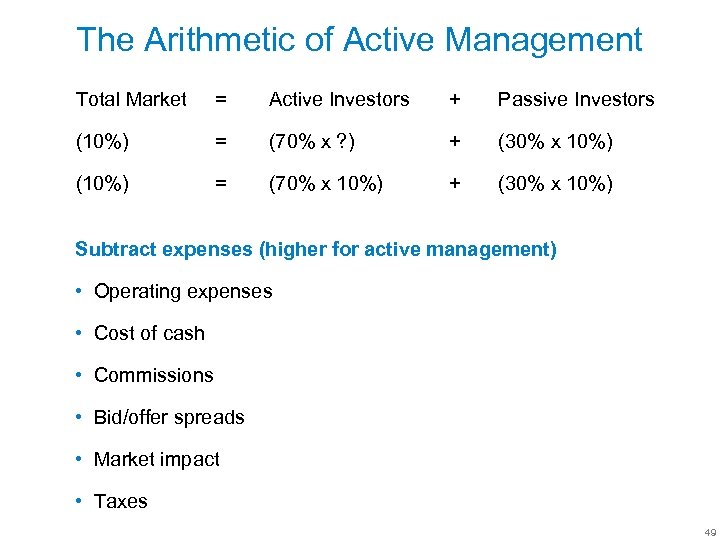 The Arithmetic of Active Management Total Market = Active Investors + Passive Investors (10%) = (70% x ? ) + (30% x 10%) (10%) = (70% x 10%) + (30% x 10%) Subtract expenses (higher for active management) • Operating expenses • Cost of cash • Commissions • Bid/offer spreads • Market impact • Taxes 49
 Summary • If you invest in actively managed funds, you have the hope of outperformance. • However, the evidence demonstrates that it is the triumph of hype, hope and marketing over wisdom and experience. 50
![Peter Lynch “[Investors] think of the so-called professionals … as having all the advantages.](https://present5.com/presentation/b7bc36fe71dd78d244cab29395a79764/image-51.jpg "Peter Lynch “[Investors] think of the so-called professionals … as having all the advantages.") Peter Lynch “[Investors] think of the so-called professionals … as having all the advantages. That is total crap. … They'd be better off in an index fund. ” Source: Is There Life After Babe Ruth? Barron’s, April 2, 1990. 51
Peter Lynch “[Investors] think of the so-called professionals … as having all the advantages. That is total crap. … They'd be better off in an index fund. ” Source: Is There Life After Babe Ruth? Barron’s, April 2, 1990. 51
 Warren Buffett “Most investors, both institutional and individual, will find that the best way to own common stocks is through an index fund that charges minimal fees. Those following this path are sure to beat the net results (after fees and expenses) delivered by the great majority of investment professionals. ” Source: Warren Buffett, Chairman’s Letter. February 28, 1997. 52
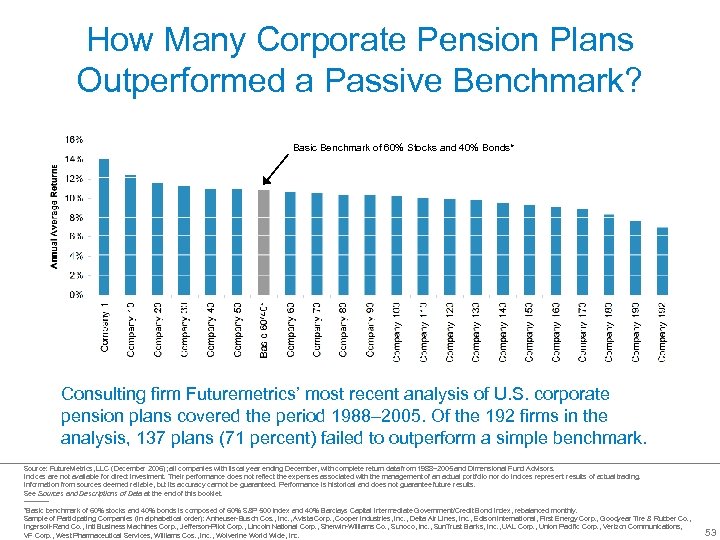 How Many Corporate Pension Plans Outperformed a Passive Benchmark? Basic Benchmark of 60% Stocks and 40% Bonds* Consulting firm Futuremetrics’ most recent analysis of U. S. corporate pension plans covered the period 1988– 2005. Of the 192 firms in the analysis, 137 plans (71 percent) failed to outperform a simple benchmark. Source: Future. Metrics, LLC (December 2006); all companies with fiscal year ending December, with complete return data from 1988– 2005 and Dimensional Fund Advisors. Indices are not available for direct investment. Their performance does not reflect the expenses associated with the management of an actual portfolio nor do indices represent results of actual trading. Information from sources deemed reliable, but its accuracy cannot be guaranteed. Performance is historical and does not guarantee future results. See Sources and Descriptions of Data at the end of this booklet. *Basic benchmark of 60% stocks and 40% bonds is composed of 60% S&P 500 Index and 40% Barclays Capital Intermediate Government/Credit Bond Index, rebalanced monthly. Sample of Participating Companies (in alphabetical order): Anheuser-Busch Cos. , Inc. , Avista Corp. , Cooper Industries, Inc. , Delta Air Lines, Inc. , Edison International, First Energy Corp. , Goodyear Tire & Rubber Co. , Ingersoll-Rand Co. , Intl Business Machines Corp. , Jefferson-Pilot Corp. , Lincoln National Corp. , Sherwin-Williams Co. , Sunoco, Inc. , Sun. Trust Banks, Inc. , UAL Corp. , Union Pacific Corp. , Verizon Communications, VF Corp. , West Pharmaceutical Services, Williams Cos. , Inc. , Wolverine World Wide, Inc. 53
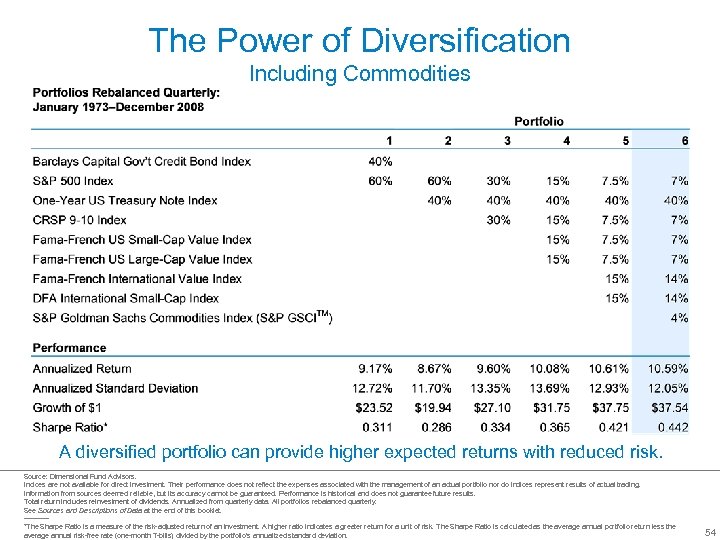 The Power of Diversification Including Commodities A diversified portfolio can provide higher expected returns with reduced risk. Source: Dimensional Fund Advisors. Indices are not available for direct investment. Their performance does not reflect the expenses associated with the management of an actual portfolio nor do indices represent results of actual trading. Information from sources deemed reliable, but its accuracy cannot be guaranteed. Performance is historical and does not guarantee future results. Total return includes reinvestment of dividends. Annualized from quarterly data. All portfolios rebalanced quarterly. See Sources and Descriptions of Data at the end of this booklet. *The Sharpe Ratio is a measure of the risk-adjusted return of an investment. A higher ratio indicates a greater return for a unit of risk. The Sharpe Ratio is calculated as the average annual portfolio return less the average annual risk-free rate (one-month T-bills) divided by the portfolio’s annualized standard deviation. 54
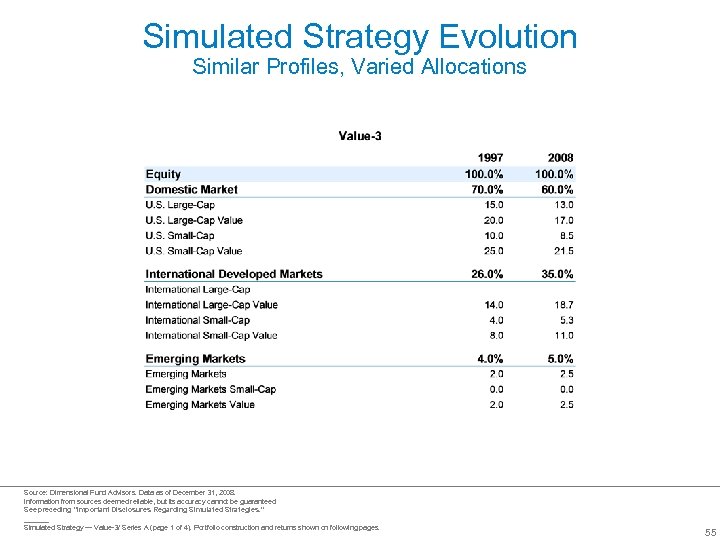 Simulated Strategy Evolution Similar Profiles, Varied Allocations Source: Dimensional Fund Advisors. Data as of December 31, 2008. Information from sources deemed reliable, but its accuracy cannot be guaranteed. See preceding “Important Disclosures Regarding Simulated Strategies. ” Simulated Strategy — Value-3/ Series A (page 1 of 4). Portfolio construction and returns shown on following pages. 55
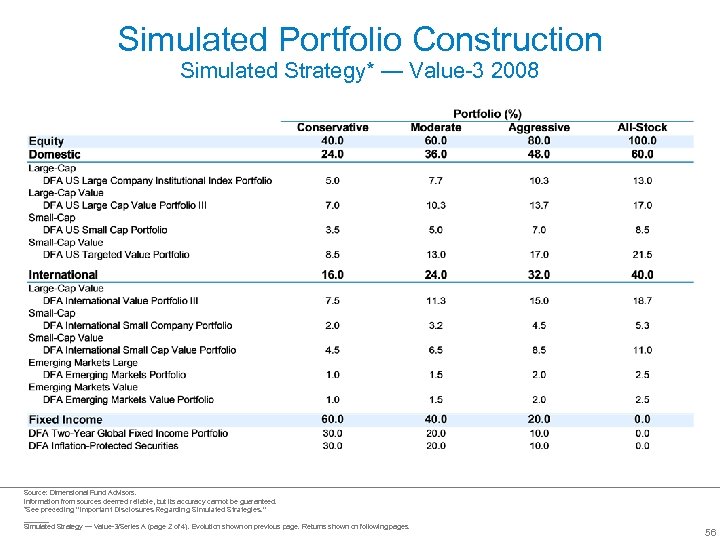 Simulated Portfolio Construction Simulated Strategy* — Value-3 2008 Source: Dimensional Fund Advisors. Information from sources deemed reliable, but its accuracy cannot be guaranteed. *See preceding “Important Disclosures Regarding Simulated Strategies. ” Simulated Strategy — Value-3/Series A (page 2 of 4). Evolution shown on previous page. Returns shown on following pages. 56
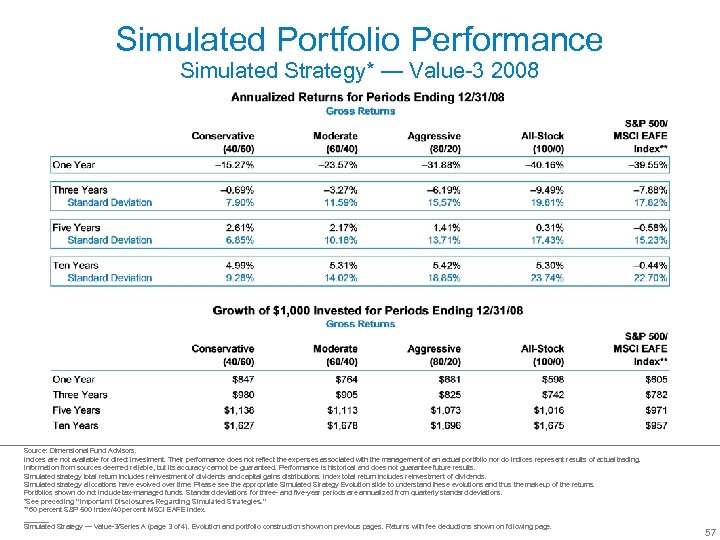 Simulated Portfolio Performance Simulated Strategy* — Value-3 2008 Source: Dimensional Fund Advisors. Indices are not available for direct investment. Their performance does not reflect the expenses associated with the management of an actual portfolio nor do indices represent results of actual trading. Information from sources deemed reliable, but its accuracy cannot be guaranteed. Performance is historical and does not guarantee future results. Simulated strategy total return includes reinvestment of dividends and capital gains distributions. Index total return includes reinvestment of dividends. Simulated strategy allocations have evolved over time. Please see the appropriate Simulated Strategy Evolution slide to understand these evolutions and thus the makeup of the returns. Portfolios shown do not include tax-managed funds. Standard deviations for three- and five-year periods are annualized from quarterly standard deviations. *See preceding “Important Disclosures Regarding Simulated Strategies. ” **60 percent S&P 500 Index/40 percent MSCI EAFE Index. Simulated Strategy — Value-3/Series A (page 3 of 4). Evolution and portfolio construction shown on previous pages. Returns with fee deductions shown on following page. 57
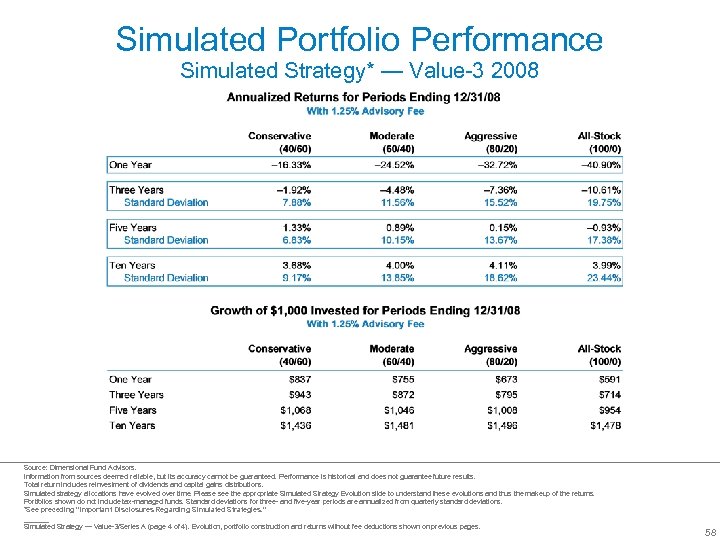 Simulated Portfolio Performance Simulated Strategy* — Value-3 2008 Source: Dimensional Fund Advisors. Information from sources deemed reliable, but its accuracy cannot be guaranteed. Performance is historical and does not guarantee future results. Total return includes reinvestment of dividends and capital gains distributions. Simulated strategy allocations have evolved over time. Please see the appropriate Simulated Strategy Evolution slide to understand these evolutions and thus the makeup of the returns. Portfolios shown do not include tax-managed funds. Standard deviations for three- and five-year periods are annualized from quarterly standard deviations. *See preceding “Important Disclosures Regarding Simulated Strategies. ” Simulated Strategy — Value-3/Series A (page 4 of 4). Evolution, portfolio construction and returns without fee deductions shown on previous pages. 58
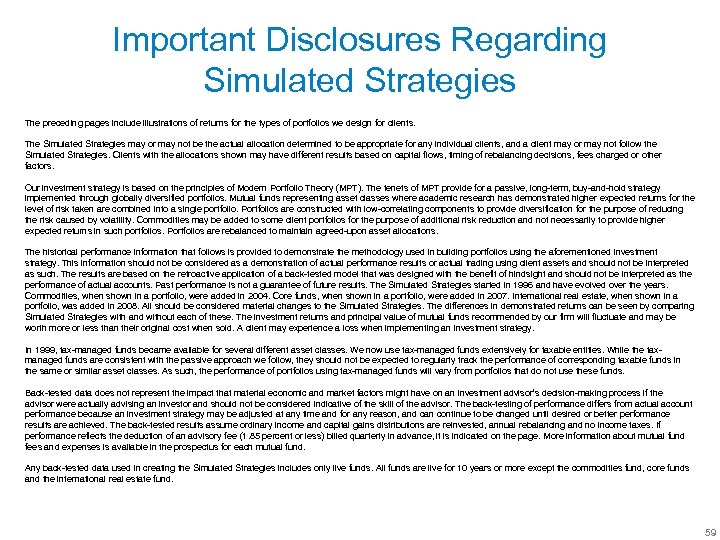 Important Disclosures Regarding Simulated Strategies The preceding pages include illustrations of returns for the types of portfolios we design for clients. The Simulated Strategies may or may not be the actual allocation determined to be appropriate for any individual clients, and a client may or may not follow the Simulated Strategies. Clients with the allocations shown may have different results based on capital flows, timing of rebalancing decisions, fees charged or other factors. Our investment strategy is based on the principles of Modern Portfolio Theory (MPT). The tenets of MPT provide for a passive, long-term, buy-and-hold strategy implemented through globally diversified portfolios. Mutual funds representing asset classes where academic research has demonstrated higher expected returns for the level of risk taken are combined into a single portfolio. Portfolios are constructed with low-correlating components to provide diversification for the purpose of reducing the risk caused by volatility. Commodities may be added to some client portfolios for the purpose of additional risk reduction and not necessarily to provide higher expected returns in such portfolios. Portfolios are rebalanced to maintain agreed-upon asset allocations. The historical performance information that follows is provided to demonstrate the methodology used in building portfolios using the aforementioned investment strategy. This information should not be considered as a demonstration of actual performance results or actual trading using client assets and should not be interpreted as such. The results are based on the retroactive application of a back-tested model that was designed with the benefit of hindsight and should not be interpreted as the performance of actual accounts. Past performance is not a guarantee of future results. The Simulated Strategies started in 1996 and have evolved over the years. Commodities, when shown in a portfolio, were added in 2004. Core funds, when shown in a portfolio, were added in 2007. International real estate, when shown in a portfolio, was added in 2008. All should be considered material changes to the Simulated Strategies. The differences in demonstrated returns can be seen by comparing Simulated Strategies with and without each of these. The investment returns and principal value of mutual funds recommended by our firm will fluctuate and may be worth more or less than their original cost when sold. A client may experience a loss when implementing an investment strategy. In 1999, tax-managed funds became available for several different asset classes. We now use tax-managed funds extensively for taxable entities. While the taxmanaged funds are consistent with the passive approach we follow, they should not be expected to regularly track the performance of corresponding taxable funds in the same or similar asset classes. As such, the performance of portfolios using tax-managed funds will vary from portfolios that do not use these funds. Back-tested data does not represent the impact that material economic and market factors might have on an investment advisor’s decision-making process if the advisor were actually advising an investor and should not be considered indicative of the skill of the advisor. The back-testing of performance differs from actual account performance because an investment strategy may be adjusted at any time and for any reason, and can continue to be changed until desired or better performance results are achieved. The back-tested results assume ordinary income and capital gains distributions are reinvested, annual rebalancing and no income taxes. If performance reflects the deduction of an advisory fee (1. 85 percent or less) billed quarterly in advance, it is indicated on the page. More information about mutual fund fees and expenses is available in the prospectus for each mutual fund. Any back-tested data used in creating the Simulated Strategies includes only live funds. All funds are live for 10 years or more except the commodities fund, core funds and the international real estate fund. 59
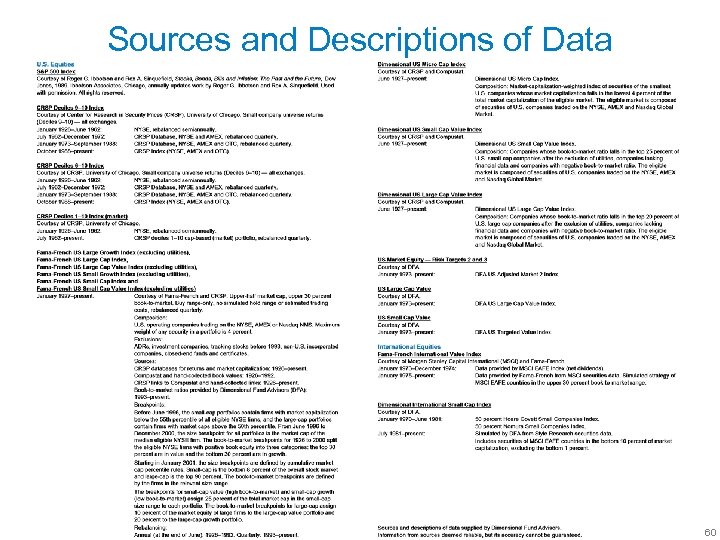 Sources and Descriptions of Data 60
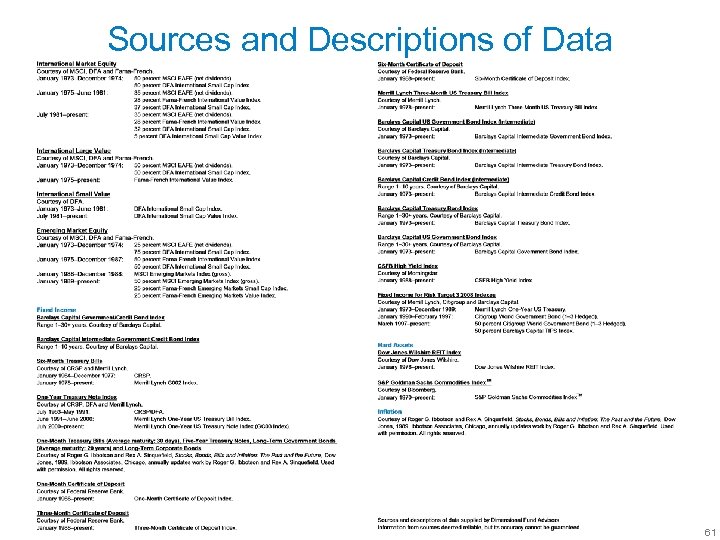 Sources and Descriptions of Data 61