


 Скачать презентацию The Scientist Game Chris Slaughter Dr PH courtesy
eb6464feea68fda8caffc26d1587b045.ppt
- Количество слайдов: 52
 The Scientist Game Chris Slaughter, Dr. PH (courtesy of Scott Emerson) Dept of Biostatistics Vanderbilt University 1 © 2002, 2003, 2006, 2008 Scott S. Emerson, M. D. , Ph. D.
 Overview • A simplified universe – One dimensional universe observed over time – Each position in the universe has an object – Goal is to discover any rules that might determine which objects are in a given location at a particular time 2
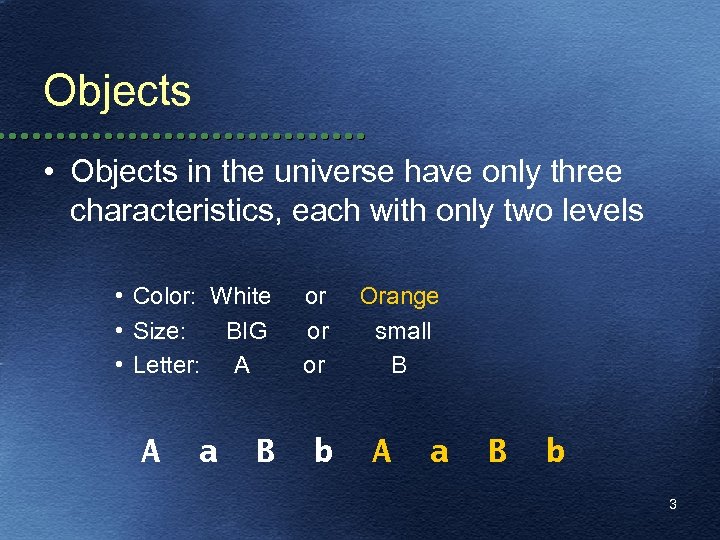 Objects • Objects in the universe have only three characteristics, each with only two levels • Color: White • Size: BIG • Letter: A A a B or or or b Orange small B A a B b 3
 Universal Laws • The level of each characteristic (color, size, letter) for the object at any position in the universe is either • completely determined by the prior sequence of that characteristic for objects at that position, OR • is completely random (anything is permissible) • (No patterns involving probabilities less than 1) • (Adjacent positions have no effect) 4
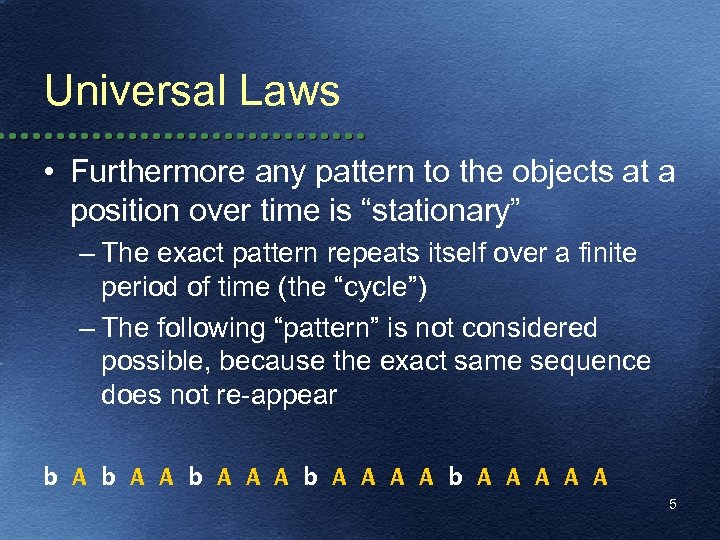 Universal Laws • Furthermore any pattern to the objects at a position over time is “stationary” – The exact pattern repeats itself over a finite period of time (the “cycle”) – The following “pattern” is not considered possible, because the exact same sequence does not re-appear b A A A A b A A A 5
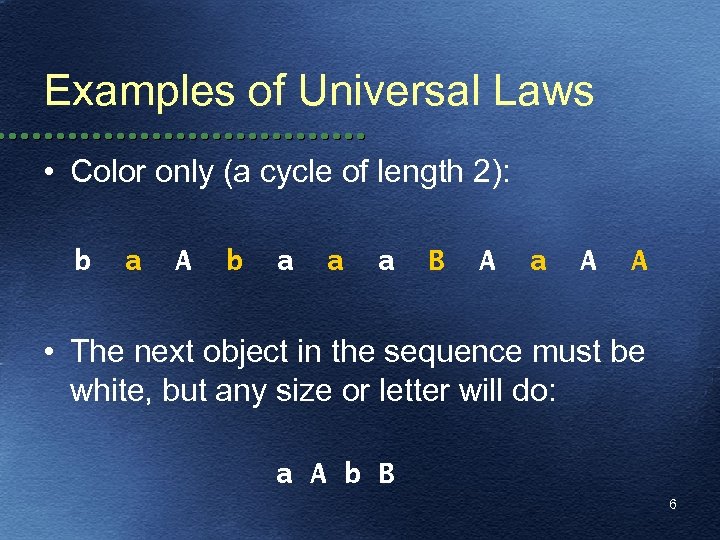 Examples of Universal Laws • Color only (a cycle of length 2): b a A b a a a B A a A A • The next object in the sequence must be white, but any size or letter will do: a A b B 6
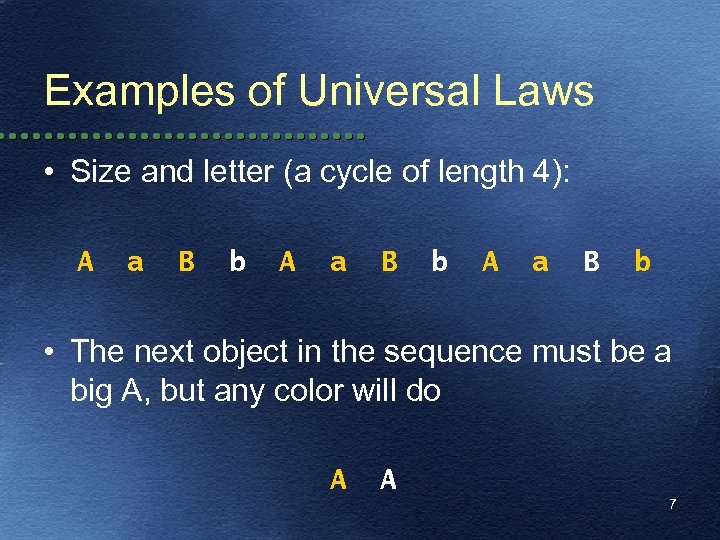 Examples of Universal Laws • Size and letter (a cycle of length 4): A a B b • The next object in the sequence must be a big A, but any color will do A A 7
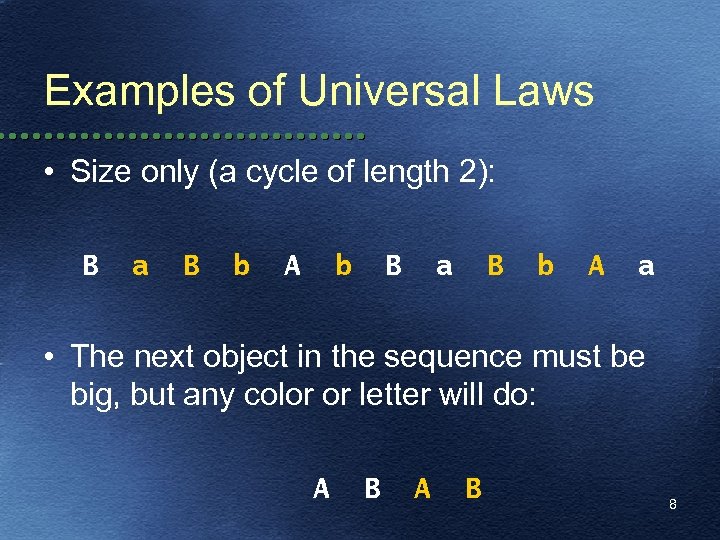 Examples of Universal Laws • Size only (a cycle of length 2): B a B b A b B a B b A a • The next object in the sequence must be big, but any color or letter will do: A B 8
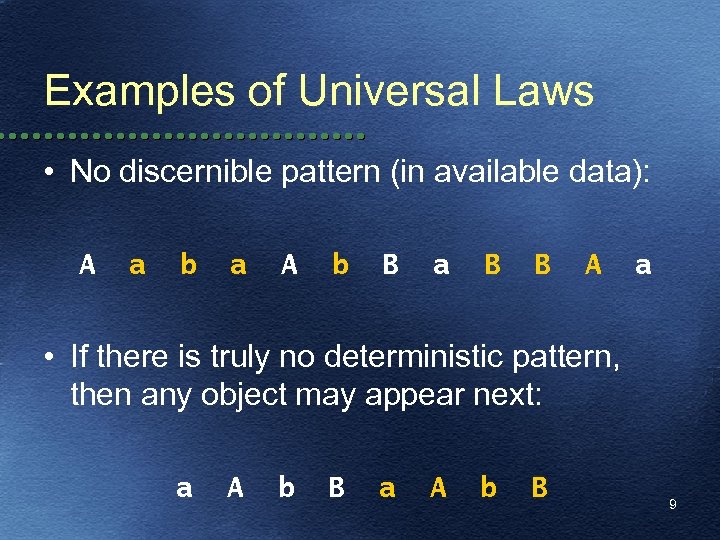 Examples of Universal Laws • No discernible pattern (in available data): A a b a A b B a B B A a • If there is truly no deterministic pattern, then any object may appear next: a A b B 9
 Scientific Task • Goal is therefore to decide for some position – whether a rule governs the level of each characteristic, and – if so, what that rule is (pattern to the sequence) 10
 Hypothesis Generation • Initially we have observational data gathered over time – Amount of available information varies from position to position – We want to identify some position that is the most likely to be governed by some deterministic rule 11
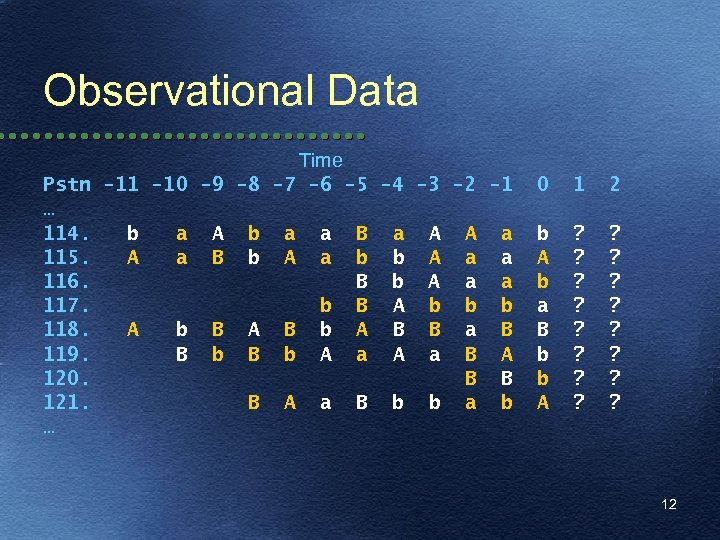 Observational Data Time Pstn -11 -10 -9 -8 -7 -6 -5 -4 -3 -2 -1 … 114. b a A b a a B a A A a 115. A a B b A a b b A a a 116. B b A a a 117. b B A b b b 118. A b B A B b A B B a B 119. B b A a B A 120. B B 121. B A a B b b a b … 0 1 2 b A b a B b b A ? ? ? ? 12
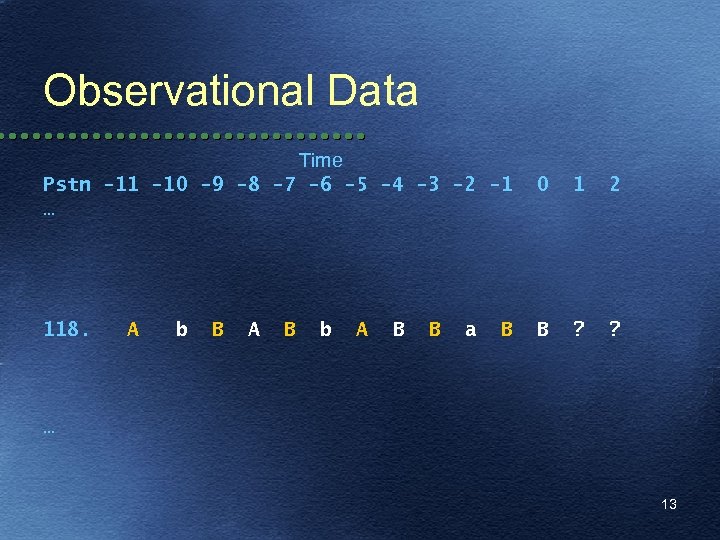 Observational Data Time Pstn -11 -10 -9 -8 -7 -6 -5 -4 -3 -2 -1 … 0 1 2 118. B ? ? A b B A B b A B B a B … 13
 Next Step? • Further observation? – Might take too long – Won’t really establish cause and effect 14
 Experimentation • You can try to put an object in the position – If it cannot come next, it disintegrates and you can try another – If it can come next, it stays and you can try a different object to follow it • Ultimately, a sequence of experiments can be used 15
 Experimental Goal • You need to devise a series of experiments to discover – whether a deterministic rule governs the sequence of objects at position 118, and – if there is such a rule, what it is 16
 Real World • Problem: – You must buy objects to experiment with • (apply for a grant) • Question: – What object should you try next in the sequence in order to determine the rule? 17
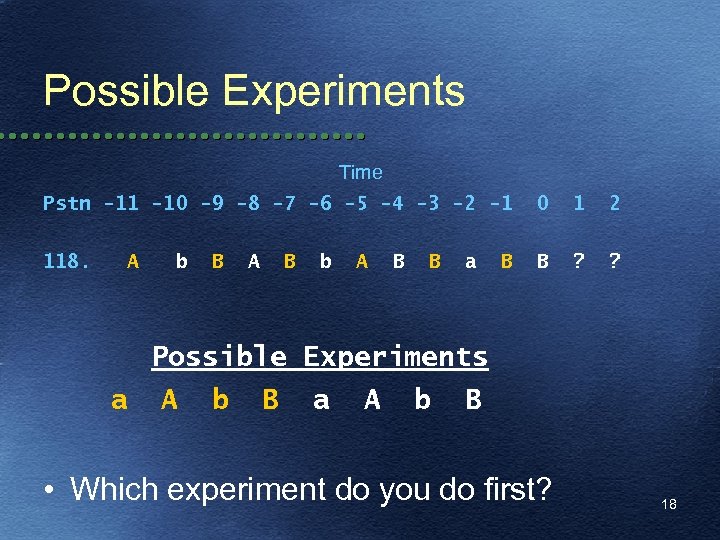 Possible Experiments Time Pstn -11 -10 -9 -8 -7 -6 -5 -4 -3 -2 -1 0 1 2 118. B ? ? A b B A B b A B B a B Possible Experiments a A b B • Which experiment do you do first? 18
 Reviewing the Grant Application • Did you choose a good experiment? – In order to determine whether your grant application should be funded, we review an ideal scientific approach • Observation • Formulating hypotheses • Devising experiments which discriminate between hypotheses 19
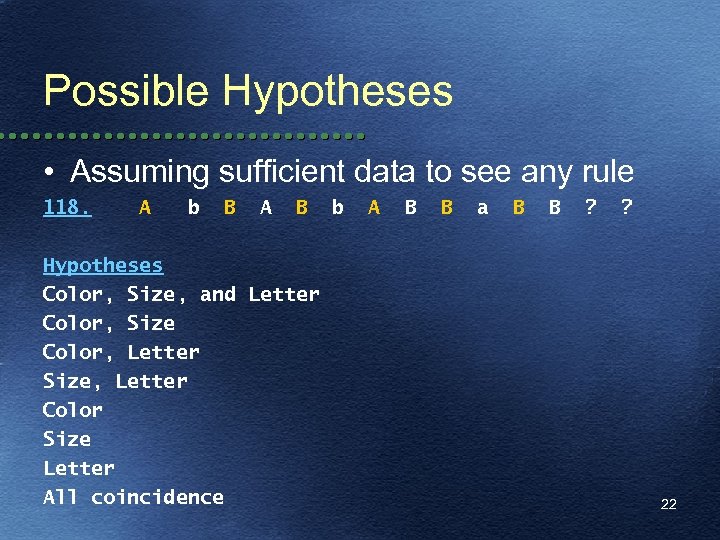
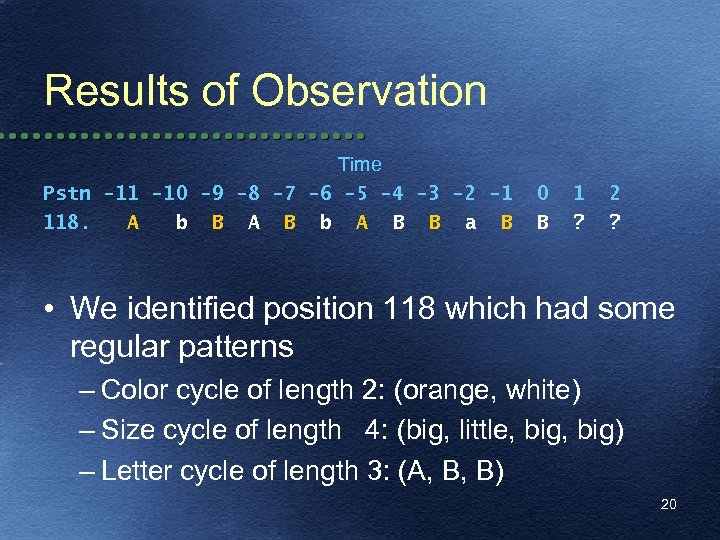 Results of Observation Time Pstn -11 -10 -9 -8 -7 -6 -5 -4 -3 -2 -1 118. A b B A B b A B B a B 0 B 1 ? 2 ? • We identified position 118 which had some regular patterns – Color cycle of length 2: (orange, white) – Size cycle of length 4: (big, little, big) – Letter cycle of length 3: (A, B, B) 20
 Define Hypotheses • Deterministic pattern versus random chance for each characteristic – Recognize that some or all observed patterns might be coincidence • Chance observation of a pattern for a single characteristic (e. g. , color) with sample size 12 (assuming each level equally likely) – – 1 out of 1, 024 for a cycle of length 2 1 out of 512 for a cycle of length 3 1 out of 256 for a cycle of length 4 1 out of 134, 217, 728 for all three simultaneously 21
 Possible Hypotheses • Assuming sufficient data to see any rule 118. A b B A B Hypotheses Color, Size, and Letter Color, Size Color, Letter Size, Letter Color Size Letter All coincidence b A B B a B B ? ? 22
 Most Popular First Choice 118. A b B A B Hypotheses Color, Size, and Letter Color, Size Color, Letter Size, Letter Color Size Letter All coincidence b A B B a B B ? ? Possible Experiments A 23
 Most Popular First Choice 118. A b B A B Hypotheses Color, Size, and Letter Color, Size Color, Letter Size, Letter Color Size Letter All coincidence b A B B a B B ? ? Possible Experiments A + 24
 Most Popular First Choice 118. A b B A B Hypotheses Color, Size, and Letter Color, Size Color, Letter Size, Letter Color Size Letter All coincidence b A B B a B B ? ? Possible Experiments A + + 25
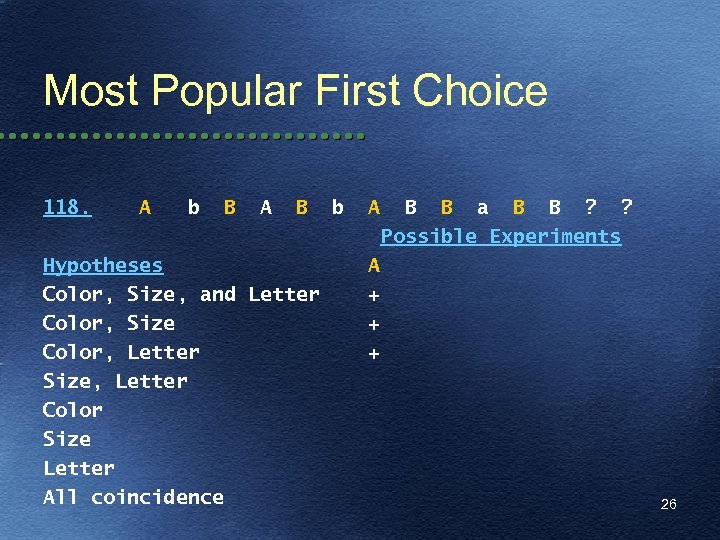 Most Popular First Choice 118. A b B A B Hypotheses Color, Size, and Letter Color, Size Color, Letter Size, Letter Color Size Letter All coincidence b A B B a B B ? ? Possible Experiments A + + + 26
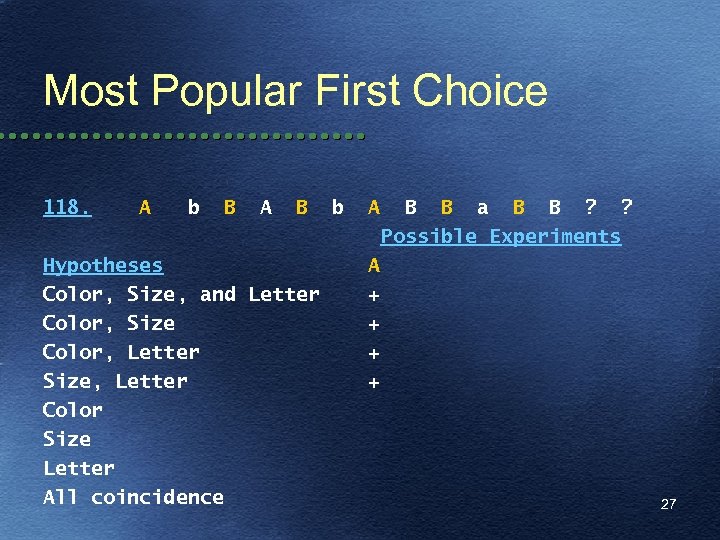 Most Popular First Choice 118. A b B A B Hypotheses Color, Size, and Letter Color, Size Color, Letter Size, Letter Color Size Letter All coincidence b A B B a B B ? ? Possible Experiments A + + 27
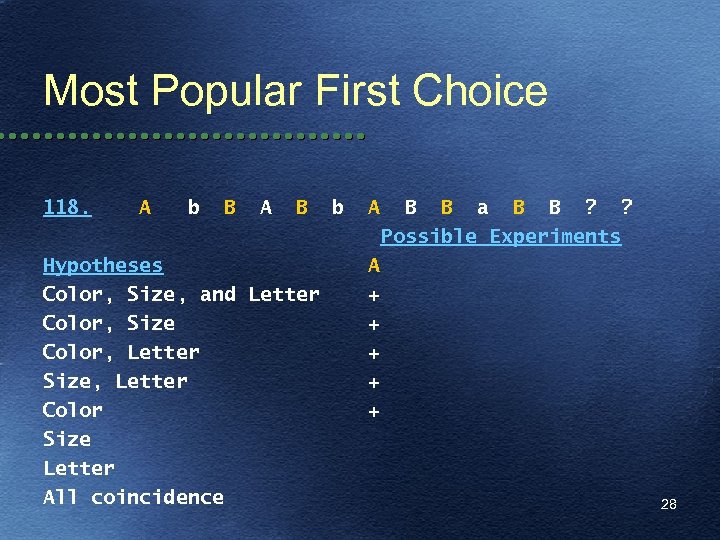 Most Popular First Choice 118. A b B A B Hypotheses Color, Size, and Letter Color, Size Color, Letter Size, Letter Color Size Letter All coincidence b A B B a B B ? ? Possible Experiments A + + + 28
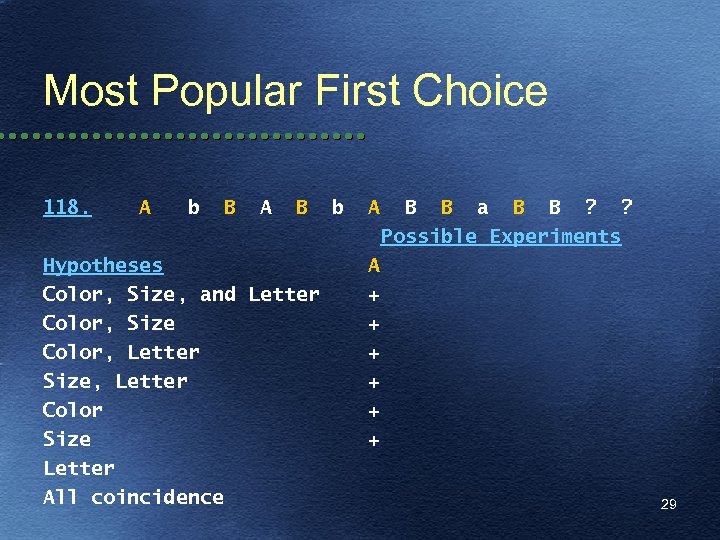 Most Popular First Choice 118. A b B A B Hypotheses Color, Size, and Letter Color, Size Color, Letter Size, Letter Color Size Letter All coincidence b A B B a B B ? ? Possible Experiments A + + + 29
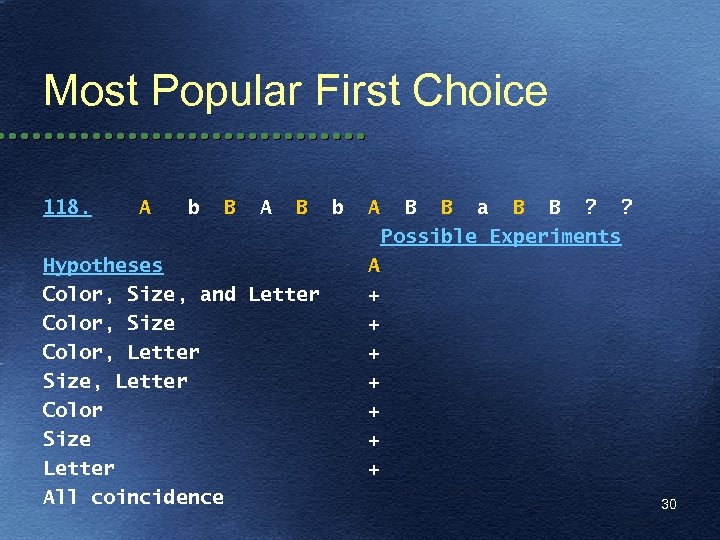 Most Popular First Choice 118. A b B A B Hypotheses Color, Size, and Letter Color, Size Color, Letter Size, Letter Color Size Letter All coincidence b A B B a B B ? ? Possible Experiments A + + + + 30
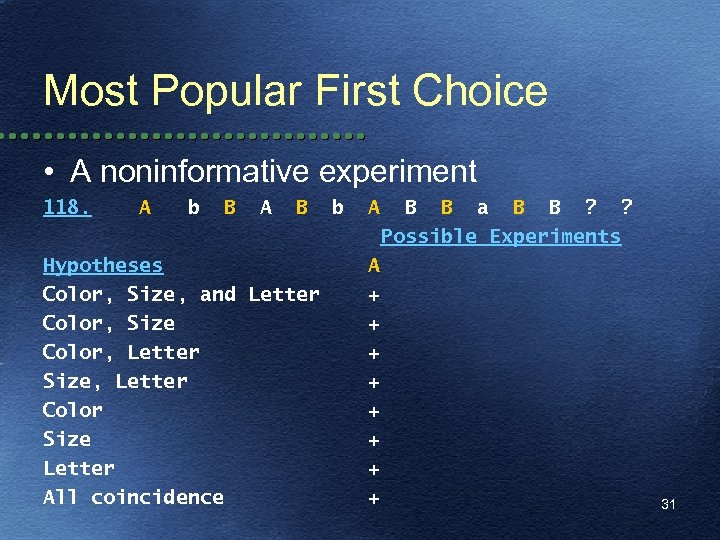 Most Popular First Choice • A noninformative experiment 118. A b B A B Hypotheses Color, Size, and Letter Color, Size Color, Letter Size, Letter Color Size Letter All coincidence b A A + + + + B B a B B ? ? Possible Experiments 31
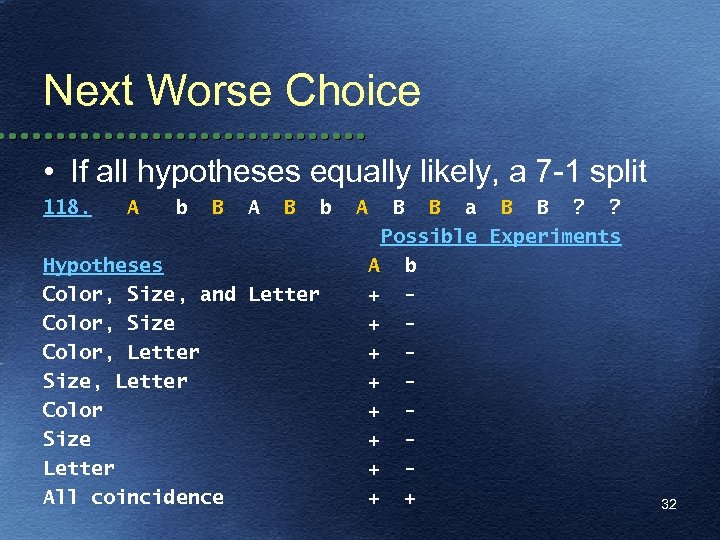 Next Worse Choice • If all hypotheses equally likely, a 7 -1 split 118. A b B A B Hypotheses Color, Size, and Letter Color, Size Color, Letter Size, Letter Color Size Letter All coincidence b A B B a B B ? ? Possible Experiments A b + + + + + 32
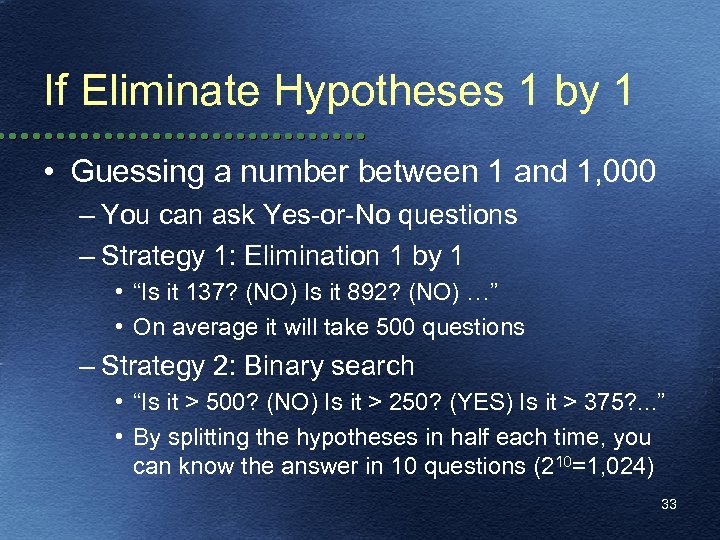 If Eliminate Hypotheses 1 by 1 • Guessing a number between 1 and 1, 000 – You can ask Yes-or-No questions – Strategy 1: Elimination 1 by 1 • “Is it 137? (NO) Is it 892? (NO) …” • On average it will take 500 questions – Strategy 2: Binary search • “Is it > 500? (NO) Is it > 250? (YES) Is it > 375? . . . ” • By splitting the hypotheses in half each time, you can know the answer in 10 questions (210=1, 024) 33
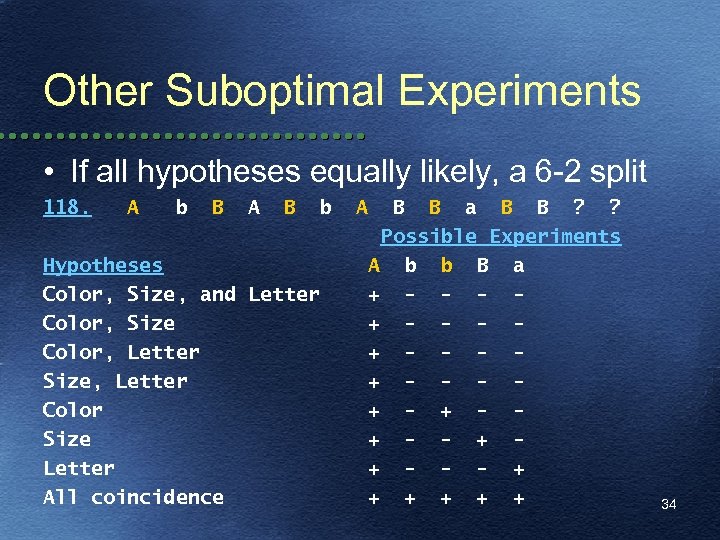 Other Suboptimal Experiments • If all hypotheses equally likely, a 6 -2 split 118. A b B A B Hypotheses Color, Size, and Letter Color, Size Color, Letter Size, Letter Color Size Letter All coincidence b A B B a B B ? ? Possible Experiments A b b B a + - - - + - + - - + + - - - + + + 34
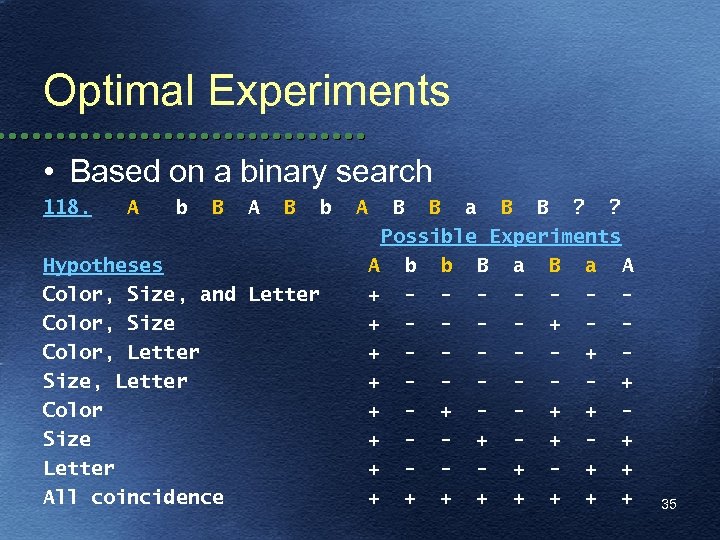 Optimal Experiments • Based on a binary search 118. A b B A B Hypotheses Color, Size, and Letter Color, Size Color, Letter Size, Letter Color Size Letter All coincidence b A B B a B B ? ? Possible Experiments A b b B a A + - - - + - - - + + - - + + + - - + - + + - - - + + + 35
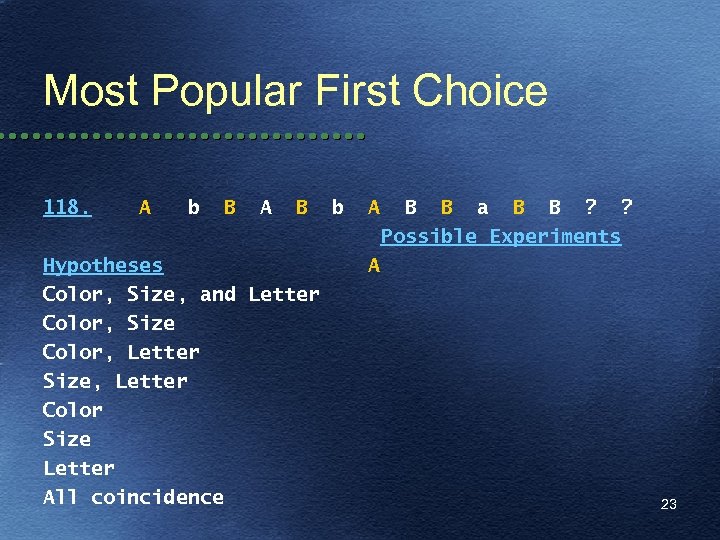
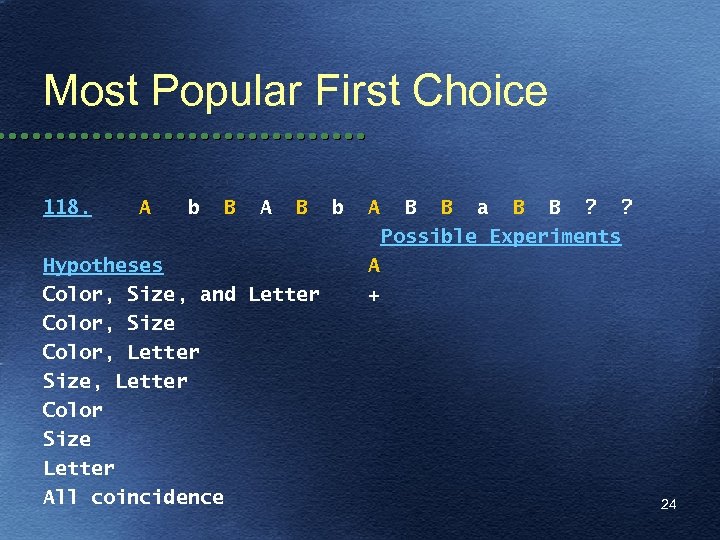
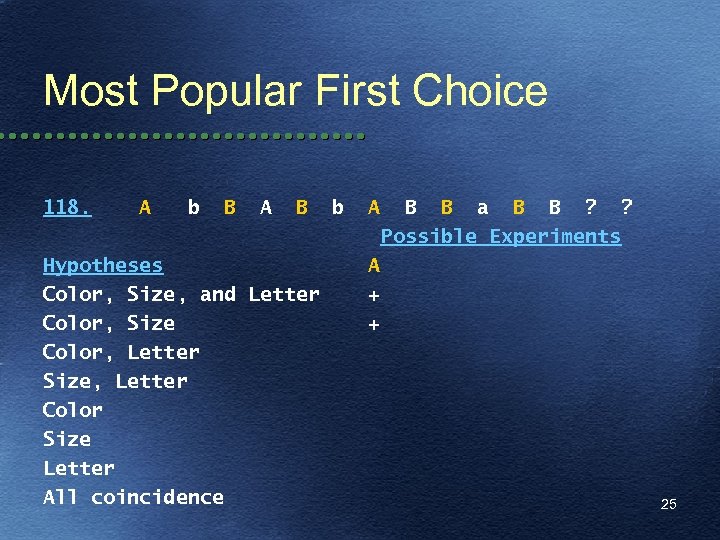
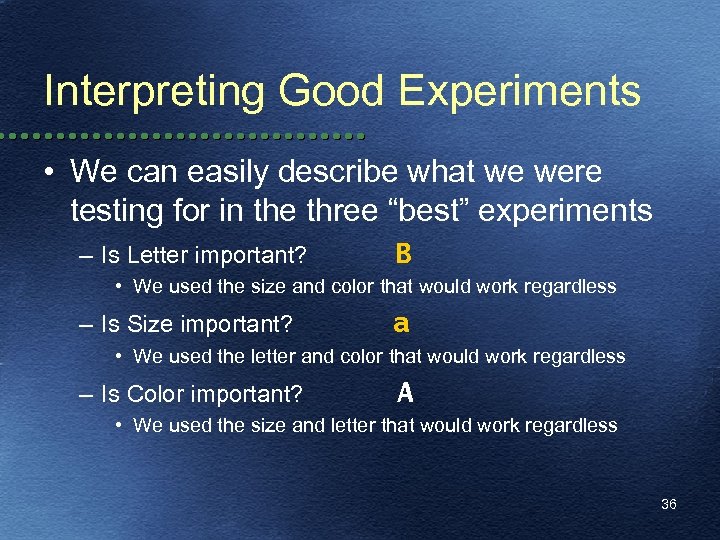 Interpreting Good Experiments • We can easily describe what we were testing for in the three “best” experiments – Is Letter important? B • We used the size and color that would work regardless – Is Size important? a • We used the letter and color that would work regardless – Is Color important? A • We used the size and letter that would work regardless 36
 Sequence of Experiments • Separate question into three experiments – Address each characteristic separately – Avoid “confounding” the question • Perform these 3 experiments in sequence – Results uniquely identify the 8 hypotheses – (Eliminating hypotheses 1 at a time would on average take 4 experiments) 37
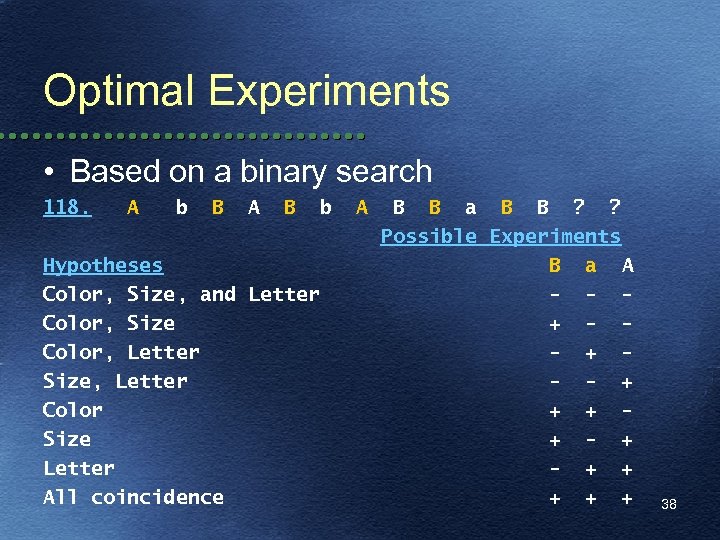 Optimal Experiments • Based on a binary search 118. A b B A B Hypotheses Color, Size, and Letter Color, Size Color, Letter Size, Letter Color Size Letter All coincidence b A B B a B B ? ? Possible Experiments B a A - - + + - + + + 38
 Other Experimental Sequences • No other series of 3 will always do this – But conditional on specific results from first experiment, there are may be additional good experiments for the second stage, e. g. , – Suppose first experiment: A and it does not disintegrate » Then we know color does not matter – Good choices for the next experiment: B a » Choose different letter or size, but not both – BUT: If first experiment had disintegrated, only two good choices: B a » Must use orange, because color matters 39
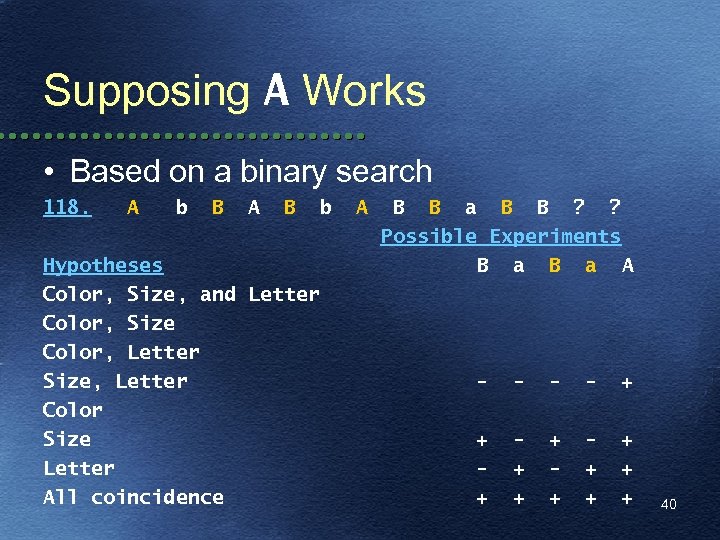 Supposing A Works • Based on a binary search 118. A b B A B Hypotheses Color, Size, and Letter Color, Size Color, Letter Size, Letter Color Size Letter All coincidence b A B B a B B ? ? Possible Experiments B a A - - + + + 40
 If Hypotheses not Equally Likely • With a binary outcome, we want to eliminate 50% of the “prior probability” – Example: • Assume 99. 85% of positions truly have no pattern • Others have “independent, equiprobable patterns” • Expect to see 0. 00002% with patterns like 118 – Maybe we examined millions of positions • Best approach may have been to try: b – Discriminates between no pattern (like 49% of positions) and some pattern (like the other 51% of positions) 41 – On average, 2. 52 experiments (1 expt 49%, 4 expt 51%)
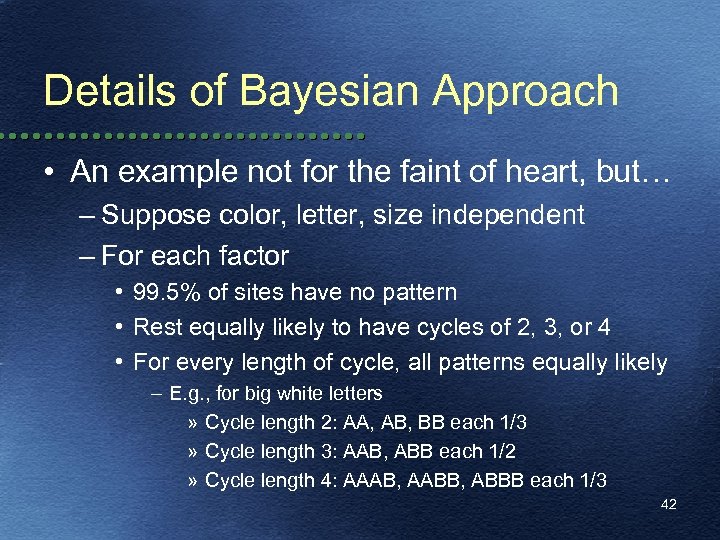 Details of Bayesian Approach • An example not for the faint of heart, but… – Suppose color, letter, size independent – For each factor • 99. 5% of sites have no pattern • Rest equally likely to have cycles of 2, 3, or 4 • For every length of cycle, all patterns equally likely – E. g. , for big white letters » Cycle length 2: AA, AB, BB each 1/3 » Cycle length 3: AAB, ABB each 1/2 » Cycle length 4: AAAB, AABB, ABBB each 1/3 42
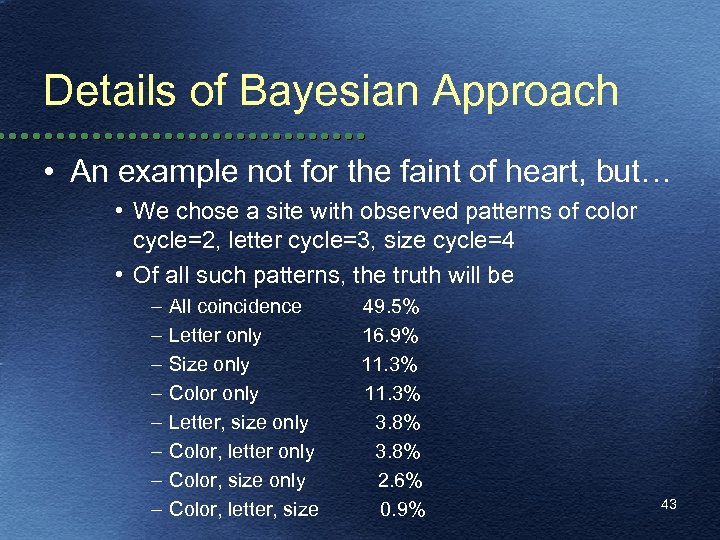 Details of Bayesian Approach • An example not for the faint of heart, but… • We chose a site with observed patterns of color cycle=2, letter cycle=3, size cycle=4 • Of all such patterns, the truth will be – – – – All coincidence Letter only Size only Color only Letter, size only Color, letter only Color, size only Color, letter, size 49. 5% 16. 9% 11. 3% 3. 8% 2. 6% 0. 9% 43
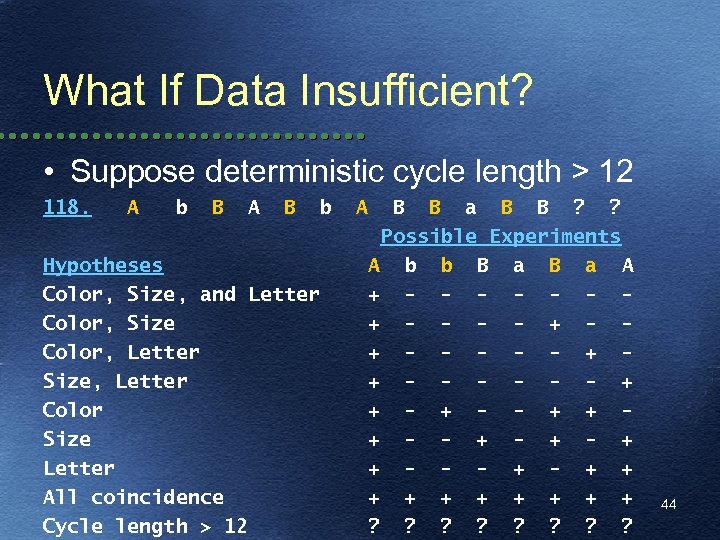 What If Data Insufficient? • Suppose deterministic cycle length > 12 118. A b B A B Hypotheses Color, Size, and Letter Color, Size Color, Letter Size, Letter Color Size Letter All coincidence Cycle length > 12 b A B B a B B ? ? Possible Experiments A b b B a A + - - - + - - - + + - - + + + - - + - + + - - - + + + ? ? ? ? 44
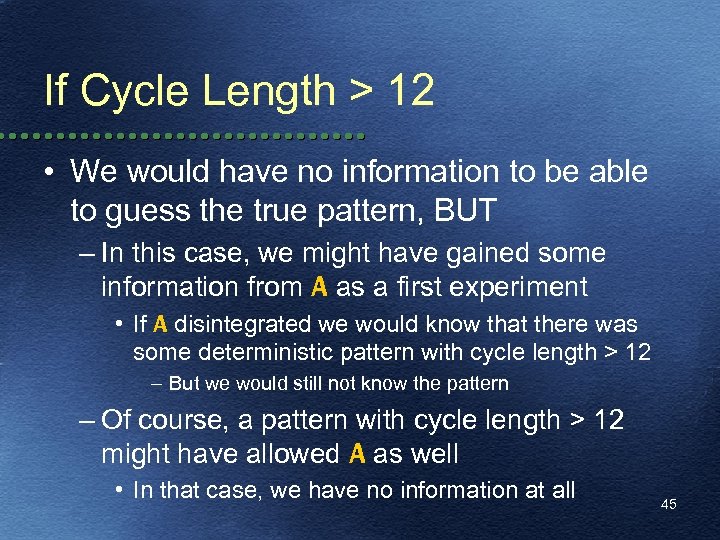 If Cycle Length > 12 • We would have no information to be able to guess the true pattern, BUT – In this case, we might have gained some information from A as a first experiment • If A disintegrated we would know that there was some deterministic pattern with cycle length > 12 – But we would still not know the pattern – Of course, a pattern with cycle length > 12 might have allowed A as well • In that case, we have no information at all 45
 Moral: Hypotheses • The goal of the experiment should be to “decide which” not “prove that” • A well designed experiment discriminates between hypotheses – The hypotheses should be the most important, viable hypotheses 46
 Moral: Experiment • All other things being equal, an experiment should be equally informative for all possible outcomes – In the presence of a binary outcome, use a binary search • (using prior probability of being true) – But may need to consider simplicity of experiments, time, cost • (What lessons can be learned from Master Mind? ) 47
 In the Presence of Variability • We use statistics to quantify the precision of our inference – We will describe our confidence/belief in our conclusions using frequentist or Bayesian probability statements – Discriminating between hypotheses will be based on a frequentist confidence interval or a Bayesian credible interval 48
 Interval Estimates • Frequentist confidence intervals – The set of all hypotheses for which the observed data are “typical” • There is more than a negligible probability of obtaining such results when those hypotheses are true • Bayesian credible intervals – The set of hypotheses that are most probable given the observed data • Also incorporates our prior belief in the hypotheses 9 4
 Frequentist Evidence • Does frequentist evidence provide evidence? – Is it relevant to calculate the probability of data that you know you observed? • Relevance especially questionable if calculated on a hypothesis that is unlikely a priori • My answer in experimental design: Yes – Design an experiment that has results that are not consistent with one of the viable, important 50 hypotheses
 Statistical Experimental Design • I believe a scientific approach to the use of statistics is to – Decide a level of confidence used to construct frequentist confidence intervals or Bayesian credible intervals – Ensure adequate statistical precision (sample size) to discriminate between relevant scientific hypotheses • The intervals should not contain two hypotheses that were to be discriminated between 51
 Impact on Statistical Power • I choose equal one-sided type I and type II errors – E. g. , 97. 5% power to detect the alternative in a one-sided level 0. 025 hypothesis test • In this way, at the end of the study, the 95% CI will not contain both the null and alternative hypotheses – I will have discriminated between the hypotheses with high confidence 52