


 Скачать презентацию The science of personality research Opinion vs
83bddfd5a668d0f175cebbb9b19a2d0c.ppt
- Количество слайдов: 154
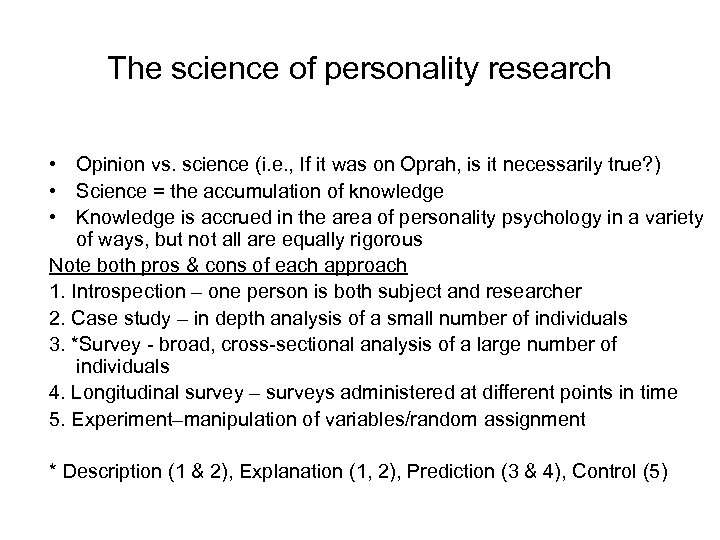 The science of personality research • Opinion vs. science (i. e. , If it was on Oprah, is it necessarily true? ) • Science = the accumulation of knowledge • Knowledge is accrued in the area of personality psychology in a variety of ways, but not all are equally rigorous Note both pros & cons of each approach 1. Introspection – one person is both subject and researcher 2. Case study – in depth analysis of a small number of individuals 3. *Survey - broad, cross-sectional analysis of a large number of individuals 4. Longitudinal survey – surveys administered at different points in time 5. Experiment–manipulation of variables/random assignment * Description (1 & 2), Explanation (1, 2), Prediction (3 & 4), Control (5)
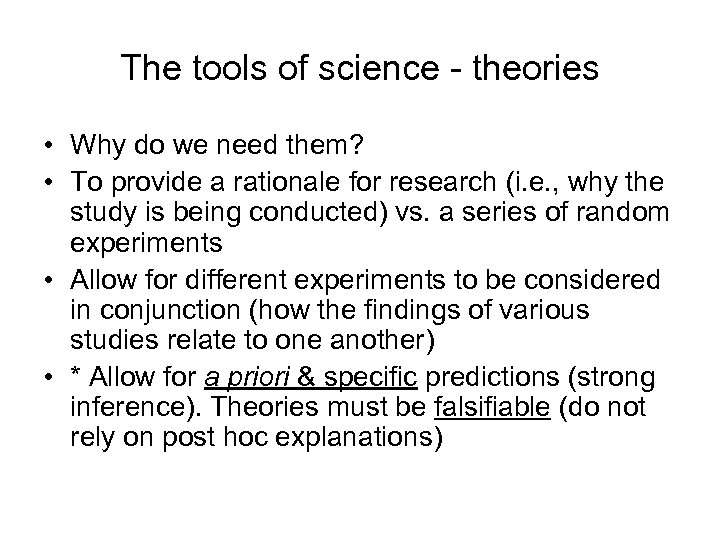 The tools of science - theories • Why do we need them? • To provide a rationale for research (i. e. , why the study is being conducted) vs. a series of random experiments • Allow for different experiments to be considered in conjunction (how the findings of various studies relate to one another) • * Allow for a priori & specific predictions (strong inference). Theories must be falsifiable (do not rely on post hoc explanations)
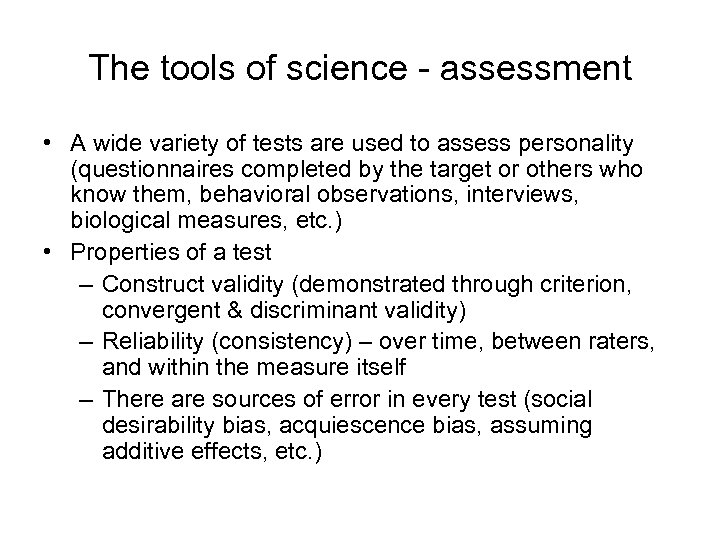 The tools of science - assessment • A wide variety of tests are used to assess personality (questionnaires completed by the target or others who know them, behavioral observations, interviews, biological measures, etc. ) • Properties of a test – Construct validity (demonstrated through criterion, convergent & discriminant validity) – Reliability (consistency) – over time, between raters, and within the measure itself – There are sources of error in every test (social desirability bias, acquiescence bias, assuming additive effects, etc. )
 Psychology is replete with terminology. Here are some that didn’t make it. • Reintarnation: Coming back to life as a hillbilly. • Foreploy: Any misrepresentation about yourself for the purpose of later getting sex. • Osteopornosis: A degenerate disease. • Karmageddon: It's like, when everybody is sending off all these really bad vibes, right? And then, like, the Earth explodes and it's like, a serious bummer. • Ignoranus: A person who's both stupid an a--hole. • Sarchasm: The gulf between the author of sarcastic wit and the person who doesn't get it. **************** • Personality: a stable pattern (over time and across situations) of affect, cognitions and behavior.
 Thematic Apperception Test-TAT • On a blank piece of paper, write a pseudonym and the last 4 digits of your ID • After looking at the picture provided on the overhead, please write a story that: – Indicates what is happening in the picture – Describes the thoughts and feelings of the character(s) – Describes what led up to the events depicted – Describes what is the most likely outcome
 Explaining all behavior (Freud) • Determinism - driven by energy (libido) of a sexual and aggressive nature – Explain all behavior using these two basic motives? • Conflict – within (id and superego), and between the individual and society • Unconscious - aspects of ourselves that are unknown • What information is contained in the unconscious?
 Self-awareness • What did Freud think was contained in the unconscious? • According to Freud, we are not aware of most of our motives (these are unconscious) • Conscious – limited aspects of the self that are known • Preconscious – Information that moves from the unconscious to the conscious passes through the preconscious (material you can be made aware of by directing attention to it) – Now referred to as the “cognitive unconscious”
 Evidence for the unconscious? • A large number of studies to address the issue “Is there an unconscious” • Two key questions: – Do we have the ability to cognitively take-in information without knowing it? – If so, does this information influence our subsequent actions? i. e. , Was Freud correct?
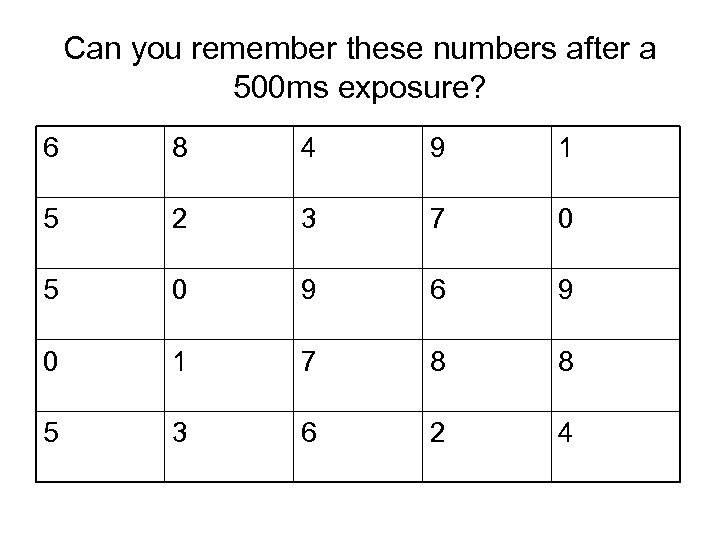 Can you remember these numbers after a 500 ms exposure? 6 8 4 9 1 5 2 3 7 0 5 0 9 6 9 0 1 7 8 8 5 3 6 2 4
 Recall of visual or auditory information • Short-term memory (also known as “working memory”) can hold a limited amount of information, but only if it is rehearsed. • Otherwise, most of the information we are exposed to stays in the sensory register – Unlimited capacity, but very short duration – Approximately 2 -3 seconds for both iconic (visual) and echoic (auditory) memory • about 5 numbers can be recalled from the 25 – Therefore, most info. is lost (this is adaptive)
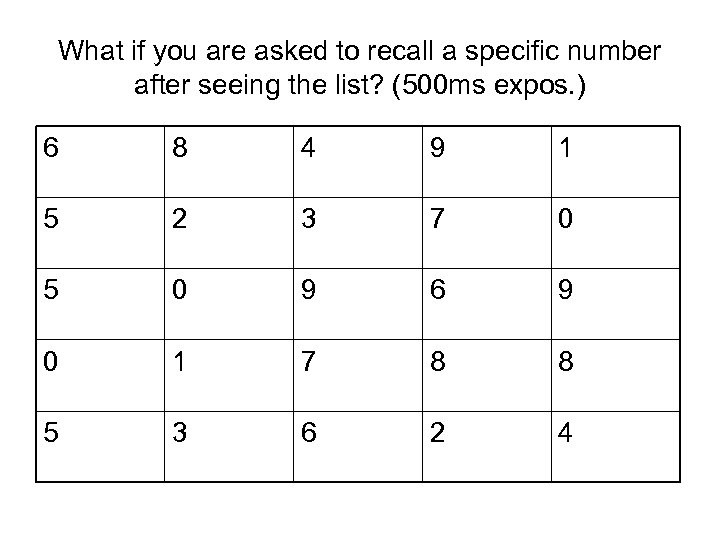 What if you are asked to recall a specific number after seeing the list? (500 ms expos. ) 6 8 4 9 1 5 2 3 7 0 5 0 9 6 9 0 1 7 8 8 5 3 6 2 4
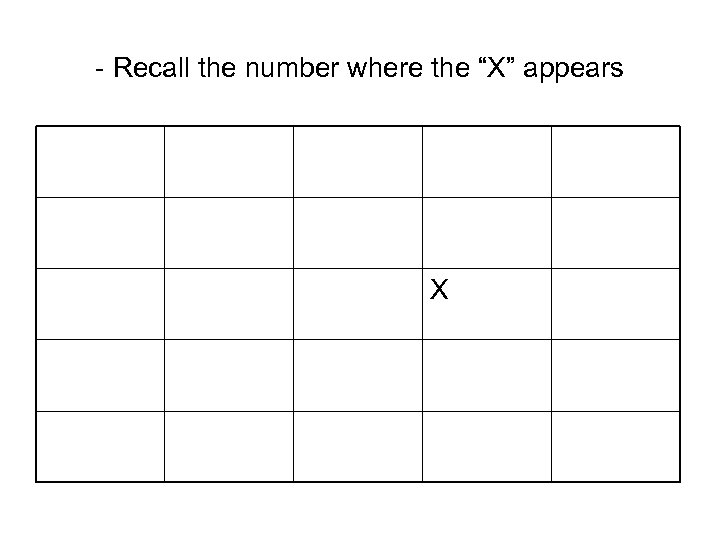 - Recall the number where the “X” appears X
 Summary of visual recall experiment • All of the information is in your sensory register so you can recall any one of the 25 numbers within 2 -3 seconds. – e. g. , X = ? • A simple memory experiment demonstrates we are not fully aware of all information in memory. • But does this info influence our behavior?
 Unconscious priming Klinger & Greenwald, 1995 • 80 college students (40 males & 40 female) recruited from introductory psychology class • all participants took part in a computerized task in which they had to indicate whether pairs of words presented several seconds apart were associated (yes/no response with RT recorded) • Between the presentation of the two words, a picture was flashed briefly on the screen and in half of the trials the picture was related to the words while for the remaining trials the picture was unrelated e. g. , Related: “duck” Picture of birds “Sparrow” Unrelated: “duck” Picture of cars “Sparrow”
 Unconscious priming - cont • All pictures were masked (50 ms) or legible (500 ms) • Reaction times (RTs) for correct responses were used to quantify speed of judgments • Results indicate that RTs were faster for related pictures vs. unrelated pictures • RTs were faster for masked (unconscious) vs. legible (conscious) pictures - Why? • The priming effect for the pictures only exists if the prime occurs within a short period of time (approx. 3 s) of the first word, and the second word occurs immediately after • Could salience of stimulus increase effect duration? Some clinical data on long term unconscious effects…
 Childhood experiences and adult functioning • Can childhood trauma serve as the stimulus that later influences adult behavior? • Theory for Dissociative Identity Disorder (DID, formerly MPD) – child is physically or sexually traumatized and they depersonalize the event and develop other identities to protect themselves (an unconscious event). • This example would (in theory) involve a long term effect of the unconscious • Clinical data (retrospective accounts) indicate that 96% have been sexually or physically abused (repressed) • Research?
 Recovery of repressed memories vs. false memory syndrome • Prospective research suggests that the incidence of DID is 1 -4% for those children having been abused (no greater than that observed in the general pop. ). Why? • Memories are inaccurate (more so as time passes and info. is imputed from other experiences) & the method of recovery can enhance the inaccuracies (e. g. , witness a car wreck; attack of a professor) • Iatrogenic effect vs. longitudinal studies • Loftus – research shows that recovered memories are very inaccurate; especially details, but also their occurrence
 More on Freud: Theoretical structures • Id – pleasure principle, initial focus of libido, primary process thinking, no contact with reality (completely unconscious) • Superego – last of these three structures to develop, internalized morality, no contact with reality (completely unconscious) • Given the characteristics of the above two structures, how can they be satisfied? • Ego – reality principle, secondary process thinking, exists at the unconscious, preconscious, and conscious levels, employs defense mechanisms to mediate between the id and superego and reality
 Some defense mechanisms • Denial – repression of material into the unconscious (it is the most basic defense and is at the heart of all other defenses) • Projection – attribute to others what is denied in the self • Reaction formation – expressing the opposite feeling of what is being experienced • Displacement – expression towards a safer object • Intellectualization - rationalizing so as to minimize the affective experience • Sublimation – higher level of defense whereby one redirects anxiety towards something productive • Research on the defenses?
 Adams, Wright, & Lohr, 1996 • Much research focuses on defense against libidinal wishes (sex and/or aggression). • Using the Index of Homophobia (a standardized measure), they identified male students who scored either high (n=35) or low (n=29) • Exposed everyone to erotic videos depicting heterosexual, male homosexual and lesbian interactions • Arousal measured via a self report questionnaire & plythysmograph (blood volume)
 Adams, Wright, & Lohr, ’ 96 - continued • Both groups of males were aroused by heterosexual and lesbian erotic videos (both physiological and self-report) • Neither group self-reported arousal to homosexual male video • There was, however, a physiological response to the male homosexual video but only for homophobic males • Individuals could be unaware (denial? ) and/or expressing the opposite feelings (reaction formation? )
 Adams, Wright, & Lohr, ’ 96 - continued 2 • Confounds in the study? – Unknown if this generalizes to females? – Small N, college students only, limited range of ages, all Caucasians from the U. S. A. , etc. – Missing any control groups? • Strengths: both physiological and selfreport measures; manipulated variables
 Arousal itself = confound? • A confound with other types of arousal such as anxiety? See “misattribution of arousal” effect • Dutton & Aron, 1974: Female RA, male Ss – 2 bridges over the Capilano River, in BC, Canada – 230 ft drop, unstable rope, with low hand supports – 10 ft drop, stable, with high wood hand rails • Ss completed questionnaire, wrote a story about a female (graded for sexual content), & given phone # of RA • Note: Ss were NOT randomly assigned to bridge conditions (Why? Consequence of this? )
 Thematic Apperception Test (TAT) – Examining “projection” • Developed by Murray in 1938 • Follows from other projective tests such as the word association task (Jung) and the Rorschach Ink Blot test, & all are commonly used in clinical settings • Assumption that vague stimuli will require you to add material in order to complete the task (e. g. , write a story) • This process will require that you draw from your own personal experiences, biases, etc. • Projection is also assumed to occur because the context is safer (appears less self-relevant), thus the client should be less defensive
 Scoring of Projective tests • Projective tests allow for a broader range of responses (e. g. , as opposed to a T/F format) – Impossible to anticipate the variety of responses – Subtle (qualitative) differences between responses are difficult to detect and quantify • Typically results in lower reliability (consistency) – test-retest and inter-rater – Lower reliability limits validity • Tests vs. Techniques? – Tests require standardized administration, scoring, and interpretation (reliability and validity)
 Psychosexual stages of development • Also referred to as “erogenous zones” as they denote the changing focus of libido throughout the lifespan • 1. Oral – “I want”; experience the world through the mouth by biting, licking, tasting (most sensitive) – oral aggressive vs. oral dependent (timing of the weaning) • 2. Anal – “I control”; experience/learn to control – anal expulsive vs anal retentive (extreme approaches re: control) Article: Character and anal eroticism – – Meaning of expressions: “Brown noser” and “Kiss my ass” Orderly – clean (why? ), conscientious, trustworthy Parsimony – avarice (greed) – why connect it with money? Obstinacy – defiance, rage, vengefulness
 Psychosexual stages of development - cont • 3. Phallic – Gender identity; incestuous feelings that should eventually result in identification with same sex parent – Heterosexual vs. “homosexual impulse” – See complexes (next slide) • 4. Latency – sublimation of development to activities • 5. Genital – mature adult relationships (ideally the superego is fully developed, and this leads one to pursue appropriate relationships)
 Oedipus/Electra Complex • Phallic – Gender identity; incestuous feelings that should eventually result in identification with same sex parent – Heterosexual vs. “homosexual impulse” • Males • desire mommy & see daddy as competition/threat • Experience castration anxiety • identify with daddy to resolve the complex • Females • desire mommy, but switch to daddy due to “penis envy” • How can this complex be resolved? • Research?
 Subliminal Psychodynamic Activation (SPA) • Research to examine the Oedipus complex • Assumes: subliminal information activates Oedipal conflicts • Subliminal = stimuli detected less than 50% of the time • Given the results of the previous research on the unconscious, it is clear that subliminal information exists • Can it influence our behavior over extended periods of time? • Advertisers seem to think so… (overheads & slide)
 SPA research – Silverman et al. , 1978 • SPA research attempts to activate the Oedipal conflict in males (e. g. , competition between fathers and sons) • Theory: All adult competition is interpreted as reflecting a re-experience of this event • Recruited 90 male college students • All threw darts to get a baseline score • Then they were randomly assigned to view one of three messages using a tachistoscope (flashes messages) – “Beating daddy is wrong” – “Beating daddy is OK” – “People are walking”
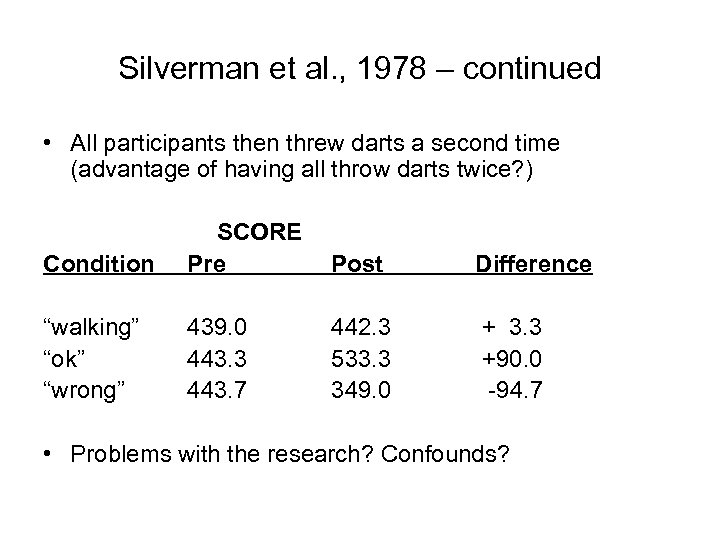 Silverman et al. , 1978 – continued • All participants then threw darts a second time (advantage of having all throw darts twice? ) Condition SCORE Pre Post Difference “walking” “ok” “wrong” 439. 0 443. 3 443. 7 442. 3 533. 3 349. 0 + 3. 3 +90. 0 -94. 7 • Problems with the research? Confounds?
 Does the Silverman study support Freud’s theory? • Not directly. • It does demonstrate that the subliminal message improved performance, but this does not demonstrate the role of the Oedipus complex (nor that it exists) – e. g. , the messages themselves may differ in their affective tone (pleasant vs. unpleasant vs. neutral) and that alone may have influenced performance (e. g. , research on sports and colors) • Research using the phrase “Mommy and I are one. ” – Same limitations as above – e. g. , patients diagnosed with schizophrenia who are assigned to this condition are more likely to show some remission of symptoms; also in females with eating disorders
 Concluding remarks on Freud • No body of research has (or ever will) prove or disprove all of Freud’s theories (too complex to test) • All behaviors can be explained by referring to either conscious motivation or unconscious (undetected) motivation • Science requires that a theory be falsifiable (Popper) • However, specific aspects of Freud’s theories can and have been tested, and the findings indicate that some of his work merits consideration. • Freud’s views are still espoused by approximately 4% of modern day psychologists • His theories sparked a variety of responses
 Jung’s personality types Two attitudes: 1) Introversion – express libido towards inner experiences (collective unconscious) 2) Extraversion - express libido towards external experiences Four functions: sensing, intuiting, feeling, thinking • Results in 8 “types” • Myers-Briggs Type Indicator (MBTI) • Express our personality in conscious daily experience and in the collective unconscious
 Carl Jung – structures of consciousness • Ego - conscious awareness • Personal Unconscious - small portion of the unconscious • Collective Unconscious - shared unconscious represented in recurrent themes (dreams, art, literature, etc. ) – Archetypes – powerful emotional symbols that reoccur in life (e. g. , anima/animus, hero/demon, mother/wise old man, etc.
 Why do we dream? Jung’s views on dreaming: • Creative outlet (principle of equivalence) • Release of unconscious conflicts • Paranormal experiences accounted for through dreams? Modern day views on why we dream: • Cognitive consolidation (creation of or strengthening of neural pathways) • Random neural activity of the brain that is reinterpreted (after the fact) to be more cohesive • A purely restorative function (REM sleep)
 Psychodynamic Interpretation of Dreams Most commonly occurring dream themes for college students: • falling, being chased, sex, and a being late Psychodynamic interpretations: • Manifest (Jung) vs. Latent (Freud) content • running = escape wish (someone/something) • climbing = attempts to achieve something • falling = insecurity • body parts = fixations (e. g. , teeth = aggress) • persons of same sex and demo is you
 Significance of Dream Content • Most dreaming occurs during REM sleep • Bizarre dreams are more likely to occur during REM dreaming • Jung believed that dreaming reflected our ability to connect with the collective unconscious. – This would be reflected in traits like creativity.
 Research on dreaming and creativity • Klueger (1977) collected 2 -week dream diaries from 40 college students. Subjects also completed a standardized measure of creativity (questionnaire) • Judges, blind to the creativity scores of the subjects, scored each dream report for its archetypal content • The frequency of archetypal images in dreams was shown to correlate positively with scores on the measure of creativity • Confounds? • No control for the dreamers tendency to embellish their dream content (creative people are more likely to provide a creative recall of their dream) – when controlled, the relation no longer exists • How can we explain other paranormal experiences as they relate to dreams? e. g. , reports of precognition? • Do such outcomes occur at rate greater than chance?
 Paranormal experiences from dreams? • Numerous studies have tested for the presence of ESP in dreaming with mixed results (i. e. , a small number of researchers have concluded that there are significant findings, but these are not replicated by others) • Blackmore (1995) evaluated the psychic abilities of a well-known English psychic (Chris Robinson) who claims to have precognitive dreams. • An object was placed in a box in the subject’s home for a week. The subject recorded his dreams and then guessed which object from a list was in the box based on the dreams • Hit rate was 2 out of 12 (approx. 17%). Because there were 6 options to choose from, this did not differ significantly from the “hit” rate expected by chance (1 in 6 = 17%). • Numerous other studies have likewise failed to show a significant effect in controlled experimental settings.
 Alfred Adler • Social interest - gemeinschaftsgefuhl – transcending our own needs to identify with the needs and concerns of others – fundamental need to interact with others • Compensatory strivings to offset “organ inferiority” (a perceived rather than a real weakness) • Emphasized perception of reality (recall bias obscures the direction of causality from childhood events to present) • Emphasis on conscious awareness, but still highlights the importance of childhood • Key is sibling relationships (vs. parental) • First borns as more likely to achieve (see research on intelligence, success, etc. ), more likely to be conservative & authoritarian.
 Born to Rebel: Birth order (Sullaway, 1996) • Can historical events be determined by intra-familial relationships? • Thesis: Older children (1 st borns) are likely to more closely identify with parents and adopt a conservative approach while latter borns will rebel • Examine historical events to conform this pattern
 Birth order (cont) • Analysis of astronauts (a highly creative and dangerous job or does it represent a conservative model? ) • Analysis of King Henry’s wives (assumes that being sexual unavailable is a risky strategy and would result in being beheaded) • Do we behead King Louis? (standing with the King meant opposing the people of France and could cost one their life – risky choice) – French revolution • The supreme court of the U. S. (liberal decisions in the 1970 s vs. conservative decisions in the 1980 s)
 Confounds in B. O. research • What variables may confound the effects of birth order (i. e. , Why might Adler’s or Sulloway’s theories not apply to you? ) • Difficulties defining which action is “risky” • age between siblings • gender of child and his/her siblings (1 st born male vs. 1 st born female) • cultural variations • changes in the family structure (more prominent today) • * SES and the number of children in a family • * B. O. can’t be manipulated (NOT CAUSAL)!
 Karen Horney: Feminist perspective – last slide for exam 1 • Everyone experiences basic anxiety as an infant and deals with it in one of three ways – moving against (aggression) – moving towards (affiliation or dependency) – moving away (isolation) • Continue to deal with anxiety in the same way as adults • Women differ from men in how they deal with anxiety • Other fundamental differences between male and female personality is determined by societal pressures – Anatomical factors were emphasized by Freud whereas Horney reinterpreted penis envy as “repressed womanhood” (an early social psychological model). What does the penis represent? – Modern day examples; glass ceiling, presidency, etc.
 Gender Differences in Personality • Freud: “Anatomy is destiny!” • Horney’s reinterpretation of penis envy as “repressed womanhood” (an early social psychological model) Modern day social psychological research on gender • School teachers (Sadker & Sadker, 1986): qualitative and quantitative differences in interactions by gender • Differential media pressure - effects on body satisfaction • Research by Jennings-Walstedt, Geis, & Brown (1980) on role reversed commercials – Female college students were randomly assigned to either 4 traditional or 4 role reversed commercials, then took part in an Asch-type conformity test and had self-confidence rated when giving a speech.
 Hormones and gender differences 23 rd chromosome determines gender • XY (male) - At approx. 6 weeks gestation the testes develop and begin producing progesterone & estrogen, and larger amounts of androgen. • XX (female) – At approx 12 weeks, the gonad buds develop into ovaries. The absence of the testes results in larger amounts of progesterone & estrogen production. • Animal research: Injection of androgens into animal fetuses results in more aggressive behavior later in life • Human research: Incidence of XYY inmates, though later determined that this occurs at the same rate in the general pop. • Menstrual cycle: Estrogen drops halfway through the cycle and again at the end. Progesterone increases after ovulation & drops before menstruation if egg is not fertilized. Changes in hormonal levels have been related to mood changes. • Note: Complex behaviors are not explained by a single hormone.
 Sociobiological theory • Consider how males and females differ in their personalities as they are expressed in relationships • Evolutionary pressures differ by gender • Females have high investment in children so should be more selective (traits they seek? ) – Why is there a need to ensure paternal certainty? • Males have relatively short temporal investment so no need to be selective (what traits should they seek? ) • What might “physical attractiveness” represent in addition to beauty? • Health (i. e. , reproductive potential)
 Sociobiological theory - p. 2 • Various species demonstrate increased sexual potency (shorter refractory period) for males when new females are introduced (vs. repeated copulation with the same female); quantity – Known as the “Coolidge Effect” • Females need to have paternal certainty (access to resources) and must be selective based on parental investment theory (more time required & less fertile time across the lifespan)
 Sociobiological theory - p. 3 • Are there different search criteria employed for short and long term relationships? • For males it’s sexual availability and fertility, respectively • For females, it’s sexual availability and ambition/earning potential, respectively • Note: Promiscuity is seen as desirable by both genders for short-, but not for long-, term relationships
 Research Over 10, 000 individuals from 33 countries (Buss, 1992) • Among the top traits for both men and women in short term relationships was promiscuity (sexual availability) • For long term relationships the top trait for both groups is physical attractiveness • For females, earning potential was consistently rated high (noteworthy, given the population sampled) Examination of personal ads (Kenrick & Keefe, 1992) • Females seek males who are older than themselves and are economically established. Their own ads emphasize their beauty. • Males emphasize their own economic achievements and seek younger attractive women
 Jealousy by gender • “Would you experience more distress over sexual infidelity or emotional infidelity? ” (Buss et al. , 1999) – Imagine partner falling in love with someone else vs. Imagine partner trying different sexual positions with someone else. • 83% of females more jealous of emotional infidelity vs. 40% of males • males show greater physiological arousal to imagined sex of partner with someone else • Why are males more jealous about sexual infidelity? • Because it threatens paternal certainty • Why are females more jealous of emotional infidelity? • Because it threatens access to resources
 Critique of sociobiological theory • Studied almost exclusively in college students • Do dating and mating involve the same motives? • Sociobiological theory (like evolutionary theory) does not predict specific future behavior, it explains events post hoc – this is a major weakness (recall that Freud could likewise explain anything after the fact) – e. g. , long vs. short-necked giraffes • Evolutionary drift - some events are a consequence of adaptive behavior but are not themselves adaptive
 Attachment Styles • A model that generalizes across species and links the evolutionary & psychodynamic perspectives • Based on theories and research forwarded by John Bowlby (1969) on mammals showing how off-spring separate from parent(s) • Importance of initial strong attachment in mammals: maximize survival • During separation: 1. separation protest 2. silence 3. re-attachment • Ainsworth (1979; Ainsworth & Bowlby, 1991) studied infants and their unique responses to their mothers to classify individual differences in attachment (see p. 175) • secure, avoidant, and anxious-ambivalent babies – Confounds: No inter-rater reliability for child behaviors, the stranger is no longer a stranger after 1 st session, small sample, little info. regarding the nature of the room, the interactions, etc.
 Adult attachment types; Hazen & Shaver, 1987 You do not need to know (or write down these three types) – p. 470 A: I find it relatively easy to get close to others and am comfortable depending on them and having them depend on me. I don’t often worry about being abandoned or about someone getting too close to me. B: I am somewhat uncomfortable being close to others; I find it difficult to trust them completely, difficult to allow myself to depend on them. I am nervous when anyone gets too close, and often love partners want me to be more intimate than I feel comfortable being. C: I find that others are reluctant to get as close as I would like. I often worry that my partner doesn’t really love me or won’t want to stay with me. I want to merge completely with another person, and this desire sometimes scares people away. • Distribution in the population: A = 55%, B = 30%, C = 15% • Attachment styles appear to be stable across the lifespan (20 yr. Studies) • predicts well-being, health, and mortality also longevity and happiness in adult romantic relationships
 Erikson’s Developmental Stages (lifespan model); p. 144 1. Trust vs. mistrust - infant learns to trust parents for survival needs 4. Industry vs. Inferiority - trial and error with mastery, learn which tasks you can do. 7. Generativity vs. stagnation - Have you achieved anything productive? 2 Autonomy vs shame - learn to act independent of parents 5. Identity vs. Role confusion - self identity begins to form (why now? ) 8. Integrity vs. despair - Happiness with one’s life, though resigned to the fact it’s ending 3. Initiative vs. guilt - learn to initiate actions, thoughts, and emotional experiences 6. Intimacy vs isolation -adult relationships - “decision” is often made more than once Numerous ego crises occur throughout (e. g. , adolescence, midlife, late life)
 Summary of recent research on stages • Little support for the idea of a “crisis” marked by stress and turmoil in either adolescents or adulthood (only about 20% of individuals experience it) – Erikson emphasized identity formation • Difficult to experimentally differentiate early internal experiences (stages) • Erikson’s stages represent conflicts of theoretical interest, not necessary/invariant developmental milestones • Recent research has emphasized the last stage due to the increase in the population of that age
 Regrets - predict well being only in the elderly • Omission – regret not doing something • Commission – regret doing something • Which are more salient? – Mr. Paul sells stocks in Co. B to buy stocks in Co. A: - $1200. – Mr. George owns stocks in Co. A and is thinking of changing to Co. A, but doesn’t: - $1200. Who feels more regret? (Tversky) • Regrets of commission appear costlier in the present, but regrets of omission affect us more in the long term (note: there are more of the latter) • Number of regrets are not predicted by age • Regret saliency & whether you had control over the regret is more relevant to well-being (Lecci et al. 1994)
 The self-concept • When is your spit no longer your spit? (G. Allport) • A permeable boundary that defines what is and is not “ours” has always been central to the self-concept. • A sense of one’s personal identity; also referred to as self-awareness • When does it develop? How do we know? – Darwin (1877): self-awareness achieved when child recognizes self in the mirror (physical awareness = self-concept) – Researchers covertly dabbled rouge on participants’ noses before placing them in front of a mirror (Gallup & Suarez, 1986). – 15 -18 months old children will, upon seeing the red spot, touch their noses (self-directed behavior) • Self-directed behavior in the mirror – Primates viewing mirror image with object on head – Dolphins touched with marking and non-marking markers
 The self concept – appearance & voice Diverging views of the self • Appearance – we perceive ourselves differently than do others. (never look quite right in photos) • Study of incoming freshman at the U. of Wisconsin (Mita et al. , 1977). Participants photographed and they and a close friend were shown the photos and reverse image photos. – Friends preferred the actual photo, participants preferred reverse images. These represent what we are accustomed to seeing. • Sound funny on tape? Recordings of subject’s voice is rated as more familiar by friends when compared to self ratings (also identified faster).
 Expanding the self-concept • Beginning with simple self-awareness, the self-concept elaborates to include psychological components. – e. g. , we define ourselves in terms of gender, group membership, traits, etc. • Self-concept relates directly to our actions – e. g. , children with a positive self-concept tend to be more confident, independent, optimistic, & assertive (Maccoby, 1980) • One self concept vs. Multiple selves (“I wasn’t myself. ”) – Multiple selves to deal with unfavorable self-discrepancies
 Theories on the self (William James, 1890) • The self as “I” (awareness, current knowledge) • The self as “me” (defined in descending order of importance) – 1. spiritual me (values, attitudes) – 2. social me (all relationships) – 3. material me (all possessions & your body) • Multiple selves compete for a limited resource (you)
 Carl Rogers • Strive in life to reach our “ideal self” and congruence between actual and ideal self – Cognitive distortions (denial) may be used • Emergence of the true (ideal) self requires “unconditional positive regard” – unpleasant behavior occurs only when absent • Self assessment using Q-sort technique – card deck sorted as “like me” and “not like me” • Autobiographical statement • Biased to maintain self-concept (look for congruent info and discount incongruent info)
 Self-congruence research (Swann, 1991, 1992) • Participants (90 college students) do a computer task and are given the opportunity to compare their performance to that of novices or experts – Likely outcome of such comparisons? • Those with low self-esteem were more likely to compare to experts, whereas those with high self-esteem prefer comparisons to novices – i. e. , Self-congruence bias – we seek out and prefer info that is consistent with our self-concept – Most individuals show a tendency for positive self-enhancement in everyday life (downplay failure in favor of success) • Research on marital couples: Those with negative selfconcepts were more committed to spouses who thought poorly of them (vs. those who thought well of them)
 Possible Selves (Higgins) • Actual - Ideal self discrepancies determine selfesteem and well-being • Possible selves - activated by cues in the environment (infinite number) – valence - positive or negative – temporal - past, present, or future • Differences between Private & Public self? – greater discrepancies seen in individualistic cultures (similar in collectivistic cultures)
 Research on public-private self (Triandis, 1987) • Scenario involving a friend who is hospitalized 60 miles from your home. – Do you visit him/her? (private vs. public) – Would you enjoy doing this or would you simply feel obligated to do this? (private vs. public) • What are some reasons why you would not smoke? (private vs. public) • Responses differed for collectivistic vs. individualistic cultures – My health, money, etc. vs. bad example for children & 2 nd hand smoke • Survey of professional athletes – Prefer league MVP (individualistic) vs. league championship (collectivistic) – Observations of “team” play at the international level • Note: Limitations of survey research
 Eastern View of the Self • Self as Tao or “no mind” • All that which cannot be known (unconscious? ) – e. g. , “I am ____. ” Create list. Remove these things, and you are that which is left. By definition, you are what you cannot conceive. • West: Define the self by summing all the known constituent parts vs. East: defining the self by eliminating all of the constituent parts • You cannot know yourself because of your unique perspective. – paradox - This sentence contains an error. – Both knower and known (see also W. James)
 East meets West • Maslow’s Need Hierarchy – physiological, safety, belongingness/love, esteem (all of these are deficiency needs) – self-actualization as transcendence of the self (a sufficiency need) • Gestalt Psychology (Fritz Perls) – the whole is greater than the sum of its parts (i. e. , one cannot know the self by merely understanding the parts) – taking responsibility for ones’ actions (wont vs. can’t) and living for the moment
 Shaped or Inherited? : A behavioral approach • “Give me a dozen healthy infants, and I will make them at random…” (Watson) • Do we have free will or are we the slaves of our environment? • Are artists born or made? (see Cohen et al, 2002) • Read Skinner’s article “Man”
 Classical conditioning – reflexive actions/learning by temporal associations • The story of Pavlov, a dog, & serendipity – Unconditioned stimulus (UCS) - a stimulus that produces a response without learning – Conditioned stimulus (CS) - a stimulus that produces a response after learning – Unconditioned response (UCR) - a response to a stimulus that occurs without learning – Conditioned response (CR) - learned response – neutral stimulus - any stimulus that does not produce a response (all CS were neutral at one time) • Before conditioning: food = UCS, salivating = UCR, bell = neutral stimulus • After conditioning: bell = CS, salivating = CR
 Key concepts • What happens if we keep ringing the bell? • Extinction - CS no longer produces the CR • Spontaneous recovery - after a break, the previously extinct CS produces the CR • Higher order conditioning - a CS is paired with another CS to get the CR • What happens if we make a sound that is similar to the bell? (a lesson from alcohol poisoning)
 Key concepts - continued • Generalization - producing the same CR for a similar CS (e. g. , all alcohol; anything that sounds like a bell) • Discrimination - produces a CR for only a very specific CS (e. g. only “Mad Dog” wine; high pitched bell) • One time conditioning (Garcia effect) - learning occurs after a single pairing of neutral & unconditioned stimulus – Why would this be adaptive for aversive CRs? – This can occur even for reinforcers and lead to nonproductive behavior (e. g. , superstitious behavior) • In order to explain most of your day-to-day behavior it is also necessary to consider non-reflexive actions (not just salivating & fears)
 Operant conditioning • non-reflexive actions • Law of effect – every behavior has a consequence, and the consequence determines if the behavior will re-occur (temporal association is no longer required) • Reinforcement - anything that increase the incidence of the behavior to which it is linked • Punishment - anything that decreases the incidence of the behavior to which it is linked • Positive - to add • Negative - to remove • Examples?
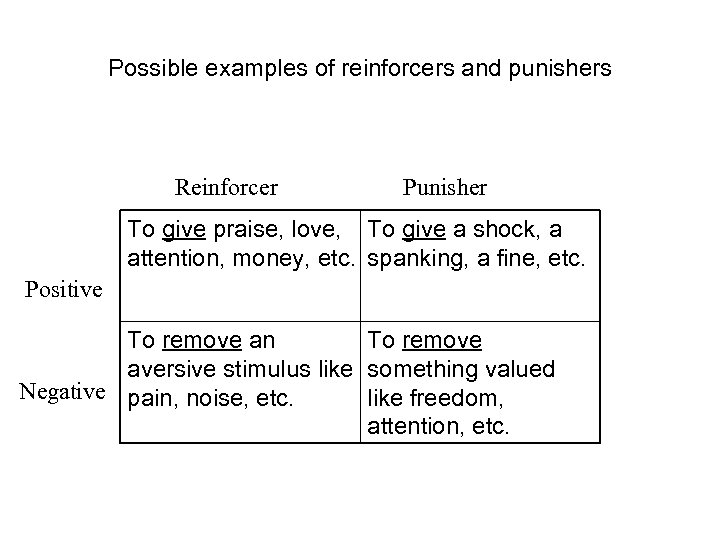 Possible examples of reinforcers and punishers Reinforcer Punisher To give praise, love, To give a shock, a attention, money, etc. spanking, a fine, etc. Positive To remove an To remove aversive stimulus like something valued Negative pain, noise, etc. like freedom, attention, etc.
 Schedules of reinforcement & punishment • Continuous - best way to acquire a new behavior (or extinguish an existing behavior) – Why not ideal to maintain the new learning? • Ratio - number of responses for the reinforcement • Interval – there is an interval of time before the next response is reinforced/punished • Variable - changing schedule • Fixed - stable schedule
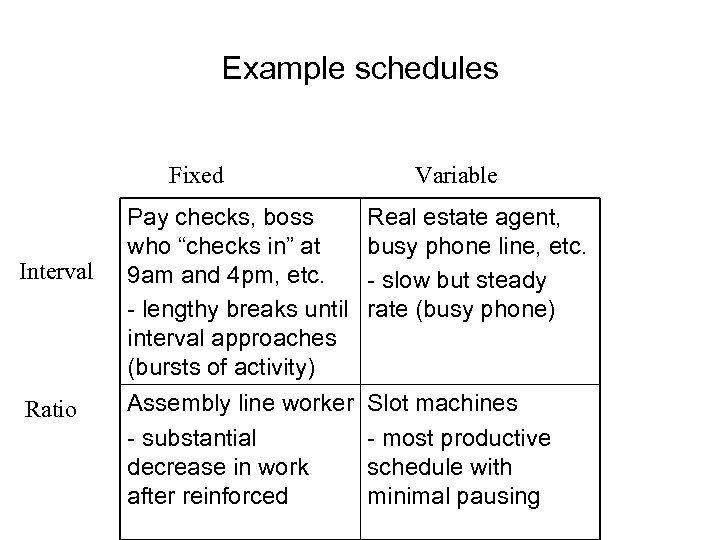 Example schedules Fixed Interval Ratio Variable Pay checks, boss who “checks in” at 9 am and 4 pm, etc. - lengthy breaks until interval approaches (bursts of activity) Real estate agent, busy phone line, etc. - slow but steady rate (busy phone) Assembly line worker - substantial decrease in work after reinforced Slot machines - most productive schedule with minimal pausing
 Behavioral Applications • Biofeedback – controlling automated functioning (mixed results) • Treatment of simple phobias – Phobias are intense fears (or nonnormative fears) that lead to dysfunction – Systematic desensitization – developed by J. Wolpe • Establish a fear hierarchy – from least feared to most feared • Systematically expose the individual to each stimulus on the fear hierarchy beginning with the lowest (up to several months) • Must be in a relaxed state while exposed to the stimulus • Must NOT remove the feared stimulus until fear is diminished otherwise the fear is reinforced • Fears can be reinforced without ever being exposed to the stimulus • If fears are acquired through random pairings, why are some fears (e. g. , spiders, snakes) so common?
 Preparedness for phobias, Ohman et al. , 1985 • Learning may not occur randomly, rather we may be predisposed to learn some associations more easily – e. g. , Are we prepared to acquire some fears more easily? Most common fears…(adaptive? ) • 70 male and female participants with no known history of phobias were recruited • half of the subjects were assigned to a condition pairing flowers & faces with shocks while others paired shocks with snakes and spiders • All participants had arousal (fear) assessed using GSR and EEG readings • stimuli were paired with the shocks until a fear response was acquired. The findings…
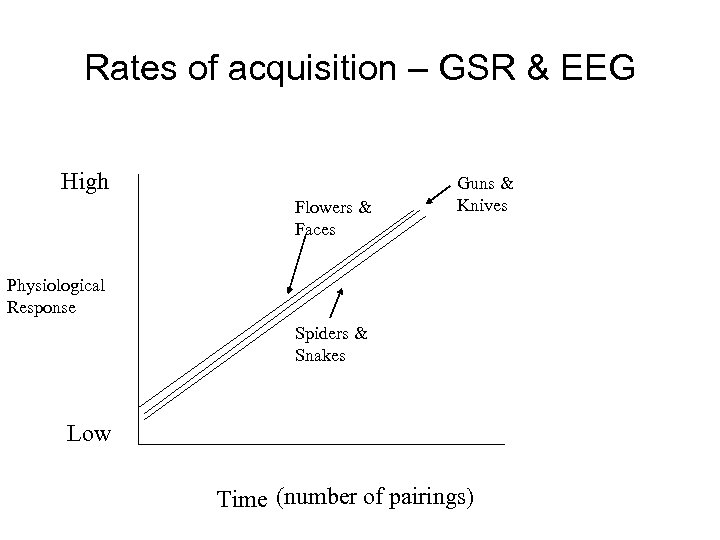 Rates of acquisition – GSR & EEG High Flowers & Faces Guns & Knives Physiological Response Spiders & Snakes Low Time (number of pairings)
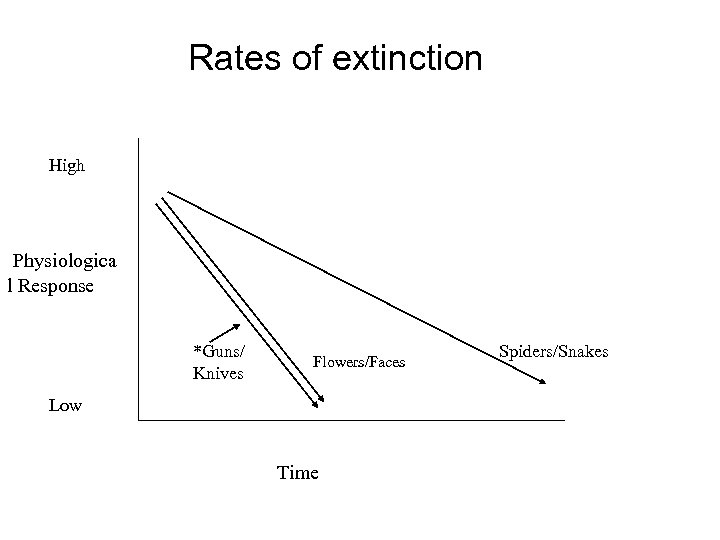 Rates of extinction High Physiologica l Response *Guns/ Knives Flowers/Faces Low Time Spiders/Snakes
 Preparedness for phobias, Ohman et al. , 1985 (cont. ) Summary • no difference in acquisition times • significant difference in extinction rates (faster for flowers and faces) • Repeated the study for guns and knives and found acquisition and extinction curves similar to those found in flowers and faces
 Preparedness for phobias, Ohman et al. , 1985 • Evolutionary adaptiveness confirmed? Confounds/strengths? • Employed self-report and physiological measures of fear • Used two physiological measures (GSR and EEG) • Tested both acquisition and extinction times • Other qualitative differences between guns/knives and flowers/faces?
 New evidence: Cook, Hodes, & Lang, 1986 • Replicated Ohman’s study using cardiac response instead of GSR and EEG • Also found that acquisition of fear for phobia relevant stimuli (spiders and snakes) was faster when relying on cardiac response • extinction curves were equal across conditions when subjects were told that shocks would stop
 Evidence for belongingness • Acquisition and extinction curves appear to be related to the extent to which the stimuli belongs with the aversive event (does the sensory modality for the UCS match that for the previously neutral, but now conditioned, stimulus? ) – e. g. , shock (tactile) for spiders and snakes (tactile) – e. g. , aversive odor (olfactory) for a skunk (olfactory)
 Autobiographical statement • Did the autobiography leave you with any questions? • Consider: 1) content (emphasis on what is included), 2) what is omitted, and 3) the form (how it is conveyed) – e. g. , Does the statement/person focus on the past, present, or future? What is the valence (pos/neg)? What aspects of life appear most salient (family history, accomplishments, current relationships, goals, etc. )? Definitiveness vs. uncertainty? • Simplest assessment in terms of administration, but most difficult in terms of scoring & amount of work by the respondent – Open-ended so difficult to standardized and compare results • Provides access to self-perceptions (your view of who you are) and the factors that you believe influenced you (strengths/limitations? )
 Explaining more complex behavior – last slide for exam 2 • Shaping through successive approximations – e. g. , a bear riding a motorcycle • Approach-approach conflicts – Stimuli that provide two equally desirable consequences – Attraction increases for the stimulus you have not selected and decreases for the one you have selected. Why? – Examples? • Avoidance-avoidance conflicts – Stimuli that provide two equally undesirable consequences – Fear increases for the stimulus you have selected and decreases for the stimulus you have not selected (moving away from). – Examples?
 Conflict from a single stimulus • Approach-avoidance conflicts (Dollard & Millar) – The same stimulus provides both reinforcing and punishing qualities and both increase in intensity as you move toward it. – Examples? • Semi-starved rat seeking cheese on electrified grid • The phone call • The rate at which fear and attraction increase/decrease is not the same and varies as a function of the distance to the target. – See diagram
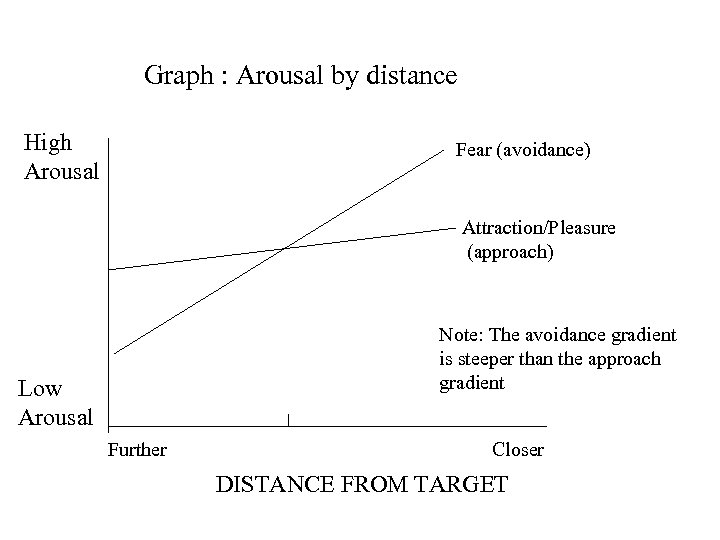 Graph : Arousal by distance High Arousal Fear (avoidance) Attraction/Pleasure (approach) Note: The avoidance gradient is steeper than the approach gradient Low Arousal Further Closer DISTANCE FROM TARGET
 Cognitive Perspective • Mental representations of objects and their significance • Each is idiosyncratically defined with a great deal of complexity • Evolution has moved the environment into the brain (perception vs. “reality”) – No direct experience of the environment (e. g. , eye). • Mediated by perception of the environment, and this is decidedly a cognitive event (mediated by expectancies, motivation, etc. ) • This perspective can more easily explain complex behaviors (most human action) and does not deny the presence of cognitive processes (thoughts & feelings) • For example, when considering approach/avoidance conflicts, it is possible to examine individual differences in how one cognitively construes the same event (e. g. , Is a test as a potential for success or failure? ) – Less variability for the semi-starved rat considering food/shock
 Social learning/cognitive theory • Behavior = Behavioral expectancy (regardless of the reinforcing or punishing contingencies, do you expect the consequence? ) X reward value (idiosyncratic value one places on the reinforcer or punisher) – Julian Rotter, 1970 s • Modeling/imitation: learning in the absence of reinforcement for either the target or the model • Modeling occurs in other species as well (e. g. , fear of snakes in monkeys reared in captivity after exposure to monkeys reared in wild) • Survey research as well as experiments have examined this process
 Effects of violent/aggressive models • Effects of aggressive models on children? (see Bobo doll experiment; Bandura, 1973) – Modeling is most effective when it is a similar model Media coverage as a source of modeling • Huston & Cofer, 1986, reviewed the literature on violent TV viewing in childhood (survey research) • Found it to prospectively predict adult aggressive behavior. Confounds for this survey research? • Findings persist even after controlling for SES, level of supervision, and aggression as a child • What are the effects of aggressive models on adults? – Behaviors are less overt; a readiness for aggressive behavior – Weaker modeling effects for pro-social behavior
 Self-regulatory theory (Mischel) • 1. Reward value – differential value for certain rewards & punishers (different between individuals & over time) • 2. Expectancies – typically based on previous experience • 3. Encoding strategies – how information is interpreted by the individual (exam feedback), framing effects, etc • 4. Competencies – actual ability mediates these processes (self-efficacy beliefs – see also Bandura) • 5. Self-regulation – how goals influence/regulate all of the previous four factors – research by Kunda (1990) examining motivated reasoning - an event with a 60% likelihood of occurring can be described as “not very likely” (get cancer) to “somewhat likely” (get an “A”) – e. g. , how goals influence the interpretation of a test grade
 George Kelly (1955) • • • Construct theory Humans as scientists Where did your “experiments” begin? Personal theories = constructs Used to explain the present and predict the future • “Ask them, they might just tell you. ” (credible approach that emphasizes the subjective appraisals of individuals
 Fundamental Postulate and Corollaries • How you represent the environment is affected by the anticipation of events • assume replication; oriented to the future • uniqueness of your construct system • finite number of dichotomous constructs • range of convenience for any construct – If events can’t be explained by any construct, this leads to anxiety • choice of constructs and their ordinal association (you can have any theories, but theories you choose limit what you’ll find)
 Repetory Grid (Kelly) • P. 1: Identify the important people in your life • P. 2: Think about the three individuals and how two are alike on some trait and yet different from the third person on the same trait. – e. g. , 2 of the 3 are really organized while third person is really disorganized
 Cognitive complexity • Kelly defined cognitive complexity as having many superordinate (or core) constructs – Patient with single core construct of “Army – not Army” • Greater cognitive complexity is associated with better adaptiveness as it means you have more ways of interpreting events (vs. being very limited in how you view things) • Tetlock & Suedfeld have studied the cognitive complexity of communications and how it predicts conflict. Lower complexity = maladaptive (conflict) – e. g. , examined UN communications between countries and could predict times of conflict
 Cognitive perspectives on depression • Maladaptive cognitions & attributions e. g. , learned helplessness in a dog restrained (failure to acquire new learning) – Seligman, 1978 • Cognitive triad (Beck) – 1. negative thoughts about the self (“I suck”) internal vs. external attributions – 2. neg. thoughts about the everyone else (“no one loves me”) – general vs. specific conclusions – 3. Negative thoughts about the future (“things will never change”) – stable vs. changing • Stable differences in control beliefs (Rotter’s LOC scale) • Cognitive interventions are one of the most effective treatments for depression (equal to medications)
 Biological: Humoral theory (Galen, 450 BC) • Influence of early medicine on trait theory • Body fluids can determine dispositions – Sanguine (blood) - cheerful – Melancholic (black bile) - depressive – Choleric (yellow bile) - irritable – Phlegmatic (phlegm/mucus) - unemotional • Blood/fluid letting to “treat” personality • Why would this model persist over time? (primary targets of intervention? )
 Modern-day Versions of Humoral Theory • Galen’s melancholic temperament has been equated with low levels of serotonin (Hamer & Copeland, 1998) • Likewise, low levels of serotonin have been associated with irritability in animals (Depue, 1995) and depression in humans (Zoloft, Prozac, Paxil, Effexor, Serzone, etc. ) • *Today we still do not understand the mechanisms affecting depression (Kirsch et al, 2002 for a critique of SSRIs – no better than placebo based on all FDA data) • Blood type and personality (Eysenck) – AB - extraversion; B – neuroticism – Attempts at replicating a blood type – personality connection have been unsuccessful (e. g. , Cramer & Imaike, 2002)
 Hans Eysenck (research from 1967 - 1997) • There are reliable differences in personality observed around the world • Suggested biological determinants of personality – Blood type – there also reliable differences in blood types observed around the world and these are the cause of different personality types (often mistaken for cultural influences) • few findings emerged to support this perspective – Brain activity – activation in certain parts of the brain predicts different behavioral patterns associated with traits • more support for this model, especially for the traits of extraversion/introversion
 Introversion/extraversion • Differences in cortical activity in the ascending reticular activating system (ARAS) predict different behavior • Theory (Eysenck, 1967): – Extraverts are chronically under aroused and seek stimulation for the brain (ARAS) – Introverts are chronically over aroused and seek to avoid stimulation (ARAS) • Research: – Performance and exposure to loud/soft music – Preferred and optimal volume of background music for a dual attention task – No difference at baseline, but response to stimulation differs (greater for the extravert)
 Eysenck’s model for activating the brain • Proposed that we can stimulate our brains through our interactions with others • Extraverts seek out stimulation while introverts avoid it • Interpersonal interactions result in increased brain activity, and this can be heightened by minimizing personal distance/personal space • Differences in preference for personal space have been observed worldwide (e. g. , UK = approximately 6 feet, African nations = approx. 2 feet, US = approx. 4 feet • When people interact, they are attempting to reach their preferred personal space. This is difficult when different people have different personal space preferences • Eysenck studied interactions at meetings of the United Nations (“UN dance”)
 Summary of Eysenck’s work • Differences in cortical activity in the ascending reticular activating system (ARAS) predict different behavior • Theory (Eysenck, 1967): – Extraverts are chronically under aroused and seek stimulation for the brain (ARAS) – Introverts are chronically over aroused and seek to avoid stimulation (ARAS) • Research (by Eysenck and colleagues): – Performance and exposure to loud/soft music, optimal volume of background music for a dual attention task (No difference at baseline, but response to stimulation differs) • Use of personal space to regulate level of stimulation
 Other factors that effect personal space? • Spacing follows predictable patterns as individuals fill a room • What circumstances will allow us to violate our personal space preferences? • Environmental: Crowding conditions allow us to tolerate personal space violations for short periods of time • Self determined: Altering eye contact can be used to either minimize physical closeness or increase it • Intimacy of the relationship (generally only permit violations of personal space for those emotionally close to you)
 How else do we stimulate our brains? • Activities that are considered high in sensation seeking or “need for stimulation” (Zuckerman) – skydiving, driving fast down a tight road, confrontations or other intense interactions with others that minimize personal distance, ingesting caffeine, sugar, nicotine, etc. • There is general support for the fact that such activities alter brain activity and that there are individual differences in the brain’s responsiveness • Some inconsistent findings may be due to how brain activity is quantified – intensity, duration, speed of neuronal response following exposure to the stimulus, may each indicate different findings.
 BIS/BAS (J. Grey) • A broader model that has recently received more empirical support involves more diffuse brain activation – behavioral activating system (approach motivation) – behavioral inhibition system (avoidance motivation) • BAS – individuals are focused on reinforcers not punishers (heightened neuronal sensitivity) • BIS – individuals are focused on punishers not reinforcers (heightened neuronal sensitivity) • Related this to anxiety, depression, and several other disorders like alcoholism
 Biological evidence for abnormal behavior • Schizophrenia is one of the disorders with the strongest biological evidence – 48% incidence for those having both parents or an identical twin (MZ) with the disorder • Evidence at the neuroanatomical level (enlarged ventricles) and neurochemical level (dopamine) • For depression, there is also some neurochemical evidence (seratonin and epinephrin) • Questionable research on genes that underlie disorders such as alcoholism, criminality, sexual identity, etc. • The exact mechanisms in all cases are not fully understood (recall Humoral theory!)
 Understanding genetics • Genes are arranged along chromosomes = strands of paired DNA • Human cells have 46 chromosomes (except sperm cells and egg cells, each of which have 23 chromosomes) • The union of the sperm & egg cells creates a 46 chromosome cell with a somewhat random selection of genetic material from each parent. • Children will share 50% of their genetic composition with each biological parent. • Full siblings also have a 50% genetic overlap as they. 25 chance of sharing a gene from mother and. 25 from father • Monozygotic twins (identical) – have 100% genetic overlap as they come from the same sperm and egg • Dizygotic twins (fraternal) – have 50% genetic overlap as they are formed from two sperm and two eggs (same as full siblings) • Examine overlap of personality traits as a function of genetic overlap
 Do genetics underlie personality? • Temperament – stable individual differences in emotional reactivity – Commonly studied in children (i. e. , how does one respond to various stimuli such as a hug, loud noise, etc. ) • Use of twin studies to determine aspects of temperament that are due to genetics vs. environment (heritability coefficient -. 4 to. 6 for most traits) – Dunn & Plomin, 1990 found heritability coefficients of. 4 to. 6 depending on the trait (e. g. , neuroticism is highest, openness to new experience/creativity is lowest) • Comparison of monozygotic (MZ) and dizygotic (DZ) twins (if there is twice as much overlap for the MZ twins relative to DZ twins then this suggests the role of heredity as MZ twins are genetically identical – twice that of DZ twins) – e. g. , genes affect temperament (aggression) and this might influence if one plays a sport like football (vs. an athletic gene).
 Do MZ vs. DZ twins tell the whole story? • If MZ twins are reared apart, does that mean that all similarities are due to genetics? (this is assumed) – e. g. , DZ twin with schizophrenia – 17 -24% incidence MZ twin has a 48% incidence • Similarities due to the fact that each person engenders similar responses from the environment (Phelps et al, ‘ 97) • Monochorionic (MC) MZ twins – have a single placenta and circulation system (about one third of cases) • Dichorionic (DC) MZ twins - have two separate single placenta and circulation systems • Consider the in utero environment (shared = MC) – MZ twins – 48% when MZ is MC (drops to 28% when DC) • More is due to environment than we thought
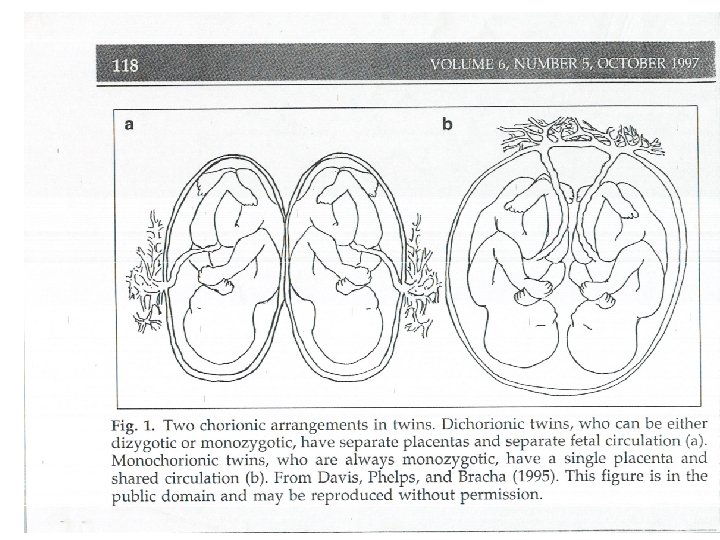
 Sokol et al. , 1995 • Compared MC and DC MZ twins at ages 4 through 6 using the Personality Inventory for Children. • MC MZ twins were more similar on all 20 of the personality scales measures by the Personality Inventory for Children (13 were statistically significant) • The observed differences can not be due to genetics since these are MZ twins (genetically identical), so differences must be due to the effects of the pre-birth environment. • Note: Also found differences between MC and DC MZ twins with regard to intelligence scores, incidence of schizophrenia, etc. (greater similarity for the MC twins)
 Course Outline • MC MZ twins were more similar on all 20 of the personality scales measures by the Personality Inventory for Children (also for IQ, incidence of schizophrenia, etc) – Sokol et al. , 1995 • Theories – we’re done! • Assessment – measuring personality – Completed the TAT, autobiographical statement, and Repetory Grid (PPA and NEO-PI still to come). • Personality disorders An example personality assessment…
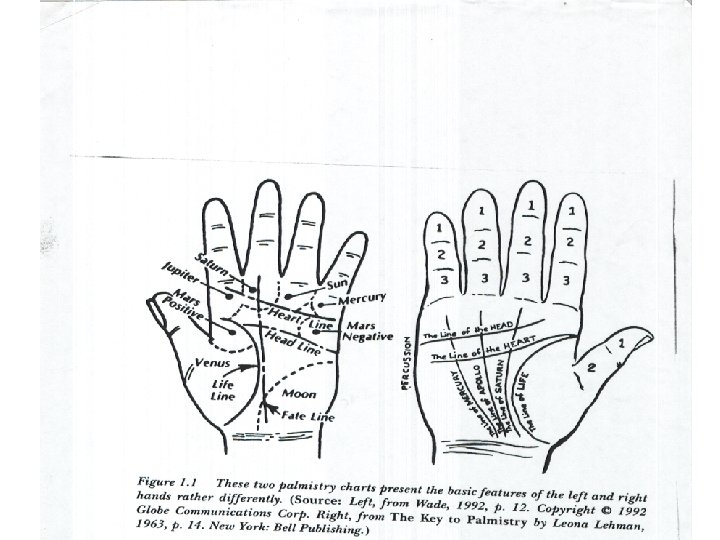
 Roots of Assessment • Astrology - stars as gods vs. planets – shift from religious to scientific explanations • Palm reading • Biorhythms - physical, mental, emotional • Barnum effect - broad and slightly positive statements; – Most non-standardized, unreliable, and non-validated procedures rely on the Barnum effect – Stock statements - true in all circumstances – Fishing statements – general statements that can be interpreted in many ways (“you’ve experienced a loss”) – Research (Glick, 1985) suggests that people are more likely to believe Barnum-type false feedback vs. real personality assessments.
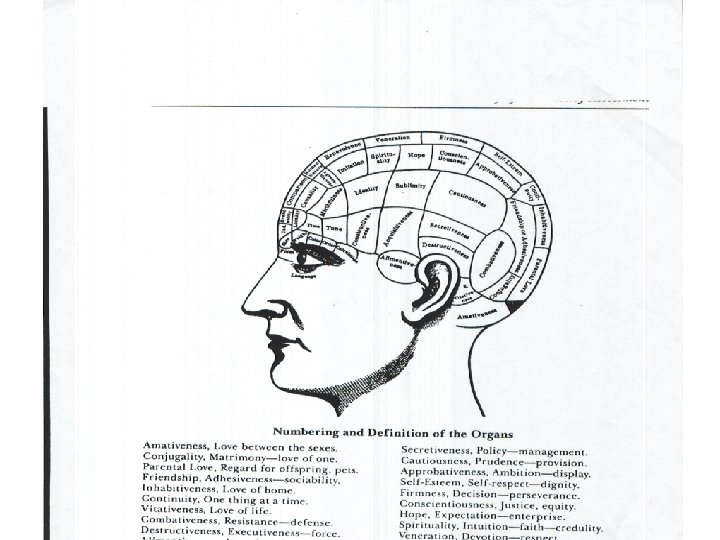
 Morphological Assessment • Criminality (Lombroso) - physical features that predict criminality – L’uomo delinquente • Phrenology (Gall) - skull morphology advanced the field of assessment (see example) – localization – Quantification – standardization
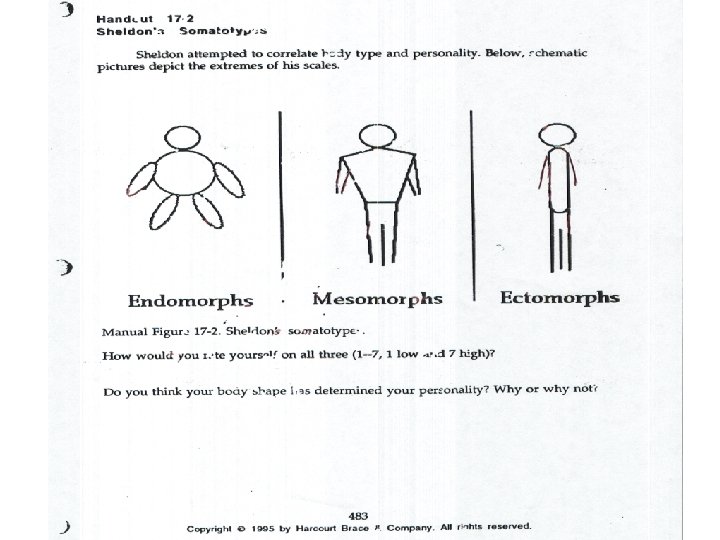
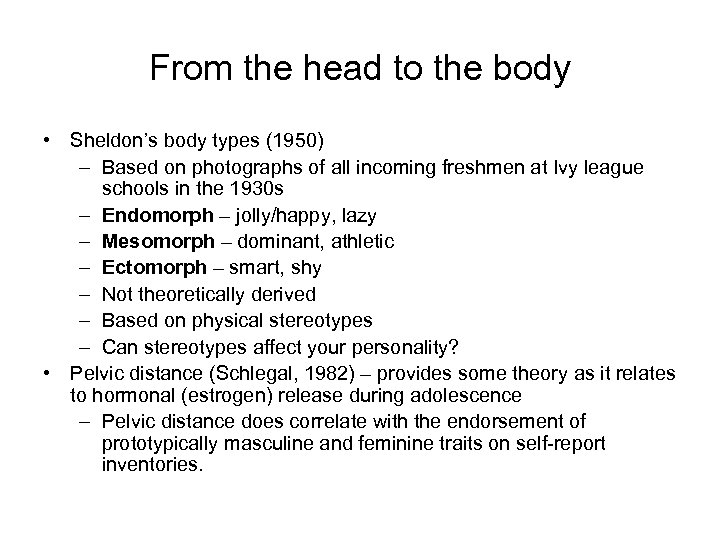 From the head to the body • Sheldon’s body types (1950) – Based on photographs of all incoming freshmen at Ivy league schools in the 1930 s – Endomorph – jolly/happy, lazy – Mesomorph – dominant, athletic – Ectomorph – smart, shy – Not theoretically derived – Based on physical stereotypes – Can stereotypes affect your personality? • Pelvic distance (Schlegal, 1982) – provides some theory as it relates to hormonal (estrogen) release during adolescence – Pelvic distance does correlate with the endorsement of prototypically masculine and feminine traits on self-report inventories.
 Assessment in the 20 th century • Psychodynamic methods: word association, TAT, Rorschach, etc. – Minimal standardization (see recent exception for the Rorschach – Exner’s, 1987, scoring system) • MMPI - developed in 1940 using an empirical approach, revised in 1989 (MMPI-2) and has 567 T/F items – – – Most widely used personality inventory in clinical settings items generally lack face validity scales (lie, defensiveness, infrequency) Assesses m/f, Si, D, Hs, Pa, etc. (psychopathology= personality) T/F answer format requires many items • Today, Likert (e. g. , 0 -4) scales allow for fewer items and items have face validity (for the non-clinical population)
 Traits • Descriptors used to predict behavior • Locus of Control (LOC; Rotter) – Internal - control over one’s own destiny – External - fatalistic, chance outcomes • Most individuals are internals in NA culture. This is more adaptive as well. • Implications for school/work re: effort • Relationships • Health
 Control/predictability and stress • Glass & Singer 1972 • Uncontrollable and aversive noise and its effects on performance – Two conditions: one with “control button” and one without – Assessed persistence with anagrams, and performance in a follow-up task • Benefits reflected in sustained effortful behavior and outcomes • None of the participants ever actually pushed the button, so there were no differences in exposure to the loud aversive sounds – Emphasis is perceived rather than real control • Ultimately, the researchers stopped hooking up the button (dummy switch) • What if the participants had tried to push the button? • Higher cost for thinking you have control then realizing you don’t vs. never thinking you had it (we rarely have the opportunity to assess control beliefs in everyday life; that’s why perception is key)
 Experimental research on control • Studies in old age homes (Langer, 1983; Rodin, 1986) to assess the effects of predictability and control – 3 conditions (control, predictability, neither) – equal time in all visits, and everyone does so within regular visiting hours – predicted health and mortality within the next year – implications/applications? – Strengths/limitations of this study relative to Glass & Singer (1972) and other survey studies? • Similar research in work settings involving control over how to do tasks; in prisons involving control over TV programming, chair locations (Ruback et al. , 1986; Wener et al. , 1987)
 Optimism and pessimism • Perceptions do not reflect actual difference in the experience of life events (see also NA and PA) – Differ in the interpretation, recall, & experience of real and hypothetical life events so as to reinforce their initial views – Their affective experience is to be happier and to reconstrue events in a positive light (i. e. , rationalize) – e. g. , you get rejected from 1 school & accepted by UNCW. How do you now evaluate UNCW and the rejecting school? • Healthier? – Most are survey studies of health and optimism. – Heart patients matched prior to surgery on prognosis and preoperative health. Optimism (and LOC) predicts mortality and complications – Hole punch of medical students to assess rate of healing; related to optimism and LOC (Glaser, 1996)
 Other traits linked to health • Type A vs. Type B personality – Cluster of traits such as competitive, goal oriented, driven, quick to anger vs. calm and less work oriented – health is better in Type Bs – Short term life satisfaction is higher in Type A – Recent research on other “Types” • Hardiness and stress – Cluster of traits (e. g. , commitment, control) that predict how well one handles stress (e. g. , Kobassa, 1977) – Typically stress results in physical illness (Selye’s General Adaptation Syndrome), but not for high hardiness individuals
 Trait Revolution • Mischel shock (Personality and Assessment; Mischel, 1968) – 1. Traits account for only 9% of behavior • Personality vs. situation debate (data on school children in different settings – predicting behaviors like lying) – 2. Traits are just labels. • Attempts to address the 1 st critique with new measures, but more difficult to counter the 2 nd critique • Modern personality inventories can go beyond 9% (see NEO-PI) • * Problematic to predict a single instance of behavior from general trends (S. Epstein), but we can predict behavioral tendencies • Traits predict best in situations without clear “situational scripts” – e. g. , first date behavior vs. seventh date behavior • A theoretical model linking individual behaviors to traits & factors
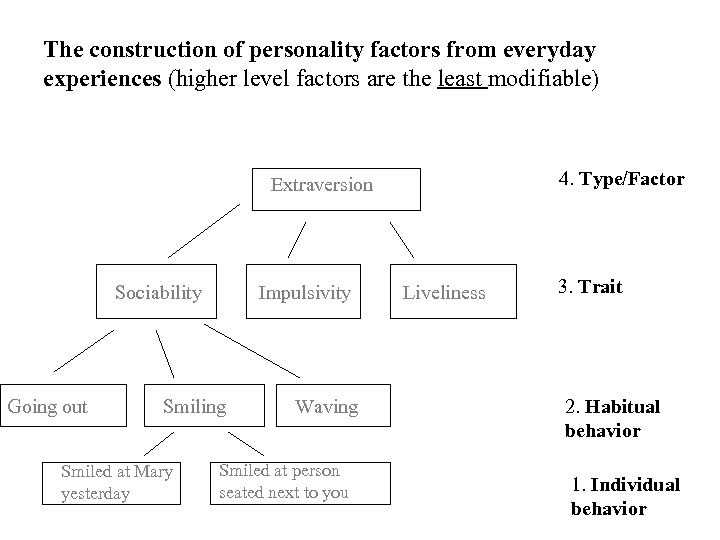 The construction of personality factors from everyday experiences (higher level factors are the least modifiable) 4. Type/Factor Extraversion Sociability Going out Impulsivity Smiling Smiled at Mary yesterday Waving Smiled at person seated next to you Liveliness 3. Trait 2. Habitual behavior 1. Individual behavior
 Organizing traits • From 450 B. C. to present • Organizing structure for personality • Eysenck’s three personality “factors” to describe all relevant personality traits – 1. extraversion/introversion -ARAS – 2. neuroticism/emotional stability -limbic system – 3. psychoticism (abnormal personality) /ego strength (tolerate stress, reality focus) - Circumplex model (for the normal population)
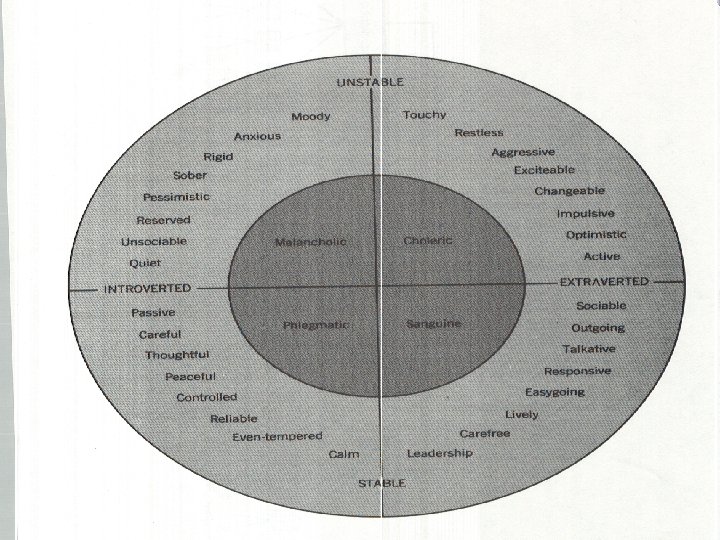
 Other ways of organizing traits • Allport’s cardinal, central, secondary • Cattell’s 16 PF • The Big Five (Costa & Mc. Crae, 1985) – Neuroticism - emotional stability/instability (very stable) – Extraversion - sensation seeking/pos emotions (very stable) – Openness - to new experience (creativity) – Agreeableness - quality of interactions – Conscientiousness – responsibility • Research suggests that N & E are more related to biological factors (i. e. , highest heritability coefficients – approximately. 6) • Within person variability predicted by situations, whereas within person stability is predicted by trait scores on the NEO (Fleeson, 2000)
 Scoring the NEO-FFI • • Recode items (see last page of handout) Sum columns to get five total scores Compare your scores to norm values See overhead and descriptions
 Big Five and Everyday life • NEO profile that best predicts school/work performance? – High C, N, and O (adaptive application of N) • O is related to productivity as a function of the structure of the setting (high O works best in less structured settings) • Low C and low A generally predict poor productivity in a variety of school and work-related settings • High N is a general predictor for psychological problems (depression, anxiety, etc. ), and the more extreme the score, the more likely the problems • Costa & Mc. Crae suggest that psychopathology is defined by extreme scores on the NEO – Some research suggests that these traits are observed across species such as dogs, chimps, & hyenas (Gosling & John, 1999)
 Responses to Mischel’s critique • New trait measures such as the NEO (validated at the item and scale level, Likert ratings, face valid) • Act-frequency approach (Buss & Craik, 1983) – Identify actions that reflect the trait of interest – Rate the extent to which each represents the prototype for that trait (prototypicality ratings) • Personal goal assessment – The idiosyncratic expression of basic motives (hunger vs. “truffles for the wedding”) – Traits in context (LOC vs. control over the relevant experiences in your life; e. g. , goal to “get married” or “get a degree”)
 Gordon Allport (1930) – last slide for exam 3 • Consider how traits and motivation (goals) each assess different (unique) aspects of personality • “Havings” and “Doings” of personality (Allport, 1930; Cantor, 1990) – stable features (traits) and more dynamic features (goals) • Traits (havings) can reflect biological predispositions that may limit the opportunities for what one can do. • Goals can determine how their traits manifest in their actions (goals are the doings of personality) • Both predict behavior: Traits predict about 20% of university grades and goals relating to both school and non-school activities can account for an additional 10 -20% (Little, Lecci, & Wadkinson, 1992)
 Goal assessments - continuing with a 3 rd response to Mischel’s critique • From more fleeting/transient experiences to life long pursuits – Current Concerns (Klinger, 1977) – Personal Projects Analysis (Little, 1983) – Personal Strivings (Emmons, 1986) – Life Tasks (Cantor, 1987) – Goal Systems Assessment Battery (Karoly & Ruehlman, 1995) • Intersection of motivational and cognitive perspectives; “Hot Cognitions”
 Important features of goal construal • PPA = Personal projects Analysis (Little, 1983) • Adults average about 14 personal goals • Content may be significant – e. g. , Health goals for hypochondriacs – Most common goal across settings & populations: “lose weight” 5 factors used to interpret the PPA • Meaningfulness (importance, enjoyment) • Efficacy (progress, outcome, skills) • Structure (control, initiation, time adequacy) • Stress (stress, difficulty, challenge) • Social Support (visibility, other’s view)
 Meaning-Efficacy trade-off • Molecular goals (time focused & concrete) – high efficacy but low meaningfulness • Molar goals (broad, life long pursuits) – low efficacy but high meaningfulness • Anxiety can be predicted from goals with hi meaning & low efficacy • Research on college students and their goals shows that depression is marked by low efficacy & low meaningfulness (Lecci et al. , 1994) • Depression can also be marked by the failure to disengage (Kuhl, 1986) from unsuccessful projects - depression as “information” • Goals also linked to hypochondriasis (more illness prevention goals with low efficacy and hi stress; Lecci et al. , 1996), life satisfaction (Palys & Little, 1993), health (Emmons & King, 1988) • Project system coherence comes from a balance of projects or from “Project spin”
 Ipsative scoring for the PPA • Ipsative scoring refers to comparisons within the individual (no need for a norm group, though normative scoring can be done) • Goals can be scored by comparing your own score at one time to scores from obtained from another time – Only meaningful if scores can change (traits are supposed to be stable, so any changes on the NEO are considered error in measurement) – Your goals, however, can change. • Goals can also be scored by comparing ratings across different content domains (e. g. , social vs. academic) – look at your scores • Most clinical work and counseling interventions with goals adopt the ipsative scoring procedures (goal of intervention can be perceived changes in the goal system) • Goals can also be scored normatively (see next slide)
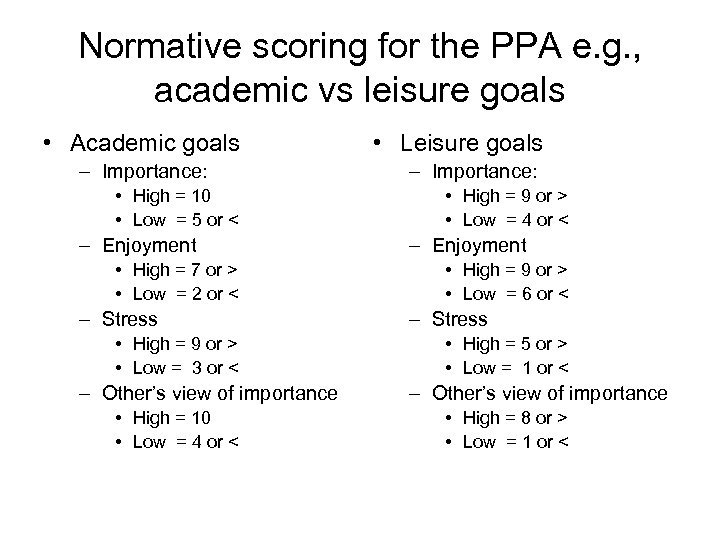 Normative scoring for the PPA e. g. , academic vs leisure goals • Academic goals – Importance: • High = 10 • Low = 5 or < – Enjoyment • High = 7 or > • Low = 2 or < – Stress • High = 9 or > • Low = 3 or < – Other’s view of importance • High = 10 • Low = 4 or < • Leisure goals – Importance: • High = 9 or > • Low = 4 or < – Enjoyment • High = 9 or > • Low = 6 or < – Stress • High = 5 or > • Low = 1 or < – Other’s view of importance • High = 8 or > • Low = 1 or <
 Class “cocktail” party – don’t write this down • Please complete the top half of the self assessment form & print your name on the bottom • Once finished the assessment, please stand in line to get drinks (bring your books with you) • You will be assigned to groups of 6 -7 • After getting drinks, sit together somewhere • You need to be familiar with the names of those in your group, find out what they are doing this summer and their long term plans.
 Self vs. Peer Ratings – include in class notes • High degree of consistency between self ratings and the ratings of others even after only a brief interaction – Almost as accurate as assessments from those who know you very well • How does social desirability effect ratings? Social constraints? The short time period of the assessment? • Which traits will show the greatest discrepancies? • Do discrepancies necessarily reflect problems with the self-report? – Real differences between internal and external presentation may be meaningful • FUNDAMENTAL ATTRIBUTION ERROR – When evaluating others, people tend to attribute behavior to traits – When evaluating our own behavior, we tend to attribute it to the situation (Why? - baserates)
 What is Abnormal Behavior? • Deviance - from societal norms – If too deviant (rare) then not identified as a disorder. – If too common, then it is no longer non-normative. • Dysfunction - relationships and work • Distress - affective discomfort (experienced by the individual or created in others) • Danger - to self (e. g. , suicidal) or others • Pervasive - impacting all aspects of life • Longstanding - at least early adulthood • Note: Each of the above are neither necessary nor sufficient
 Psychiatric Disorders • • • Diagnostic criteria defined by the DSM-IV AXIS I defines clinical syndromes AXIS II defines the personality & developmental disorders 60% chance of having an AXIS II disorder if one has AXIS I disorder Those with one personality disorder are 5 times more likely to have a second PD • Enduring pattern of inner experience or behavior that deviates from the individual’s culture in at least 2 of the following 4 areas: – cognition: perception of self, others & events – affect: range, intensity, and appropriateness – interpersonal functioning (occupational) – impulse control
 Personality Disorders • Incidence of 10 -15% in the population Problems diagnosing personality disorders. Why? • Typically diagnosed secondary to AXIS I disorder(s) • Extensive symptom overlap among the PDs • PDs reflect a stable pattern with a long duration that can be traced back at least to adolescence or early adulthood (i. e. , PDs should not be diagnosed in children) – e. g. , conduct disorder >>>> Antisocial PD – e. g. , identity disorder >>>> Borderline PD
 Myth of mental illness? (Szasz) • Criteria used to define “mental illness” change as a function of shifts in cultural values and normative experiences over time – e. g. , earlier version of the DSM considered homosexuality as a disorder, now consider PMS as a disorder, – Other examples of changing criteria: MPD, Pseudocyesis, etc. • Mental illness = Disease (medical) model or is it a myth? – “Myth of Mental Illness” (1968) • Can patterns of behavior, affect, or cognition be an illness? – e. g. , conservativism? – e. g. , suicide? (“Cruel Compassion”)
 AXIS II: Cluster A • All three involve odd or eccentric behavior • Paranoid PD – hostile & threatening interpretation of the actions and intentions of others, suspiciousness, quick to anger • Schizoid PD – flat affect with no desire for interactions, and limited interests, few pleasures, isolative, indifferent & detached • Schizotypal PD – some paranoia, unusual perceptions, odd behaviors/beliefs, inappropriate affect, isolative, ideas of reference, social anxiety • More commonly diagnosed in males, typically single, with jobs resulting in minimal interpersonal contact. • All cluster A PDs generally result in isolation of the individual, but for different reasons (cf. Avoidant PD)
 Analysis of “Bob” • Unusual behaviors in the interview? • Examples?
 Applying theories to PDs (e. g. , Paranoid PD) • Biological – recall the twin data suggesting the strong genetic link between those with schizophrenia and those sharing a genetic history (according to the ICD-10, cluster A personality disorders are just milder forms of schizophrenia) • Cognitive – reasoning errors associated with paranoia (e. g. , paranoid individuals require less information to come to a decision compared to non-paranoid individuals: Hemsley & Garety, 1986 study on colored balls) • Psychodynamic – paranoia is an unconscious defense against the “homosexual impulse” (reaction formation and projection: I love a man - I hate him - He hates me. i. e. , paranoia. ) • Behavioral – a failure to receive positive reinforcers for prosocial behavior, so one resorts to bizarre behavior to get attention. Also paranoid explanations may be more appealing than alternative.
 AXIS II: Cluster B • All involve dramatic/emotional presentations • Borderline PD – instability of affect and relationships, parasuicidal behavior (suicidal gestures with high visibility but low lethality), frantic attempts to avoid abandonment, intense & inappropriate emotions, affective extremes are common • Narcissistic PD – seeks attention, lacks empathy, vulnerable to criticism, grandiose self view, requires admiration, exploitive • Histrionic PD – seeks attention, sexualizes all interactions, use of physical appearance for attention, rapidly shifting shallow emotions, theatrical, shallow speech, focus on physical symptoms • Antisocial PD – deceitful, criminality, impulsive and reckless, little remorse, irritable and aggressive, irresponsible • Cluster B PDs are typically involved in relationships, but they are problematic. Diagnosed more in females (except antisocial)
 Analysis of Candy Johnson • Unusual behaviors in the interview or inconsistencies? • Examples?
 ASPD: Two theoretical perspectives • “Sociopath” - refers to the hypothesized social factors that underlie this disorder – Early problems with learning right/wrong (behavioral) – “Mani sans deliria” - Mania without delirium – Moral insanity - illustrated by lack of remorse • “Psychopath” - refers to the presumed physiological causal factors – research (Lykken, 1957) on ASPD’s attenuated response to positive punishers relative to non-ASPDs – Response to negative punishers and rewards is similar to that of non-ASPDs (Schmauk, 1970)
 AXIS II: Cluster C • All Cluster Cs involve fear and anxiety • Avoidant PD – fear of criticism from others, social phobia may occur, isolative, views self as inept, unlikely to be in a relationship • Obsessive-compulsive PD – perfectionistic, unwilling to delegate, inability to meet deadlines, preoccupied with details, rigid, hordes money • Dependent PD – unable to act alone on any decision, needs others, subservient and may place themselves in humiliating circumstances, difficulty expressing disagreement, fear of abandonment, always in a relationship *********************** • PD NOS – not meeting the criteria for any one PD, but they have features of several; can refer to more than one PD
 Analysis of Julian Robbins • Unusual behaviors in the interview? • Examples?
 Comparison of Personality Assessments • TAT (& Rorschach)- subjective scoring, socially desirable response sets are less obvious, assumes unconscious processes • Rep Grid – perceptions, social networks, socially desirable response is less obvious • NEO - objective scoring, representative norms, straight forward assessment • Autobiographical statement – most open-ended (broad) and most consistent with the subjective experience, but hardest to score and compare • PPA - straight forward, normative & ipsative scoring, samples everyday behavior. (see normative scoring) • How would different PDs do on each test?